Interviews are opportunities to demonstrate your expertise, and this guide is here to help you shine. Explore the essential Vinyl Application interview questions that employers frequently ask, paired with strategies for crafting responses that set you apart from the competition.
Questions Asked in Vinyl Application Interview
Q 1. What types of vinyl films are you familiar with (e.g., cast, calendared)?
I’m familiar with a wide range of vinyl films, categorized primarily by their manufacturing process: cast and calendared. Beyond these, we also have specific films designed for particular applications, like perforated vinyl for window graphics or reflective vinyl for safety signage.
- Cast Vinyl: This is generally considered the higher-quality option. It’s more flexible and conforms better to complex curves, making it ideal for vehicle wraps and intricate designs. It also offers superior durability and longevity.
- Calendared Vinyl: This is a more economical choice, often used for simpler applications like signage or short-term promotional graphics. It’s less flexible and prone to cracking on sharp curves.
- Other types: This includes specialty films like polymeric PVC, which is exceptionally durable and offers excellent color vibrancy, and monomeric PVC, a more cost-effective option often used for short-term applications. We also work with textured and specialty colored films.
Q 2. Explain the difference between cast and calendared vinyl.
The key difference lies in their manufacturing process. Think of it like the difference between kneading dough (cast) and rolling it flat (calendared).
- Cast Vinyl: Is created by pouring liquid vinyl onto a release liner and allowing it to slowly cure. This process creates a very flexible and durable film capable of stretching and conforming to complex shapes without cracking or losing its integrity. Imagine wrapping it around a car – cast vinyl handles the curves beautifully.
- Calendared Vinyl: Is made by pressing a vinyl sheet between rollers. This results in a less flexible, thinner, and less expensive film. While suitable for flat surfaces, it’s more prone to cracking and wrinkling when applied to curved surfaces. Think of it like applying a sticker; it works well on a flat surface but struggles on a curved one.
In short: Cast vinyl is superior in flexibility, durability, and longevity, but calendared vinyl offers a more budget-friendly option for simpler applications.
Q 3. Describe your experience with various application tools (e.g., squeegees, heat guns).
My experience encompasses a wide range of application tools, each serving a specific purpose. Proper tool selection is critical for achieving a professional finish.
- Squeegees: I use various squeegees with different blade materials (felt, hard plastic, rubber) and sizes depending on the size and complexity of the project. Felt squeegees are great for intricate areas, while hard plastic squeegees are better for larger, flatter surfaces. The technique is crucial; I use even pressure to avoid scratching or leaving marks.
- Heat Guns: Essential for shaping and manipulating the vinyl, especially on curved surfaces or around complex details. I carefully control the heat and distance to avoid damaging the vinyl or the substrate. Proper heat application is key to achieving a smooth, wrinkle-free finish.
- Cutting Plotters: Expertise in operating a cutting plotter is crucial for precision cutting, ensuring the vinyl fits perfectly. This involves choosing the right blade, settings, and weeding techniques to produce clean and accurate cuts.
- Other Tools: This also includes tools like application tapes, rulers, measuring tapes, and safety knives for precise cutting and weeding.
Q 4. How do you prepare a surface for vinyl application?
Surface preparation is paramount; a clean, smooth surface is essential for a successful vinyl application. Failing to do this properly is a recipe for disaster!
- Cleaning: Thoroughly clean the surface with a suitable degreaser to remove dirt, grease, wax, and other contaminants. I typically use isopropyl alcohol and a microfiber cloth.
- Inspection: Carefully inspect the surface for any imperfections like scratches, dents, or loose paint. Address these before applying the vinyl to prevent them from showing through.
- Primer: Depending on the surface material and the vinyl type, I may use a primer to enhance adhesion and prevent bubbling. This is especially important for surfaces that are porous or have a tendency to be difficult to adhere to.
- Drying: Ensure the surface is completely dry before applying the vinyl. Any moisture can compromise adhesion.
Proper surface preparation ensures the vinyl adheres firmly and lasts for its intended lifespan. A rushed job at this stage often leads to long-term issues.
Q 5. What are the steps involved in applying a vinyl wrap to a vehicle?
Wrapping a vehicle is a multi-step process demanding precision and patience. Each step builds upon the previous one.
- Preparation: This includes thorough cleaning, decontaminating, and inspecting the vehicle’s surface.
- Pattern Creation and Cutting: Creating and cutting the vinyl according to precise measurements taken from the vehicle.
- Application: Starting with a large, flat panel and slowly working around the vehicle using heat and a squeegee to minimize bubbles and wrinkles.
- Trimming and Detailing: Precise trimming of the excess vinyl and attention to smaller details using appropriate techniques and tools.
- Final Inspection: A thorough review of the finished wrap for any imperfections or areas that require correction or further refinement.
This is a simplified overview. The exact steps may vary depending on the complexity of the vehicle’s design and the type of vinyl being used.
Q 6. How do you handle air bubbles and wrinkles during application?
Air bubbles and wrinkles are common challenges, but manageable with the right techniques.
- Air Bubbles: Small bubbles can often be removed by carefully piercing them with a needle and then smoothing them out with a squeegee. Larger bubbles may require lifting the affected area and carefully repositioning the vinyl. Heat is your ally here; gentle application helps to stretch the vinyl and release the trapped air.
- Wrinkles: These are usually addressed by using a heat gun and carefully stretching the vinyl to smooth out the wrinkles. Starting in the center and working outwards is key. In some cases, a small area may require removal and reapplication.
Prevention is better than cure. Proper application techniques and careful attention to detail during the initial application can greatly minimize these issues.
Q 7. What techniques do you use to ensure a seamless wrap?
Achieving a seamless wrap demands precision, patience, and a keen eye for detail. Several techniques contribute to a flawless finish.
- Overlap Technique: Overlapping the edges of vinyl panels helps to create a smoother transition, masking the seams. Proper blending and trimming are crucial here.
- Heat Application: Strategic use of a heat gun allows for better conforming of vinyl to complex curves and effectively shrinks out wrinkles.
- Seam Placement: Consider the placement of seams carefully, often aligning them with panel lines or edges to minimize visibility.
- Careful Trimming: Precise trimming is essential to make seams virtually invisible and to create a clean, polished look.
- Pre-stretching: Carefully stretching the vinyl before application can help minimize wrinkles and ensure the vinyl conforms better to the surface.
Practice and experience play a crucial role in mastering these techniques. The more complex the project, the greater the need for refined skills and tools.
Q 8. How do you remove wrinkles from already applied vinyl?
Removing wrinkles from already applied vinyl depends heavily on the type of vinyl, the substrate it’s applied to, and how long it’s been there. For minor wrinkles shortly after application, you can often gently lift an edge with a squeegee or heat gun (on a low setting!), and then re-apply, smoothing out the wrinkles as you go. Think of it like smoothing out a sticker; slow and steady wins the race! For more stubborn wrinkles or those that have been there for a while, you might need to carefully peel back a section, clean the surface, and re-apply. A heat gun can be helpful in this process to soften the adhesive. However, if the vinyl is significantly damaged or the adhesive has fully set, complete removal and re-application might be necessary.
Important Note: Always test a small, inconspicuous area first to ensure you’re not damaging the vinyl or the surface underneath.
Q 9. What are the different types of adhesives used in vinyl applications?
The adhesive used in vinyl applications varies greatly, affecting the application process and the longevity of the vinyl. Common types include:
- Permanent Adhesive: Designed for long-lasting applications where removal isn’t intended. These are very strong and often difficult to remove without leaving residue.
- Removable Adhesive: Allows for easy removal without leaving significant residue. This is perfect for temporary signage or applications where changes are expected. However, it may not be as durable as permanent adhesive.
- Semi-Permanent Adhesive: Falls between permanent and removable, offering a balance between longevity and removability. It usually leaves minimal residue.
- Pressure-Sensitive Adhesive (PSA): The most common type in vinyl applications. It bonds when pressure is applied, allowing for repositioning before final adhesion. This is what you typically find on sticker vinyl.
The choice of adhesive depends entirely on the project requirements. For a car wrap, you’d want a permanent adhesive; for a window decal, a removable or semi-permanent adhesive would be more suitable.
Q 10. Explain your experience with weeding vinyl.
Weeding vinyl is a crucial step, and my experience is extensive. It involves meticulously removing the excess vinyl from around the cut design, leaving only the desired graphic. I’ve weeded countless designs of varying complexity, from simple text to intricate logos with small, detailed elements. I use a variety of tools depending on the design – a weeding hook for detailed work, tweezers for smaller pieces, and even a fine-tipped blade for stubborn vinyl. Patience and precision are key. One of the most challenging aspects I’ve encountered is weeding extremely fine lines or very small details. In these instances, I’ve found using a magnifying glass and a good light source makes a huge difference. A consistent, controlled approach and the right tools are essential for clean weeding, resulting in a professional-looking finished product.
Q 11. How do you measure and cut vinyl for a specific application?
Accurately measuring and cutting vinyl is fundamental. Before cutting, I meticulously measure the application area. I then use design software (such as Adobe Illustrator or CorelDraw) to create the vinyl graphic, ensuring accurate dimensions to match the measurements. For simple shapes, I can sometimes do the measurements and cutting by hand, but for intricate designs, I always rely on a vinyl cutter. I always add a small ‘bleed’ area to my designs to compensate for minor inaccuracies during application. Once the design is finalized in the software, I select the correct size and ensure the cut settings are optimized for the specific vinyl type. Proper calibration of the cutting machine is crucial for precision.
Q 12. Describe your experience using a vinyl cutter.
I’m highly proficient with vinyl cutters, having used various models from different manufacturers. My experience includes operating both manual and automated cutters. I’m comfortable using different software programs to design and send cut files to the machine. This involves choosing the correct blade depth and speed settings to ensure clean and precise cuts, taking into account the thickness of the vinyl. Troubleshooting issues like blade jams or incorrect cuts is part of my daily routine. I also understand how to properly load and unload the material, maintain the cutting mat, and handle different vinyl types and their unique characteristics. For example, I understand that thinner vinyl requires a shallower blade depth than thicker vinyl to prevent cutting through the backing.
Q 13. What safety precautions do you follow when working with vinyl?
Safety is paramount when working with vinyl. I always work in a well-ventilated area to avoid inhaling vinyl dust, which is a potential respiratory irritant. I use safety glasses to protect my eyes from flying debris during the cutting process. When using a heat gun, I maintain a safe distance to avoid burns. I also ensure my workspace is clean and clutter-free to prevent accidents. Proper disposal of used vinyl scraps is also important. For example, many vinyl types are not easily recyclable and need to be disposed of appropriately.
Q 14. How do you clean and maintain your application tools?
Maintaining my application tools is critical for consistent results and longevity. After each use, I carefully clean my weeding tools with isopropyl alcohol to remove any adhesive residue. I store them in a safe, organized location to prevent damage. For the vinyl cutter, I regularly clean the cutting mat to prevent build-up that could affect cutting accuracy. Regular blade replacement is crucial to ensure clean cuts and prevent damage to the vinyl. Finally, I ensure the machine is properly stored to protect it from dust and moisture.
Q 15. What are the common challenges you encounter during vinyl application?
Vinyl application, while seemingly straightforward, presents several common challenges. These often stem from environmental factors, substrate inconsistencies, and the inherent properties of the vinyl itself. For example, working in direct sunlight can cause the adhesive to cure too quickly, leading to wrinkles and bubbles. Similarly, applying vinyl to a surface with imperfections like dust or grease will result in poor adhesion and lifting. Another common challenge is working with complex curves and contours, requiring specialized techniques and potentially different vinyl types.
- Environmental Conditions: Heat, humidity, and wind can all negatively affect the application process.
- Substrate Preparation: Insufficient cleaning or preparation of the application surface is a leading cause of failure.
- Vinyl Handling: Improper handling of the vinyl itself, such as creasing or stretching, can lead to imperfections in the final result.
- Application Technique: Incorrect application techniques, such as insufficient smoothing or leaving trapped air bubbles, are frequent issues.
Career Expert Tips:
- Ace those interviews! Prepare effectively by reviewing the Top 50 Most Common Interview Questions on ResumeGemini.
- Navigate your job search with confidence! Explore a wide range of Career Tips on ResumeGemini. Learn about common challenges and recommendations to overcome them.
- Craft the perfect resume! Master the Art of Resume Writing with ResumeGemini’s guide. Showcase your unique qualifications and achievements effectively.
- Don’t miss out on holiday savings! Build your dream resume with ResumeGemini’s ATS optimized templates.
Q 16. How do you troubleshoot common application problems (e.g., bubbling, lifting)?
Troubleshooting bubbling and lifting requires a systematic approach. First, identify the cause: is it due to trapped air, poor adhesion, or a combination of factors? For bubbles, a small needle can carefully release trapped air; however, larger bubbles often require lifting and reapplying the section. Lifting, on the other hand, is usually indicative of poor substrate preparation or insufficient adhesive contact.
- Identify the Problem Area: Locate the exact position of bubbles or lifted sections.
- Determine the Root Cause: Is it air entrapment, poor adhesion, or damage to the vinyl?
- Small Bubbles: Use a small needle to carefully release trapped air, smoothing the area with a squeegee.
- Large Bubbles/Lifting: Gently lift the affected area, clean the substrate, and reapply, ensuring proper smoothing and removal of all air bubbles.
- Persistent Issues: If the problem persists, consider using a heat gun to reactivate the adhesive (always test in an inconspicuous area first), or consult the manufacturer’s guidelines for specific recommendations.
Q 17. Describe your experience with different types of substrates (e.g., painted surfaces, plastics, glass).
My experience spans a wide variety of substrates. Each presents unique challenges and requires tailored application techniques. For instance, painted surfaces require meticulous cleaning to ensure the vinyl adheres properly. Plastics can be tricky, as some types are prone to warping or reacting with the vinyl adhesive. Glass surfaces are generally easier to work with, but require extreme cleanliness to prevent dust particles from compromising the bond. I’ve worked extensively with smooth surfaces, textured surfaces, and even slightly porous surfaces, always adapting my approach to achieve optimal results.
- Painted Surfaces: Require thorough cleaning to remove dust, grease, and any loose paint particles.
- Plastics: Surface type matters significantly, some plastics require a specific primer or adhesive promoter for optimal bond.
- Glass: Cleaning is critical; even fingerprints can affect adhesion.
Q 18. How do you ensure proper adhesion on various surfaces?
Ensuring proper adhesion depends on a multifaceted approach. Firstly, meticulous surface preparation is paramount. This involves thorough cleaning, degreasing, and removing any loose particles. The choice of adhesive is crucial; some vinyls are better suited for certain substrates than others. Proper application technique – including using the right tools, applying even pressure, and eliminating air bubbles – is critical. Finally, environmental factors like temperature and humidity play a significant role; ideal conditions often ensure better adhesion.
- Surface Cleaning: Use appropriate cleaners to remove dust, grease, and any contaminants.
- Appropriate Adhesive: Choose the correct vinyl and adhesive for the intended substrate.
- Proper Application Technique: Ensure even pressure during application to remove all air bubbles.
- Environmental Conditions: Work within optimal temperature and humidity ranges.
Q 19. What is your experience with different types of overlaminates?
Overlaminates provide an extra layer of protection and enhance the longevity and aesthetic appeal of vinyl graphics. I have experience with various types, including gloss, matte, and textured overlaminates, each offering distinct properties. Gloss overlaminates give a high-shine finish, ideal for vibrant colors and eye-catching designs. Matte overlaminates offer a less reflective, more subdued appearance, perfect for applications where glare is undesirable. Textured overlaminates can mimic the look and feel of other materials, adding another design element. The choice of overlaminate depends on the desired aesthetic and environmental considerations; for instance, a UV-resistant overlaminate is crucial for outdoor applications.
- Gloss Overlaminates: Provides a high-shine, vibrant finish.
- Matte Overlaminates: Reduces glare and provides a more subtle appearance.
- Textured Overlaminates: Adds a tactile and visual dimension to the design.
- UV Resistant Overlaminates: Essential for outdoor installations to protect against fading and degradation.
Q 20. How do you handle complex curves and contours during application?
Applying vinyl to complex curves and contours requires patience, skill, and often, specialized tools. Pre-cutting the vinyl using a plotter, taking into account the stretch and give of the material, is crucial. Using heat is often necessary to conform the vinyl to the shape of the substrate, while ensuring that no stretching or distorting happens. Small sections, careful application, and plenty of smoothing help avoid wrinkles and bubbles. Working in stages and using multiple squeegees for hard-to-reach areas further improves results.
- Pre-Cutting and Plotting: Accurate plotting is essential for proper fit on complex curves.
- Heat Application: A heat gun can help conform the vinyl to curves but requires careful control to prevent damage.
- Multiple Squeegees: Use various squeegee shapes and sizes for access to complex areas.
- Patience and Skill: Working in sections and ensuring proper smoothing is key.
Q 21. What is your experience with color matching and print alignment?
Color matching and print alignment are critical for a professional finish. Accurate color matching involves understanding color profiles, utilizing color management software, and working with high-quality print equipment. For alignment, accurate registration marks on the printed vinyl and precise placement during application are vital. Utilizing alignment tools, like laser alignment systems, enhances accuracy further. Experience in these areas is essential for consistently achieving the desired aesthetic. In cases of slight misalignment, minor adjustments can often be made before final smoothing. But significantly misaligned prints require a complete reapplication.
- Color Management Software: Ensures consistent and accurate color reproduction.
- Print Alignment Tools: Improves the precision of vinyl application.
- Precise Application Techniques: Careful placement to align the print as needed.
- Understanding Color Profiles: Necessary for accurate color matching across different devices.
Q 22. How do you manage large-scale projects effectively?
Managing large-scale vinyl application projects effectively requires meticulous planning and strong organizational skills. It’s akin to orchestrating a complex symphony – each instrument (team member, material, step) must play its part in harmony. My approach involves a phased strategy:
- Detailed Project Breakdown: First, I decompose the project into smaller, manageable tasks. For example, a large-scale building wrap might be broken down into sections, each with its own timeline and team.
- Resource Allocation: This includes assigning team members based on their expertise (e.g., experienced installers for complex curves, detail-oriented individuals for intricate designs). Materials are ordered well in advance to avoid delays.
- Timeline Management: A Gantt chart or similar project management tool is crucial. This visual representation helps track progress, identify potential bottlenecks, and adjust the schedule as needed.
- Communication and Collaboration: Frequent communication with the client, designers, and team members is vital. Regular meetings and progress reports keep everyone informed and aligned.
- Quality Control: Implementing checks at various stages ensures that the final product meets the highest standards. This includes inspecting materials, verifying measurements, and conducting quality checks during and after installation.
For example, on a recent project involving the application of vinyl graphics to multiple vehicles for a fleet, I successfully managed the project by assigning individual teams to each vehicle, coordinating material delivery to each location, and using a shared online project management system to keep everyone updated and track progress. The result was a flawless, on-time completion.
Q 23. How do you determine the amount of vinyl needed for a project?
Determining the amount of vinyl needed is a critical step that prevents waste and ensures sufficient material. It involves a precise calculation process:
- Accurate Measurements: Thorough measurements of the application surface are essential. This often involves multiple measurements to account for curves, irregularities, and overlaps. For intricate designs, consider using a digital measuring tool for greater accuracy.
- Design Considerations: The design itself impacts vinyl consumption. Complex patterns or large images will require more material than simpler designs. Consider the repeatability of patterns and optimize layout to minimize waste.
- Waste Factor: Include a waste factor (typically 10-20%, depending on complexity) to account for cutting errors, material defects, and unavoidable trimming. Complex curves or irregular shapes may require a higher waste factor.
- Software Calculation: Design software like Adobe Illustrator or CorelDRAW often provides tools for calculating the required area, offering a more precise estimate.
For instance, when calculating the vinyl needed for a vehicle wrap, I would measure the vehicle’s surface area (including doors, windows, etc.), account for overlapping areas in the design, add a 15% waste factor, and then order vinyl based on the total.
Q 24. Describe your experience with vinyl removal techniques.
Vinyl removal techniques vary depending on the type of vinyl, the substrate, and the application’s age. Safety is paramount – always wear appropriate protective gear (gloves, eye protection).
- Heat Gun Method: Applying heat with a heat gun softens the adhesive, making the vinyl easier to peel. This is effective for most vinyl types, but care must be taken to avoid damaging the underlying surface. Gentle scraping may be needed.
- Chemical Solvents: For stubborn adhesive residue, specialized vinyl removal solvents can be employed. Always test on an inconspicuous area first to ensure compatibility with the substrate. Follow manufacturer’s instructions carefully.
- Mechanical Removal: Using a plastic scraper or putty knife (never metal) is useful for removing small pieces of remaining vinyl. This approach must be used cautiously to prevent scratching the substrate.
A recent challenge involved removing aged, heavily adhered vinyl from a textured brick wall. We utilized a combination of heat gun application, carefully applied solvent, and diligent scraping to remove the vinyl without damaging the brick. It was a time-consuming but successful project highlighting the importance of using the right approach for each scenario.
Q 25. What software are you proficient in for designing and preparing vinyl graphics?
My proficiency in design software is crucial for accurate vinyl graphic preparation. I’m highly skilled in:
- Adobe Illustrator: This vector-based software is my primary tool for creating and editing vinyl designs. I utilize its features for precise vector creation, color management, and file export for vinyl cutters.
- CorelDRAW: I’m also proficient in CorelDRAW, another vector graphics editor commonly used in the signage industry. I leverage its powerful tools for design and pre-press preparation.
- Other relevant software: I have experience with RIP software (Raster Image Processor), essential for communicating designs to large-format printers and plotters. This ensures color accuracy and high-quality outputs.
Using these tools, I can create designs that are easily vectorized for cutting, ensuring clean lines and precise cuts in the final product. This efficiency is a key advantage, leading to reduced waste and increased accuracy.
Q 26. What is your experience with different types of vinyl cutting tools?
My experience encompasses a wide range of vinyl cutting tools, each suited for different applications and material thicknesses:
- Plotters (Roland, Graphtec): These are my primary tools for precision cutting, enabling intricate designs and accurate shapes. I’m familiar with various cutting blade types and settings, allowing for optimization based on vinyl type and design complexity.
- Craft Cutters (Cricut, Silhouette): These smaller cutters are excellent for smaller-scale projects, prototypes, or intricate designs on thinner vinyl materials.
- Manual Cutting Tools: Although less precise, I’m also skilled in manual cutting using sharp blades and cutting mats for smaller, simpler designs.
Understanding the capabilities and limitations of each tool enables me to select the most efficient and appropriate technology for a given task. For example, a large-scale vehicle wrap would require a professional plotter, whereas a smaller, personalized decal might be suitable for a craft cutter.
Q 27. How do you maintain the quality of your work while working under pressure and tight deadlines?
Maintaining quality under pressure requires a structured approach and focus on efficiency. It’s about working smarter, not harder:
- Prioritization: I identify critical tasks and focus on them first, ensuring timely completion of the most important aspects of the project.
- Process Optimization: streamlining my workflow by identifying and eliminating any unnecessary steps improves efficiency and reduces errors. This includes using templates, pre-cut materials and efficient installation techniques.
- Detailed Planning: Careful pre-planning minimizes on-the-job improvisations, saving valuable time and reducing the risk of mistakes under pressure.
- Self-Assessment: Regular checks of accuracy and quality help to identify and correct potential issues early, preventing major problems later.
For instance, during a project with a very tight deadline for several large-scale wall decals, we implemented pre-cutting of the designs and prepared all the materials in advance. This allowed the installation team to focus solely on application, leading to a successful and flawless outcome, even under time constraints.
Q 28. Describe a time you had to overcome a challenging vinyl application problem.
One challenging project involved applying vinyl graphics to a complex, curved surface – a fiberglass boat hull. The challenge was ensuring a smooth, wrinkle-free application on a non-flat surface with multiple curves and contours.
Solution: We meticulously planned the application process. We created a template using a flexible, conformable material to accurately map the surface. This allowed for precise vinyl cutting and aided in the placement of the graphics on the hull. The vinyl was carefully applied using a combination of heat, squeegees, and a wet application method to minimize bubbles and wrinkles. This involved multiple passes and careful attention to detail. The final result was a perfectly applied, visually stunning wrap.
This project underscored the importance of careful planning, material selection, and specialized application techniques for achieving high-quality results on non-standard surfaces.
Key Topics to Learn for Vinyl Application Interview
- Material Properties: Understanding the characteristics of various vinyl types (e.g., calendared, cast, monomeric, polymeric) and their suitability for different applications.
- Application Methods: Mastering different application techniques such as wet application, dry application, and heat application, including the use of squeegees, rollers, and heat guns.
- Substrate Preparation: Understanding the importance of proper surface cleaning and preparation to ensure optimal adhesion and longevity of the vinyl application.
- Design and Layout: Familiarity with design software and the principles of vinyl design, including considerations for color, resolution, and print bleeds.
- Troubleshooting and Problem-Solving: Developing skills to identify and resolve common issues such as air bubbles, wrinkles, and peeling.
- Health and Safety: Understanding and adhering to relevant health and safety regulations concerning vinyl application materials and processes.
- Cutting and Weeding Techniques: Proficiency in using cutting plotters and performing precise weeding to achieve clean and accurate vinyl graphics.
- Post-Application Care and Maintenance: Knowledge of appropriate care and maintenance procedures to extend the life of the vinyl application.
- Large Format Printing: Understanding the principles of large-format printing and its role in vinyl applications.
- Color Management: Knowledge of color profiles and their importance in ensuring accurate color reproduction in vinyl applications.
Next Steps
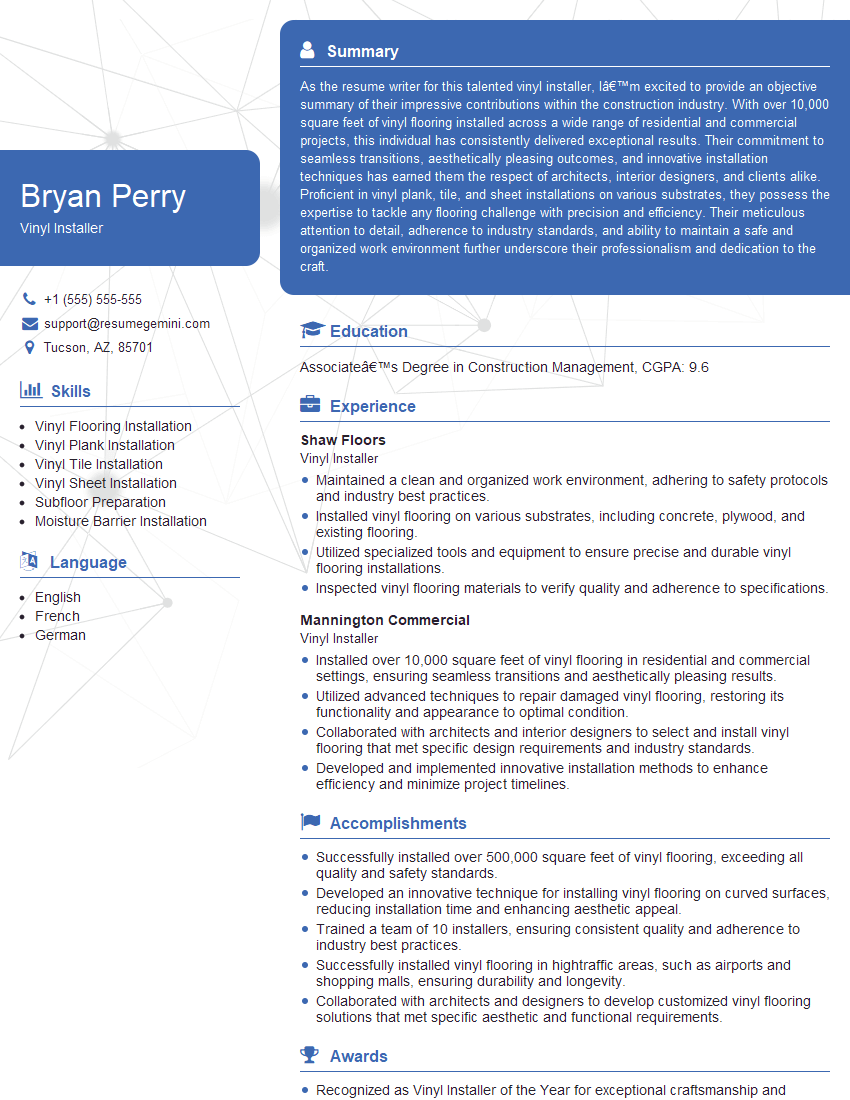
Mastering vinyl application techniques opens doors to exciting career opportunities in various industries, from signage and advertising to vehicle wraps and interior design. A strong understanding of these skills makes you a highly valuable asset to any employer. To increase your chances of landing your dream job, focus on creating an ATS-friendly resume that highlights your relevant skills and experience. ResumeGemini is a trusted resource that can help you build a professional and impactful resume. They provide examples of resumes tailored to the Vinyl Application field, helping you showcase your expertise effectively.
Explore more articles
Users Rating of Our Blogs
Share Your Experience
We value your feedback! Please rate our content and share your thoughts (optional).
What Readers Say About Our Blog
To the interviewgemini.com Webmaster.
Very helpful and content specific questions to help prepare me for my interview!
Thank you
To the interviewgemini.com Webmaster.
This was kind of a unique content I found around the specialized skills. Very helpful questions and good detailed answers.
Very Helpful blog, thank you Interviewgemini team.