Are you ready to stand out in your next interview? Understanding and preparing for Historical Reconstruction interview questions is a game-changer. In this blog, we’ve compiled key questions and expert advice to help you showcase your skills with confidence and precision. Let’s get started on your journey to acing the interview.
Questions Asked in Historical Reconstruction Interview
Q 1. Explain the difference between interpretation and reconstruction in historical contexts.
Interpretation and reconstruction in history are closely related but distinct processes. Interpretation involves analyzing existing historical evidence – documents, artifacts, etc. – to understand past events and their meanings. It’s about making sense of the past, offering explanations and drawing conclusions based on available data. Think of it as reading a faded manuscript; you need to decipher the writing and understand its context. Reconstruction, on the other hand, goes a step further. It involves actively recreating aspects of the past based on that interpretation, whether it’s building a replica of a Roman villa or staging a historical battle. Reconstruction is like using that deciphered manuscript to rebuild the scene it describes. It’s a more active, creative process built upon the foundation of careful interpretation.
For example, interpreting Roman pottery shards might involve analyzing their style, materials, and decoration to determine their date and origin. Reconstructing a Roman kiln would involve using that interpretive knowledge to design and build a functional replica, based on the available evidence and informed speculation within the bounds of what is known.
Q 2. Describe your experience with primary source analysis for historical reconstruction.
My experience with primary source analysis is extensive. I’ve worked on numerous projects involving the detailed examination of diverse primary sources. This includes analyzing medieval manuscripts, deciphering archaeological inscriptions, and interpreting the structural remains of ancient buildings. A key example is my work on a project reconstructing a 14th-century English manor house. We started by meticulously examining estate records, tax rolls, and building plans (where available). These documents, though fragmented and sometimes ambiguous, provided invaluable insights into the layout, materials, and even the daily life within the manor. We cross-referenced these with archaeological findings from the site, carefully noting any discrepancies and weighing the validity of different sources.
A crucial part of this analysis was understanding the biases and limitations inherent in primary sources. For instance, estate records might overemphasize the grandeur of the manor, while archaeological evidence reveals more about the less glamorous aspects of daily life. By carefully considering these biases, I could build a more nuanced and complete picture of the manor and its inhabitants.
Q 3. How do you approach verifying the authenticity of historical artifacts used in reconstruction?
Verifying the authenticity of historical artifacts is paramount in reconstruction. It ensures the accuracy and credibility of the project. My approach involves a multi-faceted strategy. First, I begin with provenance research, tracing the artifact’s history from its discovery to its current location. This often involves examining documentation, such as excavation reports, museum records, and private collections’ histories.
Second, I use scientific techniques for authentication. This may include material analysis (e.g., radiocarbon dating, thermoluminescence dating), stylistic analysis comparing the artifact to similar known objects, and examining for signs of forgery or alteration. Third, I consult with experts in relevant fields—archaeologists, conservators, art historians—to gain additional perspectives and validate my findings. For instance, a suspected medieval sword would be analyzed metallurgically to verify its age, its style would be compared to contemporary examples, and its markings scrutinized for inconsistencies.
It’s important to remember that the process is iterative; new evidence may emerge, requiring further verification and potentially adjustments to the initial assessments.
Q 4. What are the ethical considerations involved in historical reconstruction projects?
Ethical considerations are central to historical reconstruction. A key aspect is respect for cultural heritage. Reconstructions should not misrepresent or appropriate cultures, particularly those marginalized or historically oppressed. We must be sensitive to the potential for misinterpretation and avoid perpetuating harmful stereotypes. For example, reconstructing a Native American village demands consultation with and the involvement of the relevant community to ensure respectful representation.
Another important aspect is accuracy and transparency. Reconstructions should clearly distinguish between known facts and educated guesses or interpretations. This prevents the creation of historical ‘fiction’ presented as reality. Any uncertainties or ambiguities must be openly acknowledged. Finally, environmental and conservation concerns are crucial; reconstruction projects must be mindful of the environmental impact, minimizing harm to existing sites and utilizing sustainable practices.
Q 5. Explain your understanding of different reconstruction methodologies (e.g., experimental archaeology).
Various methodologies exist in historical reconstruction. Experimental archaeology is one of the most valuable. It involves replicating past technologies and practices to understand how they worked and the skills involved. For example, to understand how medieval blacksmiths created swords, we might construct a replica forge and attempt to forge a sword using period techniques. This provides hands-on understanding and insights often unavailable through purely textual or visual sources.
Beyond experimental archaeology, other methodologies include digital reconstruction, using 3D modeling and other technologies to create virtual representations of past environments or structures; analogical reasoning, which involves drawing comparisons between similar historical events or technologies; and historical analogy where we compare and contrast similar cultural settings and events from different time periods.
The choice of methodology depends on the research question, the availability of evidence, and the project’s goals. Often, a combination of methodologies is employed for a comprehensive approach.
Q 6. How do you handle conflicting historical accounts when undertaking a reconstruction project?
Conflicting historical accounts are common and require careful consideration. My approach involves a thorough analysis of each account, considering its source, author, intended audience, and potential biases. I examine the evidence each account offers and evaluate its consistency with other sources. I look for corroborating evidence from archaeology, material culture, or other independent sources to resolve discrepancies.
Sometimes, the conflict cannot be resolved definitively, and acknowledging the uncertainty becomes part of the reconstruction. In such cases, I might present multiple interpretations, clearly explaining the different accounts and the evidence supporting each. Transparency about these ambiguities is crucial. The goal is not to force a single, definitive narrative but to provide a comprehensive and balanced presentation of the available evidence and interpretations.
Q 7. Describe your experience with budgeting and resource management in a historical reconstruction project.
Budgeting and resource management are critical aspects of historical reconstruction projects. My experience includes developing detailed budgets encompassing material costs, labor, research, permitting, and contingency planning. I’ve employed various project management techniques, including Gantt charts, to track progress and allocate resources effectively. Securing funding involves writing grant proposals, seeking sponsorships, and engaging in fundraising activities.
Efficient resource management requires careful planning and prioritization. This includes identifying and securing essential materials, recruiting and managing skilled personnel, and optimizing timelines. For instance, in a recent project reconstructing a Roman road, we carefully sourced appropriate materials, scheduled labor effectively considering weather conditions, and ensured all necessary permits were obtained. Throughout the process, regular monitoring of expenditures and adjustments to the budget were crucial to staying on track and successfully completing the project within the allocated resources.
Q 8. How do you ensure accuracy and avoid anachronisms in historical reconstructions?
Ensuring accuracy in historical reconstruction is paramount. It’s like assembling a giant jigsaw puzzle where many pieces are missing or damaged. We avoid anachronisms – the misplacement of objects or customs into a period where they don’t belong – through meticulous research and a rigorous methodology. This starts with consulting primary sources: original documents, artifacts, and archaeological evidence from the period being reconstructed. We cross-reference these findings with secondary sources, scholarly articles, and expert opinions, always critically evaluating the reliability of each source. For example, when reconstructing a Roman villa, we wouldn’t use modern bricks or roofing materials; instead, we’d carefully analyze the remains of Roman brick kilns and study surviving architectural treatises to determine appropriate materials and building techniques. Any deviation requires clear justification, documented in our research and methodology reports.
We also employ a process of iterative refinement. Initial hypotheses are tested against new evidence as it emerges, leading to adjustments and corrections in the reconstruction. This iterative approach ensures that our work reflects the most current scholarly understanding and avoids perpetuating inaccuracies.
Q 9. Discuss the role of technology (e.g., 3D modeling, GIS) in modern historical reconstruction.
Technology plays a crucial role in modern historical reconstruction, significantly enhancing accuracy and efficiency. 3D modeling allows us to create detailed virtual representations of structures and objects, even if only fragments remain. For instance, we can digitally reconstruct a destroyed medieval castle using surviving foundations and architectural drawings, creating a realistic 3D model that can be explored and analyzed from all angles. This also allows for ‘virtual excavations’ helping researchers make decisions about actual excavations.
Geographic Information Systems (GIS) are equally important for spatial analysis. GIS allows us to map the location of archaeological findings, analyze their spatial relationships, and integrate this data with historical maps and other geographic information. This helps in understanding settlement patterns, urban development, and landscape evolution. Imagine reconstructing a Roman road network: GIS helps us visualize the routes, their connections to settlements, and their impact on the landscape. By combining 3D modeling and GIS, we can create interactive and immersive reconstructions that bring history to life.
Q 10. How do you communicate complex historical information to a non-specialist audience?
Communicating complex historical information to a non-specialist audience requires a shift in approach. Instead of using technical jargon, we employ storytelling techniques to make the information engaging and accessible. We use narratives, visuals, and interactive experiences to convey the historical context and significance of the reconstruction. Think of it like transforming dry academic research into a compelling movie script. We use visuals, like photographs, illustrations, and 3D models to explain complex processes or structures that would otherwise be difficult to understand. We also create interactive exhibits and digital platforms to enhance engagement.
For example, instead of simply presenting a technical report on the construction of a medieval watermill, we could create a virtual tour of the mill, explaining each component and its function in a clear, concise manner, complemented by audio-visual elements that immerse the audience in the historical setting. Keeping the language simple and avoiding technical terms is crucial, while still ensuring historical accuracy.
Q 11. Describe your experience working collaboratively with other specialists (e.g., archaeologists, architects).
Collaboration is the cornerstone of successful historical reconstruction. It’s a highly interdisciplinary field, requiring expertise from various specialists. I’ve extensively collaborated with archaeologists, who provide crucial data from excavations; architects, who ensure structural integrity and authenticity of the reconstruction; material scientists, who analyze the composition and properties of historical materials; and historians, who provide historical context and interpret the findings. This collaborative work often involves regular meetings, shared databases, and joint publications.
For example, during the reconstruction of a historical building, I’ve worked closely with archaeologists to interpret their findings, and with architects to ensure that the reconstruction adheres to historical building techniques while also meeting modern safety standards. The open exchange of information and expertise ensures that the reconstruction project is both historically accurate and structurally sound.
Q 12. How do you manage risks and potential challenges in historical reconstruction projects?
Managing risks and challenges in historical reconstruction projects requires proactive planning and risk assessment. Potential challenges include budget constraints, limited access to primary sources, the degradation of historical materials, and unforeseen archaeological discoveries. We mitigate these risks through thorough planning, detailed budgeting, and contingency planning. We also establish clear communication channels and decision-making processes to ensure that any unforeseen challenges can be addressed efficiently and effectively.
For example, when working with fragile historical materials, we employ specialized conservation techniques and establish strict protocols to prevent further damage. If an unexpected archaeological discovery is made during the reconstruction process, we pause the work and consult with experts to assess the significance of the find and determine the best course of action, often involving further archaeological investigation.
Q 13. What are your preferred methods for documenting and archiving the process of historical reconstruction?
Comprehensive documentation and archiving are essential for preserving the integrity and replicability of historical reconstruction projects. We use a combination of methods, including detailed written reports, photographic documentation, 3D models, and digital databases. We meticulously record every step of the process, from initial research to the final presentation, ensuring that all decisions and modifications are clearly documented. This documentation not only serves as a record of the project but also allows for future researchers to review and build upon our work.
The format is crucial: utilizing standardized data formats ensures long-term accessibility. For example, we use specific file naming conventions for images and utilize structured databases for organizing research data and findings. This ensures that the archive is easily searchable and accessible for future scholars and researchers.
Q 14. Explain your understanding of the preservation and conservation of historical materials.
Preservation and conservation of historical materials are central to my work. It’s about safeguarding the physical remains of the past for future generations. This involves a deep understanding of material science and conservation techniques to protect artifacts and structures from decay and damage. We employ various methods, depending on the material and its condition. This could include stabilizing structures, cleaning artifacts, and using appropriate storage and display methods.
For example, when working with ancient textiles, we use specialized cleaning techniques and climate-controlled environments to prevent further degradation. For stone structures, we might use consolidants to strengthen the stone and protect it from erosion. The goal is always to minimize intervention while maximizing the preservation of the historical material, ensuring its long-term survival and the continued possibility of research and understanding.
Q 15. How do you incorporate public engagement and community involvement in historical reconstruction projects?
Public engagement is crucial for successful historical reconstruction. It ensures the project resonates with the community, fosters a sense of ownership, and provides valuable insights. We achieve this through various methods:
- Community workshops and consultations: We involve local residents, historians, and experts in planning and design stages, gathering their perspectives and ensuring the project reflects local narratives.
- Volunteer programs: We offer opportunities for community members to participate actively in the reconstruction process, from research and artifact handling to construction and interpretation.
- Educational outreach programs: We develop interactive exhibits, guided tours, and educational materials that engage diverse audiences and communicate the significance of the project.
- Interactive online platforms: We use websites, social media, and online forums to share updates, solicit feedback, and encourage dialogue about the reconstruction project.
For example, during a reconstruction of a historical mill, we held community workshops to gather oral histories and photographs from residents whose families had worked there. This enriched our understanding of the mill’s social and economic role, leading to a more authentic and meaningful representation.
Career Expert Tips:
- Ace those interviews! Prepare effectively by reviewing the Top 50 Most Common Interview Questions on ResumeGemini.
- Navigate your job search with confidence! Explore a wide range of Career Tips on ResumeGemini. Learn about common challenges and recommendations to overcome them.
- Craft the perfect resume! Master the Art of Resume Writing with ResumeGemini’s guide. Showcase your unique qualifications and achievements effectively.
- Don’t miss out on holiday savings! Build your dream resume with ResumeGemini’s ATS optimized templates.
Q 16. Describe a time you had to solve a problem related to historical reconstruction.
During the reconstruction of a 19th-century blacksmith shop, we faced a significant challenge: authentic reproduction of the bellows. Our initial attempts using traditional materials proved ineffective, producing insufficient airflow. We needed to balance historical accuracy with functionality.
To solve this, we adopted a multi-pronged approach:
- Detailed historical research: We examined surviving bellows from similar periods and locations, scrutinizing construction techniques and materials.
- Collaboration with experts: We consulted with blacksmiths and historical artisans, seeking their expertise in bellows construction and operation. They provided insights into materials, techniques, and the importance of leather quality and stitching.
- Experimentation and iteration: We constructed several prototype bellows using various materials and designs, testing airflow and durability. This iterative process led us to a design that achieved the desired airflow while remaining historically faithful.
This experience highlighted the iterative nature of historical reconstruction, the importance of collaboration, and the necessity of adapting traditional methods to modern contexts while maintaining authenticity.
Q 17. How do you stay current with the latest research and methodologies in historical reconstruction?
Staying current involves a continuous commitment to scholarly engagement. I achieve this through:
- Regularly reviewing peer-reviewed journals and academic publications: I focus on journals specializing in archaeology, architectural history, material culture, and relevant historical periods.
- Attending conferences and workshops: These events provide opportunities to network with other researchers, learn about the latest methodologies, and engage in discussions on current research.
- Engaging with online resources and databases: I utilize online archives, digital libraries, and academic databases to access primary sources, research articles, and technical information.
- Mentorship and collaboration: I actively seek guidance from experienced scholars and collaborate on research projects to share knowledge and learn from diverse perspectives.
For instance, recent advancements in archaeometry – the application of scientific methods to archaeology – have greatly influenced my approach to material analysis in reconstruction projects.
Q 18. What are the limitations and biases inherent in historical reconstruction?
Historical reconstruction inherently faces limitations and biases. These stem from several sources:
- Incomplete evidence: We often work with fragmented sources, resulting in gaps in our understanding. Interpretations must acknowledge these limitations.
- Bias in surviving sources: Historical records often reflect the perspectives of those who created them, leading to skewed or incomplete narratives. For example, records focusing primarily on the experiences of the wealthy might neglect the perspectives of the working class.
- Modern interpretations: Our understanding of the past is shaped by current perspectives and values. This can influence our choices regarding materials, techniques, and interpretations, potentially leading to anachronisms or misrepresentations.
- Financial and logistical constraints: Budgetary limitations and access to resources can restrict the scope and accuracy of a reconstruction project.
Addressing these biases requires critical self-reflection, transparent documentation of methodology, acknowledging limitations, and engaging with multiple perspectives to create a nuanced and accurate representation.
Q 19. Explain your experience with creating accurate historical representations for public display.
Creating accurate representations for public display requires meticulous attention to detail and a multi-faceted approach:
- Thorough research: This forms the basis for accurate representations. I consult primary sources, archival materials, and relevant scholarly literature.
- Material authenticity: I strive to use historically accurate materials and construction techniques. When this isn’t feasible, I document the reasons and substitutions made.
- Contextualization: The display must provide context for the artifact or scene, explaining its historical significance and helping visitors understand its meaning.
- Accessibility and interpretation: The presentation must be accessible and engaging for diverse audiences, avoiding jargon and providing clear explanations. Interpretive panels, interactive elements, and guided tours are valuable tools.
In a recent exhibit on colonial life, we meticulously researched clothing styles, household items, and building materials to ensure accuracy. We complemented the display with detailed interpretive panels that explained the social and economic context of colonial life.
Q 20. How do you evaluate the success of a historical reconstruction project?
Evaluating the success of a historical reconstruction project involves multiple criteria:
- Accuracy and authenticity: To what extent does the reconstruction accurately reflect the historical source material? This is evaluated through rigorous review by peers and experts.
- Educational impact: Does the project effectively educate and engage visitors, fostering understanding and appreciation of the past?
- Community engagement: How successfully did the project integrate with the local community and contribute to local identity and pride?
- Long-term preservation: Are there plans in place to ensure the long-term preservation and maintenance of the reconstruction?
- Accessibility and inclusivity: Was the project accessible and inclusive to diverse audiences?
Feedback mechanisms, such as visitor surveys and expert reviews, are crucial in gauging the impact and effectiveness of the project. Long-term monitoring helps to assess its longevity and continued relevance.
Q 21. Describe your experience with different types of historical reconstruction (e.g., buildings, events, lifestyles).
My experience spans various types of historical reconstruction:
- Building reconstruction: This involves recreating structures based on historical plans, archaeological evidence, and surviving examples. This includes careful consideration of materials, techniques, and construction methods.
- Event reconstruction: This focuses on recreating historical events, such as battles or festivals. It involves careful research into the context, participants, and logistics of the event. Ethical considerations are paramount, particularly when dealing with sensitive historical events.
- Lifestyle reconstruction: This involves recreating aspects of daily life in a specific historical period. This might involve recreating clothing, tools, food preparation methods, or social practices. This often requires extensive research into material culture and social history.
Each type necessitates a different approach and expertise. Building reconstruction demands strong architectural and engineering knowledge, while event reconstruction requires a deep understanding of historical context and logistical planning. Lifestyle reconstruction relies heavily on ethnographic and social history research. All, however, require meticulous attention to historical detail and a commitment to authenticity.
Q 22. How do you adapt your reconstruction approach to different historical periods and cultures?
Adapting my reconstruction approach hinges on understanding the unique characteristics of each historical period and culture. It’s not a ‘one-size-fits-all’ approach. For example, reconstructing a Roman villa requires different methodologies than reconstructing a medieval castle or a 19th-century American town.
- Material Culture: The availability and types of materials used in construction vary wildly. Roman builders used concrete, while medieval builders relied on stone and timber. Understanding these differences is crucial for accurate reconstruction.
- Technological Advancements: The level of technological sophistication influences the methods and tools used. Reconstructing a Neolithic settlement demands different approaches than reconstructing an industrial factory.
- Cultural Practices: Social structures, beliefs, and customs affect architectural styles, settlement patterns, and even the deposition of artifacts. For instance, understanding burial practices is vital for reconstructing funerary monuments.
- Archaeological Context: The way archaeological data is preserved and interpreted varies significantly across periods and regions. A stratified archaeological site will provide a different level of detail than scattered surface finds.
My approach involves extensive research into the specific period and culture, including studying primary sources like written records, artistic representations, and archaeological evidence. I then develop a detailed methodology that considers these unique factors. This might involve collaborating with specialists in various fields, such as archaeologists, anthropologists, and architects, to ensure the highest level of accuracy and authenticity.
Q 23. What software or tools are you proficient in using for historical reconstruction?
Proficiency in various software and tools is essential for accurate and efficient historical reconstruction. My expertise spans a range of programs, each serving a specific purpose.
- 3D Modeling Software (e.g., Blender, SketchUp): I use these to create virtual models of structures and objects, enabling visualization and analysis of spatial relationships.
- Geographic Information Systems (GIS) software (e.g., ArcGIS, QGIS): GIS is invaluable for spatial data analysis, allowing me to map archaeological sites, analyze settlement patterns, and create detailed geographical reconstructions.
- Digital Image Processing Software (e.g., Photoshop, GIMP): These tools are crucial for enhancing and analyzing images from archaeological excavations and historical documents.
- Data Analysis Software (e.g., R, Python): I use these for statistical analysis of large datasets, for example, analyzing pottery shards or carbon dating results.
- CAD Software (e.g., AutoCAD): For creating precise architectural drawings and plans, particularly for reconstructing buildings.
In addition to software, I’m skilled in using various surveying equipment, such as total stations and GPS receivers, for accurate field measurements during site investigations. The choice of tools depends entirely on the nature of the project and the available data.
Q 24. How do you handle unexpected discoveries or new evidence during a reconstruction project?
Unexpected discoveries are the spice of historical reconstruction! They require flexibility, careful analysis, and a willingness to adapt the project’s scope and timeline. My approach involves several key steps:
- Careful Documentation: Thorough documentation of the unexpected discovery, including its location, context, and associated artifacts, is paramount. High-resolution photography and precise measurements are essential.
- Interdisciplinary Collaboration: Consulting with specialists in relevant fields (e.g., geologists, botanists, or other archaeologists) is often necessary to understand the significance of the discovery.
- Re-evaluation of Existing Hypotheses: The new evidence may require a re-evaluation of existing hypotheses and theories regarding the site or event being reconstructed.
- Methodology Adjustment: The project’s methodology may need adjusting to incorporate the new data, which may involve additional research, fieldwork, or analysis.
- Transparency and Communication: Keeping stakeholders informed about the discovery and its implications is crucial to maintain project integrity and credibility.
For instance, the unexpected discovery of a previously unknown burial chamber during the reconstruction of a Roman villa would necessitate a reassessment of the villa’s layout, social structure, and its relationship to the broader community. The project’s scope would likely expand to include a thorough investigation of the chamber.
Q 25. Describe your understanding of the legal and regulatory aspects of historical reconstruction.
Legal and regulatory aspects are critical. They involve several key areas:
- Archaeological Heritage Laws: Many countries have strict laws protecting archaeological sites and artifacts. Any reconstruction project must comply with these regulations, obtaining necessary permits and licenses before undertaking any work. Failure to comply can lead to legal penalties and project termination.
- Data Ownership and Access: Understanding the ownership and access rights to archaeological data and artifacts is crucial. Data sharing agreements may need to be negotiated with various stakeholders.
- Intellectual Property Rights: Copyright and intellectual property issues surrounding images, publications, and other outputs from the reconstruction project must be carefully managed.
- Environmental Regulations: Any work involving ground-penetrating radar or excavation might require environmental impact assessments and permits to ensure minimal disturbance to the environment.
- Repatriation of Artifacts: In some cases, reconstructed items or discovered artifacts may need to be repatriated to their original owners or communities, according to cultural heritage agreements.
I always ensure that all legal and regulatory aspects are thoroughly addressed at every stage of a project, working closely with legal counsel and relevant authorities to maintain compliance.
Q 26. How do you balance historical accuracy with the needs and expectations of stakeholders?
Balancing historical accuracy with stakeholder needs requires careful negotiation and clear communication. Historical accuracy is my top priority. However, I recognize that stakeholders – be they funding bodies, local communities, or museum curators – may have different expectations regarding the presentation and interpretation of the reconstruction.
My approach involves:
- Defining Clear Objectives: Establishing clear objectives at the outset of the project, including the intended audience and their expectations, is crucial.
- Open Communication: Maintaining open and honest communication with stakeholders throughout the project, ensuring transparency about the reconstruction process and any limitations or uncertainties.
- Compromise and Negotiation: Sometimes compromises might need to be made, but these should not compromise the core principles of historical accuracy. For example, a visual representation may need to incorporate elements of artistic license while adhering to verifiable historical data.
- Contextualization: Providing clear explanations of the evidence base, any limitations, and any areas of interpretation or speculation will assist stakeholders in understanding the reconstruction’s reliability and limitations.
For example, while reconstructing a historical battlefield, a local community might prefer a focus on tourism, while historians might prioritize a scientifically accurate depiction of tactical maneuvers. Balancing these perspectives involves explaining the research methodologies, highlighting the evidence-based aspects, and showcasing the visual appeal in a way that respects the historical narrative.
Q 27. Explain your experience with presenting your work to an audience (e.g., conference presentations, public talks).
Presenting my work involves a multi-faceted approach tailored to the specific audience. I’ve presented at numerous international conferences, given public talks at museums and historical societies, and participated in workshops and educational outreach programs.
- Conference Presentations: My conference presentations typically include a combination of visual aids (images, 3D models, maps) and narrative descriptions, focusing on the research methodology, key findings, and scholarly contributions.
- Public Talks: For public talks, I adopt a more accessible and engaging style, using relatable analogies and storytelling to make the subject matter more engaging for a general audience. I focus on the narrative aspects of the reconstruction and its implications for understanding the past.
- Workshops and Educational Programs: For workshops and educational programs, I use interactive techniques, encouraging audience participation and discussion. This helps ensure deeper understanding and engagement with the concepts of historical reconstruction.
Regardless of the format, I always ensure that my presentations are well-structured, visually compelling, and accurate, reflecting the rigor and precision of my research. Effective communication is key to conveying the significance of my work to a diverse audience.
Q 28. How would you approach reconstructing a historically significant event with limited available information?
Reconstructing a historically significant event with limited information requires a cautious and methodical approach, focusing on what *can* be known rather than speculating on what cannot. My strategy involves several steps:
- Extensive Literature Review: Begin with an exhaustive search of available historical records, including written sources, artistic representations, and related archaeological finds.
- Identifying Key Gaps: Clearly identify the areas where information is lacking. Acknowledging these gaps is crucial for maintaining intellectual honesty.
- Analogical Reasoning: If direct evidence is limited, drawing parallels with similar events or situations from other contexts might provide some insights, but always with a clear caveat stating the limitations of this method.
- Scenario Modeling: Develop plausible scenarios based on the available evidence, considering various possibilities and their probabilities. This method allows you to present a range of possible interpretations rather than a single, potentially inaccurate reconstruction.
- Visualizations: Use visualizations to represent the range of possibilities, indicating areas where knowledge is uncertain or speculative. Transparency regarding these limitations is paramount.
- Interdisciplinary Collaboration: Consulting experts in related fields can help to fill information gaps and provide alternative perspectives.
For example, reconstructing a lost battle with limited written accounts might involve analyzing battlefield topography, the types of weapons used at the time, and the likely military tactics employed. While the precise sequence of events may remain unknown, a probable scenario can be developed and presented with appropriate caveats.
Key Topics to Learn for Historical Reconstruction Interview
- Historiographical Approaches: Understanding different schools of thought in historical interpretation (e.g., social history, cultural history, political history) and their application to Reconstruction.
- Political and Social Dynamics of Reconstruction: Analyzing the interplay between federal policies, state governments, and local communities during the Reconstruction era. This includes examining the roles of key figures and organizations.
- Economic Transformations: Evaluating the impact of Reconstruction on the Southern economy, including the challenges faced by formerly enslaved people and the rise of sharecropping and tenant farming.
- Race Relations and Social Change: Assessing the complexities of race relations during Reconstruction, including the rise of white supremacy and the efforts to secure civil rights for African Americans.
- The Legacy of Reconstruction: Understanding the long-term consequences of Reconstruction on American society, politics, and culture, and its continued relevance in contemporary discussions of race and equality.
- Primary Source Analysis: Demonstrating proficiency in interpreting and analyzing primary sources such as letters, diaries, newspapers, and official documents from the Reconstruction era.
- Research Methods and Historiography: Articulating your understanding of historical research methods, including archival research, oral history, and the critical evaluation of historical sources.
- Problem-Solving and Critical Thinking: Applying your knowledge to analyze complex historical events and interpret conflicting perspectives. Be prepared to discuss historical debates and controversies surrounding Reconstruction.
Next Steps
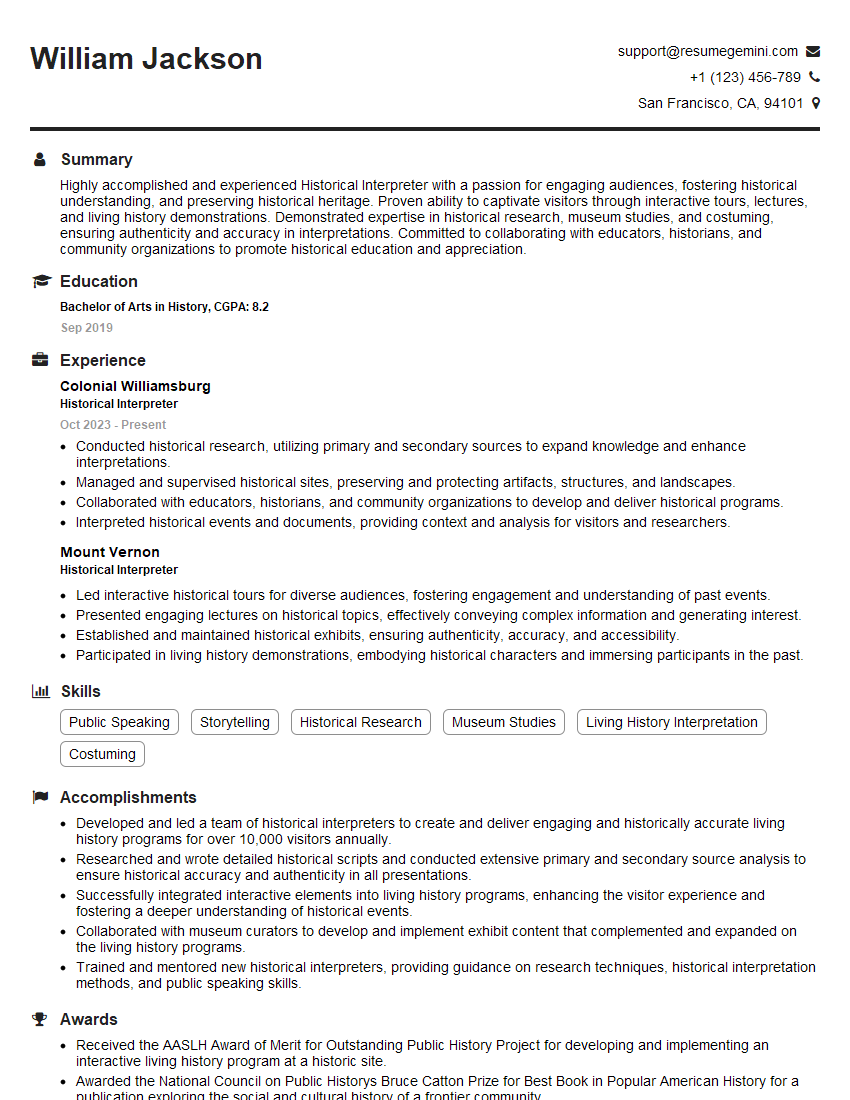
Mastering Historical Reconstruction opens doors to exciting careers in academia, museums, archives, and historical preservation. A strong understanding of this crucial period in American history is highly valued by employers. To significantly enhance your job prospects, create a compelling and ATS-friendly resume that highlights your skills and experience. ResumeGemini is a trusted resource that can help you build a professional and impactful resume tailored to the specific requirements of Historical Reconstruction roles. Examples of resumes tailored to this field are available to help guide you.
Explore more articles
Users Rating of Our Blogs
Share Your Experience
We value your feedback! Please rate our content and share your thoughts (optional).
What Readers Say About Our Blog
To the interviewgemini.com Webmaster.
Very helpful and content specific questions to help prepare me for my interview!
Thank you
To the interviewgemini.com Webmaster.
This was kind of a unique content I found around the specialized skills. Very helpful questions and good detailed answers.
Very Helpful blog, thank you Interviewgemini team.