Every successful interview starts with knowing what to expect. In this blog, we’ll take you through the top Piping Systems Management interview questions, breaking them down with expert tips to help you deliver impactful answers. Step into your next interview fully prepared and ready to succeed.
Questions Asked in Piping Systems Management Interview
Q 1. Explain the different types of piping materials and their applications.
Piping systems utilize a variety of materials, each chosen based on the application’s specific requirements regarding pressure, temperature, corrosive properties of the fluid, and cost. The selection process is crucial for safety and system longevity.
- Carbon Steel: The workhorse of piping systems. It’s strong, readily available, and relatively inexpensive. Commonly used in low-to-medium pressure applications transporting water, steam, or non-corrosive gases. However, it’s susceptible to corrosion in certain environments.
- Stainless Steel: Offers superior corrosion resistance compared to carbon steel, making it ideal for handling corrosive fluids or in environments prone to oxidation. Different grades (e.g., 304, 316) provide varying degrees of corrosion resistance. Used in food processing, chemical plants, and pharmaceutical industries.
- Copper: Excellent corrosion resistance, high thermal conductivity, and ease of joining make it suitable for potable water systems and HVAC applications. It’s more expensive than steel but its longevity often justifies the cost.
- PVC (Polyvinyl Chloride): A common choice for non-pressure applications or low-pressure systems handling chemicals or wastewater. It’s lightweight, corrosion-resistant, and relatively inexpensive. However, it has limitations with high temperatures and pressures.
- Ductile Iron: A strong and ductile material offering good corrosion resistance, often used in water distribution systems and wastewater treatment plants. Its strength makes it suitable for underground applications.
- Cast Iron: While historically popular, its brittleness and susceptibility to corrosion have led to a decrease in use, mostly now found in older systems.
For example, in a power plant, carbon steel might be used for the main steam lines, while stainless steel would be preferred for handling treated water to avoid corrosion.
Q 2. Describe your experience with piping stress analysis software.
I have extensive experience using CAESAR II and AutoPIPE, industry-standard software for piping stress analysis. My expertise extends to model creation, analysis execution, and report interpretation. I’m proficient in defining boundary conditions, applying loads (dead weight, thermal expansion, wind, seismic), and verifying the model’s accuracy. I have successfully utilized these programs to design and analyze piping systems for various projects, ensuring they meet safety and operational requirements. For instance, in a recent project involving a large refinery expansion, I used CAESAR II to model the complex piping network, predicting stresses under various operating conditions and identifying potential areas of concern like high stress concentrations, thereby ensuring the system’s structural integrity.
Beyond simply running the software, I understand the underlying engineering principles of stress analysis and can critically evaluate the results. This includes identifying potential modelling errors and ensuring the results are realistic and reflect the actual system behaviour. I can also tailor the analysis approach to account for specific project constraints and requirements. This might involve the application of different analysis methods or the use of specialized elements within the software to accurately model complex components or connections.
Q 3. How do you determine the appropriate pipe size for a given application?
Determining appropriate pipe size involves a multifaceted approach, balancing several factors. It’s not simply about flow rate; pressure drop, velocity, and economic considerations also play crucial roles.
- Determine the required flow rate: This is based on the process requirements (e.g., gallons per minute or cubic meters per hour).
- Select the fluid properties: Viscosity, density, and temperature affect pressure drop and velocity.
- Use appropriate calculation methods: The Darcy-Weisbach equation or similar methods are used to calculate the pressure drop given the flow rate, pipe length, roughness, and fluid properties. Software programs are often used to simplify this process.
- Consider acceptable velocity: Excessive velocity can lead to erosion or noise, while low velocity may result in sedimentation. Recommended velocity ranges vary depending on the fluid and pipe material.
- Evaluate economic factors: Larger diameter pipes reduce pressure drop, but increase the initial cost. An economic analysis may be required to balance these factors, optimizing cost over the system’s lifespan.
Imagine designing a water distribution system for a building. The flow rate would be calculated based on the building’s water demands. Then, using hydraulic calculations, the pipe diameter would be selected such that the pressure at the furthest point still meets the minimum required pressure, while simultaneously avoiding excessively high velocities that could cause noise or erosion. This often involves iterative calculations and software tools to find the most efficient and cost-effective solution.
Q 4. What are the different types of pipe supports and their functions?
Pipe supports are critical for maintaining the structural integrity of a piping system, preventing excessive stresses, and ensuring safe operation. They are designed to accommodate thermal expansion, weight, and other loads.
- Rigid Supports: These firmly restrain pipe movement in all directions. They are typically used at anchor points or where directional changes are minimal. Examples include welded supports, bolted supports, and concrete saddles.
- Spring Supports (or Constant Support): These allow for axial movement due to thermal expansion. They provide a constant support force, independent of pipe movement within their operating range. Used in systems where thermal expansion is significant.
- Guide Supports (or Movement Restraints): These restrict movement in a single direction. They prevent lateral movement or sway, but allow for axial movement due to thermal expansion. They are typically used to prevent vibration.
- Variable Spring Supports: These supports provide a variable support force depending on the pipe displacement. They are used to minimize stress on the piping system caused by thermal expansion.
- Snubbers: Used to protect piping systems from excessive movement in case of an earthquake or other seismic events. They allow normal movement during thermal expansion but restrain excessive movement.
The type and location of supports are carefully planned using specialized software and calculations to ensure the system can withstand various operating conditions and emergencies.
Q 5. Explain your experience with piping isometric drawings.
Piping isometric drawings are three-dimensional representations of piping systems, providing a comprehensive view of the piping layout, including all components, dimensions, and specifications. My experience involves interpreting these drawings, creating them using specialized software (e.g., AutoCAD P&ID), and using them for design, construction, and maintenance purposes.
I can extract crucial information from isometrics, such as pipe sizes, materials, fittings, valves, and support locations. This information is critical for material take-offs, cost estimation, and construction planning. Conversely, I’m adept at developing isometrics from process and instrumentation diagrams (P&IDs) and three-dimensional models, ensuring accuracy and consistency with the overall design. This includes coordinating with other disciplines to confirm the proper location of pipes, supports, and other equipment.
For example, in one project, I used isometric drawings to identify potential clashes between the piping system and other structural elements. This early detection prevented costly rework during construction, thereby saving both time and money.
Q 6. How do you ensure compliance with relevant piping codes and standards (e.g., ASME B31.1, B31.3)?
Adherence to relevant piping codes and standards is paramount for safety and regulatory compliance. My experience encompasses a thorough understanding and application of codes like ASME B31.1 (Power Piping) and ASME B31.3 (Process Piping). I use these standards as a guiding framework throughout the entire piping system lifecycle, from design to construction and operation.
This involves:
- Material Selection: Selecting materials that meet the required pressure temperature ratings and corrosion resistance based on the code’s guidelines.
- Stress Analysis: Performing stress analysis that satisfies code requirements for allowable stresses and flexibility.
- Support Design: Designing supports that comply with the code’s requirements for support spacing and load capacity.
- Inspection and Testing: Ensuring that the system meets all code requirements during fabrication, installation, and testing.
- Documentation: Maintaining comprehensive documentation that demonstrates compliance with all applicable codes and standards.
Q 7. Describe your experience with piping hydraulic calculations.
Piping hydraulic calculations are essential for determining pressure drops, flow rates, and pump requirements. My experience includes applying various calculation methods, using software tools, and interpreting results to ensure efficient and effective fluid transport.
This involves using equations such as the Darcy-Weisbach equation to calculate frictional losses, accounting for minor losses due to fittings and valves, and determining the required pump head and power. I’m proficient in using specialized software, such as Pipe-Flo, to perform complex hydraulic simulations. For example, I once used this software to optimize a large water distribution system, identifying bottlenecks and suggesting modifications to improve system efficiency and reduce energy consumption. Understanding the implications of different flow regimes (laminar vs. turbulent) and the impact of fluid properties on hydraulic performance are also crucial parts of my expertise. I can also perform calculations manually, especially for simpler systems or as a check on software results, to demonstrate a complete understanding of the underlying principles.
Q 8. How do you manage piping system design changes during a project?
Managing piping system design changes requires a robust, controlled process to ensure safety, functionality, and adherence to project timelines and budgets. Think of it like renovating a house – you wouldn’t just start tearing down walls without a plan.
My approach involves:
- Formal Change Request System: All changes, no matter how minor, are documented through a formal change request. This includes the reason for the change, impact assessment (cost, schedule, safety), proposed solutions, and approvals from relevant stakeholders (engineering, procurement, construction).
- Design Review Meetings: Regular meetings with the engineering team, contractors, and client representatives are crucial to review proposed changes and their implications. This ensures everyone is aligned and potential conflicts are identified early.
- Version Control: Using a robust version control system (like Autodesk Vault or similar) to track all design iterations is essential. This allows us to easily revert to previous versions if needed and maintain a clear audit trail.
- Impact Analysis: A thorough impact analysis is performed to assess the ripple effects of any design change on other aspects of the project, including fabrication, installation, testing, and commissioning.
- Redesign and Documentation: Once a change is approved, the design is updated accordingly, and all relevant documentation (drawings, specifications, etc.) is revised and re-issued.
For example, in a recent petrochemical plant project, a change request was submitted to increase the pipe diameter in a critical section to improve flow rate. Our process ensured this change was thoroughly reviewed, its impact on pressure drop, support structures, and instrumentation was assessed, and appropriate revisions were made to the design and procurement schedule. This prevented potential delays and safety hazards.
Q 9. What are the common causes of piping failures and how do you prevent them?
Piping failures are costly and can be catastrophic. They often stem from a combination of factors, rather than a single cause. Think of it like a chain – if one link breaks, the whole chain fails.
- Corrosion: This is a major culprit, especially in harsh environments. It weakens pipe walls, leading to leaks and bursts. Prevention involves selecting appropriate materials (stainless steel, duplex steel, etc.), applying protective coatings, and implementing regular inspection and maintenance programs.
- Erosion: High-velocity fluids can erode pipe walls, especially at bends and fittings. Proper fluid velocity calculations, using appropriate pipe sizes and strategically placed erosion-resistant liners, can mitigate this.
- Stress Corrosion Cracking (SCC): A combination of tensile stress and corrosive environment can lead to cracking. Careful material selection, stress analysis, and proper environmental control are key preventive measures.
- Fatigue: Repeated cycles of pressure and temperature fluctuations can cause fatigue cracks. Proper design considerations, including appropriate safety factors and stress analysis, are vital.
- Improper Installation: Poor welding, inadequate support, and misalignment can lead to premature failure. Rigorous quality control during fabrication and installation is crucial.
For instance, in an offshore oil platform project, we experienced a minor leak due to pitting corrosion. By implementing a cathodic protection system and replacing the affected section with a corrosion-resistant material, we prevented major damage and ensured operational safety.
Q 10. Explain your experience with piping fabrication and installation.
My experience encompasses all aspects of piping fabrication and installation, from initial design review to final inspection. I’ve overseen projects ranging from small industrial facilities to large-scale refinery expansions.
My involvement includes:
- Reviewing fabrication drawings and specifications: Ensuring they conform to relevant codes and standards (ASME B31.1, ASME B31.3, etc.).
- Material selection and procurement: Specifying the right materials based on service conditions and cost-effectiveness.
- Fabrication shop inspections: Monitoring welding procedures, non-destructive testing (NDT) techniques (like radiography, ultrasonic testing), and quality control measures.
- Field installation supervision: Ensuring proper alignment, support, and installation techniques are followed. I actively work with construction crews to ensure adherence to safety protocols and best practices.
- Pre-commissioning inspections: Checking for any flaws or discrepancies before the system is activated.
In a recent power plant project, I successfully managed the fabrication and installation of a complex network of high-pressure steam lines. Through careful planning and on-site supervision, we completed the project on time and within budget, maintaining the highest safety and quality standards.
Q 11. How do you perform piping system testing and commissioning?
Piping system testing and commissioning is crucial for ensuring the system’s integrity and proper functionality. It’s the final step before handing over the project, ensuring everything works as designed. Think of it as a rigorous medical checkup before the system goes ‘live.’
My approach includes:
- Pre-commissioning inspections: A visual inspection to verify the piping system’s physical completeness, proper alignment, and installation quality.
- Hydrostatic testing: Filling the system with water under pressure to detect any leaks or weaknesses. This is often a crucial test, particularly in high-pressure systems.
- Pneumatic testing: Using air or nitrogen under pressure for systems where water is not suitable. This is often used for gas pipelines and systems with intricate configurations.
- Leak testing: Identifying and repairing any leaks after pressure testing using specialized equipment.
- Functional testing: Verifying that valves, pumps, and other components are working correctly and meeting performance specifications.
- Commissioning documentation: Thoroughly documenting all test results, including any deviations from the design specifications and the corrective actions taken.
In a pharmaceutical plant project, we successfully commissioned a complex clean-in-place (CIP) system, performing rigorous testing to ensure sterility and leak tightness, meeting stringent regulatory requirements.
Q 12. Describe your experience with piping insulation and corrosion protection.
Piping insulation and corrosion protection are critical for maintaining system efficiency, safety, and longevity. Insulation minimizes heat loss (or gain, depending on the application), while corrosion protection prevents degradation of the pipe material.
My experience includes:
- Insulation material selection: Choosing materials with appropriate thermal performance, fire resistance, and environmental compatibility (e.g., fiberglass, mineral wool, polyurethane).
- Insulation installation supervision: Ensuring proper installation techniques to minimize heat loss and prevent damage to the insulation.
- Corrosion protection methods: Specifying and supervising the application of various corrosion protection systems, including coatings (epoxy, polyurethane), linings, and cathodic protection.
- Inspection and maintenance: Regularly inspecting insulated and protected piping to ensure the system’s integrity and identify any deterioration or damage.
In a chemical processing plant, we utilized a combination of high-performance insulation and specialized coatings to protect piping from aggressive chemicals, enhancing efficiency and significantly extending the lifespan of the system.
Q 13. What are the key considerations for designing piping systems in hazardous areas?
Designing piping systems in hazardous areas requires stringent adherence to safety standards and regulations (like API, IEC, and OSHA). The goal is to minimize the risk of fire, explosion, or toxic gas release.
Key considerations include:
- Hazardous area classification: Accurately classifying the area based on the presence of flammable or explosive materials (Zone 0, 1, 2, etc.). This dictates the type of equipment and materials permitted.
- Material selection: Choosing inherently safe materials that are resistant to ignition and corrosion.
- Equipment selection: Using explosion-proof or intrinsically safe equipment (pumps, valves, instrumentation) that meet the area classification.
- Leak detection and prevention: Implementing leak detection systems and pressure relief valves to prevent the buildup of flammable gases.
- Fire protection: Incorporating fire protection measures such as fire suppression systems and fire-resistant materials.
- Electrical and instrumentation considerations: Meeting stringent electrical safety standards to prevent ignition hazards.
In an offshore oil and gas platform project, we meticulously designed a piping system for a hazardous area, selecting appropriate materials, equipment, and safety features, ensuring compliance with all relevant regulations and minimizing the risk of catastrophic events.
Q 14. How do you manage piping system maintenance and repairs?
Effective piping system maintenance and repair is crucial for ensuring operational reliability, safety, and preventing costly downtime. It’s like regular car maintenance – preventative care is cheaper and safer than emergency repairs.
My approach involves:
- Developing a comprehensive maintenance plan: This includes a schedule for routine inspections, preventative maintenance tasks (like lubrication, cleaning), and predictive maintenance techniques (vibration analysis, thermography).
- Implementing a computerized maintenance management system (CMMS): Tracking maintenance activities, spare parts inventory, and generating reports.
- Regular inspections and monitoring: Conducting visual inspections, leak detection, and other monitoring to identify potential problems early.
- Developing repair procedures: Establishing clear procedures for repairs, ensuring safety, and maintaining the system’s integrity.
- Training and competency: Ensuring that maintenance personnel have the necessary training and skills to perform their tasks safely and effectively.
In a chemical manufacturing plant, we implemented a preventative maintenance program that reduced unplanned downtime by 40% and improved overall system reliability. This resulted in significant cost savings and reduced operational risks.
Q 15. Explain your experience with piping system documentation and record-keeping.
Piping system documentation is the backbone of any successful project. It ensures everyone – from designers to maintenance crews – is on the same page. My experience spans creating and managing comprehensive documentation packages, including Isometric Drawings, Piping and Instrumentation Diagrams (P&IDs), Bill of Materials (BOMs), and as-built drawings. I’m proficient in various software like AutoCAD, PDMS, and SmartPlant 3D. Record-keeping involves meticulous tracking of all changes, revisions, and approvals throughout the lifecycle of the piping system. This includes maintaining a detailed history of inspections, maintenance, repairs, and modifications. For example, on a recent refinery project, I implemented a digital document management system, drastically improving accessibility and reducing errors associated with outdated or misplaced documents. This system allowed for efficient collaboration amongst engineers, contractors, and operations staff.
Career Expert Tips:
- Ace those interviews! Prepare effectively by reviewing the Top 50 Most Common Interview Questions on ResumeGemini.
- Navigate your job search with confidence! Explore a wide range of Career Tips on ResumeGemini. Learn about common challenges and recommendations to overcome them.
- Craft the perfect resume! Master the Art of Resume Writing with ResumeGemini’s guide. Showcase your unique qualifications and achievements effectively.
- Don’t miss out on holiday savings! Build your dream resume with ResumeGemini’s ATS optimized templates.
Q 16. How do you handle piping system conflicts with other disciplines?
Piping system conflicts with other disciplines, like structural, electrical, and instrumentation, are inevitable in complex projects. My approach involves proactive communication and collaboration from the initial design stages. We use 3D modeling software to visualize the entire plant layout and identify potential clashes early on. Regular interdisciplinary meetings are crucial, allowing us to discuss and resolve discrepancies collaboratively. When conflicts do arise, I prioritize finding solutions that minimize rework and maintain project schedule and budget. For instance, on a chemical plant project, a proposed pipe route conflicted with a structural beam. By working closely with the structural engineers, we identified an alternate route that avoided the conflict without compromising safety or functionality. The key is open dialogue, compromise, and a willingness to explore creative solutions.
Q 17. Describe your experience with different types of pipe fittings and their applications.
My experience encompasses a wide range of pipe fittings, each tailored to specific applications.
- Elbows: Used to change the direction of pipe flow. Long radius elbows minimize pressure drop compared to short radius elbows.
- Tees: Branch connections, allowing for splitting or merging flow streams.
- Reducers: Connect pipes of different diameters, often used for transitioning between sizes.
- Flanges: Used for joining pipe sections together, offering easy disassembly for maintenance.
- Unions: Similar to flanges, but simpler in design and often used for smaller diameter pipes.
- Valves: Control the flow of fluids (discussed further in question 5).
Q 18. What are the different types of pipe joints and their advantages/disadvantages?
Pipe joints are crucial for ensuring leak-free and reliable connections. Common types include:
- Threaded Joints: Relatively simple and inexpensive, suitable for smaller diameter pipes and lower pressures. However, they can be prone to leakage under high pressure and vibration.
- Flanged Joints: Robust and reliable, offering easy disassembly for maintenance. Require more space and are more expensive than threaded joints.
- Welded Joints: Strongest and most leak-tight joint, ideal for high-pressure and critical applications. Requires skilled welders and specialized equipment.
- Socket-Weld Joints: A type of welded joint where the pipe is inserted into a socket on the fitting before welding. Offers a strong and compact connection.
Q 19. How do you select the appropriate type of valve for a given application?
Valve selection is critical for controlling fluid flow, pressure, and direction. The process involves considering several factors:
- Fluid properties: Viscosity, temperature, corrosiveness, and abrasiveness.
- Operating pressure and temperature: The valve must withstand the operating conditions without failure.
- Flow rate: The valve must be sized to handle the required flow rate efficiently.
- Actuation method: Manual, pneumatic, electric, or hydraulic actuation, depending on accessibility and automation requirements.
- Maintenance requirements: Some valves require more frequent maintenance than others.
Q 20. Explain your experience with piping system instrumentation and control.
Piping system instrumentation and control (IS&C) are essential for monitoring and managing the system’s performance. My experience covers the selection, installation, and commissioning of various instruments, including pressure transmitters, flow meters, temperature sensors, and level indicators. I’m familiar with different control systems, including distributed control systems (DCS) and programmable logic controllers (PLCs). I’ve worked on projects involving the integration of IS&C systems with SCADA (Supervisory Control and Data Acquisition) systems, enabling remote monitoring and control of the piping system. For example, on a recent power plant project, I was responsible for integrating flow meters with the DCS to monitor and control the flow of cooling water through the system. This allowed operators to monitor and adjust the flow rate in real-time, optimizing plant efficiency and preventing potential issues.
Q 21. How do you ensure the safety of personnel during piping system work?
Safety is paramount in any piping system work. My approach to ensuring personnel safety involves a multi-layered strategy:
- Risk assessment and hazard identification: Identifying potential hazards, such as confined spaces, high-pressure systems, and hazardous materials.
- Permit-to-work system: Ensuring that all work is authorized and documented, including risk assessments and control measures.
- Lockout/Tagout procedures: Preventing accidental energy release during maintenance or repair work.
- Personal Protective Equipment (PPE): Ensuring that workers have and wear appropriate PPE, including hard hats, safety glasses, gloves, and protective clothing.
- Training and competency assurance: Making sure workers are properly trained and competent to perform their tasks safely.
- Emergency response plans: Developing and practicing emergency response plans to handle unforeseen incidents.
Q 22. Describe your experience with piping system design software (e.g., AutoCAD Plant 3D, PDMS).
My experience with piping system design software is extensive. I’ve worked extensively with AutoCAD Plant 3D for over eight years, utilizing its capabilities for 3D modeling, isometric generation, and material takeoffs on numerous projects, ranging from small chemical plants to large-scale refinery upgrades. I’m proficient in creating intelligent piping components, managing pipe specifications, and generating detailed fabrication drawings. I’ve also had experience with PDMS, primarily focusing on its database management and clash detection features for large-scale projects where collaborative design is crucial. For instance, on a recent petrochemical project, using Plant 3D’s clash detection capabilities saved us significant time and cost by identifying and resolving conflicts between piping, structural steel, and equipment early in the design phase. This prevented costly rework during construction. Beyond the core functionality, I’m adept at using the software’s customization tools to improve efficiency and streamline workflows for specific project needs.
Q 23. What is your experience with HAZOP studies for piping systems?
HAZOP (Hazard and Operability) studies are integral to ensuring piping system safety. My experience involves actively participating in HAZOP teams, contributing to the identification of potential hazards and developing mitigation strategies. This includes reviewing piping and instrumentation diagrams (P&IDs), process flow diagrams (PFDs), and other relevant documentation to identify deviations from normal operating conditions. We use a structured approach, considering various parameters like pressure, temperature, flow rate, and material compatibility. For example, in a recent HAZOP study on a high-pressure steam line, we identified a potential for a rupture due to water hammer. We subsequently recommended the installation of surge arrestors and additional safety relief valves to mitigate this risk. Documenting all identified hazards, potential causes, consequences, and recommended safeguards is crucial, and I’m experienced in compiling thorough HAZOP reports compliant with industry standards.
Q 24. How do you manage piping projects within budget and schedule?
Managing piping projects within budget and schedule requires a proactive, multi-faceted approach. It starts with accurate cost estimations based on detailed engineering design, material pricing, and labor costs. We use Earned Value Management (EVM) to track progress against the baseline plan. Regular project meetings with the team and stakeholders are essential for transparent communication and early identification of potential problems. I use project management software to monitor progress, resource allocation, and potential schedule slips. For instance, on a recent project where a critical valve delivery was delayed, we identified the impact on the schedule and proactively explored alternative solutions such as using a substitute valve or adjusting the work sequence to minimize the delay’s overall impact. This involved close coordination with vendors and contractors. Contingency planning is also vital—anticipating potential challenges and having mitigation strategies in place is key to staying on track.
Q 25. Explain your understanding of fluid mechanics principles related to piping systems.
A strong understanding of fluid mechanics is fundamental to successful piping system design. This involves applying principles of fluid statics (pressure, head loss) and fluid dynamics (flow rates, friction losses, turbulence). I use equations like the Bernoulli equation and Darcy-Weisbach equation to calculate pressure drop, velocity, and pipe sizing. I account for factors like pipe roughness, fluid viscosity, and flow regime (laminar vs. turbulent) to ensure optimal system performance. For instance, when designing a long-distance pipeline, an accurate calculation of friction losses is critical to ensure sufficient pumping power. Improperly sized pipes can lead to excessive energy consumption, and neglecting minor losses (e.g., valves and fittings) can lead to significant errors. Furthermore, understanding fluid behavior under different conditions is essential; for instance, cavitation can occur in high-velocity flows, leading to equipment damage.
Q 26. Describe your experience with piping system thermal expansion analysis.
Thermal expansion analysis is crucial for preventing damage in piping systems due to temperature changes. My experience encompasses using both analytical methods and sophisticated software for this. Analytical methods involve calculating the expansion using known material properties and temperature differentials. Software like Caesar II allows for more complex analyses, considering pipe supports, anchors, and restraints. We perform stress analysis to ensure that expansion stresses remain within allowable limits and that proper expansion loops or other compensatory measures are incorporated into the design. In a refinery setting, high-temperature process lines experience significant thermal expansion. Neglecting this can lead to excessive stress on pipe supports, leading to failures. We ensure that the expansion loops and supports are appropriately designed to accommodate these movements without causing damage. This includes accounting for variations in ambient temperature to avoid unexpected stresses.
Q 27. What are some common challenges you’ve faced in managing piping systems?
Throughout my career, I’ve encountered several common challenges in managing piping systems. One common challenge is dealing with unforeseen site conditions during construction. Unexpected underground utilities or variations in soil conditions can necessitate redesign and delays. Another significant challenge is coordinating different disciplines (structural, electrical, instrumentation) to avoid clashes and ensure smooth integration. Also, managing changes during the project lifecycle and maintaining accurate as-built documentation are critical tasks. Dealing with material shortages or delivery delays also requires proactive problem-solving, potentially involving finding alternative vendors or materials. Finally, adhering to stringent safety regulations and codes while maintaining project efficiency can be complex. Successful mitigation strategies often involve detailed planning, thorough communication, and proactive risk assessment throughout the project’s lifespan.
Q 28. How do you stay current with the latest advancements in piping systems technology?
Staying current in piping systems technology is paramount. I actively participate in industry conferences and webinars, attend training courses offered by software vendors and professional organizations, and regularly read industry publications and journals. I actively engage in online communities and forums, discussing challenges and best practices with other professionals. I also leverage online resources and databases to access the latest codes and standards. Specifically, I follow advancements in materials science (e.g., new corrosion-resistant alloys), improved design software capabilities (e.g., enhanced simulation and analysis tools), and emerging technologies in leak detection and predictive maintenance. This commitment to continuous learning allows me to implement the most effective and efficient techniques in piping system design, construction, and management.
Key Topics to Learn for Piping Systems Management Interview
- Piping System Design Principles: Understanding fluid mechanics, pressure drop calculations, and material selection criteria for various applications (e.g., high-pressure, corrosive environments).
- Practical Application: Analyzing piping and instrumentation diagrams (P&IDs), interpreting specifications, and identifying potential design flaws or areas for optimization.
- Piping System Construction and Installation: Familiarity with welding techniques, pipe fitting procedures, and quality control measures to ensure compliance with industry standards.
- Practical Application: Troubleshooting issues during installation, overseeing field inspections, and managing construction schedules and budgets.
- Piping System Maintenance and Repair: Developing and implementing preventative maintenance plans, performing root cause analysis for failures, and managing repair projects effectively.
- Practical Application: Diagnosing leaks, addressing corrosion issues, and scheduling necessary repairs to minimize downtime and ensure system integrity.
- Safety and Regulatory Compliance: Understanding relevant safety regulations (OSHA, ASME, etc.), implementing safety protocols, and conducting risk assessments for piping systems.
- Practical Application: Developing and implementing safety procedures, conducting regular inspections, and ensuring compliance with all applicable regulations.
- Project Management in Piping Systems: Planning, scheduling, and managing piping system projects from initiation to completion, including budgeting, resource allocation, and risk management.
- Practical Application: Using project management tools and techniques to deliver projects on time and within budget while meeting quality standards.
- Advanced Topics (as applicable to your experience): Consider exploring topics such as Finite Element Analysis (FEA) for piping stress analysis, or specialized piping systems like cryogenic or high-purity applications.
Next Steps
Mastering Piping Systems Management is crucial for career advancement in the engineering and construction industries, opening doors to leadership roles and higher earning potential. To maximize your job prospects, it’s essential to create a compelling, ATS-friendly resume that highlights your skills and experience effectively. ResumeGemini is a trusted resource to help you build a professional and impactful resume. They offer examples of resumes tailored specifically to Piping Systems Management to guide you in showcasing your qualifications. This will significantly enhance your chances of landing your dream job.
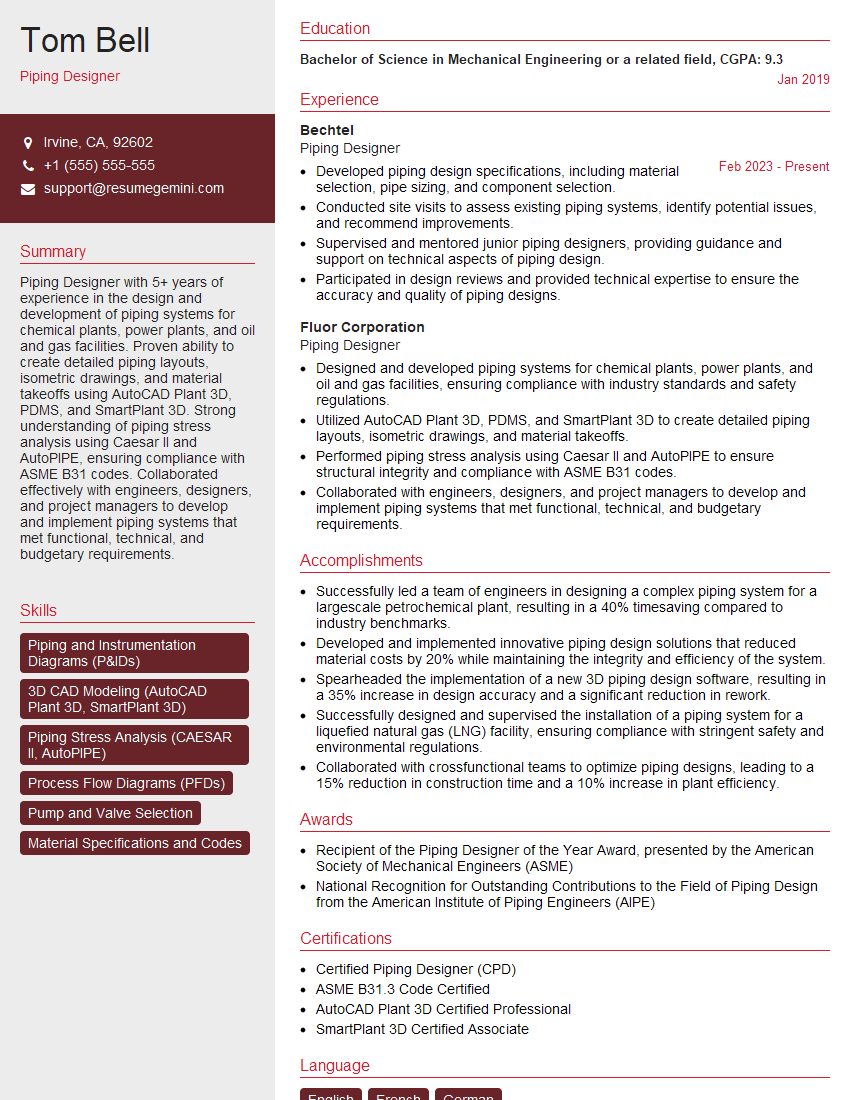
Explore more articles
Users Rating of Our Blogs
Share Your Experience
We value your feedback! Please rate our content and share your thoughts (optional).
What Readers Say About Our Blog
To the interviewgemini.com Webmaster.
Very helpful and content specific questions to help prepare me for my interview!
Thank you
To the interviewgemini.com Webmaster.
This was kind of a unique content I found around the specialized skills. Very helpful questions and good detailed answers.
Very Helpful blog, thank you Interviewgemini team.