Are you ready to stand out in your next interview? Understanding and preparing for Wallcovering Installation Techniques interview questions is a game-changer. In this blog, we’ve compiled key questions and expert advice to help you showcase your skills with confidence and precision. Let’s get started on your journey to acing the interview.
Questions Asked in Wallcovering Installation Techniques Interview
Q 1. What types of wallcovering materials have you worked with?
Over my career, I’ve worked with a wide variety of wallcovering materials. This includes traditional vinyl wallcoverings, which are durable and easy to clean, making them popular for high-traffic areas. I’ve also installed many types of non-woven wallcoverings; these are easier to hang because they don’t require pre-pasting. I have experience with grass cloths, offering a natural texture and sophisticated look, and fabrics, which add a luxurious feel to any room. More recently, I’ve worked extensively with textured wallcoverings, offering a three-dimensional effect, and metallic wallcoverings, which add a touch of glamour. Each material presents its own unique challenges and requires a slightly different approach to installation.
- Vinyl: Durable, washable, wide range of patterns and colors.
- Non-woven: Easy to hang, less likely to shrink or stretch.
- Grasscloth: Natural look, requires careful handling.
- Fabric: Luxurious feel, often requires professional installation.
- Textured: Adds dimension, can be tricky to match patterns.
- Metallic: Adds shine and glamour, can be sensitive to scratches.
Q 2. Describe your experience with different paste application methods.
Paste application is a crucial step, impacting the final result significantly. I’m proficient in several methods. For pre-pasted wallcoverings, I simply activate the adhesive according to the manufacturer’s instructions, usually by soaking the paper in water. This is quick and clean. For paste-the-wall methods, I use a paste roller to apply the adhesive evenly to the wall, ensuring a consistent bond. This is preferred for heavier wallcoverings. Finally, I’m experienced with the paste-the-paper method, applying the adhesive directly to the back of the wallpaper using a paste brush or roller; this is commonly used for more delicate or uniquely patterned wallpapers. The choice depends largely on the type of wallcovering and personal preference, but a key aspect is always ensuring even adhesive distribution to prevent bubbles or wrinkles.
Q 3. How do you prepare a wall surface for wallcovering installation?
Proper wall preparation is paramount for a successful wallcovering installation. A poorly prepared surface can lead to peeling, bubbling, and an uneven finish. My process begins with a thorough cleaning of the wall to remove dust, dirt, grease, or any loose debris. I use a good quality primer to create a uniform surface, especially if dealing with porous walls or old paint. Any cracks or holes are filled and sanded smooth. If the wall has a glossy finish, I’ll lightly sand it to provide better adhesion. Finally, I thoroughly inspect the surface to ensure it’s clean, smooth, and ready for the wallcovering. Think of it like preparing a canvas before painting – a smooth, clean surface ensures the best possible result.
Q 4. Explain your process for measuring and cutting wallcovering.
Accurate measuring and cutting are vital for minimizing waste and ensuring a professional finish. I start by carefully measuring the wall height and width, accounting for any doors, windows, or other obstacles. I then add extra length to each strip to allow for pattern matching and trimming. Pattern matching requires careful consideration, often involving laying out multiple strips on the floor to ensure a seamless transition. Once the length is determined, I use a sharp utility knife and a metal straight edge to cut each strip precisely. I always double-check my measurements to avoid errors. Precision here saves significant time and material later in the process.
Q 5. What tools and equipment are essential for efficient wallcovering installation?
Having the right tools makes all the difference in efficiency and quality. My essential tools include a measuring tape, a plumb bob (for perfectly vertical seams), a sharp utility knife and cutting mat, a paste brush or roller, a smoothing brush or squeegee (to eliminate air bubbles), a seam roller (for securing seams), and a sponge. In addition, I use a stepladder or scaffolding for taller walls, and a drop cloth to protect the floor. A good quality primer and adhesive are also crucial for the longevity and appearance of the project. It’s always better to invest in high-quality tools; they not only last longer but also improve the precision and outcome of the project significantly.
Q 6. How do you handle challenging situations like matching patterns or working around obstacles?
Pattern matching and working around obstacles are common challenges, but I have strategies to handle them effectively. For pattern matching, careful planning is key, as I mentioned earlier. I meticulously lay out strips on the floor to visualize the pattern and ensure proper alignment. For obstacles like outlets or light switches, I measure carefully and cut precise openings around them, often using a utility knife and a sharp blade. Sometimes it’s necessary to create custom-cut pieces to perfectly fit these obstructions. It’s all about meticulous planning and precise execution to create a clean, professional look. Having a plan of attack before I even start working, including visualizing the challenges and planning solutions, is essential to a smooth installation.
Q 7. What are the common causes of wallcovering bubbles and how do you fix them?
Bubbles in wallcovering are often caused by insufficient adhesive, trapped air, or uneven application. To fix small bubbles, I carefully pierce them with a pin and gently smooth out the air using a smoothing brush or squeegee. For larger bubbles, I may need to lift a section of the wallcovering carefully, reapply adhesive, and smooth it out. If the bubble is close to a seam, I may need to carefully separate the seam, reapply adhesive, and re-join it. Prevention is always best, so paying close attention to adhesive application and smoothing the wallpaper thoroughly during installation minimizes the risk of bubbles forming.
Q 8. How do you ensure proper seam alignment and avoid visible seams?
Achieving seamless wallcovering installation is crucial for a professional finish. It’s all about meticulous planning and precise execution. Improper alignment leads to noticeable seams, detracting from the overall aesthetic. My approach begins with careful measurement and cutting of the wallpaper panels to ensure consistent length and width. Then, I use a plumb line or laser level to establish a perfectly vertical starting point for the first panel. This provides a reference for aligning subsequent panels.
For intricate patterns, I match the design elements precisely before applying adhesive, sometimes marking the seams with a pencil to maintain consistent alignment. Throughout the installation, I frequently step back to check for misalignments. The key is to maintain consistent pressure and smooth out any bubbles or wrinkles to prevent shifting after the adhesive sets. A soft roller helps to ensure even pressure along the seams. If I see a slight imperfection, a razor blade can carefully trim excess wallpaper at the seam, which, when followed with careful smoothing, is almost invisible.
- Using a seam roller: This specialized tool provides even pressure, helping to create a strong, secure seam and prevent future lifting.
- Book matching: For patterned wallpaper, consider book matching to create a mirror image across the seams, camouflaging any potential misalignments.
Q 9. Describe your experience with installing various types of wallcovering (vinyl, fabric, etc.)
My experience encompasses a wide range of wallcovering materials, each with its unique installation characteristics. I’ve worked extensively with vinyl wallcovering, known for its durability and washability. Vinyl installations require careful attention to smoothing out air bubbles, as they can be more resistant to adhesive adjustments. With its versatility, I’ve used it in various settings, from high-traffic areas to bathrooms and kitchens.
Fabric wallcoverings, while offering a more luxurious feel, present different challenges. They often require specialized paste, and the material is more delicate. Careful handling is crucial to avoid tearing or stretching. I find that fabric wallpapers lend a more sophisticated air to a room and are often used in bedrooms or living rooms.
I also have experience with grass cloth, which is highly textured, and requires careful handling during the installation. This type of wallpaper requires a paste to be applied to the wall itself, rather than the material, as it is rather delicate.
My experience with each type has honed my skills in material handling, adhesive selection, and installation techniques tailored to the specific requirements of each material. Each material presents its own unique set of challenges; it’s about recognizing those challenges and reacting accordingly.
Q 10. How do you clean up after a wallcovering installation project?
Maintaining a clean worksite is paramount, both for the safety of my clients and for the quality of the finished product. My cleanup process is thorough and systematic, starting immediately after the installation is complete.
I use a wet-dry vacuum and various brushes, depending on the type of wall covering installed, to remove any excess adhesive or wallpaper scraps. The vacuuming is crucial to prevent residue from accumulating on the floor or surfaces. Paint scrapers and putty knives assist with removing excess adhesive and any stubborn debris from the walls and trim. After a thorough vacuuming, I then use a damp cloth or sponge to wipe down any remaining residue or adhesive spots. All tools are cleaned and stored away in a designated area. Dispose of the waste material properly according to local regulations and in an environmentally conscious way.
I always aim to leave the work area cleaner than I found it. This ensures that my clients feel comfortable and satisfied with the overall experience, ensuring that they will return for future business.
Q 11. What safety precautions do you take during wallcovering installation?
Safety is my top priority throughout every wallcovering project. This begins with proper preparation. I always wear appropriate safety gear, including safety glasses to protect my eyes from flying debris, and gloves to protect my hands from the adhesive and sharp tools.
I use drop cloths to protect the floors and furniture, ensuring that the adhesive doesn’t damage anything unintentionally. When working with ladders, I always ensure they are stable and properly positioned. I also take extra care when using sharp tools such as utility knives or razor blades, using them cautiously and attentively. Proper ventilation is ensured throughout the process, especially when working with adhesives or primers that emit fumes. I also educate my clients on safety measures before and during the installation, advising them to vacate the space until the adhesives have dried and the work area is completely clean and safe for return. This safety protocol safeguards me and those around me from accidents, ensuring a smooth installation.
Q 12. Explain your experience with different types of wallcovering adhesives.
My experience with different adhesives is extensive, and the selection process depends heavily on the type of wallcovering being installed and the wall surface. There are various types of adhesives, including pre-pasted papers, clear adhesive pastes, and heavy-duty adhesives for vinyl or textured wallpapers. Pre-pasted options offer convenience, while heavy-duty adhesives provide superior bonding for more challenging installations.
For vinyl wallcoverings, I often use a heavy-duty adhesive designed for its strength and durability. For fabric wallcoverings, a more delicate paste is required to avoid damaging the material. I always follow the manufacturer’s instructions for each adhesive, ensuring proper mixing and application. Choosing the right adhesive is crucial to prevent issues such as peeling or bubbling, ensuring a long-lasting, professional finish. I always test the adhesive on an inconspicuous area first to check for compatibility and ensure it won’t damage or discolor the wallcovering.
Q 13. How do you deal with difficult wall surfaces (uneven, textured, etc.)?
Uneven or textured walls present significant challenges in wallcovering installation. My approach involves careful preparation to create a smooth, consistent surface for the wallpaper to adhere to. I start by assessing the severity of the imperfections. For minor imperfections, I might use a lightweight spackling compound to fill in small holes or cracks.
For more significant irregularities, I might recommend skim coating, a technique where a thin layer of joint compound is applied to the entire wall to create a uniform surface. After the compound dries, I use sandpaper to smooth the surface and prime the walls with a high-quality primer, which allows for the best adhesion and minimizes the chances of the wallpaper showing the imperfections underneath. Using a primer is crucial to achieve a professional, even look and to help reduce the chances of the wallpaper lifting in the future.
The goal is to create a surface as smooth as possible, although this may not be possible in some scenarios. In these cases, a thicker wallpaper with more texture will help to mask the imperfections of the wall underneath.
Q 14. Describe your experience with large-scale commercial wallcovering projects.
I have extensive experience with large-scale commercial wallcovering projects, including offices, hotels, and retail spaces. These projects often involve coordination with other contractors, adherence to strict deadlines, and managing larger teams.
Successful completion requires meticulous planning, detailed scheduling, and efficient material management. I always start with a thorough site survey to assess the scope of the project, identify potential challenges, and develop a detailed installation plan. This planning minimizes on-site issues and ensures efficient workflow. We use a detailed project management system to track materials, schedule the workforce, and maintain communication across different teams. Large-scale projects may also require specialized equipment, such as lifts or scaffolding, that are safely deployed and consistently monitored. This methodical approach guarantees the timely and high-quality completion of large projects, while maintaining a consistent level of client satisfaction.
Q 15. What is your experience with wallpaper removal and preparation of walls for re-wallpapering?
Wallpaper removal and wall preparation are critical for a successful wallpapering project. It’s akin to building a strong foundation for a house – if the base isn’t solid, the whole structure will suffer. My process begins with assessing the existing wallcovering. For vinyl, I typically use a scoring tool and a spray bottle of hot water with a little dish soap to soften the adhesive. For more stubborn papers, a wallpaper steamer is invaluable. I work in sections, carefully peeling back the paper and scraping off any remaining adhesive with a putty knife or scraper. I then inspect the wall for any imperfections like holes, cracks, or uneven surfaces. These are repaired using spackle and sanded smooth. After that, it’s crucial to prime the walls. This seals any remaining adhesive, creates a uniform surface for the new wallpaper to adhere to, and prevents bleed-through of colors or textures. I always use a high-quality primer specifically designed for wallpaper.
For example, recently I encountered a particularly challenging removal job involving several layers of outdated wallpaper, some of which were heavily textured. I used a combination of steaming, scraping, and chemical removers to successfully remove all the layers without damaging the wallboard. Then, multiple coats of primer were applied to ensure a clean and smooth surface for the new wallpaper.
Career Expert Tips:
- Ace those interviews! Prepare effectively by reviewing the Top 50 Most Common Interview Questions on ResumeGemini.
- Navigate your job search with confidence! Explore a wide range of Career Tips on ResumeGemini. Learn about common challenges and recommendations to overcome them.
- Craft the perfect resume! Master the Art of Resume Writing with ResumeGemini’s guide. Showcase your unique qualifications and achievements effectively.
- Don’t miss out on holiday savings! Build your dream resume with ResumeGemini’s ATS optimized templates.
Q 16. How do you calculate the amount of wallcovering needed for a project?
Calculating the amount of wallpaper needed is crucial to avoid costly mistakes. It’s a straightforward process, but accuracy is essential. I start by measuring the height and width of each wall to be covered. Then, I add up the total square footage. Next, I consider the pattern repeat of the wallpaper. This is the distance the pattern repeats vertically. Most patterns will require some waste due to matching. For example, a 24-inch pattern repeat necessitates carefully matching and aligning the pattern, leading to more waste. I always add at least 10% to 15% extra to the total square footage to account for waste, pattern matching, and any mistakes. Remember to factor in any areas with doors, windows, or other openings. This will help to obtain a precise amount.
For instance, if I have a room with four walls totaling 200 square feet and a wallpaper with a 12-inch repeat, I will add approximately 20-30 square feet, to account for pattern matching and trimming. A bit more will be added for a larger repeating pattern. It’s always better to have a little extra than to run short mid-project.
Q 17. What is your experience with working from blueprints or design specifications?
I have extensive experience working from blueprints and design specifications. This is frequently crucial for commercial projects or those involving complex designs or layouts. I carefully review the plans to understand the scope of the work, the type of wallpaper being used, and any specific installation instructions. I use the blueprints to determine accurate measurements and to identify any potential challenges before starting the installation. This ensures that the final result accurately reflects the client’s vision.
In a recent project for a boutique hotel, the blueprints detailed the exact location and type of wallcovering for each room. Adhering to the plans ensured seamless consistency with the hotel’s design scheme.
Q 18. How do you handle customer requests or changes during a project?
Open communication and flexibility are key when handling customer requests or changes during a project. I always welcome client feedback and attempt to accommodate reasonable requests whenever possible. Before making any changes, I discuss them with the client, explain any potential impact on the project timeline or cost, and ensure they fully understand the implications. If a significant change is necessary, I provide a revised quote and schedule. Transparency and clear communication ensure the client remains satisfied throughout the process.
For example, a client once requested a change in wallpaper after the initial selection. We discussed the change and how it might affect the project timeline and overall price, leading to a minor adjustment in the quote and a small delay. Maintaining clear communication with the client at every step kept the project on track.
Q 19. Describe your experience with using a plumb bob or laser level for accurate installation.
Using a plumb bob or laser level is essential for ensuring perfectly straight and aligned wallpaper installation. A plumb bob is ideal for establishing a perfectly vertical line, while a laser level projects a horizontal or vertical plane to assist in aligning multiple strips. I use these tools to establish a starting point and maintain consistency throughout the installation process. This ensures professional-looking results, and prevents any noticeable misalignments, particularly important with patterned wallpapers.
Imagine trying to hang wallpaper without a level – the lines would likely be crooked and it will show. The plumb bob and laser level are simple tools that make a massive difference in the quality of the finished work.
Q 20. How do you maintain a clean and organized work area during installation?
Maintaining a clean and organized work area is crucial for efficiency and safety. I use drop cloths to protect floors and furniture. Tools and materials are kept organized and easily accessible. Waste is disposed of properly and regularly. Regular cleanup prevents accidents and allows for smoother, more efficient workflow. This also minimizes the disruption and mess for the client.
Think of it like a surgeon preparing for an operation – a clean, organized space allows for greater focus and precision. The same applies to wallpaper installation.
Q 21. What is your experience with using specialized tools for wallpaper trimming or cutting?
I’m proficient in using various specialized tools for wallpaper trimming and cutting, including utility knives, snap-off blades, seam rollers, and trimming tools. Sharp blades are crucial for clean cuts, particularly with delicate or textured wallpapers. Seam rollers ensure proper adhesion between wallpaper strips, while trimming tools help achieve precise edges around windows and doors. Regular maintenance and sharpening of these tools are essential for optimal results and safety.
For instance, using a sharp utility knife with snap-off blades allows for precise cutting and avoiding tearing of the wallpaper. The seam roller ensures that no air bubbles or gaps are left between the strips.
Q 22. Describe your troubleshooting experience with common wallcovering installation problems.
Troubleshooting wallcovering installation issues requires a systematic approach. I start by carefully examining the problem, identifying its root cause – is it the wall preparation, the wallpaper itself, or the installation technique? Common problems include bubbling, seams that won’t adhere, and color inconsistencies.
- Bubbling: Often caused by insufficient smoothing or air trapped beneath the wallpaper. I’ll carefully pierce the bubble with a pin and smooth it out, working the air towards the edges. If the problem persists, it may indicate improper adhesive application or moisture trapped behind the wall.
- Seams not adhering: This could be due to poor matching of the edges, insufficient adhesive, or uneven wall surfaces. I would check the alignment, reapply adhesive to the problem area, and use a seam roller to ensure proper bonding.
- Color inconsistencies: This can be due to differences in the wallpaper batch or improper lighting during installation. Working in good light and using a consistent application technique is crucial. In cases of batch variation, replacing the affected sections with a matching batch from the supplier is sometimes necessary.
Beyond these, I also address issues like peeling wallpaper (often a sign of improper primer or wall preparation), shrinkage (often a result of humidity changes), and pattern mismatches (requiring careful measurement and planning).
Q 23. How do you ensure the longevity and durability of your wallcovering installations?
Ensuring the longevity of a wallcovering installation involves meticulous preparation and careful execution. The key is focusing on three crucial areas: proper wall preparation, using high-quality materials, and employing the correct installation techniques.
- Wall Preparation: This is the most critical step. Walls need to be clean, dry, and free of any imperfections. I always recommend filling holes and cracks with appropriate filler, sanding smooth, and applying a primer to ensure a strong bond and consistent color absorption. The type of primer will depend on the wall surface and the type of wallpaper.
- High-Quality Materials: Using high-quality wallpaper and adhesive is essential. Cheap materials can result in bubbling, peeling, and premature fading. I always carefully check the wallpaper’s manufacturer instructions for specific requirements.
- Correct Installation Techniques: Careful measurement, precise cutting, and thorough smoothing are crucial to prevent issues like bubbling and seam separation. Using the right tools, such as seam rollers and smoothing brushes, ensures optimal adhesion and a professional finish.
Finally, proper post-installation care, such as avoiding excessive moisture and cleaning according to the manufacturer’s instructions, helps to extend the life of the wallcovering.
Q 24. What are some common mistakes to avoid during wallcovering installation?
Several common mistakes can significantly impact the quality and longevity of a wallcovering installation. Avoiding these pitfalls is key to achieving a professional result.
- Poor Wall Preparation: Neglecting to properly clean, repair, and prime the walls is a major mistake. This can lead to poor adhesion, bubbling, and premature failure of the wallpaper.
- Incorrect Adhesive Application: Applying too little or too much adhesive, or using the wrong type, can compromise the bond. Always follow the manufacturer’s instructions on adhesive quantity and application technique.
- Improper Seam Matching: Inaccurate pattern matching results in a visually unappealing and unprofessional finish. Careful measurement and precise cutting are crucial.
- Insufficient Smoothing: Failing to properly smooth out air bubbles and creases can lead to bubbling and unsightly imperfections. Use a smoothing brush or roller diligently to remove all air pockets.
- Ignoring Manufacturer’s Instructions: Neglecting to read and follow the wallpaper and adhesive manufacturer’s instructions is a recipe for disaster. Each material has unique application requirements.
By avoiding these mistakes, installers can significantly improve the quality, longevity, and aesthetic appeal of their work.
Q 25. How do you manage your time effectively during a wallcovering installation project?
Effective time management is crucial for successful wallcovering installation. I utilize a few key strategies:
- Detailed Planning: Before starting any project, I meticulously measure the walls, calculate the required wallpaper rolls, and plan the layout to minimize waste and optimize the workflow. This detailed preparation allows me to execute the installation efficiently.
- Organized Workspace: Maintaining a clean and organized workspace is paramount. Having all necessary tools and materials readily available minimizes time spent searching and improves efficiency.
- Efficient Techniques: I employ efficient cutting and pasting techniques to reduce downtime and accelerate the process. This includes using a sharp utility knife for precise cuts and adopting a methodical approach to wallpaper application.
- Realistic Scheduling: I always provide a realistic timeline based on the size of the project, wall conditions, and wallpaper type. Overestimating rather than underestimating is always better.
- Teamwork (when applicable): On larger projects, working with a skilled assistant can significantly increase productivity, allowing for task delegation and specialized roles.
By combining meticulous planning with optimized workflow and efficient techniques, I can complete projects on time and to a high standard.
Q 26. Describe a time you had to problem-solve a challenging wallcovering installation issue.
I once encountered a particularly challenging installation in a home with significant wall imperfections. The walls were old, uneven, with several large cracks and patches that had been poorly repaired. Simply applying wallpaper wouldn’t have yielded a satisfactory result.
My solution involved a multi-step approach: I first spent considerable time repairing the major cracks and imperfections using high-quality fillers and ensuring a smooth surface. Then, I applied a high-quality bonding primer specifically designed for uneven surfaces, which provided a uniform base for the wallpaper. Finally, I used a heavy-duty, textured wallpaper to mask any remaining minor imperfections. The end result was a stunning and professional-looking installation that disguised the underlying wall problems flawlessly.
This experience highlighted the importance of thorough wall preparation and the selection of appropriate materials to overcome challenging installation circumstances.
Q 27. What is your preferred method for dealing with corners and difficult angles during installation?
My preferred method for handling corners and difficult angles involves precision cutting and meticulous matching. For inside corners, I carefully measure and cut the wallpaper, overlapping the edges slightly before applying adhesive and firmly pressing the wallpaper into the corner. I then use a seam roller to ensure a clean and strong bond. For outside corners, I create a mitered cut (a 45-degree angled cut), overlapping the two pieces slightly to avoid gaps or unsightly seams.
Dealing with unusually shaped or angled walls requires careful planning and precise measurements. In these situations, I often create templates from paper or cardboard to ensure accurate cutting and a perfect fit. The technique might involve creating multiple pieces to perfectly conform to the unusual shape, using the template as a guide for each cut.
Patience and attention to detail are key for achieving a seamless transition in such areas, ensuring a consistent and aesthetically pleasing finish.
Q 28. How do you stay current with the latest trends and techniques in wallcovering installation?
Staying up-to-date in this field is crucial for maintaining a competitive edge. I utilize several methods to stay informed about the latest trends and techniques:
- Industry Publications and Websites: I regularly read trade publications, online blogs, and industry-specific news websites to stay abreast of new products, techniques, and design trends.
- Professional Development Courses and Workshops: I participate in workshops and seminars offered by wallpaper manufacturers and industry associations, learning about new installation methods and best practices.
- Networking with Other Professionals: I actively network with other installers and professionals in the field, sharing experiences, best practices, and exchanging information about new products and trends.
- Manufacturer Training: Many manufacturers offer specialized training programs on their products and application techniques, providing valuable insights and updates.
By proactively seeking out and incorporating new information, I can ensure my installation techniques remain current and that I can offer my clients the latest and most effective solutions.
Key Topics to Learn for Wallcovering Installation Techniques Interview
- Surface Preparation: Understanding different wall types (drywall, plaster, etc.), proper cleaning methods, and the application of primers and sealers for optimal adhesion.
- Pattern Matching and Measurement: Accurately measuring wall space, calculating material needs, and mastering techniques for precise pattern matching (e.g., drop match, straight match).
- Paste Application and Hanging Techniques: Choosing the correct adhesive for various wallcovering types, proper paste application methods (pre-pasted, paste-the-wall), and efficient hanging techniques to minimize seams and bubbles.
- Seam Treatment and Finishing: Techniques for creating seamless transitions between wallcovering panels, trimming excess material, and using appropriate tools for clean edges and corners.
- Troubleshooting Common Issues: Identifying and resolving problems such as bubbling, wrinkles, gaps, and mismatched patterns; understanding the causes and implementing effective solutions.
- Working with Different Wallcovering Materials: Practical experience and theoretical knowledge of various materials like vinyl, fabric, grasscloth, and textured wallcoverings, including their unique installation requirements.
- Safety Procedures and Best Practices: Understanding and implementing safe working practices, including proper use of tools and equipment, maintaining a clean work area, and adhering to relevant safety regulations.
- Tools and Equipment: Familiarity with essential tools like seam rollers, smoothing brushes, measuring tapes, utility knives, and other specialized equipment used in wallcovering installation.
Next Steps
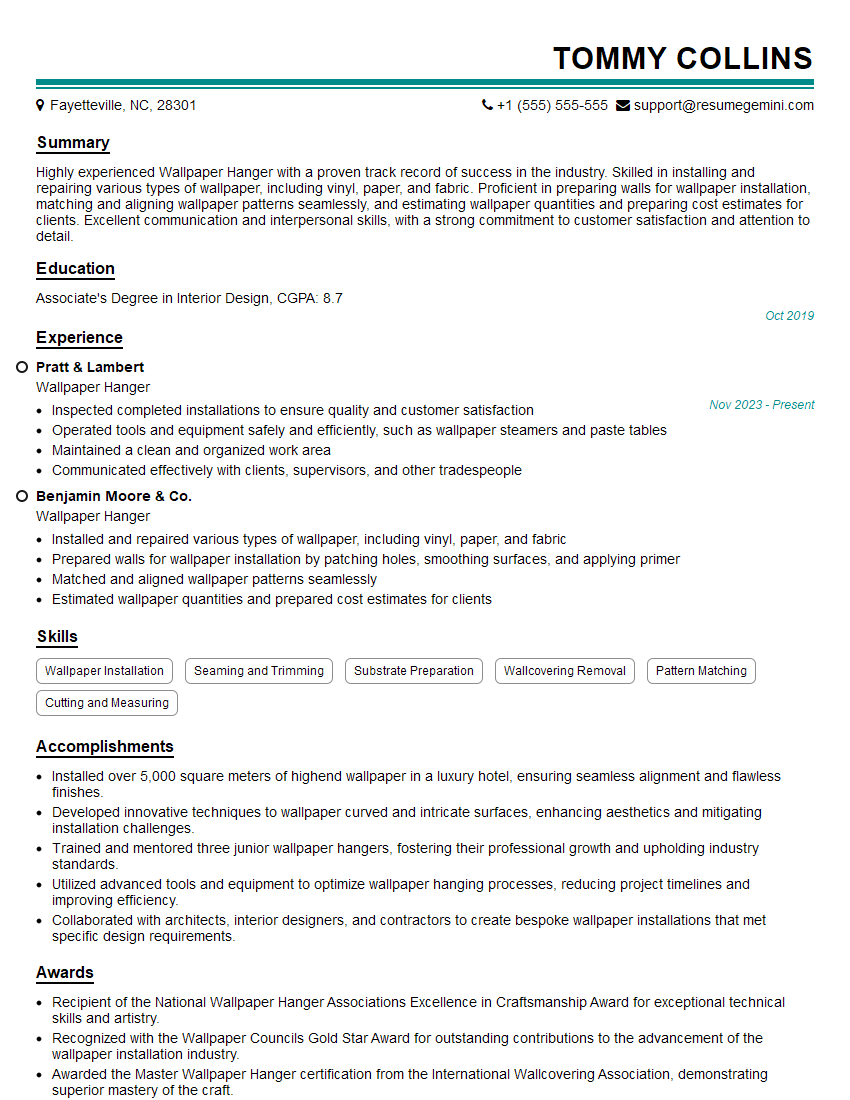
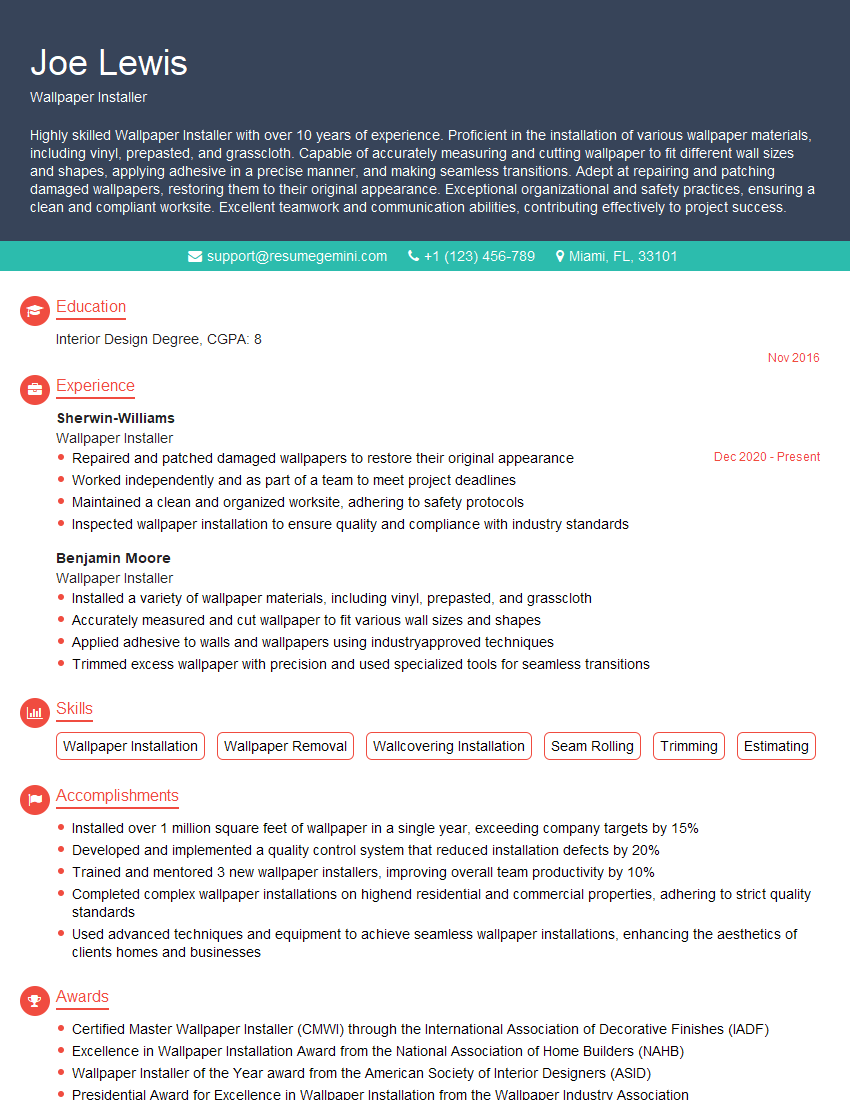
Mastering wallcovering installation techniques is crucial for career advancement in the construction and interior design fields, opening doors to higher-paying positions and specialized projects. A well-crafted resume is your key to unlocking these opportunities. Creating an ATS-friendly resume is essential to ensure your application is seen by hiring managers. ResumeGemini is a trusted resource to help you build a professional and impactful resume that highlights your skills and experience effectively. Examples of resumes tailored to Wallcovering Installation Techniques are available to help guide you in showcasing your expertise. Take the next step towards your dream job – invest in a strong resume that reflects your abilities.
Explore more articles
Users Rating of Our Blogs
Share Your Experience
We value your feedback! Please rate our content and share your thoughts (optional).
What Readers Say About Our Blog
To the interviewgemini.com Webmaster.
Very helpful and content specific questions to help prepare me for my interview!
Thank you
To the interviewgemini.com Webmaster.
This was kind of a unique content I found around the specialized skills. Very helpful questions and good detailed answers.
Very Helpful blog, thank you Interviewgemini team.