Are you ready to stand out in your next interview? Understanding and preparing for Biodiesel Purification interview questions is a game-changer. In this blog, we’ve compiled key questions and expert advice to help you showcase your skills with confidence and precision. Let’s get started on your journey to acing the interview.
Questions Asked in Biodiesel Purification Interview
Q 1. Explain the different methods used for biodiesel purification.
Biodiesel purification is crucial for meeting quality standards and ensuring engine compatibility. Several methods are employed, often in combination, to remove impurities. These methods can be broadly categorized as:
- Water Washing: This is a fundamental step to remove glycerol and other water-soluble impurities.
- Acid/Base Washing: Used to neutralize any remaining free fatty acids or soaps.
- Drying: Removes excess water to prevent microbial growth and improve fuel stability.
- Filtration: Removes solid particles, such as catalyst residues or unreacted materials.
- Dehydration (e.g., using molecular sieves): For achieving ultra-low water content, crucial for long-term storage.
The specific methods and their sequence will depend on the feedstock, the transesterification process used, and the desired quality of the final biodiesel product. For instance, biodiesel produced from high-free fatty acid feedstocks might require more extensive acid washing steps.
Q 2. Describe the role of water washing in biodiesel purification.
Water washing is a critical step in biodiesel purification because it efficiently removes glycerol, the major byproduct of the transesterification reaction. Glycerol is highly undesirable in biodiesel as it can cause engine problems like injector clogging and increased emissions. The process involves mixing the crude biodiesel with water, allowing the glycerol (being water-soluble) to partition into the aqueous phase. After settling, the glycerol-rich water layer is separated from the biodiesel layer. This is often aided by centrifugation to enhance separation efficiency.
Think of it like washing a greasy dish – the water dissolves the grease and carries it away, leaving behind the clean dish (biodiesel). The effectiveness of water washing depends on factors such as the water-to-biodiesel ratio, the mixing intensity, and the settling time. Improper water washing can lead to residual glycerol in the final product, impacting its quality.
Q 3. What are the common impurities found in crude biodiesel?
Crude biodiesel contains various impurities arising from the feedstock and the transesterification process. Common impurities include:
- Glycerol: The main byproduct of transesterification.
- Soapstock: A mixture of soaps formed from the reaction of free fatty acids in the feedstock with the catalyst (usually sodium or potassium hydroxide).
- Unreacted Triglycerides: These are the starting materials that haven’t fully reacted during transesterification.
- Mono- and Diglycerides: Intermediate products of the transesterification reaction.
- Catalyst Residues: Leftover catalyst from the transesterification process.
- Water: Can be present from the feedstock or absorbed from the atmosphere.
- Solid Particles: These may originate from the feedstock or equipment.
The presence of these impurities can negatively affect the biodiesel’s physical and chemical properties, including its oxidation stability, cloud point, and cetane number.
Q 4. How do you determine the optimal temperature and pressure for biodiesel purification?
Determining the optimal temperature and pressure for biodiesel purification is crucial for effective impurity removal without causing undesirable side effects. The optimal conditions depend on several factors including the purification method being used, the type of impurities being targeted, and the properties of the biodiesel itself. Generally:
- Water Washing: Often conducted at ambient temperature and atmospheric pressure to prevent excessive water solubility of biodiesel components.
- Filtration: The temperature may be slightly elevated to reduce viscosity and improve filtration efficiency. Pressure may be applied depending on the type of filtration method used.
- Drying: Temperature is carefully controlled to avoid decomposition or oxidation of biodiesel. Vacuum drying can be used to lower the boiling point of water and facilitate faster drying at lower temperatures.
Experimental testing is often required to determine the optimal parameters for a specific setup and biodiesel feedstock. This involves analyzing the effect of different temperature and pressure combinations on the efficiency of impurity removal and the quality of the purified biodiesel.
Q 5. Explain the importance of filtration in biodiesel purification.
Filtration plays a vital role in biodiesel purification by removing solid particles and ensuring that the final product is free from contaminants that can damage fuel systems. These solid particles can be catalyst residues, unreacted feedstock components, or even inadvertently introduced material during processing. Efficient filtration prevents clogging of fuel injectors, fuel pumps, and filters in engines, ensuring smooth operation and extending the lifespan of equipment.
Consider a fine mesh sieve removing pebbles from sand – a similar concept is applied to biodiesel purification, but on a much finer scale, targeting micron and submicron-sized particles.
Q 6. What are the different types of filtration used in biodiesel purification?
Various filtration techniques are used depending on the desired particle size removal and the throughput requirements. These include:
- Depth Filtration: Uses a filter medium with a complex structure to trap particles within the medium’s pores. This is effective for removing a wide range of particle sizes.
- Surface Filtration: Particles are retained on the surface of the filter medium, requiring more frequent filter changes. This is typically suitable for removing larger particles.
- Membrane Filtration (e.g., microfiltration, ultrafiltration): Uses membranes with precisely defined pore sizes to remove particles based on their size. These are very effective for removing fine particles and can provide a high degree of purification.
- Centrifugation: Although not strictly filtration, it’s a crucial separation technique that removes solid particles by using centrifugal force.
The choice of filtration method depends on factors like the nature and size of the impurities, the desired level of purification, and economic considerations.
Q 7. How do you measure the free glycerol content in purified biodiesel?
The free glycerol content in purified biodiesel is a key indicator of its quality and is typically measured using Gas Chromatography (GC). GC separates the components of the biodiesel sample based on their boiling points, allowing for precise quantification of the glycerol present. This method provides accurate and reliable results, which are essential for quality control and compliance with industry standards.
In a nutshell, GC works by injecting a small sample of the biodiesel into a heated column. Different components travel through the column at different rates, are detected, and their concentration is calculated. The amount of free glycerol present reflects the efficiency of the purification process. Other methods like titration can also be employed but GC provides a higher degree of accuracy.
Q 8. What are the ASTM standards for biodiesel quality?
ASTM International (formerly known as the American Society for Testing and Materials) publishes numerous standards that dictate the quality parameters for biodiesel. These standards ensure consistency and safety across the industry. Key standards include ASTM D6751, which covers the specifications for biodiesel fuel (B100), and ASTM D7467, which covers the specifications for biodiesel blends (e.g., B5, B20). These standards cover a wide range of properties, including:
- Cetane number: A measure of the fuel’s ignition quality.
- Kinematic viscosity: How easily the fuel flows.
- Acid number: An indicator of the presence of free fatty acids.
- Water content: The amount of water present in the fuel.
- Flash point: The lowest temperature at which the fuel’s vapors can ignite.
- Sulfur content: The amount of sulfur present in the fuel.
Meeting these standards is crucial for ensuring the biodiesel’s performance in engines, its storage stability, and its environmental impact. Non-compliance can lead to engine damage, increased emissions, and other problems.
Q 9. Describe the process of removing methanol from biodiesel.
Removing methanol from biodiesel is a critical step in purification. Methanol, a byproduct of the transesterification process used in biodiesel production, is toxic and must be carefully removed. Common methods include:
- Water washing: Methanol is highly soluble in water. This process involves washing the biodiesel with water, causing the methanol to dissolve into the aqueous phase which is then separated. Careful control of water quantity is necessary to avoid significant biodiesel losses.
- Vacuum distillation: This method leverages the difference in boiling points between methanol (64.7 °C) and biodiesel (significantly higher). By applying a vacuum, the boiling point of methanol is lowered, allowing for its efficient removal without excessive heat damaging the biodiesel.
- Membrane separation: Membrane filtration technologies, such as nanofiltration or reverse osmosis, can selectively remove methanol based on its size and solubility. This method offers a more environmentally friendly approach compared to solvent-based techniques.
The choice of method depends on factors like the initial methanol content, the desired level of purification, and economic considerations. Often, a combination of techniques is employed to achieve optimal results. For example, water washing might be followed by vacuum distillation for a higher level of purity.
Q 10. Explain the significance of acid value in assessing biodiesel quality.
The acid value, expressed as milligrams of potassium hydroxide (KOH) per gram of biodiesel, is a crucial indicator of biodiesel quality. It represents the amount of free fatty acids (FFAs) present. High acid value indicates a higher concentration of FFAs, which can:
- Reduce the fuel’s oxidative stability: FFAs can accelerate oxidation, leading to the formation of gums and sediments that can clog engine fuel systems.
- Corrode engine components: FFAs can be corrosive to engine parts, reducing their lifespan.
- Lower the biodiesel’s cetane number: Lowering the cetane number means poor ignition quality.
A low acid value is therefore essential for ensuring a high-quality fuel with good storage stability and compatibility with engines. ASTM standards specify a maximum allowable acid value for biodiesel, typically in the range of 0.5 mg KOH/g. Exceeding this value can render the biodiesel unfit for use.
Q 11. What are the environmental implications of improper biodiesel purification?
Improper biodiesel purification can have several significant environmental implications:
- Water pollution: Unremoved methanol and other impurities, if discharged into waterways, can be highly toxic to aquatic life and disrupt the ecosystem.
- Air pollution: Incomplete purification can lead to increased emissions of harmful pollutants during combustion, such as particulate matter and unburned hydrocarbons.
- Soil contamination: Improper disposal of waste streams from purification processes can contaminate the soil, potentially harming plant life and groundwater.
- Increased greenhouse gas emissions: If the purification process is energy-intensive and inefficient, it could result in a larger carbon footprint, counteracting the environmental benefits of biodiesel.
Responsible purification is vital for minimizing the environmental impact of biodiesel and maximizing its sustainability advantages. This involves using efficient purification techniques, proper waste management, and adherence to environmental regulations.
Q 12. How do you troubleshoot common problems encountered during biodiesel purification?
Troubleshooting during biodiesel purification often involves systematic investigation. Common problems and their solutions include:
- High acid value: This indicates incomplete transesterification. Possible solutions involve checking the reaction conditions (temperature, time, catalyst concentration) and ensuring sufficient mixing. Adding fresh catalyst or performing a second transesterification might be necessary.
- High methanol content: This points to inadequate methanol removal. Check the efficiency of the purification method (water washing, vacuum distillation, etc.). Optimizing the process parameters or switching to a more effective technique may be required.
- Emulsion formation: This is often caused by poor water washing technique. Adjusting the water-to-biodiesel ratio, improving mixing, and ensuring proper settling time can help resolve the issue.
- High water content: This can be addressed by using effective drying techniques. Ensure sufficient time for drying and consider using a vacuum or other methods to enhance water removal.
Careful record-keeping during the entire process, including reaction conditions and purification parameters, is critical for effective troubleshooting. Analyzing samples at different stages can pinpoint the source of the problem and guide corrective actions.
Q 13. Describe your experience with different types of drying techniques for biodiesel.
Drying is essential to remove residual water from purified biodiesel, improving its storage stability and preventing microbial growth. Several techniques are employed:
- Air drying: This is the simplest method, involving exposing the biodiesel to air for a period to allow for evaporation. It’s effective for lower water contents but can be slow and inefficient.
- Vacuum drying: Applying vacuum reduces the boiling point of water, accelerating evaporation. This is more effective than air drying, particularly for higher water contents.
- Centrifugal drying: Centrifugation uses high speed rotation to separate the water phase from the biodiesel. This method is particularly useful for separating emulsions.
- Molecular sieve drying: Molecular sieves are porous materials that selectively adsorb water molecules. This method is highly effective for achieving very low water contents.
The optimal drying technique depends on the water content, the required level of dryness, and economic considerations. Often, a combination of methods is employed to achieve the desired result. For example, centrifugal drying might be followed by vacuum drying for enhanced efficiency.
Q 14. What is the role of catalysts in biodiesel production and how do they impact purification?
Catalysts play a crucial role in biodiesel production by accelerating the transesterification reaction between triglycerides (fats or oils) and methanol. Common catalysts include homogeneous catalysts (e.g., sodium hydroxide, potassium hydroxide) and heterogeneous catalysts (e.g., solid base catalysts). While catalysts speed up the reaction, their presence impacts purification.
- Homogeneous catalysts: These catalysts dissolve in the reaction mixture and need to be removed during purification to avoid corrosion and other problems. This is typically done through water washing, followed by careful separation of the aqueous and biodiesel phases. Residual catalyst can increase the acid value.
- Heterogeneous catalysts: These catalysts remain solid throughout the reaction and are easier to separate, reducing the purification requirements. However, they may leave traces of catalyst particles or leached metal ions in the biodiesel which need to be filtered out to avoid issues with engine wear and corrosion.
The choice of catalyst influences the purification process and complexity. While heterogeneous catalysts offer advantages regarding purification, homogeneous catalysts are often more efficient and cost-effective for the transesterification reaction itself. The purification process is designed to remove any catalyst traces that could compromise biodiesel quality and engine performance.
Q 15. How do you ensure the safety of personnel during biodiesel purification processes?
Ensuring personnel safety during biodiesel purification is paramount. It starts with comprehensive safety training covering all potential hazards, including exposure to corrosive chemicals (like methanol and catalysts), flammable materials, and high-pressure equipment. We implement strict adherence to safety protocols, including the use of personal protective equipment (PPE) like goggles, gloves, lab coats, and respirators. Regular safety inspections of equipment and facilities are conducted to identify and mitigate potential risks. Emergency response plans, including detailed procedures for spills and equipment malfunctions, are developed and regularly practiced. For instance, we have a designated emergency shower and eyewash station readily available, and all personnel are trained in their proper use. Furthermore, we maintain detailed safety data sheets (SDS) for all chemicals used in the process, readily accessible to all workers. Regular safety meetings reinforce safe work practices and encourage reporting of near-miss incidents to foster a proactive safety culture.
Career Expert Tips:
- Ace those interviews! Prepare effectively by reviewing the Top 50 Most Common Interview Questions on ResumeGemini.
- Navigate your job search with confidence! Explore a wide range of Career Tips on ResumeGemini. Learn about common challenges and recommendations to overcome them.
- Craft the perfect resume! Master the Art of Resume Writing with ResumeGemini’s guide. Showcase your unique qualifications and achievements effectively.
- Don’t miss out on holiday savings! Build your dream resume with ResumeGemini’s ATS optimized templates.
Q 16. What are the economic considerations associated with biodiesel purification methods?
Economic considerations in biodiesel purification are significant. The cost of purification methods varies considerably depending on the chosen technique and the quality of the initial feedstock. For example, using advanced technologies like vacuum distillation or chromatography results in higher-quality biodiesel but involves substantial capital investment and operational costs. Conversely, simpler methods like settling and filtration are cheaper but may not yield the same level of purity. The choice must balance the cost of purification with the potential increase in biodiesel value due to higher quality. Higher purity biodiesel typically commands a higher market price, offsetting purification costs. Energy consumption during purification is another major factor. Efficient processes minimize energy use, reducing operational expenses and the overall carbon footprint of biodiesel production. Waste management is another economic consideration, as proper disposal or recycling of byproducts can add costs, which is why choosing efficient processes is important.
Q 17. Explain the difference between physical and chemical purification methods for biodiesel.
Biodiesel purification methods are broadly classified as physical or chemical. Physical methods primarily rely on separating impurities based on their physical properties, such as density or boiling point. Examples include settling, filtration (using different filter media like diatomaceous earth), centrifugation (spinning to separate solids and liquids), and vacuum distillation (boiling at reduced pressure to separate components based on their volatility). These methods are generally less expensive but may not entirely remove all impurities, particularly polar contaminants. In contrast, chemical methods involve chemical reactions to remove impurities or alter their properties. Examples include washing with water (to remove soapstock and glycerol), acid treatment (to remove alkaline catalysts), and adsorption using activated carbon (to remove color and odor). Chemical methods are often more effective in removing specific impurities but can add cost and complexity, generating chemical waste requiring careful management. The best approach often involves a combination of both physical and chemical methods to achieve the desired biodiesel purity.
Q 18. Describe your experience with quality control testing in biodiesel production.
Quality control is integral to biodiesel production. My experience involves implementing and overseeing a robust QC program encompassing various tests at different stages of the purification process. These tests include determining the free glycerol content, measuring the water content, analyzing the acid value, evaluating the kinematic viscosity, and assessing the oxidative stability. We use standardized methods (like ASTM standards) for these analyses, ensuring consistency and comparability of results. We maintain detailed records of all quality control tests, allowing us to track the quality of our biodiesel throughout the production process and identify any areas for improvement. In one instance, we found consistently high free glycerol levels. By investigating the transesterification reaction parameters, we identified a problem with incomplete reaction and were able to optimize the process by adjusting reaction time and temperature, significantly improving the quality of the final product. Data analysis and continuous improvement are key components of my QC approach.
Q 19. How do you manage waste generated during biodiesel purification?
Managing waste generated during biodiesel purification is crucial for environmental protection and regulatory compliance. Waste streams include glycerol (a byproduct of transesterification), soapstock (a mixture of soap and impurities), spent catalysts, and wastewater. We employ several waste management strategies. Glycerol, a valuable byproduct, is often recovered and sold or used in other applications. Soapstock may be processed further to recover valuable components or disposed of according to regulations. Spent catalysts are neutralized and disposed of safely. Wastewater is treated to remove pollutants before discharge. We work closely with licensed waste disposal companies to ensure environmentally responsible handling and disposal of all hazardous waste, always adhering to all local, state and federal environmental regulations. A comprehensive waste minimization plan, which includes process optimization and recycling strategies, is in place to reduce waste generation and promote sustainability.
Q 20. What are the challenges in scaling up biodiesel purification processes?
Scaling up biodiesel purification processes presents several challenges. Maintaining consistent product quality across different scales requires careful process control and optimization. Larger-scale operations necessitate robust and reliable equipment capable of handling increased throughput. This may involve significant capital investment and modifications to existing infrastructure. Furthermore, efficient heat and mass transfer become more critical at larger scales, potentially requiring innovative designs to minimize energy consumption and maintain product uniformity. Waste management also becomes more complex and challenging, requiring scaled-up treatment facilities and potentially higher disposal costs. Maintaining consistent quality control becomes more critical, necessitating an expanded QC program with additional testing and monitoring capabilities. Careful planning and thorough engineering are needed to address these challenges successfully during scale-up.
Q 21. Explain your understanding of different biodiesel feedstocks and their impact on purification.
Different biodiesel feedstocks significantly impact purification requirements. Feedstock quality directly influences the types and amounts of impurities present in the crude biodiesel. For example, using high-quality feedstocks, like refined vegetable oils, generally results in less impurities requiring less extensive purification. Conversely, using lower-quality feedstocks, like waste cooking oil or animal fats, results in a higher concentration of free fatty acids, glycerol, and other contaminants, necessitating more rigorous purification steps. The presence of certain impurities, such as free fatty acids, can affect the stability and quality of the final biodiesel product. Therefore, feedstock selection significantly impacts the purification strategy and costs. For example, using waste cooking oil often necessitates an additional pretreatment step (like acid esterification) to reduce free fatty acids before transesterification, adding complexity and cost. In my experience, we adapted our purification procedures to accommodate the variable quality of different feedstocks, using a combination of techniques to consistently achieve high-quality biodiesel. This flexibility is key to efficient and economically viable biodiesel production.
Q 22. Describe your experience using analytical instruments such as Gas Chromatography (GC) or High-Performance Liquid Chromatography (HPLC) in biodiesel analysis.
Gas Chromatography (GC) and High-Performance Liquid Chromatography (HPLC) are indispensable tools in biodiesel analysis, providing detailed information about its composition and purity. My experience spans several years, encompassing both routine quality control and troubleshooting complex issues. GC is primarily used to analyze the fatty acid methyl esters (FAMEs) profile – the heart of biodiesel. This involves separating individual FAMEs based on their boiling points and detecting them using a flame ionization detector (FID) or other suitable detector. We use this data to determine the percentage of each FAME present, a critical parameter for biodiesel quality assessment. For instance, we might use GC to ensure that the biodiesel conforms to ASTM D6751 standards, which set limits on the content of specific FAMEs and impurities. HPLC, on the other hand, is often employed to quantify other components, such as glycerol, mono- and diglycerides, and free fatty acids (FFAs), which are impurities that need to be kept low for optimal performance and engine compatibility. During my time at [Previous Company Name], I was responsible for developing and validating a new HPLC method for precisely quantifying FFAs in biodiesel, significantly improving the accuracy of our quality control process. This involved meticulously optimizing the chromatographic conditions, including column selection, mobile phase composition, and detection parameters, and subsequently validating the method against established standards.
Q 23. What are the common problems associated with biodiesel storage and how can purification help mitigate these issues?
Biodiesel, like other vegetable oils, is susceptible to degradation during storage. Common problems include oxidation, leading to the formation of undesirable polymers and peroxides, which increase viscosity and decrease fuel quality. These oxidation products can also negatively impact engine performance and even cause damage. Another issue is the settling of impurities, especially if the biodiesel wasn’t properly purified before storage. This can lead to clogging of fuel filters and injectors. Microbial growth is also a concern, especially in biodiesel with high moisture content. This can lead to the formation of acidic compounds that corrode engine parts. Purification significantly mitigates these problems. Removing FFAs, water, glycerol, and other impurities minimizes oxidation susceptibility, as these impurities catalyze oxidative degradation. Efficient removal of water minimizes the chance of microbial growth. Furthermore, removing particulate matter before storage prevents sedimentation and filter clogging. For example, we implemented a rigorous purification protocol at [Previous Company Name] involving several stages to reduce FFA content by over 90%, resulting in a significant reduction in oxidation rates during long-term storage studies. This was validated by regular monitoring of peroxide value and viscosity over a period of six months.
Q 24. Discuss your experience with different types of adsorbents used in biodiesel purification.
My experience encompasses a range of adsorbents used in biodiesel purification. Activated carbons are widely used, particularly for removing color and odor, as well as some organic impurities. They have a high surface area, allowing for efficient adsorption. However, activated carbons can also adsorb FAMEs, reducing the yield if not used carefully. Clay-based adsorbents, such as bleaching clays, are also popular due to their cost-effectiveness. They are mainly used to remove impurities like color and residual catalysts. Different types of clays have different adsorption capacities, so selecting the appropriate clay is crucial. Ion-exchange resins are often used to remove FFAs and other acidic components. These resins selectively exchange their ions with acidic species, effectively neutralizing them. Molecular sieves are used to remove water. They have precisely sized pores that selectively trap water molecules. In one project at [Previous Company Name], we compared the performance of activated carbon and bleaching clay in removing color from biodiesel produced from waste cooking oil. We found that while activated carbon provided superior color removal, the bleaching clay offered a more economical solution with acceptable performance. Our findings led to the adoption of a two-stage purification process, using bleaching clay for the bulk removal of impurities and activated carbon for final color polishing.
Q 25. How do you ensure the compliance of your biodiesel purification processes with relevant regulations?
Ensuring compliance with relevant regulations is paramount in biodiesel purification. This involves adhering to strict quality standards defined by bodies like ASTM International (in the US) and EN (in Europe). These standards specify limits on various parameters, including FAME profile, FFAs, water content, viscosity, and the presence of certain contaminants. We rigorously monitor all parameters throughout the purification process, using validated analytical methods as described earlier. This includes regular calibration and maintenance of analytical instruments to ensure accurate results. Furthermore, we maintain detailed records of all processes, including raw material characteristics, process parameters, and quality control results. This documentation is essential for demonstrating compliance to regulatory bodies during audits. We also implement a robust quality management system, often based on ISO 9001 principles, to maintain consistency and traceability throughout the process. For example, a deviation from the established parameters would trigger an immediate investigation and corrective action, with all documentation meticulously updated. This proactive approach to quality management prevents non-compliance and ensures the production of safe, high-quality biodiesel.
Q 26. Describe your experience with process control and automation in biodiesel purification.
Process control and automation are vital for efficient and consistent biodiesel purification. Automation helps in optimizing process parameters such as temperature, flow rates, and residence times, leading to improved efficiency and reduced variability. We use programmable logic controllers (PLCs) and supervisory control and data acquisition (SCADA) systems to monitor and control various stages of the process. These systems provide real-time monitoring of key parameters, enabling prompt detection and correction of any deviations. Automated systems also enhance safety by reducing manual handling and minimizing the risk of human error. For example, at [Previous Company Name], we implemented an automated control system for our adsorption column, which precisely controlled the flow rate of biodiesel and the regeneration cycle of the adsorbent. This automation resulted in a more consistent product quality and reduced production costs by optimizing the adsorbent usage. Moreover, the automated data logging system generated comprehensive reports, facilitating real-time process analysis and quality assurance.
Q 27. What are your strategies for continuous improvement in biodiesel purification processes?
Continuous improvement is an ongoing process in biodiesel purification. Our strategies involve a combination of data analysis, process optimization, and technological advancements. We regularly analyze process data to identify areas for improvement, such as bottlenecks or variations in product quality. Statistical Process Control (SPC) techniques are employed to monitor key parameters and detect any trends that indicate potential problems. Process optimization involves exploring modifications to parameters like temperature, residence times, and flow rates to maximize efficiency and product quality. This often involves the use of simulation software to predict the effects of changes before implementing them in the actual process. We also stay abreast of the latest technological advancements in purification techniques, such as the exploration of novel adsorbents or membrane technologies. For instance, we are currently investigating the use of supercritical fluid extraction as a potential alternative to conventional adsorption methods for removing impurities, which could significantly reduce energy consumption and improve efficiency. The implementation of Lean manufacturing principles also plays a crucial role in identifying and removing waste in our processes, thus improving overall efficiency and minimizing costs.
Key Topics to Learn for Biodiesel Purification Interview
- Fundamentals of Biodiesel Production: Understand the transesterification process, feedstock selection, and reaction kinetics. This forms the base for understanding purification needs.
- Water Removal Techniques: Explore various methods like settling, centrifugation, and vacuum distillation. Be prepared to discuss the advantages and disadvantages of each, considering factors like cost and efficiency.
- Glycerol Separation and Purification: Discuss different separation techniques and their impact on biodiesel yield and quality. Understand the value of glycerol as a byproduct and potential downstream processing.
- Acid and Free Fatty Acid (FFA) Removal: Explain the significance of FFA content and its impact on biodiesel properties. Detail methods like washing, acid treatment, or enzymatic methods for FFA reduction.
- Solid Impurity Removal: Describe techniques like filtration (e.g., membrane filtration) and its importance in meeting quality standards. Understand how particle size and type affect filter selection.
- Color and Odor Improvement: Discuss bleaching methods and their impact on biodiesel aesthetics and market value. Understand the chemistry behind color and odor removal.
- Quality Control and Testing: Familiarize yourself with standard biodiesel quality parameters (ASTM, EN standards) and relevant analytical techniques (e.g., titration, chromatography). Be ready to discuss quality assurance and control procedures.
- Environmental Considerations: Understand the environmental impact of biodiesel purification methods and waste management strategies. Discuss sustainable practices and responsible disposal of byproducts.
- Troubleshooting and Problem-Solving: Prepare to discuss common challenges encountered during biodiesel purification and your approach to identifying and resolving them. This showcases practical experience and analytical thinking.
- Advanced Purification Techniques: Explore emerging technologies like supercritical fluid extraction or advanced membrane technologies and their potential applications in biodiesel purification.
Next Steps
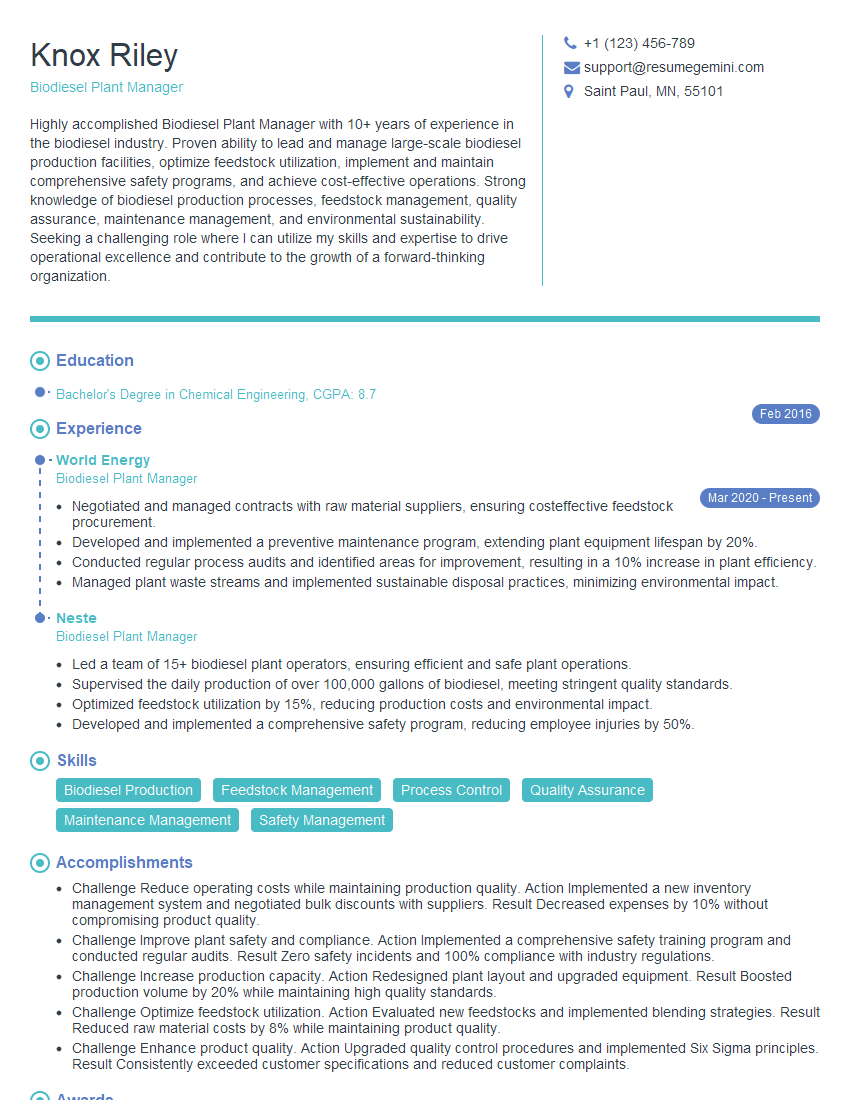
Mastering biodiesel purification is crucial for a successful and rewarding career in the renewable energy sector. This specialized knowledge opens doors to exciting roles and positions you as a valuable asset to any team. To significantly improve your job prospects, focus on crafting a strong, ATS-friendly resume that highlights your skills and experience effectively. ResumeGemini is a trusted resource for building professional resumes, and we provide examples tailored specifically to the Biodiesel Purification field to help you stand out from the competition. Take the next step towards your dream job today!
Explore more articles
Users Rating of Our Blogs
Share Your Experience
We value your feedback! Please rate our content and share your thoughts (optional).
What Readers Say About Our Blog
To the interviewgemini.com Webmaster.
Very helpful and content specific questions to help prepare me for my interview!
Thank you
To the interviewgemini.com Webmaster.
This was kind of a unique content I found around the specialized skills. Very helpful questions and good detailed answers.
Very Helpful blog, thank you Interviewgemini team.