Interviews are opportunities to demonstrate your expertise, and this guide is here to help you shine. Explore the essential Biodiesel Process Modeling interview questions that employers frequently ask, paired with strategies for crafting responses that set you apart from the competition.
Questions Asked in Biodiesel Process Modeling Interview
Q 1. Explain the different types of reactors used in biodiesel production and their suitability for various feedstocks.
Biodiesel production utilizes various reactor types, each with its strengths and weaknesses depending on the feedstock. The choice significantly impacts process efficiency and product quality.
- Batch Reactors: These are simple and cost-effective, ideal for small-scale operations or testing different feedstocks. They’re suitable for diverse feedstocks but suffer from limitations in scalability and consistent product quality due to variations in reaction conditions over time.
- Continuous Stirred Tank Reactors (CSTRs): CSTRs offer better control over reaction parameters, leading to more consistent product quality. They’re advantageous for larger-scale production and can handle a range of feedstocks. However, maintaining a uniform mixing and temperature profile throughout the reactor can be challenging, especially with high-viscosity feedstocks.
- Plug Flow Reactors (PFRs): These reactors offer efficient conversion with less byproduct formation compared to CSTRs, especially when dealing with feedstocks requiring precise reaction control. They are well-suited for handling high-viscosity feedstocks due to less mixing, however achieving optimal uniformity requires careful design and operational parameter control.
For example, a batch reactor might be suitable for experimenting with waste cooking oil, while a CSTR or PFR would be preferred for commercial-scale production using soybean oil or other vegetable oils. The selection always involves a trade-off between capital cost, operational complexity, and the desired level of product consistency.
Q 2. Describe the kinetics of transesterification and its impact on biodiesel yield.
Transesterification, the core reaction in biodiesel production, involves the reaction of triglycerides (from vegetable oils or animal fats) with an alcohol (usually methanol) in the presence of a catalyst to produce fatty acid methyl esters (FAME, biodiesel) and glycerol. The kinetics are complex, typically modeled as a series of reversible reactions.
The reaction rate is influenced by several factors, including:
- Temperature: Higher temperatures generally accelerate the reaction but can also lead to unwanted side reactions.
- Molar Ratio of Alcohol to Oil: Excess alcohol is usually employed to shift the equilibrium towards biodiesel formation.
- Catalyst Concentration: The catalyst influences the reaction rate. Too little catalyst results in slow conversion while excessive catalyst may lead to saponification (soap formation).
- Mixing: Effective mixing is crucial to ensure proper contact between reactants.
The impact on biodiesel yield is directly related to reaction kinetics. A slower reaction rate means incomplete conversion of triglycerides and reduced biodiesel yield. Accurate kinetic modeling is crucial to predict the yield, reaction time, and optimal operational parameters for efficient biodiesel production.
A simplified kinetic model might involve a pseudo-first-order reaction, assuming excess alcohol, where the rate of transesterification is proportional to the concentration of triglycerides. More sophisticated models might consider the individual reaction steps and account for reverse reactions and side reactions.
Q 3. How do you model the mass and energy balances in a biodiesel process?
Modeling mass and energy balances in a biodiesel process is essential for optimizing design and operation. It involves systematically accounting for all the mass and energy streams entering and leaving the system.
Mass Balance: This involves tracking the amount of each component (triglycerides, alcohol, catalyst, biodiesel, glycerol, etc.) throughout the process. For example, you would write mass balance equations for each component around each unit operation (reactor, separation column, etc.).
Example: Mass balance on Methanol around the reactor: F_methanol_in - F_methanol_out = R_methanol
Where:
F_methanol_inis the methanol flow rate into the reactorF_methanol_outis the methanol flow rate out of the reactorR_methanolis the rate of methanol consumption in the reactor.
Energy Balance: This involves tracking the energy flows associated with heat transfer, reaction enthalpy, and work done. Energy balance equations are developed around each unit operation, taking into account enthalpy changes due to phase changes, chemical reactions, and heat losses.
Example: Energy balance around the reactor: Q + H_in - H_out = ΔH_reaction
Where:
Qis the heat added or removed from the reactorH_inis the enthalpy of the inlet streamsH_outis the enthalpy of the outlet streamsΔH_reactionis the heat of reaction for transesterification.
These mass and energy balances, combined with kinetic models and thermodynamic properties, form the basis for simulating the biodiesel production process.
Q 4. What software packages are you familiar with for biodiesel process simulation (e.g., Aspen Plus, gPROMS)?
I’m proficient in several process simulation packages commonly used in biodiesel process modeling. My experience includes:
- Aspen Plus: A widely used commercial software capable of simulating complex chemical processes, including the transesterification reaction. Its extensive thermodynamic databases and rigorous equation solvers are invaluable for optimizing biodiesel production.
- gPROMS: Another powerful process simulator offering advanced features like dynamic simulation and optimization capabilities. It’s particularly useful for modeling and optimizing the control strategies of biodiesel production plants.
- MATLAB with toolboxes (e.g., Simulink): MATLAB’s flexibility makes it useful for developing custom models and integrating with other data analysis and optimization tools.
My choice of software depends on the specific project requirements. For example, for a large-scale process optimization study, Aspen Plus or gPROMS would be preferred due to their robust capabilities. For smaller-scale modeling or development of customized models, MATLAB might be a better choice.
Q 5. Explain the role of catalysts in biodiesel production and how you would model their effect.
Catalysts play a crucial role in transesterification, significantly accelerating the reaction rate and improving the overall yield of biodiesel. Homogenous catalysts (like sodium or potassium hydroxide) and heterogeneous catalysts (like solid base catalysts) are commonly used.
Modeling the Catalyst Effect: The impact of the catalyst can be modeled through several approaches.
- Rate Enhancement Factor: The catalyst’s effect can be incorporated into the kinetic model by including a term that directly multiplies the reaction rate constant. This term is typically a function of catalyst concentration and temperature.
- Langmuir-Hinshelwood Kinetics: For heterogeneous catalysts, this approach considers the adsorption of reactants onto the catalyst surface, their subsequent reaction, and desorption of products. This model requires parameters related to adsorption and desorption equilibrium constants and surface reaction rate constants.
For example, if we have a simplified pseudo-first-order kinetic model:
r = k * C_triglycerides
Incorporating the catalyst effect using a rate enhancement factor, we can modify it to:
r = k * f(catalyst_concentration, temperature) * C_triglycerides
Where f(catalyst_concentration, temperature) represents the rate enhancement factor.
Accurate catalyst modeling necessitates understanding the reaction mechanisms on the catalyst surface and accounting for catalyst deactivation over time.
Q 6. How would you model the impact of feedstock quality variations on biodiesel yield and quality?
Feedstock quality variations significantly impact biodiesel yield and quality. These variations can include differences in free fatty acid (FFA) content, moisture content, viscosity, and the type and concentration of triglycerides.
Modeling the Impact: These variations should be included in the process model. For example:
- FFA Content: High FFA content leads to saponification (soap formation), reducing biodiesel yield and quality. The model should include a sub-model accounting for saponification reactions, which are often temperature and catalyst concentration dependent.
- Moisture Content: Excess moisture can hinder transesterification and lead to catalyst deactivation. The model should consider the impact of water on reaction kinetics and catalyst activity.
- Triglyceride Composition: Different triglycerides have different reaction rates. The model can incorporate this by considering the composition of the triglycerides in the feedstock and their individual reaction kinetics.
Sensitivity analysis is crucial to determine the impact of each variation on the overall biodiesel process. This involves systematically varying the input parameters (e.g., FFA content, moisture content) and observing their effect on the output parameters (biodiesel yield, quality parameters).
For instance, if a model predicts that a 1% increase in FFA content leads to a 5% reduction in biodiesel yield, this information can be used to establish quality control measures for feedstock selection and pretreatment.
Q 7. Describe different methods for optimizing biodiesel production processes.
Optimizing biodiesel production involves improving process efficiency, yield, and product quality. Several methods can be employed:
- Process Simulation and Optimization: Using software packages like Aspen Plus or gPROMS, we can create detailed process models and use optimization algorithms to find the optimal operating conditions (temperature, pressure, molar ratios, etc.) that maximize yield and minimize costs.
- Response Surface Methodology (RSM): RSM is a statistical technique used to design experiments and analyze the effects of multiple parameters on the process response (e.g., biodiesel yield). It’s useful for identifying the optimal parameter combinations.
- Genetic Algorithms (GA) and other Evolutionary Algorithms: GAs are powerful optimization methods well-suited for complex, non-linear problems. They can efficiently search for optimal operating conditions in high-dimensional parameter spaces.
- Machine Learning (ML) Techniques: ML models can be trained on experimental data to predict biodiesel yield and quality, enabling accurate forecasting and optimization.
- Process Integration Techniques: Integrating different process units and implementing heat integration strategies can reduce energy consumption and improve overall efficiency.
The choice of optimization method depends on the complexity of the process and the available data. Often, a combination of approaches is employed for a comprehensive optimization strategy.
Q 8. How do you account for side reactions and by-product formation in your model?
Accurately modeling biodiesel production requires acknowledging that the transesterification reaction, while central, isn’t the only process occurring. Several side reactions produce by-products that impact yield and product quality. These are typically incorporated into the model through kinetic expressions. For example, saponification, where triglycerides react with methanol to form soap (soapstock), is a significant side reaction, particularly at high temperatures or high alkali concentrations. This is often modeled using a separate reaction rate equation, usually dependent on the concentration of alkali catalyst, free fatty acids (FFAs) in the feedstock, and temperature.
Another important consideration is the formation of dimers and polymers, which can increase viscosity and negatively affect fuel properties. These reactions are often less well understood and might be represented using empirical correlations based on experimental data rather than fully mechanistic kinetics. The model will include parameters for each reaction rate (activation energy, pre-exponential factor, etc.), which need to be carefully determined through parameter estimation using experimental data. A comprehensive model might include mass balances for all reactants, products, and significant by-products to account for the overall material flow and changes in composition during the reaction process.
For instance, you could model the soap formation rate as a function of the FFA concentration: Ratesaponification = ksap * [FFA] * [NaOH] where ksap is the rate constant for saponification, [FFA] is the concentration of free fatty acids, and [NaOH] is the concentration of sodium hydroxide. The values for ksap would be obtained by fitting the model to experimental data.
Q 9. Explain how you would validate a biodiesel process model.
Validating a biodiesel process model is crucial to ensure its accuracy and reliability. This involves a multi-step process. First, we’d perform rigorous model verification to check that the mathematical equations and algorithms are correctly implemented in the chosen software. This involves code reviews and testing with known inputs and expected outputs. Secondly, we’d compare the model’s predictions to experimental data obtained from a well-designed set of experiments. These experiments should cover a wide range of operating conditions (temperature, methanol-to-oil ratio, catalyst concentration, reaction time) relevant to the practical process. Data analysis techniques such as regression analysis are used to quantify the model’s accuracy. We look for good agreement between predicted and measured values for biodiesel yield, fatty acid methyl ester (FAME) profile, and by-product concentrations. Statistical metrics like R-squared and root mean squared error (RMSE) help quantify the goodness-of-fit.
If discrepancies exist, we’d refine the model by adjusting parameters, adding new reactions, or improving the underlying assumptions. This iterative process continues until satisfactory agreement between model predictions and experimental data is achieved. For example, if the model consistently under-predicts the soap formation, we would need to investigate the accuracy of the saponification reaction rate constant and perhaps refine the model to account for other factors contributing to soap formation.
The validation process should also include assessing the model’s predictive capability under conditions not included in the original experimental dataset. This helps gauge its robustness and generalizability. Finally, independent verification with data from a different experimental setup or research group adds further confidence in the model’s reliability.
Q 10. Describe your experience with experimental design and data analysis in the context of biodiesel production.
My experience in experimental design for biodiesel production focuses on achieving statistically significant and reliable results using Design of Experiments (DOE) methodologies. For instance, I’ve extensively utilized Response Surface Methodology (RSM) to optimize reaction parameters. RSM helps us systematically vary factors like temperature, methanol-to-oil ratio, and catalyst concentration to understand their individual and interactive effects on biodiesel yield and quality. We usually employ central composite designs or Box-Behnken designs, which offer good coverage of the experimental space and allow for the estimation of quadratic effects.
Data analysis involves statistical software like R or MATLAB. We perform analysis of variance (ANOVA) to test the significance of effects, build regression models to predict response variables (biodiesel yield, FAME profile, etc.), and optimize parameters for desired outcomes using techniques like ridge analysis. For example, we might optimize for maximum biodiesel yield while minimizing soap formation. Robust design methodologies ensure the process is less sensitive to unavoidable variations in feedstock quality or operating conditions. Visualization techniques such as contour plots and 3D response surfaces aid in understanding complex interactions and guiding optimization strategies. This ensures that experimental resources are used efficiently and we obtain a model that accurately reflects the true process behavior.
Q 11. How would you model the separation and purification steps in biodiesel production?
Modeling the separation and purification steps in biodiesel production involves techniques specific to each unit operation. For example, water washing, to remove soapstock and glycerol, can be modeled using mass transfer principles, considering the partitioning of components between the aqueous and organic phases. This typically involves equilibrium relationships (distribution coefficients) and mass transfer coefficients to describe the rate of solute transfer. The model would incorporate parameters reflecting the solubility of different compounds in water and the efficiency of mixing.
Similarly, distillation or evaporation to remove excess methanol can be modeled using equilibrium-stage calculations (e.g., using the McCabe-Thiele method or more rigorous simulation software) which consider the vapor-liquid equilibrium of the methanol-biodiesel mixture. The model should consider the energy balance, accounting for the heat input required for vaporization and the heat losses in the system. Centrifugation, used for separating biodiesel and glycerol phases, can be modeled using hydrodynamic principles to predict the separation efficiency based on particle size and density differences. In all cases, the goal is to accurately represent the changes in composition and material flow during each separation step, leading to a prediction of the final biodiesel quality.
Q 12. What are the key challenges in scaling up a biodiesel process from lab-scale to industrial scale?
Scaling up a biodiesel process from lab-scale to industrial scale presents significant challenges. Heat and mass transfer become more complex in larger reactors, requiring careful consideration of mixing and flow patterns. A lab-scale reactor may be well-mixed, but industrial-scale reactors may have significant temperature and concentration gradients. This necessitates the use of Computational Fluid Dynamics (CFD) simulations to optimize reactor design and ensure uniform reaction conditions. Furthermore, the kinetics observed in smaller reactors may not directly translate to industrial-scale reactors due to factors like improved heat removal in larger systems.
Another key issue is the variability of feedstock quality. Industrial feedstocks are less consistent than purified materials used in the lab. The model must be robust enough to handle variations in fatty acid composition, free fatty acids content, and moisture, factors which significantly affect reaction kinetics and product quality. Cost considerations are paramount. Economic optimization becomes crucial, balancing capital investment (reactor size, separation equipment) against operating costs (energy consumption, catalyst usage, waste disposal). Careful consideration of safety aspects, like pressure relief systems and handling of flammable materials, is also essential in scaling up a process. Finally, efficient waste management strategies are needed to deal with larger volumes of glycerol and soapstock.
Q 13. How would you model the environmental impact of biodiesel production?
Modeling the environmental impact of biodiesel production requires a Life Cycle Assessment (LCA). This involves evaluating the environmental burdens associated with all stages of the process, from feedstock cultivation to biodiesel use and end-of-life management. The model would need to quantify greenhouse gas emissions (CO2, CH4, N2O) at each step, such as feedstock production (fertilizer use, land use change), transesterification (energy consumption), and by-product handling (wastewater treatment). Energy consumption is a critical parameter; a model should carefully track electricity and fuel use throughout the process, considering different energy sources (renewable vs. fossil fuels). Water usage and wastewater generation are also important environmental factors, requiring analysis of water pollution potential.
Different impact assessment methods can be employed, like the ReCiPe method or CML, to quantify the overall environmental footprint of the biodiesel production process. The model could then be used to compare different feedstocks (e.g., soybean oil vs. algae oil) or process configurations (different catalysts, solvents, and separation techniques) to identify options with lower environmental impact. The goal is to provide a comprehensive and transparent representation of the environmental tradeoffs associated with biodiesel production, allowing for informed decision-making towards sustainable practices.
Q 14. Explain your understanding of different biodiesel quality standards and specifications.
Biodiesel quality standards and specifications are crucial for ensuring its safe and effective use as a fuel. These standards vary by country and region, but generally address key properties that influence engine performance and environmental impact. Common parameters include:
- Fatty acid methyl ester (FAME) content: This specifies the minimum percentage of FAMEs in the biodiesel, typically above 96.5%.
- Viscosity: Viscosity is essential for proper fuel flow and atomization in engines. Standards define acceptable viscosity ranges at different temperatures.
- Water content: Excess water can lead to corrosion and microbial growth in fuel storage tanks. Standards limit the maximum water content.
- Free glycerin content: Glycerin acts as a contaminant and increases viscosity. Standards limit its concentration.
- Cetane number: This measures the ignition quality of the fuel, impacting engine performance and emissions. Biodiesel typically has higher cetane numbers than petroleum diesel.
- Oxidative stability: This indicates the resistance of biodiesel to degradation through oxidation, affecting its storage life and engine compatibility.
- Cold filter plugging point (CFPP): This is the lowest temperature at which biodiesel will flow properly through a fuel filter. CFPP is essential in colder climates.
Compliance with these standards is often mandated by regulations and ensured through quality control testing. Understanding and incorporating these quality parameters into process models is crucial for ensuring that the produced biodiesel meets the specified requirements and is suitable for its intended application.
Q 15. How do you incorporate economic considerations into your biodiesel process models?
Incorporating economic considerations into biodiesel process models is crucial for evaluating the viability and profitability of a plant. It’s not just about the technical feasibility; we need to understand the financial implications at every stage.
This involves several key aspects:
- Feedstock Cost Modeling: We integrate models that account for the fluctuating price of raw materials like vegetable oils, animal fats, or recycled cooking oil. These models consider factors like seasonality, geographical location, and market demand.
- Production Cost Estimation: This involves quantifying the costs associated with energy consumption (electricity, steam), catalysts, labor, and maintenance. We use detailed energy balances from the process model to accurately estimate these costs.
- Product Pricing and Revenue Forecasting: We incorporate market analysis data to predict biodiesel selling prices and forecast revenue streams. Sensitivity analyses are crucial here to assess the impact of price fluctuations on profitability.
- Capital Cost Analysis: We model the initial investment required for plant construction, equipment purchase, and installation. This includes depreciation and return on investment calculations.
- Optimization for Profit Maximization: Once all costs and revenues are integrated, we use optimization techniques to find the operating parameters that maximize profit, considering constraints like feedstock availability, energy limits, and environmental regulations.
For example, in a recent project, we developed a model that predicted a 15% increase in profitability by optimizing the reaction temperature and catalyst concentration, while simultaneously reducing energy consumption by 10%. This was achieved by coupling a detailed process model with a comprehensive economic model using software like Aspen Plus and GAMS.
Career Expert Tips:
- Ace those interviews! Prepare effectively by reviewing the Top 50 Most Common Interview Questions on ResumeGemini.
- Navigate your job search with confidence! Explore a wide range of Career Tips on ResumeGemini. Learn about common challenges and recommendations to overcome them.
- Craft the perfect resume! Master the Art of Resume Writing with ResumeGemini’s guide. Showcase your unique qualifications and achievements effectively.
- Don’t miss out on holiday savings! Build your dream resume with ResumeGemini’s ATS optimized templates.
Q 16. Describe your experience with process control and automation in biodiesel production.
My experience with process control and automation in biodiesel production spans various aspects, from designing control strategies to implementing advanced automation systems. I’ve worked on projects involving both batch and continuous biodiesel production processes.
In batch processes, I’ve designed control algorithms for precise temperature and mixing control during transesterification, ensuring consistent product quality. This often involves using programmable logic controllers (PLCs) and supervisory control and data acquisition (SCADA) systems to monitor and control critical process parameters.
For continuous processes, I have experience with model predictive control (MPC) and advanced process control (APC) techniques to optimize the entire production line, including feedstock pretreatment, reaction, separation, and purification. This includes integrating online analytical sensors for real-time feedback control.
I’m proficient in using software packages such as AspenTech’s DMCplus for implementing MPC strategies. In one project, we implemented an MPC system to maintain consistent biodiesel quality despite variations in feedstock composition, leading to a 5% improvement in yield and a 3% reduction in waste.
Q 17. How would you troubleshoot a problem in a biodiesel production plant using process modeling?
Troubleshooting a biodiesel plant using process modeling is a systematic approach that leverages the model’s predictive capabilities. Imagine a process model as a virtual twin of the plant. When a problem arises, we can use the model to simulate different scenarios and pinpoint the root cause.
Here’s a typical troubleshooting process:
- Data Acquisition: Gather real-time process data from the plant, including temperature, pressure, flow rates, and product quality parameters. This data provides the basis for comparing the real plant’s behavior with the model’s predictions.
- Model Calibration and Validation: Ensure the process model accurately reflects the plant’s current state. This might involve adjusting parameters based on the collected data.
- Deviation Analysis: Compare the model’s predictions with the real-time plant data. Identify significant deviations that indicate a problem.
- Hypothesis Generation: Based on the deviations, formulate hypotheses about the potential causes of the problem. For instance, a lower-than-expected yield might be due to insufficient catalyst concentration, incomplete mixing, or low feedstock quality.
- Model-Based Simulation: Use the model to simulate the impact of each hypothesis. By systematically changing parameters in the model (e.g., catalyst concentration), we can predict the resulting impact on product quality and yield.
- Root Cause Identification: The simulation results help identify the most likely root cause. The hypothesis that best explains the observed deviations is likely the correct one.
- Corrective Action: Recommend appropriate corrective actions based on the identified root cause. This could involve adjusting process parameters, replacing equipment, or changing the feedstock.
For instance, if the biodiesel yield is consistently lower than expected, we might use the model to simulate the effect of varying methanol-to-oil ratios, reaction time, and temperature, helping to pinpoint the specific factor causing the reduced yield.
Q 18. What are the limitations of current biodiesel process models?
Current biodiesel process models, while powerful, have several limitations:
- Simplified Kinetics and Thermodynamics: Many models use simplified reaction kinetics and thermodynamic assumptions, which may not accurately capture the complexity of the transesterification reaction and the impact of impurities in the feedstock.
- Limited Consideration of Feedstock Variability: Models often struggle to accurately represent the impact of variations in feedstock composition (FFA content, water content, etc.) on the reaction and product quality.
- Challenges in Modeling Catalyst Deactivation: Predicting catalyst deactivation and its impact on reaction performance is difficult, leading to inaccuracies in long-term predictions.
- Lack of Integration with Upstream and Downstream Processes: Many models focus only on the transesterification reaction, neglecting the impact of upstream processes (feedstock pretreatment) and downstream processes (purification and water removal).
- Computational Expense of Detailed Models: Highly detailed models can require significant computational resources, making real-time optimization challenging.
Overcoming these limitations requires advanced modeling techniques, such as incorporating more detailed reaction kinetics, using machine learning to predict feedstock variability and catalyst deactivation, and developing integrated models that encompass the entire biodiesel production chain.
Q 19. How would you incorporate uncertainty and variability into your biodiesel process models?
Incorporating uncertainty and variability into biodiesel process models is crucial for generating realistic and robust predictions. Biodiesel production is inherently affected by many uncertain factors. We can’t just assume perfect conditions.
Here’s how we handle uncertainty:
- Probabilistic Modeling: Instead of using deterministic parameters, we use probability distributions to represent uncertain variables, such as feedstock composition, catalyst activity, and energy prices.
- Monte Carlo Simulation: This technique involves running the model repeatedly with different parameter values drawn from their probability distributions. This generates a range of possible outcomes, giving us insights into the uncertainty surrounding predictions.
- Sensitivity Analysis: We perform sensitivity analyses to identify the parameters that have the most significant impact on the model’s outputs. This helps us focus our efforts on reducing uncertainties associated with these key parameters.
- Robust Optimization Techniques: These techniques aim to find solutions that are optimal across a range of possible scenarios, rather than just under a single, idealized set of conditions. This helps us develop robust process designs that are less sensitive to uncertainties.
For example, we might model the uncertainty in feedstock FFA content using a triangular distribution, and then use Monte Carlo simulation to assess the impact on the final biodiesel quality and the need for pre-treatment steps. This allows for a more realistic assessment of the plant’s performance under various operating conditions.
Q 20. Describe your experience with model predictive control (MPC) in the context of biodiesel production.
My experience with Model Predictive Control (MPC) in biodiesel production centers on its ability to optimize the process in real-time, handling variability and constraints effectively. MPC is particularly advantageous in continuous biodiesel production.
MPC uses a dynamic process model to predict the future behavior of the system and then optimizes the control actions to achieve desired setpoints while satisfying operational constraints (e.g., temperature limits, catalyst concentration ranges). It’s a sophisticated control strategy that accounts for process dynamics and future disturbances.
In a continuous biodiesel plant, MPC can be used to:
- Optimize reaction conditions: Maintain optimal temperature, pressure, and reactant ratios for maximum yield and product quality, despite fluctuations in feedstock characteristics.
- Improve energy efficiency: Minimize energy consumption by optimizing heating and cooling schedules.
- Handle disturbances: Effectively compensate for unexpected variations in feedstock composition or equipment malfunctions.
- Improve product consistency: Maintain consistent product quality despite process disturbances.
In a previous project, we implemented an MPC strategy that improved the yield by 4% and reduced energy consumption by 6% compared to conventional PID control. The key was accurate model development, incorporating detailed reaction kinetics and feedstock variability using software like AspenTech’s DMCplus.
Q 21. How would you use process modeling to improve the energy efficiency of biodiesel production?
Process modeling is a powerful tool for improving the energy efficiency of biodiesel production. By simulating different operating scenarios and designs, we can identify opportunities for energy savings without compromising product quality or yield.
Here are some strategies:
- Heat Integration: Process modeling allows us to analyze the heat streams within the process and identify opportunities for heat recovery and integration. For example, the heat generated during the transesterification reaction could be used to preheat the reactants, reducing energy consumption.
- Optimization of Reaction Conditions: Modeling can help determine the optimal reaction temperature, pressure, and residence time that maximize yield while minimizing energy input. Small changes in these parameters can lead to significant energy savings.
- Process Design Improvements: The model can be used to evaluate different reactor designs and configurations to determine the most energy-efficient option. For instance, comparing a continuous stirred-tank reactor (CSTR) with a plug flow reactor (PFR) in terms of energy requirements.
- Waste Heat Recovery: We can model the waste heat streams leaving the process and evaluate the feasibility of using this heat for other purposes, such as generating electricity or heating other parts of the plant.
- Energy Efficient Separation Techniques: Modeling allows optimization of separation processes like distillation and filtration to reduce the energy needed for product purification.
For example, in a recent study, we used process modeling to identify an energy saving of 12% by implementing a heat integration scheme that recovered waste heat from the reaction and used it to preheat the feedstock. This improved the overall energy efficiency of the plant significantly without affecting product quality.
Q 22. Explain how you would use process modeling to reduce waste and emissions in biodiesel production.
Process modeling in biodiesel production is crucial for optimizing efficiency and minimizing waste and emissions. We can achieve this by creating a virtual representation of the entire process, from feedstock selection to final product purification. This allows us to simulate different scenarios and identify areas for improvement before implementing them in the real world, saving time and resources.
For example, by modeling the transesterification reaction (the core of biodiesel production), we can optimize reaction parameters like temperature, methanol-to-oil ratio, and catalyst concentration to maximize biodiesel yield and minimize byproduct formation (e.g., glycerol). A detailed model can predict the amounts of wastewater and greenhouse gas emissions generated under various operating conditions. This enables us to identify optimal settings that minimize these outputs. We could also model the energy consumption of each unit operation within the plant to find ways to improve energy efficiency and reduce the overall carbon footprint. Ultimately, this leads to a leaner, greener, and more profitable biodiesel operation.
- Wastewater Minimization: Modeling can help optimize the separation and purification steps, reducing the volume of wastewater requiring treatment.
- Emission Reduction: By predicting emissions, we can design for improved process control and implement strategies to capture and reuse emissions or find technologies that inherently produce less.
Q 23. Describe your experience with different types of process modeling techniques (e.g., steady-state, dynamic).
My experience encompasses both steady-state and dynamic process modeling techniques. Steady-state models provide a snapshot of the process at a specific point in time, assuming constant operating conditions. These are useful for initial process design and optimization under nominal operating conditions. For instance, I’ve used steady-state models to evaluate the impact of different feedstock qualities on biodiesel yield and to optimize the design of reactors and separation units.
Dynamic modeling, on the other hand, captures the time-dependent behavior of the process, allowing us to analyze the impact of disturbances and changes in operating conditions. This is particularly important in assessing the controllability and stability of the process. For example, I’ve developed dynamic models to simulate the transient response of the biodiesel production process to fluctuations in feedstock composition or changes in reaction temperature, allowing for the design of robust control strategies to prevent deviations from optimal conditions and improve product quality consistency. I’m proficient in using software like Aspen Plus, gPROMS, and MATLAB/Simulink for both types of modeling.
Q 24. How would you use process modeling to optimize the use of renewable resources in biodiesel production?
Process modeling is instrumental in optimizing the use of renewable resources in biodiesel production. By integrating data on different feedstock sources (e.g., waste vegetable oils, algae, used cooking oil), the model can evaluate the economic and environmental viability of each. For example, we can simulate the impact of using different feedstocks on biodiesel yield, quality, and overall cost. This analysis helps in making informed decisions about feedstock selection, potentially prioritizing those with high yields, low environmental impact, and readily available supply. Furthermore, by modelling the entire process, including waste streams, we can analyze the potential for integrating the byproducts (like glycerol) into other valuable products thereby maximising resource utilization and preventing waste.
Moreover, the model can help optimize the process to reduce energy consumption, minimize water usage, and reduce the reliance on non-renewable resources throughout the whole lifecycle. This would contribute to achieving a truly sustainable biodiesel production system.
Q 25. Explain the importance of data acquisition and analysis in biodiesel process modeling.
Data acquisition and analysis are the cornerstones of successful biodiesel process modeling. High-quality data provides the foundation for creating an accurate and reliable model. This includes parameters like reaction temperatures, pressures, reactant concentrations, product yields, and energy consumption. The data must be collected consistently using calibrated instruments and documented thoroughly. The data quality directly affects the model’s predictive power. Inaccurate or incomplete data leads to poor model performance and unreliable predictions.
Data analysis involves exploring the relationships within the dataset, identifying patterns, outliers, and potential errors. Techniques like statistical analysis, principal component analysis (PCA), and data visualization are essential in this phase. This helps refine the model, identify areas for improvement in data collection, and ensure the model accurately represents the real-world process. I routinely employ statistical software like R or Python with data science libraries like Pandas and Scikit-learn to analyze the data.
Q 26. How would you handle missing data or outliers in your biodiesel process data?
Handling missing data and outliers is a crucial aspect of data pre-processing. Missing data can be addressed using several techniques, depending on the extent of the missingness and the nature of the data. Methods include imputation (filling in missing values based on existing data using methods such as mean imputation or more sophisticated techniques like k-Nearest Neighbors), or deletion (removing data points with significant missing values if the impact is minor). Outliers, which can severely skew the results, are dealt with through careful analysis. I’d investigate the reason for the outlier (instrument malfunction, data entry error, etc.). If the outlier is due to a genuine process anomaly, it might provide valuable insights; however, if it’s an error, it would be removed or corrected.
Robust statistical methods, less sensitive to outliers, can be incorporated into the model itself, helping to mitigate their effects. In the modeling process, I use techniques like robust regression which minimize the effect of outliers during model fitting.
Q 27. Describe your experience with integrating process modeling with other simulation tools (e.g., process economics, environmental impact assessment).
Integrating process modeling with other simulation tools is critical for a holistic understanding of the biodiesel production process. I have experience integrating process models with process economics simulators (like SuperPro Designer) to estimate production costs, profitability, and sensitivity to changes in input prices and operating conditions. This allows for economic evaluation of different process designs and optimization strategies. Similarly, I’ve integrated process models with life cycle assessment (LCA) tools to evaluate the environmental impact of the process across its entire lifecycle, from feedstock production to product disposal. This gives a comprehensive picture of the environmental sustainability of various biodiesel production methods.
This integrated approach provides a far more comprehensive understanding than solely using process modeling alone. By integrating all the different aspects, it allows for decision-making that considers both economic and environmental performance.
Q 28. How would you communicate complex technical information about biodiesel process modeling to a non-technical audience?
Communicating complex technical information about biodiesel process modeling to a non-technical audience requires a clear and concise approach. I would avoid technical jargon and use simple analogies. For instance, I would explain process modeling as creating a digital twin of the biodiesel plant, allowing us to virtually test different strategies to improve efficiency and sustainability, akin to testing different recipes in a kitchen before cooking a full meal. I would use visual aids such as charts and diagrams to illustrate key concepts and results. A focus on the benefits – lower costs, reduced emissions, and more sustainable production – is crucial to engaging the audience.
I’d prioritize presenting the key findings in a simple and relatable way, emphasizing the practical implications of the modeling work. For instance, I might say something like: ‘Our model showed that by optimizing the reaction temperature, we could reduce greenhouse gas emissions by 15%.’ Finally, I would be prepared to answer questions in a clear and accessible manner, ensuring the audience feels comfortable and understands the overall message.
Key Topics to Learn for Biodiesel Process Modeling Interview
- Reaction Kinetics and Thermodynamics: Understanding the chemical reactions involved in biodiesel production, including transesterification, and the thermodynamic principles governing the process. This includes equilibrium constants and reaction rate expressions.
- Reactor Modeling: Applying different reactor models (e.g., CSTR, PFR) to simulate biodiesel reactors and optimize process parameters such as temperature, pressure, and residence time. Practical application involves predicting reactor performance and identifying potential bottlenecks.
- Process Simulation Software: Familiarity with commonly used process simulation software (e.g., Aspen Plus, ChemCAD) for modeling and optimizing biodiesel production processes. This includes building process flow diagrams (PFDs) and interpreting simulation results.
- Mass and Energy Balances: Performing accurate mass and energy balances on the entire biodiesel production process to ensure efficient resource utilization and optimal energy integration. This is critical for economic analysis and process optimization.
- Process Optimization Techniques: Applying optimization techniques (e.g., linear programming, nonlinear programming) to improve process efficiency, reduce costs, and enhance product quality. This might involve maximizing biodiesel yield or minimizing waste generation.
- Feedstock Characterization: Understanding the impact of different feedstock properties (e.g., free fatty acid content, water content) on biodiesel production and process design. This includes methods for analyzing feedstock quality and its influence on the process.
- Product Quality and Specifications: Knowledge of biodiesel quality standards and specifications (e.g., ASTM standards) and how process parameters affect product quality. This includes understanding the impact of different parameters on key properties like viscosity, cetane number, and oxidative stability.
- Process Control and Instrumentation: Understanding the principles of process control and the instrumentation used in biodiesel production to maintain optimal operating conditions and ensure product consistency. This involves understanding feedback control loops and sensor technology.
- Economic Analysis and Cost Estimation: Performing economic evaluations of different biodiesel production processes to assess their feasibility and profitability. This includes cost estimation of raw materials, energy, and capital equipment.
- Environmental Impact Assessment: Understanding the environmental impact of biodiesel production and exploring methods for minimizing its environmental footprint. This includes analyzing greenhouse gas emissions and waste management strategies.
Next Steps
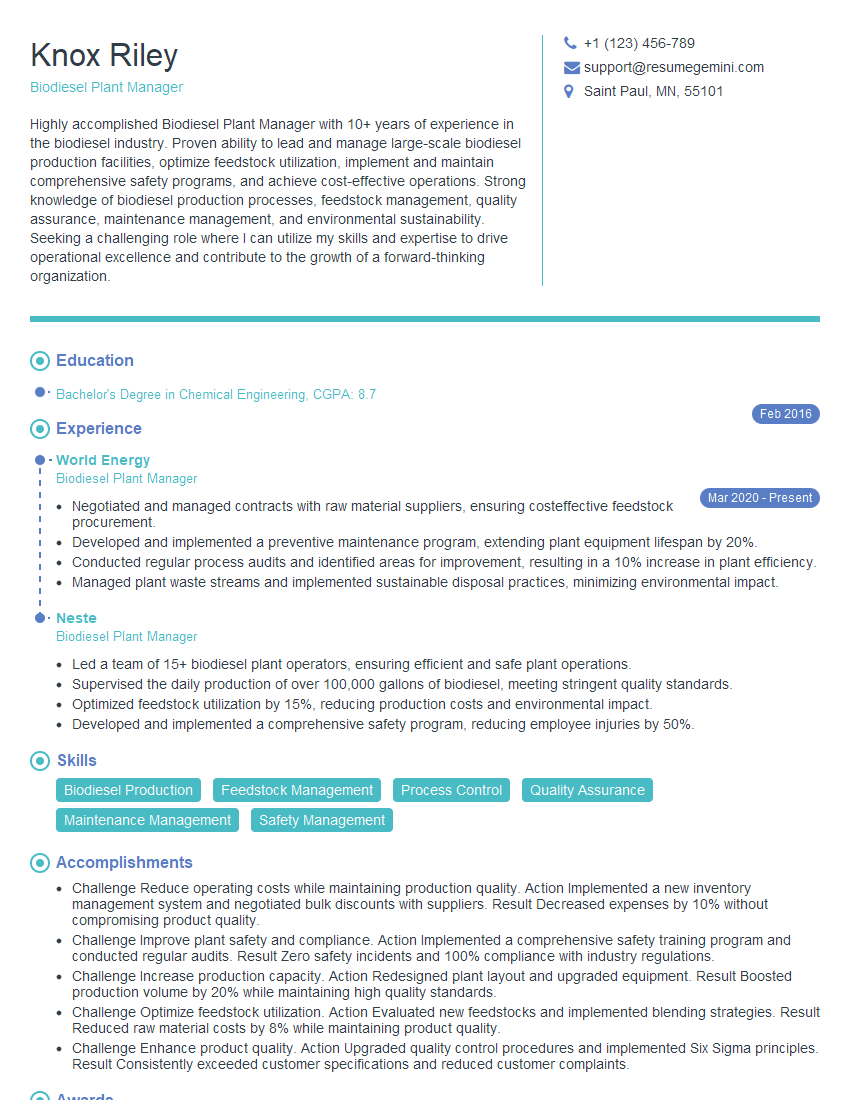
Mastering Biodiesel Process Modeling opens doors to exciting career opportunities in research, process engineering, and optimization within the renewable energy sector. A strong understanding of these concepts is highly sought after by employers. To significantly increase your chances of landing your dream job, focus on building an ATS-friendly resume that highlights your skills and experience effectively. ResumeGemini is a trusted resource to help you create a professional and impactful resume. They provide examples of resumes tailored to Biodiesel Process Modeling to guide you through the process. Take the next step towards your career success today!

Explore more articles
Users Rating of Our Blogs
Share Your Experience
We value your feedback! Please rate our content and share your thoughts (optional).
What Readers Say About Our Blog
To the interviewgemini.com Webmaster.
Very helpful and content specific questions to help prepare me for my interview!
Thank you
To the interviewgemini.com Webmaster.
This was kind of a unique content I found around the specialized skills. Very helpful questions and good detailed answers.
Very Helpful blog, thank you Interviewgemini team.