Are you ready to stand out in your next interview? Understanding and preparing for Biodiesel Process Scaleup interview questions is a game-changer. In this blog, we’ve compiled key questions and expert advice to help you showcase your skills with confidence and precision. Let’s get started on your journey to acing the interview.
Questions Asked in Biodiesel Process Scaleup Interview
Q 1. Explain the different methods for biodiesel process scale-up.
Biodiesel process scale-up involves transitioning from lab-scale experiments to larger-scale production. Several methods exist, each with its strengths and weaknesses. The choice depends on factors like initial investment, desired production capacity, and available resources.
- Linear Scale-up: This is the simplest method, directly increasing all process parameters (reactor volume, reactant flow rates, etc.) proportionally. It’s suitable for processes with minimal complexities but may not accurately reflect reality due to scale-dependent effects.
- Scale-up based on constant residence time: This approach maintains a consistent reaction time by adjusting flow rates proportionally to the increase in reactor volume. It’s particularly useful for reactions with well-defined kinetics, ensuring reaction completion remains consistent.
- Scale-up based on constant mixing time: This is crucial for heterogeneous reactions like biodiesel production, where efficient mixing is vital for reactant contact. It focuses on maintaining a constant mixing time as reactor volume increases, often requiring adjustments to impeller design and speed.
- Geometric Similarity Scale-up: This sophisticated method maintains the geometric ratios of the reactor and its internal components (e.g., impeller size and position) throughout the scaling process, ensuring similarity in mixing and heat transfer characteristics.
- Empirical Scale-up: This approach relies on experimental data gathered at different scales. It involves testing different scaling factors and analyzing the results to optimize the process for the desired scale. This requires extensive experimentation and data analysis.
For example, a lab-scale reactor might be 1L, and a pilot plant scale could be 100L or even 1000L. The scale-up strategy dictates how we adjust parameters like stirring speed, reaction temperature, and reactant addition rates to maintain efficiency and product quality across the different scales.
Q 2. Describe the challenges in scaling up a biodiesel process from lab to pilot plant.
Scaling up biodiesel production from lab to pilot plant presents several challenges. The most significant include:
- Heat and Mass Transfer Limitations: Lab reactors often have high surface area-to-volume ratios, facilitating efficient heat and mass transfer. Scaling up diminishes this ratio, leading to uneven heating and mixing, potentially impacting reaction efficiency and product quality.
- Mixing Efficiency: Achieving efficient mixing in larger reactors can be difficult. Impeller design and power consumption need careful consideration to ensure adequate mixing throughout the reactor volume. Poor mixing leads to incomplete reactions and inconsistent product quality.
- Reaction Kinetics: Lab-scale reaction kinetics may not accurately reflect larger-scale operations. The increased reactor volume and altered mixing dynamics can affect the reaction rate and overall yield.
- Process Control and Automation: Implementing accurate and reliable process control systems is critical in larger-scale reactors. Monitoring and controlling temperature, pressure, and reactant flow rates precisely become more complex.
- Cost Increase: The costs associated with larger reactors, instrumentation, and automation increase significantly when moving from lab to pilot plant scale. Careful planning and economic analysis are essential.
For instance, a reaction that completes perfectly in a 1L reactor might show significant incomplete conversion in a 100L reactor if mixing isn’t carefully optimized. This necessitates rigorous pilot plant testing and optimization to identify and mitigate such issues before full-scale production.
Q 3. How do you ensure the quality and consistency of biodiesel during scale-up?
Maintaining biodiesel quality and consistency during scale-up requires rigorous quality control measures at each stage. This includes:
- Raw Material Characterization: Thoroughly analyzing the oil feedstock’s properties (free fatty acid content, moisture content, etc.) is crucial. Variations in feedstock quality directly affect the biodiesel yield and quality.
- Process Parameter Control: Implementing robust control systems to maintain consistent reaction parameters (temperature, pressure, reactant molar ratios, and reaction time) is critical. Deviations from optimal conditions can negatively impact product quality.
- In-process Monitoring: Employing online or at-line analytical techniques (e.g., near-infrared spectroscopy, titrations) to monitor reaction progress and product characteristics (e.g., fatty acid methyl ester content, glycerol content) in real-time is essential.
- Product Quality Testing: Rigorous final product testing is necessary to ensure it meets ASTM standards (e.g., for viscosity, cetane number, water content, etc.). This confirms that the scaled-up process consistently produces high-quality biodiesel.
- Statistical Process Control (SPC): Implementing SPC techniques helps identify and address variations in product quality, helping maintain consistency throughout the scale-up process.
For example, regular monitoring of the methanol-to-oil ratio is crucial. Slight variations can drastically affect the final product’s composition and quality. Implementing feedback control loops to automatically adjust the ratio based on real-time data ensures consistent product quality.
Q 4. What are the key process parameters to monitor during biodiesel production scale-up?
Monitoring key process parameters is paramount during biodiesel production scale-up. These include:
- Temperature: Maintaining the optimal reaction temperature is critical for efficient transesterification. Variations can affect reaction rate and product quality.
- Pressure: While often atmospheric, maintaining consistent pressure is important, especially in larger reactors, to ensure uniform mixing and prevent unwanted side reactions.
- Reactant Molar Ratio (Methanol to Oil): The stoichiometric ratio is crucial for complete conversion of triglycerides to fatty acid methyl esters (FAMEs). Variations can affect yield and product purity.
- Catalyst Concentration: The catalyst (typically sodium or potassium hydroxide) concentration impacts reaction rate. Careful control is essential for optimal conversion.
- Reaction Time: Sufficient reaction time is needed for complete transesterification. Monitoring allows for optimization and prevents incomplete conversion.
- Mixing Speed and Efficiency: Effective mixing is crucial, especially in larger reactors, for uniform reactant contact and efficient reaction kinetics. Monitoring parameters like impeller speed and power consumption helps assess mixing efficacy.
- Glycerol Concentration: Glycerol concentration is an indicator of the extent of the transesterification reaction. Monitoring glycerol concentration helps in optimizing the process and ensuring high biodiesel yield.
Continuous monitoring of these parameters through automated systems allows for real-time adjustments, ensuring optimal biodiesel production and consistent quality across scales.
Q 5. How do you address potential bottlenecks in the scaling-up process?
Addressing potential bottlenecks during scale-up is crucial for successful transition. Common bottlenecks include:
- Insufficient Mixing: In larger reactors, inefficient mixing can cause incomplete reactions and inconsistencies. Solutions include optimizing impeller design, increasing agitation speed, or using baffles.
- Heat Transfer Limitations: Poor heat transfer can result in temperature gradients, affecting reaction rate and product quality. Solutions include using jacketed reactors, employing external heating/cooling systems, or using improved heat transfer fluids.
- Limited Reactor Capacity: If the reactor volume is insufficient to handle the scaled-up production rate, solutions involve purchasing a larger reactor or running multiple smaller reactors in parallel.
- Downstream Processing Bottlenecks: Issues with product separation, purification, or water removal can limit throughput. Solutions include optimizing separation techniques (e.g., centrifugation), improving filtration methods, and employing efficient drying strategies.
- Automation and Control Limitations: Inconsistent automation or control systems can lead to process deviations. Upgrades or improvements in automation and control systems are required.
For example, if glycerol removal proves to be a bottleneck, investing in advanced separation techniques like membrane filtration can significantly enhance the process efficiency.
Q 6. Discuss the economic considerations involved in biodiesel process scale-up.
Economic considerations are paramount in biodiesel process scale-up. Factors to consider include:
- Capital Costs: The initial investment for larger reactors, auxiliary equipment (e.g., pumps, heat exchangers), and automation systems is substantial. Detailed cost estimations and economic feasibility studies are crucial.
- Operating Costs: These include energy consumption for heating, mixing, and pumping, raw material costs, labor costs, and maintenance expenses. Optimization strategies are needed to minimize these costs.
- Product Yield and Quality: Higher yields and consistent product quality translate to greater profitability. Process optimization and quality control are key to maximizing returns.
- Waste Management: Proper handling and disposal of waste products (e.g., glycerol) are crucial, both environmentally and economically. Waste treatment costs need to be factored into the overall economic analysis.
- Scale of Production: The economy of scale needs to be considered. Larger-scale operations generally offer lower production costs per unit, but higher upfront investments are required.
A thorough cost-benefit analysis, comparing different scale-up scenarios and technologies, should guide decision-making. Careful consideration of these factors ensures a financially viable biodiesel production operation.
Q 7. Explain your experience with different reactor designs for biodiesel production.
My experience encompasses various reactor designs for biodiesel production. Each design presents advantages and disadvantages, impacting efficiency and cost-effectiveness.
- Batch Reactors: These are simple and relatively inexpensive but lack the continuous production capacity required for large-scale operations. They are suitable for small-scale or experimental purposes.
- Continuous Stirred Tank Reactors (CSTRs): CSTRs offer continuous operation, enabling higher production rates. They provide good mixing but may require more complex control systems.
- Plug Flow Reactors (PFRs): PFRs provide better conversion efficiency than CSTRs for certain reaction kinetics due to their lower residence time distribution. However, they are less suitable for reactions sensitive to mixing conditions.
- Fixed Bed Reactors: While less common for homogeneous transesterification, fixed-bed reactors are employed when heterogeneous catalysts are used, offering advantages in catalyst separation and reuse. However, mass and heat transfer limitations can arise.
In a past project, we compared the performance of a CSTR and a PFR for biodiesel synthesis. While the PFR initially showed a higher conversion rate, careful consideration of mixing efficiency and residence time distribution highlighted the CSTR as the more suitable choice for that specific scale, balancing initial investment with production capacity and yield.
Q 8. How do you optimize the reaction conditions for efficient biodiesel yield during scale-up?
Optimizing reaction conditions for efficient biodiesel yield during scale-up is crucial for economic viability and product quality. It involves a careful balance of several factors, building upon the results of smaller-scale experiments. Think of it like baking a cake – you need the right ingredients (reactants) and the right temperature and time (reaction conditions) for optimal results. In biodiesel production, these factors include:
- Molar Ratio of Reactants: The ratio of oil (triglyceride) to methanol (alcohol) and catalyst (typically sodium or potassium hydroxide) is paramount. A slight excess of methanol is usually employed to drive the reaction to completion. We use carefully designed experiments to determine the optimal molar ratio for maximum yield and minimal free glycerol. For example, a shift from a 6:1 methanol to oil molar ratio in lab-scale to a 6.5:1 ratio in pilot-scale might improve yield.
- Catalyst Concentration: Too little catalyst slows the reaction; too much can lead to soap formation (saponification) and reduced purity. We systematically adjust the catalyst concentration across scales to maintain the reaction rate while minimizing side reactions. Precise control is especially critical in larger reactors where heat dissipation can become a factor.
- Reaction Temperature: Higher temperatures generally accelerate the reaction, but excessively high temperatures can degrade the biodiesel or lead to methanol loss. We carefully monitor temperature using sophisticated control systems that maintain a precise set point across various scales. A typical range is 50-65°C.
- Reaction Time: Sufficient reaction time is essential for complete conversion of triglycerides to fatty acid methyl esters (FAME). However, prolonged reaction times increase production costs. We optimize the reaction time based on the kinetics determined during smaller-scale experiments, typically ranging from 60 to 120 minutes. We use advanced techniques like real-time monitoring of glycerol concentration to determine when the reaction reaches completion.
- Mixing: Efficient mixing is essential for uniform contact between the reactants and catalyst, impacting the reaction rate and yield. We carefully design and select impellers appropriate for the scale to ensure efficient mixing, avoiding dead zones in the reactor.
By systematically adjusting these parameters and using statistical methods such as response surface methodology (RSM), we can develop a robust and optimal process that ensures high biodiesel yields across different scales.
Q 9. Describe your experience with process validation and qualification in biodiesel production.
Process validation and qualification are critical for ensuring the consistent quality and safety of biodiesel produced at scale. My experience encompasses all stages, from establishing the design space during lab-scale experiments to final product testing and certification. It’s like building a house: you wouldn’t build it without blueprints (qualification) and rigorous inspections (validation) throughout the process.
Qualification involves demonstrating that the equipment and processes are designed and installed correctly. This includes:
- Design Qualification (DQ): Verifying that the design of the equipment and process meets the specified requirements.
- Installation Qualification (IQ): Confirming that the equipment is installed and properly functioning as per the design specifications.
- Operational Qualification (OQ): Verifying that the equipment operates within its designed parameters under various operating conditions.
Validation involves demonstrating that the process consistently produces biodiesel meeting the required quality and safety standards. This includes:
- Process Validation: Verifying that the process produces the desired product quality consistently under routine operation.
- Performance Qualification (PQ): Demonstrating that the validated process continuously meets predetermined quality criteria. This often involves multiple batches under varied conditions.
We utilize standard operating procedures (SOPs), calibrated instruments, and detailed documentation to meticulously document every step of both qualification and validation. We also regularly conduct audits to ensure ongoing compliance and identify any areas for process improvement.
Q 10. What are the safety considerations for scaling up a biodiesel production process?
Scaling up biodiesel production involves significant safety considerations, especially concerning the flammable nature of methanol and the potential for exothermic reactions. It’s crucial to adopt robust safety protocols to protect personnel and the environment. Imagine scaling up a campfire: a small fire is easily managed, but a large bonfire requires careful planning and control.
- Fire and Explosion Hazards: Methanol is highly flammable, and the process involves handling significant quantities of this material. We employ explosion-proof equipment, fire suppression systems, and stringent safety protocols to mitigate fire risks. Emergency response plans and regular training are crucial.
- Toxicity Hazards: Methanol is toxic and can cause serious health problems. We implement strict controls to prevent inhalation, skin contact, and ingestion. Personal protective equipment (PPE) and local exhaust ventilation systems are mandatory.
- Process Safety Management (PSM): A comprehensive PSM system is crucial. This includes hazard identification and risk assessment, process safety information management, operating procedures, emergency response planning, and employee training.
- Waste Management: Safe handling and disposal of waste streams, including glycerol and wastewater, are vital. This includes implementing proper containment measures, treatment processes, and disposal methods in compliance with regulations.
- Pressure Vessel Safety: Biodiesel reactors are often high-pressure vessels. We meticulously ensure the proper design, maintenance, and inspection of these vessels to prevent failures and potential accidents.
By meticulously addressing these hazards and implementing robust safety protocols, we minimize the risks associated with biodiesel production at scale.
Q 11. How do you handle waste streams and by-products during biodiesel production scale-up?
Efficient waste handling is essential for environmental sustainability and regulatory compliance in biodiesel production. The primary by-products are glycerol, wastewater, and potentially catalyst residues. We implement a strategy that views these as valuable resources or problems to be solved, rather than just waste.
- Glycerol Recovery and Purification: Glycerol is a valuable co-product that can be used in various applications, including cosmetics, pharmaceuticals, and food industries. We utilize techniques such as distillation, evaporation, and membrane filtration to recover and purify glycerol for sale or further processing.
- Wastewater Treatment: Wastewater generated during biodiesel production often contains methanol, soaps, and other impurities. We employ biological treatment methods, often combined with chemical precipitation or filtration, to remove pollutants before safe discharge or reuse. This could involve anaerobic digestion, activated sludge processes, or membrane bioreactors.
- Catalyst Residue Management: Catalyst residues can be neutralized and safely disposed of according to regulatory guidelines. In some cases, techniques like ion exchange or filtration can recover and reuse the catalyst, reducing costs and minimizing waste.
- Solid Waste Management: Solid waste, such as spent filter materials, needs to be handled appropriately. We often partner with certified waste disposal companies to ensure environmentally sound disposal.
A sustainable approach focuses on minimizing waste generation through process optimization and maximizing the recovery and reuse of by-products. This not only reduces environmental impact but also improves economic efficiency.
Q 12. Describe your experience with different feedstock options for biodiesel production and their impact on scale-up.
Feedstock selection significantly impacts the economics and sustainability of biodiesel production. Different feedstocks present varying challenges during scale-up. Imagine trying to build a house using different types of wood; each has its strengths and weaknesses.
- Vegetable Oils: Soybean, rapeseed, and palm oils are common feedstocks. Scale-up considerations include sourcing sufficient quantities of high-quality oil at competitive prices. Storage and handling of large volumes of oil also require careful planning.
- Animal Fats: Tallow and grease from animal sources can be used, presenting different logistical challenges regarding sourcing and handling. Purity and quality can vary considerably, impacting the biodiesel production process.
- Waste Cooking Oils (WCO): Recycling WCO is environmentally beneficial but requires careful pretreatment to remove contaminants. The scale-up process must account for the variability in the quality and composition of WCO.
- Algae: Algae are a promising feedstock, but large-scale cultivation and harvesting present significant technical and economic challenges. Process development and scale-up of algae-based biodiesel are still under active research.
The choice of feedstock influences the entire process, from pretreatment and reaction conditions to product quality and purification. We rigorously analyze the quality characteristics of each feedstock to optimize the process for the specific material and to ensure consistent biodiesel quality.
Q 13. How do you ensure regulatory compliance during biodiesel production scale-up?
Ensuring regulatory compliance is paramount in biodiesel production scale-up. This involves navigating a complex web of local, national, and international regulations. It’s like following a detailed recipe: you must follow all the instructions precisely to achieve the desired outcome.
- ASTM Standards: Adhering to ASTM standards for biodiesel quality (ASTM D6751) is crucial for market acceptance. We conduct rigorous testing of the final product to ensure compliance with these standards.
- Environmental Regulations: Regulations regarding air emissions, wastewater discharge, and solid waste disposal vary by location. We need to design and operate facilities in strict compliance with all relevant environmental regulations.
- Safety Regulations: We must comply with Occupational Safety and Health Administration (OSHA) regulations and other relevant safety standards to ensure a safe working environment.
- Food and Drug Administration (FDA) Regulations: If biodiesel is intended for use as a fuel additive or in food-related applications, compliance with FDA regulations is necessary. We carefully trace all materials used in production to ensure they meet food-grade standards where necessary.
- Documentation and Record Keeping: Meticulous documentation of all aspects of the production process is essential to demonstrate compliance. This includes keeping accurate records of feedstock quality, process parameters, product testing results, and waste management.
Continuous monitoring, auditing, and adaptation to evolving regulations are critical to maintain long-term compliance.
Q 14. Explain the importance of process control strategies in biodiesel production.
Process control strategies are fundamental for producing high-quality biodiesel consistently and efficiently. They ensure the reaction proceeds optimally, minimize waste, and maximize product yield. Think of it as steering a ship: you need precise controls to navigate effectively.
- Temperature Control: Precise control of the reaction temperature is vital to prevent side reactions and maintain optimal reaction rates. This often involves using automated temperature control systems with feedback loops.
- Flow Rate Control: Controlling the flow rates of reactants and catalyst ensures consistent mixing and uniform reaction conditions. Mass flow controllers are used to accurately regulate flow rates.
- Pressure Control: Pressure control is important in some biodiesel production methods, particularly those employing supercritical methanol. Automated pressure control systems maintain optimal pressure within the reactor.
- pH Control: Maintaining the appropriate pH is crucial for optimal catalyst activity. This often involves using inline pH sensors and control systems to automatically adjust the pH using acid or base.
- Real-time Monitoring and Analysis: Using online analytical techniques, such as near-infrared (NIR) spectroscopy or gas chromatography, provides real-time data on the reaction progress. This allows for adjustments to be made to optimize the process and minimize deviations from the optimal conditions.
Implementing sophisticated process control strategies through advanced process control (APC) techniques, like model predictive control (MPC), enables us to optimize biodiesel production, ensuring both high quality and efficiency.
Q 15. What are the common problems encountered during biodiesel process scale-up?
Scaling up biodiesel production from lab-scale to industrial levels presents several challenges. These often stem from the inherent complexities of the transesterification reaction and the downstream processing steps.
- Reaction Kinetics and Mixing: Achieving uniform mixing in larger reactors becomes significantly more difficult. Incomplete mixing leads to inconsistent reaction rates and reduced yield. Imagine trying to stir a giant pot of soup compared to a small bowl – it’s much harder to ensure everything is evenly heated and mixed.
- Heat Transfer: Effective heat management is crucial for controlling the reaction temperature. Larger reactors require more sophisticated heating and cooling systems to maintain optimal conditions. Inefficient heat transfer can lead to hotspots and reduced product quality.
- Mass Transfer: Efficient mass transfer of reactants (oil and methanol) is essential. In larger reactors, this can be hampered by slower diffusion rates, leading to incomplete conversion. Think of it like trying to dissolve sugar in a large glass of water versus a small one; the sugar dissolves more slowly in the larger glass.
- Separation Challenges: Separating biodiesel from glycerol and other byproducts becomes more complex at larger scales. This might require larger and more efficient separation equipment, such as centrifuges or decanters.
- Process Control and Automation: Managing a larger-scale process requires advanced automation and control systems. Manual control becomes impractical and error-prone at industrial levels.
- Waste Management: Handling larger volumes of glycerol and other byproducts requires robust and environmentally sound waste management strategies.
Career Expert Tips:
- Ace those interviews! Prepare effectively by reviewing the Top 50 Most Common Interview Questions on ResumeGemini.
- Navigate your job search with confidence! Explore a wide range of Career Tips on ResumeGemini. Learn about common challenges and recommendations to overcome them.
- Craft the perfect resume! Master the Art of Resume Writing with ResumeGemini’s guide. Showcase your unique qualifications and achievements effectively.
- Don’t miss out on holiday savings! Build your dream resume with ResumeGemini’s ATS optimized templates.
Q 16. Describe your approach to troubleshooting issues in biodiesel production.
My approach to troubleshooting biodiesel production issues is systematic and data-driven. I typically follow these steps:
- Identify the Problem: This involves carefully analyzing process parameters (temperature, pressure, residence time, reactant ratios, etc.) and product quality (yield, purity, properties). I also assess operational logs, instrument readings, and visual observations.
- Isolate the Root Cause: This often involves a combination of process understanding, data analysis, and potentially conducting targeted experiments. For example, if the yield is low, I’d investigate if it’s due to incomplete mixing, inadequate reaction time, or insufficient catalyst concentration.
- Develop and Test Solutions: Based on the root cause analysis, I’d propose solutions that could involve changes to process parameters, reactor design, or separation techniques. These solutions are tested systematically to ensure efficacy.
- Implement and Monitor: Once a solution is validated, it is implemented, and the process is carefully monitored to ensure stability and consistent results. This often includes implementing robust process control measures.
- Document and Learn: All troubleshooting steps, including root causes, solutions, and results, are meticulously documented to prevent recurrence of similar issues and improve our overall understanding of the process.
Q 17. How do you use data analysis to optimize the biodiesel process?
Data analysis is fundamental to biodiesel process optimization. We collect a wide range of process and quality data, including reactant concentrations, reaction temperatures, reaction times, yields, and product properties.
This data is then analyzed using statistical methods such as regression analysis, ANOVA, and design of experiments (DOE). DOE helps us efficiently investigate the impact of multiple process variables on the response variables (e.g., yield and purity). For example, we might use a factorial design to determine the optimal combination of temperature, methanol-to-oil ratio, and catalyst concentration.
Furthermore, process monitoring software and advanced process control (APC) algorithms, can analyze real-time data and automatically adjust process parameters to maintain optimal operating conditions, minimizing variations and maximizing efficiency.
Q 18. What is your experience with process simulation software for biodiesel production?
I have extensive experience using process simulation software like Aspen Plus and COMSOL Multiphysics for biodiesel production. These tools allow us to model the entire process, from reactor design and reaction kinetics to downstream separation and purification.
For example, Aspen Plus can be used to model the transesterification reaction kinetics, predict product yields, and optimize reactor design for maximum efficiency. COMSOL can help simulate fluid dynamics within the reactor, ensuring optimal mixing and heat transfer. These simulations allow us to virtually test different scenarios and design modifications before implementation in a real-world setting, saving both time and resources.
Simulation also allows us to explore and compare different reactor designs (e.g., batch, continuous stirred-tank reactor (CSTR), plug flow reactor (PFR)) and separation techniques (e.g., settling, centrifugation, washing) to determine the most optimal configuration for a given scale and feedstock.
Q 19. Describe your experience with different separation techniques used in biodiesel production.
Several separation techniques are employed in biodiesel production, each with its advantages and disadvantages depending on the scale and desired purity.
- Settling: This is a simple gravity-based separation method used in smaller-scale operations. It is cost-effective but slow and less efficient at completely separating glycerol.
- Centrifugation: Centrifuges accelerate the separation process by applying centrifugal force, leading to faster and more complete separation of biodiesel and glycerol. They are commonly used in larger-scale operations.
- Decantation: This involves carefully removing the top layer (biodiesel) after settling. It’s simple but may not be as effective as centrifugation for complete separation.
- Washing: This is a critical step to remove residual methanol, soapstock, and other impurities from the biodiesel. It involves washing the biodiesel with water to remove polar components.
- Drying: After washing, the biodiesel is often dried to remove residual water, improving its quality and stability.
The choice of separation techniques depends on factors like the feedstock characteristics, desired product purity, and the overall cost-effectiveness of the process. A combination of these techniques is often employed for optimal results.
Q 20. Explain your understanding of mass and energy balances in biodiesel production.
Mass and energy balances are fundamental to understanding and optimizing biodiesel production. A mass balance ensures that the mass of reactants equals the mass of products and byproducts. This allows us to track the conversion efficiency and identify potential losses.
For example, we can calculate the theoretical yield of biodiesel based on the amount of oil and methanol used and compare it to the actual yield to determine the process efficiency. Deviations indicate potential problems with the reaction or separation steps. We use stoichiometric equations for the transesterification reaction to create our mass balance calculations.
An energy balance accounts for all energy inputs (heating, mixing) and outputs (heat losses, energy in the product stream) within the process. It helps us determine energy consumption, identify areas for energy savings, and optimize heating and cooling strategies. This is crucial for reducing production costs and minimizing the environmental impact of the process.
Accurate mass and energy balances are crucial for designing efficient processes, optimizing resource utilization, and meeting regulatory requirements. For instance, deviations from expected balances can pinpoint leakages, incomplete conversions, or inefficiencies in the system.
Q 21. How do you ensure the sustainability of the biodiesel production process?
Ensuring the sustainability of biodiesel production involves considering its entire lifecycle, from feedstock sourcing to waste management. Key aspects include:
- Sustainable Feedstock: Using waste cooking oil, animal fats, or other non-food sources minimizes competition with food production and reduces reliance on fossil fuels. The use of algae or other renewable resources is also a very active area of research and development.
- Energy Efficiency: Optimizing the process to minimize energy consumption is crucial. This could involve using more efficient reactors, improving heat transfer, or integrating renewable energy sources into the process.
- Waste Management: Developing effective strategies for managing glycerol and other byproducts is important. Glycerol can be valorized into other useful products, thus creating a circular economy model. Proper waste disposal procedures minimize environmental impact.
- Environmental Impact Assessment: Conducting Life Cycle Assessments (LCA) to evaluate the environmental footprint of the entire process is necessary to identify areas for improvement and to meet sustainability goals.
- Social Responsibility: Ensuring fair labor practices and promoting local economic development are key aspects of sustainable biodiesel production. This includes careful selection of feedstock suppliers and consideration for the local community.
Sustainability should be integrated into every aspect of the process, from design and operation to waste management and product lifecycle. It’s not simply an add-on, but a core component of a successful and responsible biodiesel operation.
Q 22. What are the key performance indicators (KPIs) for a successful biodiesel production scale-up?
Key Performance Indicators (KPIs) for successful biodiesel scale-up are crucial for monitoring efficiency, profitability, and environmental impact. They should cover the entire production process, from feedstock acquisition to final product quality and distribution. Think of them as the vital signs of your biodiesel operation.
- Yield: The amount of biodiesel produced per unit of feedstock (e.g., kg biodiesel/kg oil). A high yield indicates efficient conversion and minimizes waste. For example, a target might be 95% yield, constantly monitored and analyzed for deviations.
- Purity: Measured by parameters like free glycerin content, methyl esters content, and water content, ensuring the biodiesel meets quality standards (e.g., ASTM D6751). Regular quality control tests are vital to maintain consistent product quality.
- Production Capacity: The volume of biodiesel produced per unit time (e.g., liters/hour). Scale-up directly impacts this KPI, necessitating careful process design and equipment selection to achieve projected capacity.
- Production Cost: This includes raw material costs, energy consumption, labor, and maintenance. Careful cost analysis is crucial to ensure economic viability and identify areas for optimization. Comparing production costs per liter at different scales is essential for profitability assessment.
- Waste Management Efficiency: Efficiently managing glycerin and other byproducts is critical. This includes minimizing waste generation, recycling where possible, and responsibly disposing of remaining waste, adhering to environmental regulations. Monitoring waste streams and implementing effective waste treatment processes are crucial.
- Energy Consumption: Tracking energy use per unit of biodiesel produced (e.g., kWh/liter). Reducing energy consumption minimizes operational costs and lowers the carbon footprint.
Regular monitoring and analysis of these KPIs allow for timely identification of bottlenecks and optimization opportunities, leading to a more efficient and profitable biodiesel production process.
Q 23. Describe your experience with project management in a biodiesel production environment.
My experience in biodiesel project management spans several large-scale projects. I’ve been involved in every stage, from initial feasibility studies and process design to construction oversight, commissioning, and ultimately, plant operation. I utilize a structured approach, typically employing Agile methodologies adapted for the engineering and production environment. This allows for flexibility in response to unforeseen challenges common in scale-up projects.
For example, in one project, we encountered unexpected delays due to a supplier failing to deliver critical equipment on time. Using a risk register (a detailed list of potential problems and mitigation strategies), we swiftly implemented a contingency plan involving sourcing the equipment from an alternative supplier, minimizing the overall project delay. This highlights the importance of proactive risk management and having backup plans.
I am proficient in using project management software like MS Project or Primavera P6 for scheduling, resource allocation, and progress tracking. I also emphasize clear communication and collaboration among all stakeholders, including engineering, operations, procurement, and environmental teams. Regular progress meetings, coupled with detailed reporting, ensure everyone is aligned and informed.
Q 24. How do you manage risk during the biodiesel process scale-up?
Risk management during biodiesel scale-up is paramount, as it involves significant capital investment and complex technological challenges. My approach employs a structured, proactive strategy, starting with a thorough hazard and operability study (HAZOP) to identify potential hazards and operational issues in the process.
- Risk Identification: This involves brainstorming potential problems, including feedstock variability, equipment malfunctions, process upsets, and environmental concerns.
- Risk Assessment: Each identified risk is assessed based on its likelihood and potential impact. This often involves using qualitative or quantitative risk matrices.
- Risk Mitigation: For high-risk scenarios, we develop and implement specific mitigation strategies. Examples include redundant equipment, robust process control systems, comprehensive safety protocols, and thorough operator training.
- Monitoring and Review: Risks are continuously monitored and reassessed throughout the project lifecycle. Regular safety audits and process reviews are crucial to ensure the effectiveness of mitigation strategies.
Consider a scenario involving a potential fire hazard due to the flammability of biodiesel. Our mitigation strategy would include installing fire suppression systems, implementing strict fire safety protocols, and providing comprehensive fire safety training to plant personnel. This layered approach ensures that even if one safety measure fails, others are in place to prevent a catastrophic event.
Q 25. What are the environmental impacts of biodiesel production and how are they mitigated?
Biodiesel production, while environmentally beneficial compared to petroleum diesel, still has environmental impacts that must be carefully managed. The key concerns are:
- Wastewater: The process generates wastewater containing glycerin, methanol, and other impurities. Proper treatment is essential to prevent water pollution. Techniques such as anaerobic digestion or advanced oxidation processes can be employed.
- Greenhouse Gas Emissions: While biodiesel reduces greenhouse gas emissions compared to petroleum diesel, the production process itself generates emissions. Energy-efficient equipment and renewable energy sources can mitigate these.
- Air Emissions: Emissions from combustion during the transesterification process need to be controlled. Effective ventilation and emission control systems are necessary.
- Waste Glycerin: Glycerin is a byproduct of biodiesel production. Finding sustainable uses for this byproduct, such as in cosmetics or pharmaceuticals, is crucial for minimizing waste and maximizing resource utilization.
Mitigation strategies include implementing best available technologies (BAT) for wastewater treatment, optimizing energy efficiency, employing renewable energy sources, and developing strategies for utilizing glycerin byproduct. Adherence to environmental regulations and obtaining the necessary permits are crucial.
Q 26. Explain your understanding of different biodiesel quality standards.
Biodiesel quality standards are crucial to ensure its compatibility with existing diesel engines and to meet environmental regulations. Several standards exist, with ASTM D6751 being a widely recognized standard in the US and EN 14214 in Europe. These standards specify requirements for various parameters, including:
- Free Glycerin Content: Limits the amount of unconverted glycerin, which can cause engine problems.
- Water Content: Excessive water can lead to corrosion and microbial growth.
- Methyl Ester Content: Specifies the minimum percentage of fatty acid methyl esters (FAME).
- Viscosity: Affects fuel flow and engine performance.
- Cetane Number: A measure of ignition quality.
Understanding and adhering to these standards is critical for ensuring product quality, meeting market demands, and preventing engine damage. Regular quality control testing throughout the production process and using certified testing labs ensures compliance.
Q 27. How do you stay updated on the latest advancements in biodiesel technology?
Staying updated on the latest advancements in biodiesel technology is vital for maintaining competitiveness and improving efficiency. My approach involves a multi-pronged strategy:
- Academic Journals and Publications: I regularly review scientific journals like the Journal of the American Oil Chemists’ Society and Bioresource Technology for the latest research findings and technological breakthroughs.
- Industry Conferences and Trade Shows: Attending conferences such as the National Biodiesel Conference & Expo allows for networking with industry experts and learning about the latest technologies and innovations firsthand.
- Professional Organizations: Membership in professional organizations, such as the National Biodiesel Board (NBB), provides access to industry news, publications, and networking opportunities.
- Online Resources: I actively follow relevant online resources, including industry websites, news articles, and technical reports, for up-to-date information on emerging trends and technological advancements.
This continuous learning ensures that I am aware of the latest innovations in feedstock selection, process optimization, catalyst development, and waste management, allowing me to make informed decisions and implement the most efficient and sustainable practices.
Q 28. Describe your experience with designing and implementing a biodiesel production plant.
I have extensive experience in designing and implementing biodiesel production plants, encompassing all phases from conceptual design to commissioning. This involves a detailed understanding of process engineering, equipment selection, safety considerations, and environmental regulations.
A typical project begins with a thorough feasibility study, assessing feedstock availability, market demand, environmental impact, and economic viability. Following this, the process design phase involves selecting the appropriate production technology (e.g., batch or continuous), optimizing process parameters, and specifying the required equipment. This includes reactors, separators, storage tanks, and purification systems. Detailed engineering drawings, P&IDs (Piping and Instrumentation Diagrams), and process simulations are crucial at this stage. The next step involves procurement of equipment, construction oversight, and rigorous commissioning and testing to ensure the plant meets design specifications and safety standards. Finally, comprehensive operator training is provided before plant start-up.
For example, in a recent project, we successfully implemented a continuous biodiesel production plant using a highly efficient and environmentally friendly process. This involved a thorough lifecycle assessment to minimize the environmental impact and maximize resource utilization. The plant achieved significant cost savings by optimizing energy consumption and utilizing a novel waste glycerin treatment process.
Key Topics to Learn for Biodiesel Process Scaleup Interview
- Raw Material Handling and Pre-treatment: Understanding the impact of feedstock quality (oil type, free fatty acids, water content) on the process efficiency and biodiesel yield. Practical application: Analyzing and optimizing pre-treatment steps like degumming, deacidification, and drying for various feedstocks.
- Transesterification Reaction Kinetics and Optimization: Mastering the chemical principles behind transesterification, including reaction mechanisms, catalyst selection (homogeneous vs. heterogeneous), and reaction parameters (temperature, time, molar ratio). Practical application: Designing and scaling-up reactors for optimal conversion and minimizing byproduct formation.
- Process Intensification Techniques: Exploring innovative methods to enhance efficiency and reduce environmental impact. Practical application: Evaluating the feasibility and advantages of techniques like ultrasound-assisted transesterification or supercritical fluid extraction.
- Separation and Purification: Understanding the principles of separation techniques used to isolate biodiesel from glycerol and other byproducts (e.g., distillation, washing, settling). Practical application: Optimizing separation processes for high purity biodiesel and efficient glycerol recovery.
- Quality Control and Analysis: Familiarizing yourself with biodiesel quality standards (ASTM, EN) and analytical techniques used to ensure product quality (e.g., chromatography, spectroscopy). Practical application: Implementing robust quality control measures throughout the scale-up process.
- Process Economics and Sustainability: Analyzing the economic viability of biodiesel production at different scales, considering factors like feedstock cost, energy consumption, and environmental impact. Practical application: Developing life cycle assessments and cost models for different biodiesel production processes.
- Safety and Environmental Regulations: Understanding safety protocols and environmental regulations related to biodiesel production and handling. Practical application: Designing and implementing safe and environmentally responsible biodiesel production processes.
- Scale-up Strategies and Challenges: Understanding the challenges associated with scaling up biodiesel production from lab-scale to pilot-plant and industrial scales. Practical application: Applying appropriate scale-up methodologies (e.g., geometric similarity, mass and energy balance) and troubleshooting potential issues.
Next Steps
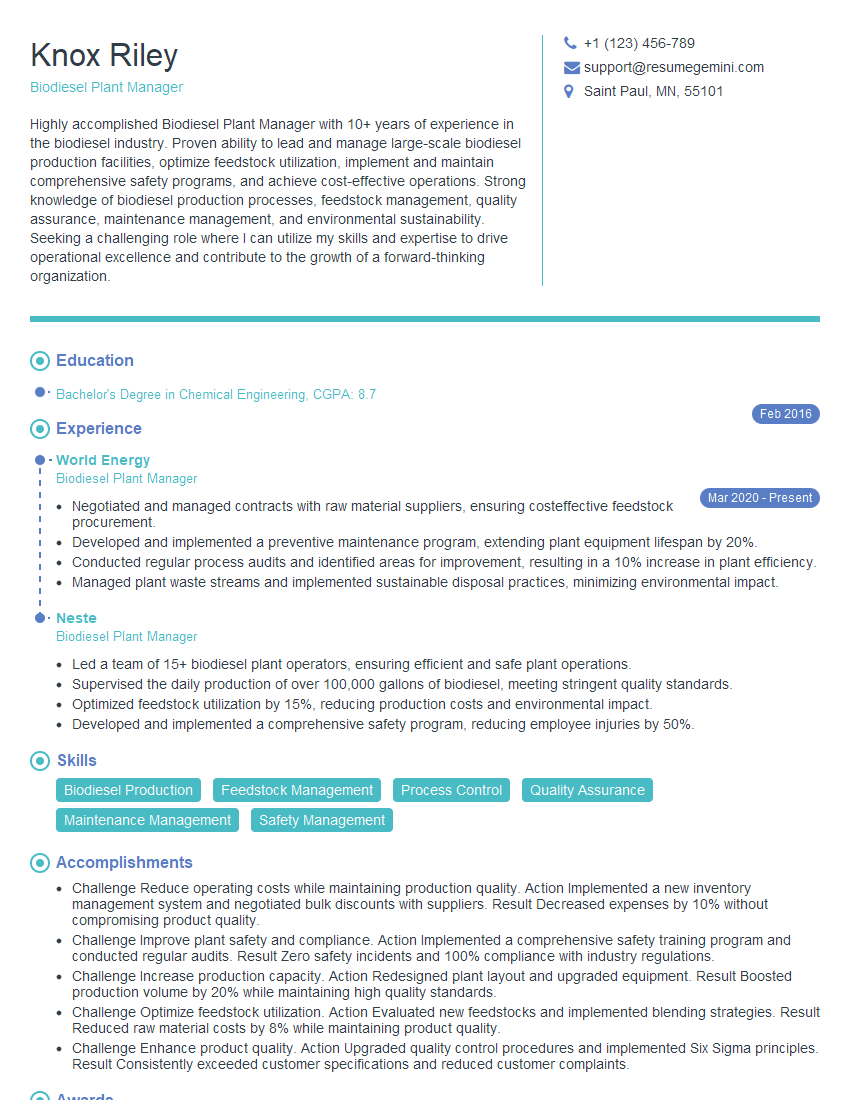
Mastering Biodiesel Process Scaleup is crucial for career advancement in the renewable energy sector, opening doors to exciting roles in research, development, engineering, and operations. To maximize your job prospects, crafting a strong, ATS-friendly resume is essential. ResumeGemini is a trusted resource to help you build a professional and impactful resume that showcases your skills and experience effectively. Examples of resumes tailored to Biodiesel Process Scaleup are available to guide you.

Explore more articles
Users Rating of Our Blogs
Share Your Experience
We value your feedback! Please rate our content and share your thoughts (optional).
What Readers Say About Our Blog
To the interviewgemini.com Webmaster.
Very helpful and content specific questions to help prepare me for my interview!
Thank you
To the interviewgemini.com Webmaster.
This was kind of a unique content I found around the specialized skills. Very helpful questions and good detailed answers.
Very Helpful blog, thank you Interviewgemini team.