Unlock your full potential by mastering the most common Knowledge of Piping Materials interview questions. This blog offers a deep dive into the critical topics, ensuring you’re not only prepared to answer but to excel. With these insights, you’ll approach your interview with clarity and confidence.
Questions Asked in Knowledge of Piping Materials Interview
Q 1. What are the common materials used in piping systems and their applications?
Piping systems utilize a wide variety of materials, each chosen based on the fluid being transported, operating conditions, and cost considerations. Here are some common ones:
- Carbon Steel: The workhorse of the industry, excellent for strength and cost-effectiveness. Commonly used in high-pressure steam lines, oil and gas pipelines, and industrial process lines. Susceptible to corrosion, so often requires protective coatings or linings.
- Stainless Steel: Offers superior corrosion resistance, making it ideal for applications involving corrosive fluids (acids, chemicals) or hygienic requirements (food processing, pharmaceuticals). Different grades (304, 316, etc.) provide varying degrees of corrosion resistance and strength.
- Copper: Excellent corrosion resistance and thermal conductivity, frequently used in potable water systems, refrigeration lines, and HVAC applications. Relatively soft and less suitable for high-pressure applications.
- Cast Iron: Durable and relatively inexpensive, often found in older drainage and sewage systems. Fragile and susceptible to cracking under stress.
- Plastic Pipes (PVC, CPVC, PE): Lightweight, corrosion-resistant, and easy to install. Widely used for chemical drainage, potable water distribution (especially in residential settings), and irrigation. May have limitations regarding temperature and pressure resistance.
- Ductile Iron: A stronger and more durable alternative to cast iron, offering better resistance to impact and corrosion. Used in underground water mains and pressure pipelines.
The choice of material is a critical design decision, balancing performance, longevity, and cost.
Q 2. Explain the difference between Schedule 40 and Schedule 80 pipes.
Schedule 40 and Schedule 80 pipes are both standard designations for pipe wall thickness, primarily used with steel and other metallic pipes. The schedule number indicates the pipe’s wall thickness relative to its nominal diameter (the inside diameter of the pipe is slightly less than the nominal diameter). A higher schedule number corresponds to a thicker wall and, therefore, greater pressure rating.
Schedule 40 is commonly used for general-purpose applications where the pressure requirements are moderate. It offers a balance between strength, weight, and cost.
Schedule 80 provides significantly thicker walls and higher pressure ratings than Schedule 40. It’s selected for higher-pressure systems where greater safety and durability are paramount.
Think of it like this: Schedule 40 is like a standard-weight water bottle, while Schedule 80 is like a much more robust, thicker water bottle designed for extreme conditions.
Choosing between Schedule 40 and 80 depends critically on the design pressure of the system and the safety requirements. A higher pressure application necessitates a Schedule 80 pipe.
Q 3. Describe the factors influencing the selection of piping materials.
Selecting the appropriate piping material is a multifaceted process influenced by several key factors:
- Fluid Properties: The nature of the fluid being transported (corrosive, abrasive, temperature, viscosity) dictates the material’s resistance to degradation.
- Operating Pressure and Temperature: Higher pressures and temperatures require materials with greater strength and resistance to creep (slow deformation under sustained stress).
- Environmental Conditions: External factors like soil conditions (for underground piping), exposure to UV radiation (for aboveground piping), and ambient temperature all impact material selection.
- Cost: Material cost is a significant factor, especially in large-scale projects. The design must balance performance and cost.
- Safety Regulations: Industry standards and safety codes dictate appropriate material choices for specific applications (e.g., potable water systems).
- Maintainability and Life Cycle: Ease of installation, maintenance, and repair are crucial for long-term cost-effectiveness. Materials with long service life are preferred.
Often, engineers utilize material selection charts and databases which summarize material properties to aid in this process. The final choice involves a careful consideration of all these factors and a trade-off between competing priorities.
Q 4. What are the common types of pipe fittings and their uses?
Pipe fittings are essential components that connect pipes, change direction, or modify flow. Here are some common types:
- Elbows: Change the direction of flow, available in various angles (45°, 90°, etc.).
- Tees: Provide branching connections, allowing flow to split or join.
- Reducers: Connect pipes of different diameters.
- Couplings: Join two pipes of the same diameter.
- Unions: Disconnectable couplings allowing for easy pipe separation and maintenance.
- Flanges: Used with gaskets for high-pressure connections, offering ease of disassembly.
- Valves: Control the flow of fluids (gate valves, globe valves, ball valves, check valves, etc.).
The selection of fittings depends on the specific needs of the piping system, taking into account pressure, temperature, and flow requirements. For instance, high-pressure systems would typically utilize flanges, while low-pressure systems might use threaded fittings.
Q 5. How do you determine the appropriate pipe wall thickness for a given application?
Determining the appropriate pipe wall thickness involves several steps, typically relying on pressure vessel codes and standards (like ASME B31.1 for power piping). The process involves:
- Identify the design pressure and temperature: This is determined from process requirements and safety factors.
- Select the pipe material: The material properties (yield strength, allowable stress) are crucial for calculations.
- Apply the appropriate design code: The code provides equations and allowable stress values for calculating the required wall thickness.
- Calculate the minimum wall thickness using the code’s formula: This usually involves considering the internal pressure, pipe diameter, allowable stress, and other factors.
- Consider corrosion allowance: Add an extra thickness to account for potential corrosion over the pipe’s lifespan. This adds to the minimum calculated wall thickness.
- Select the standard pipe size and schedule: Choose a commercially available pipe size and schedule that meets or exceeds the calculated minimum wall thickness.
Ignoring these calculations can have serious consequences, potentially leading to catastrophic pipe failures.
Q 6. What are the common pipe joining methods and their advantages/disadvantages?
Several methods exist for joining pipes, each with advantages and disadvantages:
- Welding: Strong, permanent joint. Requires skilled welders and appropriate equipment. Susceptible to defects if not properly executed.
- Threaded Connections: Relatively simple and quick for smaller diameter pipes. Less strong than welds, prone to leakage if not properly sealed.
- Flanged Connections: Versatile, easy to disassemble for maintenance. Can be bulky and expensive, requires gaskets.
- Solvent Welding (for plastic pipes): Quick and efficient, creates a strong joint. Limited to specific plastic materials. Needs proper surface preparation.
- Compression Fittings: Relatively easy to install, requiring less specialized skills. Not as strong as welds, and may require frequent tightening.
- Mechanical Couplings: Relatively easy installation, reusable. The clamping mechanism could loosen over time.
The choice depends on factors such as the pipe material, pressure, diameter, and the accessibility of the joint location.
Q 7. Explain the concept of pipe stress analysis.
Pipe stress analysis is the process of determining the stresses and strains in a piping system under various operating conditions. It’s crucial for ensuring the system’s structural integrity and preventing failures. This involves considering forces from:
- Internal Pressure: The pressure of the fluid inside the pipe creates hoop stress and longitudinal stress.
- Weight of the Pipe and Fluid: Gravity exerts forces on the piping system.
- Thermal Expansion and Contraction: Temperature changes cause the pipe to expand or contract, inducing stress.
- Seismic Loads: Earthquakes create dynamic forces on the piping system.
- Wind Loads: Wind can exert significant forces on exposed piping.
Software packages employing finite element analysis (FEA) are commonly used for complex piping systems. The analysis ensures the system operates safely and reliably by identifying areas of high stress and recommending design modifications to reduce the risk of failure.
Without proper stress analysis, there’s a considerable risk of leaks, ruptures, or structural damage, leading to potentially significant financial losses, environmental damage, and safety hazards. Imagine a power plant’s steam line failing due to improper stress analysis—the consequences could be catastrophic.
Q 8. What are the different types of pipe supports and their functions?
Pipe supports are crucial for maintaining the integrity and functionality of piping systems. They prevent excessive stress, vibration, and movement, ensuring safe and reliable operation. Different types are selected based on factors like pipe size, pressure, temperature, and the surrounding environment.
- Anchors: These are fixed supports that restrict both vertical and horizontal movement. Think of them as the foundation of your piping system, typically used at strategic points to prevent overall system movement.
- Guides: These restrict movement in one direction, typically horizontal, allowing for thermal expansion in the other direction. Imagine them as letting the pipe ‘breathe’ a little while keeping it aligned.
- Hangers: These supports primarily carry the weight of the pipe, allowing for vertical movement due to thermal expansion. Picture them as carefully lifting and suspending a section of pipe.
- Saddles: These cradle the pipe, offering support at the bottom. They are useful for larger pipes that need additional support along their length.
- Spring Supports: These supports accommodate for thermal expansion and contraction through a spring mechanism, compensating for changes in pipe length.
- Variable Spring Hangers: These allow for greater adjustment and compensation for varying loads and temperatures.
For example, a high-pressure steam line might need strong anchors and guides to prevent movement and maintain alignment. In contrast, a chilled water line might use spring hangers to accommodate for the expansion and contraction due to temperature changes.
Q 9. How do you select the appropriate valve type for a given application?
Selecting the right valve is paramount for efficient and safe operation of a piping system. The choice depends critically on the fluid, pressure, temperature, flow rate, required shut-off capability, and maintenance requirements.
- Gate Valves: Used for on/off service, offering minimal pressure drop when fully open. Think of a simple ‘on/off’ switch for large pipelines.
- Globe Valves: Used for throttling and regulating flow, but with higher pressure drop than gate valves. They’re like a volume control for the fluid flow.
- Ball Valves: Simple quarter-turn on/off valves, offering fast operation and tight shut-off. These are like a quick, decisive switch for frequent use.
- Butterfly Valves: Compact, quarter-turn valves ideal for large diameter lines and on/off applications. They offer a good balance of size and function.
- Check Valves: Prevent backflow of fluid. Think of a one-way street for the fluid, ensuring it flows only in the intended direction.
- Control Valves: Used to precisely regulate flow rate, pressure, or temperature; often pneumatically or electrically actuated. These are akin to sophisticated, automated flow controllers.
For instance, a high-pressure, high-temperature steam line would likely employ a gate valve for its simplicity and minimal pressure drop when fully open, while a process line requiring precise flow control would utilize a control valve.
Q 10. Describe the importance of material compatibility in piping systems.
Material compatibility is essential in preventing corrosion, leakage, and contamination within piping systems. Choosing incompatible materials can lead to catastrophic failures, environmental damage, and significant economic losses.
The importance lies in selecting materials that won’t react with the transported fluid or the surrounding environment. This involves considering factors such as:
- Chemical Compatibility: Ensuring the pipe material won’t corrode or degrade when exposed to the fluid.
- Temperature Compatibility: Selecting a material that can withstand the operating temperature without losing strength or undergoing significant dimensional changes.
- Pressure Compatibility: Choosing a material with sufficient strength to handle the operating pressure without yielding or bursting.
For example, using carbon steel pipes to transport highly corrosive chemicals like acids would lead to rapid degradation and potential leaks. In this case, materials like stainless steel, PVC, or other specialized corrosion-resistant alloys would be necessary.
Q 11. What are the common corrosion mechanisms affecting piping materials?
Several corrosion mechanisms can affect piping materials, leading to degradation and potential failure. Understanding these mechanisms is vital for effective corrosion mitigation strategies.
- Uniform Corrosion: This is a general attack across the entire surface area of the pipe, typically caused by exposure to an aggressive environment. Imagine a gradual wearing away of the pipe’s surface.
- Pitting Corrosion: This is localized corrosion that creates small, deep pits on the pipe’s surface, often due to the presence of impurities or localized chemical reactions. This creates weak points that could lead to unexpected failure.
- Crevice Corrosion: This occurs in confined spaces, such as under gaskets or in pipe joints, where stagnant fluid can accumulate and promote corrosion. Think of a hidden, slow-acting corrosive process.
- Galvanic Corrosion: This happens when two dissimilar metals are in contact in an electrolyte (like water). The more active metal corrodes preferentially. This is like a battery effect within the pipe system.
- Stress Corrosion Cracking (SCC): This is the cracking of a metal due to the combined action of tensile stress and a corrosive environment. It’s like a metal fatigue amplified by corrosion.
Q 12. How do you mitigate corrosion in piping systems?
Corrosion mitigation in piping systems is crucial for ensuring safety, reliability, and longevity. Strategies often involve a combination of approaches.
- Material Selection: Choosing corrosion-resistant materials like stainless steel, PVC, or other specialized alloys based on the fluid and environment.
- Protective Coatings: Applying coatings like paints, linings, or cladding to provide a barrier between the pipe and the corrosive environment.
- Corrosion Inhibitors: Adding chemicals to the fluid to slow down or prevent corrosion.
- Cathodic Protection: This is an electrochemical method that protects the pipe by making it the cathode in an electrochemical cell, preventing electron loss and corrosion. Think of it as creating a protective shield through electrical means.
- Design Modifications: Optimizing the design to minimize stagnant areas or crevices where corrosion can occur. This includes proper drainage and avoiding sharp bends.
For example, a chemical plant handling highly corrosive acids might employ a combination of corrosion-resistant alloy pipes, specialized linings, and continuous corrosion monitoring.
Q 13. What are the relevant codes and standards for piping design and materials?
Several codes and standards govern piping design and material selection to ensure safety and reliability. Adherence to these standards is crucial for ensuring a safe and efficient piping system.
- ASME B31.1: Power Piping: Covers the design, materials, fabrication, erection, testing, and inspection of power piping systems.
- ASME B31.3: Process Piping: Governs the design, construction, testing, and operation of process piping systems in various industries.
- API 510: Pressure Vessel Inspection Code: Provides guidelines for inspecting and repairing pressure vessels.
- ASME B31.4: Liquid Petroleum Transportation Piping Systems: Specifically addresses piping systems in the petroleum industry.
- ASTM Standards: Various ASTM standards cover specific materials used in piping, including their properties, testing methods, and specifications.
Q 14. (e.g., ASME B31.1, ASME B31.3) Explain the significance of these codes.
The significance of codes like ASME B31.1 and ASME B31.3 lies in their provision of comprehensive guidelines that ensure the safe and reliable design and construction of piping systems. These codes address various aspects, including:
- Material Specifications: Defining allowable materials and their properties for different operating conditions.
- Design Calculations: Providing formulas and methods for calculating pipe wall thickness, stress levels, and support requirements.
- Fabrication and Erection: Specifying welding procedures, inspection requirements, and quality control measures.
- Testing and Inspection: Outlining procedures for hydrostatic testing, radiographic inspection, and other quality assurance methods.
Compliance with these codes is often mandated by regulatory bodies and is crucial for preventing failures, protecting personnel, and minimizing environmental risks. Non-compliance can result in legal repercussions, financial losses, and potential harm to the environment and people.
For example, adherence to ASME B31.3 during the design of a refinery’s process piping ensures that the system can withstand the pressures and temperatures involved, preventing catastrophic failures. Similarly, adherence to ASME B31.1 in the design of a power plant piping system ensures safe and reliable operation of critical components.
Q 15. Explain the importance of Non-Destructive Testing (NDT) in piping.
Non-Destructive Testing (NDT) in piping is crucial for ensuring safety, reliability, and longevity of the system. It allows us to assess the integrity of pipes without causing damage, preventing catastrophic failures and costly repairs. Imagine a scenario where a hidden crack in a high-pressure pipeline goes undetected – the consequences could be devastating. NDT helps avoid such situations by identifying flaws early on.
Essentially, NDT provides a thorough examination of the pipe’s material properties and structural integrity, checking for things like cracks, corrosion, erosion, and weld defects. This is particularly important in critical applications like oil and gas pipelines, chemical processing plants, and nuclear power facilities.
Career Expert Tips:
- Ace those interviews! Prepare effectively by reviewing the Top 50 Most Common Interview Questions on ResumeGemini.
- Navigate your job search with confidence! Explore a wide range of Career Tips on ResumeGemini. Learn about common challenges and recommendations to overcome them.
- Craft the perfect resume! Master the Art of Resume Writing with ResumeGemini’s guide. Showcase your unique qualifications and achievements effectively.
- Don’t miss out on holiday savings! Build your dream resume with ResumeGemini’s ATS optimized templates.
Q 16. What are the common NDT methods used for piping inspection?
Several common NDT methods are used for piping inspection, each with its strengths and limitations. The choice depends on the material, pipe diameter, accessibility, and the type of defect being sought. Some common methods include:
- Radiographic Testing (RT): Uses X-rays or gamma rays to detect internal flaws like cracks, porosity, and inclusions. Think of it like a medical X-ray for pipes.
- Ultrasonic Testing (UT): Employs high-frequency sound waves to detect both surface and subsurface flaws. This method is very sensitive and works well on various materials and geometries.
- Magnetic Particle Testing (MT): Used for ferromagnetic materials (like steel) to detect surface and near-surface cracks. It involves magnetizing the pipe and applying magnetic particles, which will accumulate at any cracks.
- Liquid Penetrant Testing (PT): A surface inspection method that uses a dye to highlight surface cracks. It’s simple, relatively inexpensive, and good for detecting small surface discontinuities.
- Eddy Current Testing (ECT): Uses electromagnetic induction to detect surface and subsurface flaws in conductive materials. It’s particularly useful for detecting corrosion and pitting.
Often, a combination of NDT methods is employed to achieve comprehensive inspection coverage.
Q 17. Describe your experience with piping material specifications.
My experience with piping material specifications spans over [Number] years, encompassing a wide range of industries. I’m proficient in interpreting and applying various international and industry-specific standards such as ASME B31.1, ASME B31.3, and ASTM standards. I have hands-on experience in specifying materials for various applications, from low-pressure water lines to high-pressure steam and gas systems.
For example, I once worked on a project requiring the selection of material for a high-temperature, high-pressure steam line in a power plant. This involved careful consideration of factors like yield strength, creep strength, and corrosion resistance at elevated temperatures. The final material selection was based on a thorough analysis of the operating conditions and a review of available material properties, ultimately selecting a high-grade austenitic stainless steel.
I’m also familiar with material traceability and certification requirements, ensuring that the specified materials meet the required quality standards and are properly documented.
Q 18. How do you interpret piping and instrumentation diagrams (P&IDs)?
Piping and Instrumentation Diagrams (P&IDs) are the blueprints for piping systems. They provide a detailed representation of the process equipment, piping, instrumentation, and control systems. My understanding of P&IDs extends beyond simply reading the diagrams; I can interpret them to understand the process flow, identify potential hazards, and contribute to design optimization.
Interpreting a P&ID involves understanding the symbols, line designations, and instrumentation tags. For example, a valve symbol indicates a flow control point, and the line designation might indicate the pipe’s diameter and material. Instrumentation tags provide information about the instruments used for monitoring and control. I’ve used this knowledge to ensure the correct materials are selected for each section of the pipe, taking into account the pressure, temperature, and the nature of the fluids being transported.
Q 19. Explain the process of material selection for high-pressure piping systems.
Material selection for high-pressure piping systems is a critical task that requires a multi-faceted approach. It’s not just about picking a strong material; several factors must be considered simultaneously.
- Pressure and Temperature: The material’s yield strength, tensile strength, and creep resistance must be sufficient to withstand the operating pressure and temperature. Higher pressures and temperatures necessitate materials with superior mechanical properties.
- Fluid Compatibility: The material must be compatible with the fluid being transported. Some materials might corrode or degrade in the presence of certain chemicals.
- Weldability: The chosen material must be readily weldable to ensure the integrity of the pipe joints. This is especially important in high-pressure systems where leaks can be catastrophic.
- Cost: While performance is paramount, cost is also a consideration. Choosing the most expensive material isn’t always the best solution; a cost-benefit analysis is necessary.
- Safety and Regulations: Material selection must comply with relevant safety codes and regulations. This could involve using materials certified to meet specific standards.
In essence, it’s a balancing act between performance, cost, and safety. Software tools and engineering calculations are often used to support the material selection process.
Q 20. What are the considerations for selecting materials in cryogenic applications?
Cryogenic applications present unique challenges for material selection due to the extremely low temperatures involved. Materials must retain their ductility and toughness at these temperatures, preventing brittle fracture. Common considerations include:
- Low-Temperature Toughness: The material’s impact strength must remain high at cryogenic temperatures to prevent brittle failure. Certain austenitic stainless steels and nickel-based alloys are commonly used because they exhibit good low-temperature toughness.
- Thermal Shrinkage: Significant thermal shrinkage occurs as materials cool to cryogenic temperatures. This must be considered to prevent stress and potential failure.
- Material Compatibility: Material compatibility with cryogenic fluids is vital. Some materials may become brittle or experience changes in their physical properties at extremely low temperatures.
Careful consideration of these factors is paramount to ensure safe and reliable operation of cryogenic systems. Thorough material testing and characterization are crucial before deployment.
Q 21. How do you handle material failures in piping systems?
Handling material failures in piping systems involves a systematic approach to ensure safety, prevent further damage, and determine the root cause. The steps usually involve:
- Immediate Action: Isolate the affected section of the piping system to prevent further leakage or damage. This might involve shutting down the system or isolating valves.
- Investigation: Thoroughly investigate the failure to determine its root cause. This may involve visual inspection, NDT, metallurgical analysis, and chemical analysis.
- Repair or Replacement: Once the cause is determined, decide whether to repair the damaged section or replace it entirely. This decision will depend on the extent of the damage, the cost of repair versus replacement, and safety considerations.
- Corrective Actions: Implement corrective actions to prevent similar failures in the future. This may involve modifying the operating procedures, changing the material specification, or improving the design of the piping system.
- Documentation: Thoroughly document the entire process, including the failure investigation, repair or replacement activities, and implemented corrective actions. This documentation will help in future maintenance and risk assessment.
The goal is not only to fix the immediate problem but to learn from the failure and prevent its recurrence. A thorough root cause analysis is paramount in this process.
Q 22. What is your experience with different types of pipe insulation?
My experience with pipe insulation encompasses a wide range of materials and applications. The choice of insulation depends heavily on factors like temperature, operating pressure, environmental conditions, and the fluid being transported. I’ve worked extensively with common types such as fiberglass, calcium silicate, polyurethane foam, and mineral wool.
- Fiberglass: A cost-effective option for moderate temperatures, offering good thermal performance. However, it’s susceptible to moisture damage and requires careful handling due to its fibrous nature. I’ve used this extensively in HVAC systems and less demanding industrial applications.
- Calcium Silicate: Excellent for high-temperature applications, offering superior fire resistance and durability. It’s heavier than fiberglass and more expensive, but its robustness makes it ideal for critical process piping where safety is paramount. I recall using this in a refinery project involving high-temperature steam lines.
- Polyurethane Foam: A popular choice for its excellent thermal performance and ease of application. Its closed-cell structure provides good moisture resistance, making it suitable for outdoor applications. I’ve seen it used extensively in chilled water lines and cryogenic systems.
- Mineral Wool: Similar to fiberglass in thermal performance but often preferred for its higher resistance to moisture and fire. It’s a good all-around option for various temperature ranges and offers good sound dampening properties.
Beyond material selection, my experience also includes specifying insulation thickness based on heat loss calculations, ensuring proper vapor barriers are installed to prevent condensation, and designing for ease of inspection and maintenance.
Q 23. Describe your experience with piping design software.
My piping design software experience is extensive, spanning several industry-standard packages. Proficiency in these tools is crucial for efficient design, analysis, and documentation.
- AutoCAD: I’m highly proficient in AutoCAD, using it for 2D drafting, creating isometric drawings, and developing detailed piping and instrumentation diagrams (P&IDs).
- PDMS (Plant Design Management System): I have significant experience with PDMS, particularly in 3D modeling of complex piping systems. This allows for clash detection, efficient routing, and accurate material take-offs, streamlining the construction process. I’ve used PDMS on large-scale refinery and chemical plant projects.
- Revit: While my experience with Revit is more focused on integrating piping designs into broader building information modeling (BIM) workflows, I’m comfortable using it for coordination with other disciplines and developing detailed piping models.
Beyond these core programs, I’m also familiar with CAESAR II for pipe stress analysis and other specialized software for hydraulic calculations and pipe sizing. I consistently use these programs to ensure designs meet industry codes and standards, optimizing both cost and safety.
Q 24. (e.g., AutoCAD, PDMS, Revit) How familiar are you with relevant software?
As mentioned, my familiarity with AutoCAD, PDMS, and Revit is strong, reflecting years of practical application in diverse projects. The level of proficiency varies slightly depending on the specific software and the project needs. However, I can confidently use all three to create accurate and comprehensive piping designs.
Beyond these, my experience includes using specialized software for pipe stress analysis (like CAESAR II), hydraulic calculations, and material selection databases. This holistic approach ensures I can tackle any piping design challenge efficiently and effectively.
Q 25. What are the environmental considerations in piping material selection?
Environmental considerations are paramount in piping material selection, impacting both the project’s lifecycle and the surrounding environment. Key factors include:
- Material Toxicity: Choosing non-toxic materials is crucial, especially for applications handling hazardous substances. Avoiding materials that leach harmful chemicals into the environment is a priority.
- Recyclability: Selecting materials with high recyclability rates minimizes waste and reduces environmental impact at the end of the pipe’s lifespan. This aligns with sustainable practices in the industry.
- Manufacturing Processes: Considering the environmental footprint of the manufacturing process is essential. Choosing materials with lower energy-intensive production methods is preferable.
- Greenhouse Gas Emissions: Certain materials have higher carbon footprints than others, so minimizing emissions during manufacturing and transportation is critical. This factors into a project’s overall sustainability assessment.
- Corrosion and Leakage: Selecting appropriate materials to prevent corrosion and leakage reduces the risk of environmental contamination from fluid release. This is particularly important for pipelines transporting hazardous materials.
For instance, in a project involving potable water, the choice of piping material would prioritize non-toxic and corrosion-resistant materials, ensuring water quality remains unaffected. In contrast, handling highly corrosive chemicals might require specialized materials like exotic alloys, even if they have a higher environmental impact during production, because preventing leaks outweighs the manufacturing concerns.
Q 26. How do you ensure the quality of piping materials during procurement?
Ensuring the quality of piping materials during procurement is crucial for project success and safety. My approach involves several key steps:
- Material Specification: Precisely defining the required materials using industry standards (e.g., ASTM, ASME) and specifying the necessary certifications is paramount. This includes chemical composition, mechanical properties, and tolerances.
- Supplier Selection: Choosing reputable suppliers with a proven track record of quality and adherence to standards is vital. This might involve reviewing their certifications (e.g., ISO 9001) and conducting site visits if necessary.
- Material Traceability: Implementing a system for tracking materials throughout the supply chain ensures that all materials meet the specified requirements. This includes maintaining comprehensive documentation and certification records.
- Inspection and Testing: Conducting thorough inspections and tests on incoming materials, including visual checks, dimensional measurements, and possibly metallurgical testing, is a critical quality control measure.
- Documentation and Records: Maintaining detailed records of all material inspections, certifications, and test results provides a complete audit trail, ensuring accountability and facilitating future maintenance and repairs.
For example, for a critical application such as a high-pressure steam line, we would require not only certified materials but also witnessed testing of critical parameters like tensile strength and yield point at a certified testing facility.
Q 27. Describe your experience with piping system maintenance and repair.
My experience in piping system maintenance and repair covers a broad range of tasks, from routine inspections to major repairs. This involves both preventative maintenance and addressing unexpected failures.
- Preventative Maintenance: Regular inspections, including visual checks for corrosion, leaks, and damage, are essential. This also involves adhering to scheduled maintenance activities like valve lubrication and pressure testing.
- Repair and Replacement: This encompasses a variety of tasks, including repairing leaks, replacing damaged sections of pipe, and rectifying corrosion issues. This often involves specialized welding and fabrication techniques.
- Troubleshooting: Diagnosing the root causes of piping system failures is critical for implementing effective repairs and preventing future issues. This requires a thorough understanding of system dynamics and potential failure modes.
- Instrumentation and Control Systems: Maintenance and repair also involve working with associated instrumentation and control systems to ensure the overall system operates safely and efficiently.
- Safety Procedures: Strict adherence to safety protocols, including lockout/tagout procedures and personal protective equipment (PPE) use, is paramount throughout maintenance and repair activities.
I recall a situation where a critical pipeline experienced a leak due to unexpected corrosion. Through thorough investigation, we identified the root cause as localized pitting due to water chemistry issues. The solution involved replacing the affected section with a corrosion-resistant material and implementing a regular water quality monitoring program to prevent future incidents.
Q 28. Explain your understanding of HAZOP studies related to piping systems.
A HAZOP (Hazard and Operability) study is a systematic technique for identifying potential hazards and operational problems in a process system, including piping systems. It involves a structured team review, considering deviations from the intended design and operation.
My understanding of HAZOP studies related to piping systems includes:
- HAZOP Team Composition: A multi-disciplinary team with expertise in process engineering, piping design, instrumentation, and safety is essential for a comprehensive review.
- Guide Words: Using guide words (e.g., ‘no,’ ‘more,’ ‘less,’ ‘as well as’) to systematically explore deviations from the design intent is central to the HAZOP process.
- Process Flow Diagrams (PFDs) and P&IDs: These diagrams serve as the basis for the HAZOP study, guiding the team through the process flow and identifying potential problem areas.
- Hazard Identification and Risk Assessment: The HAZOP team identifies potential hazards and evaluates their associated risks, considering likelihood and severity.
- Recommendations and Mitigation Strategies: The study culminates in specific recommendations for mitigating identified hazards, ranging from design changes to operational procedures.
In a practical application, a HAZOP study on a new pipeline might identify the potential for a rupture due to excessive pressure. This could lead to recommendations such as incorporating pressure relief valves, adding additional pressure sensors, and implementing stricter operational procedures to prevent over-pressurization. The HAZOP process ensures that potential hazards are identified and addressed proactively, thereby improving the overall safety and reliability of the piping system.
Key Topics to Learn for Knowledge of Piping Materials Interview
- Material Selection Criteria: Understanding factors influencing material choice (pressure, temperature, fluid compatibility, cost, regulations).
- Common Piping Materials: In-depth knowledge of properties and applications of various materials like carbon steel, stainless steel, PVC, HDPE, and other specialized alloys.
- Corrosion and Degradation: Identifying potential corrosion mechanisms, understanding mitigation strategies, and selecting appropriate materials for corrosive environments.
- Welding and Joining Techniques: Familiarity with different joining methods for various piping materials and their suitability for specific applications.
- Pipe Fittings and Components: Understanding the function and selection of various pipe fittings (elbows, tees, flanges) and components (valves, gaskets).
- Industry Standards and Codes: Knowledge of relevant industry standards (e.g., ASME B31.1, ASME B31.3) and their application in piping design and construction.
- Practical Applications: Ability to discuss real-world scenarios where specific piping materials are chosen and the rationale behind those choices. Consider examples from different industries (e.g., oil & gas, chemical processing).
- Failure Analysis: Understanding common causes of pipe failure (e.g., stress corrosion cracking, fatigue) and methods for preventing failures.
- Non-Destructive Testing (NDT): Familiarity with common NDT methods used for inspecting piping materials (e.g., radiography, ultrasonic testing).
- Material Specifications and Data Sheets: Ability to interpret material datasheets and specifications to make informed decisions.
Next Steps
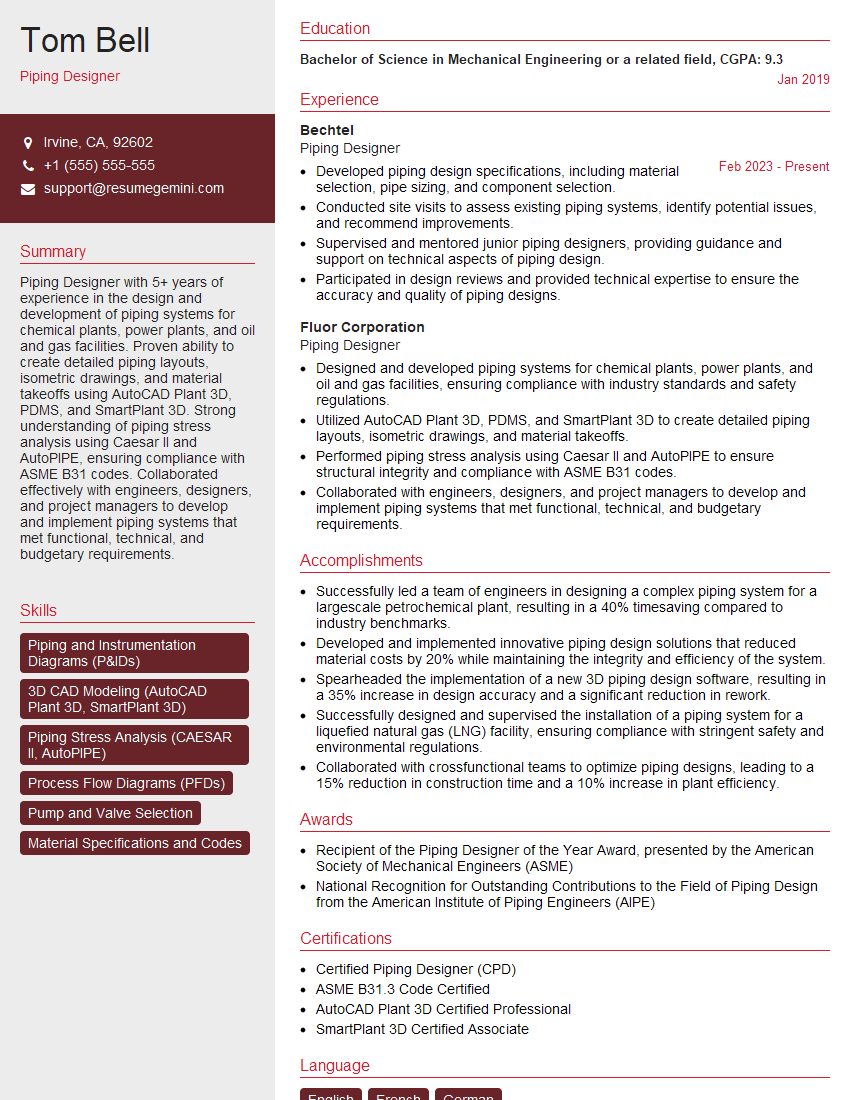
Mastering knowledge of piping materials is crucial for career advancement in engineering and related fields. A strong understanding of these concepts opens doors to more challenging and rewarding roles. To maximize your job prospects, creating an ATS-friendly resume is essential. This ensures your application gets noticed by recruiters and hiring managers. We highly recommend using ResumeGemini to build a professional and impactful resume. ResumeGemini offers a streamlined process and provides examples of resumes tailored to Knowledge of Piping Materials to help you create a winning application. Take the next step towards your dream career today!
Explore more articles
Users Rating of Our Blogs
Share Your Experience
We value your feedback! Please rate our content and share your thoughts (optional).
What Readers Say About Our Blog
To the interviewgemini.com Webmaster.
Very helpful and content specific questions to help prepare me for my interview!
Thank you
To the interviewgemini.com Webmaster.
This was kind of a unique content I found around the specialized skills. Very helpful questions and good detailed answers.
Very Helpful blog, thank you Interviewgemini team.