Interviews are more than just a Q&A session—they’re a chance to prove your worth. This blog dives into essential High-Capacity Transit (HCT) Planning interview questions and expert tips to help you align your answers with what hiring managers are looking for. Start preparing to shine!
Questions Asked in High-Capacity Transit (HCT) Planning Interview
Q 1. Explain the difference between Level of Service (LOS) and Transit Service Performance Indicators (TSPIs).
Level of Service (LOS) and Transit Service Performance Indicators (TSPIs) are both crucial in evaluating transit systems, but they focus on different aspects. LOS generally describes the quality of service experienced by passengers, often using qualitative measures like crowding, waiting times, and comfort. Think of it like rating a restaurant experience – a great LOS means a pleasant and efficient trip. TSPIs, on the other hand, are more quantitative measures that assess the overall efficiency and effectiveness of the transit system itself. These metrics are often focused on operational performance, such as on-time performance, ridership, and cost-effectiveness.
For example, a high LOS might indicate low crowding and short wait times, while high TSPIs might indicate high on-time performance and high ridership per vehicle-hour. A system can have a high LOS but poor TSPIs (e.g., frequent, small buses might offer a good passenger experience but have low overall efficiency). Conversely, a system may have excellent TSPIs, but a poor LOS due to excessively long transfers or uncomfortable vehicles.
Q 2. Describe your experience with transit demand modeling software (e.g., TransCAD, Cube, VISUM).
I have extensive experience with several transit demand modeling software packages, including TransCAD, Cube, and VISUM. My experience spans from data preprocessing and network development to model calibration, validation, and scenario analysis. In one project, I used TransCAD to model the impact of a proposed Bus Rapid Transit (BRT) system on a congested urban corridor. This involved importing GIS data, developing a detailed transit network, estimating trip generation and distribution using various models, and ultimately projecting ridership under different BRT scenarios. The output allowed us to demonstrate the potential of BRT to reduce congestion and improve travel times.
With Cube, I’ve worked on more complex scenarios involving integrated transit and land use modeling, leveraging its powerful capabilities for large-scale simulations. VISUM’s strength in microscopic traffic simulation proved particularly useful when assessing the impact of HCT projects on surrounding road networks. I’m comfortable navigating the complexities of each software package and adapting my approach based on the specific project requirements and available data.
Q 3. How do you incorporate equity considerations into HCT planning?
Incorporating equity considerations into HCT planning is paramount. We must ensure that the benefits of improved transit are accessible to all members of the community, regardless of income, race, ethnicity, or disability. This is achieved through a multi-faceted approach. First, we conduct thorough equity analyses using demographic data overlaid on transit maps and accessibility assessments. This allows us to identify communities currently underserved by transit. Second, we prioritize routes and service improvements that address these inequities, ensuring service reaches those communities that need it most.
For instance, during a recent project, we used GIS to analyze the location of low-income households and minority groups relative to proposed HCT stations and routes. This revealed significant disparities in access, and we subsequently modified the design to better serve these under-served areas. This may involve adding new routes or increasing frequency along lines serving these areas. We also consider the cost of transit itself and employ strategies to ensure affordability, such as reduced fares or integrated fare systems.
Q 4. What are the key performance indicators (KPIs) you would use to evaluate the success of a new HCT system?
Evaluating the success of a new HCT system requires a comprehensive set of KPIs, encompassing both operational efficiency and user experience. Key operational KPIs would include:
- Ridership: Total ridership, ridership per vehicle-hour, and ridership growth over time.
- On-time performance: Percentage of trips arriving on schedule.
- Vehicle utilization: Average passenger load and seat occupancy.
- Operating cost per passenger: A measure of efficiency.
Equally crucial are user-experience KPIs:
- Customer satisfaction: Measured through surveys and feedback mechanisms.
- Travel time savings: Comparison of travel times before and after the system’s implementation.
- Accessibility: The percentage of the population within a reasonable distance of HCT services.
- Safety: Accident rates and crime reports related to the HCT system.
By tracking these indicators, we can objectively assess the system’s performance and identify areas for improvement.
Q 5. Explain the concept of transit-oriented development (TOD) and its impact on HCT planning.
Transit-Oriented Development (TOD) is a planning approach that promotes the creation of vibrant, mixed-use communities centered around high-quality public transit. It fosters walkability, bikeability, and reduced reliance on private vehicles. In HCT planning, TOD plays a crucial role by maximizing the benefits of the new system. By strategically locating high-density housing, retail spaces, and employment centers near HCT stations, we can encourage transit ridership and reduce traffic congestion.
Imagine a scenario where an HCT line connects a suburban area to the city center. Without TOD, the line might not be very successful because people still need to drive to the station. However, integrating TOD strategies near stations creates a self-contained environment where many needs can be met without car travel. This leads to increased ridership, reduced environmental impact, and enhanced livability. This symbiotic relationship between effective transit and strategic land use development is fundamental to successful HCT planning.
Q 6. Discuss the role of Geographic Information Systems (GIS) in HCT planning.
Geographic Information Systems (GIS) are indispensable tools in HCT planning. They enable us to visually analyze and integrate various datasets related to demographics, land use, transportation networks, and environmental features. For example, GIS helps us to:
- Map existing transit networks and identify areas with limited service.
- Analyze demographic data to pinpoint underserved communities and target improvements.
- Model accessibility to transit services and assess the potential impact on travel times.
- Visualize and evaluate alternative route options, considering factors like topography, land use, and environmental constraints.
- Integrate with other modeling software to create comprehensive analyses of HCT systems.
In essence, GIS provides the spatial framework for comprehensive and data-driven HCT planning, supporting informed decision-making throughout the entire process.
Q 7. How do you assess the environmental impact of HCT projects?
Assessing the environmental impact of HCT projects involves a holistic evaluation of greenhouse gas emissions, air quality, noise pollution, and land use changes. We employ various methods, including lifecycle assessments to analyze the environmental impact across the entire project lifecycle, from construction to operation. This includes assessing the emissions from vehicle operation, construction materials, and energy consumption. We also use air quality modeling tools to predict changes in air pollution levels resulting from HCT implementation, comparing them to the existing scenario.
Furthermore, we consider the impact on noise pollution and analyze the potential for noise mitigation strategies. Land use changes are evaluated in terms of habitat loss and fragmentation and we explore measures to minimize environmental disruption during the construction and operation phases. Finally, we often incorporate environmental considerations into the decision-making process through cost-benefit analyses that include environmental externalities. This ensures that HCT projects contribute positively to environmental sustainability.
Q 8. Describe your experience with different HCT modes (e.g., Bus Rapid Transit, Light Rail, Subway).
My experience spans various High-Capacity Transit (HCT) modes, each with its unique strengths and challenges. Bus Rapid Transit (BRT) systems, for example, offer a cost-effective way to improve bus service by providing dedicated lanes, signal priority, and off-board fare collection. I’ve worked on projects implementing BRT in dense urban areas, focusing on optimizing route planning and station placement to maximize efficiency and ridership. Light rail, with its higher capacity and dedicated right-of-way, is ideal for corridors with moderate to high ridership densities. My involvement in light rail projects included route selection analysis, station design considerations, and integration with existing transit networks. Finally, subways, providing the highest capacity and speed, are crucial for extremely high-density urban areas. In one project, I contributed to the feasibility study of a new subway line, assessing factors like geological conditions, construction costs, and potential ridership impacts.
Each mode presents different operational considerations. For example, BRT’s flexibility allows for easier route adjustments, while light rail and subways require more significant upfront investment and are less adaptable to route changes. Understanding these nuances is critical to selecting the most appropriate HCT mode for a given context.
Q 9. What are the challenges of integrating different HCT modes into a cohesive system?
Integrating different HCT modes into a cohesive system presents several challenges. A key issue is ensuring seamless transfers between modes. Passengers shouldn’t face confusing navigation or long wait times when switching between a bus, light rail, and subway. This necessitates careful coordination of schedules and potentially the development of integrated ticketing systems. Another challenge is standardization. Different modes may have varying levels of accessibility, fare structures, and operational practices. Harmonizing these aspects is crucial for a positive user experience.
Furthermore, the physical integration of different modes can be complex. This involves designing intermodal transfer stations that are efficient, accessible, and safe. The location and design of these stations must consider pedestrian flows, accessibility, and integration with surrounding infrastructure. Finally, data integration is key to efficient system management. Real-time data from different modes must be seamlessly integrated to provide accurate information to passengers and operators, facilitating optimized scheduling and resource allocation.
Q 10. How do you estimate the ridership for a proposed HCT system?
Estimating ridership for a proposed HCT system involves a multi-step process. We start with a thorough understanding of the existing transportation patterns and demographics. This may involve analyzing existing transit data, conducting origin-destination surveys, and utilizing travel demand modeling software. We then develop a range of scenarios based on different service levels, fares, and potential land use changes.
Several models are employed to estimate ridership, including regression analysis, which relates ridership to factors like population density, income levels, and travel times, and four-step travel demand models which are more sophisticated and take into account trip generation, distribution, mode choice, and assignment. These models help predict the number of passengers who would utilize the proposed system under various conditions. Sensitivity analysis is then performed to assess the impact of different assumptions and uncertainties on the ridership forecasts. Finally, we incorporate a margin of error to account for the inherent uncertainties in predicting future behavior.
Q 11. Explain the process of developing a transit network plan.
Developing a transit network plan is an iterative process that involves several key stages. It begins with defining the project goals and objectives, clearly articulating the needs of the community and the desired outcomes of the transit system. This sets the stage for the subsequent steps.
- Demand Forecasting and Analysis: Understanding future travel demands is crucial for optimal network design. This involves analyzing existing travel patterns, population projections, and land use plans.
- Network Design: Creating various network configurations involves considering factors such as route alignment, station locations, frequency of service, and mode selection.
- Financial Planning: Assessing the costs and funding sources is crucial. This includes capital costs (infrastructure construction), operational costs (staffing, maintenance), and revenue projections.
- Environmental Impact Assessment: Environmental considerations are paramount. This stage involves evaluating the potential impacts on air quality, noise levels, and natural habitats.
- Public Consultation: Extensive public engagement is essential to gather feedback and build community support. This may involve public forums, surveys, and online consultations.
- Implementation and Monitoring: Once the plan is finalized, the implementation phase begins, followed by ongoing monitoring and evaluation of the system’s performance.
Throughout this entire process, iterative feedback loops allow for continuous refinement of the plan, ensuring its alignment with the community’s needs and evolving circumstances.
Q 12. How do you address accessibility concerns in HCT planning?
Addressing accessibility concerns is crucial in HCT planning. This involves designing and operating the system to be usable by people of all abilities, including those with disabilities. This includes considerations for:
- Accessible Stations: Stations must be equipped with ramps, elevators, tactile paving, and audible announcements.
- Accessible Vehicles: Buses and trains must have wheelchair ramps or lifts, designated seating areas for wheelchair users, and visual and auditory announcements.
- Information and Wayfinding: Clear and accessible signage, maps, and real-time information are essential for navigating the transit system.
- Integration with Other Modes: Seamless connections to other transportation modes, including paratransit services, must be provided.
Accessibility compliance often involves adhering to regulations like the Americans with Disabilities Act (ADA) in the United States or similar legislation in other countries. During the planning phase, accessibility audits and consultations with disability advocacy groups are essential to ensure that the HCT system meets the needs of all users.
Q 13. Describe your experience with cost-benefit analysis for HCT projects.
Cost-benefit analysis (CBA) is a critical tool in evaluating HCT projects. It involves comparing the total costs of a project with its total benefits over its lifespan, usually expressed in terms of net present value (NPV). The costs include capital costs (construction, land acquisition), operational costs (maintenance, staffing, energy), and any environmental mitigation costs. Benefits include reduced travel times, improved accessibility, decreased traffic congestion, and potential economic benefits from increased land values and improved economic activity.
Estimating benefits requires careful consideration of various factors and often involves using economic models to quantify the value of reduced travel times, fewer accidents, and other intangible benefits. Sensitivity analysis is crucial to assess the impact of uncertainties in cost and benefit estimates on the overall CBA result. A robust CBA helps justify investment decisions by providing a clear picture of the project’s overall financial viability and its impact on society.
Q 14. How do you incorporate public input into the HCT planning process?
Incorporating public input is crucial for successful HCT planning. It ensures that the resulting system meets the needs and preferences of the community. Several strategies can be employed:
- Public Forums and Meetings: Holding open meetings allows for direct interaction with the community, gathering feedback on proposed plans.
- Surveys and Questionnaires: Surveys can be used to gather broader feedback from a larger segment of the population.
- Online Engagement Platforms: Online platforms allow for ongoing engagement and feedback collection, including interactive maps and comment sections.
- Focus Groups: Focus groups allow for in-depth discussions with specific stakeholder groups.
- Community Workshops: Workshops provide opportunities for interactive engagement and collaborative planning.
The key is to provide various channels for public input and to ensure that feedback is carefully considered and documented throughout the planning process. Transparency and active communication with the public are vital for building trust and ensuring the project’s success.
Q 15. What are some common challenges faced in HCT project implementation?
Implementing High-Capacity Transit (HCT) projects presents numerous challenges. These can be broadly categorized into technical, logistical, financial, and social hurdles.
- Technical Challenges: These include integrating new HCT systems with existing infrastructure, managing complex engineering designs (especially in dense urban environments), ensuring system reliability and safety, and selecting appropriate technology (e.g., bus rapid transit, light rail, or metro).
- Logistical Challenges: Securing right-of-way, managing construction impacts on surrounding communities, coordinating with various utility companies, and dealing with potential traffic disruptions during construction are significant logistical obstacles.
- Financial Challenges: HCT projects are capital-intensive, requiring substantial upfront investment. Securing funding, managing project budgets effectively, and ensuring long-term financial sustainability are crucial. This often involves navigating complex funding sources and securing public and private partnerships.
- Social Challenges: Gaining public acceptance and addressing concerns from affected communities is vital. This involves effective communication, public outreach, and mitigating negative impacts on residents, businesses, and the environment. Addressing potential displacement or negative impacts on property values is crucial for social acceptance.
For example, a light rail project might face challenges in acquiring land for new tracks in a densely populated area, while a bus rapid transit system might struggle with coordinating with existing bus networks and ensuring sufficient space for dedicated bus lanes.
Career Expert Tips:
- Ace those interviews! Prepare effectively by reviewing the Top 50 Most Common Interview Questions on ResumeGemini.
- Navigate your job search with confidence! Explore a wide range of Career Tips on ResumeGemini. Learn about common challenges and recommendations to overcome them.
- Craft the perfect resume! Master the Art of Resume Writing with ResumeGemini’s guide. Showcase your unique qualifications and achievements effectively.
- Don’t miss out on holiday savings! Build your dream resume with ResumeGemini’s ATS optimized templates.
Q 16. Explain the role of stakeholder management in HCT planning.
Stakeholder management is paramount in HCT planning. It involves identifying, engaging, and managing the expectations of all individuals and groups impacted by or interested in the project. This includes a wide range of stakeholders such as:
- Residents: Directly affected by construction and the new transit system.
- Businesses: Whose operations might be impacted by construction or changes in traffic patterns.
- Local Governments: Responsible for permitting, land use, and overall project oversight.
- Transit Agencies: Responsible for the operation and maintenance of the HCT system.
- Funding Agencies: Providing financial support for the project.
- Environmental groups: Concerned about the environmental impact of the project.
Effective stakeholder management requires proactive communication, transparency, and engagement throughout the planning process. This ensures that concerns are addressed, buy-in is obtained, and potential conflicts are minimized. Think of it as building a strong foundation of trust and mutual understanding. Ignoring stakeholders can lead to delays, cost overruns, and even project failure.
Q 17. How do you address potential conflicts between different stakeholder groups?
Addressing conflicts between stakeholders requires a structured and collaborative approach. The following strategies are crucial:
- Open Communication: Establish clear communication channels and forums for stakeholders to express their concerns and perspectives.
- Mediation and Negotiation: Employ trained mediators or facilitators to help conflicting parties find common ground.
- Compromise and Collaboration: Encourage stakeholders to seek mutually acceptable solutions through compromise and collaborative problem-solving.
- Transparency and Fairness: Ensure that all stakeholders are treated fairly and that decision-making processes are transparent and equitable.
- Documentation: Maintain detailed records of communication, agreements, and decisions made to prevent misunderstandings and disputes.
For instance, if residents are concerned about increased noise pollution from a new light rail line, the project team might propose noise mitigation measures such as sound barriers or quieter train technology, thus finding a compromise that addresses the residents’ concerns.
Q 18. Discuss the importance of data collection and analysis in HCT planning.
Data collection and analysis are the cornerstones of effective HCT planning. Robust data informs every decision, from route selection to service frequency optimization. Data sources include:
- Ridership data: Existing transit usage patterns, including origin-destination data.
- Demographic data: Population density, income levels, and other socio-economic factors.
- Land use data: Identifying areas with high concentrations of employment, residential areas, and other key destinations.
- Traffic data: Analyzing existing traffic congestion patterns to identify areas where HCT can alleviate congestion.
- Geographic information systems (GIS) data: Mapping infrastructure, topography, and other relevant geographical information.
This data is analyzed using various techniques like statistical modeling, network analysis, and simulation to project future ridership, optimize route designs, and predict the impact on traffic flow. For example, analyzing ridership data might reveal a high demand for transit service between two specific areas, justifying the addition of a new HCT line or increased service frequency.
Q 19. Describe your experience with developing a transit schedule.
Developing a transit schedule is a complex process involving multiple steps and considerations. In one project, I was responsible for creating a schedule for a new bus rapid transit (BRT) system. The process involved:
- Defining Service Requirements: Determining the desired level of service (headway, frequency, operating hours) based on projected ridership demand.
- Network Optimization: Using transit scheduling software to design a network that efficiently connects key origins and destinations, minimizing travel times and transfer requirements.
- Vehicle Scheduling: Assigning buses to routes and times, taking into account vehicle availability and maintenance requirements.
- Crew Scheduling: Developing work schedules for drivers and other personnel, ensuring sufficient staffing levels and adherence to labor regulations.
- Integration with Existing Systems: Coordinating the BRT schedule with existing bus and other transit services to ensure seamless transfers and avoid conflicts.
We employed specialized software that allowed us to simulate different scheduling scenarios and optimize for factors such as passenger wait times, vehicle utilization, and overall operating efficiency.
Q 20. How do you evaluate the effectiveness of a transit schedule?
Evaluating the effectiveness of a transit schedule involves monitoring key performance indicators (KPIs) and using data-driven analysis. KPIs include:
- On-time performance: Percentage of trips arriving on schedule.
- Passenger wait times: Average time passengers spend waiting at stops.
- Ridership: Actual number of passengers carried compared to projections.
- Vehicle occupancy: Average number of passengers per vehicle.
- Customer satisfaction: Surveys and feedback to gauge passenger satisfaction with the service.
- Operating costs: Tracking expenses compared to budget.
By regularly monitoring these KPIs, we can identify areas for improvement and make data-driven adjustments to the schedule. For instance, if on-time performance is consistently low on a particular route, we might need to investigate the cause (e.g., traffic congestion, insufficient staffing) and adjust the schedule or implement other solutions.
Q 21. What are the key factors to consider when selecting a route for a new HCT line?
Selecting a route for a new HCT line involves a careful evaluation of various factors. These factors can be broadly categorized into:
- Demand: Identifying areas with high ridership potential based on population density, employment centers, and other activity generators.
- Infrastructure: Assessing the availability of existing infrastructure (e.g., roads, rights-of-way) and the feasibility of constructing new infrastructure.
- Cost: Estimating the cost of land acquisition, construction, and ongoing operation of the line.
- Environmental impact: Evaluating the potential environmental consequences of the proposed route, such as habitat disruption or air pollution.
- Community Impact: Considering the potential impact on businesses, residents, and other stakeholders along the proposed route.
- Connectivity: Ensuring that the route connects effectively with other transit modes and key destinations.
A multi-criteria decision analysis (MCDA) approach is often employed, weighing these factors according to their relative importance and selecting the route that maximizes overall benefits while minimizing negative consequences. A route that appears initially attractive from a demand perspective might be ruled out due to prohibitive construction costs or significant environmental concerns.
Q 22. Explain the concept of modal share and its relevance to HCT planning.
Modal share refers to the percentage of trips made using a particular mode of transportation, such as cars, buses, trains, or bicycles, within a given area. In HCT planning, understanding modal share is crucial because it directly impacts the effectiveness and efficiency of the transit system. A higher modal share for public transit signifies a successful shift away from private vehicles, leading to reduced congestion, improved air quality, and a more sustainable transportation system.
For example, if a city aims to reduce traffic congestion, it might set a goal to increase the modal share of bus rapid transit (BRT) from 10% to 20% within a decade. This goal would drive planning decisions, such as BRT route optimization, improved frequency, and enhanced accessibility.
Analyzing modal share involves collecting data on travel patterns, mode choices, and population demographics. We use this data to model the impact of various HCT strategies and to predict future modal shifts. This allows us to justify investments in HCT projects based on their potential to attract commuters away from private vehicles.
Q 23. How do you incorporate smart technologies into HCT planning?
Smart technologies are revolutionizing HCT planning, offering opportunities for improved efficiency, optimized operations, and enhanced user experience. We incorporate these technologies in several ways:
- Intelligent Transportation Systems (ITS): This includes adaptive traffic signal control, which gives priority to buses at intersections (transit signal priority), and real-time passenger information systems displaying accurate arrival times on digital displays and mobile apps.
- Data Analytics and Predictive Modeling: Using data from various sources – GPS tracking of buses, smart card usage, and mobile apps – we can predict demand fluctuations, identify bottlenecks, and optimize routes and schedules dynamically.
- Automated Vehicle Location (AVL) and Automatic Passenger Counting (APC): These systems provide real-time data on bus locations and passenger loads, allowing for efficient dispatching and resource allocation.
- Mobility-as-a-Service (MaaS) platforms: Integrating various modes of transportation into a single app, providing users with seamless journey planning and payment options, thus encouraging multimodal travel.
For instance, in a recent project, we used predictive modeling based on historical ridership data and weather forecasts to adjust bus schedules in anticipation of rush hour surges, ensuring smoother and more reliable service. This led to a significant reduction in passenger wait times and improved overall user satisfaction.
Q 24. Discuss the role of funding and financing in HCT projects.
Funding and financing HCT projects are critical to their success. Securing adequate funding involves a multi-pronged approach:
- Government Grants and Subsidies: We actively seek funding from local, regional, and national government agencies that prioritize sustainable transportation initiatives. These often require detailed project proposals demonstrating the project’s feasibility, societal benefits, and economic impact.
- Public-Private Partnerships (PPPs): PPPs leverage the expertise and financial resources of both public and private sectors. This involves structuring agreements that allocate responsibilities and risks effectively to maximize project success while maintaining public oversight.
- Value Capture Financing: This innovative approach involves capturing the increased property values resulting from improved transit access. This can provide a dedicated funding stream for ongoing maintenance and operations.
- Bond Issuance: For large-scale projects, issuing municipal bonds can provide access to substantial capital. The creditworthiness of the issuing entity is paramount in securing favorable interest rates.
A well-structured financial plan is crucial. It should clearly outline all funding sources, anticipated expenditures, and a robust risk mitigation strategy to address potential cost overruns or delays.
Q 25. How do you manage risks associated with HCT projects?
HCT projects are complex and inherently carry various risks. Effective risk management is essential for project success:
- Risk Identification: This involves systematically identifying potential risks, such as construction delays, cost overruns, environmental impacts, or unforeseen technical challenges.
- Risk Assessment: Each identified risk is assessed based on its likelihood and potential impact. This allows us to prioritize risks and allocate resources accordingly.
- Risk Mitigation: We develop and implement strategies to reduce the likelihood or impact of identified risks. This may involve contingency planning, robust quality control measures, and early stakeholder engagement.
- Risk Monitoring and Control: Throughout the project lifecycle, we continuously monitor risks and implement corrective actions as needed. Regular progress reviews and transparent communication are key.
For example, in one project, we anticipated potential construction delays due to inclement weather. We incorporated a contingency plan that included buffer time in the schedule and pre-negotiated agreements with contractors to minimize financial penalties in case of delays. This proactive approach allowed us to complete the project on time and within budget.
Q 26. Describe your experience with the environmental review process for HCT projects.
Environmental review is a critical component of HCT planning, ensuring projects comply with environmental regulations and minimize negative impacts. My experience includes:
- Environmental Impact Assessment (EIA): Leading and participating in EIAs, identifying potential environmental impacts, and developing mitigation strategies.
- Stakeholder Consultation: Engaging with communities, environmental groups, and regulatory agencies to address environmental concerns and incorporate their feedback into project designs.
- Permitting and Compliance: Navigating the complex permitting process, ensuring all necessary approvals are obtained, and maintaining compliance throughout project construction and operation.
- Sustainability Initiatives: Incorporating sustainable design principles into HCT projects, such as using green building materials, minimizing energy consumption, and promoting biodiversity.
In a recent project, we conducted a comprehensive EIA, which identified potential impacts on local ecosystems. We subsequently implemented mitigation measures, such as habitat restoration and noise reduction strategies, to ensure the project met environmental standards and received necessary permits.
Q 27. Explain the concept of transit signal priority and its benefits.
Transit signal priority (TSP) is a technology that optimizes traffic signals to give priority to buses and other transit vehicles. This reduces delays at intersections, leading to improved travel times, increased service reliability, and enhanced passenger satisfaction.
TSP works by detecting approaching transit vehicles and adjusting signal timing in real-time. This can involve extending green lights, shortening red lights, or even temporarily halting traffic on intersecting streets to allow the bus to pass quickly and safely. This contrasts with standard signal timing which is based on pre-programmed cycles and doesn’t account for real-time traffic conditions.
Benefits of TSP include:
- Reduced travel times: Faster transit journeys improve the attractiveness of public transport.
- Improved reliability: More predictable arrival times increase ridership.
- Increased ridership: Faster and more reliable service boosts passenger numbers.
- Reduced fuel consumption and emissions: Less idling at intersections helps reduce environmental impact.
Implementing TSP requires installing specialized detectors at intersections and integrating them with the traffic management system. Data analysis is crucial for optimizing TSP strategies and ensuring effectiveness.
Q 28. How do you measure the effectiveness of a bus rapid transit (BRT) system?
Measuring the effectiveness of a BRT system involves evaluating various performance indicators across multiple dimensions:
- Ridership: Tracking ridership growth over time to assess system popularity and demand.
- Travel Time: Comparing travel times on the BRT system versus alternative modes of transport.
- Speed and Reliability: Analyzing the average speed and on-time performance of BRT vehicles.
- Passenger Satisfaction: Conducting surveys and feedback mechanisms to gauge user satisfaction with the service.
- Accessibility: Assessing the accessibility of the BRT system for people with disabilities and those from diverse socioeconomic backgrounds.
- Safety: Monitoring accident rates and implementing measures to improve safety.
- Financial Sustainability: Evaluating the financial performance of the system and its ability to cover operating costs and future investments.
- Environmental Impact: Assessing the system’s impact on air quality, greenhouse gas emissions, and energy consumption.
A holistic approach, combining quantitative data with qualitative feedback, provides a comprehensive understanding of BRT system performance. Key performance indicators should be established upfront, and regular monitoring is essential to track progress, identify areas for improvement, and make data-driven adjustments to operations and planning.
Key Topics to Learn for High-Capacity Transit (HCT) Planning Interview
- Demand Forecasting and Modeling: Understanding techniques for predicting future transit ridership, including population growth, land use patterns, and economic factors. Practical application: Developing a ridership forecast for a proposed light rail extension.
- Network Design and Optimization: Analyzing existing transit networks and designing new high-capacity systems, considering factors like route efficiency, accessibility, and cost-effectiveness. Practical application: Evaluating different alignment options for a Bus Rapid Transit (BRT) corridor.
- Transit Technology and Integration: Familiarizing yourself with various HCT technologies (e.g., light rail, BRT, subway), their operational characteristics, and their integration with other modes of transportation. Practical application: Assessing the feasibility of integrating a new automated guided vehicle system with an existing bus network.
- Project Planning and Management: Understanding the lifecycle of HCT projects, including feasibility studies, environmental impact assessments, design, construction, and implementation. Practical application: Developing a project schedule and budget for a new subway line.
- Financial Planning and Funding: Knowing the various funding sources for HCT projects and developing effective financial plans. Practical application: Preparing a funding application for a federal grant to support a BRT project.
- Stakeholder Engagement and Communication: Understanding the importance of community engagement and effective communication throughout the project lifecycle. Practical application: Developing a public outreach strategy for a proposed HCT project.
- Data Analysis and Visualization: Proficiency in analyzing large datasets related to transit ridership, performance, and costs, and effectively communicating findings through data visualization. Practical application: Creating visualizations to illustrate the impact of a proposed HCT improvement on travel times and emissions.
Next Steps
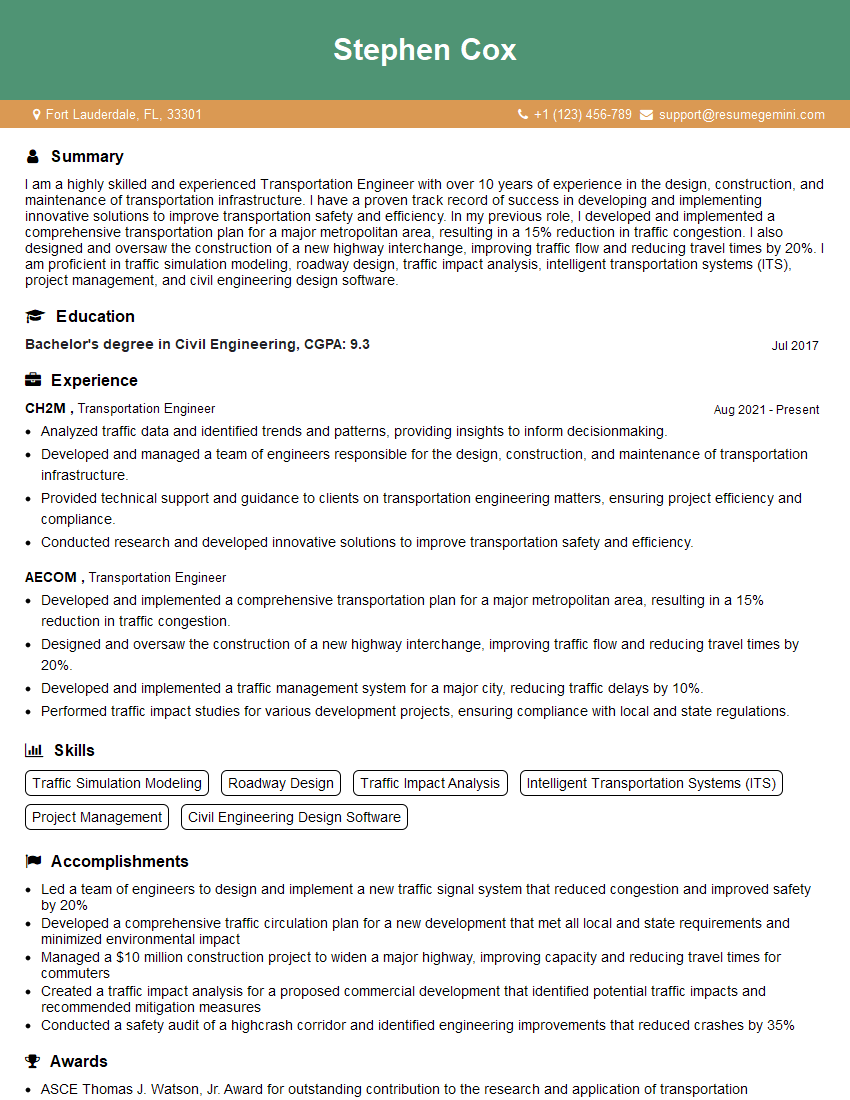
Mastering High-Capacity Transit (HCT) Planning opens doors to exciting and impactful careers in urban planning, transportation engineering, and public policy. To maximize your job prospects, creating a strong, ATS-friendly resume is crucial. ResumeGemini is a trusted resource that can help you build a professional and effective resume tailored to your specific experience and the requirements of HCT Planning positions. We provide examples of resumes specifically designed for High-Capacity Transit (HCT) Planning roles to guide you in crafting your own compelling application materials. Take the next step towards your dream career – invest in building a resume that showcases your expertise effectively.
Explore more articles
Users Rating of Our Blogs
Share Your Experience
We value your feedback! Please rate our content and share your thoughts (optional).
What Readers Say About Our Blog
To the interviewgemini.com Webmaster.
Very helpful and content specific questions to help prepare me for my interview!
Thank you
To the interviewgemini.com Webmaster.
This was kind of a unique content I found around the specialized skills. Very helpful questions and good detailed answers.
Very Helpful blog, thank you Interviewgemini team.