Preparation is the key to success in any interview. In this post, we’ll explore crucial Cotton Marketing and Trading interview questions and equip you with strategies to craft impactful answers. Whether you’re a beginner or a pro, these tips will elevate your preparation.
Questions Asked in Cotton Marketing and Trading Interview
Q 1. Explain the current global cotton market trends and their impact on pricing.
The global cotton market is currently experiencing a dynamic interplay of factors influencing pricing. Supply chain disruptions, weather patterns, and global economic conditions all play significant roles. For example, unpredictable weather events like droughts or floods in major cotton-producing regions like India, the US, and Brazil can drastically reduce yields, leading to price spikes. Conversely, a bumper crop in a key producing nation can depress prices. Increased demand from textile manufacturing hubs in Asia, coupled with geopolitical instability in certain regions, can also contribute to price volatility. Currently, we see fluctuations driven by factors such as the ongoing war in Ukraine impacting fertilizer prices and energy costs, therefore increasing the cost of production. The overall trend, however, leans toward a cautious optimism, with prices influenced by both supply-side constraints and demand-driven growth. It’s a complex ecosystem where even subtle shifts in one area can trigger a ripple effect throughout the entire market.
Q 2. Describe the different types of cotton contracts and their implications.
Cotton contracts come in various forms, each with specific implications for buyers and sellers. The most common are:
- Spot Contracts: These involve immediate delivery of cotton at an agreed-upon price. They offer certainty in timing but expose buyers to price fluctuations between the contract agreement and actual delivery.
- Forward Contracts: These specify delivery at a future date and price agreed upon today. They offer price certainty for both parties but lack the flexibility of futures contracts.
- Futures Contracts: These are standardized contracts traded on exchanges, specifying quantity, quality, and delivery date. They allow for hedging against price risk and offer liquidity. For example, a contract on ICE Futures U.S. (Intercontinental Exchange) is a widely used benchmark.
- Options Contracts: These give the buyer the right, but not the obligation, to buy or sell cotton at a specific price on or before a certain date. They provide flexibility and downside protection, with a cost (premium) for that optionality. A call option allows the buyer to purchase cotton at the strike price; a put option lets the buyer sell cotton at the strike price.
The choice of contract depends on a trader’s risk appetite and market outlook. A risk-averse mill might prefer futures or options to hedge against price increases, while a speculator might use futures to bet on price movements.
Q 3. How do you assess the quality of cotton based on fiber properties?
Cotton quality assessment is crucial for determining its value and suitability for different textile applications. Fiber properties are meticulously analyzed using advanced testing methods. Key aspects include:
- Fiber Length: Longer fibers generally produce stronger and finer yarns. High Volume Instrument (HVI) testing measures this precisely.
- Fiber Strength: This determines the yarn’s tensile strength and durability, again measured with HVI.
- Fiber Uniformity: Consistent fiber length improves spinning performance and yarn quality. Uniformity Index (UI) from HVI quantifies this.
- Fiber Micronaire: This relates to fiber maturity and fineness, influencing yarn feel and hand. Lower micronaire indicates finer fibers.
- Fiber Color: Whiteness is crucial for certain applications; yellowness is undesirable.
- Fiber Trash Content: Impurities like leaf fragments and seeds reduce quality.
These measurements, along with visual inspection, provide a comprehensive profile of the cotton’s quality, directly affecting its price in the market. For instance, extra-long staple cotton commands higher prices due to its superior properties.
Q 4. What are the key factors influencing cotton prices in the international market?
Several factors play a pivotal role in determining international cotton prices. These can be broadly categorized into:
- Supply and Demand: Global cotton production, influenced by weather, pest infestations, and acreage planted, directly impacts supply. Demand, driven by apparel manufacturing and other textile industries, is a counterbalancing force. A mismatch between these two creates volatility.
- Government Policies: Subsidies or trade restrictions imposed by various governments can significantly impact prices. Export quotas, tariffs, and support prices create market distortions.
- Currency Fluctuations: Changes in the value of currencies relative to the US dollar, which is the standard currency for cotton trading, can affect import and export costs and pricing.
- Speculation: Futures trading and investment in cotton derivatives influence prices, sometimes irrespective of fundamental supply and demand factors.
- Economic Conditions: Global economic growth or recession directly affects the demand for textiles and cotton. Recessions generally reduce demand, lowering prices.
- Technological Advancements: Innovations in cotton production, processing, and textile manufacturing can impact both supply and demand, leading to price changes. For example, genetically modified cotton varieties with improved yield have implications for pricing.
Understanding the interplay of these elements is crucial for successful cotton trading.
Q 5. Explain your understanding of cotton futures and options trading.
Cotton futures and options trading are fundamental aspects of risk management and price speculation in the cotton market. Futures contracts represent agreements to buy or sell a specific quantity of cotton at a predetermined price on a future date. These are traded on exchanges like ICE Futures U.S., offering price transparency and liquidity. They enable producers and mills to hedge against price volatility. A producer can sell futures contracts to lock in a price for their future harvest, protecting against potential price declines. Similarly, a mill can buy futures to ensure a stable supply of cotton at a known cost.
Options contracts grant the buyer the right, but not the obligation, to buy (call option) or sell (put option) cotton at a specified price (strike price) before or on a particular date. Options provide flexibility; they can be used to limit downside risk while maintaining the potential for upside gains. For instance, a mill could buy a put option to protect against significant price increases.
Understanding the intricacies of futures and options trading requires a strong grasp of market dynamics, risk management strategies, and the use of sophisticated analytical tools.
Q 6. How do you manage risk in cotton trading?
Risk management in cotton trading is paramount due to the inherent volatility of the market. Strategies employed include:
- Hedging: Utilizing futures and options contracts to offset potential losses due to price fluctuations. This is a cornerstone of risk management for both producers and processors.
- Diversification: Spreading investments across various cotton types, origins, and contracts to reduce exposure to a single market segment.
- Price Forecasting: Employing statistical models and market analysis to predict price movements and make informed trading decisions. This involves considering macroeconomic factors, supply chain dynamics, and market sentiment.
- Inventory Management: Careful planning and control of cotton inventory levels to minimize storage costs and potential losses due to price declines.
- Contractual Agreements: Negotiating contracts with clear terms and conditions to mitigate risks associated with delivery, quality disputes, and payment terms.
- Insurance: Protecting against unforeseen events like natural disasters that can impact crop yields or damage inventory.
A well-structured risk management plan tailored to specific market conditions and individual risk tolerance is crucial for success in cotton trading.
Q 7. Describe your experience with cotton supply chain management.
My experience in cotton supply chain management encompasses all stages, from farm to finished textile. I’ve been involved in:
- Sourcing: Identifying and contracting with reliable cotton producers, ensuring quality and quantity, and negotiating favorable pricing.
- Ginning and Processing: Overseeing the ginning process and collaborating with cotton processing facilities to ensure quality standards are met.
- Logistics and Transportation: Coordinating the efficient movement of cotton bales from farms to processing facilities, warehouses, and mills, managing transportation costs and minimizing delays.
- Quality Control: Implementing rigorous quality control measures at each stage of the supply chain to maintain consistency and meet customer specifications.
- Inventory Management: Optimizing inventory levels to balance supply and demand, minimizing storage costs, and preventing losses due to deterioration.
- Relationship Management: Building strong relationships with producers, processors, and clients to ensure smooth operations and efficient collaboration throughout the supply chain.
I am adept at leveraging technology and data analytics to improve efficiency, transparency, and traceability throughout the cotton supply chain. For example, I’ve utilized blockchain technology to enhance transparency and track cotton bales from origin to final product, assuring ethical sourcing and quality control.
Q 8. How do you negotiate contracts with cotton farmers or suppliers?
Negotiating cotton contracts requires a balanced approach, prioritizing fairness and mutual benefit. It starts with understanding the farmer’s perspective – their production costs, yield expectations, and market knowledge. I begin by establishing a strong rapport, building trust through open communication and transparency. Then, we discuss the specifics: quantity, quality (grade, staple length, micronaire), delivery schedule, and price. Price negotiation often involves analyzing current market prices, considering future market trends (using forecasting models and analyzing futures contracts), and factoring in any potential risks like weather damage or price volatility. I might offer different payment structures – upfront payment, staged payments upon delivery, or even a combination – to suit the farmer’s needs. Ultimately, a successful negotiation results in a win-win scenario, ensuring fair compensation for the farmer while securing a stable supply for my company.
For instance, I once negotiated a contract with a group of smallholder farmers in a drought-affected region. Instead of a fixed price, we agreed on a price floor and a potential bonus based on the final yield and quality, effectively sharing the risk and reward. This fostered strong relations and ensured a consistent supply, even under challenging circumstances.
Q 9. Explain the role of logistics in cotton marketing and trading.
Logistics are the backbone of successful cotton marketing and trading. It encompasses the entire process of moving cotton from the farm to the mill or export terminal. This includes harvesting, ginning (separating seeds from fiber), transportation (trucks, trains, ships), warehousing, and handling. Efficient logistics are crucial for minimizing costs, preserving quality, and ensuring timely delivery. Delays can lead to significant losses due to spoilage, storage costs, and missed market opportunities. I utilize various tools and strategies to ensure efficient logistics, such as collaborating with reliable transport companies, optimizing storage facilities, and leveraging technology like GPS tracking and inventory management systems. Proper documentation and traceability throughout the supply chain are critical for compliance and transparency.
For example, we recently implemented a real-time tracking system for our cotton shipments. This allowed us to monitor the location and status of each consignment, proactively address potential delays, and ensure prompt delivery to our clients, improving our overall efficiency and customer satisfaction.
Q 10. How do you ensure compliance with international regulations in cotton trading?
Compliance with international regulations is paramount in cotton trading. This involves adhering to rules concerning fair trade practices, labor standards, environmental protection, and trade sanctions. Key regulations I frequently work with include those from the World Trade Organization (WTO), relevant national and regional authorities, and industry-specific standards like the Better Cotton Initiative (BCI). We conduct thorough due diligence on our suppliers, ensuring they comply with all relevant labor and environmental laws. We maintain meticulous records of all transactions, including origin, certifications, and transportation details, to facilitate audits and ensure transparency. Any potential non-compliance is addressed promptly and proactively, prioritizing ethical and sustainable practices.
For instance, we conduct regular audits of our ginning facilities to ensure compliance with environmental regulations concerning wastewater management and waste disposal. This is not only a legal requirement but also essential for maintaining our reputation and ensuring sustainable sourcing practices.
Q 11. Describe your experience with cotton quality control procedures.
Cotton quality control is crucial for ensuring consistent quality and meeting customer specifications. Our procedures start at the farm level, where we work with farmers to understand their practices and promote best practices for growing high-quality cotton. We then conduct rigorous testing at the ginning stage, analyzing parameters like fiber length, strength, micronaire, and color. This involves using industry-standard equipment and following established protocols. Samples are taken from each bale, and the results are documented and used to grade the cotton. We further conduct quality checks at the warehousing and processing stages to maintain consistency and prevent any degradation. This ensures the cotton meets the specific requirements of our buyers, whether it’s for yarn production, textile manufacturing, or other applications.
For example, we recently identified a batch of cotton with unusually high impurities. Our quality control team immediately quarantined the batch, and we investigated the cause, working with the supplier to implement corrective measures to prevent similar issues in the future.
Q 12. What are the key challenges facing the cotton industry today?
The cotton industry faces several significant challenges. Climate change is a major concern, affecting yields and quality due to erratic weather patterns and increased pest infestations. Competition from synthetic fibers is another challenge, requiring the cotton industry to continuously innovate and highlight the sustainability and unique properties of natural cotton. Price volatility remains a constant issue, impacting farmer income and trader profitability. Ensuring sustainable and ethical sourcing, addressing labor issues, and meeting growing demand for traceability and transparency are also critical concerns. Addressing these challenges requires collaborative efforts from farmers, traders, manufacturers, and policymakers to promote innovation, sustainability, and responsible practices.
For example, the industry is investing heavily in research and development to create drought-resistant cotton varieties and improve pest management strategies, thus mitigating the impacts of climate change.
Q 13. How do you analyze market data to make informed trading decisions?
Analyzing market data is fundamental to making informed trading decisions. I utilize a combination of quantitative and qualitative methods. This includes monitoring daily price fluctuations, analyzing historical data to identify trends and patterns, studying weather forecasts and their potential impact on crop yields, and considering global supply and demand dynamics. I also factor in economic indicators, like inflation and exchange rates, and analyze government policies and regulations that may affect the market. Sophisticated statistical models and forecasting techniques are employed to predict future price movements. News articles, industry reports, and competitor analysis provide additional insights, enabling a comprehensive understanding of the market landscape. This holistic approach helps mitigate risks and capitalize on profitable opportunities.
For example, by analyzing weather patterns and anticipating a potential crop shortfall in a key growing region, I was able to secure a large volume of cotton at a favorable price, generating significant profits when prices later surged due to the anticipated shortage.
Q 14. How do you develop marketing strategies for cotton products?
Developing effective marketing strategies for cotton products requires a deep understanding of the target market and the unique properties of cotton. This involves identifying key customer segments (e.g., textile manufacturers, apparel brands, consumers), understanding their needs and preferences, and developing a value proposition that highlights the benefits of cotton – its softness, breathability, sustainability, and versatility. This might involve emphasizing specific qualities like organic certification, traceability, or unique fiber characteristics to appeal to specific niches. Marketing channels vary depending on the target market and may include direct sales, online platforms, trade shows, and industry publications. Building strong relationships with key clients and fostering brand awareness are crucial elements of a successful marketing strategy.
For example, we recently launched a marketing campaign highlighting the sustainability and traceability of our cotton, targeting environmentally conscious apparel brands. This resulted in a significant increase in demand and solidified our position as a responsible and reliable supplier.
Q 15. What is your understanding of sustainable cotton production?
Sustainable cotton production focuses on minimizing the environmental and social impacts of growing and processing cotton. It’s about creating a system that’s economically viable for farmers, while protecting natural resources and ensuring fair labor practices. This involves a multifaceted approach.
- Reduced Water Usage: Implementing drip irrigation and other water-efficient techniques.
- Minimizing Pesticide Use: Employing integrated pest management (IPM) strategies to reduce reliance on harmful chemicals, promoting biodiversity and natural pest control.
- Soil Health Improvement: Using cover crops, no-till farming, and crop rotation to enhance soil fertility and reduce erosion.
- Fair Labor Practices: Ensuring fair wages, safe working conditions, and prohibiting child labor throughout the supply chain.
- Traceability and Transparency: Using blockchain technology or other systems to track cotton from field to finished product, building trust and accountability.
For example, the Better Cotton Initiative (BCI) is a prominent organization promoting sustainable cotton production through a system of farmer training and certification. A company committed to sustainability might source only BCI cotton to ensure their products align with their ethical and environmental goals.
Career Expert Tips:
- Ace those interviews! Prepare effectively by reviewing the Top 50 Most Common Interview Questions on ResumeGemini.
- Navigate your job search with confidence! Explore a wide range of Career Tips on ResumeGemini. Learn about common challenges and recommendations to overcome them.
- Craft the perfect resume! Master the Art of Resume Writing with ResumeGemini’s guide. Showcase your unique qualifications and achievements effectively.
- Don’t miss out on holiday savings! Build your dream resume with ResumeGemini’s ATS optimized templates.
Q 16. Explain your experience using cotton trading platforms and software.
My experience with cotton trading platforms and software is extensive. I’ve utilized various platforms, including those offering real-time market data, order management systems, and supply chain tracking tools. I’m proficient in using software that facilitates hedging, price risk management, and contract negotiation. I’m also familiar with electronic trading systems that allow for efficient buying and selling of cotton contracts.
For instance, I’ve used platforms that provide detailed historical price data, allowing me to perform thorough market analysis and identify trends. These platforms also enable me to track shipments and manage logistics efficiently. My experience extends to using software for generating reports on inventory levels, financial performance, and compliance with industry regulations. I’m comfortable navigating complex data sets and using analytical tools to inform trading decisions.
Q 17. How do you manage inventory levels of cotton?
Managing cotton inventory effectively requires a balance between meeting market demand and minimizing storage costs and risks. My approach involves a multi-pronged strategy.
- Demand Forecasting: I utilize historical data, market trends, and economic indicators to predict future demand for cotton. This helps in determining the optimal inventory levels to avoid shortages or overstocking.
- Inventory Tracking: I use sophisticated inventory management systems to track cotton across all stages of the supply chain, from storage facilities to processing plants to finished goods. Real-time tracking allows for quick responses to potential issues.
- Risk Management: I implement strategies to mitigate risks associated with price fluctuations, storage conditions, and potential spoilage. This might involve hedging techniques, proper storage facilities, and insurance coverage.
- Regular Audits: Periodic audits are performed to verify inventory levels and ensure accuracy in reporting.
For example, if I anticipate a surge in demand due to a seasonal trend, I’ll adjust my inventory levels accordingly, ensuring sufficient stock to meet the increased demand without incurring excessive storage costs. Conversely, if prices are expected to fall, I might reduce inventory to minimize potential losses.
Q 18. Describe your experience working with different stakeholders in the cotton industry.
My work in the cotton industry has involved collaborating with a diverse range of stakeholders, including farmers, ginners, spinners, traders, textile manufacturers, and buyers. Building strong relationships with these stakeholders is critical to success.
- Farmers: I work closely with farmers to understand their needs, provide market insights, and ensure fair pricing for their cotton.
- Ginners: I collaborate with ginners to ensure high-quality cotton processing and timely delivery.
- Spinners: I work with spinners to understand their fiber requirements and facilitate the supply of appropriate grades of cotton.
- Traders: I network with other traders to access market intelligence and facilitate transactions.
- Textile Manufacturers and Buyers: I maintain relationships with these parties to understand market trends and provide suitable cotton supplies.
For example, in negotiating a contract with a spinner, I must balance their need for specific cotton quality with the farmer’s production capabilities and market price. This requires careful consideration of all aspects of the transaction to ensure a mutually beneficial agreement.
Q 19. How do you forecast cotton prices?
Cotton price forecasting involves analyzing various factors influencing supply and demand. It’s a complex process that requires a deep understanding of the market.
- Global Supply and Demand: Analyzing global cotton production, consumption, and inventory levels. Major cotton-producing countries’ weather patterns significantly impact supply.
- Economic Indicators: Monitoring macroeconomic factors like inflation, exchange rates, and interest rates, which influence consumer demand for textiles.
- Government Policies: Analyzing government policies relating to agricultural subsidies, import/export tariffs, and trade agreements impacting supply and demand.
- Technological Advancements: Assessing the impact of new technologies on cotton production and processing efficiency.
- Statistical Modeling: Using time series analysis, regression models, and other statistical techniques to predict future price movements based on historical data.
I often combine quantitative analysis with qualitative factors, such as geopolitical events and unexpected weather conditions, to refine my forecasts. No forecast is perfect, but a thorough analysis increases the chances of accuracy.
Q 20. What is your understanding of the different cotton grades and standards?
Cotton grades and standards are crucial in determining quality and price. Different systems exist worldwide, but common factors include fiber length, strength, uniformity, micronaire (fiber fineness), and color.
- Fiber Length: Longer fibers generally produce stronger, higher-quality yarns.
- Fiber Strength: Measured by tensile strength, it indicates the yarn’s resistance to breaking.
- Uniformity: Consistent fiber length improves spinning efficiency and yarn quality.
- Micronaire: Relates to fiber fineness and affects yarn softness and texture.
- Color: White or near-white cotton is generally preferred.
- Trash Content: The amount of foreign materials like leaves and seeds affects quality.
Organizations like the USDA (United States Department of Agriculture) and other international bodies establish standardized testing methods and grading systems. Understanding these systems is vital for accurate pricing and contract negotiation. For example, knowing the difference between ‘extra-long staple’ and ‘short staple’ cotton is critical for selecting the right fiber for specific textile applications.
Q 21. How do you handle discrepancies in cotton shipments?
Discrepancies in cotton shipments can arise from various issues, including inaccurate weighing, quality mismatches, or damage during transit. Handling these situations requires a systematic approach.
- Verification of Documents: Carefully reviewing shipping documents, including weight certificates, quality reports, and bills of lading, to identify any inconsistencies.
- Independent Inspection: Engaging an independent inspection agency to verify the quality and quantity of the cotton received. This provides an impartial assessment of any discrepancies.
- Communication with Stakeholders: Open and transparent communication with all parties involved – shippers, carriers, and buyers – is crucial for resolving the issue promptly.
- Negotiation and Dispute Resolution: Negotiating a fair resolution with all parties involved, potentially involving arbitration or litigation if necessary. This could involve adjustments in price, replacement of damaged goods, or other compensatory measures.
- Documentation of the Process: Maintaining detailed records of all communications, inspections, and resolutions to ensure transparency and accountability.
For example, if a shipment arrives with lower weight than documented, I’d immediately initiate an investigation, coordinating with the carrier and shipper to determine the cause. Based on the findings, we would negotiate a suitable settlement.
Q 22. How do you build relationships with key clients in the cotton industry?
Building strong relationships with key clients in the cotton industry is paramount for long-term success. It’s not just about making a sale; it’s about building trust and mutual understanding. I approach this by focusing on several key strategies:
- Consistent Communication: Regular check-ins, whether it’s a quick phone call, email, or in-person meeting, keeps the lines of communication open. This allows me to understand their evolving needs and address any concerns promptly.
- Understanding Their Business: I take the time to learn about my clients’ specific needs, challenges, and goals. This allows me to tailor my approach to their unique circumstances and offer solutions that truly address their problems.
- Providing Value Beyond the Transaction: I offer market insights, industry updates, and even advice on best practices. This positions me as a trusted advisor, not just a supplier.
- Building Personal Connections: Attending industry events, participating in trade shows, and even simply having a friendly conversation builds rapport and fosters personal relationships. This human element is crucial in forging strong and lasting partnerships.
- Following Up: After every transaction, I ensure I follow up to check on client satisfaction and identify potential areas for improvement. This shows commitment and reinforces my dedication to client success.
For example, I once helped a long-term client navigate a sudden shortage of high-quality cotton by leveraging my network to secure an alternative supply, even at a slightly higher cost. This act of going the extra mile solidified our relationship and further strengthened their trust in my capabilities.
Q 23. Explain your experience in hedging against cotton price volatility.
Hedging against cotton price volatility is critical in mitigating risk. Cotton prices are susceptible to numerous factors, including weather patterns, global demand, and geopolitical events. My experience involves utilizing several hedging strategies:
- Futures Contracts: I regularly use futures contracts on exchanges like ICE Futures US to lock in prices for future purchases or sales. This helps protect against adverse price movements. For instance, if I anticipate selling a large quantity of cotton in three months, I might sell futures contracts today to lock in a price, protecting against a potential price decline.
- Options Contracts: Options provide flexibility. A call option gives me the right, but not the obligation, to buy cotton at a specific price on a future date. A put option gives me the right to sell. This allows me to capitalize on favorable price movements while limiting potential losses.
- Forward Contracts: These are private agreements with buyers or sellers to exchange cotton at a predetermined price and date. They offer a customized approach to hedging, tailored to the specific needs of each transaction.
A successful hedging strategy requires a deep understanding of market dynamics and risk tolerance. I continuously monitor market trends and adjust my hedging approach as needed. The goal is not to eliminate risk entirely but to manage it effectively and optimize profitability.
Q 24. How do you use market intelligence to identify new opportunities in the cotton market?
Market intelligence is the lifeblood of identifying new opportunities in the cotton market. I utilize various sources to gather and analyze information:
- Industry Publications and Reports: I regularly review publications like the USDA reports on cotton production and consumption, industry journals, and market analyses to gain insights into supply, demand, and price trends.
- Government Data: Data on imports, exports, and consumption patterns from various government sources provides a macro perspective on the market.
- Online Market Data Platforms: I use specialized platforms that provide real-time market data, price charts, and analytical tools to track price movements and identify emerging trends.
- Industry Networks: Attending industry conferences and maintaining strong relationships with key players within the supply chain provides invaluable information and insights that are not always publicly available.
- Competitor Analysis: Understanding the strategies and activities of competitors helps me identify unmet needs and potentially lucrative market niches.
For example, analyzing recent trends in sustainable cotton production, I identified a growing demand for organic and ethically sourced cotton, leading to the development of a successful marketing strategy focusing on this niche market.
Q 25. Describe your experience with cotton export/import documentation and procedures.
Experience with cotton export/import documentation and procedures is essential for seamless transactions. I have extensive experience handling all aspects, including:
- Letters of Credit (LCs): Negotiating and managing LCs to secure payments from importers. This involves close coordination with banks and ensuring compliance with all LC terms and conditions.
- Bill of Lading (B/L): Ensuring accurate and timely issuance of B/Ls, serving as proof of shipment and transfer of ownership.
- Commercial Invoice: Preparing and verifying the accuracy of commercial invoices, detailing the goods being shipped, price, and other relevant information.
- Packing List: Creating detailed packing lists to ensure the accurate representation of the content of each shipment.
- Certificates of Origin: Obtaining and verifying certificates of origin to meet the import requirements of the destination country.
- Phytosanitary Certificates: Securing phytosanitary certificates, as needed, to meet plant health regulations.
I am proficient in navigating customs regulations and procedures in various countries. My experience has ensured smooth and compliant trade operations, minimizing delays and potential disputes.
Q 26. How do you address ethical concerns related to cotton production?
Addressing ethical concerns related to cotton production is paramount. My approach centers on promoting sustainable and responsible sourcing practices:
- Supporting Fair Labor Practices: I actively seek out suppliers who adhere to strict labor standards, ensuring fair wages, safe working conditions, and the absence of child labor. I frequently audit suppliers to confirm adherence to these standards.
- Promoting Sustainable Farming Practices: I prioritize sourcing cotton from farms that utilize environmentally friendly practices, minimizing the use of pesticides and fertilizers and reducing water consumption. I am actively involved in promoting organic and other sustainable cotton initiatives.
- Transparency and Traceability: I support initiatives that improve the traceability of cotton throughout the supply chain, allowing for greater transparency and accountability.
- Collaborating with Ethical Organizations: I actively participate in and collaborate with industry organizations committed to promoting ethical cotton production.
By prioritizing these ethical considerations, I not only contribute to a more sustainable industry but also enhance the reputation of my clients and build trust with consumers increasingly concerned about the ethical sourcing of products.
Q 27. How do you measure the success of your cotton marketing strategies?
Measuring the success of cotton marketing strategies requires a multifaceted approach. Key performance indicators (KPIs) I track include:
- Sales Volume and Revenue: These are fundamental metrics that directly reflect the success of marketing efforts.
- Market Share: Tracking market share indicates the effectiveness of strategies in gaining competitive advantage.
- Customer Acquisition Cost (CAC): This helps in evaluating the efficiency of marketing investments.
- Customer Retention Rate: High retention signifies successful relationship building and brand loyalty.
- Brand Awareness and Perception: This is tracked through surveys, market research, and online sentiment analysis.
- Profitability: Ultimately, the success of a strategy is measured by its contribution to overall profitability.
I regularly analyze these KPIs to identify areas for improvement and refine my strategies accordingly. Regular reporting and review ensure continuous optimization and adaptation to changing market conditions.
Q 28. Describe a situation where you had to resolve a conflict related to cotton quality or delivery.
In one instance, a client reported that a delivered shipment of cotton did not meet the agreed-upon quality specifications. The cotton had a higher than acceptable level of impurities. Here’s how I resolved the conflict:
- Immediate Communication: I contacted the client immediately to acknowledge the issue and express my commitment to finding a resolution.
- Thorough Investigation: I conducted a thorough investigation, examining the relevant documentation, including the quality certificates, inspection reports, and shipment manifests.
- Collaboration with Supplier: I collaborated with the supplier to determine the cause of the discrepancy and to ascertain their liability.
- Objective Assessment: Based on the investigation findings, I made an objective assessment of the situation and the extent of the quality deviation.
- Negotiated Solution: I worked with the client and supplier to negotiate a mutually acceptable solution, which involved a partial price adjustment and a commitment from the supplier to implement improved quality control measures.
- Documentation and Communication: The entire process was meticulously documented, and transparent communication was maintained throughout with both the client and the supplier.
This situation highlighted the importance of clear communication, thorough documentation, and collaborative problem-solving to maintain strong client relationships and uphold quality standards in the industry.
Key Topics to Learn for Your Cotton Marketing and Trading Interview
- Understanding Cotton Grades and Standards: Learn the various grading systems (e.g., USDA) and their impact on pricing and quality. Consider the practical application of assessing cotton quality through physical inspection and lab testing.
- Global Cotton Market Dynamics: Analyze supply and demand factors influencing cotton prices. Understand the role of major producing and consuming countries, and how geopolitical events can affect the market. Explore forecasting techniques and their limitations.
- Cotton Trading Strategies and Risk Management: Familiarize yourself with different trading instruments (futures, options, etc.) and risk mitigation strategies like hedging. Practice applying these strategies to hypothetical scenarios.
- Logistics and Supply Chain Management in Cotton: Understand the complexities of transporting and storing cotton, including considerations for quality preservation and efficiency. Analyze challenges related to global logistics and potential solutions.
- Contract Negotiation and Legal Aspects: Develop skills in negotiating favorable contracts, understanding terms and conditions, and addressing potential legal issues. Consider the impact of international trade regulations.
- Data Analysis and Market Research: Learn how to interpret market data, conduct competitor analysis, and make informed decisions based on market trends. Practice using relevant data analysis tools.
- Financial Modeling and Valuation: Understand how to build financial models to evaluate investment opportunities in cotton and assess the profitability of trading strategies.
Next Steps
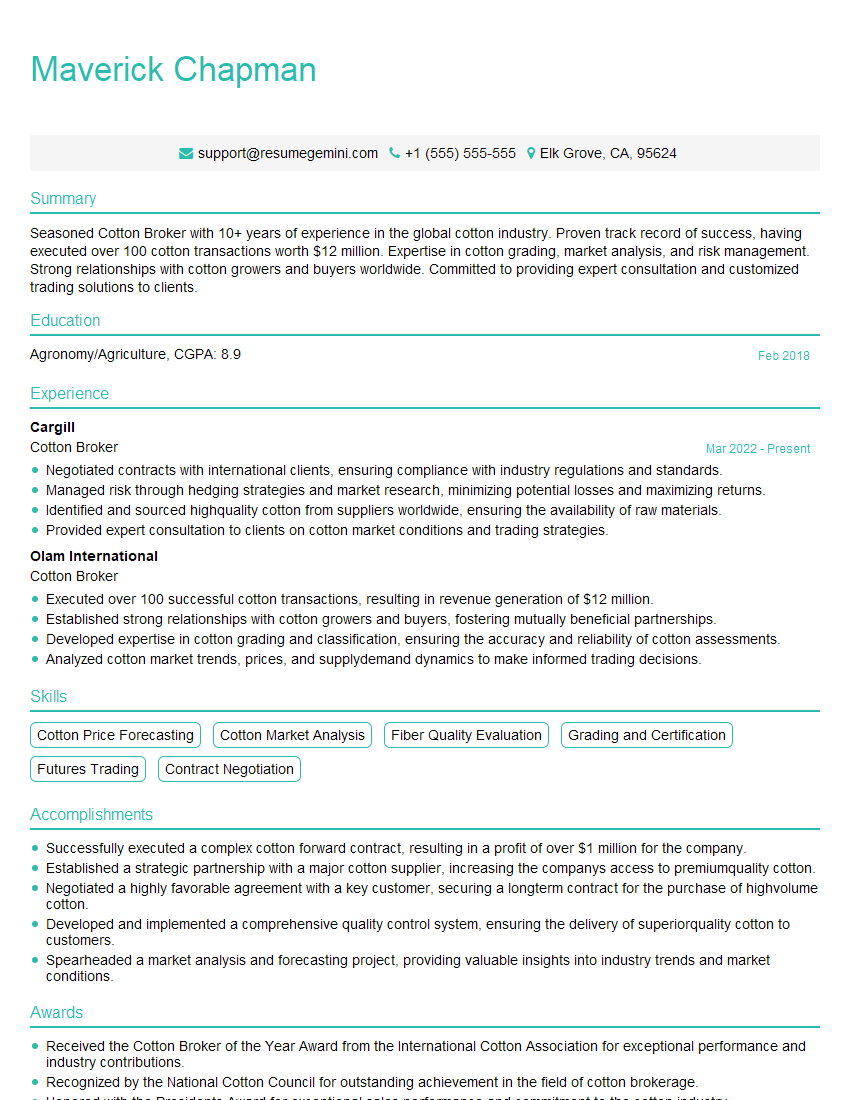
Mastering Cotton Marketing and Trading opens doors to a dynamic and rewarding career with excellent growth potential. This specialized knowledge is highly sought after in the global agricultural sector, offering opportunities for advancement and significant financial rewards. To maximize your job prospects, create an ATS-friendly resume that highlights your relevant skills and experience. We strongly recommend using ResumeGemini, a trusted resource, to build a professional and impactful resume that will get noticed. ResumeGemini provides examples of resumes tailored to Cotton Marketing and Trading to help you create a compelling application. Take the next step towards your dream career – build a winning resume today!
Explore more articles
Users Rating of Our Blogs
Share Your Experience
We value your feedback! Please rate our content and share your thoughts (optional).
What Readers Say About Our Blog
To the interviewgemini.com Webmaster.
Very helpful and content specific questions to help prepare me for my interview!
Thank you
To the interviewgemini.com Webmaster.
This was kind of a unique content I found around the specialized skills. Very helpful questions and good detailed answers.
Very Helpful blog, thank you Interviewgemini team.