Unlock your full potential by mastering the most common Structural Analysis and Calculation interview questions. This blog offers a deep dive into the critical topics, ensuring you’re not only prepared to answer but to excel. With these insights, you’ll approach your interview with clarity and confidence.
Questions Asked in Structural Analysis and Calculation Interview
Q 1. Explain the difference between static and dynamic analysis.
The key difference between static and dynamic analysis lies in how they handle loads. Static analysis assumes loads are applied slowly and steadily, allowing the structure to reach equilibrium at each load increment. Think of gently placing a book on a table – the table reacts, but there’s no significant acceleration or vibration. The calculations focus on determining stresses, strains, and deflections under these constant loads. In contrast, dynamic analysis considers loads that change over time, such as earthquakes, wind gusts, or moving vehicles. These loads introduce inertia and acceleration, significantly affecting the structure’s response. Imagine dropping the book onto the table – the impact creates vibrations and the table’s response is much more complex than in the static case. Dynamic analysis requires more sophisticated techniques to account for these time-varying forces and resulting accelerations.
In practical terms, a static analysis is often sufficient for structures under relatively constant loads, like a simple building under its own weight and typical occupancy. However, dynamic analysis is crucial for structures subjected to dynamic events, like bridges experiencing traffic vibrations, or skyscrapers facing high winds.
Q 2. Describe the various methods used for structural analysis.
Several methods are employed for structural analysis, each with its own strengths and limitations. These methods can be broadly categorized as:
- Force Method (also known as the flexibility method): This method focuses on determining the internal forces in a structure based on the compatibility of displacements. It’s particularly useful for indeterminate structures (structures with more supports than required for stability), but can become cumbersome for complex geometries.
- Displacement Method (also known as the stiffness method): This is the most widely used method, especially in computer-aided structural analysis software. It establishes equilibrium of forces at nodes (connection points) in a structure to solve for displacements, from which internal forces are then derived. It’s highly efficient for complex structures and readily adaptable to computer programming.
- Finite Element Method (FEM): This numerical technique divides a structure into numerous small elements, solving for behavior within each element and combining the results to model the overall behavior. FEM is extremely versatile and powerful, capable of handling complex geometries, material properties, and load conditions. It’s the backbone of most modern structural analysis software.
- Direct Stiffness Method: A specific implementation of the displacement method that is very well-suited to computerization and is the foundation for most modern structural analysis programs.
The choice of method depends on factors such as the complexity of the structure, the desired level of accuracy, and available computational resources. Often, modern software will employ a combination of these methods.
Q 3. What are the assumptions made in linear elastic analysis?
Linear elastic analysis rests upon several fundamental assumptions which simplify the calculations but might not hold true in all real-world scenarios. These assumptions include:
- Linearity: The relationship between stress and strain is linear, following Hooke’s Law (stress is directly proportional to strain). This means that doubling the load doubles the deformation. This is often a reasonable simplification for many materials under normal loading conditions.
- Elasticity: The material returns to its original shape after the load is removed. There’s no permanent deformation. While many structural materials exhibit elastic behavior within their working stress range, this assumption might fail if the structure is subjected to high loads or cyclic loading leading to plastic deformation.
- Small Displacements: The deformations of the structure are small compared to its overall dimensions. This allows for the simplification of equations and neglect of second-order effects. However, for slender structures under significant loads, this assumption may break down.
- Homogeneity: The material properties are uniform throughout the structure. This is rarely perfectly true in reality, due to variations in material composition or manufacturing processes, but it allows for simpler models.
- Isotropy: The material properties are the same in all directions. Many common structural materials like steel and concrete are approximately isotropic, but composite materials and materials with directional reinforcement would require different analysis methods.
It’s vital to understand the limitations of these assumptions. If any of them are significantly violated, more advanced nonlinear analysis techniques might be required for accurate results.
Q 4. Explain the concept of load path in structural design.
The load path is the route that loads take through a structure from their point of application to the supports. Imagine a simple bridge: the weight of a car (the load) is transferred through the car’s wheels to the bridge deck, then down through the beams, columns, and finally to the foundations which transfer the load to the ground. Understanding and carefully designing the load path is essential for ensuring that the structure can safely carry its intended loads. A well-defined load path minimizes stresses and prevents overloading of any individual component. A poorly designed load path can lead to structural failure.
For example, a poorly designed connection between a beam and a column might interrupt the efficient load path, resulting in high stresses and potential failure at that point. This is critical for all structures. A building’s load path encompasses its various load-bearing elements, ensuring all external and internal loads (dead and live) are efficiently transferred to the ground.
Q 5. How do you account for live loads and dead loads in structural design?
Dead loads are the permanent loads acting on a structure, including the weight of the structure itself (e.g., beams, columns, walls, roof), and any permanently attached fixtures. These loads are relatively constant and predictable. Live loads are temporary loads that vary over time, such as the weight of people, furniture, equipment, snow, or wind. These are more unpredictable and require consideration of worst-case scenarios.
In structural design, both dead and live loads are carefully considered. Design codes provide guidelines for determining the magnitude of these loads based on factors such as location, occupancy, and environmental conditions. The total load on a structural element is usually calculated by summing the dead load and a factored live load (multiplied by a load factor to account for uncertainties). For example, a design might consider 1.2 times the dead load and 1.6 times the live load (these factors will vary based on specific codes and local conditions) for ultimate limit state calculations, to account for load variability.
Q 6. What are the different types of structural failure modes?
Structural failure modes describe how a structure might fail under load. Some common failure modes include:
- Tensile Failure: The structure fails due to excessive pulling forces, leading to cracking or rupture.
- Compressive Failure: The structure fails due to excessive squeezing forces, potentially resulting in buckling or crushing.
- Shear Failure: The structure fails due to excessive shearing forces, leading to cracking along planes parallel to the applied force.
- Flexural Failure (Bending): The structure fails due to bending moments, leading to cracking or yielding on the tensile side of the member.
- Torsional Failure: The structure fails due to twisting moments, leading to cracking or yielding.
- Buckling Failure: A slender structural member fails by suddenly deflecting laterally under compressive loads. This is a stability failure which can happen at loads below the material yield strength.
- Fatigue Failure: The structure fails after repeated cycles of loading and unloading. This is common in structures subjected to dynamic loading.
Understanding the possible failure modes is crucial for designing safe and reliable structures. Engineers consider these failure modes and use appropriate safety factors to prevent failure under anticipated loading conditions.
Q 7. Explain the concept of factor of safety and its importance.
The factor of safety (FOS) is a ratio that accounts for uncertainties and unforeseen events in structural design. It’s the ratio of the ultimate strength (the maximum load a structure can withstand before failure) to the allowable stress (the maximum stress permitted under normal operating conditions). A higher FOS indicates a more conservative design with a lower risk of failure. For example, an FOS of 2 means the structure is designed to withstand twice the anticipated maximum load.
The importance of FOS is immense. It accounts for uncertainties such as: inaccuracies in material properties, variations in load magnitudes, unexpected environmental effects (like extreme winds or earthquakes), and imperfections in construction. Without an appropriate FOS, a structure might fail even under normal operating conditions. Design codes typically specify minimum acceptable FOS values based on the type of structure, material, and loading conditions. Choosing the right FOS involves balancing safety, cost, and other relevant factors. A higher FOS means a more expensive and potentially over-engineered structure, while a lower FOS increases the risk of failure. This is a key design consideration.
Q 8. Describe the process of finite element analysis (FEA).
Finite Element Analysis (FEA) is a powerful computational method used to predict how a product reacts to real-world forces, vibration, heat, fluid flow, and other physical effects. Imagine breaking down a complex structure, like a car chassis, into many smaller, simpler pieces called ‘finite elements’. Each element is analyzed individually, and the results are then combined to model the behavior of the entire structure.
The process typically involves these steps:
- Pre-processing: This stage involves creating a geometric model of the structure using CAD software, defining the material properties of each element, applying boundary conditions (constraints, like fixed supports), and specifying loads (forces, pressures, temperatures).
- Meshing: The geometric model is divided into a mesh of finite elements. The accuracy of the analysis is highly dependent on the mesh density – finer meshes generally yield more accurate results but require more computational resources.
- Solving: A sophisticated computer program solves a system of equations that governs the behavior of each element under the applied loads. This results in a numerical solution for displacements, stresses, and strains at each element.
- Post-processing: The results are then visualized and interpreted. This often involves creating contour plots of stress and displacement to identify potential areas of failure or high stress concentration.
For example, FEA can be used to analyze the stress distribution in a bridge under traffic loads, helping engineers to design a safer and more efficient structure.
Q 9. What are the advantages and disadvantages of using FEA?
FEA offers several advantages:
- High Accuracy: It can provide detailed stress and displacement information, allowing for optimized designs.
- Cost-Effectiveness: It reduces the need for expensive physical prototypes, saving time and resources.
- Complex Geometry Handling: It can handle complex geometries that are difficult or impossible to analyze using analytical methods.
- Wide range of applications: FEA can be applied to a broad spectrum of engineering problems, from structural analysis to fluid dynamics.
However, there are also disadvantages:
- Computational Cost: Complex models can require significant computing power and time.
- Mesh Dependency: The accuracy of the results is dependent on the mesh quality. An inadequate mesh can lead to inaccurate or misleading results.
- Requires Expertise: Performing FEA requires specialized knowledge and skills in software usage and interpretation of results. An incorrect setup can lead to erroneous results.
- Idealization and Simplifications: Real-world scenarios often involve complexities that require simplifications in the model, potentially affecting the accuracy.
Q 10. How do you validate the results obtained from FEA?
Validating FEA results is crucial to ensure reliability. This is done through several methods:
- Comparison with Analytical Solutions: For simpler problems, results can be compared to analytical solutions derived from engineering formulas. This serves as a benchmark for accuracy.
- Experimental Verification: The most reliable method involves comparing FEA predictions with experimental data obtained from physical testing. This could involve strain gauge measurements or destructive testing of prototypes.
- Mesh Convergence Studies: Performing analyses with increasingly finer meshes helps determine whether the solution has converged to a stable value. If the results change significantly with mesh refinement, it indicates a need for a finer mesh.
- Benchmarking against established software: Comparing results obtained from multiple FEA software packages can help identify potential errors or discrepancies.
- Expert Review: Having an experienced engineer review the model setup, boundary conditions, and results is crucial for identifying potential sources of error or misinterpretations.
Imagine designing a new aircraft wing. You’d not only rely on FEA but also conduct wind tunnel testing to validate the aerodynamic performance predicted by the FEA model.
Q 11. Explain the concept of buckling in columns.
Buckling is a sudden, significant change in shape of a slender structural member, such as a column, under a compressive load. Instead of failing by crushing, the column bends sideways and fails due to this instability. Think of a soda can; if you compress it gently from both ends, it will buckle rather than crush.
Several factors influence buckling: the column’s length, material properties (elastic modulus), cross-sectional geometry, and how the ends are supported (fixed, pinned, free).
The critical load at which buckling occurs depends on these factors. Beyond this critical load, the column becomes unstable and rapidly deforms, leading to failure.
Q 12. Describe Euler’s buckling formula and its limitations.
Euler’s buckling formula provides a theoretical prediction of the critical buckling load (Pcr) for a slender column with ideal conditions:
Pcr = (π²EI) / (KL)²
Where:
Pcris the critical buckling loadEis the modulus of elasticity of the column materialIis the area moment of inertia of the column’s cross-sectionLis the effective length of the columnKis the effective length factor, which depends on the end conditions of the column (e.g., K=1 for both ends pinned, K=0.5 for both ends fixed).
Limitations of Euler’s formula:
- Applies only to slender columns: It assumes the column is perfectly straight, homogeneous, and linearly elastic. It’s inaccurate for short, stubby columns which tend to fail by crushing before buckling.
- Ideal end conditions: It assumes ideal end conditions, which are rarely found in real-world structures.
- Ignores initial imperfections: Real columns have initial imperfections (slight bends or eccentricities) which significantly reduce the buckling load.
- Linear elastic behavior: The formula is not applicable when the material yields before buckling occurs.
Q 13. What is the influence of slenderness ratio on column buckling?
The slenderness ratio is defined as the ratio of the effective length (KL) of the column to the least radius of gyration (r) of its cross-section:
Slenderness Ratio = (KL) / r
The slenderness ratio is a crucial factor in determining the buckling behavior of a column. Higher slenderness ratios indicate more slender columns that are more susceptible to buckling under compressive loads. Columns with low slenderness ratios tend to fail by crushing before buckling.
Euler’s formula is only valid for columns with high slenderness ratios. For intermediate slenderness ratios, more complex formulas, which take into account material yielding, are required. The design codes provide suitable charts and equations to consider these factors in practical design.
Q 14. How do you design a reinforced concrete beam?
Designing a reinforced concrete beam involves ensuring it can safely carry the applied loads without excessive deflection or cracking. The design process generally follows these steps:
- Determine the loads: This includes dead loads (self-weight of the beam and any permanent attachments) and live loads (variable loads, like occupancy or snow).
- Calculate the bending moments and shear forces: Using structural analysis techniques, determine the maximum bending moment and shear force the beam will experience.
- Select the beam dimensions: Based on architectural requirements and preliminary calculations, select the beam’s width and depth. This selection usually involves an iterative process to find an optimal size.
- Determine the required reinforcement: Using appropriate design codes (e.g., ACI 318 for the US), calculate the required area of tensile reinforcement (steel bars) based on the bending moment. This involves considering factors like concrete strength, steel strength, and allowable stresses.
- Check for shear capacity: Verify that the beam’s shear capacity is sufficient to resist the shear forces. This may involve adding shear reinforcement (stirrups) if necessary.
- Detail the reinforcement: Develop a detailed drawing showing the location, size, and spacing of reinforcement bars, including the placement of stirrups.
- Check for deflection and cracking: Ensure the beam’s deflection and cracking are within acceptable limits as specified by relevant building codes.
This design process ensures the beam’s structural integrity, meeting safety requirements and minimizing potential failures. It’s important to utilize design codes and software tools for accurate calculations and ensure compliance with local regulations.
Q 15. How do you design a steel beam?
Designing a steel beam involves a systematic process ensuring it can safely carry intended loads. It begins with determining the load requirements – dead loads (self-weight of the beam and other permanent elements), live loads (variable loads like people, furniture, or snow), and environmental loads (wind, seismic). These are analyzed to find the maximum bending moment and shear force the beam will experience.
Next, we select a suitable steel section from readily available standard shapes (I-beams, channels, etc.) using design tables or software. The section must have sufficient bending resistance (section modulus) to withstand the maximum bending moment and sufficient shear resistance to handle the maximum shear force. We use the relevant design codes (like AISC in the US or Eurocode in Europe) to check for compliance with stress and deflection limits. The beam’s stability needs to be checked to make sure it doesn’t buckle under compression forces.
Finally, we finalize the design by detailing connections to other structural members, ensuring proper weld sizes, bolt specifications, and bearing conditions. This also involves checking for local buckling and other failure modes at the connections. For instance, a simple I-beam might need welded or bolted end plates to connect it to columns, while a more complex design might need a moment connection to transfer bending moments efficiently.
Example: Let’s say we’re designing a beam for a small office. After load calculations, we find the maximum bending moment is 100 kNm. Using a design code, we select a standard I-beam section with a section modulus greater than the required value (calculated using the bending moment and allowable stress of the steel). We then check for shear capacity and deflection limits. If all requirements are met, the beam is deemed fit for purpose.
Career Expert Tips:
- Ace those interviews! Prepare effectively by reviewing the Top 50 Most Common Interview Questions on ResumeGemini.
- Navigate your job search with confidence! Explore a wide range of Career Tips on ResumeGemini. Learn about common challenges and recommendations to overcome them.
- Craft the perfect resume! Master the Art of Resume Writing with ResumeGemini’s guide. Showcase your unique qualifications and achievements effectively.
- Don’t miss out on holiday savings! Build your dream resume with ResumeGemini’s ATS optimized templates.
Q 16. Explain the concept of moment distribution.
Moment distribution is an iterative method used to analyze indeterminate structures, particularly those with multiple fixed or continuous beams. It’s a powerful technique for determining the moments at supports and joints in statically indeterminate beams, meaning those where the equilibrium equations alone aren’t sufficient to determine all reactions and internal forces. The method simplifies the calculation by distributing moments between members according to their relative stiffness.
Imagine a continuous beam resting on several supports. Each support exerts a reaction force on the beam, influencing the moments at those points. Moment distribution systematically iterates, adjusting moments at each support based on how the neighboring members share the load. The process continues until the changes in moment between iterations become negligible.
The core principle is based on the concept of stiffness: stiffer members resist more moment. This stiffness is determined by the member’s properties, like its length and moment of inertia. Fixed-end moments are first calculated, which are the initial moments at the support due to the external loading. These moments are then distributed amongst connected members, followed by carry-over to adjacent members. This distribution and carry-over are repeated until the moments converge to a final solution.
Example: Consider a continuous beam with two spans. Initial moments are calculated based on each span’s loading. The moment at the intermediate support is then distributed to each adjacent span, and a portion of this distributed moment is carried over to the other supports. This continues until the changes are minimal, yielding the final moments at each support.
Q 17. Describe the different types of structural connections.
Structural connections are crucial for transferring loads between different structural elements. Their design significantly impacts the overall structural behavior and integrity. They’re broadly categorized into:
- Rigid Connections: These connections fully restrain the rotation of connected members. They transfer both shear and moment between elements. Examples include welded connections or heavily reinforced bolted connections.
- Pinned Connections: These allow free rotation at the connection, transferring only shear forces. Examples include a simply supported beam resting on a pin or a hinge.
- Semi-rigid Connections: These connections offer some rotational restraint, lying between rigid and pinned connections. They are difficult to model accurately but have gained importance with the widespread use of high-strength bolts and advanced connection detailing. Their behavior falls somewhere between fully rigid and fully pinned, requiring careful analysis.
The choice of connection type depends on factors such as load requirements, material properties, construction methods, and aesthetic considerations. For example, rigid connections are preferred in moment-resisting frames to transfer bending moments and ensure stability, while pinned connections might be used where flexibility is desired or where moments are not significant.
Q 18. How do you select appropriate materials for structural design?
Material selection for structural design is critical and depends on several factors: strength, stiffness, durability, cost, and availability. We consider the structural demands, the intended lifespan of the structure, and the environmental conditions. The design codes provide allowable stresses and other material properties for various materials, helping us make informed decisions.
Strength and Stiffness: High strength-to-weight ratios are preferred to minimize material usage and costs. Steel, for example, provides excellent strength, but concrete is often preferred for compression-dominant elements due to its cost-effectiveness. Aluminum alloys offer a good strength-to-weight ratio but might not be suitable for all applications.
Durability: Consider the material’s resistance to corrosion, decay, and other environmental factors. Concrete needs reinforcement to resist tensile forces, while steel requires protective coatings in corrosive environments. Timber requires treatment to resist insects and rot.
Cost and Availability: Materials’ costs and availability within the region influence the choices. Concrete is often readily available and economical, while steel might require specialized fabrication techniques. Timber is a renewable resource but its suitability depends on the local climate and resources.
Example: For a high-rise building in a coastal area, the material selection might prioritize steel (high strength, easily fabricated) with protective coatings to resist corrosion. For a residential building in a region with abundant timber resources, a timber structure might be a cost-effective and sustainable choice, provided proper treatment is applied.
Q 19. What are the common design codes and standards used in structural engineering?
Numerous design codes and standards govern structural engineering practices globally. These codes ensure safety, reliability, and consistency in design. The specific codes used depend on the location, the type of structure, and the materials used. Some of the commonly used codes include:
- AISC (American Institute of Steel Construction): Provides design specifications for steel structures in the United States and other countries.
- ACI (American Concrete Institute): Provides design guidelines for concrete structures.
- ASCE (American Society of Civil Engineers): Develops standards for various aspects of civil engineering, including structural engineering.
- Eurocodes: A series of harmonized standards used in Europe for structural design.
- IBC (International Building Code): Provides a comprehensive set of requirements for building design and construction in the United States.
These codes provide allowable stresses, load factors, and design procedures to ensure safety. Engineers must meticulously follow these codes during the design process to ensure compliance and obtain necessary approvals.
Q 20. Explain the importance of detailing in structural design.
Detailing in structural design is the process of creating comprehensive drawings and specifications that clearly communicate the design intent to fabricators and contractors. It’s an essential step bridging the gap between analysis and construction. Proper detailing ensures the structure is built accurately and safely.
Detailing involves specifying all aspects of the structural members, including dimensions, materials, connections, and tolerances. It helps prevent errors in construction and ensures proper functionality of the structure. For example, detailing specifies the precise location and type of bolts, welds, and other connection elements. It specifies the arrangement of reinforcement bars in a concrete column or beam and the size, type, and spacing of the stirrups.
Without proper detailing, ambiguity can lead to incorrect construction practices, jeopardizing the safety and performance of the structure. Moreover, a well-detailed design facilitates efficient fabrication and construction. Clear and precise drawings save time and reduce errors during construction, leading to project cost savings and a higher-quality final product.
Example: A poorly detailed connection might lead to inadequate weld sizes, resulting in a weak connection that is prone to failure. A detailed drawing clearly showing the correct weld type, size, and placement ensures that the connection is constructed according to the design intent, ensuring the intended strength and safety.
Q 21. What are the different types of foundation systems?
Foundation systems transfer structural loads safely from the superstructure to the supporting soil or rock. The choice of foundation depends on several factors, including soil conditions, load magnitude, and cost considerations. Common foundation systems include:
- Shallow Foundations: These foundations transfer loads to the upper soil layers. Examples include:
- Spread Footings: Individual footings supporting columns or walls.
- Strip Footings: Continuous footings supporting walls.
- Combined Footings: Footings supporting multiple columns.
- Raft Foundations (Mat Foundations): A large concrete slab supporting the entire structure, used when soil conditions are poor or loads are high.
- Deep Foundations: These transfer loads to deeper, stronger soil or rock strata. Examples include:
- Piles: Vertical columns driven or drilled into the ground to support significant loads.
- Caissons: Large-diameter drilled shafts filled with concrete to support heavy loads.
- Pier Foundations: Large diameter shafts used in situations where piles cannot be easily installed.
The selection of a foundation system requires geotechnical investigation to determine soil properties, bearing capacity, and potential settlement. Analysis is performed to determine the appropriate foundation size and design to ensure adequate safety and serviceability.
Example: A high-rise building on soft soil would typically require deep foundations such as piles or caissons to transfer the substantial loads to deeper, more stable soil layers. A small residential building on stable soil might only require shallow spread footings.
Q 22. How do you design a shallow foundation?
Designing a shallow foundation involves creating a foundation element whose depth is relatively small compared to its width. The primary goal is to transfer the structural load from the building to the soil through a relatively wide base. This is typically done for structures with lighter loads and where suitable soil conditions exist at a shallow depth.
The design process generally follows these steps:
- Soil Investigation: This is crucial. We conduct soil tests (like Standard Penetration Tests or Cone Penetration Tests) to determine the soil’s bearing capacity (the maximum pressure the soil can withstand without excessive settlement), shear strength, and compressibility.
- Load Calculation: We calculate the total dead load (weight of the structure) and live load (occupancy loads, snow, etc.) that the foundation will support. This load is then converted to a pressure (pressure = load/area).
- Foundation Size Determination: We use the soil bearing capacity and the calculated pressure to determine the required foundation area. The formula is simple: Area = Load / (Allowable Bearing Pressure). The allowable bearing pressure is often a fraction (e.g., 0.5) of the ultimate bearing capacity, providing a safety factor.
- Foundation Type Selection: Common shallow foundations include spread footings (individual footings under each column or wall), combined footings (supporting multiple columns), strip footings (continuous footing along a wall), and raft foundations (covering the entire building’s footprint for weak soils). The choice depends on the load distribution, soil conditions, and cost considerations.
- Design for Settlement: We analyze potential settlement (compression of the soil under load) using appropriate soil mechanics principles. Excessive settlement can cause cracking and other structural problems.
- Reinforcement Design (if needed): Depending on the soil conditions and load, reinforcement (steel bars) might be needed to increase the foundation’s strength and prevent cracking. This usually entails detailing the reinforcement layout in accordance with relevant building codes.
Example: Imagine designing a foundation for a small residential house on relatively firm soil. We might use spread footings under each column. Soil tests reveal an allowable bearing pressure of 200 kPa. If the total load on one column is 100 kN, the required footing area is 0.5 square meters (100 kN / 200 kPa). We would then design the footing dimensions accordingly, considering factors such as depth and reinforcement.
Q 23. How do you design a deep foundation?
Deep foundations are used when shallow foundations are unsuitable, such as when dealing with weak soil or very high loads. These foundations transfer loads to stronger soil strata deeper in the ground. The depth is significantly greater than the width.
The design process is more complex than for shallow foundations and often involves geotechnical engineers specializing in deep foundation design:
- Detailed Geotechnical Investigation: This is paramount. We need to understand the soil profile (layers of soil and their properties) in detail to determine the appropriate depth and type of deep foundation.
- Foundation Type Selection: Common deep foundation types include piles (driven or cast-in-place), piers (drilled shafts), and caissons (large-diameter, watertight shafts).
- Capacity Calculation: The capacity of deep foundations depends on several factors, including the soil’s bearing capacity at depth, the pile’s geometry (diameter, length), and the material properties. Specialized software and analysis methods are employed for these calculations. We might use ‘p-y curves’ to model soil-pile interaction.
- Settlement Analysis: Settlement is a key concern, particularly with groups of piles. We analyze the settlement behavior using advanced analytical techniques or numerical modeling (finite element analysis). The goal is to ensure that differential settlement (uneven settlement) is minimized.
- Structural Design: We design the individual piles or piers to withstand the applied loads, considering factors such as buckling, shear, and bending.
- Construction Considerations: Deep foundation design involves a good understanding of construction methods. Factors such as the type of soil, ground water conditions, and the available construction equipment greatly influence the design.
Example: A high-rise building in a downtown area with soft clay soil at the surface might necessitate the use of piles. We’d perform extensive soil borings to define the soil profile and design piles to transfer the building’s enormous weight to a firm stratum deeper down. The pile design would include considerations for axial capacity (vertical load) and lateral capacity (resistance to horizontal loads). Sophisticated computer models might be used to assess overall building settlement.
Q 24. Explain the concept of soil-structure interaction.
Soil-structure interaction (SSI) refers to the mutual influence between a structure and the surrounding soil. It’s not simply the soil supporting the structure; the soil’s stiffness, damping, and inertial properties affect the structure’s response to loads, and vice versa. Ignoring SSI can lead to inaccurate predictions of structural behavior, especially in dynamic events like earthquakes.
Consider a building on a stiff soil compared to one on a soft soil. The stiff soil will allow less movement and hence reduce the building’s response to dynamic loads. Conversely, the soft soil will be more compliant, leading to increased movement and potentially higher stresses within the structure.
Key aspects of SSI:
- Foundation flexibility: The foundation’s stiffness relative to the structure’s stiffness influences the load distribution and overall response.
- Soil stiffness: The soil’s stiffness affects the structure’s natural frequencies and mode shapes, thus influencing its response to dynamic loads.
- Soil damping: The soil’s ability to dissipate energy reduces the structure’s vibrations.
- Radiation damping: Energy is radiated away from the structure into the soil, contributing to damping.
Accounting for SSI in design: SSI is typically accounted for using advanced analytical techniques or numerical methods like finite element analysis (FEA). Simulations allow engineers to model the soil and structure as an integrated system, capturing their interaction accurately.
Q 25. How do you account for seismic loads in structural design?
Seismic loads are forces generated by earthquakes that act on structures. Accounting for them is crucial in regions with seismic activity to ensure structural safety. The design process involves several steps:
- Seismic Hazard Analysis: Determine the probability and intensity of earthquakes at the site. This usually involves consulting seismic hazard maps and considering local geological conditions.
- Site Response Analysis: Analyze how the ground motion will be amplified or modified by local soil conditions. Soft soils tend to amplify ground shaking.
- Structural Analysis: Perform a dynamic analysis of the structure subjected to the design earthquake ground motion. This considers the structure’s dynamic properties (mass, stiffness, damping) and the characteristics of the ground shaking.
- Design Forces Determination: Based on the structural analysis, determine the design forces (shear, bending moments, etc.) that the structure must resist. These forces are used for structural member design.
- Structural Design: Design the structural elements (beams, columns, walls, foundations) to resist the design forces, ensuring adequate strength and ductility.
- Detailing: Ensure proper detailing of connections and reinforcement to ensure the structure’s ability to withstand the anticipated deformations under seismic loading.
Examples of seismic design considerations: Base isolation, ductility detailing, and special moment frames are all techniques employed to improve a structure’s seismic performance.
Q 26. Describe the different types of seismic analysis methods.
Several methods exist for seismic analysis, each with its own level of complexity and accuracy:
- Equivalent Static Analysis: This is a simplified approach where the seismic effects are represented by equivalent static forces applied to the structure. It is suitable for regular, low-rise structures.
- Response Spectrum Analysis: A more sophisticated method that considers the structure’s dynamic properties and the response spectrum of the design earthquake. It provides a more accurate estimate of the seismic forces. It’s suitable for moderately complex structures.
- Time History Analysis: This is the most accurate but computationally intensive method. It uses a time-varying ground motion record to simulate the structure’s response over time. It is employed for complex or critical structures and to capture non-linear behavior.
- Pushover Analysis: A non-linear static analysis method used to assess the structure’s collapse capacity under seismic loads. It’s used to evaluate the structure’s ductile behavior and potential weak points.
The choice of method depends on the structural complexity, importance of the structure, and the required level of accuracy.
Q 27. Explain the concept of structural damping.
Structural damping is the dissipation of energy within a structure during vibration. It reduces the amplitude of vibrations, preventing excessive oscillations and potential damage. Damping mechanisms include material damping (internal friction within materials), joint damping (energy loss at connections), and radiation damping (energy radiated into the surrounding soil). The effect of damping is to reduce the amplitude of oscillations over time. The damping ratio, often represented by the symbol ζ (zeta), is used to quantify the level of damping. A higher damping ratio indicates greater energy dissipation and less vibration.
Importance in Seismic Design: Damping is crucial in seismic design because it significantly influences the structure’s response to earthquakes. Higher damping reduces the peak response to ground shaking, making the structure safer.
Incorporating damping in analysis: Damping is often modeled using a damping ratio in dynamic analyses. The damping ratio is chosen based on experience, experimental data, or building codes.
Q 28. How do you handle uncertainties in structural analysis?
Uncertainties are inherent in structural analysis because of variability in material properties, loading conditions, and modeling assumptions. We address these uncertainties using several techniques:
- Probabilistic Methods: These methods incorporate the variability of input parameters (material strength, loads, etc.) using probability distributions. This allows for the calculation of the probability of failure and the determination of design parameters that meet specific reliability targets.
- Partial Factors and Load Factors: Building codes typically incorporate partial factors of safety that are applied to material strengths and load factors applied to load magnitudes. This accounts for variability and provides additional safety margins.
- Sensitivity Studies: These studies investigate the influence of individual parameters on the overall structural response. This helps identify the most significant sources of uncertainty and focus design efforts accordingly.
- Nonlinear Analysis: Nonlinear analysis methods consider the material’s non-linear behavior, which more realistically reflects the actual structural response under extreme loads. This is especially useful when accounting for the uncertainties inherent in large deformations.
- Model Validation: Comparing the analytical model’s predictions with experimental data from physical tests is crucial. This helps verify the accuracy of the analytical model and identify potential areas of improvement.
Example: When designing a bridge, we might consider the variability in the strength of the concrete used. A probabilistic approach would incorporate this variability into the analysis, allowing for the assessment of the probability that the bridge would fail under various loading scenarios.
Key Topics to Learn for Structural Analysis and Calculation Interview
- Statics and Equilibrium: Understanding forces, moments, and reactions in statically determinate and indeterminate structures. Practical application: Analyzing loads on a simple beam.
- Stress and Strain: Comprehending stress-strain relationships, material properties (Young’s modulus, Poisson’s ratio), and failure criteria. Practical application: Designing a column to withstand compressive loads.
- Trusses and Frames: Analyzing statically determinate and indeterminate trusses and frames using methods like the method of joints, method of sections, and matrix methods. Practical application: Analyzing a bridge structure.
- Beams and Bending: Understanding bending moments, shear forces, deflection, and stress distribution in beams under various loading conditions. Practical application: Designing a floor beam for a building.
- Columns and Buckling: Analyzing column stability and buckling behavior, understanding Euler’s formula and critical loads. Practical application: Designing a slender column for a high-rise building.
- Finite Element Analysis (FEA): Familiarity with the basic concepts and applications of FEA in structural analysis. Practical application: Modeling and analyzing complex structures using FEA software.
- Influence Lines: Understanding the concept of influence lines and their application in determining maximum moments and shears in indeterminate structures. Practical application: Analyzing the impact of moving loads on a bridge.
- Material Behavior: Understanding different material models (linear elastic, plastic, etc.) and their impact on structural behavior. Practical application: Selecting appropriate materials for specific structural applications.
Next Steps
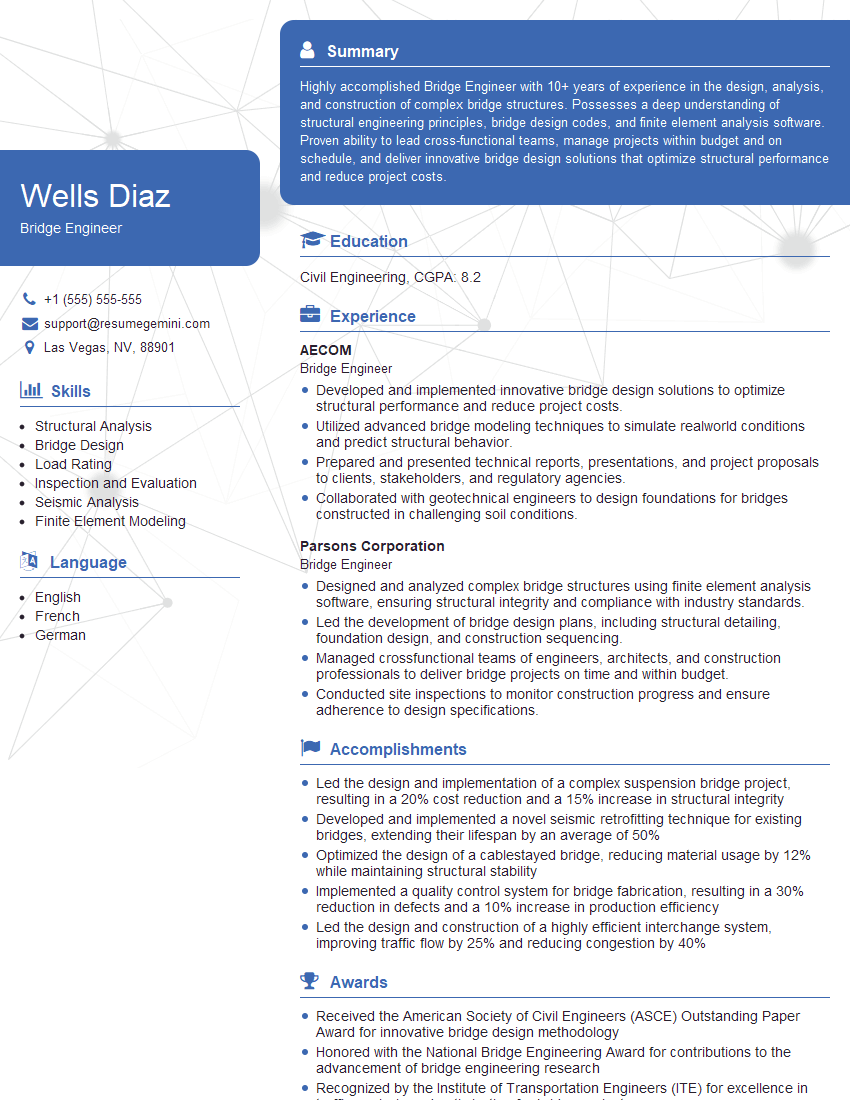
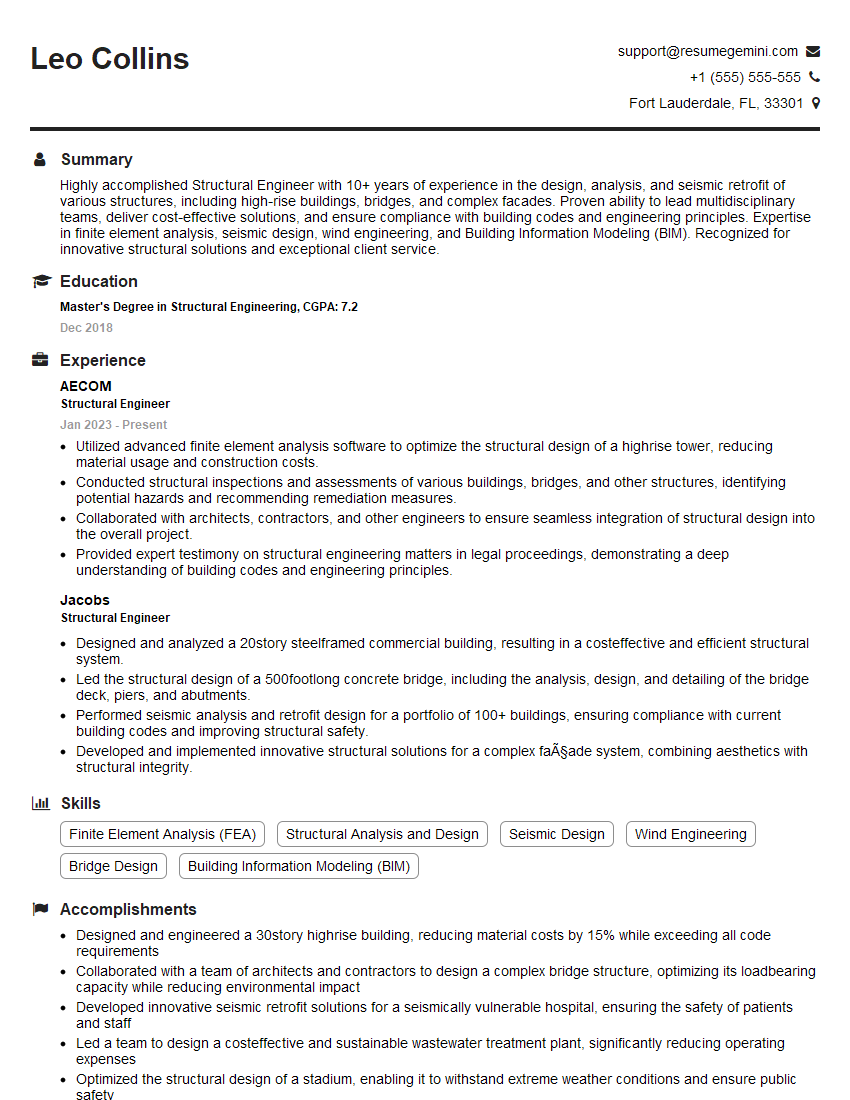
Mastering Structural Analysis and Calculation is crucial for a successful and rewarding career in structural engineering. A strong understanding of these principles opens doors to exciting projects and leadership opportunities. To maximize your job prospects, create an ATS-friendly resume that highlights your skills and experience effectively. ResumeGemini is a trusted resource that can help you build a professional and impactful resume tailored to the structural engineering field. Examples of resumes tailored to Structural Analysis and Calculation are available to guide you through the process. Invest time in crafting a strong resume – it’s your first impression to potential employers.



Explore more articles
Users Rating of Our Blogs
Share Your Experience
We value your feedback! Please rate our content and share your thoughts (optional).
What Readers Say About Our Blog
To the interviewgemini.com Webmaster.
Very helpful and content specific questions to help prepare me for my interview!
Thank you
To the interviewgemini.com Webmaster.
This was kind of a unique content I found around the specialized skills. Very helpful questions and good detailed answers.
Very Helpful blog, thank you Interviewgemini team.