Interviews are opportunities to demonstrate your expertise, and this guide is here to help you shine. Explore the essential Orientation and Mobility Skills Training interview questions that employers frequently ask, paired with strategies for crafting responses that set you apart from the competition.
Questions Asked in Orientation and Mobility Skills Training Interview
Q 1. Describe the different techniques used for cane travel.
Cane travel techniques are crucial for safe and independent mobility for people with visual impairments. The type of technique used often depends on the individual’s skills and the environment. We primarily teach three main techniques:
- Trailing Technique: The cane is held loosely in the hand and swings in a pendulum-like motion. It’s used to detect changes in the walking surface and obstacles at a distance. Think of it like a gentle exploration of the path ahead. This is often the first technique taught.
- Lateral Technique: The cane is swept back and forth in a broad arc to detect obstacles and changes in the walking surface to the side. It allows individuals to assess a wider area than the trailing technique. Imagine it as a ‘sweeping’ motion to clear the surrounding space.
- Touch Technique: The cane is used to actively ‘feel’ and follow a route. This is commonly used when navigating intricate areas or following a well-defined path like a curb. It’s a more controlled and precise method, akin to carefully feeling your way along a familiar route.
Beyond these, we adapt techniques based on individual needs. For instance, someone with limited upper body strength might benefit from a lighter cane or modified sweeping patterns, while someone with limited mobility might use a shorter cane or chair-based techniques.
Q 2. Explain the concept of ‘environmental orientation’ and its importance in O&M training.
Environmental orientation is the ability to understand and mentally map one’s surroundings. It’s a critical component of O&M training because it allows individuals to navigate independently and confidently. It’s not just about knowing where you are, but understanding the relationship between different landmarks, streets, and buildings. For example, understanding the layout of a city block, knowing which direction leads to a specific store, and even predicting changes in elevation are all parts of environmental orientation. We use a variety of techniques to develop environmental orientation, including:
- Tactile exploration: Physically touching surfaces to understand their texture, shape, and location.
- Auditory cues: Using sounds to identify landmarks or changes in environment (e.g., traffic, shop sounds, etc.).
- Spatial memory: Using mental maps to recall routes and locations.
- Landmark identification: Identifying and memorizing key visual or tactile landmarks to assist with orientation.
Poor environmental orientation can lead to frustration and decreased independence, so building these skills is fundamental to our training approach.
Q 3. How do you assess a client’s current O&M skills?
Assessing a client’s O&M skills requires a multifaceted approach. It begins with an interview to understand their history, previous experiences with mobility, and their goals. I then proceed with observation in various environments: a structured setting like my office, followed by a more naturalistic setting, such as a local park or shopping centre.
The assessment includes observing their use of a cane (if applicable), their ability to follow a route, their awareness of their surroundings, their use of environmental cues, and their ability to problem-solve in different situations. I might use standardized assessments, but importantly, I assess functional skills—can they safely and efficiently navigate to their specific destination?
For example, I might ask a client to walk a specific route, noting their efficiency, safety, and the strategies they employ. I also observe their responses to unexpected obstacles, how they ask for help, and their overall confidence level.
Q 4. What are the key considerations when teaching route travel?
Teaching route travel involves more than just memorizing a sequence of steps; it’s about building a cognitive map of the environment. Key considerations include:
- Breaking down the route: Dividing the route into smaller, manageable segments with distinct landmarks. This makes learning less overwhelming and improves success.
- Landmark identification and sequencing: Focusing on clear, consistent, and easy-to-identify landmarks and teaching the client to use these as reference points for navigation.
- Safety considerations: Ensuring the client is aware of and can avoid potential hazards such as traffic, construction sites, or uneven pavement. This is particularly crucial in busy areas.
- Developing flexible strategies: Preparing the client for variations in their route and teaching them how to adapt their approach depending on environmental changes, like construction or road closures. This is about adaptable navigation, not just rigid memorization.
- Repetition and practice: Consistent practice is key to solidifying route knowledge and building confidence. We gradually increase the complexity of the routes as the client’s skills improve. The process is iterative and client-specific.
For example, I’d guide a client initially along a simple route from their home to a nearby store, marking key landmarks. Each subsequent session would gradually increase the complexity and length until the client can travel the route independently and confidently.
Q 5. Explain the differences between tactile, auditory, and kinesthetic cues in O&M.
Tactile, auditory, and kinesthetic cues are all integral to O&M. They provide different types of information about the environment and the client’s position within it.
- Tactile cues: These involve information gathered through touch, such as the texture of a surface, the shape of an object, or the presence of a curb or wall. Using a cane enhances tactile awareness and greatly expands their perception of the environment.
- Auditory cues: These include sounds like traffic, speech, building noises, and environmental sounds like wind. These help to locate objects, understand the surroundings, and recognize landmarks.
- Kinesthetic cues: These are internal cues received through bodily sensations, such as balance, posture, and muscle tension. They help the individual understand their orientation and movements within the environment.
Imagine crossing a street; a visually impaired individual might use auditory cues (traffic sounds) to judge the safety of crossing, tactile cues from a curb to understand where the street ends, and kinesthetic cues to maintain balance. We teach our clients to integrate all three effectively for safe and efficient travel.
Q 6. How do you adapt O&M instruction for clients with different cognitive abilities?
Adapting O&M instruction for clients with diverse cognitive abilities is crucial. My approach is to individualize the learning process, adjusting the complexity of tasks, teaching methods, and communication strategies as needed.
For clients with mild cognitive impairments, I might use simpler language, break down tasks into smaller steps, and use visual aids (if appropriate) to reinforce learning. With clients with more significant cognitive challenges, I focus on concrete, hands-on activities. The communication may need to be simpler and more repetitive, and I adjust the pace to match their capabilities. In cases of cognitive impairments, consistent and repetitive practice over time is paramount to learning. We celebrate small successes and focus on building a client’s confidence.
For example, for a client with memory challenges, I might use highly visual aids such as large tactile maps and consistent verbal cues to learn a route. Success requires patience and a highly individualized approach.
Q 7. Describe your experience with various assistive devices used in O&M.
Throughout my career, I’ve worked extensively with a range of assistive devices, including long canes (various weights and lengths), electronic travel aids (ETAs), GPS devices, smart canes, and apps designed for navigation. My experience goes beyond simple use; I understand their strengths, limitations, and appropriate applications.
Long canes are foundational, but ETAs, for example, provide auditory cues about obstacles, while GPS-based apps help with route planning and situational awareness. Smart canes integrate technology to provide haptic feedback, combining technological assistance with the skills acquired through traditional cane travel. My expertise extends to teaching clients how to integrate these technologies into their existing cane technique and to choose technologies appropriate to their needs, abilities, and environment.
I’ve found that effective instruction necessitates a thorough understanding of how various technologies can support different aspects of orientation and mobility, as well as the potential limitations of any device.
Q 8. How do you address safety concerns during O&M instruction?
Safety is paramount in Orientation and Mobility (O&M) instruction. We address safety concerns proactively and reactively. Proactively, this involves thorough route planning, considering environmental factors like traffic, construction, and uneven surfaces. We teach safe travel techniques, such as using the cane effectively, maintaining appropriate spacing from obstacles, and employing strategies for crossing streets safely. We also ensure the client understands the importance of situational awareness and how to react to unexpected events. Reactively, if a near-miss or incident occurs, we debrief the situation calmly, analyzing what happened and identifying strategies for preventing similar occurrences in the future. This might involve adjusting travel techniques, modifying the route, or reinforcing specific safety skills. For example, if a client almost collided with a vehicle, we’d review proper street crossing techniques and practice them in a controlled environment. We also emphasize the importance of reporting any accidents or incidents to ensure appropriate follow-up and prevent future problems.
Q 9. Explain the process of teaching spatial awareness.
Teaching spatial awareness involves building a client’s understanding of their environment and their position within it. We begin with simple activities, such as identifying near and far objects, describing the shape of a room, or recognizing changes in floor texture. Gradually, we introduce more complex concepts, such as understanding relative direction (left, right, forward, backward), estimating distances, and mentally mapping routes. We use a variety of techniques, including tactile exploration, verbal cues, and visual aids (for clients with some residual vision). A common exercise involves guiding a client through a simple maze or obstacle course, asking them to describe their surroundings and their own movements. We might also use real-world scenarios, such as navigating a familiar building or planning a trip to a new location, allowing the client to practice and refine their spatial awareness skills in realistic situations. For example, describing a path from their home to a coffee shop, including landmarks and turns.
Q 10. How do you incorporate technology into your O&M instruction?
Technology plays a significant role in modern O&M instruction. GPS devices and apps like BlindSquare and Aira can provide real-time location information, route guidance, and obstacle detection. Smartphone apps can also aid in identifying objects, reading text, and accessing information. I use these tools to supplement, not replace, traditional O&M skills. For instance, a client might learn to use a GPS app for independent travel to familiar locations, but they would also need strong cane skills to navigate unforeseen obstacles or changes in the environment. Other technologies such as smart canes that incorporate sensors offer added layers of safety and orientation. We incorporate training on these technologies as part of a holistic O&M program ensuring the client understands both the capabilities and limitations of the devices.
Q 11. What are some common challenges faced by individuals with visual impairments, and how do you address them?
Individuals with visual impairments face a variety of challenges, including difficulty with navigation, object recognition, and environmental awareness. They may also experience social anxieties and challenges in accessing information. To address these, we use a multi-faceted approach. For navigation challenges, we focus on building strong cane skills, developing route planning strategies, and using assistive technology. We address object recognition difficulties through tactile exploration and verbal descriptions. To overcome environmental awareness challenges, we teach strategies for interpreting auditory and tactile cues. To help with social anxieties, we incorporate role-playing and real-world practice to build confidence. For example, I helped a client overcome their fear of crossing busy intersections by gradually exposing them to progressively busier environments, beginning with quiet residential streets and working up to major thoroughfares, reinforcing their successful use of street crossing techniques along the way. We adapt the pace of instruction to the client’s learning style and needs, employing patience and understanding throughout.
Q 12. How do you develop individualized O&M goals for your clients?
Developing individualized O&M goals is a crucial part of the process. It begins with a comprehensive assessment, which includes evaluating the client’s current skills, limitations, and personal goals. We consider their age, cognitive abilities, physical condition, and preferred learning style. Then, we collaborate with the client, their family, and other professionals, such as teachers or therapists, to create a personalized plan that aligns with their specific needs and aspirations. These goals should be SMART – Specific, Measurable, Achievable, Relevant, and Time-bound. For example, a goal might be, “Independently navigate from home to the local grocery store using a long cane within six weeks.” We regularly review and revise these goals, ensuring that they remain challenging yet achievable and reflect the client’s progress.
Q 13. Describe your experience working with diverse populations.
I have extensive experience working with diverse populations, including children, adults, and seniors, with varying levels of visual impairment. My approach emphasizes cultural sensitivity and individualized instruction. I’ve worked with clients from diverse linguistic and cultural backgrounds, adapting my techniques to suit their communication styles and preferences. I’ve worked with clients who have additional disabilities, such as cognitive impairments or mobility limitations, requiring a flexible and adaptive approach to instruction. A key aspect is incorporating cultural considerations into the training process. For instance, when working with a client from a different cultural background, I take the time to understand their cultural norms and preferences to ensure the training process is respectful and effective. This might involve incorporating familiar routes or landmarks into training sessions, or modifying techniques to align with their cultural practices.
Q 14. How do you document your client’s progress in O&M training?
Documentation of client progress is critical. We utilize detailed progress notes, recording each session’s objectives, activities, and the client’s performance. These notes include observations on skill acquisition, challenges faced, and strategies implemented. We use standardized assessment tools to measure progress objectively, using rating scales to assess cane skills, route planning, and other areas of performance. These data are used to inform modifications to the O&M plan, demonstrating accountability and enabling a clear, comprehensive overview of progress over time. Regular progress reports are provided to the client, their family, and other relevant professionals. The information is maintained confidentially in accordance with privacy regulations.
Q 15. How do you measure the effectiveness of your O&M instruction?
Measuring the effectiveness of O&M instruction is crucial for ensuring client progress and program efficacy. It’s not a one-size-fits-all approach; we utilize a multifaceted evaluation strategy that combines quantitative and qualitative data.
- Pre- and Post-Tests: We administer standardized tests, such as the Orientation and Mobility Assessment (OMA), to track improvements in specific skills like route travel, independent mobility, and use of assistive devices. This provides concrete, measurable data.
- Observation during training sessions: Direct observation allows for assessment of skills in real-world settings and identification of areas requiring further attention. We note improvements in spatial awareness, cane technique, and environmental awareness.
- Client self-reporting and feedback: Regular check-ins with the client are crucial. We ask about their confidence levels, the challenges they face in their daily routines, and their overall satisfaction with their progress. This provides valuable qualitative insights.
- Functional assessments in real-world environments: We conduct assessments in various settings familiar to the client (home, work, community) to gauge their ability to navigate independently and safely. This goes beyond the structured testing environment.
- Collaboration with other professionals: We regularly communicate with teachers, therapists, and family members to obtain diverse perspectives on the client’s progress, creating a holistic view.
For example, a client struggling with route travel might show improved accuracy and speed after a series of training sessions, demonstrating effectiveness. Conversely, if minimal progress is noted despite intervention, we’d re-evaluate our teaching methods and strategies.
Career Expert Tips:
- Ace those interviews! Prepare effectively by reviewing the Top 50 Most Common Interview Questions on ResumeGemini.
- Navigate your job search with confidence! Explore a wide range of Career Tips on ResumeGemini. Learn about common challenges and recommendations to overcome them.
- Craft the perfect resume! Master the Art of Resume Writing with ResumeGemini’s guide. Showcase your unique qualifications and achievements effectively.
- Don’t miss out on holiday savings! Build your dream resume with ResumeGemini’s ATS optimized templates.
Q 16. How do you maintain confidentiality when working with clients?
Maintaining client confidentiality is paramount, and it’s a cornerstone of my professional practice. I adhere to strict ethical guidelines and legal regulations surrounding protected health information (PHI).
- HIPAA Compliance: I am fully aware of and compliant with the Health Insurance Portability and Accountability Act (HIPAA) regulations, which govern the privacy and security of protected health information.
- Secure Record Keeping: All client files, both physical and electronic, are stored securely and are only accessible to authorized personnel. Electronic records are password protected and encrypted.
- Confidentiality Agreements: If necessary, I will utilize written confidentiality agreements with any collaborating professionals or support staff.
- Only disclosing information with consent: I will only disclose information about a client to third parties with the client’s explicit written consent, except where legally mandated, such as in cases of suspected abuse or neglect.
- Privacy in conversations: I ensure privacy during conversations, whether in person, on the phone, or through electronic communication.
For instance, I would never discuss a client’s case with anyone not directly involved in their care without explicit consent, even with close colleagues.
Q 17. What is your understanding of the Americans with Disabilities Act (ADA) in relation to O&M?
The Americans with Disabilities Act (ADA) is fundamental to my work as an O&M specialist. The ADA prohibits discrimination against individuals with disabilities in all areas of public life, including employment, state and local government services, public accommodations, commercial facilities, and transportation.
In relation to O&M, the ADA mandates reasonable accommodations to ensure individuals with visual impairments have equal access to education, employment, and community participation. This might include providing O&M services, modifying physical environments to improve accessibility, and providing assistive technology.
For example, an employer must provide reasonable accommodations such as O&M training and adapted workspaces, ensuring that a visually impaired employee has equal opportunities to perform their job. Public buildings must comply with ADA accessibility guidelines to ensure safe and independent navigation for everyone, including individuals with visual impairments.
Understanding and applying the ADA’s requirements ensures that my clients can fully participate in society, and that I am practicing ethically and legally.
Q 18. How would you handle a situation where a client is struggling to learn a new skill?
When a client struggles with a new skill, I approach the situation with patience and a systematic problem-solving approach. The key is to identify the root cause of the difficulty and adjust my teaching strategies accordingly.
- Identify the specific challenge: Through observation and questioning, I pinpoint the exact aspect of the skill causing difficulty. Is it a physical limitation, a cognitive challenge, or a lack of understanding of the concept?
- Break down the skill: Complex skills are broken down into smaller, manageable steps. This makes learning less overwhelming and allows for focused practice on specific components.
- Adjust teaching methods: I adapt my teaching strategies based on the client’s learning style and preferences. Some may benefit from hands-on learning, while others may respond better to verbal instructions.
- Provide positive reinforcement and encouragement: Building the client’s confidence is crucial. Celebrating small successes, even minor advancements, boosts motivation and encourages persistence.
- Utilize assistive technology if needed: Depending on the client’s needs, I might introduce or refine the use of assistive technology like GPS devices or specialized canes.
- Reassess and modify the approach: If a particular method isn’t working, I openly re-evaluate my approach and modify it based on the client’s response. It might involve a different teaching style, a change in the learning environment, or the introduction of new resources.
For instance, if a client is struggling with using a long cane effectively, I might start with simple exercises focusing on cane placement and body posture before progressing to more complex techniques like crossing streets.
Q 19. Describe your approach to teaching object location and identification.
Teaching object location and identification is a foundational skill in O&M. My approach emphasizes a multi-sensory approach, building on the client’s remaining senses and adapting to their individual learning styles.
- Tactile exploration: I encourage clients to explore objects using their hands, paying attention to texture, shape, size, and temperature. This builds a mental image through touch.
- Auditory cues: Listening to the sounds objects make (e.g., the clinking of glasses, the rustling of papers) can provide valuable clues about their identity and location. We practice identifying objects by sound alone.
- Spatial relationships: We work on understanding the spatial relationship between the client and the object using verbal cues and landmarks. This helps develop a clear mental map of their surroundings.
- Visual aids (if applicable): For clients with some residual vision, we use large-print labels or magnifiers to enhance visual identification.
- Real-world practice: Object identification is integrated into real-world scenarios, such as finding items in a kitchen or locating landmarks during route travel.
- Memory games and activities: Fun memory-building games help strengthen the client’s ability to recall objects and their locations.
For instance, teaching a client to locate a specific item in a grocery store involves understanding the layout of the store, utilizing tactile and auditory cues, and practicing questioning others for assistance when necessary.
Q 20. Explain the importance of ongoing assessment and reassessment in O&M training.
Ongoing assessment and reassessment are vital for effective O&M training. They ensure that the training remains relevant and tailored to the client’s changing needs and progress. This dynamic process avoids a one-time evaluation approach.
- Tracking progress: Regular assessments monitor the client’s mastery of skills and identify areas needing further attention. This helps us adjust training plans and ensure optimal learning outcomes.
- Adapting to changing needs: Clients’ needs can change due to physical changes, environmental shifts, or new life circumstances. Ongoing assessments allow for timely adjustments to the training plan to maintain its effectiveness.
- Identifying new goals: As the client progresses, new goals and objectives are identified and integrated into the training plan. This keeps the training purposeful and engaging.
- Measuring success: Ongoing assessments provide concrete evidence of the effectiveness of the training program and the client’s progress toward achieving their goals. This is crucial for accountability and demonstrating the value of the O&M intervention.
- Boosting motivation: Observing progress motivates both the client and the instructor. It allows for celebration of achievements and a focus on the next set of learning objectives.
For example, a client might initially focus on cane skills; as proficiency increases, assessments reveal readiness for route training, triggering a shift in the training focus.
Q 21. How do you collaborate with other professionals involved in a client’s care?
Collaboration is essential for providing comprehensive and effective O&M services. I actively work with a range of professionals to create a supportive and holistic care plan for my clients.
- Teachers: I collaborate with teachers to ensure that classroom environments are accessible and that the student’s mobility skills are supported in the school setting. This might involve classroom modifications or strategies for independent movement within the school.
- Therapists (OT, PT): I coordinate with occupational and physical therapists to address any physical limitations that might impact the client’s mobility. This ensures a synergistic approach to skill development.
- Family members: I involve family members in the training process, providing them with strategies and techniques to support their loved one’s independent mobility at home and in the community.
- Orientation and Mobility Specialists: I work with colleagues to create a seamless transition for clients moving between settings or needing specialized support (e.g., low vision O&M).
- Social workers and case managers: Collaboration ensures that other relevant services and resources are identified and utilized to support the client’s overall well-being.
For example, working with a teacher might involve arranging for a student to have designated travel time between classes to accommodate their need for cane travel. Collaboration with the family would include showing them how to safely assist the client with complex routes at home.
Q 22. How would you adapt your instruction for a client with additional disabilities?
Adapting Orientation and Mobility (O&M) instruction for clients with additional disabilities requires a holistic approach. It’s crucial to understand the interplay of all the client’s impairments and how they affect their ability to navigate. For example, a client with both visual impairment and cerebral palsy will require different techniques than a client with only visual impairment. We start by conducting a thorough assessment, not only of their visual abilities, but also their physical, cognitive, and communicative capabilities.
My approach involves individualized instruction, breaking down complex tasks into smaller, manageable steps. For a client with limited physical mobility, I might adapt cane techniques to use less strenuous movements, or incorporate assistive devices such as a wheelchair or walker into the training. For a client with cognitive impairments, I use simplified language, visual aids, and repetition to reinforce learning. Communication is key – I collaborate closely with other professionals such as physical therapists, occupational therapists, and speech therapists to create a cohesive and supportive intervention plan. For instance, I worked with a client who was both blind and had autism spectrum disorder. We focused on building a strong routine using tactile maps and consistent verbal cues, creating a sense of predictability that reduced anxiety and increased their success in navigating their environment. This collaborative, adaptable method ensures each client receives the most effective and supportive instruction.
Q 23. Describe your experience with different types of cane techniques.
My experience encompasses a wide range of cane techniques, tailored to individual client needs and environments. The basic techniques include the trailing technique (used for detecting obstacles close to the body), the touch technique (for navigating more complex terrain), and the directional technique (used for broader area scanning and route planning). I’m proficient in teaching the various grips and angles for each technique, adjusting them based on the client’s physical capabilities. I’ve found that the progression is crucial – starting with simple techniques in controlled environments before moving to more complex situations.
Beyond the basics, I’ve also trained clients in advanced techniques such as the slalom technique for navigating narrow spaces, the sweeping technique for quickly assessing wider areas, and techniques for using the cane in conjunction with other assistive technology. For example, I recently worked with a client who needed to navigate a bustling city center. I taught her to adapt her cane techniques to incorporate the surrounding sounds and to use the cane to protect herself from traffic. Each technique is not a one-size-fits-all approach; it’s about understanding the client’s goals and challenges and selecting the technique that maximizes their independence and safety.
Q 24. How do you teach clients to use public transportation safely?
Teaching clients to use public transportation safely involves a multi-faceted approach. It starts with a thorough assessment of their cognitive and physical abilities. This is often coupled with a pre-trip visit to the actual bus stop, train station, or other transportation hub. I explain the process step-by-step, focusing on specific aspects like using auditory cues (announcements and the sounds of approaching trains), paying attention to tactile cues (different surfaces, handrails, seating), and understanding visual cues if available such as signage and markings.
Then we simulate the journey in a practice setting before attempting it in a real-world environment. Safety is paramount, so I start by teaching strategies for boarding and alighting safely, which may include using designated areas and requesting assistance. I guide them through how to buy tickets, request assistance from the staff, and maintain their personal safety throughout their journey. I provide training that includes planning ahead, using maps or GPS technology, and anticipating potential challenges. For instance, I’ve worked with clients to create detailed checklists or audio recordings to remember important steps, making the whole process less overwhelming and more efficient. The ultimate goal is to promote independent mobility, ensuring clients feel confident and safe using public transportation.
Q 25. What strategies do you use to promote self-advocacy in your clients?
Promoting self-advocacy is an essential aspect of O&M training. It empowers clients to actively participate in their own rehabilitation and navigate the world independently. I start by fostering open communication and creating a trusting environment where clients feel comfortable expressing their needs and concerns. I actively encourage them to participate in setting goals, planning lessons, and evaluating their progress.
To develop their self-advocacy skills, I role-play various scenarios, such as requesting assistance, explaining their needs to others, and addressing challenges encountered in public spaces. I equip them with the vocabulary and strategies to effectively communicate their needs and preferences. For example, I teach them how to politely ask for help, identify potential barriers, and find appropriate solutions. I also provide clients with resources and information to help them become informed advocates for themselves. This includes connecting them with local support groups, assistive technology providers, and advocacy organizations. A key strategy is demonstrating respect for their perspectives and choices, allowing them the freedom to make informed decisions about their mobility needs.
Q 26. How do you address challenges with route finding in unfamiliar environments?
Addressing challenges with route-finding in unfamiliar environments requires a combination of strategies. First, I teach clients how to utilize available resources such as maps (both tactile and visual), GPS devices, and smart phone apps. These tools should be tailored to the individual’s specific needs and abilities. We practice using these tools in a variety of settings, gradually increasing the complexity of the tasks.
I teach clients various strategies for using landmarks and environmental cues, such as sounds, smells, and textures, to orient themselves and remember routes. I emphasize the importance of breaking down a route into smaller, manageable segments. I might introduce the concept of using “checkpoints” – familiar locations along the route to help them stay on track. We practice these strategies in progressively challenging environments, from simple indoor spaces to more complex outdoor settings. For example, if a client is going to a new location, I encourage them to contact the establishment beforehand to gather information about accessibility features. Building confidence in their problem-solving abilities is a major part of this process.
Q 27. Explain the different types of maps and how they are used in O&M training.
Different types of maps play a crucial role in O&M training. Tactile maps provide raised-line representations of environments, allowing visually impaired individuals to gain a spatial understanding of an area. These can be simple diagrams representing a room’s layout or more complex representations of city streets and buildings. Large-print maps cater to clients with low vision, offering a simplified visual representation of the environment.
We also use audio maps or descriptions of the environment provided via audio recordings or apps. This could include detailed instructions, including verbal descriptions of landmarks, intersections, and points of interest. Finally, digital maps on smartphones and GPS devices provide another layer of assistance, allowing for real-time navigation and route planning. The choice of map depends on the client’s specific needs and the complexity of the environment. For example, a simple tactile map might be sufficient for navigating a small office, while a detailed digital map might be necessary for traveling across a city. I work with the client to determine which map or combination of maps best supports their navigational skills and confidence.
Q 28. Describe your experience in using GPS and other assistive technology for navigation.
GPS technology and other assistive technologies are invaluable tools in modern O&M training. I have extensive experience using various GPS devices, smartphone apps, and other assistive technologies to enhance my clients’ navigational skills. These tools provide real-time location information, route guidance, and point-of-interest data, significantly improving independence and safety.
However, it’s essential to teach clients how to use these technologies effectively and to understand their limitations. For example, GPS signals can be unreliable in certain areas, such as underground spaces or densely built-up areas. Therefore, I emphasize the importance of complementary skills, such as using a cane and environmental cues, to ensure a safe and reliable journey. We practice integrating these technologies into their daily routine, teaching them to interpret the information provided, troubleshoot technical difficulties, and adapt their approach when technology fails. For instance, I worked with a client who had trouble understanding GPS directions. We practiced using the app in a controlled setting, simplifying the interface and using landmarks to supplement the audio instructions. Using assistive technology is not about replacement, it’s about augmentation and empowering the client.
Key Topics to Learn for Orientation & Mobility Skills Training Interview
- Spatial Awareness & Route Planning: Understanding and utilizing various techniques for independent travel, including landmark recognition, tactile and auditory cues, and mental mapping. Practical application: Describe your experience planning and executing a route using different orientation and mobility skills in varied environments.
- Cane Techniques: Proficient use of different cane techniques (e.g., trailing, sweeping, directional) for detecting obstacles and navigating different terrains. Practical application: Explain how you adapt your cane technique based on the environment and the presence of specific obstacles.
- Travel Training Methods: Familiarity with various travel training methodologies and their application in different settings (e.g., initial orientation & mobility training, advanced travel training). Practical application: Discuss your experience implementing and adapting travel training techniques for individuals with diverse needs and abilities.
- Low Vision Aids & Technology: Knowledge and practical application of assistive technology, including magnifiers, electronic aids, and GPS devices. Practical application: Describe how you incorporate assistive technology into your orientation and mobility instruction and assessment.
- Safety & Emergency Procedures: Understanding and implementing safety protocols for independent travel, including emergency response plans. Practical application: Detail a scenario where you had to apply your knowledge of safety procedures while providing orientation and mobility instruction.
- Assessment & Documentation: Proficiency in conducting thorough assessments, developing individualized travel plans, and maintaining accurate documentation. Practical application: Explain your process for assessing an individual’s orientation and mobility skills and developing a suitable intervention plan.
- Ethical Considerations & Client Advocacy: Understanding and upholding professional ethics in the field of orientation and mobility. Practical application: Discuss a situation where ethical considerations played a critical role in your decision-making process as an Orientation and Mobility Specialist.
Next Steps
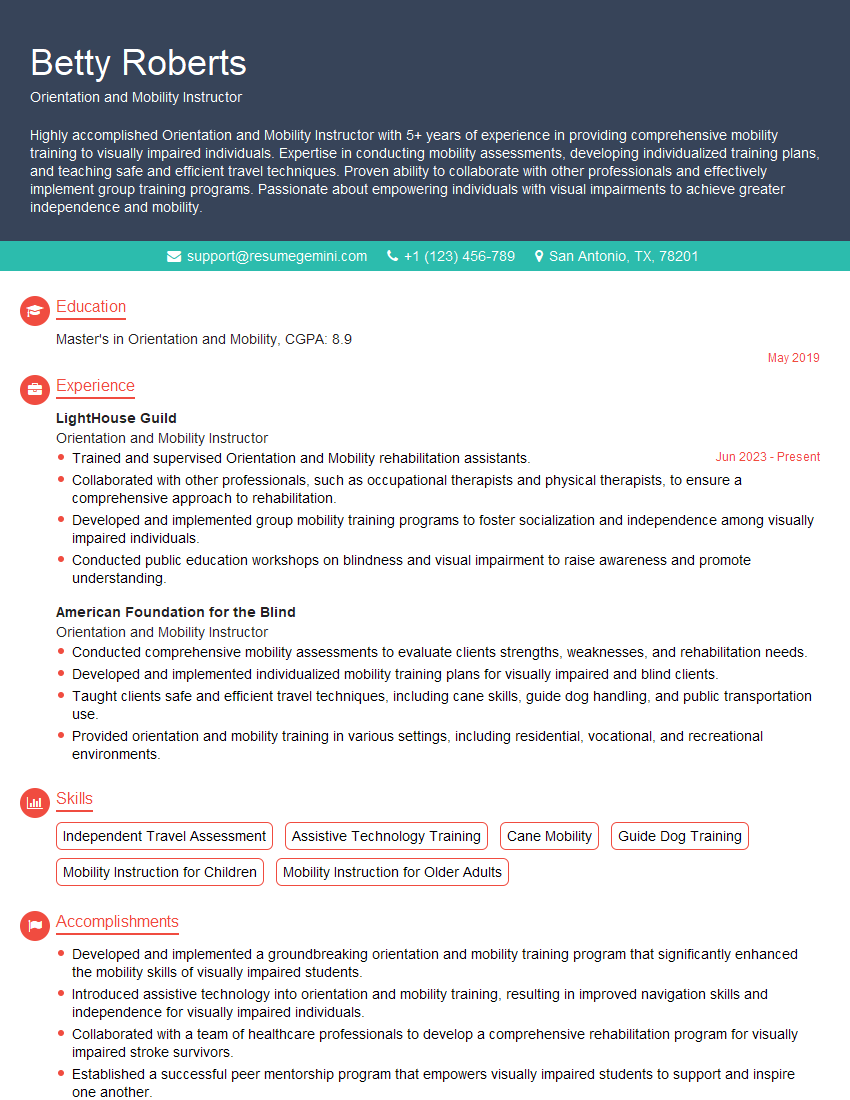
Mastering Orientation and Mobility Skills Training opens doors to rewarding careers focused on empowering individuals to achieve greater independence. To maximize your job prospects, creating a strong, ATS-friendly resume is crucial. ResumeGemini is a trusted resource to help you build a professional resume that highlights your skills and experience effectively. Examples of resumes tailored to Orientation and Mobility Skills Training are available to guide you. Take advantage of these resources to present yourself as the ideal candidate for your dream role.
Explore more articles
Users Rating of Our Blogs
Share Your Experience
We value your feedback! Please rate our content and share your thoughts (optional).
What Readers Say About Our Blog
To the interviewgemini.com Webmaster.
Very helpful and content specific questions to help prepare me for my interview!
Thank you
To the interviewgemini.com Webmaster.
This was kind of a unique content I found around the specialized skills. Very helpful questions and good detailed answers.
Very Helpful blog, thank you Interviewgemini team.