Unlock your full potential by mastering the most common Alloy Welding interview questions. This blog offers a deep dive into the critical topics, ensuring you’re not only prepared to answer but to excel. With these insights, you’ll approach your interview with clarity and confidence.
Questions Asked in Alloy Welding Interview
Q 1. Explain the difference between different alloy welding processes (e.g., MIG, TIG, SMAW).
Alloy welding encompasses several processes, each with unique characteristics. The main differences lie in the power source, electrode type, shielding method, and resulting weld characteristics.
- MIG (Gas Metal Arc Welding): Uses a continuous consumable electrode wire fed through a gun, with a shielding gas (usually Argon or a mixture of Argon and CO2) protecting the weld from atmospheric contamination. MIG is versatile, fast, and suitable for various alloy types, offering good penetration and a relatively smooth weld bead. It’s commonly used in high-volume production.
- TIG (Gas Tungsten Arc Welding): Employs a non-consumable tungsten electrode, also shielded by an inert gas (usually Argon). Filler metal is added separately, allowing for precise control over weld bead geometry. TIG is ideal for high-quality, precision welds on thinner materials and exotic alloys, though it is slower than MIG.
- SMAW (Shielded Metal Arc Welding): This process, commonly known as stick welding, utilizes a coated electrode, with the coating providing shielding and alloying elements. The electrode melts, providing both shielding and filler material. SMAW is very portable and requires minimal equipment, but it is slower than MIG or TIG and produces a less aesthetically pleasing weld bead. It’s often used in field applications where portability is paramount.
The choice of process depends on factors like material thickness, joint design, desired weld quality, access to the weld area, and production speed requirements. For instance, TIG might be preferred for welding thin titanium alloys due to its precise control, while MIG could be a better choice for joining thicker stainless steel sections quickly.
Q 2. Describe your experience with various filler metals used in alloy welding.
My experience spans a wide range of filler metals, each carefully selected based on the base metal’s composition and the desired weld properties. For instance, I’ve extensively used ER308LSi filler wire for welding 304 stainless steel, prioritizing low carbon content to minimize intergranular corrosion. In aluminum welding, I’ve used ER5356 for its excellent strength and corrosion resistance in marine environments. Working with nickel alloys often involves using filler metals like Inconel 625, tailored to match the specific alloy’s composition and ensuring superior high-temperature strength and resistance to oxidation. When working with high-strength low-alloy steels, I carefully select filler metals to match the base metal’s tensile strength and yield strength while avoiding hydrogen cracking issues. In each case, careful selection of filler metal is critical to achieving the desired weld quality and preventing problems down the line. Furthermore, I’m well-versed in the use of pre-alloyed filler metals for specific applications that minimize the risk of hot-cracking.
Q 3. What are the common challenges faced in alloy welding and how do you overcome them?
Alloy welding presents unique challenges due to the specific characteristics of different alloy families. Some common issues include:
- Hot Cracking: This occurs during solidification, primarily due to high sulfur or phosphorus content or improper welding techniques. Addressing this involves preheating the material to reduce the thermal gradient during welding and selecting appropriate filler metals with low sulfur and phosphorus content.
- Porosity: This is caused by trapped gas during welding, often stemming from poor shielding gas coverage, moisture contamination, or improper welding parameters. Solutions include ensuring proper gas coverage, keeping the materials clean and dry, and adjusting the welding parameters such as current and travel speed.
- Weld Metal Oxidation: This is a major concern with certain alloys, especially those prone to oxidation at high temperatures. Minimizing oxidation requires employing proper shielding gases and rapid cooling methods. For example, back-purging can be useful in tube welding.
- Difficult Fusion: Some alloys exhibit poor wetting characteristics, leading to poor fusion with the base metal. This can be improved through pre-weld cleaning, optimized welding parameters, and the selection of compatible filler materials.
Overcoming these challenges requires a thorough understanding of metallurgy, precise control over welding parameters, and a systematic approach to problem-solving.
Q 4. How do you ensure the quality and integrity of your alloy welds?
Ensuring weld quality and integrity is paramount. My approach involves a multi-faceted strategy:
- Visual Inspection: A thorough visual inspection is the first step, checking for any obvious defects like cracks, undercuts, or porosity.
- Dimensional Inspection: Verifying weld dimensions against specifications ensures proper penetration and fusion.
- Non-Destructive Testing (NDT): I utilize various NDT methods such as radiographic testing (RT), ultrasonic testing (UT), and dye penetrant testing (PT) to detect internal flaws such as cracks or porosity.
- Mechanical Testing: Tensile testing, bend testing, and hardness testing provide quantitative data about the weld’s mechanical properties and ensure they meet the required standards.
- Metallurgical Examination: In critical applications, a microscopic examination of the weld metal and heat-affected zone is conducted to assess microstructural characteristics and detect any potential issues.
- Documentation: Meticulous record-keeping of welding parameters, NDT results, and material certifications forms the basis of traceability and ensures compliance with quality standards.
This comprehensive approach ensures the highest level of confidence in the weld’s structural integrity and long-term performance.
Q 5. Explain the importance of pre-weld and post-weld heat treatments in alloy welding.
Pre-weld and post-weld heat treatments are crucial for controlling the microstructure and mechanical properties of the weldment and minimizing residual stresses.
- Pre-weld heat treatment: This aims to reduce residual stresses and improve the weldability of the base material. It might involve stress-relieving anneals to minimize cracking susceptibility. Preheating, especially for thicker sections, reduces the cooling rate and mitigates the risk of hydrogen cracking.
- Post-weld heat treatment (PWHT): This is critical in many applications, reducing residual stresses and improving toughness. PWHT can also enhance the corrosion resistance and refine the grain structure, especially in materials that undergo significant microstructural changes during the welding process, like some stainless steels. The specifics of PWHT (temperature and duration) depend heavily on the base metal and weld parameters.
The choice and parameters of these heat treatments are carefully determined based on material specifications, the welding process used, and the intended service conditions of the final weldment. Failure to implement these steps can lead to catastrophic failures in the long run.
Q 6. What are the different types of weld defects commonly encountered in alloy welding?
Several weld defects can occur in alloy welding, jeopardizing the weld’s integrity. Common ones include:
- Cracks: These can be caused by various factors including high residual stresses, improper heat input, or the presence of harmful elements like sulfur. Cracks can be transverse, longitudinal, or crater cracks.
- Porosity: Gas entrapment during welding leads to voids within the weld metal, reducing strength and corrosion resistance.
- Inclusions: Non-metallic particles like oxides, slag, or tungsten inclusions weaken the weld and can act as stress concentrators.
- Lack of Fusion: Inadequate penetration or inter-metallic bonding results in incomplete fusion between the weld metal and the base material, causing localized weakness.
- Undercut: Excessive weld penetration leading to a groove-like defect at the base of the weld, reducing strength and affecting aesthetics.
- Overlap: Excess weld metal that does not properly fuse with the base metal.
The likelihood and severity of these defects depend on various factors, including welding technique, equipment condition, and material properties.
Q 7. How do you identify and rectify these weld defects?
Identifying and rectifying weld defects requires a systematic approach:
- Visual Inspection: Initially, visual examination helps identify surface defects such as cracks and undercuts.
- Non-Destructive Testing (NDT): Methods like radiography, ultrasonic testing, or dye penetrant inspection are employed to detect internal flaws such as porosity, cracks, or lack of fusion.
- Defect Characterization: Once a defect is identified, its type, size, and location are carefully characterized to determine the appropriate corrective action.
- Repair Techniques: Minor surface defects might be repaired by grinding or machining. More severe defects might require rework, involving complete removal of the faulty weld and re-welding the joint using proper techniques and parameters. In some cases, a section of the base metal might need replacement.
- Re-Inspection: After repair, the weld is thoroughly re-inspected to ensure the defect has been successfully addressed and the weld meets the required quality standards.
The choice of repair technique depends on the severity and type of defect and must adhere to relevant codes and standards.
Q 8. What safety precautions do you take while performing alloy welding?
Safety is paramount in alloy welding. My approach is always to follow a layered safety protocol. This starts with proper Personal Protective Equipment (PPE), including a welding helmet with appropriate shade for the process, flame-resistant clothing, gloves, and sturdy safety footwear. I meticulously assess the work area for hazards, ensuring adequate ventilation to mitigate fumes and ensuring a clean, organized space to prevent tripping or accidents. I always utilize appropriate fire safety measures – having a fire extinguisher nearby and understanding the flammability of the materials being welded. Before commencing any work, I conduct a thorough pre-weld inspection to identify potential issues and ensure the integrity of the base materials. Additionally, I familiarize myself with the specific Safety Data Sheets (SDS) for the alloys and filler materials being used, paying close attention to potential health risks like exposure to fumes or harmful particles. Finally, I strictly adhere to all company safety regulations and procedures.
For instance, when working with highly reactive alloys like titanium, specialized inert gas shielding is essential to prevent contamination and fire hazards, necessitating meticulous gas flow control and leak checks. This goes beyond standard safety practices; it’s proactive hazard mitigation.
Q 9. Explain your understanding of weld penetration and fusion.
Weld penetration and fusion are crucial aspects of a sound weld. Weld penetration refers to the depth to which the weld material penetrates into the base metal. Insufficient penetration results in a weak joint prone to cracking, while excessive penetration can cause burn-through. Think of it like inserting a nail into wood – you need enough depth for a strong hold but not so deep that you go right through. Fusion refers to the complete melting and joining of the base metal and the filler material, creating a metallurgical bond. Inadequate fusion leads to porosity and lack of continuity, weakening the weld. Imagine trying to glue two pieces of wood together – you need complete contact for a strong bond.
Achieving both proper penetration and fusion requires careful control of welding parameters, material properties, and joint design. For example, welding thicker sections of stainless steel often requires higher amperage and voltage settings to ensure sufficient penetration, while welding thinner sheets demands lower settings to avoid burn-through. Visual inspection and non-destructive testing (NDT) methods later help to verify the quality of fusion and penetration achieved.
Q 10. Describe your experience with different types of joint designs used in alloy welding.
My experience encompasses a wide range of joint designs used in alloy welding. The choice of joint design is crucial because it significantly impacts the weld’s strength, integrity, and ease of welding. Common designs include:
- Butt joints: Simple, but require precise alignment for complete penetration. Often used for joining flat plates.
- Lap joints: Easy to fabricate, but less efficient in terms of material usage and strength compared to butt joints.
- Tee joints: Used for joining a plate to another at a right angle, often requiring specialized techniques to ensure complete penetration at the intersection.
- Corner joints:Similar to Tee joints but the intersecting plates meet at an angle.
- Edge joints: Used when the edges of two plates are being welded together, similar to butt joints but often requires backing.
The selection of the optimal joint design is influenced by several factors, including the thickness of the materials, the desired strength of the weldment, access constraints, and the welding process used. For example, when welding high-strength alloys, a carefully designed butt joint with appropriate pre-weld preparation might be favored for maximum strength and minimal distortion.
Q 11. How do you select the appropriate welding parameters (e.g., voltage, amperage, travel speed) for different alloys?
Selecting appropriate welding parameters is critical for achieving high-quality welds. These parameters are interdependent and must be carefully chosen based on the specific alloy, its thickness, the joint design, and the chosen welding process. The parameters include:
- Voltage: Affects the arc length and penetration depth. Higher voltage usually leads to deeper penetration.
- Amperage: Controls the heat input. Higher amperage generates more heat, increasing penetration and weld pool size.
- Travel speed: Determines how much heat is applied to a specific area. Slower travel speed leads to increased heat input, whereas faster speed results in lower heat input.
For instance, welding a high-strength, low-alloy steel will require a different setting than welding aluminum. High-strength steels usually need higher amperage and lower travel speed to achieve sufficient fusion and penetration, whereas aluminum, due to its high thermal conductivity, may need higher travel speed to avoid excessive heat buildup and distortion. I often rely on pre-qualified welding procedures (WPS) developed based on extensive testing and experience. These WPS serve as guidelines, but I always make adjustments based on real-time observations of the weld pool and the resulting weld bead, adapting parameters to achieve consistent, high-quality welds.
Q 12. What are the common methods for inspecting alloy welds (e.g., visual inspection, radiographic testing, ultrasonic testing)?
Inspecting alloy welds is crucial to ensuring structural integrity and safety. Several methods are employed, each offering unique advantages:
- Visual Inspection: The most basic method, involving careful observation of the weld for surface defects like cracks, porosity, undercuts, or excessive spatter. This provides a quick assessment of overall weld quality.
- Radiographic Testing (RT): Uses X-rays or gamma rays to detect internal defects like porosity, inclusions, and cracks. RT is very effective for revealing hidden flaws, but it is more expensive and requires specialized equipment and trained personnel.
- Ultrasonic Testing (UT): Employs high-frequency sound waves to detect internal defects. UT is relatively portable, and can penetrate thicker materials more easily than RT. It’s useful for detecting flaws such as laminations and cracks.
- Liquid Penetrant Testing (LPT): Used to detect surface-breaking defects. A dye is applied, and excess dye is removed, leaving the dye in any surface discontinuities.
The choice of inspection method depends on several factors, including the criticality of the weld, the material type, the accessibility of the weld, and the required level of detail. For critical applications, a combination of methods is often used to provide a comprehensive evaluation of weld quality. For example, a visual inspection might be followed by RT or UT for high-consequence welds.
Q 13. Explain your experience with non-destructive testing (NDT) methods used for alloy welds.
My experience with Non-Destructive Testing (NDT) methods for alloy welds is extensive. I’m proficient in interpreting results from various NDT techniques, including those mentioned earlier: Radiographic Testing (RT), Ultrasonic Testing (UT), and Liquid Penetrant Testing (LPT). I also have experience with Magnetic Particle Testing (MT), which is used to detect surface and near-surface flaws in ferromagnetic materials. Proficiency in NDT goes beyond simply operating the equipment; it requires a deep understanding of the underlying principles, the limitations of each technique, and the ability to correctly interpret the results to assess weld integrity. A false-positive or missed defect can have serious consequences.
For instance, when inspecting welds in pressure vessels, where failure can lead to catastrophic events, I always recommend and utilize a combination of RT and UT for a more comprehensive inspection. This two-pronged approach mitigates the risk associated with a single NDT method potentially missing a critical flaw. My experience has taught me the importance of meticulous record-keeping, detailed reporting, and the ability to communicate findings clearly to engineers and other stakeholders.
Q 14. What are the different types of alloy steels you have experience welding?
My welding experience encompasses a wide range of alloy steels. I’ve worked extensively with:
- Stainless Steels (Austenitic, Ferritic, Martensitic): These are common in various industries due to their corrosion resistance. Welding each type requires different techniques and parameters due to their varying metallurgical properties.
- High-Strength Low-Alloy (HSLA) Steels: These offer a good balance of strength and weldability, often used in structural applications. Preheating and post-weld heat treatment (PWHT) might be required to mitigate cracking.
- Nickel Alloys: Used in high-temperature and corrosion-resistant applications, these often require specialized welding procedures and filler materials due to their high reactivity.
- Tool Steels: These high-carbon steels are difficult to weld due to their hardness, often requiring specialized preheating and post-weld heat treatment.
Understanding the specific characteristics of each alloy, including its weldability, susceptibility to cracking, and the appropriate filler materials, is crucial for achieving high-quality welds. For example, welding austenitic stainless steels often requires using filler metals with similar composition and careful control of the heat input to avoid sensitization and intergranular corrosion. Each welding task demands a thorough understanding of the material’s metallurgy and the specific challenges it poses during welding. Proper preparation, correct selection of consumables, and skillful execution are key to a successful weld.
Q 15. Describe your experience with different types of aluminum alloys and their welding challenges.
My experience encompasses a wide range of aluminum alloys, each presenting unique welding challenges. For instance, 6061 aluminum, a common alloy known for its strength and weldability, can still suffer from porosity if improper welding parameters are used. Conversely, alloys like 2024, while possessing high strength, are notoriously difficult to weld due to their susceptibility to hot cracking. This is largely because of the higher magnesium content which precipitates during solidification creating stresses within the weld. I’ve worked extensively with 5052, a magnesium-manganese alloy, which is more readily weldable but prone to discoloration due to oxidation. The key to successful aluminum welding lies in meticulous control of parameters like preheating temperature, current, and travel speed, as well as the selection of appropriate filler materials to match the base metal’s composition. Each alloy requires a tailored approach; I always begin by carefully analyzing the alloy’s chemical composition and referring to relevant welding specifications before proceeding. This ensures proper heat input and prevents defects like cracking, porosity and poor fusion.
Career Expert Tips:
- Ace those interviews! Prepare effectively by reviewing the Top 50 Most Common Interview Questions on ResumeGemini.
- Navigate your job search with confidence! Explore a wide range of Career Tips on ResumeGemini. Learn about common challenges and recommendations to overcome them.
- Craft the perfect resume! Master the Art of Resume Writing with ResumeGemini’s guide. Showcase your unique qualifications and achievements effectively.
- Don’t miss out on holiday savings! Build your dream resume with ResumeGemini’s ATS optimized templates.
Q 16. What are the effects of different alloying elements on the weldability of metals?
Alloying elements significantly influence a metal’s weldability. For example, elements that form strong intermetallic compounds, such as magnesium in aluminum alloys, can lead to hot cracking during solidification due to the formation of brittle phases. On the other hand, manganese in steel improves weldability by increasing strength and ductility. Carbon in steel, while beneficial for strength, increases the risk of hardening and cracking if not managed properly. Silicon in aluminum enhances fluidity but can cause porosity if not controlled. In essence, the effects of alloying elements are complex and often interdependent. Understanding these interactions is critical for selecting appropriate welding processes, filler metals, and parameters to prevent weld defects. This requires a deep understanding of phase diagrams and the metallurgical transformations occurring during welding.
Q 17. How do you manage the risk of hot cracking and cold cracking during alloy welding?
Hot cracking, occurring during solidification, and cold cracking, occurring after solidification, are major concerns in alloy welding. Managing these risks involves a multi-pronged approach. For hot cracking, we focus on minimizing residual stresses through proper joint design, preheating to reduce the temperature gradient during solidification, and selecting filler materials with low levels of harmful elements like sulfur and phosphorus. For instance, in welding high-strength steel, preheating to a specific temperature range before welding can significantly reduce the risk of hot cracking. Regarding cold cracking, the focus shifts to reducing hydrogen content within the weld. This is achieved through using low-hydrogen electrodes, ensuring proper drying of electrodes, and controlling the moisture content of the shielding gas (in gas tungsten arc welding (GTAW)). Controlling the cooling rate by using appropriate pre and post-weld heat treatments also contributes to mitigation of cold cracking. Regular monitoring of the welding process and employing non-destructive testing techniques like radiographic inspection are critical for early detection.
Q 18. How do you handle situations where weld integrity is compromised?
Compromised weld integrity necessitates a systematic response. First, the extent of the damage must be assessed. This typically involves visual inspection and non-destructive testing methods such as radiography, ultrasonic testing, or liquid penetrant testing. Once the extent of the defect is known, a decision must be made regarding repair or rejection of the weld. Minor defects might be acceptable depending on the application and relevant codes. For significant flaws, the weld might need repair, often involving grinding out the defective area and re-welding using appropriate techniques and parameters. In extreme cases, the entire component might be scrapped. Documentation throughout this entire process is vital, including records of the original welding procedures, inspection results, and any repair actions taken. This ensures traceability and accountability.
Q 19. Explain your understanding of the different welding codes and standards relevant to alloy welding.
My understanding of welding codes and standards is extensive. I’m proficient in interpreting and applying codes like AWS D1.1 (Structural Welding Code – Steel), AWS D1.2 (Structural Welding Code – Aluminum), and ASME Section IX (Welding and Brazing Qualifications). These codes provide detailed guidelines on welding procedures, welder qualification, inspection techniques, and acceptance criteria. Understanding these standards is crucial for ensuring the safety and integrity of welded structures. I regularly consult these codes when preparing welding procedure specifications (WPS), ensuring compliance with relevant requirements for different materials and applications. Each project necessitates adherence to the applicable code, ensuring all aspects of the weld meet or exceed the standards for quality and safety.
Q 20. Describe your experience working with complex geometries and welding configurations.
I possess significant experience in welding complex geometries and configurations. This includes working with thin-walled structures where precise heat control is paramount to prevent distortion and burn-through. I’ve also handled out-of-position welds (vertical, overhead) requiring specialized techniques. For example, I’ve used specialized tooling and advanced welding techniques, such as pulsed current GTAW, for welding intricate parts in aerospace applications. Additionally, I’ve worked extensively with fillet welds, butt welds, and lap welds using different joining techniques such as friction stir welding which is particularly useful for joining difficult-to-weld materials or achieving high strength joints. Understanding the effect of weld shrinkage and distortion on complex geometries is crucial for planning the weld sequence and controlling distortion during welding.
Q 21. Explain your troubleshooting experience related to issues like porosity, slag inclusion, or lack of fusion.
Troubleshooting weld defects like porosity, slag inclusion, and lack of fusion requires systematic analysis. Porosity, often caused by gas entrapment, can be addressed by optimizing shielding gas flow and purity, improving joint design, and controlling welding parameters. Slag inclusion, resulting from inadequate slag removal, necessitates cleaner welding techniques, proper electrode manipulation, and the use of appropriate cleaning tools. Lack of fusion, indicated by incomplete penetration, usually indicates improper current, travel speed, or joint design. My approach involves a thorough visual inspection, followed by more advanced techniques if necessary. I meticulously analyze the welding procedure, inspect the equipment, and reassess the welding parameters to determine the root cause of the defect. Corrective actions would be documented and implemented to prevent recurrence. The combination of experience and systematic troubleshooting methodology ensures reliable and high-quality welds.
Q 22. How do you ensure consistent weld quality across multiple welding operations?
Maintaining consistent weld quality across multiple operations hinges on a meticulous approach to process control. It’s not just about skill; it’s about standardization and monitoring every step.
Standardized Procedures: We need detailed, documented welding procedures (WPS) specifying parameters like amperage, voltage, travel speed, and shielding gas flow rate for each material and joint type. These WPS become the blueprint for every weld.
Regular Equipment Calibration: Welding machines, like power sources and wire feeders, must be regularly calibrated to ensure accurate output. Imagine trying to bake a cake with an inaccurate oven – the results wouldn’t be consistent! Regular checks maintain precision.
Qualified Welders: Consistent quality necessitates skilled welders who understand and adhere to the WPS. Regular welder qualification testing through certifications proves their competency.
Material Control: The base materials need to be consistently prepped and cleaned. Contaminants like oil or rust significantly impact weld quality. Think of it as painting a wall – a clean surface ensures proper adhesion.
Regular Monitoring and Quality Control: Visual inspection, destructive testing (like tensile testing), and non-destructive testing (like radiography) are crucial to identify defects and ensure the welds meet specifications. This continuous monitoring allows for timely adjustments.
Q 23. How do you interpret welding symbols and blueprints?
Welding symbols and blueprints are the language of welding, providing crucial information for accurate fabrication. Understanding these is fundamental.
Blueprint Interpretation: Blueprints show the overall design, dimensions, and material specifications. I interpret these to understand the geometry of the joint and the types of welds required (e.g., fillet, groove, butt). These provide the ‘big picture’ context for the welding process.
Welding Symbol Interpretation: The welding symbol is a concise graphical representation of the weld details, including:
- Reference Line: The baseline defining the weld location.
- Arrow Side: Indicates where the weld is placed.
- Other Side: Indicates the weld configuration on the opposite side (if any).
- Weld Symbols: Specific symbols indicating the weld type (e.g., a symbol for a fillet weld or groove weld).
- Dimensions and Specifications: Numerical data indicating the weld size, length, and other essential parameters.
My experience includes interpreting complex blueprints for large-scale projects, ensuring all welding details are understood and correctly executed. Incorrect interpretation can lead to significant rework or even structural failure.
Q 24. Describe your experience with automated welding systems and robotic welding.
I have extensive experience with automated welding systems, particularly robotic welding. This technology significantly enhances productivity, consistency, and safety in high-volume production.
Robotic Welding: I’ve programmed and operated robotic welding systems for various applications, including automotive parts manufacturing and pipeline welding. These robots are incredibly precise and can perform complex welds consistently, reducing human error and fatigue.
Automated Welding Systems: I’m familiar with various automated systems, from simple automated guided vehicles (AGVs) moving parts to sophisticated systems integrating robots, sensors, and advanced process control.
Programming and Troubleshooting: My experience includes programming welding robots using specialized software (such as FANUC or ABB robot control systems), diagnosing and resolving errors in automated systems, ensuring efficiency and optimal performance.
Automated systems require a strong understanding of programming, robotics, and welding processes. For instance, I’ve had to troubleshoot a robot’s trajectory that caused inconsistent weld penetration – identifying the cause, adjusting the program, and testing until the weld quality was restored.
Q 25. What are your experiences with different shielding gas types and their applications?
Shielding gases are critical in alloy welding, preventing atmospheric contamination and ensuring proper weld formation. The choice of gas depends heavily on the base metal and welding process.
Argon (Ar): Primarily used in GTAW and GMAW for applications requiring high purity and cleanliness. It’s excellent for aluminum and stainless steel welding. Imagine it as a protective blanket, keeping out harmful elements during the welding process.
Helium (He): Offers higher heat transfer than argon, allowing for faster welding speeds. It’s often used in specialized applications where penetration depth is needed. Helium’s higher cost limits its widespread use.
Carbon Dioxide (CO2): Commonly used in GMAW (MIG welding) for steel welding. It’s cost-effective but produces slightly less clean welds compared to inert gases like argon.
Gas Mixtures: Many applications use gas mixtures, such as argon-helium or argon-CO2, to optimize properties like arc stability and penetration. These are customized based on the specific needs of the weld joint.
In practice, I select the shielding gas based on the type of metal being welded, the welding process being used, and the desired weld properties. For example, when welding thin stainless steel sheets using GMAW, I’d use a blend of Argon and CO2 to get good arc stability and prevent burn-through.
Q 26. How do you maintain your welding equipment and ensure its optimal performance?
Regular maintenance is crucial for optimal welding equipment performance and safety. Neglecting it leads to reduced efficiency, poor weld quality, and potential hazards.
Daily Checks: Before every welding operation, I inspect cables, gas connections, torch tips, and consumables for any damage or wear. This is like a pre-flight check for an airplane—essential for safe operation.
Regular Cleaning: I regularly clean the welding equipment, removing spatter and debris that can hinder performance. A clean machine is a reliable machine.
Consumable Replacement: Welding consumables, like electrodes, wire, and nozzles, need timely replacement based on wear and tear. Using worn-out consumables significantly impacts weld quality.
Preventive Maintenance: I follow a schedule for preventative maintenance, including regular checks of the power source, wire feeder, and gas system, ensuring calibration and addressing potential issues before they cause major problems. It’s a proactive approach—fixing things before they break.
Proper maintenance not only extends the equipment’s lifespan but also ensures consistent weld quality and safety. For instance, a clogged gas nozzle can lead to inconsistent shielding gas flow, producing porous welds, and could even be a safety hazard.
Q 27. Describe a time you had to solve a complex welding problem. What was the problem, and what steps did you take to resolve it?
During a large-scale pipeline project, we encountered significant porosity in the welds produced by one of our welders. Initial inspections showed inconsistent penetration and numerous small gas bubbles in the weld metal.
Problem Identification: We analyzed the welds to identify the root cause. This included checking the welding procedure, evaluating the welder’s technique, and inspecting the equipment for issues.
Investigation: We discovered that the welder was using an outdated welding procedure, leading to incorrect voltage and amperage settings for the thick pipeline steel. Moreover, a small leak in the shielding gas line was causing insufficient shielding gas coverage.
Solution Implementation: We corrected the welding procedure to suit the steel thickness, replaced the defective gas line section and thoroughly tested the gas flow, and provided the welder with additional training on proper welding techniques and shielding gas management.
Verification: After the corrections, we performed destructive testing on the re-welded sections to verify the improved quality. This proactive approach resolved the issue and prevented further problems.
This experience highlighted the importance of thorough investigation, precise parameter control, and rigorous quality assurance in complex alloy welding projects. Problem resolution depended on both technical expertise and teamwork.
Q 28. What are your future goals related to alloy welding and your career?
My future goals center on continuous learning and advancement in the field of alloy welding. I aim to expand my expertise in specialized alloy welding techniques, such as laser welding and friction stir welding, and I aspire to advance my expertise in advanced materials and processes.
Technical Expertise: I want to deepen my understanding of advanced welding techniques and materials. This includes exploring emerging technologies and understanding their applications in different industries.
Leadership and Mentorship: I envision myself leading a team of skilled welders, sharing my knowledge, and fostering a culture of safety and excellence within a welding shop.
Industry Contribution: I would like to contribute to the advancement of the welding industry through participation in industry research, developing innovative welding processes, and sharing my expertise through publications or presentations.
My ultimate goal is to contribute to the creation of safer, more efficient, and higher-quality welded products.
Key Topics to Learn for Alloy Welding Interview
- Alloy Composition and Properties: Understanding the impact of different alloying elements on weldability, strength, and corrosion resistance. This includes knowing how to interpret material datasheets.
- Welding Processes for Alloys: Mastering various welding techniques like Gas Tungsten Arc Welding (GTAW), Gas Metal Arc Welding (GMAW), and others relevant to specific alloys. Understand the advantages and limitations of each process for different applications.
- Joint Design and Preparation: Knowing how to properly prepare weld joints for optimal strength and minimizing defects. This includes understanding different joint configurations and their suitability for specific alloys.
- Heat Affected Zone (HAZ): Understanding the changes in the base material’s properties within the HAZ and how to mitigate potential issues like cracking or embrittlement.
- Weld Defects and their Causes: Identifying common weld defects (porosity, cracking, inclusions) and understanding the root causes, preventative measures, and corrective actions.
- Welding Codes and Standards: Familiarity with relevant codes and standards (e.g., AWS D1.1) and their application in ensuring weld quality and safety.
- Non-Destructive Testing (NDT): Understanding common NDT methods like visual inspection, radiography, and ultrasonic testing used to evaluate weld integrity.
- Safety Procedures and Regulations: Demonstrating a thorough understanding of safety protocols and regulations related to alloy welding, including PPE and hazard mitigation.
- Troubleshooting and Problem-Solving: Be prepared to discuss how you would approach and solve common welding challenges encountered in real-world scenarios.
- Practical Experience and Case Studies: Reflect on your past experiences and be ready to discuss specific projects, challenges overcome, and lessons learned.
Next Steps
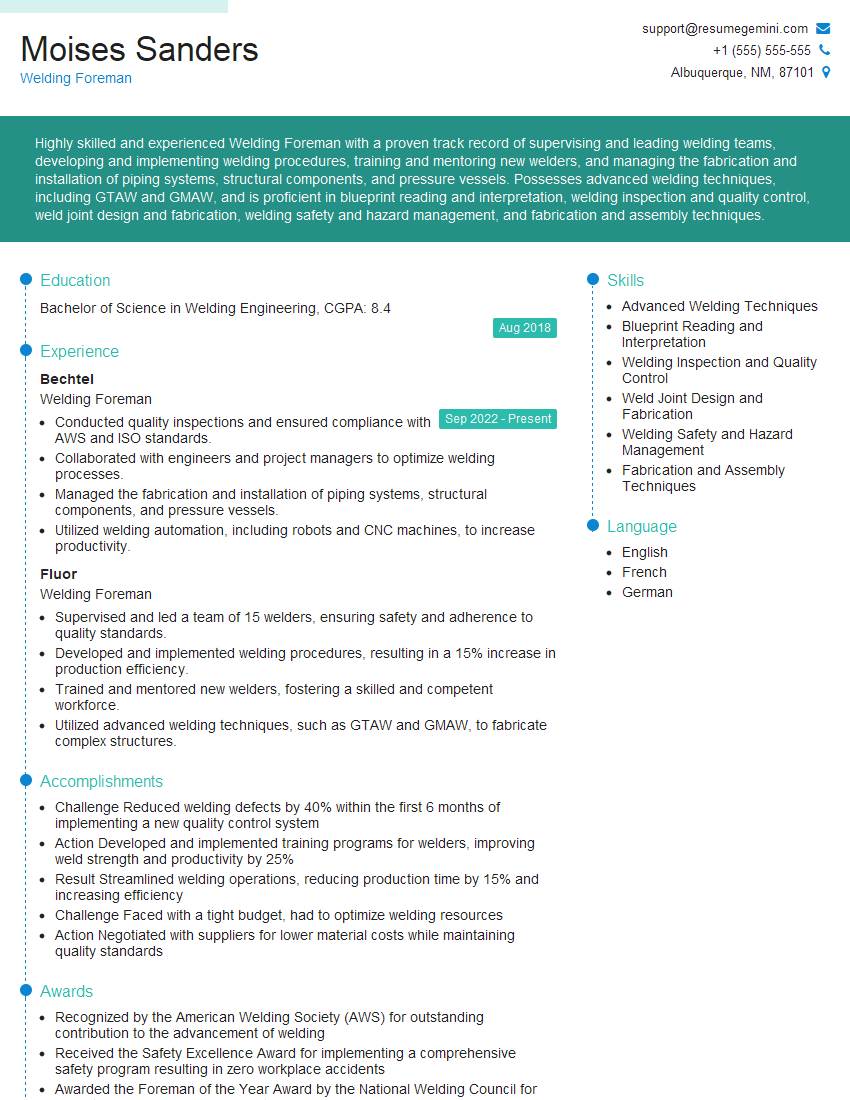
Mastering alloy welding opens doors to exciting career opportunities with significant growth potential in various industries. A strong foundation in these key areas will set you apart. To maximize your job prospects, it’s crucial to present your skills effectively. Crafting an ATS-friendly resume is essential for getting your application noticed by recruiters. We highly recommend using ResumeGemini to build a professional and impactful resume that highlights your expertise. Examples of resumes tailored to Alloy Welding professionals are available to help you get started.
Explore more articles
Users Rating of Our Blogs
Share Your Experience
We value your feedback! Please rate our content and share your thoughts (optional).
What Readers Say About Our Blog
To the interviewgemini.com Webmaster.
Very helpful and content specific questions to help prepare me for my interview!
Thank you
To the interviewgemini.com Webmaster.
This was kind of a unique content I found around the specialized skills. Very helpful questions and good detailed answers.
Very Helpful blog, thank you Interviewgemini team.