The right preparation can turn an interview into an opportunity to showcase your expertise. This guide to Experience with seismic tomography interview questions is your ultimate resource, providing key insights and tips to help you ace your responses and stand out as a top candidate.
Questions Asked in Experience with seismic tomography Interview
Q 1. Explain the principles behind seismic tomography.
Seismic tomography is like a medical CT scan, but for the Earth. Instead of X-rays, we use seismic waves generated by earthquakes or explosions. These waves travel through the Earth’s interior, and their travel times and waveforms are affected by the Earth’s internal structure. By measuring these changes, we can create a three-dimensional image of the Earth’s subsurface, revealing variations in seismic velocity. These velocity variations reflect differences in temperature, composition, and pressure, providing crucial insights into Earth’s processes, from plate tectonics to mantle convection.
Q 2. Describe different seismic tomography methods (e.g., traveltime tomography, full waveform inversion).
Several methods exist for seismic tomography. Traveltime tomography is the most classical approach. It uses the arrival times of seismic waves at seismic stations to infer velocity variations. Think of it like measuring the time it takes for a sound wave to travel through different materials – denser materials slow down the waves. Full waveform inversion (FWI) is a more advanced technique that uses the entire seismic waveform, not just the arrival time. This allows for higher resolution images but requires significantly more computational power and data. FWI is analogous to comparing the entire shape of the sound wave, not just when it arrives, to reconstruct the material’s properties. Other methods include, but are not limited to, ambient noise tomography and surface wave tomography, each leveraging different seismic wave types and data sources.
Q 3. What are the limitations of seismic tomography?
Seismic tomography, while powerful, has limitations. One major constraint is resolution – the ability to distinguish small details. Resolution is generally better near the surface and decreases with depth due to the increasing distance between seismic sources and receivers. Another challenge is the non-uniqueness problem; multiple velocity models can produce similar data fits. We mitigate this by using prior information (e.g., geological models) and regularization methods. Finally, data coverage influences accuracy. Sparse seismic networks limit the ability to image certain areas thoroughly, leading to uncertainties in the tomographic images.
Q 4. How do you handle noise and uncertainties in seismic data for tomography?
Seismic data are inherently noisy, contaminated by various sources like instrumental errors and ambient noise. We handle this through several techniques. Filtering removes unwanted high-frequency noise. Statistical methods, like robust inversion algorithms, downplay the influence of outliers caused by noise. We might also employ techniques such as wavefield separation to isolate the signals of interest from various wave types. Furthermore, we use uncertainty quantification methods to estimate and visualize the reliability of the tomographic images. A common approach involves running multiple inversions with slightly different starting models or parameters to characterize the variability of the results.
Q 5. Explain the concept of resolution in seismic tomography.
Resolution in seismic tomography refers to the smallest feature size that can be reliably imaged. A high-resolution image reveals fine details, while a low-resolution image shows only broader features. Resolution is limited by the wavelength of the seismic waves used (longer wavelengths provide lower resolution), the distribution of seismic sources and receivers (sparse networks lead to poor resolution), and the data quality. Resolution analysis is crucial to interpret tomographic images correctly; you can’t claim to have detected a small plume if your resolution is too coarse to image such a feature. Resolution is often represented by a resolution matrix or a checkerboard test, simulating the ability of the method to reconstruct a pattern of known velocity variation.
Q 6. Discuss different types of seismic waves used in tomography and their advantages/disadvantages.
Seismic tomography utilizes different wave types, each with advantages and disadvantages. P-waves (compressional waves) are the fastest and travel through both solids and liquids, providing a broad view of the Earth’s interior. However, they are sensitive to variations in both compressional and shear modulus, making interpretation complex. S-waves (shear waves) only travel through solids and are more sensitive to shear modulus variations, offering complementary information. Their slower speed restricts the depth of penetration compared to P-waves. Surface waves, like Rayleigh and Love waves, are sensitive to the shallow structure of the Earth and can provide high-resolution images of the crust and upper mantle. Their sensitivity to the shallower regions, however, limits their usefulness for deeper Earth investigation. The choice of wave type depends on the research question and the depth range of interest.
Q 7. How do you interpret tomographic images?
Interpreting tomographic images requires careful consideration. Velocity variations are typically displayed as color-coded maps or cross-sections. Slower velocities might represent hotter, less dense regions (e.g., mantle plumes), while faster velocities could indicate cooler, denser material (e.g., subducting slabs). We need to correlate the tomographic images with other geophysical and geological data (e.g., surface geology, gravity anomalies, and geochemical information) to provide a comprehensive interpretation. It is crucial to consider the resolution limitations of the images and acknowledge the uncertainties inherent in the tomographic process. The interpretation is an iterative process; initial interpretations may be refined as new data become available or as our understanding of Earth’s processes evolves.
Q 8. What are the key parameters used in seismic tomography inversions?
Seismic tomography inversions rely on several key parameters to reconstruct subsurface velocity structures. These parameters essentially dictate how we interpret the travel times of seismic waves to infer the properties of the Earth’s interior. The most crucial parameters include:
- Observed travel times: These are the primary data, representing the time it takes for seismic waves to travel from the source (earthquake or explosion) to the receiver (seismometer). Accuracy and completeness are paramount.
- Ray paths: These are the theoretical paths the seismic waves take through the Earth, calculated based on an initial velocity model. The accuracy of ray tracing is critical, especially in complex velocity structures.
- Velocity model parameters: The inversion process aims to refine a starting velocity model. This usually involves a grid or mesh defining the subsurface, with each cell containing a velocity value. The resolution and smoothness of this model are adjustable parameters influencing the outcome.
- Data weighting: Not all data points are created equal. Data weighting schemes (e.g., based on signal-to-noise ratio) are applied to emphasize reliable measurements and downweight noisy ones, improving the stability of the inversion.
- Regularization parameters: These parameters control the smoothness or roughness of the final velocity model, preventing overfitting to noisy data. They essentially balance the fit to the observed data with the model’s complexity. Common regularization techniques involve damping (reducing high-frequency variations) or imposing smoothness constraints.
The choice and tuning of these parameters are crucial for obtaining geologically meaningful and reliable tomographic images. For instance, using inappropriate regularization might lead to overly smooth models that mask important geological features, while insufficient regularization could amplify noise and produce unrealistic results.
Q 9. Describe your experience with seismic data processing before tomography.
My experience in seismic data processing before tomography is extensive. It forms the bedrock of successful tomographic inversions. I’ve worked with various datasets, from local earthquake networks to global seismic arrays. My preprocessing steps routinely include:
- Noise reduction: Identifying and attenuating various noise sources like instrument noise, cultural noise, and ambient seismic noise using techniques like filtering (e.g., bandpass, wavelet) and singular value decomposition (SVD).
- Arrival time picking: Precisely identifying the arrival times of different seismic phases (P-waves, S-waves) on seismograms. This is often done manually for high-quality data, but automated methods like cross-correlation are employed for large datasets. Accuracy is essential as errors propagate directly to the tomographic inversion.
- Event location: Determining the location (latitude, longitude, depth, and origin time) of seismic events. Accurate hypocenter location is paramount for reliable ray tracing. I use various location techniques including those based on least-squares methods, considering uncertainties in arrival times.
- Data editing and quality control: Examining seismograms for glitches, outliers, and other irregularities to eliminate faulty data that can bias the inversion.
A recent project involved processing data from a dense seismic array deployed across a volcanic region. We had to carefully filter out the pervasive microseismic noise to extract reliable P-wave arrival times for tomographic imaging of the magma chamber.
Q 10. What software packages are you proficient in for seismic tomography?
I am proficient in several software packages widely used for seismic tomography. My expertise includes:
- Seismic Unix (SU): A powerful and versatile open-source package for seismic data processing and analysis. I have used it extensively for pre-processing steps, such as filtering, event location, and ray tracing.
- ObsPy: An excellent python-based package for seismic data handling, analysis, and visualization. I utilize its capabilities for data manipulation, signal processing, and integration with other tools for tomography.
- LOTOS: I’ve experience using this package specifically for tomographic inversion, focusing on its capabilities for handling large datasets and various inversion algorithms.
- Simulps120: I’m familiar with this package for its capacity to deal with challenging aspects of tomographic modeling.
My proficiency in these packages allows me to perform a complete workflow, from initial data processing to final model interpretation and visualization. I’m also comfortable writing custom scripts and workflows to adapt to specific project needs.
Q 11. Explain your experience with different inversion algorithms.
I have experience with a range of seismic tomography inversion algorithms, each with its strengths and weaknesses. My experience encompasses:
- Least-squares methods: These are common and relatively straightforward approaches that minimize the difference between observed and predicted travel times. I’m familiar with variations including damped least squares and iterative methods like conjugate gradient.
- Non-linear iterative methods: These are critical for handling the non-linear relationship between velocity structure and travel times. I often use approaches like the damped least-squares method with iterative updates to the velocity model.
- Bayesian methods: These approaches incorporate prior information and quantify uncertainties in the final model. They are particularly useful when dealing with sparse or noisy data. I’ve utilized Markov Chain Monte Carlo (MCMC) methods within a Bayesian framework.
- Waveform inversion: While computationally more demanding, waveform inversion utilizes the full seismic waveform information (not just arrival times) leading to more detailed and potentially higher-resolution images. This method is gaining popularity due to advancements in computing power.
The choice of algorithm depends heavily on the specific project requirements, data quality, and computational resources. For instance, when dealing with a large dataset with complex geology, a more robust but computationally expensive iterative non-linear method may be necessary, whereas for a smaller dataset with good data quality, a simpler least-squares method might suffice.
Q 12. How do you assess the quality and reliability of tomographic models?
Assessing the quality and reliability of tomographic models is crucial. I employ several strategies:
- Resolution analysis: This involves determining the spatial resolution of the model by examining the resolution matrix or checkerboard tests. This helps identify areas where the model is well-resolved and areas where the resolution is poor, potentially due to data sparsity or complex wave propagation.
- Model variance analysis: This determines the uncertainty associated with the model parameters, providing insights into the reliability of the results. This can be done through techniques like bootstrapping or Monte Carlo simulations.
- Comparison with other datasets: Comparing the tomographic model with other geophysical data (e.g., gravity, magnetic, surface geology) helps to validate the model and identify inconsistencies.
- Back-projection of residuals: Analyzing the difference between observed and calculated travel times to identify areas of high misfit, indicating potential problems with data quality or model assumptions. This helps to refine the model or investigate sources of error.
- Sensitivity analysis: Assessing the impact of different parameter choices (e.g., regularization parameters, data weighting) on the final model. A stable model shows little sensitivity to reasonable changes in these parameters.
A recent study involved comparing our 3D tomographic model of a subduction zone with independently derived surface geology maps and GPS velocity data. This multi-constraint approach greatly enhanced the confidence in our interpretation of the subsurface structures.
Q 13. Describe your experience with 3D seismic tomography.
My experience with 3D seismic tomography is substantial. It presents a significant computational challenge compared to 2D tomography, but offers far greater insights into the complexity of subsurface structures. I’ve worked on projects involving:
- Regional-scale studies: Imaging the Earth’s crust and upper mantle beneath entire regions, using large datasets from seismic networks. This has involved managing very large datasets, parallel processing, and advanced inversion techniques.
- Exploration geophysics: Applying 3D tomography to resolve subsurface structures relevant to hydrocarbon exploration, geothermal energy, or mineral exploration. This requires careful consideration of the specific geological context and the integration of different types of seismic data.
- Volcanic monitoring: Using dense seismic arrays to image magma chambers and volcanic conduits in 3D. This helps to understand volcanic processes and improve eruption forecasting.
The move from 2D to 3D requires careful consideration of the computational resources and the complexity of the inversion algorithm. Efficient data structures, parallel computing, and robust inversion strategies are crucial for handling the increased dimensionality. For instance, a recent project involved developing a parallel inversion scheme to handle a terabyte-scale seismic dataset for 3D imaging of a large subduction zone.
Q 14. How do you incorporate prior information into tomographic inversions?
Incorporating prior information into tomographic inversions significantly improves the stability and resolution of the results, especially when dealing with limited or noisy data. I use several approaches:
- Smoothness constraints: Imposing smoothness constraints on the velocity model penalizes rapid variations in velocity, leading to smoother, more stable models. This is a form of regularization, and the degree of smoothness is controlled by a regularization parameter.
- Incorporation of geological models: Integrating existing geological models (e.g., from surface mapping or drilling data) as prior information helps to constrain the inversion and enhance the geological relevance of the resulting model. This can be done by setting fixed velocity values in certain regions or incorporating prior distributions within a Bayesian framework.
- Using a priori velocity models: Starting the inversion with a pre-existing velocity model (e.g., from regional studies or other geophysical data) guides the inversion process and can speed up convergence. This is particularly useful when the data are sparse.
- Bayesian methods: Bayesian inversion naturally incorporates prior information through probability distributions. This allows for a quantitative assessment of the uncertainty associated with the final model, making it more robust.
In a recent study, we incorporated a detailed geological model of a sedimentary basin as prior information to constrain the 3D tomographic inversion. This resulted in a significantly more reliable image of the subsurface structure, reducing ambiguity and highlighting important geological features otherwise obscured by noise.
Q 15. What are some common geological structures that can be imaged with seismic tomography?
Seismic tomography, akin to a medical CT scan for the Earth, allows us to image a wide range of geological structures. The resolution and depth of penetration depend on the density and distribution of seismic sources and receivers. Commonly imaged structures include:
- Faults and Fracture Zones: These zones of weakness in the Earth’s crust are often characterized by velocity variations, making them readily identifiable in tomographic images. Their geometry and extent can reveal information about tectonic stress and strain.
- Magma Chambers and Intrusions: Hot magma is less dense than the surrounding rock, leading to lower seismic velocities. Tomography can pinpoint the location, size, and shape of magma chambers, crucial for volcanic hazard assessment.
- Subduction Zones: The complex interaction of colliding tectonic plates creates significant velocity variations. Tomography helps us visualize the descending slab, its degree of hydration, and the location of associated earthquakes.
- Sedimentary Basins: Variations in sediment type and compaction lead to variations in seismic wave speeds. Tomography can reveal the geometry and stratigraphy of basins, essential for hydrocarbon exploration.
- Mantle Plumes: These upwellings of hot material from deep within the Earth cause localized anomalies in seismic velocity, creating distinctive ‘hotspots’ in tomographic images.
Essentially, any significant change in the physical properties of subsurface rocks – whether it’s composition, temperature, or pressure – will alter seismic wave velocities and be detectable through tomography.
Career Expert Tips:
- Ace those interviews! Prepare effectively by reviewing the Top 50 Most Common Interview Questions on ResumeGemini.
- Navigate your job search with confidence! Explore a wide range of Career Tips on ResumeGemini. Learn about common challenges and recommendations to overcome them.
- Craft the perfect resume! Master the Art of Resume Writing with ResumeGemini’s guide. Showcase your unique qualifications and achievements effectively.
- Don’t miss out on holiday savings! Build your dream resume with ResumeGemini’s ATS optimized templates.
Q 16. How does seismic tomography contribute to subsurface exploration?
Seismic tomography is an invaluable tool in subsurface exploration for several reasons:
- Improved Reservoir Characterization: By providing high-resolution 3D images of subsurface structures, tomography helps to define the geometry and properties of hydrocarbon reservoirs, leading to more accurate resource estimations and optimized drilling strategies.
- Geothermal Exploration: Tomography identifies areas of high heat flow associated with geothermal systems, assisting in the selection of optimal sites for geothermal energy extraction. The identification of permeable zones is critical.
- Mineral Exploration: The technique can help locate ore bodies by detecting velocity contrasts associated with mineralized zones. The imaging resolution enables targeting exploration efforts efficiently.
- Groundwater Resource Assessment: By mapping the subsurface structure and identifying aquifers, tomography contributes to sustainable groundwater management and the development of efficient extraction strategies.
- CO2 Storage Site Selection: Tomography allows for the visualization of geological formations suitable for storing captured carbon dioxide, ensuring the long-term safety and effectiveness of carbon capture and storage (CCS) projects.
In essence, tomography transforms our understanding of the subsurface from indirect inferences to direct, three-dimensional visualizations, significantly improving the efficiency and effectiveness of exploration activities.
Q 17. Describe a challenging seismic tomography project and how you overcame the challenges.
One particularly challenging project involved creating a tomographic model of a highly complex volcanic region characterized by significant lateral heterogeneity and a lack of dense seismic array coverage. The sparse data resulted in a poorly constrained model with significant ambiguities.
To overcome these challenges, we employed several strategies:
- Prior Information Incorporation: We integrated geological and geophysical data, such as surface geology maps and gravity data, into the inversion process as prior information. This provided additional constraints and improved model resolution.
- Advanced Inversion Techniques: We moved away from simpler inversion algorithms and implemented a more robust Bayesian approach that allowed for quantification of model uncertainties and assessment of trade-offs between different model parameters.
- Data Augmentation: We explored the possibility of using data from other seismic networks to supplement our local dataset, improving the overall spatial coverage. This required careful processing and standardization of data from multiple sources.
- Iterative Model Refinement: We adopted an iterative approach, continually refining our model based on newly acquired data and advancements in inversion techniques.
The final tomographic model, though still imperfect due to the inherent limitations of sparse data, provided a significantly improved representation of the subsurface structure compared to initial attempts, leading to valuable insights into the volcanic system’s dynamics.
Q 18. How do you validate tomographic results?
Validating tomographic results is crucial to ensuring the reliability of the interpreted subsurface structure. We use a combination of approaches:
- Comparison with independent datasets: We compare our tomographic model with other geophysical data, such as gravity and magnetic data, well logs, and geological maps. Consistency across different datasets provides strong support for the model’s validity.
- Resolution analysis: We assess the resolution of the tomographic model, identifying areas of high and low resolution. Areas with poor resolution should be interpreted cautiously.
- Sensitivity tests: We conduct sensitivity analyses to evaluate the impact of variations in input parameters (e.g., seismic velocity uncertainties, data errors) on the final model. This helps quantify the uncertainty associated with our interpretations.
- Forward modeling: We create synthetic datasets based on the tomographic model and compare the synthetic data with the observed data. A good match indicates a plausible model.
- Cross-validation techniques: We employ techniques such as jackknifing or bootstrapping to test the robustness of the tomographic inversion against variations in the input dataset.
Ultimately, validation is an ongoing process involving continuous refinement and cross-checking of results using a range of methods. No single technique provides absolute validation, but a robust and consistent convergence of evidence strengthens confidence in the interpretations.
Q 19. Explain your understanding of velocity models and their significance in tomography.
Velocity models are the heart of seismic tomography. They represent the three-dimensional distribution of seismic wave velocities within the subsurface. These velocities are not uniform; they vary depending on the rock type, temperature, pressure, and fluid content.
In tomography, we start with an initial velocity model, which is iteratively refined through an inversion process that aims to find the velocity model that best explains the observed travel times of seismic waves. The significance lies in the direct relationship between velocity and the physical properties of the subsurface. For instance:
- Higher velocities often indicate denser, more rigid rocks (e.g., crystalline basement rocks).
- Lower velocities can suggest the presence of less dense materials (e.g., sediments, magma).
Accurate velocity models are crucial because they directly affect the quality of the tomographic images. Errors in the velocity model will lead to artifacts and misinterpretations in the resulting images. Therefore, careful consideration of velocity model uncertainties and the use of advanced inversion techniques are crucial aspects of successful tomography.
Q 20. What are the differences between local and global seismic tomography?
Local and global seismic tomography differ primarily in their scale and the types of seismic waves used:
- Local Seismic Tomography: This technique uses data from relatively dense seismic networks deployed over a limited area (e.g., a few hundred kilometers). It primarily uses direct P-waves and S-waves recorded by near-surface seismometers. The resolution is higher because of the proximity of the sources and receivers, allowing for the detailed imaging of near-surface structures.
- Global Seismic Tomography: This technique utilizes seismic waves from large earthquakes recorded by seismometers across the globe. It often employs surface waves in addition to body waves. The scale is vastly larger, providing images of the Earth’s mantle and core, although the resolution is lower due to the larger distances involved.
Both techniques share the same basic principle of using seismic wave travel times to infer subsurface velocity variations, but their applications and resulting images differ significantly due to the scale of observation and data acquisition strategy.
Q 21. Describe your experience with seismic tomography in specific geological settings (e.g., subduction zones, mid-ocean ridges).
My experience with seismic tomography encompasses various geological settings. For example:
- Subduction Zones: I’ve worked on projects imaging subduction zones using both local and regional seismic data. The goal was to map the geometry of the subducting slab, the location of dehydration reactions, and the distribution of seismic activity within the overriding plate. This information is crucial for understanding earthquake generation mechanisms and associated hazards.
- Mid-Ocean Ridges: I’ve been involved in studies employing ocean-bottom seismometers (OBS) to image the crustal structure at mid-ocean ridges. This revealed information about magma chamber geometry, the extent of hydrothermal circulation, and the rate of seafloor spreading. These insights are important for understanding plate tectonics and the evolution of the ocean floor.
In both cases, the specific challenges included overcoming data limitations (e.g., sparse seismic coverage, noise) and developing appropriate inversion strategies to accommodate the complexities of these geological settings. The outcome has been a significant enhancement in our knowledge of fundamental Earth processes.
Q 22. How does seismic tomography relate to other geophysical methods?
Seismic tomography is a powerful geophysical technique that uses seismic waves to image the Earth’s subsurface structure. It’s closely related to other geophysical methods, often complementing them to build a more complete picture. For instance, it works synergistically with:
- Gravity and magnetic surveys: These methods provide information about density and magnetic susceptibility variations, which can be integrated with tomographic velocity models to constrain the physical properties of subsurface structures. A high-velocity anomaly identified through tomography might correlate with a gravity high, suggesting a dense igneous intrusion.
- Electrical resistivity tomography (ERT): ERT maps electrical conductivity, offering insights into fluid content and lithology. Combined with seismic tomography, we can gain a more comprehensive understanding of the subsurface, for example, distinguishing between saline water and hydrocarbon-bearing formations.
- Magnetotellurics (MT): MT investigates the Earth’s electrical conductivity at greater depths than ERT. Integrating MT data with seismic tomography can greatly enhance our understanding of deep crustal and mantle structures, particularly in tectonic settings.
In essence, seismic tomography provides a three-dimensional velocity model, which other geophysical methods help refine and interpret. The combination leads to a much more robust understanding of the subsurface.
Q 23. What are the future trends and challenges in seismic tomography?
The future of seismic tomography is bright, but it also faces significant challenges. Key trends include:
- Increased computational power: Handling increasingly larger datasets requires advanced computing techniques, including high-performance computing and cloud computing. This will allow us to process data from dense seismic networks and achieve higher resolution images.
- Development of advanced inversion algorithms: More robust and efficient inversion algorithms are crucial to handle complex datasets and reduce uncertainties in the tomographic models. This includes incorporating a priori information and improving handling of non-linearity.
- Integration of multiple data types: Combining seismic data with other geophysical and geological information is becoming increasingly important to improve model accuracy and reduce ambiguities. This is especially relevant for resolving complex geological structures.
- Full-waveform inversion (FWI): FWI uses the full waveform information, as opposed to just travel times, leading to potentially higher resolution images and improved accuracy. However, FWI is computationally expensive and requires significant advancements.
Challenges include:
- Data availability and quality: Obtaining high-quality, dense seismic data remains a major challenge, particularly in remote areas. Noise and incomplete data coverage can limit the resolution and accuracy of tomographic models.
- Computational costs: Processing and inverting large seismic datasets can be computationally expensive and time-consuming. Optimizing algorithms and using high-performance computing are crucial for overcoming this.
- Model non-uniqueness: Seismic tomography suffers from non-uniqueness, meaning that different subsurface models can produce similar seismic data. This calls for integrating additional data and utilizing advanced inversion techniques to reduce ambiguity.
Q 24. Explain your experience with visualizing and presenting tomographic results.
Visualizing and presenting tomographic results effectively is essential for communication and interpretation. My experience involves:
- 3D visualization software: I’m proficient in using software packages such as ParaView, GMT, and specialized seismic tomography visualization tools. These allow me to create slices, cross-sections, and 3D renderings of tomographic models, highlighting key features such as velocity anomalies and structural boundaries.
- Choice of visualization methods: I select appropriate visualization methods based on the specific research question and audience. For instance, color-coded velocity maps are ideal for highlighting velocity variations, while isosurfaces can showcase the extent of specific features.
- Creation of high-quality figures and animations: I produce publication-quality figures and animations to effectively communicate research findings. Animations are particularly effective for conveying the 3D nature of subsurface structures.
- Effective use of color scales and legends: The careful selection of color scales and legends ensures that the visualizations are both visually appealing and accurately represent the data. I emphasize clarity and avoid misleading color choices.
For example, in a recent project studying a geothermal system, I used 3D visualization to identify high-velocity zones that corresponded to potential geothermal reservoirs. These visualizations were crucial for guiding exploration efforts and informing drilling decisions.
Q 25. Discuss your experience with working with large seismic datasets.
I have extensive experience handling large seismic datasets. This involves:
- Data preprocessing: This critical step involves cleaning the data by removing noise, correcting for instrument response, and ensuring data consistency. I’m skilled in using various signal processing techniques to achieve high data quality.
- Data management: Efficient data management is key. I utilize databases and file management systems to organize and access large datasets effectively. This includes using tools for data version control and archiving.
- Parallel computing: Processing large seismic datasets often necessitates the use of parallel computing techniques to reduce processing time. I leverage high-performance computing clusters and distributed computing frameworks such as MPI and OpenMP to enhance efficiency.
- Data reduction techniques: Techniques like wavefield separation and beamforming reduce the dimensionality of the data before inversion which decreases computational demand and speeds up processing.
In a previous project, I worked with a dataset exceeding 10 terabytes of seismic waveform data. Through careful planning, efficient data management, and parallel processing techniques, I successfully processed and inverted the data to obtain a high-resolution tomographic model of the Earth’s crust.
Q 26. How would you approach a tomography project with limited data?
Working with limited data requires a careful and strategic approach. My strategy typically involves:
- Careful data assessment: I thoroughly evaluate the existing data to identify potential biases, gaps, and uncertainties. This informs the choice of inversion techniques and data constraints.
- Incorporation of a priori information: Using prior geological or geophysical information (e.g., existing well logs, geological maps) as constraints during inversion can help compensate for the limited dataset and improve model resolution.
- Choosing appropriate inversion techniques: Regularization techniques are crucial with limited data to avoid overfitting and achieve a stable solution. I select techniques based on the data characteristics and the desired model resolution.
- Bayesian methods: Bayesian approaches naturally integrate prior information and quantify uncertainties in the model. This provides a more realistic assessment of the tomographic results and their limitations.
- Prioritizing model resolution: With limited data, it might be necessary to focus on a smaller region of interest to achieve higher resolution. Targeting specific geological questions or features can increase the effectiveness of the limited data.
For example, in a project with limited seismic data from a specific area, we used gravity data and geological constraints to help constrain the tomographic inversion. This resulted in a robust model despite data limitations.
Q 27. Describe your understanding of the impact of Earth’s heterogeneity on seismic wave propagation.
Earth’s heterogeneity significantly impacts seismic wave propagation. Variations in seismic velocity, density, and elastic properties cause seismic waves to:
- Scatter: Heterogeneities scatter seismic waves, reducing the amplitude of direct waves and generating scattered waves. This scattering effect obscures the direct path information, complicating seismic imaging.
- Refract and reflect: Changes in velocity cause waves to refract (bend) and reflect at interfaces between different materials. These refracted and reflected waves provide information about the subsurface structure but also introduce complexity to the wavefield.
- Change travel times: Seismic waves travel faster in denser or stiffer materials. Heterogeneities cause variations in travel times, which are the primary data used in seismic tomography. These travel-time anomalies are used to infer the subsurface velocity structure.
- Mode conversion: At interfaces between different materials, seismic waves can convert from one type (e.g., P-wave) to another (e.g., S-wave). This mode conversion affects wave propagation and introduces additional complexity.
Understanding the impact of heterogeneity is crucial for accurate seismic interpretation. Tomographic models account for these effects through advanced inversion techniques, which seek to recover the velocity structure that best explains the observed travel-time anomalies and other waveform characteristics.
Q 28. How familiar are you with different types of regularization techniques in tomography?
Regularization techniques are essential in seismic tomography to stabilize the inversion process and obtain meaningful results, especially when dealing with noisy data or incomplete data coverage. I am familiar with several types of regularization:
- L1 regularization (LASSO): This method adds a penalty term proportional to the L1 norm (sum of absolute values) of the model parameters. It promotes sparsity in the model, leading to simpler solutions with fewer parameters and potentially reducing overfitting.
- L2 regularization (Ridge regression): This method uses a penalty term proportional to the L2 norm (sum of squared values) of the model parameters. It shrinks the model parameters towards zero, reducing the impact of noisy data and preventing overfitting.
- Total variation (TV) regularization: TV regularization penalizes large variations in the model parameters, leading to smoother models. This is particularly effective for reducing noise and artifacts in the tomographic images.
- Damped least squares: This is a classic regularization method that adds a damping factor to the inversion matrix. This stabilizes the inversion process by reducing the influence of poorly constrained parameters.
The choice of regularization technique depends on the specific characteristics of the dataset and the desired properties of the model. Often, a combination of methods is used to achieve the best results. My experience includes selecting and implementing these techniques using various software packages such as MATLAB and Python.
Key Topics to Learn for Seismic Tomography Interviews
- Seismic Wave Propagation: Understanding P-waves, S-waves, and their behavior in different Earth materials. This forms the foundation of tomography.
- Tomographic Inversion Methods: Familiarize yourself with different inversion techniques (e.g., ray tracing, wavefront construction, full waveform inversion) and their strengths and limitations. Be prepared to discuss the trade-offs involved.
- Data Acquisition and Processing: Understand the process of acquiring seismic data (e.g., from earthquakes, controlled sources), preprocessing techniques (noise reduction, filtering), and the importance of data quality.
- Velocity Model Construction: Learn how to interpret tomographic images, understand the implications of resolution and uncertainties, and assess the reliability of the resulting velocity models.
- Applications of Seismic Tomography: Be ready to discuss practical applications in areas like earthquake hazard assessment, resource exploration (oil, gas, geothermal), and studying Earth’s mantle structure. Specific examples demonstrate your practical understanding.
- Interpretation and Presentation of Results: Practice effectively communicating complex geophysical data through maps, cross-sections, and other visualizations. Clear and concise communication is key.
- Error Analysis and Uncertainty Quantification: Understand how to assess the uncertainties associated with tomographic models and their implications for interpretation.
- Software and Tools: While specific software isn’t required to be named, familiarity with common seismic processing and tomography software packages will be beneficial. Demonstrating knowledge of workflow will boost your candidacy.
Next Steps
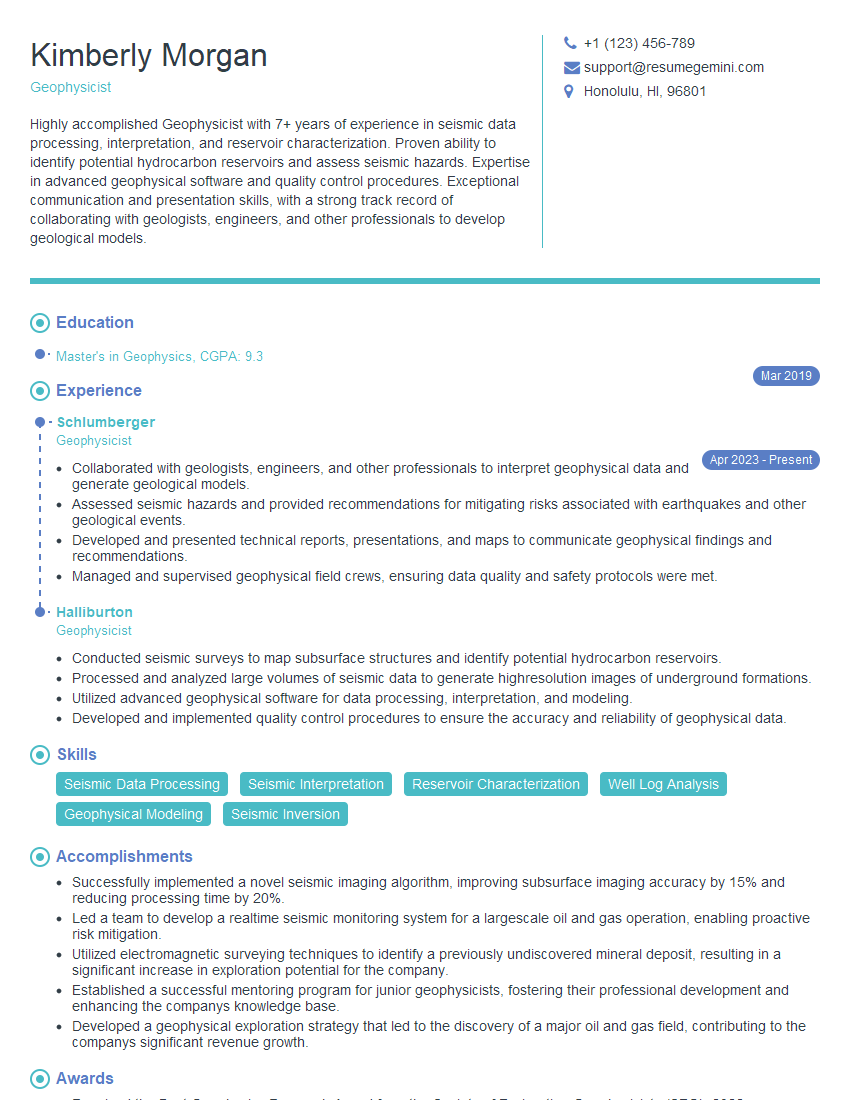
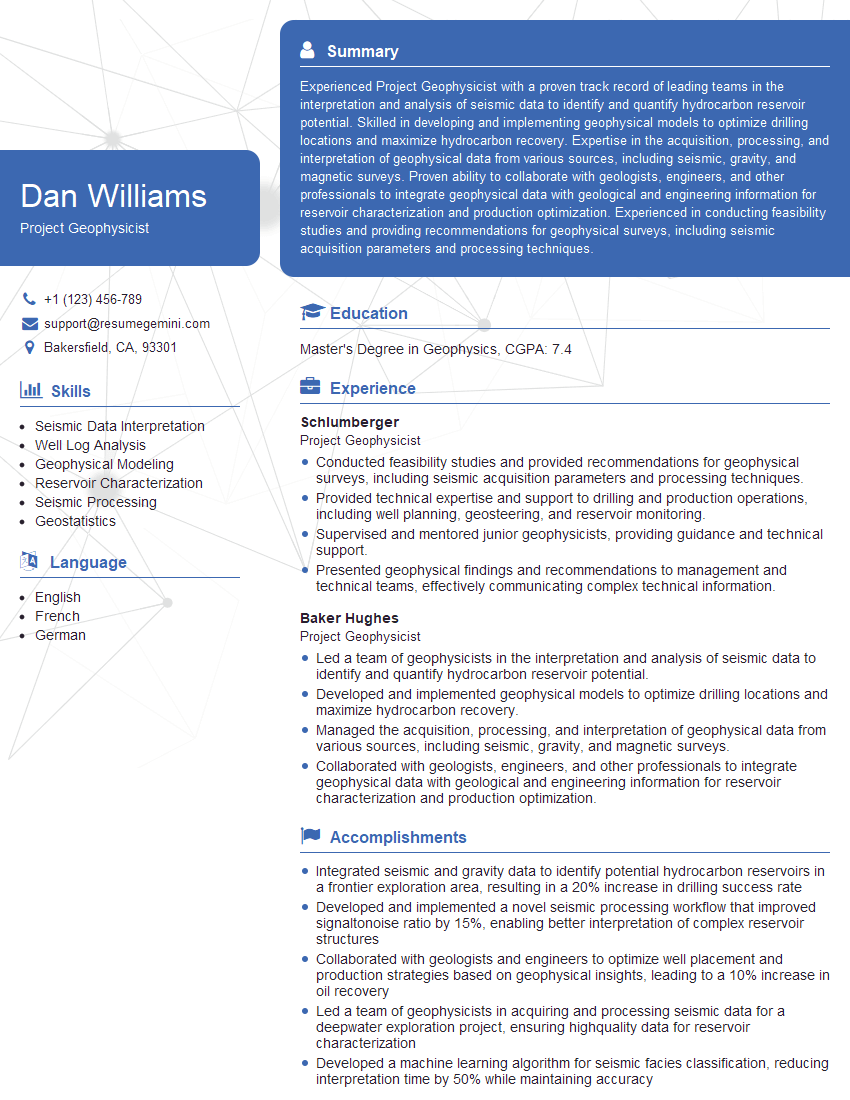
Mastering seismic tomography opens doors to exciting careers in geophysics, resource exploration, and academic research. A strong understanding of this technique is highly valued by employers. To maximize your job prospects, focus on crafting an ATS-friendly resume that clearly highlights your skills and experience. ResumeGemini is a trusted resource for building professional resumes tailored to specific industries, including geophysics. We offer examples of resumes specifically designed for candidates with experience in seismic tomography to help you showcase your expertise effectively. Invest time in a well-structured resume – it’s your first impression!
Explore more articles
Users Rating of Our Blogs
Share Your Experience
We value your feedback! Please rate our content and share your thoughts (optional).
What Readers Say About Our Blog
To the interviewgemini.com Webmaster.
Very helpful and content specific questions to help prepare me for my interview!
Thank you
To the interviewgemini.com Webmaster.
This was kind of a unique content I found around the specialized skills. Very helpful questions and good detailed answers.
Very Helpful blog, thank you Interviewgemini team.