Interviews are opportunities to demonstrate your expertise, and this guide is here to help you shine. Explore the essential Electrical wiring and cabling interview questions that employers frequently ask, paired with strategies for crafting responses that set you apart from the competition.
Questions Asked in Electrical wiring and cabling Interview
Q 1. Explain the difference between AC and DC current.
The fundamental difference between AC (Alternating Current) and DC (Direct Current) lies in the direction of electron flow. In DC, electrons flow consistently in one direction, like a river flowing downstream. This is the type of current produced by batteries. AC, on the other hand, periodically reverses its direction of electron flow, oscillating back and forth like a pendulum. This is the type of electricity that powers our homes and businesses.
Think of it like this: DC is like a water slide – the water always flows in one direction. AC is like a seesaw – it moves back and forth. This constant reversal in AC is what allows for efficient long-distance transmission of power, due to the ease of stepping voltage up and down using transformers.
Practically, DC is often used in low-voltage applications like electronics, while AC is the standard for high-voltage power distribution networks.
Q 2. Describe the NEC (National Electrical Code) and its importance.
The National Electrical Code (NEC) is a widely adopted set of regulations that governs the safe installation of electrical wiring and equipment in the United States. It’s not a law itself, but most states and municipalities adopt it as part of their building codes. The NEC is crucial because it ensures the safety of people and property by setting standards for everything from wiring methods to overcurrent protection.
Imagine building a house without any architectural guidelines – it would be chaotic and potentially dangerous. The NEC provides this vital structure for electrical work, preventing electrical fires, shocks, and other hazards. Electricians must adhere to the NEC to ensure their work is safe and compliant. Failure to do so can lead to legal repercussions and potentially life-threatening situations.
The NEC is regularly updated to reflect advancements in technology and safety standards, ensuring its continued relevance in our ever-evolving electrical landscape. Staying abreast of these updates is paramount for any professional electrician.
Q 3. What are the different types of electrical conduits and their applications?
Electrical conduits are protective tubes or channels that house and protect electrical wires and cables. Several types exist, each suited to different applications:
- Rigid Metal Conduit (RMC): Strong and durable, ideal for industrial settings and areas where physical protection is paramount. Often used in exposed locations.
- Intermediate Metal Conduit (IMC): Lighter and easier to bend than RMC, making it suitable for less demanding applications.
- Electrical Metallic Tubing (EMT): Also known as thinwall conduit, it’s lightweight and flexible, commonly used in residential and commercial construction.
- Flexible Metal Conduit (FMC): Offers flexibility for navigating complex pathways, often used for connecting equipment and appliances.
- Plastic Conduit (PVC): Cost-effective and corrosion-resistant, widely used in underground installations and less demanding above-ground applications.
The choice of conduit depends heavily on factors like the environment, the type of wiring, and the overall construction design. For instance, RMC might be chosen in a factory environment for its superior protection against potential damage, while PVC might be preferred for underground runs due to its resistance to corrosion.
Q 4. How do you identify different wire gauges and their appropriate uses?
Wire gauge refers to the diameter of a wire. A smaller gauge number indicates a thicker wire, meaning it can carry more current. This is inversely proportional – a #10 gauge wire is thicker and carries more current than a #12 gauge wire.
Wire gauge selection is critical to prevent overheating and potential fire hazards. The NEC specifies the minimum allowable wire gauge for various circuit types and amperages. For example, a 15-amp circuit might require at least a #14 gauge wire, while a 20-amp circuit might require a #12 gauge wire. Choosing a thinner gauge wire than specified could lead to overheating and a fire. Using too thick a gauge might be unnecessary and more expensive but generally safe.
Wire gauge is usually printed on the wire’s insulation, but a wire gauge chart is an invaluable tool for electricians to quickly reference.
Q 5. Explain the process of terminating a wire.
Terminating a wire involves securely connecting it to a device or another wire, usually using a connector or terminal. The process varies depending on the type of wire and the termination method.
Common methods include:
- Wire nuts: Used for joining wires of the same gauge and material within a junction box. Ensure all wires are properly stripped and twisted together before securing with a wire nut of the appropriate size.
- Screw terminals: Used on devices with screw terminals where wires are clamped down by a screw. It’s important to properly tighten the screw to ensure a secure connection.
- Crimping connectors: Used to create a mechanical connection, typically used with smaller gauge wires. A proper crimping tool is needed to ensure a strong and reliable connection.
- Soldering: Creates a more permanent connection, usually used in specialized applications. Requires skill and proper tools, including a soldering iron and flux.
Regardless of the method, always ensure the wire is properly stripped to expose the necessary amount of bare copper, avoiding damage to the conductor. Proper termination prevents loose connections, which can lead to overheating, sparking, and electrical failures.
Q 6. Describe different methods of grounding electrical systems.
Grounding provides a low-resistance path for fault currents to flow to the earth, protecting people and equipment from electrical shock and damage. Several grounding methods exist:
- Grounding rod: A metal rod driven into the earth, providing a direct path to ground.
- Grounding wire: A bare or insulated wire connecting equipment or electrical systems to a grounding electrode.
- Water pipe grounding (not recommended): Historically used, but less reliable due to modern plumbing materials. The NEC is increasingly discouraging this method.
- Grounding electrode conductor system: A network of grounding electrodes connected together to provide a robust grounding system.
The effectiveness of grounding depends on the conductivity of the soil and the quality of the connection. Proper grounding is essential for safety, particularly in high-voltage systems.
Q 7. What are the safety precautions you take when working with electricity?
Safety is paramount when working with electricity. I always adhere to these precautions:
- Lockout/Tagout (LOTO): Before working on any electrical equipment, I always de-energize the circuit and use LOTO procedures to prevent accidental energization.
- Personal Protective Equipment (PPE): I wear appropriate PPE including insulated gloves, safety glasses, and non-conductive footwear.
- Assume all circuits are energized: Never assume a circuit is de-energized until it has been verified with a voltage tester.
- Working with a partner: Whenever possible, I work with a partner to provide an extra layer of safety.
- Understanding the electrical system: I carefully study electrical schematics and diagrams before starting any work.
- Using appropriate tools: I use only tools rated for the voltage level I am working with.
- Regular training and updates: Staying up-to-date on the latest safety regulations and techniques is crucial.
Electricity can be extremely dangerous. A moment of carelessness can have devastating consequences. Prioritizing safety is not just a best practice – it’s a necessity.
Q 8. How do you troubleshoot a faulty circuit?
Troubleshooting a faulty circuit involves a systematic approach to pinpoint the problem. Think of it like detective work – you need to gather clues and eliminate possibilities. First, always prioritize safety! Turn off the power to the circuit at the breaker before starting any work.
Visual Inspection: Begin by carefully inspecting all visible wiring, connections, and components for any obvious damage like loose wires, burned insulation, or broken parts. A simple visual check can often reveal the culprit.
Testing with a Multimeter: A multimeter is your best friend. Use it to check voltage at the breaker and at various points along the circuit to identify where the voltage drops off. This helps you narrow down the faulty section.
Continuity Test: If voltage is present but the circuit isn’t working, test the continuity of the wires using your multimeter. This ensures the wires are intact and not broken. A lack of continuity indicates a break in the wire.
Component Testing: If the wiring checks out, test individual components (switches, outlets, appliances) to determine if they are faulty. A faulty switch, for example, might prevent power from reaching the rest of the circuit.
GFCI/AFCI Testing: If the circuit is protected by a Ground Fault Circuit Interrupter (GFCI) or Arc Fault Circuit Interrupter (AFCI), test those devices to ensure they are functioning correctly. A tripped GFCI or AFCI might be the cause of the problem.
For example, imagine a kitchen circuit that’s not working. You’d first turn off the breaker, then visually inspect the wiring behind the outlets and the outlets themselves. If that doesn’t reveal the problem, you’d use a multimeter to trace the voltage, perform continuity tests on the wires, and finally check if the appliances plugged into that circuit are functional. Remember, safety is paramount; if you’re uncomfortable with any step, consult a qualified electrician.
Q 9. Explain the concept of voltage drop and its significance.
Voltage drop is the reduction in voltage between the source (e.g., the electrical panel) and the load (e.g., a light fixture or appliance). Think of it like water flowing through a pipe – friction along the pipe walls causes a pressure drop. Similarly, resistance in the wires causes a voltage drop.
Significance: Excessive voltage drop can lead to several problems: reduced power to the load (dim lights, underperforming appliances), overheating of wires (fire hazard), and reduced efficiency of the circuit. The amount of voltage drop is dependent on the wire’s gauge, length, and the amount of current flowing through it.
Example: Imagine a long extension cord powering a power-hungry tool. The long length and high current draw would cause a significant voltage drop, potentially leading to the tool running poorly or the cord overheating. Properly sizing the wire according to the current draw is crucial to mitigate voltage drop.
Calculating voltage drop is important during the design phase to ensure adequate power delivery. It helps choose the correct wire gauge to minimize losses and maintain the intended voltage at the load.
Q 10. What are the different types of cable connectors?
There’s a wide variety of cable connectors, each designed for specific applications and cable types. Here are some common ones:
Crimp Connectors: These use a crimping tool to secure the wire inside a metal connector. They’re commonly used for smaller gauge wires.
Screw Terminals: These connectors use screws to hold wires in place. They are often found in electrical panels, junction boxes, and other applications where secure connections are needed.
Wire Nuts/Connectors: These twist-on connectors are used to join wires together within a junction box.
Terminal Blocks: These are used to connect multiple wires together, often found in control panels.
Splices: While not technically a connector, splices are used to join wires together by twisting the wires and insulating them (usually with electrical tape).
Fiber Optic Connectors: SC, LC, ST, and FC connectors are commonly used for fiber optic cables.
Coaxial Connectors: BNC, F-type, and RCA are used for coaxial cables that carry high-frequency signals like those used for cable TV and internet.
The choice of connector depends on factors such as wire gauge, cable type, application requirements, and safety standards. Proper selection and installation are crucial for reliable and safe electrical connections.
Q 11. How do you test the continuity of a wire?
Testing the continuity of a wire verifies if there’s an unbroken path for current to flow. You use a multimeter set to the continuity test mode (usually represented by a diode symbol).
Procedure:
Set the Multimeter: Turn on the multimeter and select the continuity test mode. You should hear a beep if continuity is detected.
Touch the Probes: Touch the two probes together. The multimeter should beep, indicating a good connection.
Test the Wire: Touch one probe to one end of the wire and the other probe to the other end. A continuous beep confirms there’s no break in the wire. If there is no beep, there is a break in the circuit.
Example: Before installing a new light fixture, you would test the continuity of the wires in the junction box to ensure there are no breaks that could cause the fixture not to work. This is a crucial safety check.
Q 12. Explain the different types of cable shielding and their purposes.
Cable shielding protects the signal from external electromagnetic interference (EMI) and radio frequency interference (RFI). Think of it as armor for your data or signal.
Foil Shielding: A thin layer of conductive metal foil wrapped around the cable. It’s effective against lower frequency EMI/RFI.
Braid Shielding: A woven mesh of conductive metal strands. Offers good protection against a broader range of frequencies compared to foil shielding. Often used in combination with foil.
Combination Shielding: Combines both foil and braid for maximum protection. Offers the best protection against EMI/RFI.
Purpose: Shielding prevents unwanted noise from interfering with the signal, ensuring data integrity and signal quality. This is especially critical in applications like audio, video, and data transmission where signal fidelity is essential. For instance, a shielded cable is necessary for high-speed data transmission networks to prevent signal degradation and data errors.
Q 13. What are the best practices for cable management?
Good cable management is crucial for safety, efficiency, and maintainability. It’s like keeping your tools organized in a workshop – everything is easily accessible, and there’s no risk of tripping or accidental damage.
Proper Bundling: Use cable ties, straps, or sleeves to keep cables organized and prevent tangling.
Labeling: Clearly label cables to identify their purpose and destination. This is particularly helpful for troubleshooting and maintenance.
Routing: Route cables neatly and securely, avoiding sharp bends or kinks that can damage the cables.
Support: Use cable trays, conduit, or other support systems to prevent cables from sagging or becoming a tripping hazard.
Color Coding: Use color-coding to help identify different cable types or circuits.
Neglecting cable management can lead to tangled cables, making maintenance and troubleshooting difficult and potentially creating fire hazards. Well-managed cables are easier to inspect, repair, and replace, minimizing downtime and ensuring safety.
Q 14. How do you identify and avoid potential hazards in electrical wiring installations?
Identifying and avoiding hazards in electrical wiring installations requires a thorough understanding of safety regulations and best practices. Think of it as proactively preventing accidents.
Overloaded Circuits: Avoid overloading circuits by plugging too many appliances into a single outlet or circuit. Use a circuit analyzer to check for circuit overloads.
Damaged Insulation: Regularly inspect wiring for damaged insulation. Exposed wires are a serious fire and shock hazard.
Improper Grounding: Ensure proper grounding to prevent electrical shocks. Grounding provides a path for fault currents to flow safely to the earth.
Incorrect Wiring: Follow proper wiring techniques and adhere to all electrical codes. Incorrect wiring can lead to short circuits and fires.
Working on Live Circuits: Always de-energize circuits before working on them to prevent electrical shocks. Never assume a circuit is off – always test it with a voltage detector.
Moisture: Avoid exposing wires to moisture, as this can cause short circuits and increase the risk of electric shock.
Proper GFCI/AFCI Protection: Install Ground Fault Circuit Interrupters (GFCIs) in bathrooms, kitchens, and outdoor areas, and Arc Fault Circuit Interrupters (AFCIs) in bedrooms to protect against electrical shocks and fires.
Ignoring these hazards can have severe consequences, ranging from minor malfunctions to fires and fatal electric shocks. Regular inspections and adherence to safety standards are essential for preventing accidents.
Q 15. What are the common causes of electrical fires?
Electrical fires are a serious hazard, often stemming from a combination of factors. Overloaded circuits are a prime culprit; think of it like trying to cram too many appliances into a single power strip – the wires overheat and can ignite surrounding materials. Faulty wiring, such as frayed insulation or loose connections, creates sparks that can easily start a fire, especially in the presence of flammable materials. Damaged appliances or cords, improperly installed wiring, and even misuse of extension cords all contribute to the risk. In essence, any situation where excessive current flows through insufficient wiring can lead to overheating and fire.
Examples: An old, brittle appliance cord sparking after being bent repeatedly; a power strip overloaded with multiple high-wattage devices; loose wiring in an old junction box causing arcing and heat buildup.
- Overloaded circuits: Using too many appliances on a single circuit.
- Faulty wiring: Damaged insulation, loose connections, or improper wiring.
- Appliance malfunctions: Defective appliances or cords.
- Improper installations: Incorrect wiring practices during installations.
Career Expert Tips:
- Ace those interviews! Prepare effectively by reviewing the Top 50 Most Common Interview Questions on ResumeGemini.
- Navigate your job search with confidence! Explore a wide range of Career Tips on ResumeGemini. Learn about common challenges and recommendations to overcome them.
- Craft the perfect resume! Master the Art of Resume Writing with ResumeGemini’s guide. Showcase your unique qualifications and achievements effectively.
- Don’t miss out on holiday savings! Build your dream resume with ResumeGemini’s ATS optimized templates.
Q 16. How do you work with different voltage levels?
Working with different voltage levels requires meticulous safety precautions and a thorough understanding of the specific voltage involved. Low-voltage circuits (typically under 50V) are generally safer, but still require caution. Higher voltage levels, such as 120V (common household voltage) and 240V (used for appliances like ovens and dryers), demand strict adherence to safety codes and the use of appropriate personal protective equipment (PPE).
The key is to always understand the voltage before touching any wires or equipment. Never assume the voltage of a circuit; always verify using a voltmeter. Proper insulation and isolation techniques are essential, including using insulated tools and working with de-energized circuits whenever possible. For higher voltage systems, lockout/tagout procedures are mandatory to prevent accidental energization during maintenance or repair.
Example: Before working on a 240V circuit, I would first visually inspect it, then use a non-contact voltage tester to verify that the power is off. Once confirmed, I would lock out the circuit breaker and apply a lockout/tagout device to prevent anyone from inadvertently turning it back on. I’d only then proceed with the work, wearing appropriate safety gloves and eye protection.
Q 17. Explain the use of different types of electrical testing equipment (e.g., multimeter, clamp meter).
Electrical testing equipment is indispensable for ensuring the safety and proper function of electrical systems. A multimeter is a versatile instrument used to measure voltage, current, and resistance. It’s like a Swiss Army knife for electricians, providing crucial information about the electrical characteristics of a circuit. For example, it allows us to check for voltage presence, measure voltage drop across components, and verify continuity in a circuit.
A clamp meter is specialized for measuring current without interrupting the circuit. Think of it as a non-invasive way to check the load on a circuit. It simply clamps around the wire, allowing you to read the current flow without having to disconnect anything. This is especially important for high-current circuits where disconnecting could be dangerous or inconvenient.
Examples: Using a multimeter to check if a socket is live; using a clamp meter to verify the current drawn by a motor.
Q 18. Describe the process of installing a circuit breaker.
Installing a circuit breaker is a critical step in protecting a circuit from overloads and short circuits. First, the power to the circuit must be switched off at the main service panel. This is crucial for safety. The circuit breaker is then carefully mounted onto the DIN rail within the panel, ensuring it’s securely fastened. The wires from the circuit are connected to the terminals of the circuit breaker, adhering to the wiring diagram and manufacturer’s instructions. Once this is done, the power is cautiously restored, and the breaker is tested to ensure it trips at its rated amperage.
Important Note: It’s essential to use the correct size circuit breaker for the intended load. A breaker that’s too small can trip unnecessarily, while one that’s too large may not protect the circuit from damage. Always consult the electrical code and the manufacturer’s specifications.
Q 19. What are the requirements for installing electrical wiring in different locations (e.g., wet locations, hazardous locations)?
Electrical wiring in various locations demands specific considerations to ensure safety and compliance with electrical codes. Wet locations, such as bathrooms and outdoor areas, require wiring and fixtures designed to resist moisture and prevent shocks. This usually involves the use of waterproof enclosures and special-rated cables. Hazardous locations, such as those containing flammable gases or dust, require explosion-proof wiring and fixtures that prevent sparks or ignition. These locations may necessitate specific conduit types, fittings, and wiring methods outlined in the National Electrical Code (NEC).
Examples: In a bathroom, wiring would be enclosed in a waterproof junction box and use a GFCI (Ground Fault Circuit Interrupter) outlet for safety; in a gas station, explosion-proof fittings and conduit would be used to prevent ignition.
Q 20. How do you handle different types of wire terminations (e.g., crimp, solder)?
Wire terminations are crucial for creating secure, reliable connections. Crimping involves using a crimping tool to securely connect a wire to a connector or terminal. It’s a quick and efficient method, but the tool must be properly calibrated and the crimp must be done correctly to ensure a good connection. Soldering involves using heat to melt solder around a wire connection, creating a strong bond. It’s generally preferred in situations where vibration is a concern, but requires more skill and precision. It’s also important to select the correct solder type for the application.
Examples: Crimping is commonly used for connecting wires to terminals in wire nuts; soldering may be preferred when making connections in electronic circuits or situations requiring high vibration resistance.
Q 21. Explain the significance of color coding in electrical wiring.
Color coding in electrical wiring is essential for quickly identifying the purpose of each wire and preventing accidental misconnections. The most common color codes vary by region and the type of wiring (e.g., household wiring versus industrial control wiring). However, consistent color coding helps electricians understand the function of each wire (e.g., hot, neutral, ground) instantly. Incorrect color coding is extremely dangerous and can lead to electrical shocks or fires. Following the established color codes is non-negotiable for safety and proper circuit function.
Example: In many regions, black or red wires represent the hot wires, white represents the neutral wire, and green or bare copper represents the ground wire.
Q 22. Describe your experience with different types of cable (e.g., coaxial, fiber optic, twisted pair).
My experience encompasses a wide range of cabling systems, each with its unique properties and applications. Let’s consider three common types:
- Coaxial Cable: I’ve worked extensively with coaxial cables, primarily in applications requiring high-frequency signal transmission with minimal signal loss, such as cable television and older internet connections. Understanding impedance matching is crucial here to avoid signal reflections. For instance, I once troubleshooted a weak signal on a cable network; after checking the connectors and signal strength at various points, I discovered a mismatch in impedance causing significant signal degradation. Replacing the faulty section with the correct impedance cable resolved the issue.
- Fiber Optic Cable: Fiber optic cables are my go-to for high-bandwidth, long-distance data transmission. I’ve been involved in projects installing fiber optic networks for both telecommunications companies and data centers. Here, careful splicing and termination are paramount to maintain signal integrity. I recall a project where a tiny misalignment during splicing caused significant signal attenuation; meticulous re-splicing resolved the problem, highlighting the importance of precision.
- Twisted Pair Cable: This is a staple in networking and telecommunications. I have experience with various types, including shielded and unshielded twisted pair (STP and UTP), understanding their respective strengths and weaknesses. STP offers better noise immunity, often preferred in environments with electromagnetic interference. A recent project involved designing a network for an industrial facility with significant electrical noise; using STP cables was essential to ensure reliable data transmission.
My experience spans selecting the appropriate cable type for specific applications, installing and terminating cables, and troubleshooting connectivity issues across these diverse cable systems.
Q 23. How do you plan and execute a wiring installation project?
Planning and executing a wiring installation project requires a systematic approach. It starts with a thorough understanding of the project requirements, including the scope, budget, and timeline. Here’s my typical process:
- Detailed Design and Planning: This involves reviewing architectural plans, electrical schematics, and client specifications to determine the cable routing, equipment placement, and necessary materials. This phase includes detailed calculations of voltage drop and current carrying capacity.
- Material Procurement: Based on the design, I procure all necessary materials, including cables, conduits, connectors, and other fittings, ensuring adherence to relevant codes and standards.
- Installation: This stage follows strict safety procedures, ensuring all work complies with local electrical codes. This includes proper grounding, bonding, and cable management. I always prioritize safety and use appropriate Personal Protective Equipment (PPE).
- Testing and Commissioning: Once the installation is complete, rigorous testing is performed to verify proper functionality and compliance with safety standards. This may involve using multimeters, continuity testers, and other specialized testing equipment.
- Documentation: Complete and accurate documentation is crucial, including “as-built” drawings reflecting the actual installation. This documentation is essential for future maintenance and troubleshooting.
For example, in a recent office building renovation, meticulous planning and coordination with other contractors were essential to ensure the electrical wiring didn’t interfere with HVAC or plumbing installations. Our adherence to a strict schedule and thorough testing resulted in the project being completed on time and within budget.
Q 24. What are your experiences with different types of electrical drawings and schematics?
I am proficient in interpreting various electrical drawings and schematics, including:
- One-line diagrams: These simplified representations show the main components of a power system.
- Wiring diagrams: These illustrate the physical connections between devices.
- Schematic diagrams: These show the logical connections and functionality of circuits.
- Panel schedules: These detail the contents of electrical panels.
My experience also includes working with both hand-drawn and computer-aided design (CAD) drawings. The ability to interpret these drawings accurately is vital for successful project execution. For example, I once used a schematic diagram to troubleshoot a faulty control circuit in a manufacturing plant. By carefully tracing the circuit paths on the schematic, I quickly identified and resolved a loose connection, preventing significant downtime.
Q 25. Describe a time you had to troubleshoot a complex electrical problem.
I was once tasked with troubleshooting intermittent power outages in a hospital operating room. This was a high-stakes situation demanding immediate attention due to the critical nature of the environment. The initial investigation revealed no obvious problems with the main power supply.
My systematic approach involved:
- Gathering Information: I collected data about the frequency and duration of outages, noting any patterns or coincidences.
- Visual Inspection: I thoroughly inspected all wiring, connections, and equipment in the operating room, looking for signs of damage or loose connections.
- Testing: I used specialized testing equipment, including a thermal imager, to identify potential overheating or short circuits in the wiring.
- Process of Elimination: Through a careful process of elimination, I eventually traced the problem to a faulty Uninterruptible Power Supply (UPS) unit that was experiencing intermittent failures.
Replacing the faulty UPS immediately resolved the issue. This experience highlighted the importance of meticulous troubleshooting, careful data analysis, and a methodical approach to problem-solving in critical environments.
Q 26. How do you stay up-to-date with the latest electrical codes and regulations?
Staying current with electrical codes and regulations is crucial for maintaining safety and compliance. My approach involves a multi-pronged strategy:
- Professional Development: I regularly attend industry conferences and workshops to learn about the latest updates and best practices.
- Online Resources: I actively utilize online resources, such as the websites of relevant regulatory bodies (e.g., NFPA, IEEE) to access the latest code updates and interpretations.
- Industry Publications: I subscribe to industry publications and journals to stay informed about advancements in electrical technology and safety standards.
- Mentorship and Collaboration: I engage with experienced colleagues and mentors to discuss emerging trends and challenges in the field.
Staying abreast of these updates ensures my work consistently meets the highest standards of safety and compliance.
Q 27. Explain your experience with different types of electrical tools and equipment.
My experience encompasses a wide range of electrical tools and equipment, from basic hand tools to sophisticated testing equipment. This includes:
- Hand Tools: Wire strippers, crimpers, screwdrivers, pliers, etc. – essential for daily tasks.
- Power Tools: Drill, saws, hole punchers – for efficient installation.
- Testing Equipment: Multimeters, clamp meters, insulation testers, continuity testers – crucial for ensuring safety and proper functionality.
- Specialized Equipment: Cable pullers, fish tape, conduit benders – for efficient cable installation in challenging environments.
Proficiency with these tools is critical for efficient and safe project execution. For example, using a thermal imager to detect hot spots in a circuit prevented a potential fire hazard in a recent project.
Q 28. Describe your understanding of electrical safety standards and regulations.
Electrical safety is paramount in my work. My understanding of safety standards and regulations includes:
- National Electrical Code (NEC): I am thoroughly familiar with the NEC and its interpretations, ensuring all my work adheres to its requirements.
- OSHA Regulations: I am well-versed in OSHA regulations concerning electrical safety, including lockout/tagout procedures and PPE requirements.
- Arc Flash Hazard Mitigation: I understand arc flash hazards and the necessary precautions to minimize risk, including performing arc flash risk assessments and implementing appropriate personal protective equipment.
- Grounding and Bonding: I am proficient in proper grounding and bonding techniques to protect against electrical shocks and equipment damage.
Safety is not just a set of rules; it’s a mindset and an integral part of my work process. For instance, before beginning any electrical work, I always ensure proper lockout/tagout procedures are followed to prevent accidental energization. It’s not just about following rules; it’s about protecting lives and preventing accidents.
Key Topics to Learn for Electrical Wiring and Cabling Interviews
- Electrical Codes and Standards: Understand relevant national and local electrical codes (e.g., NEC in the US) and their practical application in various wiring scenarios. This includes safety regulations and compliance requirements.
- Wiring Methods and Techniques: Master different wiring methods such as conduit bending, cable termination, splicing techniques, and the use of various connectors. Be prepared to discuss the advantages and disadvantages of each method in different contexts.
- Cable Types and Selection: Develop a strong understanding of various cable types (e.g., shielded, unshielded, armored), their applications, and how to select the appropriate cable for specific projects based on voltage, current, and environmental factors.
- Circuit Design and Calculations: Be able to calculate voltage drop, current flow, and determine appropriate circuit breaker sizes. Practice designing simple electrical circuits and explaining your design choices.
- Troubleshooting and Diagnostics: Develop problem-solving skills related to identifying and resolving common electrical wiring issues. Be prepared to discuss troubleshooting methodologies and the use of testing equipment.
- Safety Procedures and Practices: Demonstrate a thorough understanding of electrical safety procedures, including lockout/tagout procedures, personal protective equipment (PPE) usage, and hazard identification.
- Blueprint Reading and Interpretation: Practice interpreting electrical schematics and blueprints to understand wiring diagrams and layouts. This is crucial for understanding project requirements.
- Grounding and Bonding: Understand the importance of grounding and bonding for safety and proper system operation. Be able to explain different grounding techniques and their purpose.
Next Steps
Mastering electrical wiring and cabling opens doors to a wide range of rewarding career opportunities, offering excellent growth potential and specialized skills highly valued in the industry. To maximize your job prospects, creating a strong, ATS-friendly resume is critical. ResumeGemini can help you build a professional and impactful resume that showcases your skills and experience effectively. ResumeGemini offers examples of resumes tailored to Electrical wiring and cabling professionals, giving you a head start in creating a document that highlights your unique qualifications. Take the next step in your career journey and craft a winning resume today!
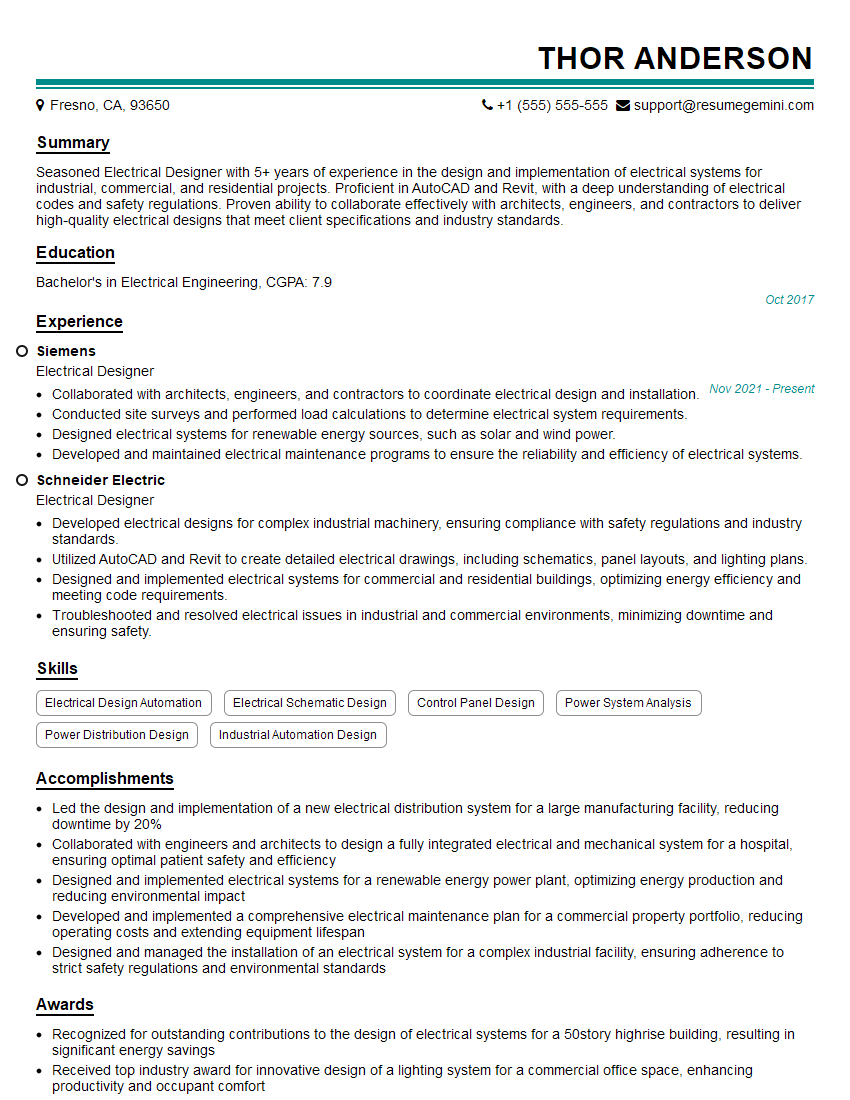
Electrical Designer Resume Sample
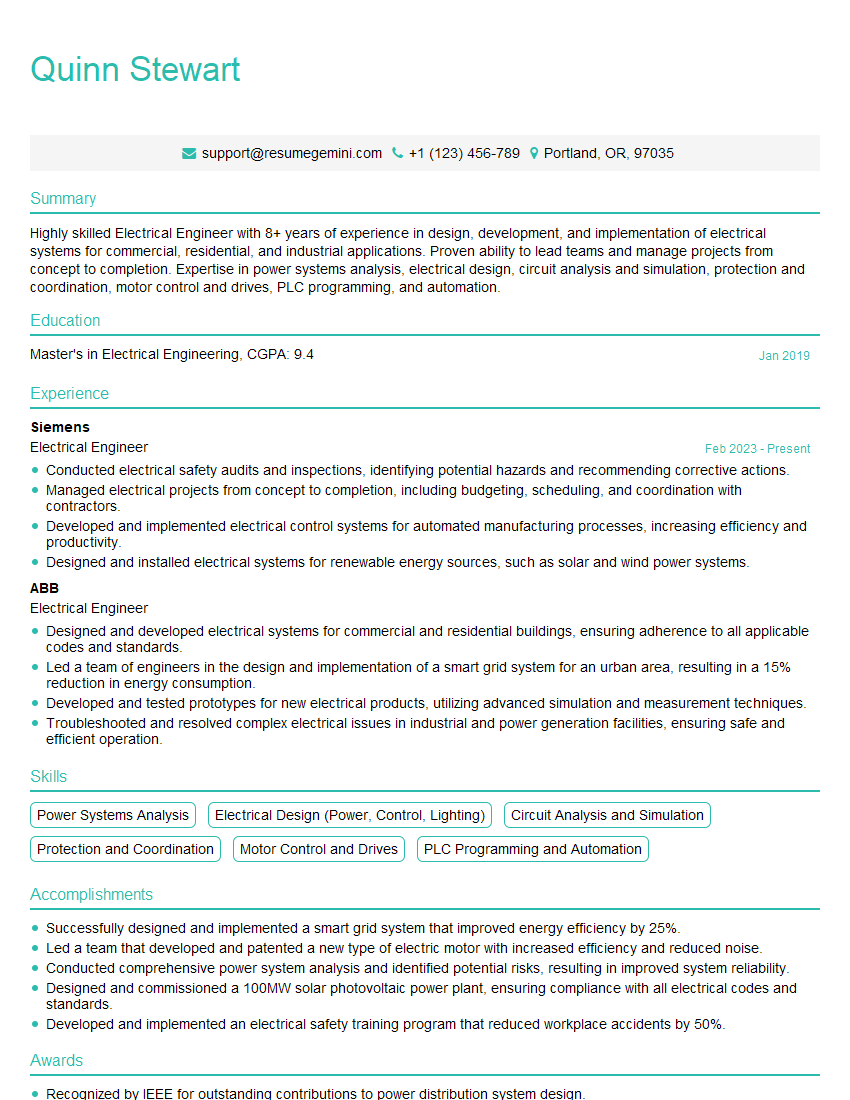
Electrical Engineer Resume Sample
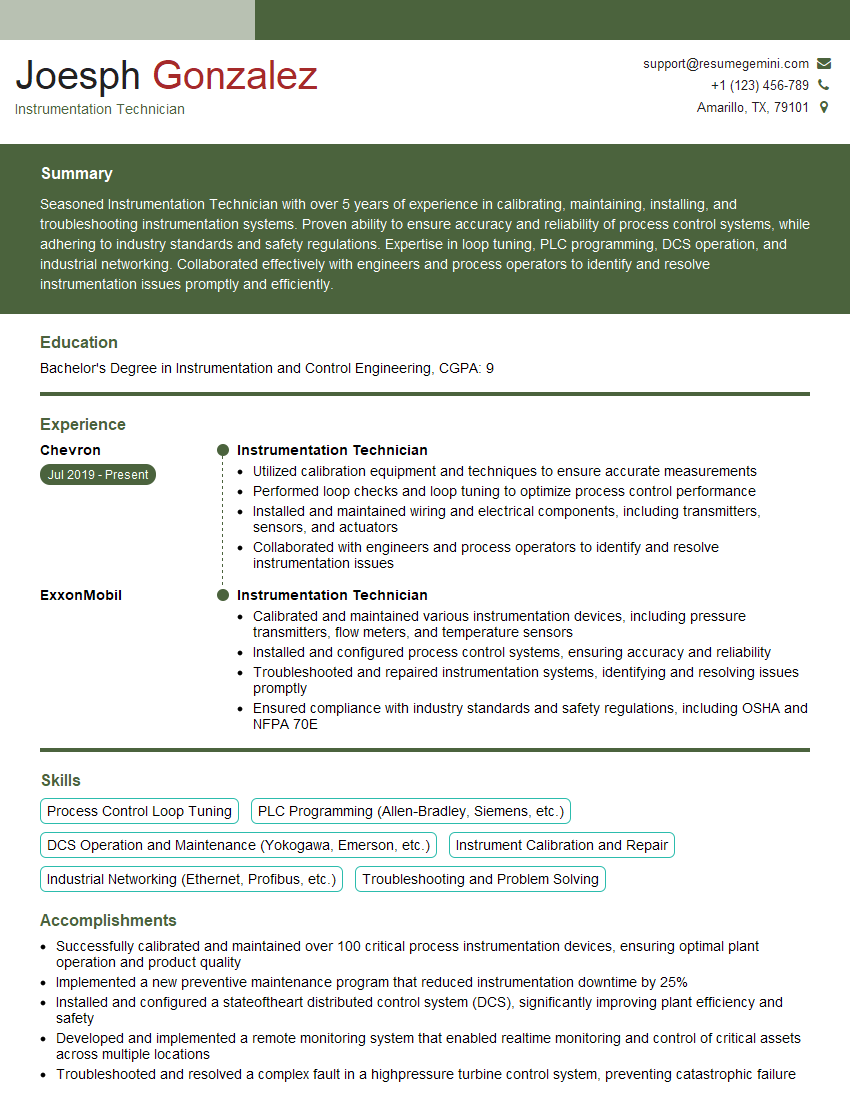
Instrumentation Technician Resume Sample
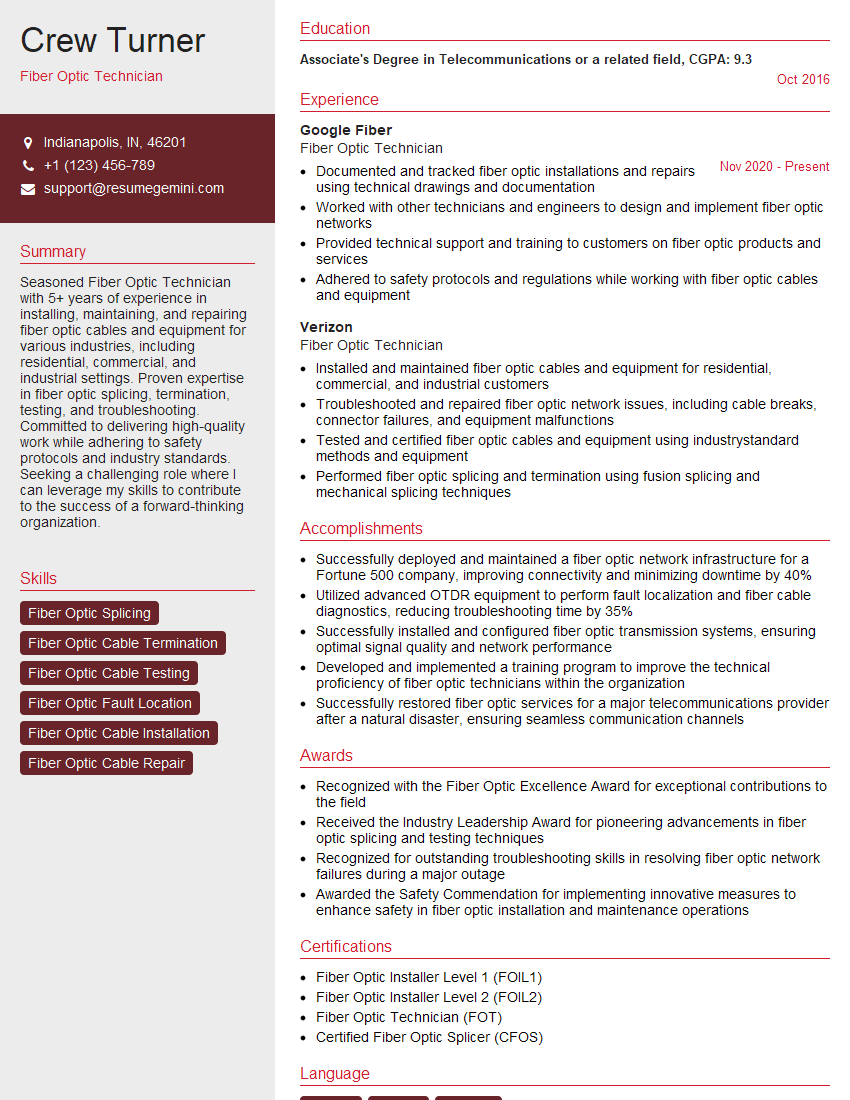
Fiber Optic Technician Resume Sample
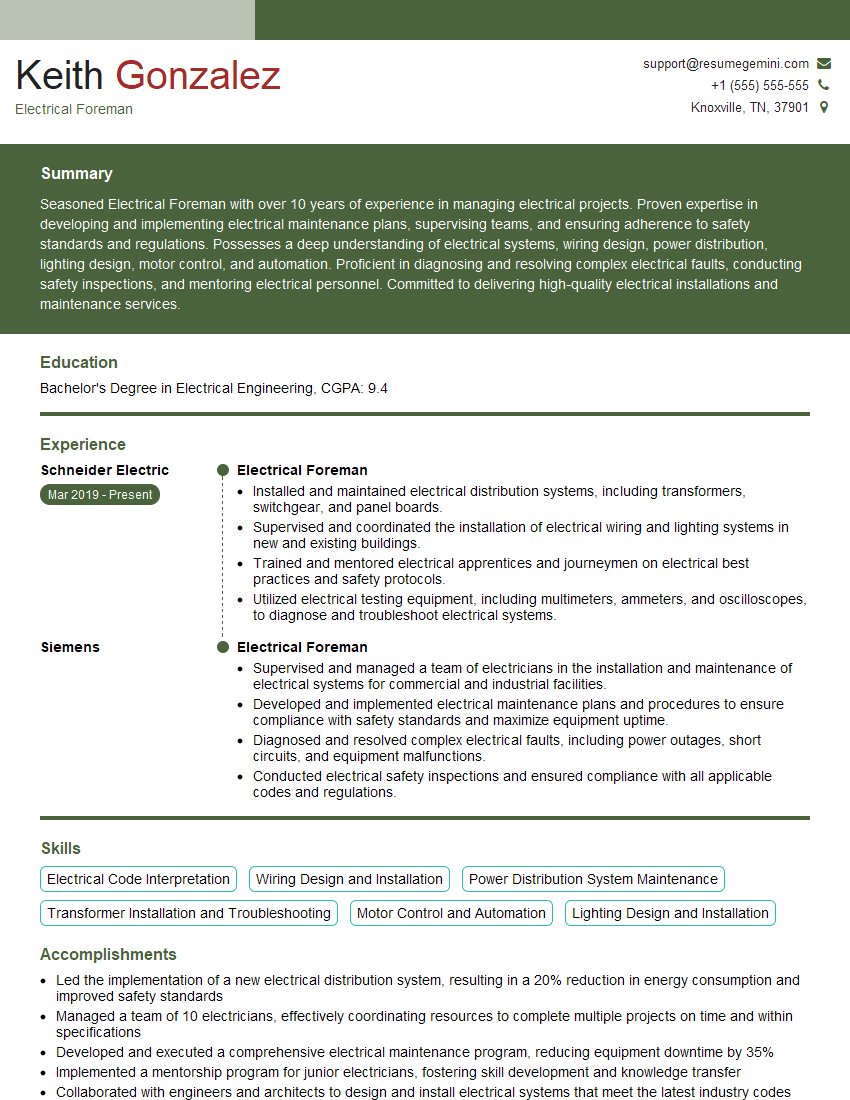
Electrical Foreman Resume Sample
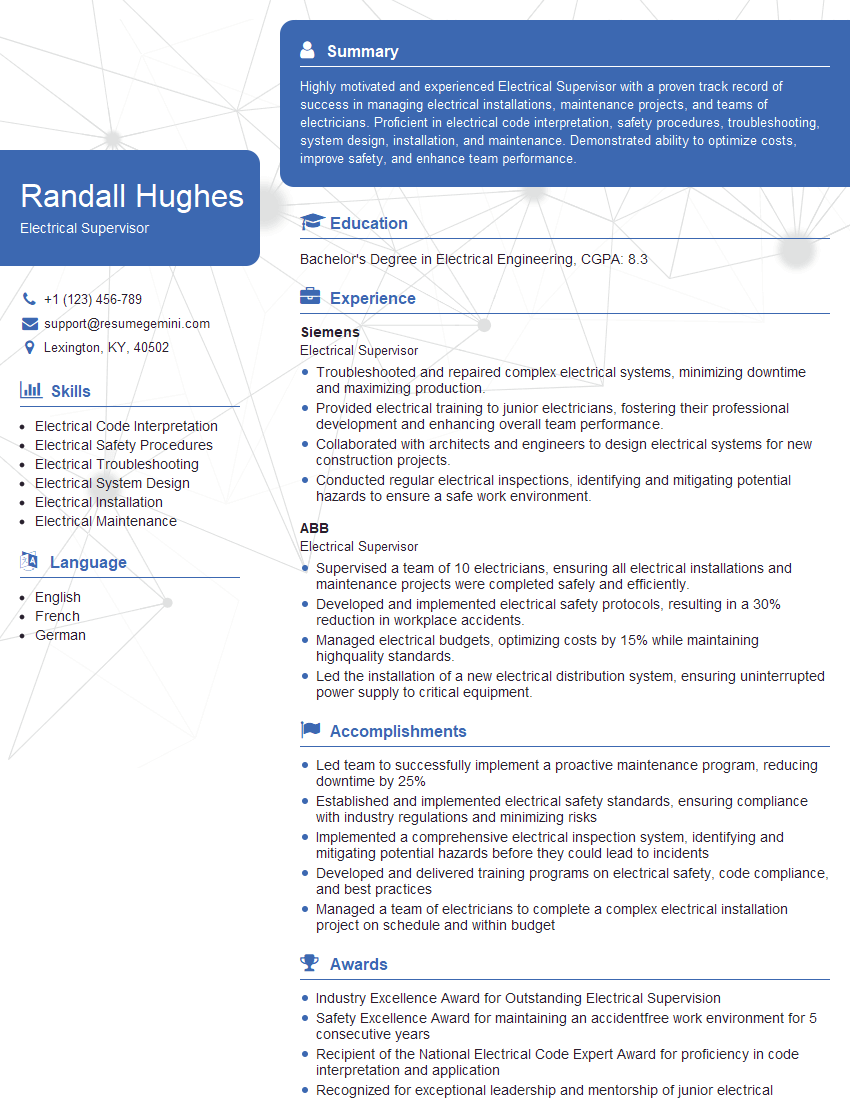
Electrical Supervisor Resume Sample
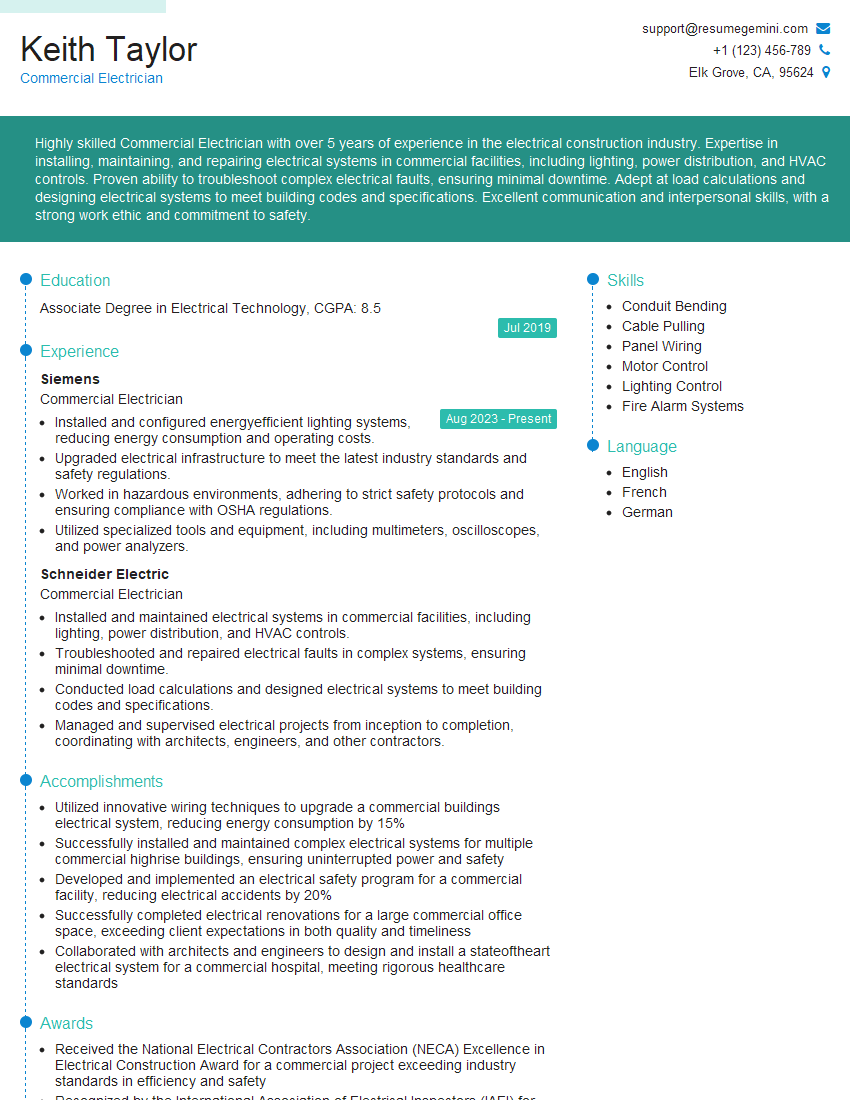
Commercial Electrician Resume Sample
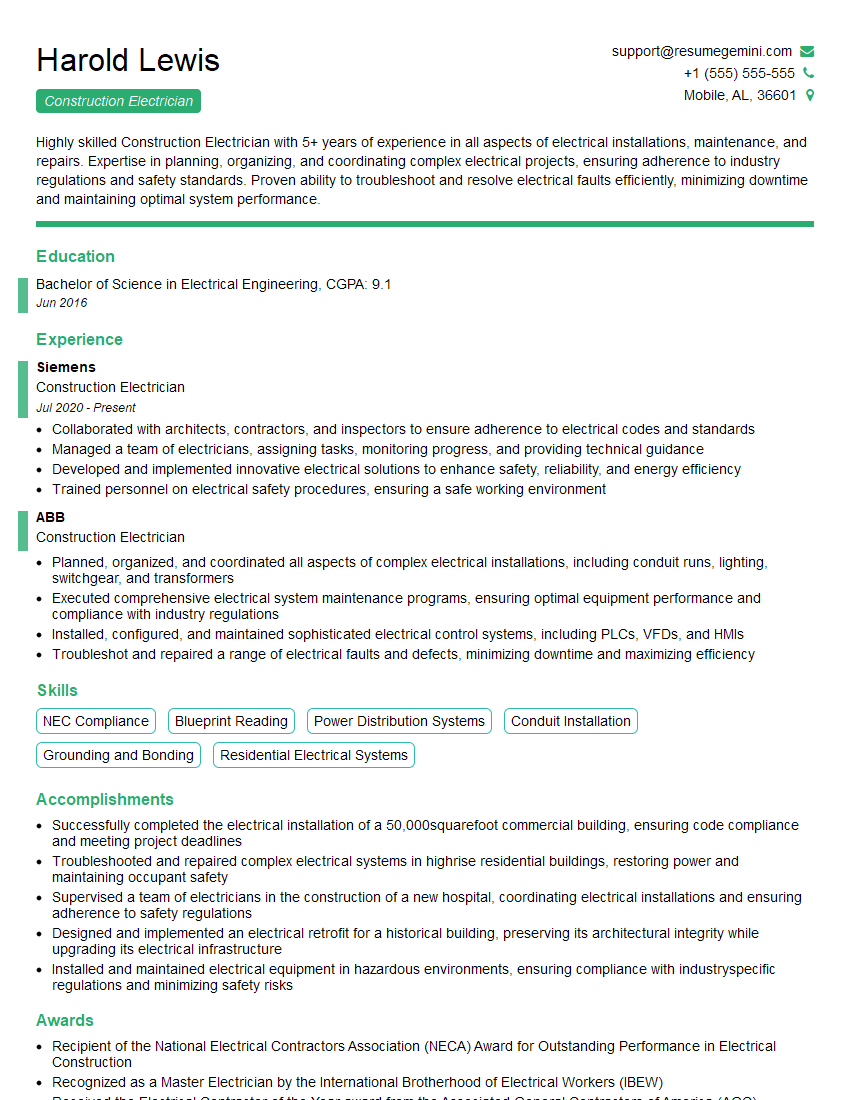
Construction Electrician Resume Sample
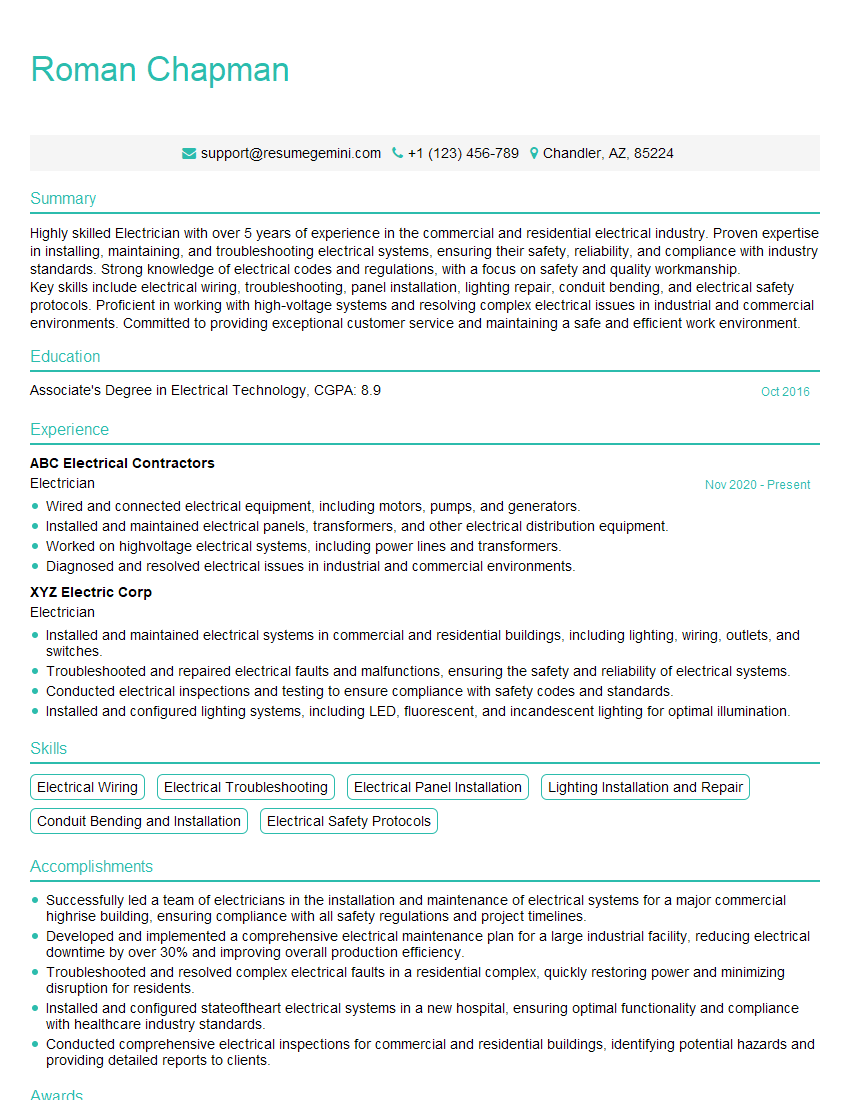
Electrician Resume Sample
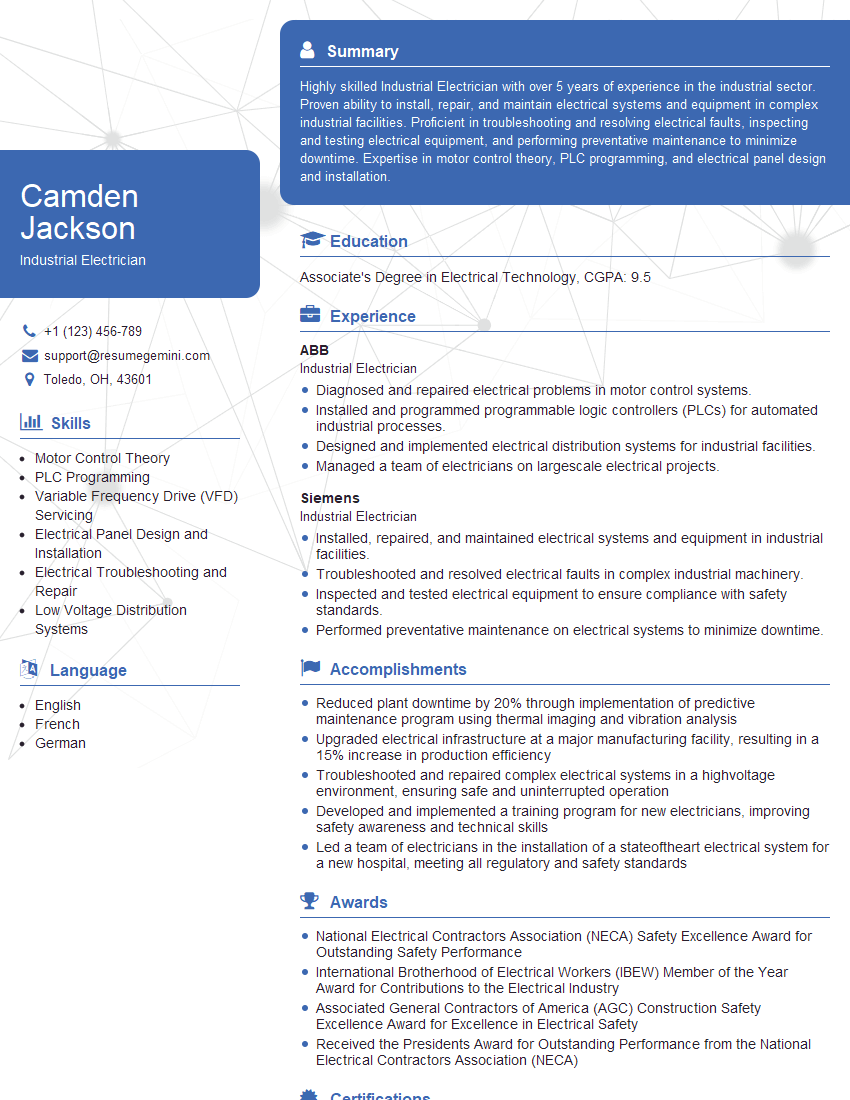
Industrial Electrician Resume Sample
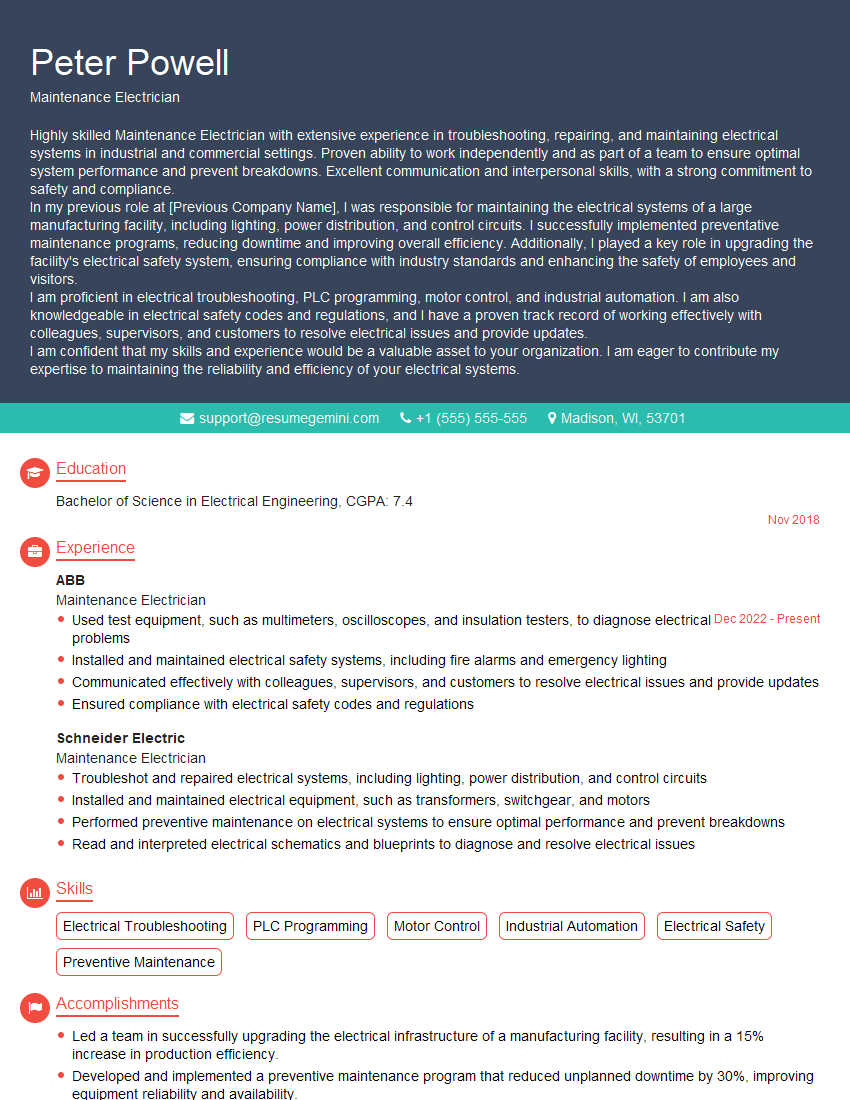
Maintenance Electrician Resume Sample
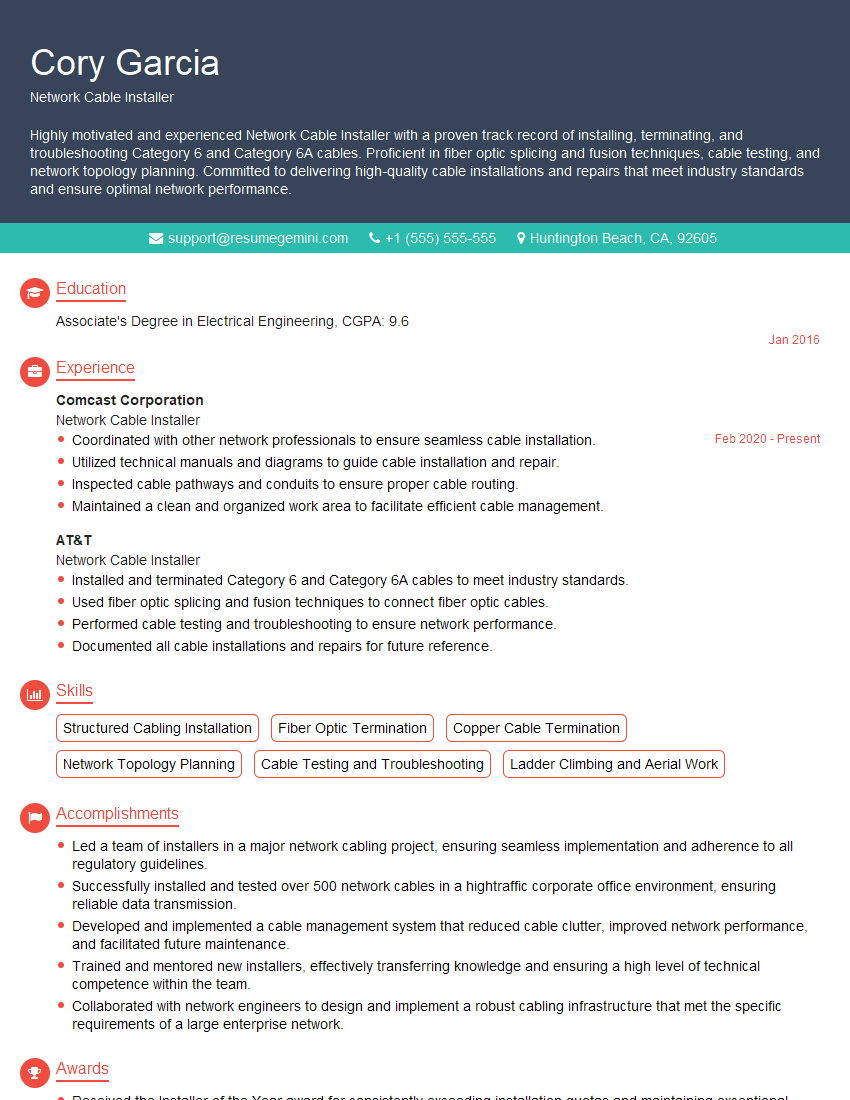
Network Cable Installer Resume Sample
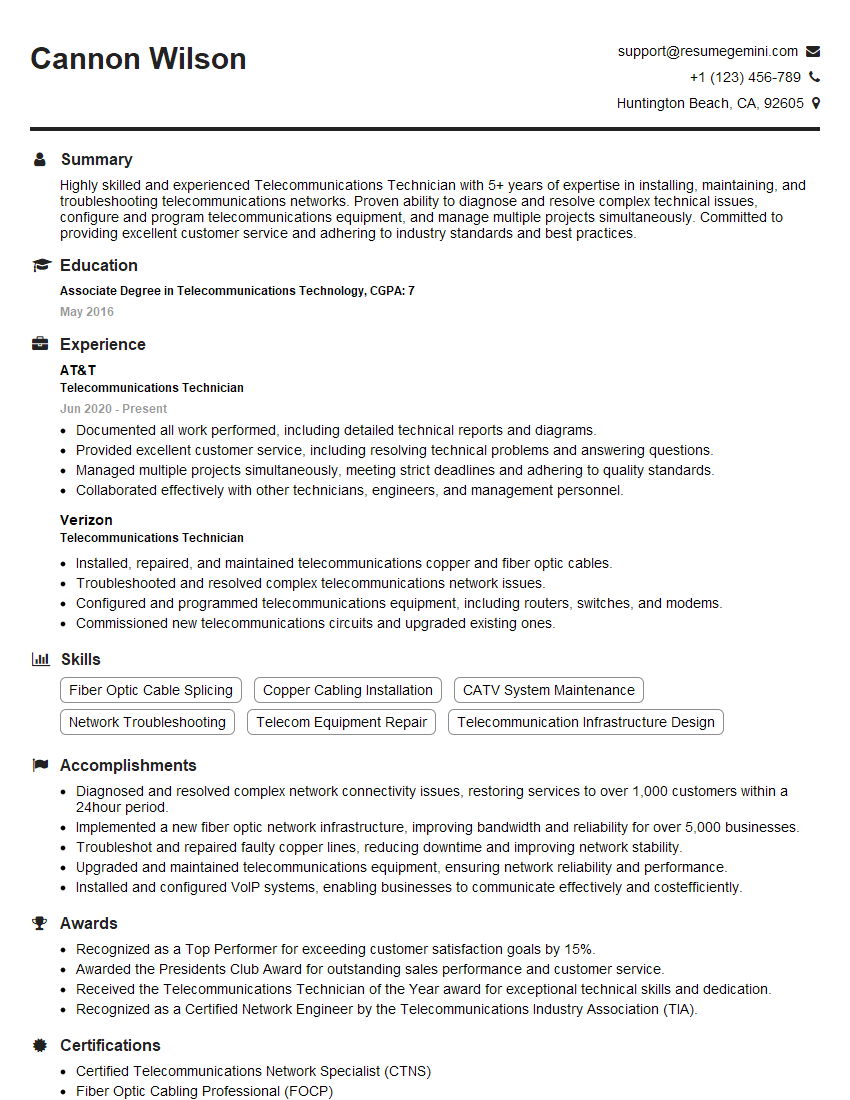
Telecommunications Technician Resume Sample
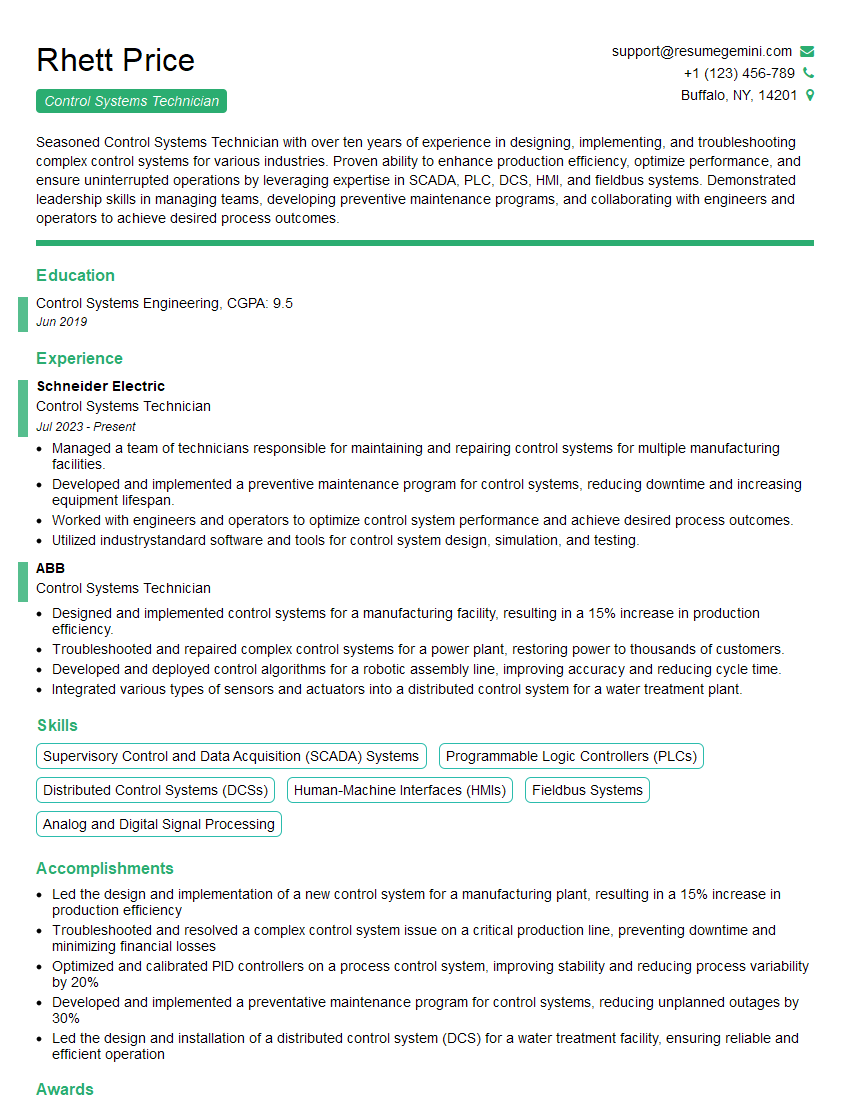
Control Systems Technician Resume Sample
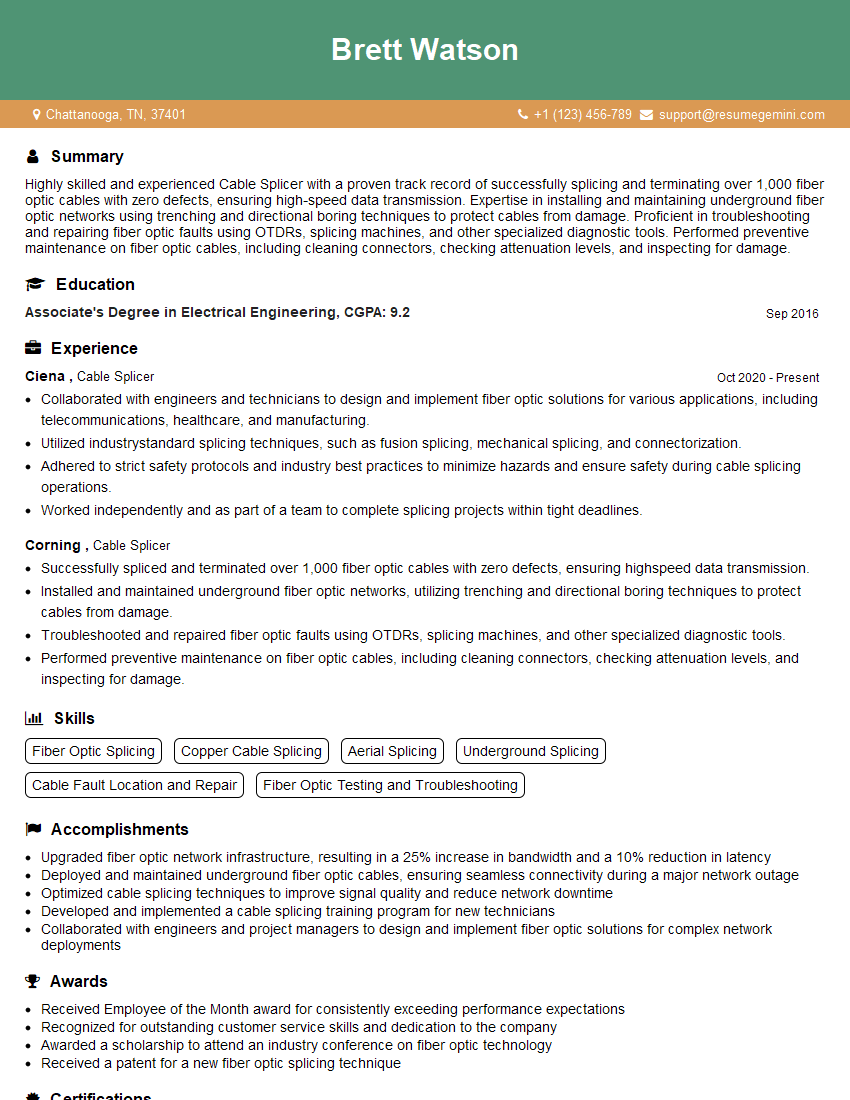
Cable Splicer Resume Sample
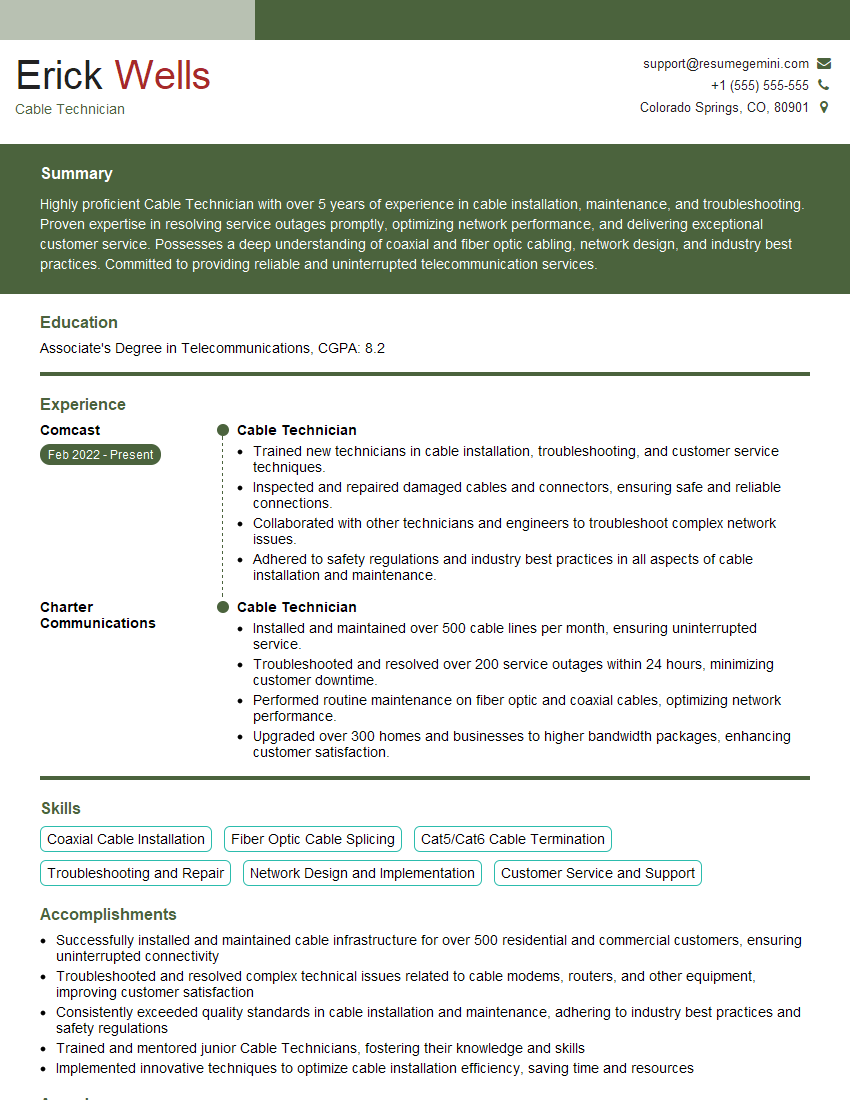
Cable Technician Resume Sample
- Electrical Designer
- Electrical Engineer
- Instrumentation Technician
- Fiber Optic Technician
- Electrical Foreman
- Electrical Supervisor
- Commercial Electrician
- Construction Electrician
- Electrician
- Industrial Electrician
- Maintenance Electrician
- Network Cable Installer
- Telecommunications Technician
- Control Systems Technician
- Cable Splicer
- Cable Technician
Explore more articles
Users Rating of Our Blogs
Share Your Experience
We value your feedback! Please rate our content and share your thoughts (optional).
What Readers Say About Our Blog
To the interviewgemini.com Webmaster.
Very helpful and content specific questions to help prepare me for my interview!
Thank you
To the interviewgemini.com Webmaster.
This was kind of a unique content I found around the specialized skills. Very helpful questions and good detailed answers.
Very Helpful blog, thank you Interviewgemini team.