Interviews are more than just a Q&A session—they’re a chance to prove your worth. This blog dives into essential Music Therapy Documentation and Reporting interview questions and expert tips to help you align your answers with what hiring managers are looking for. Start preparing to shine!
Questions Asked in Music Therapy Documentation and Reporting Interview
Q 1. Explain the importance of accurate and timely music therapy documentation.
Accurate and timely music therapy documentation is paramount for several reasons. It’s the cornerstone of ethical and effective practice, ensuring continuity of care, facilitating informed decision-making, and providing legal protection. Think of it as a detailed roadmap of the client’s journey, guiding both the therapist and other healthcare professionals.
- Continuity of Care: If another therapist takes over, or the client sees other professionals, the documentation provides a complete picture of their progress and needs.
- Informed Decision-Making: Regular documentation helps track progress toward goals, allowing for timely adjustments to treatment plans.
- Legal Protection: Comprehensive records serve as evidence of the services provided and the client’s response to treatment, protecting both the therapist and the client.
- Reimbursement: Accurate documentation is crucial for successful insurance billing.
For example, without detailed documentation, it would be difficult to justify the continuation of therapy or demonstrate the effectiveness of interventions to insurance companies or other stakeholders.
Q 2. Describe your experience using electronic health record (EHR) systems for music therapy documentation.
I have extensive experience using various EHR systems for music therapy documentation, including [mention specific EHR systems you are familiar with, e.g., EPIC, Cerner, etc.]. My proficiency extends beyond simple data entry; I’m adept at utilizing the systems’ features to create comprehensive and easily accessible records. This includes using templates for common assessments and progress notes, integrating audio or video recordings (where permitted and with client consent), and utilizing the system’s reporting features for generating summaries and progress reports.
One particular example involved using an EHR system’s built-in reporting function to create a concise summary of a client’s progress over a six-month period, which was then easily shared with their psychiatrist and case manager. The system allowed me to automatically pull relevant data, saving significant time and effort.
Q 3. What documentation formats are you familiar with (SOAP notes, progress notes, etc.)?
I’m proficient in various documentation formats. The most common are SOAP notes, progress notes, and discharge summaries.
- SOAP notes (Subjective, Objective, Assessment, Plan) offer a structured approach, allowing for a concise yet comprehensive overview of each session. The subjective section captures the client’s self-reported experience, while the objective section details observable behaviors and responses to interventions. The assessment synthesizes this information, leading to a plan for future sessions.
- Progress notes provide a broader summary of a client’s progress over a longer period (e.g., weekly or monthly). They might focus on specific goals, highlighting achievements and challenges.
- Discharge summaries provide a comprehensive overview of the client’s treatment, including goals, interventions, outcomes, and recommendations for future care.
I also adapt my documentation style to the specific needs of the setting and client population. For example, I might use a more narrative style with younger children, focusing on observable behaviors and emotional responses.
Q 4. How do you ensure HIPAA compliance in your music therapy documentation?
HIPAA compliance is a top priority. I strictly adhere to all relevant regulations to protect client privacy. This involves several key practices:
- Secure Storage: All electronic and physical documentation is stored securely, using password-protected systems and locked filing cabinets.
- Limited Access: Only authorized personnel have access to client records.
- Confidentiality Training: I maintain up-to-date knowledge of HIPAA regulations through regular training.
- Data Encryption: When transmitting sensitive data electronically, I utilize encryption protocols to ensure confidentiality.
- Client Authorization: I obtain informed consent from clients before sharing any information with third parties.
For instance, if I need to discuss a client’s case with another healthcare professional, I would only do so with the client’s explicit permission, and only share the minimum necessary information.
Q 5. How do you integrate client goals and outcomes into your documentation?
Client goals and outcomes are central to my documentation. They’re clearly defined at the beginning of therapy, collaboratively developed with the client (when appropriate), and regularly revisited.
My documentation explicitly links specific interventions to the progress made toward these goals. For example, if a client’s goal is to improve emotional regulation, I document how specific music therapy techniques (e.g., guided imagery, improvisation) were used, and the observed changes in their emotional responses. I use measurable outcomes whenever possible, such as quantifying changes in heart rate, anxiety levels, or behavioral observations. This allows for objective assessment of progress and adjustments to the treatment plan as needed.
Q 6. Describe your process for documenting both verbal and nonverbal client responses during therapy sessions.
Documenting both verbal and nonverbal client responses is crucial for a holistic understanding of their progress.
- Verbal Responses: I directly quote significant client statements, using quotation marks to ensure accuracy. I also note the tone, volume, and emotional inflection of their speech. For example, I might write: “Client stated, ‘I feel much calmer now,’ in a soft, relaxed tone.”
- Nonverbal Responses: These are equally important. I document observable behaviors such as posture, facial expressions, body language, and engagement levels. For example, I might note: “Client exhibited improved eye contact and a more relaxed posture during the improvisation exercise.”
Combining verbal and nonverbal observations gives a comprehensive picture of the client’s experience during the session and their response to the intervention.
Q 7. How do you handle documenting challenging or unexpected client behaviors?
Documenting challenging or unexpected behaviors requires a careful and objective approach. I prioritize factual accuracy, avoiding subjective interpretations. I detail the behavior objectively, including the context, triggers, and the client’s response to the intervention. For instance, I might document:
“During the session, the client exhibited increased agitation, characterized by pacing and shouting. This seemed triggered by a discussion of upcoming family events. The use of calming music and a brief period of guided imagery resulted in a gradual reduction in the client’s agitation.”
I also note any safety precautions taken and any modifications to the treatment plan that were implemented. It’s vital to consult with supervisors or other team members when appropriate to ensure the client’s safety and receive guidance on managing such situations effectively.
Q 8. How do you ensure your documentation is objective, concise, and clinically relevant?
Maintaining objective, concise, and clinically relevant documentation is paramount in music therapy. Think of it like creating a clear, concise map that guides the client’s journey and allows for effective collaboration among professionals. We avoid subjective language like “seemed happy” and instead focus on observable behaviors. For example, instead of writing ‘Client was engaged,’ I’d write ‘Client actively participated in 80% of the improvisational activity, maintaining eye contact and responding appropriately to musical cues.’ Conciseness ensures efficiency; we record only essential information. Clinical relevance means focusing on behaviors directly related to the client’s treatment goals. Each entry should directly reflect progress towards those goals, using measurable metrics whenever possible. For instance, if a goal is to improve verbal communication, I’d document the number of words spoken during the session, the clarity of speech, and any observed increase in spontaneous communication.
To ensure objectivity, I use standardized assessment tools where applicable and regularly review my notes to remove any bias or subjective interpretation. Regular supervision also helps to maintain a focus on objective documentation and clinical relevance.
Q 9. Explain your understanding of different coding systems used in music therapy billing and documentation.
Several coding systems are used in music therapy billing and documentation, depending on the country and insurance provider. In the US, the most common is the Current Procedural Terminology (CPT) codes, which are five-digit codes that describe specific medical procedures and services. These codes are crucial for reimbursement from insurance companies. For music therapy, specific CPT codes exist for individual and group sessions, and sometimes there are more specific codes describing the type of intervention utilized (e.g., neurologic music therapy, music and movement, etc.).
Another system, though less common specifically for billing, is the International Classification of Diseases (ICD) codes. These codes classify diseases and health conditions and are used for diagnosis purposes. They are often linked with CPT codes to provide a complete picture of the client’s needs and the services rendered. For example, a client with anxiety might have an ICD code reflecting their diagnosis, while the CPT code would reflect the music therapy session to treat it.
Understanding these coding systems is critical for accurate billing and communicating the nature of the service provided. Incorrect coding can lead to delays in payments or even rejection of claims. Therefore, ongoing professional development in this area is essential.
Q 10. How do you ensure continuity of care through your documentation?
Maintaining continuity of care through documentation is like creating a consistent narrative of the client’s journey. This requires clear, chronological documentation of each session, including specific details of the intervention, the client’s responses, and any notable changes in behavior or progress toward goals. I use a consistent format for my notes to ensure easy readability and tracking of progress over time.
Effective handovers to other professionals, such as between therapists or to other members of the care team, require concise summarization of the client’s progress. This includes key information about the client’s response to treatment, changes in their goals, and any updates concerning their overall well-being. Clear communication and collaboration with the treatment team are crucial for successful continuity of care.
Q 11. How do you maintain confidentiality while accurately documenting sensitive client information?
Maintaining confidentiality in music therapy documentation is ethically and legally paramount. We adhere to HIPAA regulations (in the US) and all applicable privacy laws. This involves several steps, including: using secure electronic health records systems; limiting access to client files to authorized personnel only; ensuring physical security of paper records; and always using appropriate identifiers in any documentation (e.g., client’s initials instead of full name). Any information shared outside the treatment team requires the client’s explicit consent.
When documenting sensitive information, I use precise and factual language avoiding subjective or judgmental terms. For instance, instead of saying ‘the client was upset,’ I might say, ‘the client exhibited increased respiratory rate and tearfulness during the session.’ This ensures accurate recording while respecting the client’s privacy.
Q 12. What are the ethical considerations related to music therapy documentation?
Ethical considerations in music therapy documentation are based on principles of beneficence, non-maleficence, autonomy, justice, and fidelity. These principles guide our practices and ensure ethical and legal compliance. For example, ensuring accuracy and honesty in all documentation is a core element of beneficence, preventing harm through misinformation. Respecting the client’s right to privacy and self-determination (autonomy) is vital. Fair and equitable documentation practices (justice) prevent bias. Maintaining confidentiality and professional boundaries are examples of fulfilling the principle of fidelity.
Specific ethical considerations might include informed consent for documentation, maintaining accurate billing records, and handling requests for records appropriately. Regular ethical reflection and supervision play an important role in maintaining high ethical standards in our practice.
Q 13. How would you handle a discrepancy between your observations and a colleague’s notes?
Discrepancies in observations between colleagues are opportunities for learning and improved care. If I notice a discrepancy between my notes and a colleague’s, I would first approach the colleague in a private and respectful manner. I’d share my observations in a neutral and factual way, stating specifically where the difference lies and avoid making accusatory statements. For example, “I noticed in your notes that the client demonstrated improved fine motor skills, but my observations indicated a decline in this area during today’s session. Could we discuss this further?”
We’d then engage in a collaborative discussion, sharing our individual notes and exploring possible reasons for the difference. This could involve reviewing the session’s recordings (if available), discussing the specific criteria used to assess the skill, or considering external factors that might have impacted the client’s performance. The aim is to reach a shared understanding and ensure consistency in future documentation. If the discrepancy remains unresolved, we could consult with a supervisor to facilitate the discussion.
Q 14. What is your experience with using data from music therapy documentation to track client progress?
Data from music therapy documentation is invaluable for tracking client progress. I regularly use this data to monitor the effectiveness of interventions and make informed decisions about treatment plans. This might involve charting specific behavioral changes, quantifiable improvements in skills (e.g., increased vocal range, improved motor control), or changes in standardized assessment scores. I might use graphs or charts to visually represent the client’s progress over time.
For example, if working with a client with anxiety, I might track their self-reported anxiety levels before and after sessions, noting changes in their physiological responses (heart rate, respiration) during musical activities. This data allows me to demonstrate the effectiveness of music therapy in reducing anxiety and adjust the therapeutic approach as needed. Regular review of this data is crucial for informing treatment modifications and ensuring that therapy remains relevant and effective.
Sometimes, this data is also used for research purposes (with appropriate consent) to contribute to the broader understanding of music therapy’s impact on various conditions.
Q 15. How do you use assessment data to inform your music therapy treatment plans and documentation?
Assessment data is the cornerstone of effective music therapy. It provides the crucial information needed to tailor treatment plans and accurately reflect client progress in documentation. I begin by conducting a comprehensive initial assessment, which may include observation, interviews, standardized and informal assessments, and informal musical interactions. This helps me identify the client’s strengths, weaknesses, goals, and preferences in relation to music and their therapeutic needs.
For example, if a client with anxiety scores high on a standardized anxiety scale and demonstrates difficulty with self-regulation during a musical improvisation task, my treatment plan will likely focus on developing coping mechanisms using rhythmic activities and guided imagery through music. This entire process, including the assessment results and treatment rationale, is meticulously documented. I use this data to measure progress towards established goals, modifying the plan as needed based on ongoing assessment results. This ensures the plan remains relevant and effective.
Let’s say a client initially struggled with melodic contour imitation but showed improvement over several sessions. This positive change will be reflected in my progress notes, supported by specific examples from sessions illustrating their improvement, such as ‘Client successfully imitated a four-note melody with 80% accuracy in today’s session, a marked improvement from previous sessions’. This data-driven approach ensures transparency, accountability and enables effective communication with other healthcare professionals involved in the client’s care.
Career Expert Tips:
- Ace those interviews! Prepare effectively by reviewing the Top 50 Most Common Interview Questions on ResumeGemini.
- Navigate your job search with confidence! Explore a wide range of Career Tips on ResumeGemini. Learn about common challenges and recommendations to overcome them.
- Craft the perfect resume! Master the Art of Resume Writing with ResumeGemini’s guide. Showcase your unique qualifications and achievements effectively.
- Don’t miss out on holiday savings! Build your dream resume with ResumeGemini’s ATS optimized templates.
Q 16. Describe your experience with different types of music therapy documentation software.
I have experience with a range of music therapy documentation software, including both simple spreadsheet-based systems and more sophisticated Electronic Health Record (EHR) systems integrated with client portals. Spreadsheet programs can be useful for basic record-keeping, especially in private practice settings with fewer reporting requirements. However, more complex systems often provide significant benefits, including improved data security, streamlined reporting, and better integration with other healthcare systems.
For instance, I’ve used EHR systems such as [Software Name 1] and [Software Name 2], which allow for secure storage of client information, generation of standardized reports, and the ability to track progress visually through charts and graphs. My experience spans using these platforms across various settings – from the highly structured environment of a hospital to the more flexible needs of a school or private practice. I am always evaluating new software to ensure I use the most efficient and secure system for my clients’ needs and to comply with all relevant regulations.
Q 17. How do you ensure your documentation is easily accessible and retrievable?
Ensuring accessibility and retrievability of documentation is paramount. I maintain a well-organized digital filing system using a cloud-based platform with robust security features. This allows easy access from multiple devices, facilitating collaboration with other professionals and ensuring that client information remains readily available should a client transfer care or if it’s needed for legal purposes.
My system uses a clear and consistent naming convention for files, making retrieval simple. For example, I might use a format like ClientLastName_FirstName_Date_SessionType.doc. I also regularly back up all data to a separate, secure location to prevent data loss. Furthermore, within the EHR systems, I utilize the software’s search functionalities and robust tagging systems to quickly locate specific information. This approach ensures compliance with HIPAA and other relevant regulations regarding client confidentiality and data protection.
Q 18. What are the legal implications of inaccurate or incomplete music therapy documentation?
Inaccurate or incomplete music therapy documentation carries significant legal implications. It can lead to malpractice claims, licensing board sanctions, and even legal action. Incomplete documentation can make it difficult to demonstrate the efficacy of treatment, creating vulnerabilities in the event of a dispute. Inaccurate documentation, such as misrepresenting a client’s progress or failing to record relevant information such as adverse events, could be interpreted as negligence or fraud.
For example, omitting crucial details about a client’s response to a specific intervention could hinder the ability to defend against allegations of ineffective treatment. Similarly, misreporting a client’s condition or progress could jeopardize their care and create liability. Maintaining accurate, complete, and objective documentation is not merely a professional best practice but a crucial legal safeguard. This includes adhering to strict confidentiality guidelines as outlined in HIPAA or other relevant data protection legislation.
Q 19. How do you adapt your documentation style to different settings (e.g., hospital, school, private practice)?
My documentation style adapts to different settings. In a hospital, documentation needs to be concise, focused on measurable outcomes directly relevant to the medical team, and adhere strictly to the hospital’s electronic health record system and reporting protocols. Progress notes might prioritize physiological responses to interventions, alongside the client’s emotional state and overall participation.
In a school setting, I might include more detail on the client’s social interaction skills within the musical context and how music therapy supports their classroom performance. Documentation here often needs to integrate with the educational goals and Individualized Education Programs (IEPs) of the student. In private practice, there’s more flexibility, though ethical and professional standards must always be upheld. Here I might include more qualitative data and client feedback to build a richer narrative of the therapeutic process. Regardless of the setting, the core principles of accuracy, objectivity, and client confidentiality remain paramount. This requires a constant awareness of the different requirements and expectations of each setting.
Q 20. How familiar are you with the different types of progress notes and their purpose?
I am very familiar with various types of progress notes. These include SOAP notes (Subjective, Objective, Assessment, Plan), DAP notes (Data, Assessment, Plan), and narrative progress notes.
- SOAP notes offer a structured format focusing on subjective observations (client’s statements), objective data (measurable information), assessment (clinical judgment), and the plan for future sessions. They are widely used in medical settings.
- DAP notes are a simplified version, omitting the subjective component, and are often preferred when brevity is important.
- Narrative progress notes provide a more detailed, descriptive account of the session, offering a comprehensive picture of the client’s progress and the therapeutic process. They’re useful for capturing rich qualitative data but may be less efficient for quick overviews.
The choice of note type depends on the setting and the information needed. For example, SOAP notes might be preferred in a hospital setting for their conciseness and standardized format, while narrative notes could be more appropriate in a private practice setting allowing for more in-depth reflection on the therapeutic process. Each format serves a specific purpose in communicating client information effectively and meeting reporting requirements.
Q 21. How do you prioritize information in your documentation?
Prioritizing information in documentation involves focusing on the most relevant and impactful data related to the client’s progress towards their goals. I prioritize information based on its clinical significance and relevance to the treatment plan. This usually involves emphasizing measurable outcomes, significant changes in behavior or mood, and the client’s response to interventions.
For example, if a client’s primary goal is to improve their self-esteem, I would prioritize documenting observable changes in their confidence during musical performance, their participation in group activities, and any shifts in their self-perception. I would de-emphasize less relevant details while ensuring that the overall picture of the client’s progress is accurately represented. This approach ensures the documentation is both comprehensive and efficient, allowing for easy identification of key trends and progress over time. The information is always organized chronologically, clearly showing the evolution of the treatment process and facilitating easy access for review and future reference.
Q 22. Explain your process for reviewing and revising your own documentation.
My process for reviewing and revising my own documentation is a multi-step approach focused on accuracy, clarity, and ethical considerations. Immediately after a session, I jot down brief notes to capture key observations and client responses. Later, within 24 hours, I create a more detailed entry. This initial draft undergoes a thorough review, checking for:
- Completeness: Does it accurately reflect the session’s goals, interventions, and client’s participation?
- Accuracy: Are all the facts and data precisely recorded? For example, I verify the length of the session, specific interventions used, and client’s measurable responses.
- Clarity and Objectivity: Is the language clear, concise, and avoids subjective interpretations? I focus on observable behaviors instead of assumptions. For instance, instead of writing ‘Client seemed depressed’, I’d note ‘Client displayed decreased verbal output and slumped posture.’
- Confidentiality: Does the documentation maintain client confidentiality and adhere to HIPAA regulations (or relevant privacy laws)?
- Clinical Relevance: Does the documentation clearly demonstrate the therapeutic rationale for the chosen interventions and their effectiveness?
After this self-review, I proofread for any grammatical errors or typos. This meticulous approach ensures my notes are professional, accurate, and ready for any review.
Q 23. How do you incorporate feedback from supervisors or colleagues into your documentation?
Incorporating feedback from supervisors or colleagues is crucial for professional growth. I actively seek feedback, viewing it as an opportunity for improvement. When receiving feedback, I listen attentively, ask clarifying questions, and avoid defensiveness. I then analyze the feedback, identifying areas where my documentation could be enhanced. For example, if a supervisor suggests more specific behavioral observations, I implement that immediately. If they mention a need for better integration of goals into session descriptions, I revise my approach in future entries to proactively connect interventions to the established goals. I document the feedback received, the changes made, and the date of implementation in my professional development log. This systematic approach demonstrates my commitment to continuous improvement and enhances the quality of my documentation.
Q 24. What strategies do you use to ensure your documentation is consistent with your organization’s policies and procedures?
Consistency with organizational policies and procedures is paramount. I familiarize myself with the organization’s style guide, templates, and electronic health record (EHR) system guidelines. I regularly check for updates to these policies. My EHR system includes prompts and checks to ensure required fields are completed. If a specific format is required for progress notes or discharge summaries, I adhere meticulously to those standards. I maintain a copy of the organization’s documentation guidelines readily available for reference. Any questions regarding policies are immediately addressed with my supervisor to ensure clarity and compliance. Regularly reviewing updated policies and maintaining open communication with my supervisor ensures my documentation aligns with organizational standards. This approach minimizes errors, strengthens the consistency of records, and ensures compliance with professional standards.
Q 25. Describe a situation where you had to resolve a documentation-related problem.
In one instance, I discovered an inconsistency between my session notes and the client’s progress summary. The progress summary reflected a slightly different interpretation of the client’s progress than my detailed session notes. This discrepancy could have led to inaccurate portrayal of the client’s therapeutic journey. To resolve this, I first reviewed my session notes meticulously. Then I compared my notes with my supervisor’s notes, which provided an independent perspective. We collaboratively discussed the discrepancy, identifying where different interpretations of similar client behaviors led to the inconsistency. We adjusted the progress summary to more accurately reflect the client’s overall progress as documented in the session notes, ensuring that the information in both documents was congruent and accurate. This experience highlighted the importance of regular self-review and the value of collaboration in ensuring the accuracy and consistency of my documentation.
Q 26. How do you ensure the accuracy of your billing based on your documentation?
Accuracy in billing is directly linked to the detail and accuracy of my documentation. I ensure that the codes used for billing align precisely with the services provided, as documented in my session notes. Each entry includes a clear description of interventions and client responses. For example, if I use a specific music therapy technique and it falls under a particular billing code, I explicitly mention this in my notes, ensuring clear correspondence between my documentation and the billing codes used. I frequently review the organization’s billing guidelines and codes to ensure I am billing appropriately. If I have any doubts, I consult with the billing department or my supervisor before submitting claims. This careful correlation between documentation and billing ensures accurate and ethical billing practices, minimizing potential errors and supporting financial transparency.
Q 27. What professional development activities have you undertaken related to music therapy documentation and reporting?
My professional development in music therapy documentation and reporting is an ongoing process. I’ve completed continuing education workshops focusing on documentation best practices, electronic health record (EHR) proficiency, and HIPAA compliance. I regularly attend professional conferences and webinars to stay abreast of current trends and best practices in music therapy documentation and reporting. I actively participate in peer supervision, where we review each other’s documentation, offering feedback and support. These activities have enhanced my skills and improved my understanding of the complexities of ethical and accurate documentation. I also utilize online resources and professional journals to stay updated on new guidelines and technologies.
Key Topics to Learn for Music Therapy Documentation and Reporting Interview
- SOAP Note Structure and Application: Understand the components of a SOAP note (Subjective, Objective, Assessment, Plan) and how to apply this structure effectively to document music therapy sessions. Practice writing concise and accurate SOAP notes reflecting client progress and treatment goals.
- Progress Note Writing: Master the art of writing clear, concise, and objective progress notes that demonstrate client outcomes and justify continued treatment. Focus on quantifiable data and measurable goals.
- ICD-10 and DSM-5 Coding: Familiarize yourself with the diagnostic codes used in music therapy documentation. Practice applying these codes accurately to reflect client diagnoses and treatment needs.
- Ethical Considerations in Documentation: Understand HIPAA regulations and ethical guidelines related to maintaining client confidentiality and accurate record-keeping. Be prepared to discuss best practices for protecting client information.
- Data Analysis and Reporting: Learn how to analyze data collected during music therapy sessions and create reports that effectively communicate client progress to supervisors, insurance companies, and other stakeholders. This includes understanding and utilizing various reporting formats.
- Treatment Planning and Goal Setting: Demonstrate your ability to develop individualized treatment plans with measurable goals based on client needs and assessment data. Practice articulating how your documentation supports the treatment plan and its progress.
- Technology in Documentation: Explore the use of electronic health records (EHRs) and other software in music therapy documentation. Discuss the advantages and challenges of using technology in this area.
- Legal and Regulatory Compliance: Understand the legal and regulatory requirements related to music therapy documentation in your specific practice setting. Be prepared to discuss how you maintain compliance.
Next Steps
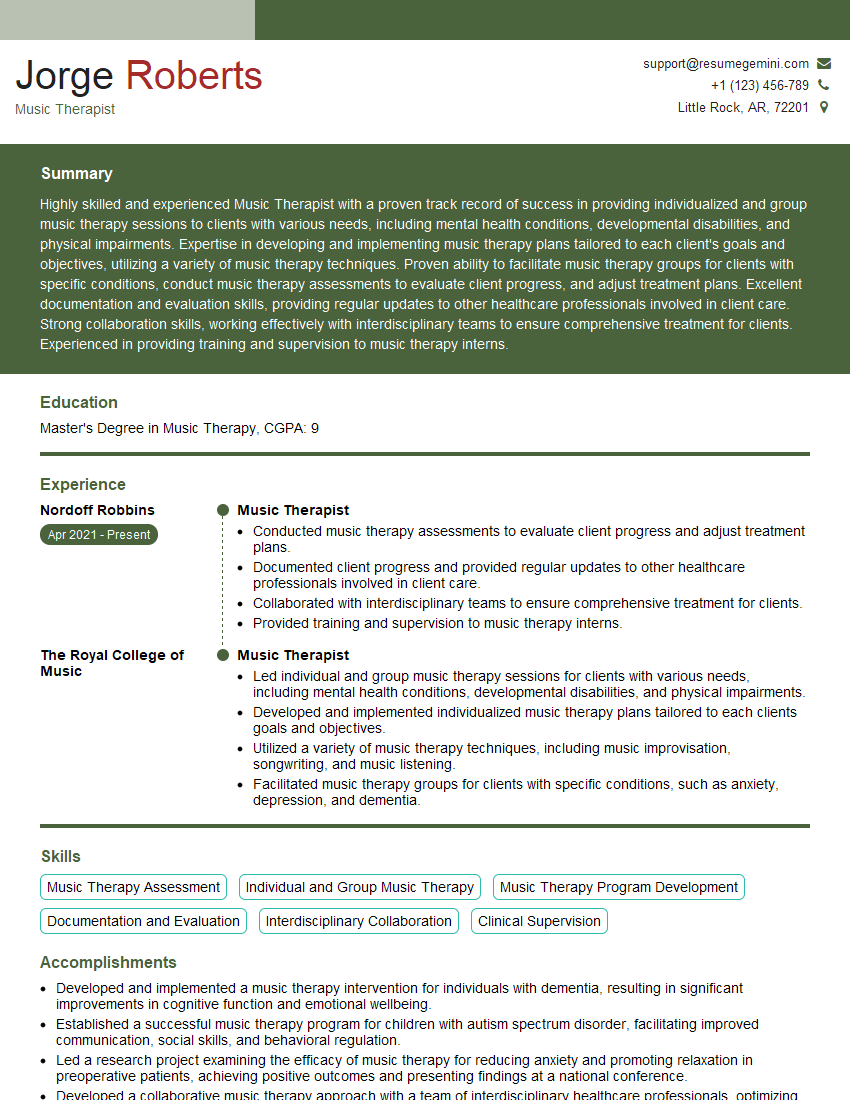
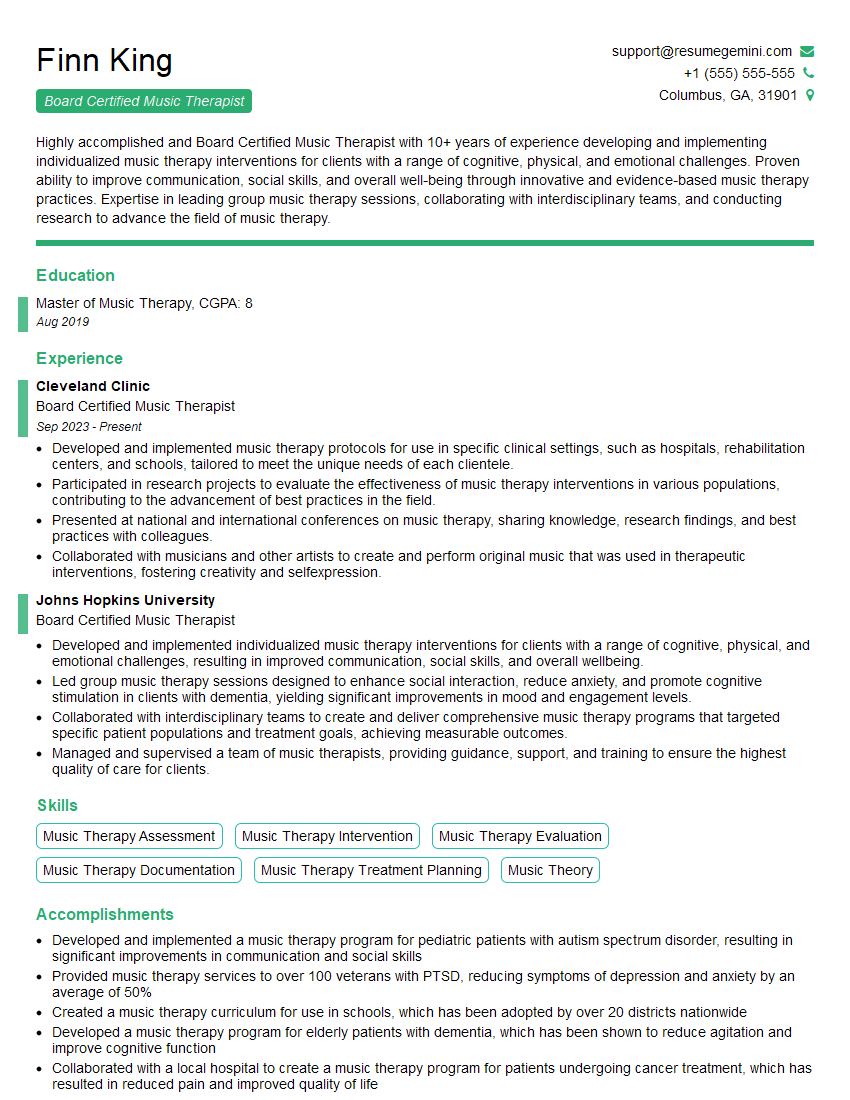
Mastering Music Therapy Documentation and Reporting is crucial for career advancement in this field. Clear, concise, and accurate documentation is essential for demonstrating your clinical competence, securing reimbursement, and ensuring client well-being. An ATS-friendly resume is vital for getting your application noticed by potential employers. To significantly enhance your job prospects, we strongly encourage you to create a professional and impactful resume using ResumeGemini. ResumeGemini provides a user-friendly platform and offers examples of resumes tailored specifically to Music Therapy Documentation and Reporting, helping you present your skills and experience effectively.
Explore more articles
Users Rating of Our Blogs
Share Your Experience
We value your feedback! Please rate our content and share your thoughts (optional).
What Readers Say About Our Blog
To the interviewgemini.com Webmaster.
Very helpful and content specific questions to help prepare me for my interview!
Thank you
To the interviewgemini.com Webmaster.
This was kind of a unique content I found around the specialized skills. Very helpful questions and good detailed answers.
Very Helpful blog, thank you Interviewgemini team.