Cracking a skill-specific interview, like one for Proficiency in Statistical Analysis Software, requires understanding the nuances of the role. In this blog, we present the questions you’re most likely to encounter, along with insights into how to answer them effectively. Let’s ensure you’re ready to make a strong impression.
Questions Asked in Proficiency in Statistical Analysis Software Interview
Q 1. Explain the difference between a Type I and Type II error.
In hypothesis testing, we make decisions based on sample data. A Type I error, also known as a false positive, occurs when we reject the null hypothesis when it’s actually true. Think of it like convicting an innocent person in a court of law. A Type II error, or a false negative, happens when we fail to reject the null hypothesis when it’s actually false. This is like letting a guilty person go free.
The probability of making a Type I error is denoted by alpha (α), often set at 0.05. The probability of making a Type II error is beta (β). The power of a test (1-β) represents the probability of correctly rejecting a false null hypothesis.
Example: Imagine testing a new drug. The null hypothesis is that the drug has no effect. A Type I error would be concluding the drug is effective when it’s not. A Type II error would be concluding the drug is ineffective when it actually is effective. The consequences of each error type should be considered when designing the study and interpreting the results.
Q 2. What are the assumptions of linear regression?
Linear regression models assume several key conditions to ensure accurate and reliable results. These assumptions are:
- Linearity: The relationship between the independent and dependent variables is linear. A scatter plot can visually assess this. If the relationship is non-linear, transformations might be needed (e.g., logarithmic).
- Independence: Observations are independent of each other. This is often violated in time series data where consecutive observations are correlated. Techniques like autoregressive models might be more appropriate for such data.
- Homoscedasticity: The variance of the errors (residuals) is constant across all levels of the independent variable. A plot of residuals versus fitted values can reveal heteroscedasticity (non-constant variance), which might require weighted least squares regression or data transformation.
- Normality: The errors are normally distributed. This assumption is particularly important for inference (hypothesis testing and confidence intervals). Histograms and Q-Q plots of the residuals can assess normality. Minor deviations from normality are often acceptable, especially with larger sample sizes.
- No multicollinearity: Independent variables are not highly correlated with each other. High multicollinearity can inflate standard errors, making it difficult to accurately estimate the individual effects of predictors. Variance Inflation Factors (VIFs) can help detect multicollinearity.
Violations of these assumptions can lead to biased or inefficient estimates, impacting the reliability of the model. Diagnostic plots and statistical tests are crucial for assessing these assumptions.
Q 3. How do you handle missing data in a dataset?
Missing data is a common problem in datasets. The best approach depends on the nature of the data, the extent of missingness, and the mechanism causing it (e.g., missing completely at random (MCAR), missing at random (MAR), missing not at random (MNAR)).
- Deletion methods: Listwise deletion (removing entire rows with missing values) is simple but can lead to substantial loss of information, especially with many variables. Pairwise deletion uses available data for each pair of variables but can lead to inconsistent results.
- Imputation methods: These methods fill in missing values with estimated values. Common techniques include mean/median/mode imputation (simple but can bias results), regression imputation (predicting missing values based on other variables), k-nearest neighbors imputation, and multiple imputation (creating multiple plausible imputed datasets and combining results). Multiple imputation is generally preferred as it accounts for uncertainty in the imputed values.
The choice of method depends on the specific situation. For instance, if missingness is random and affects a small percentage of the data, simple imputation methods might suffice. However, for complex missing data patterns or when bias is a major concern, more sophisticated imputation techniques like multiple imputation are recommended. Always carefully consider the potential biases introduced by any missing data handling method.
Q 4. Describe different methods for outlier detection.
Outliers are data points that significantly deviate from the rest of the data. Several methods can detect them:
- Box plots: Visually identify outliers as points beyond the whiskers (typically 1.5 times the interquartile range from the quartiles).
- Scatter plots: Visually inspect for points far from the main cluster of data.
- Z-scores: Calculate the Z-score for each data point (number of standard deviations from the mean). Points with absolute Z-scores above a threshold (e.g., 3) are considered outliers.
- Modified Z-scores: Similar to Z-scores but less sensitive to outliers in the calculation of the standard deviation.
- Cook’s distance (in regression): Measures the influence of each data point on the regression model’s coefficients. High Cook’s distance indicates influential outliers.
- Mahalanobis distance (in multivariate data): Measures the distance of a point from the center of a multivariate data distribution.
After detecting outliers, it’s crucial to investigate their cause. Are they errors in data entry? Do they represent truly unusual observations? Decisions on handling outliers should be made based on this investigation. Options include removal, transformation (e.g., logarithmic), or using robust statistical methods less sensitive to outliers.
Q 5. Explain the central limit theorem.
The Central Limit Theorem (CLT) states that the distribution of the sample means of a large number of independent and identically distributed (i.i.d.) random variables, regardless of the shape of the original population distribution, will approximate a normal distribution. This holds true as the sample size increases.
The CLT is fundamental in statistics because it allows us to make inferences about population parameters even when we don’t know the true population distribution. For example, we can use the CLT to construct confidence intervals or perform hypothesis tests on sample means, assuming the sample size is sufficiently large. The approximation to normality improves as the sample size increases; a common rule of thumb is that a sample size of 30 or more is often sufficient.
Example: Suppose you want to estimate the average height of all students in a large university. You take a random sample of students and calculate their average height. The CLT suggests that if you repeat this sampling process many times, the distribution of the sample means will be approximately normal, regardless of whether the student heights are normally distributed in the population.
Q 6. What is the difference between correlation and causation?
Correlation measures the strength and direction of a linear relationship between two variables. A correlation coefficient (e.g., Pearson’s r) quantifies this relationship, ranging from -1 (perfect negative correlation) to +1 (perfect positive correlation), with 0 indicating no linear relationship.
Causation implies that one variable directly influences or causes a change in another variable. Correlation does not imply causation. Just because two variables are correlated doesn’t mean one causes the other. There could be a third, unobserved variable (a confounding variable) influencing both.
Example: Ice cream sales and crime rates might be positively correlated (both increase in summer). However, this doesn’t mean that ice cream sales *cause* increased crime. The confounding variable is the hot weather, which independently influences both ice cream sales and crime rates.
Establishing causation requires more rigorous methods like controlled experiments or sophisticated causal inference techniques to account for confounding variables.
Q 7. How do you choose the appropriate statistical test for a given hypothesis?
Choosing the appropriate statistical test depends on several factors:
- Type of data: Is the data continuous, categorical, or ordinal?
- Number of groups: Are you comparing two groups or more?
- Research question: Are you testing for differences between groups, associations between variables, or predicting an outcome?
- Assumptions of the test: Does the data meet the assumptions of the chosen test (e.g., normality, independence)?
Example: To compare the mean scores of two independent groups on a continuous variable (e.g., comparing test scores of students using two different teaching methods), an independent samples t-test would be appropriate if the data is approximately normally distributed. If the data is non-normal or the sample sizes are small, a non-parametric test like the Mann-Whitney U test might be better. For comparing more than two groups, ANOVA (analysis of variance) could be used for normal data, and Kruskal-Wallis test for non-normal data.
Flowcharts and decision trees are often helpful tools for guiding the selection of appropriate statistical tests. It is crucial to understand the underlying assumptions of each test to ensure valid and reliable results.
Q 8. Explain the concept of p-value and its interpretation.
The p-value is a crucial concept in hypothesis testing. It represents the probability of observing results as extreme as, or more extreme than, the ones obtained, assuming the null hypothesis is true. In simpler terms, it tells us how likely it is that our observed data occurred by random chance alone, if there’s actually no real effect.
For example, imagine we’re testing a new drug. Our null hypothesis is that the drug has no effect. If we conduct an experiment and get a p-value of 0.03, this means there’s only a 3% chance of seeing our results if the drug is truly ineffective. A small p-value (typically below a significance level, often 0.05) leads us to reject the null hypothesis, suggesting there’s evidence to support the alternative hypothesis (e.g., the drug is effective). However, it’s crucial to remember that a p-value doesn’t tell us the size of the effect, only the likelihood of observing the data under the null hypothesis. A low p-value doesn’t automatically imply a large or practically significant effect.
Interpreting p-values requires careful consideration of the context, including the sample size, the effect size, and the potential for bias. It’s always best to consider the p-value alongside other statistical measures and domain expertise.
Q 9. What are confidence intervals and how are they constructed?
Confidence intervals provide a range of plausible values for a population parameter, such as a mean or proportion. They’re constructed based on sample data and express the uncertainty surrounding the estimate. A 95% confidence interval, for example, means that if we were to repeat the sampling process many times, 95% of the calculated intervals would contain the true population parameter.
Construction typically involves calculating the sample statistic (e.g., sample mean) and its standard error. The standard error quantifies the variability of the sample statistic. Then, we use a critical value from a relevant distribution (often the t-distribution or z-distribution) multiplied by the standard error to determine the margin of error. The confidence interval is then the sample statistic plus or minus the margin of error.
For instance, if we have a sample mean of 50 with a standard error of 5, and we’re constructing a 95% confidence interval using a z-value of 1.96 (for a large sample), the interval would be 50 ± (1.96 * 5) = (40.2, 59.8). This indicates that we are 95% confident the true population mean lies between 40.2 and 59.8.
Q 10. What is the difference between parametric and non-parametric tests?
Parametric and non-parametric tests differ fundamentally in their assumptions about the data. Parametric tests assume the data follows a specific probability distribution (e.g., normal distribution) and typically involve estimating population parameters. Non-parametric tests are distribution-free, meaning they don’t make assumptions about the underlying data distribution. They often work with ranks or other data transformations instead of raw values.
- Parametric tests: These are generally more powerful when their assumptions are met. Examples include t-tests, ANOVA, and linear regression. They offer more precise inferences if the assumptions hold true.
- Non-parametric tests: These are robust to violations of distributional assumptions and are useful when dealing with skewed data, ordinal data, or small sample sizes. Examples include the Mann-Whitney U test, the Wilcoxon signed-rank test, and the Kruskal-Wallis test. They are less sensitive to outliers but might be less powerful if parametric assumptions are met.
Choosing between them depends on the nature of the data and whether the assumptions of parametric tests are reasonably satisfied. If the assumptions are met, parametric tests are generally preferred because of their greater power. However, if the assumptions are severely violated, non-parametric tests are a more appropriate choice.
Q 11. Explain different methods for data visualization.
Data visualization is crucial for understanding patterns and trends in data. Effective methods vary depending on the type of data and the insights sought.
- Histograms: Show the distribution of a single continuous variable.
- Scatter plots: Display the relationship between two continuous variables.
- Box plots: Summarize the distribution of a continuous variable, showing median, quartiles, and outliers.
- Bar charts: Compare the frequencies or means of categorical variables.
- Line charts: Show trends over time or other continuous variables.
- Heatmaps: Visualize the correlation or magnitude of values across multiple variables.
Choosing the right visualization depends on the question being asked. For example, a scatter plot is ideal for exploring the correlation between two variables, while a bar chart is better for comparing the means of different groups. The key is to choose a method that clearly communicates the data’s main features and supports informed decision-making.
Q 12. How do you perform hypothesis testing?
Hypothesis testing involves formulating a hypothesis, collecting data, and determining whether the data supports or refutes the hypothesis. It usually follows these steps:
- State the null and alternative hypotheses: The null hypothesis (H0) is a statement of no effect or no difference, while the alternative hypothesis (H1 or Ha) proposes an effect or difference.
- Set the significance level (alpha): This is the probability of rejecting the null hypothesis when it’s actually true (Type I error). A common value is 0.05.
- Choose an appropriate test statistic: The choice depends on the type of data and the hypotheses being tested (e.g., t-test, ANOVA, chi-squared test).
- Collect data and calculate the test statistic: This involves gathering the necessary data and computing the test statistic using statistical software.
- Determine the p-value: This represents the probability of observing the obtained results (or more extreme results) if the null hypothesis were true.
- Make a decision: If the p-value is less than the significance level (alpha), we reject the null hypothesis; otherwise, we fail to reject the null hypothesis.
- Interpret the results: The decision is interpreted in the context of the research question and any limitations of the study.
It’s important to remember that failing to reject the null hypothesis doesn’t prove it’s true; it simply means there isn’t enough evidence to reject it based on the available data.
Q 13. Describe your experience with R or Python for statistical analysis.
I have extensive experience using both R and Python for statistical analysis. In R, I’m proficient in using packages like ggplot2 for data visualization, dplyr for data manipulation, and tidyr for data tidying. I’ve utilized R for complex statistical modeling, including generalized linear models (GLMs), mixed-effects models, and time series analysis. I’m also comfortable with creating custom functions and scripts for specific analytical needs. For example, I recently used R to analyze a large dataset of customer transactions to identify key drivers of customer churn using survival analysis techniques.
In Python, I leverage libraries like pandas for data manipulation, NumPy for numerical computation, scikit-learn for machine learning algorithms, and matplotlib and seaborn for data visualization. I’ve applied Python for tasks such as building predictive models, performing cluster analysis, and conducting A/B testing. A recent project involved using Python to build a machine learning model to predict customer lifetime value, improving marketing campaign targeting efficiency.
Q 14. What is your experience with SAS, SPSS, or other statistical software?
My experience with SAS extends to data management, statistical modeling, and report generation. I’ve used SAS extensively for tasks such as data cleaning, data transformation, and creating complex statistical reports. I’m familiar with PROCs like PROC MEANS, PROC REG, PROC GLM, and PROC FREQ for various analytical needs. I’ve also used SAS to develop and deploy statistical models within a production environment. For instance, I used SAS to develop a credit risk model for a financial institution, using logistic regression to predict loan defaults.
I’ve also worked with SPSS, primarily for its user-friendly interface and its capabilities in descriptive statistics and basic inferential tests. I’ve used it for analyzing survey data, conducting factor analysis, and performing reliability analyses. In one project, I used SPSS to analyze survey responses to evaluate customer satisfaction with a new product launch.
Beyond SAS and SPSS, I possess familiarity with other statistical software packages such as Stata, providing me with a diverse toolkit to tackle various statistical challenges. My selection of software always depends on the project’s specific needs and the available resources. My strength lies in adapting to different environments and leveraging the strengths of different platforms.
Q 15. Explain your experience with data cleaning and preprocessing.
Data cleaning and preprocessing is the crucial first step in any statistical analysis. It’s like preparing ingredients before cooking – you wouldn’t start baking a cake with spoiled eggs, would you? This stage involves handling missing values, identifying and addressing outliers, and transforming data into a suitable format for analysis.
My experience encompasses a wide range of techniques. For missing data, I often employ methods like imputation (replacing missing values with estimated ones) using techniques such as mean/median imputation, k-Nearest Neighbors imputation, or more sophisticated approaches like multiple imputation if the missingness is not completely random. Outliers are often detected using box plots, scatter plots, or z-score analysis. I then decide on a course of action: removal (if justified and doesn’t significantly bias the data), transformation (e.g., using logarithmic transformation to reduce the impact of extreme values), or winsorizing (capping values at a certain percentile).
Data transformation is equally important. This might involve standardizing variables (e.g., z-score normalization) to ensure they have a similar scale, or converting categorical variables into numerical representations using one-hot encoding or label encoding. I always carefully consider the implications of each technique and choose the most appropriate method based on the nature of the data and the analytical goals. For instance, in a recent project analyzing customer churn, I used multiple imputation to handle missing values in customer demographics and then applied one-hot encoding to categorical variables like customer segment before building a predictive model.
Career Expert Tips:
- Ace those interviews! Prepare effectively by reviewing the Top 50 Most Common Interview Questions on ResumeGemini.
- Navigate your job search with confidence! Explore a wide range of Career Tips on ResumeGemini. Learn about common challenges and recommendations to overcome them.
- Craft the perfect resume! Master the Art of Resume Writing with ResumeGemini’s guide. Showcase your unique qualifications and achievements effectively.
- Don’t miss out on holiday savings! Build your dream resume with ResumeGemini’s ATS optimized templates.
Q 16. How do you interpret regression coefficients?
Regression coefficients represent the change in the dependent variable associated with a one-unit change in the independent variable, holding all other variables constant. Think of it like this: if you’re predicting house prices (dependent variable) based on size (independent variable), the coefficient for size tells you how much the price increases for each additional square foot, assuming all other factors (location, age, etc.) remain the same.
In a multiple linear regression model (y = β0 + β1x1 + β2x2 + ... + βnxn + ε), each βi (except β0, the intercept) represents the coefficient for the corresponding independent variable xi. A positive coefficient indicates a positive relationship (as xi increases, y increases), while a negative coefficient indicates a negative relationship. The magnitude of the coefficient indicates the strength of the relationship. It’s crucial to consider the units of measurement for both dependent and independent variables when interpreting the magnitude.
For instance, a coefficient of 2.5 for ‘size’ (measured in square feet) and ‘price’ (measured in thousands of dollars) would mean that for every one-square-foot increase in size, the predicted price increases by $2,500. Always remember to check the statistical significance (p-value) of each coefficient to determine if the relationship is statistically meaningful.
Q 17. What are your preferred methods for model selection and evaluation?
Model selection and evaluation are critical for ensuring a model’s accuracy and generalizability. I typically employ a combination of techniques. For selection, I might use methods like stepwise regression (adding or removing variables based on statistical significance) or information criteria (AIC, BIC) which penalize model complexity. For classification problems, I might compare different models like logistic regression, support vector machines, or random forests.
Model evaluation involves assessing how well the model performs on unseen data. Key metrics include:
- R-squared (for regression): Represents the proportion of variance in the dependent variable explained by the model.
- Adjusted R-squared (for regression): A modified version of R-squared that adjusts for the number of predictors, penalizing overly complex models.
- RMSE (Root Mean Squared Error) (for regression): Measures the average difference between predicted and actual values.
- Accuracy, Precision, Recall, F1-score (for classification): These metrics assess the model’s ability to correctly classify instances.
- AUC (Area Under the ROC Curve) (for classification): Measures the model’s ability to distinguish between classes.
Cross-validation techniques like k-fold cross-validation are essential for obtaining robust estimates of model performance and avoiding overfitting. I frequently use these methods to compare models and select the best performing one, based on both statistical significance and practical considerations.
Q 18. How do you handle multicollinearity in regression analysis?
Multicollinearity occurs when two or more independent variables in a regression model are highly correlated. This can lead to unstable coefficient estimates, making it difficult to interpret the individual effects of the variables. Imagine trying to determine the impact of sunlight and temperature on plant growth if sunlight and temperature are always highly correlated – it’s hard to separate their individual contributions!
To handle multicollinearity, I employ several strategies:
- Variance Inflation Factor (VIF): I calculate VIF for each independent variable. A high VIF (typically above 5 or 10) indicates high multicollinearity. Variables with high VIFs might be removed or combined.
- Principal Component Analysis (PCA): This technique reduces the dimensionality of the data by creating new uncorrelated variables (principal components) from the original correlated variables. These components can then be used as predictors in the regression model.
- Regularization techniques (Ridge or Lasso regression): These methods add a penalty to the regression coefficients, shrinking them towards zero and reducing the impact of highly correlated variables.
The choice of method depends on the severity of multicollinearity and the specific goals of the analysis. Often, a combination of approaches is necessary to effectively address the issue. In a recent project involving marketing campaign analysis, I used PCA to reduce multicollinearity among various marketing channels before building a predictive model for customer acquisition.
Q 19. Explain your understanding of ANOVA.
Analysis of Variance (ANOVA) is a statistical test used to compare the means of two or more groups. It’s like asking whether there’s a significant difference in average height between different age groups or whether there’s a significant difference in average test scores between students using different study methods. ANOVA partitions the total variability in the data into different sources of variation – variation between groups and variation within groups.
The F-statistic is the key output of ANOVA. It compares the variance between groups to the variance within groups. A large F-statistic suggests that the differences between group means are larger than what would be expected by random chance, indicating statistically significant differences among the groups. Post-hoc tests (like Tukey’s HSD) are often used to determine which specific groups differ significantly from each other if the overall ANOVA test is significant.
For example, an ANOVA could be used to compare the average sales of three different product types to determine whether there is a statistically significant difference in sales among the products.
Q 20. What is your experience with time series analysis?
Time series analysis involves analyzing data points collected over time to identify trends, seasonality, and other patterns. Think of stock prices, weather data, or website traffic – these are all examples of time series data. The analysis often aims to forecast future values or understand the underlying dynamics of the process generating the data.
My experience includes various techniques such as:
- ARIMA (Autoregressive Integrated Moving Average) models: These models capture autocorrelations within the time series and are effective for forecasting stationary data (data with constant mean and variance).
- Exponential Smoothing methods: These assign exponentially decreasing weights to older observations, making them suitable for data with trends and seasonality.
- SARIMA (Seasonal ARIMA) models: These are extensions of ARIMA models that explicitly account for seasonal patterns.
- Decomposition methods: These separate the time series into its components (trend, seasonality, residuals) to better understand the underlying patterns.
In a recent project involving energy consumption forecasting, I used SARIMA models to predict energy demand, considering daily and weekly seasonal patterns. The accuracy of the forecast was crucial for optimizing energy production and distribution.
Q 21. How do you handle categorical variables in statistical analysis?
Categorical variables, representing groups or categories (e.g., gender, color, city), require special handling in statistical analysis because they can’t be directly used in many statistical methods that require numerical input. The most common approaches are:
- One-hot encoding: Creates new binary variables for each category. For example, if you have a ‘color’ variable with categories ‘red’, ‘blue’, and ‘green’, one-hot encoding would create three new variables: ‘color_red’, ‘color_blue’, and ‘color_green’, each taking a value of 1 if the observation belongs to that category and 0 otherwise. This is suitable for many algorithms but can increase the dimensionality of the data.
- Label encoding: Assigns a unique numerical label to each category (e.g., red=1, blue=2, green=3). While simpler, this method implies an ordinal relationship between categories, which may not always be appropriate. It’s preferable to use only when there is a meaningful order.
- Dummy coding: Similar to one-hot encoding but typically uses one less dummy variable to avoid multicollinearity issues. One category is used as a reference category.
The best approach depends on the nature of the categorical variable and the statistical method used. For example, in a logistic regression model predicting customer satisfaction, I used one-hot encoding for categorical variables like customer segment to avoid imposing any artificial ordering.
Q 22. Explain different methods for clustering analysis.
Clustering analysis is a powerful unsupervised machine learning technique used to group similar data points together. Think of it like sorting a pile of laundry – you group similar items (socks with socks, shirts with shirts) without pre-defining the categories. There are several methods, each with its strengths and weaknesses:
- K-Means Clustering: This is a popular algorithm that partitions data into k clusters, where k is a pre-defined number. The algorithm iteratively assigns data points to the nearest cluster centroid (mean) until convergence. It’s relatively simple and fast but requires specifying k beforehand and can be sensitive to initial centroid placement. For example, you might use k-means to segment customers based on their purchasing behavior into high-value, medium-value, and low-value groups.
- Hierarchical Clustering: This builds a hierarchy of clusters. Agglomerative (bottom-up) approaches start with each data point as a separate cluster and iteratively merge the closest clusters until one cluster remains. Divisive (top-down) approaches start with one cluster and recursively split it until each data point is in its own cluster. Hierarchical clustering provides a visual representation of cluster relationships in a dendrogram, but can be computationally expensive for large datasets. Imagine using it to group documents based on their textual similarity, creating a hierarchy of related topics.
- DBSCAN (Density-Based Spatial Clustering of Applications with Noise): Unlike k-means, DBSCAN doesn’t require specifying the number of clusters. It identifies clusters based on data point density. Points within a dense region are assigned to the same cluster, while points in sparse regions are considered noise. This is particularly useful for datasets with clusters of varying shapes and sizes and handles outliers effectively. Consider using it to identify geographic hotspots based on customer location data.
- Gaussian Mixture Models (GMM): This probabilistic model assumes that data points are generated from a mixture of Gaussian distributions, each representing a cluster. GMMs provide a probability of each data point belonging to each cluster, offering a more nuanced view than hard assignments. This method is suitable when clusters are overlapping or have complex shapes. For instance, it could be used to segment images based on color distributions.
The choice of clustering method depends on the specific dataset and the research question. Factors to consider include dataset size, cluster shape, the presence of outliers, and computational resources.
Q 23. What is your understanding of Bayesian statistics?
Bayesian statistics is a powerful framework for statistical inference that incorporates prior knowledge or beliefs into the analysis. Unlike frequentist statistics which focuses on the frequency of events, Bayesian statistics updates beliefs based on observed data. The core of Bayesian statistics is Bayes’ theorem:
P(A|B) = [P(B|A) * P(A)] / P(B)where:
P(A|B)is the posterior probability of event A given event B (what we want to find).P(B|A)is the likelihood of event B given event A.P(A)is the prior probability of event A (our initial belief).P(B)is the marginal likelihood of event B (a normalizing constant).
In practice, we often work with probability distributions rather than single probabilities. The prior distribution represents our initial beliefs, the likelihood represents the data, and the posterior distribution combines both to reflect updated beliefs. For example, imagine you’re estimating the probability of a coin being biased. Your prior might be a uniform distribution reflecting no initial preference. After flipping the coin 10 times and observing 8 heads, the posterior distribution would shift towards a higher probability of bias.
Bayesian methods are particularly useful when dealing with small datasets or complex models where prior knowledge can be crucial. They offer a more intuitive and flexible approach to uncertainty quantification than frequentist methods. Bayesian techniques are widely used in various fields, such as medicine, finance, and machine learning.
Q 24. How do you build and interpret a decision tree?
A decision tree is a supervised machine learning algorithm used for both classification and regression tasks. It represents a series of decisions visually as a tree-like structure. Each internal node represents a feature, each branch represents a decision rule, and each leaf node represents an outcome. Building and interpreting a decision tree involves these steps:
- Data Preparation: Clean and prepare the data, handling missing values and transforming categorical variables as needed.
- Feature Selection: Choose relevant features that will be used to build the tree. Algorithms like information gain or Gini impurity can help determine the best features to split on at each node.
- Tree Building: Recursively partition the data based on the chosen features, creating branches and leaf nodes. The splitting criteria aims to maximize homogeneity within each leaf node. Common algorithms include CART (Classification and Regression Trees) and ID3.
- Pruning (Optional): To prevent overfitting, prune the tree by removing branches that do not significantly improve prediction accuracy. This helps generalize the model to unseen data.
- Interpretation: Once built, the tree can be visually inspected to understand the decision-making process. Each path from the root to a leaf node represents a decision rule. For example, a decision tree for loan applications might consider factors like credit score, income, and debt-to-income ratio to predict loan approval or rejection.
Interpreting the tree involves tracing the paths and understanding the conditions leading to different outcomes. For example, a path might show that applicants with high credit scores and low debt-to-income ratios are more likely to be approved.
Decision trees are easy to interpret, visually appealing, and can handle both numerical and categorical data. However, they can be prone to overfitting and sensitive to small changes in the data.
Q 25. Explain your experience with A/B testing.
A/B testing, also known as split testing, is a statistical method used to compare two versions of something (e.g., a website, an email, an advertisement) to see which performs better. It’s a crucial part of data-driven decision making. My experience involves:
- Defining Hypotheses: Clearly stating the null and alternative hypotheses. For example, the null hypothesis might be that there’s no difference in conversion rates between version A and version B.
- Experimental Design: Randomly assigning users or traffic to either version A or version B. Ensuring the groups are statistically comparable is vital.
- Data Collection: Monitoring key metrics (e.g., conversion rates, click-through rates, engagement time) for both versions.
- Statistical Analysis: Using statistical tests (typically t-tests or chi-squared tests) to determine if the observed differences between the versions are statistically significant. This helps avoid concluding a difference exists when it’s just random variation.
- Result Interpretation: Drawing conclusions based on the statistical analysis and making data-driven decisions about which version to implement. It’s crucial to consider the practical significance of the results, even if statistically significant. A tiny improvement may not be worth the effort to implement.
In a recent project, I conducted A/B testing on a company’s website to compare two different landing page designs. By analyzing the conversion rates, we identified the design that significantly increased user sign-ups. The process involved careful experimental design to eliminate bias and rigorous statistical analysis to ensure reliable conclusions.
Q 26. How familiar are you with different sampling techniques?
Sampling techniques are crucial for collecting data efficiently and cost-effectively, especially when dealing with large populations. Different methods cater to specific needs and data characteristics:
- Simple Random Sampling: Each member of the population has an equal chance of being selected. This is straightforward but may not be representative if the population is heterogeneous.
- Stratified Sampling: The population is divided into strata (subgroups), and a random sample is drawn from each stratum. This ensures representation from all subgroups, useful when specific subgroups are important.
- Cluster Sampling: The population is divided into clusters, and a random sample of clusters is selected. All members within the selected clusters are included. This is cost-effective but may lead to less precise estimates.
- Systematic Sampling: Every kth member of the population is selected after a random starting point. This is simple but can be biased if there’s a pattern in the data.
- Convenience Sampling: Selecting readily available individuals. This is easy but highly prone to bias and should be avoided for formal analysis.
The choice of sampling technique depends on factors such as the research question, population characteristics, budget, and desired precision. Understanding the potential biases associated with each method is crucial for interpreting the results accurately. For instance, in a survey about customer satisfaction, stratified sampling based on demographics would ensure representation from different age groups and income levels.
Q 27. Explain your experience with data manipulation and transformation.
Data manipulation and transformation are essential steps in the data analysis process. They involve cleaning, structuring, and modifying data to make it suitable for analysis. My experience includes:
- Data Cleaning: Handling missing values (imputation or removal), identifying and correcting inconsistencies (outliers, errors), and dealing with duplicates.
- Data Transformation: Scaling (standardization, normalization), encoding categorical variables (one-hot encoding, label encoding), and creating new features from existing ones (feature engineering).
- Data Structuring: Reshaping data (pivoting, melting), merging datasets, and creating appropriate data structures (e.g., time series, matrices).
For example, in a project involving customer transaction data, I had to handle missing values in the transaction amounts by imputing them based on the average transaction amount for that customer. I then standardized the transaction amounts to ensure that all variables have a similar scale before applying machine learning algorithms. Proficient data manipulation and transformation are crucial for building reliable and accurate statistical models. They often involve using tools like SQL, Python (with libraries like Pandas), and R.
Q 28. Describe your experience with creating visualizations in Tableau or Power BI.
I have extensive experience creating visualizations in Tableau and Power BI. These tools are indispensable for effectively communicating data insights to both technical and non-technical audiences. My experience includes:
- Data Connection and Preparation: Connecting to various data sources (databases, spreadsheets, cloud storage) and cleaning/preparing data for visualization.
- Choosing Appropriate Chart Types: Selecting the most effective chart type to represent the data and insights (e.g., bar charts, scatter plots, line graphs, maps). The chart type should align with the type of data and the message being conveyed.
- Dashboard Design: Creating interactive dashboards that allow users to explore data dynamically and drill down into details. Well-designed dashboards improve user experience and make data more accessible.
- Interactive Elements: Incorporating filters, parameters, and tooltips to enhance user interaction and allow for data exploration.
- Storytelling with Data: Creating compelling narratives through visualizations, highlighting key findings and supporting them with clear and concise visuals.
In a recent project, I used Tableau to create a dashboard visualizing sales trends over time, broken down by region and product category. The interactive dashboard allowed users to filter the data and compare sales performance across different dimensions. The visualization was critical in identifying regional sales patterns and informing strategic business decisions.
Key Topics to Learn for Proficiency in Statistical Analysis Software Interview
Ace your interview by mastering these core areas. Remember, understanding the “why” behind the techniques is just as crucial as knowing the “how”!
- Data Cleaning and Preprocessing: Understanding techniques like handling missing data, outlier detection, and data transformation is essential for building reliable models. Practical application: Explain your approach to dealing with missing values in a large dataset and justify your chosen method.
- Descriptive Statistics: Go beyond simply calculating means and standard deviations. Demonstrate your understanding of data distribution, skewness, and kurtosis, and how these inform your analysis choices. Practical application: Interpret key descriptive statistics from a hypothetical dataset and explain their implications.
- Inferential Statistics: Master hypothesis testing, confidence intervals, and regression analysis. Understand the underlying assumptions and limitations of each technique. Practical application: Design a statistical test to answer a specific research question, considering power and sample size.
- Regression Modeling (Linear, Logistic, etc.): Develop a solid understanding of different regression techniques, including model selection, interpretation of coefficients, and assessing model fit. Practical application: Explain how you would choose between different regression models for a given dataset.
- Model Evaluation and Selection: Learn to evaluate model performance using appropriate metrics (e.g., R-squared, RMSE, AUC) and understand techniques for model selection and comparison. Practical application: Compare and contrast different model evaluation metrics and justify your preferred choice in a given context.
- Data Visualization: Effectively communicating your findings is key. Practice creating clear and informative visualizations using appropriate charts and graphs. Practical application: Explain how you would visually represent complex statistical results to a non-technical audience.
- Software Specific Skills: Demonstrate proficiency in the specific statistical software package required (e.g., R, SAS, SPSS, Python with relevant libraries). Focus on practical skills, including data manipulation, statistical modeling, and report generation.
Next Steps
Proficiency in statistical analysis software is highly sought after and significantly boosts your career prospects across various industries. Investing time in mastering these skills will open doors to exciting opportunities and higher earning potential. A well-crafted resume is your first step toward showcasing your abilities. Creating an ATS-friendly resume is crucial for getting your application noticed. ResumeGemini is a trusted resource to help you build a professional and impactful resume that highlights your statistical analysis skills. We provide examples of resumes tailored to Proficiency in Statistical Analysis Software to guide you.

Business Analyst Resume Sample

Market Research Analyst Resume Sample

Financial Analyst Resume Sample

Data Analyst Resume Sample

Quantitative Analyst Resume Sample
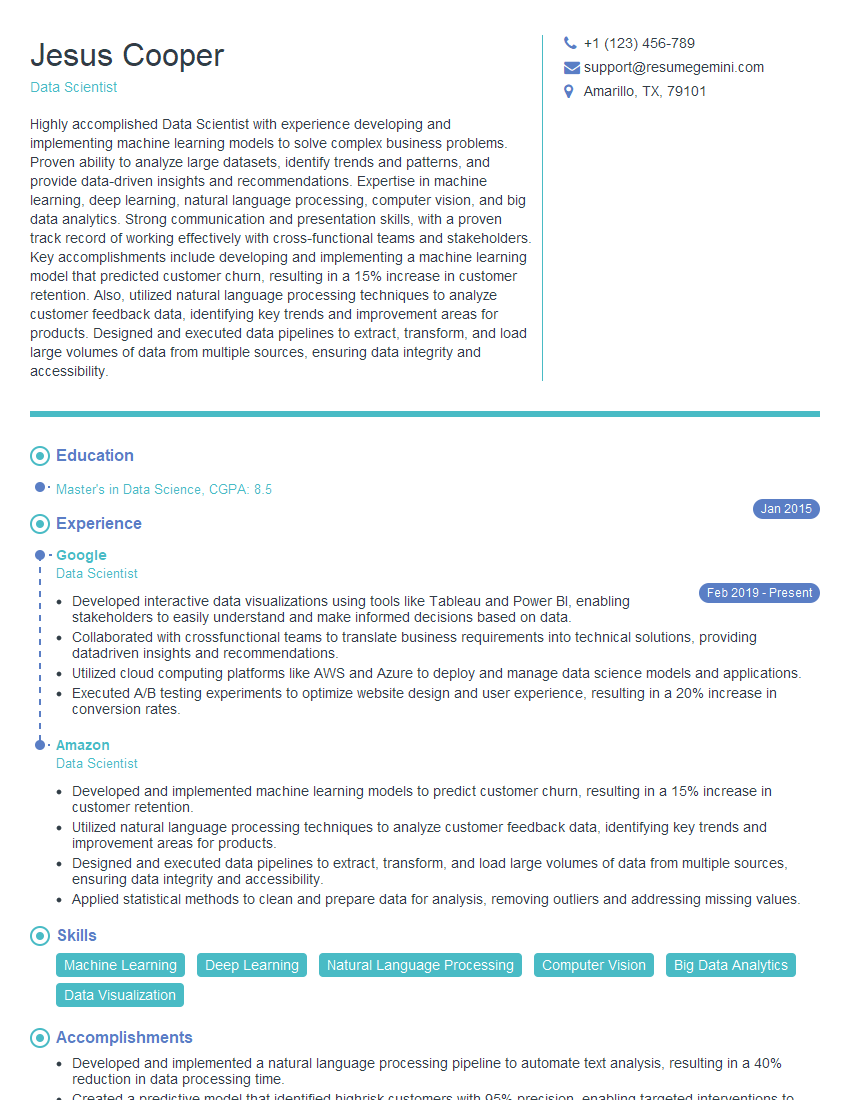
Data Scientist Resume Sample

Research Scientist Resume Sample

Actuary Resume Sample
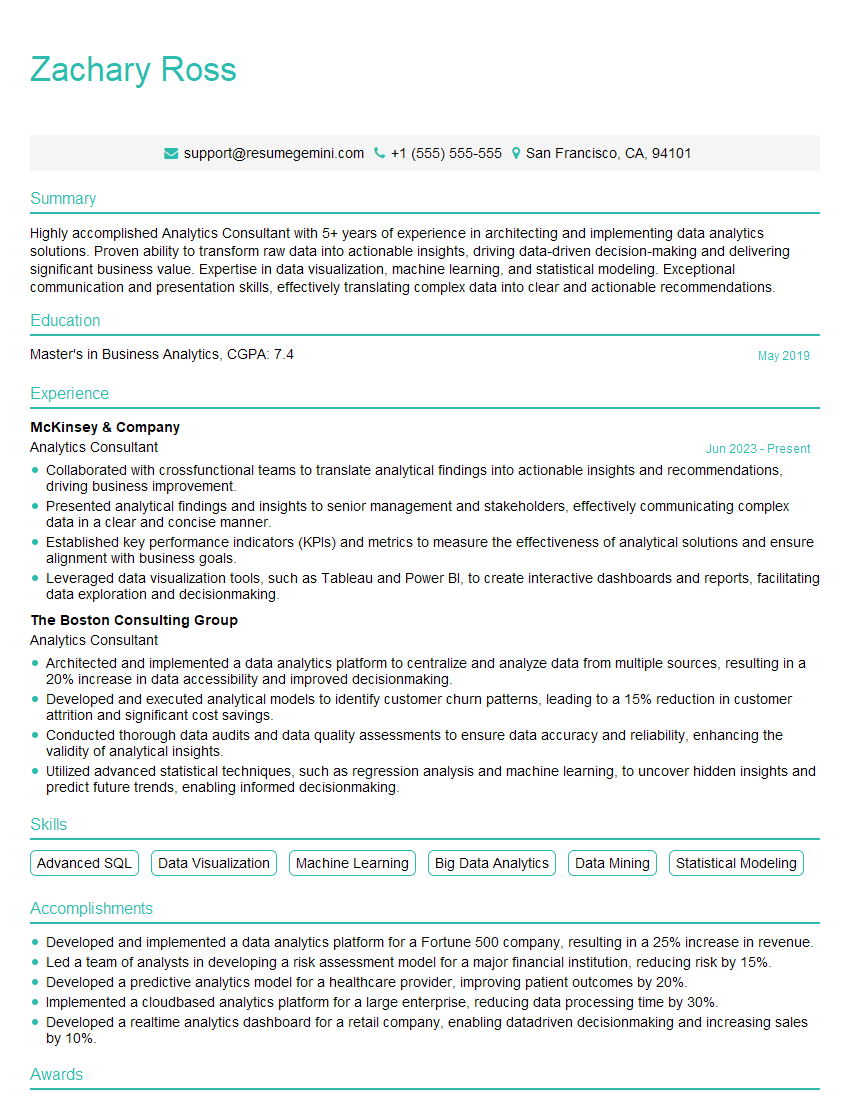
Analytics Consultant Resume Sample

Operations Research Analyst Resume Sample
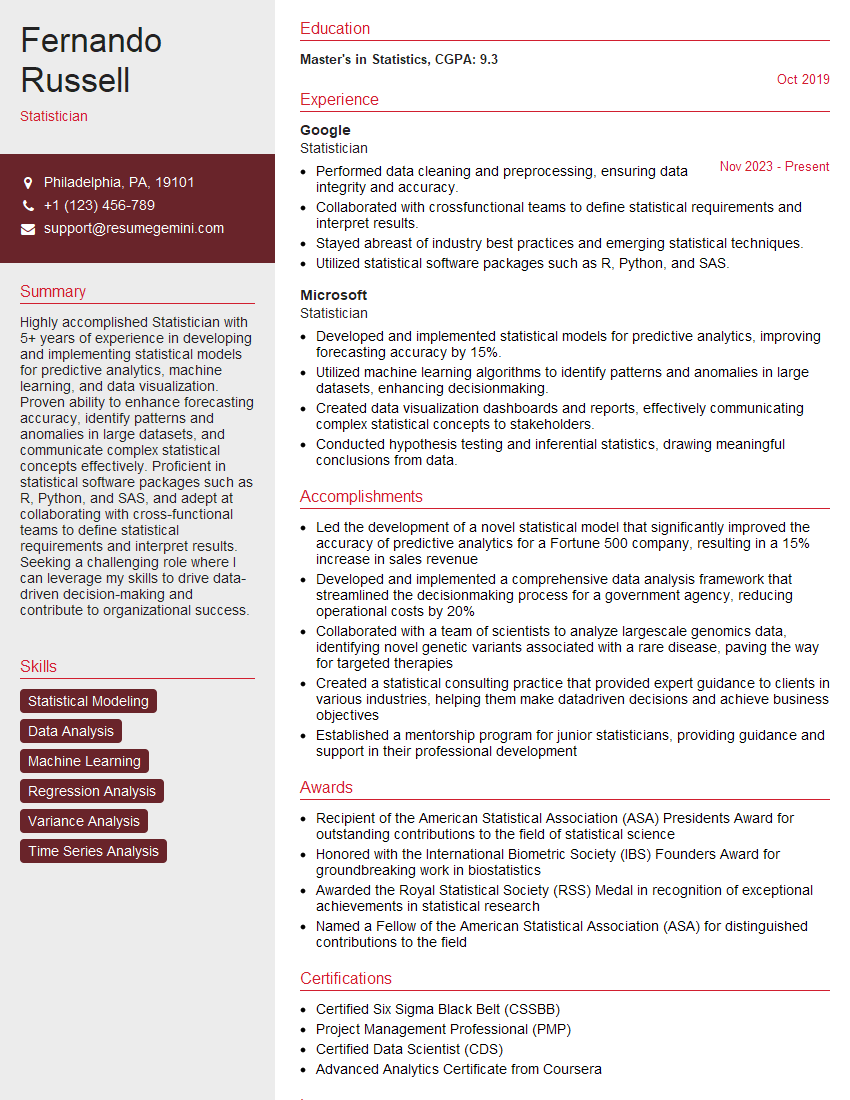
Statistician Resume Sample

Survey Statistician Resume Sample
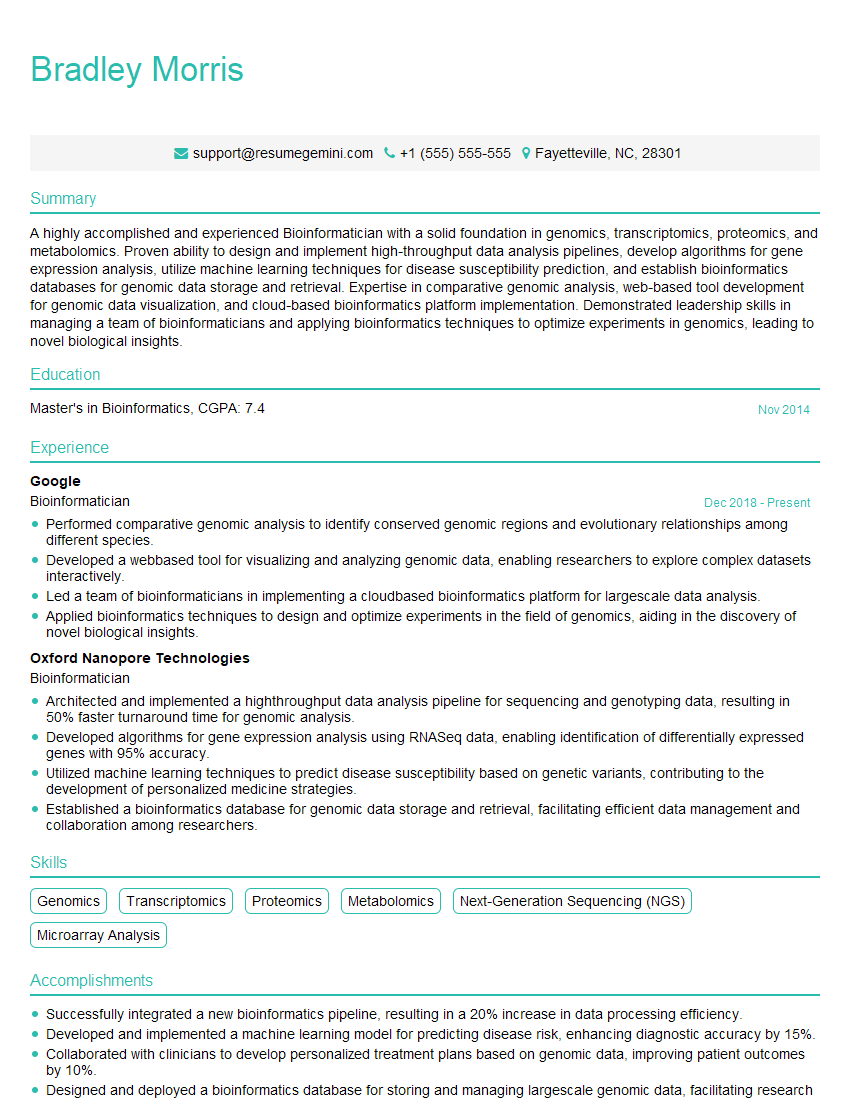
Bioinformatician Resume Sample

Biostatistician Resume Sample

Computational Biologist Resume Sample
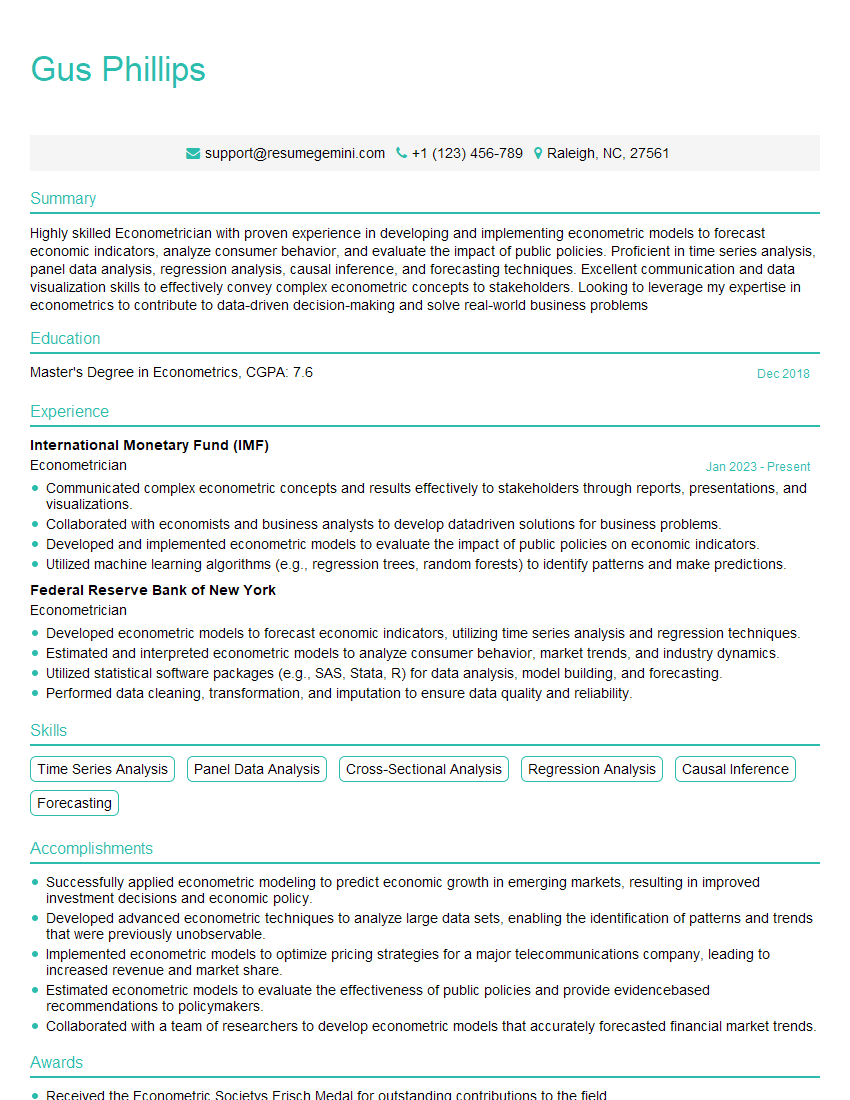
Econometrician Resume Sample

Database Administrator Resume Sample

Machine Learning Engineer Resume Sample
- Business Analyst
- Market Research Analyst
- Financial Analyst
- Data Analyst
- Quantitative Analyst
- Data Scientist
- Research Scientist
- Actuary
- Analytics Consultant
- Operations Research Analyst
- Statistician
- Survey Statistician
- Bioinformatician
- Biostatistician
- Computational Biologist
- Econometrician
- Database Administrator
- Machine Learning Engineer
Explore more articles
Users Rating of Our Blogs
Share Your Experience
We value your feedback! Please rate our content and share your thoughts (optional).
What Readers Say About Our Blog
To the interviewgemini.com Webmaster.
Very helpful and content specific questions to help prepare me for my interview!
Thank you
To the interviewgemini.com Webmaster.
This was kind of a unique content I found around the specialized skills. Very helpful questions and good detailed answers.
Very Helpful blog, thank you Interviewgemini team.