The right preparation can turn an interview into an opportunity to showcase your expertise. This guide to Economic Data Analysis interview questions is your ultimate resource, providing key insights and tips to help you ace your responses and stand out as a top candidate.
Questions Asked in Economic Data Analysis Interview
Q 1. Explain the difference between descriptive, predictive, and prescriptive analytics in the context of economic data.
Economic data analysis uses three main types of analytics: descriptive, predictive, and prescriptive. Think of them as a progression: describing what happened, predicting what might happen, and prescribing what to do.
- Descriptive Analytics: This summarizes historical economic data. For example, calculating the average inflation rate over the last decade, or visualizing the distribution of household incomes. It’s about understanding the ‘what’ happened. A simple bar chart showing GDP growth per quarter is a prime example of descriptive analytics.
- Predictive Analytics: This uses historical data to forecast future economic trends. We might build a model to predict next year’s unemployment rate based on factors like past unemployment, interest rates, and economic growth. Here, we are trying to understand the ‘what if’ scenario.
- Prescriptive Analytics: This goes beyond prediction by recommending actions to optimize economic outcomes. For example, a prescriptive model might suggest the optimal fiscal policy response to a recession based on various scenarios and their predicted effects. This tackles the ‘what to do’ aspect.
In practice, these types often work together. Descriptive analysis provides the foundation for predictive modeling, and predictive models inform prescriptive recommendations.
Q 2. What are the key assumptions of linear regression, and how do you check for their validity?
Linear regression assumes a linear relationship between the dependent and independent variables. Several key assumptions must be met for reliable results:
- Linearity: The relationship between the variables is linear. We can check this visually with scatter plots and residual plots. Non-linear relationships require transformations or different models.
- Independence of errors: The residuals (the differences between observed and predicted values) are independent. Autocorrelation violates this; we check using Durbin-Watson test or correlograms.
- Homoscedasticity: The variance of the residuals is constant across all levels of the independent variables. Heteroscedasticity (non-constant variance) is visible in funnel-shaped residual plots. We can address it with weighted least squares.
- Normality of errors: The residuals are normally distributed. Histograms and Q-Q plots help assess this. Severe deviations might necessitate transformations or robust regression techniques.
- No multicollinearity: The independent variables are not highly correlated with each other. High multicollinearity inflates standard errors and makes it difficult to isolate the effect of individual variables. We check using Variance Inflation Factor (VIF) or correlation matrices. A VIF above 5 or 10 typically indicates a problem.
Failing to meet these assumptions can lead to biased and inefficient estimates. Diagnostic checks are crucial to ensure the validity of the linear regression model.
Q 3. Describe your experience with time series analysis. What methods have you used, and what are their limitations?
I have extensive experience with time series analysis, using it frequently to model economic data that changes over time (e.g., GDP, inflation, stock prices). I’ve employed various methods, each with its limitations:
- ARIMA models (Autoregressive Integrated Moving Average): These are powerful for stationary time series (constant statistical properties over time). I’ve used them to forecast macroeconomic indicators. Limitations include the need for stationarity (often requiring differencing) and potential for overfitting.
- Exponential Smoothing: Simple and effective for forecasting, particularly when trends and seasonality are present. Methods like Holt-Winters handle these aspects well. A limitation is the assumption of a relatively smooth underlying pattern.
- ARCH/GARCH models (Autoregressive Conditional Heteroskedasticity): These are vital for modeling time series with volatility clustering (periods of high and low volatility). I’ve used them in financial time series analysis. They are complex and require careful specification.
- Vector Autoregression (VAR): Useful for modeling the interdependencies between multiple time series. I have applied VAR models to study the relationships between interest rates, inflation, and economic growth. VAR models can become computationally demanding with many variables.
The choice of method depends heavily on the data’s characteristics and the forecasting objective. Model diagnostics and out-of-sample testing are crucial to ensure accuracy and reliability.
Q 4. How do you handle missing data in economic datasets?
Missing data is a common challenge in economic datasets. The best approach depends on the extent and pattern of missingness:
- Deletion: Listwise deletion (removing entire observations with missing values) is simple but can lead to significant bias if data is not Missing Completely at Random (MCAR). Pairwise deletion, using available data for each analysis, can lead to inconsistencies.
- Imputation: This involves filling in missing values with estimated values. Methods include:
- Mean/Median/Mode Imputation: Simple but can bias results, especially if the missing data is not MCAR.
- Regression Imputation: Predicts missing values based on other variables using a regression model. More sophisticated than mean imputation but still assumes a linear relationship.
- Multiple Imputation: Creates multiple imputed datasets, each with different plausible values for the missing data, providing a more robust estimation of uncertainty.
- Model-Based Approaches: Some statistical models (like multiple imputation) can handle missing data directly during estimation, avoiding the need for pre-imputation.
Before choosing a method, it’s crucial to assess the mechanism of missingness. If the data is not MCAR, imputation methods are generally preferred over deletion, while multiple imputation is the most robust option for complex missing data patterns.
Q 5. Explain the concept of autocorrelation and how it affects regression analysis.
Autocorrelation refers to correlation between a time series and its lagged values. In simpler terms, it means that the value of the variable at one point in time is related to its value at previous points in time. For example, last month’s inflation rate might be correlated with this month’s.
In regression analysis, autocorrelation of the residuals violates the assumption of independence. This leads to inefficient and potentially biased parameter estimates. The standard errors are underestimated, leading to inflated t-statistics and an artificially high R-squared. The model may appear statistically significant when it is not.
We detect autocorrelation using the Durbin-Watson test or by inspecting correlograms of the residuals. If autocorrelation is present, we can address it using techniques like:
- Generalized Least Squares (GLS): Accounts for autocorrelation structure in the residuals.
- Newey-West Standard Errors: Provides consistent standard errors even in the presence of autocorrelation.
- Including lagged dependent variables as regressors: If the autocorrelation is a result of omitted variables, this can help.
Ignoring autocorrelation can lead to flawed inferences, so addressing it is vital for the reliability of regression results.
Q 6. What are some common econometric models you have used, and when would you choose one over another?
I’ve worked with a variety of econometric models, selecting the appropriate one based on the research question and data characteristics:
- Linear Regression: Used for analyzing the relationship between a dependent variable and one or more independent variables. Suitable when the relationship is linear and assumptions are met. I used it to study the relationship between education levels and earnings.
- Logit/Probit Models: Used for modeling binary or categorical dependent variables. I employed these for analyzing the factors influencing the decision to invest in education.
- Instrumental Variables (IV) Regression: Used to address endogeneity (correlation between the independent variable and the error term). I used IV to address the issue of simultaneous causality in estimating the impact of minimum wage on employment.
- Panel Data Models: Used for analyzing data collected on the same units (individuals, firms, countries) over multiple time periods. I employed fixed effects and random effects models to study the impact of policies across states in a country.
- Vector Autoregression (VAR): Used for analyzing the dynamic interrelationships between multiple time series. I used this to examine the dynamic interaction between GDP growth, inflation, and interest rates.
The choice depends on factors like the type of dependent variable, presence of endogeneity, and the nature of the data (cross-sectional, time series, or panel). Model selection always involves careful consideration and diagnostic testing.
Q 7. How do you interpret R-squared and adjusted R-squared?
R-squared and adjusted R-squared are measures of goodness of fit in regression models. They both indicate how well the model explains the variation in the dependent variable.
- R-squared: Represents the proportion of variance in the dependent variable explained by the independent variables. It ranges from 0 to 1. A higher R-squared indicates a better fit. However, it can be artificially inflated by adding more independent variables, even if they are not truly relevant. For example, an R-squared of 0.8 suggests that 80% of the variation in your dependent variable is explained by your independent variables.
- Adjusted R-squared: A modified version of R-squared that penalizes the addition of irrelevant independent variables. It’s a more reliable indicator of model fit, especially when comparing models with different numbers of predictors. Adjusted R-squared will be lower than R-squared and increase only when the new predictor adds value to the model. The adjusted R-squared helps prevent overfitting.
While both are valuable, adjusted R-squared provides a more accurate and unbiased assessment of model fit, particularly when considering models with differing numbers of independent variables.
Q 8. Explain the difference between heteroscedasticity and homoscedasticity.
Homoscedasticity and heteroscedasticity describe the consistency of the variance of a variable (usually the error term in a regression model) across different values of another variable (usually the predictor). Imagine you’re shooting arrows at a target. Homoscedasticity means your arrows are clustered consistently around the bullseye, regardless of how far they are from the center. The spread of your shots remains constant. Heteroscedasticity, on the other hand, is like having a tighter grouping of arrows close to the bullseye, but a wider spread as you get further away. The variance of your shot placement changes as the distance from the bullseye varies.
In statistical terms: Homoscedasticity means the variance of the error term is constant across all levels of the independent variable(s). Heteroscedasticity means the variance of the error term is not constant and changes with the independent variable(s). Heteroscedasticity violates one of the assumptions of ordinary least squares (OLS) regression, potentially leading to inefficient and biased standard errors, affecting the reliability of hypothesis tests and confidence intervals.
Example: Consider a model predicting income based on education level. Homoscedasticity would imply that the variability in income is similar across all education levels. Heteroscedasticity might appear if the variability in income is much larger for those with higher education levels (due to a wider range of high-paying jobs).
Q 9. How do you detect and address multicollinearity?
Multicollinearity occurs when two or more predictor variables in a regression model are highly correlated. This makes it difficult to isolate the individual effect of each predictor on the dependent variable, as they are essentially overlapping in their explanatory power. Imagine trying to determine the individual impact of flour and sugar on the taste of a cake when you consistently use them in a fixed ratio. It becomes hard to distinguish their unique contributions.
Detection: Multicollinearity can be detected through various methods:
- Correlation matrix: Examining the correlation coefficients between predictor variables. High correlations (generally above 0.8 or 0.7) suggest potential multicollinearity.
- Variance Inflation Factor (VIF): VIF measures how much the variance of an estimated regression coefficient increases if your predictors are correlated. A VIF above 5 or 10 is often a sign of problematic multicollinearity.
- Eigenvalues and condition index: Examining the eigenvalues of the correlation matrix. Very small eigenvalues or high condition indices (ratio of largest to smallest eigenvalue) indicate multicollinearity.
Addressing:
- Remove one or more variables: If two highly correlated variables exist, remove one. Prioritize theoretical importance and the variable that adds more independent explanatory power.
- Combine variables: Create a composite variable from the correlated predictors, like creating an index from multiple economic indicators.
- Principal Component Analysis (PCA): Use PCA to create uncorrelated variables from the original correlated ones. This can reduce dimensionality and address multicollinearity.
- Ridge or Lasso Regression: These methods are less sensitive to multicollinearity than OLS regression by shrinking the coefficients towards zero.
The best approach depends on the specific context and the nature of the data.
Q 10. What is the difference between a cross-sectional and a panel data set?
Cross-sectional data involves observations on multiple entities (individuals, firms, countries, etc.) at a single point in time. Think of a snapshot. For instance, collecting data on the income of several individuals in a particular city on a specific date.
Panel data (also called longitudinal data) involves observations on the same entities over multiple time periods. It’s like a movie, showing the evolution of those entities. For instance, tracking the income of the same individuals over several years.
The key difference is the time dimension. Cross-sectional data lacks this dimension, while panel data explicitly includes it. Panel data allows for the analysis of both within-entity and between-entity variations and often provides more statistical power than cross-sectional data alone. It is particularly useful for analyzing causal relationships as we can control for time-invariant unobserved characteristics.
Q 11. Describe your experience with different types of forecasting models (e.g., ARIMA, exponential smoothing).
My experience encompasses a variety of forecasting models, including ARIMA and exponential smoothing techniques. I’ve successfully applied these methods in diverse economic contexts, such as forecasting GDP growth, inflation rates, and consumer spending.
ARIMA (Autoregressive Integrated Moving Average) models are particularly powerful for time series data exhibiting trends and seasonality. I have utilized ARIMA models to identify and capture patterns in macroeconomic data, leading to more accurate and reliable predictions than simpler methods. The order of the ARIMA model (p, d, q) is crucial, and its selection often involves techniques like AIC or BIC model selection.
Exponential smoothing methods, including simple exponential smoothing, Holt’s linear trend method, and Holt-Winters methods, offer a more computationally efficient alternative, especially when dealing with large datasets or complex seasonal patterns. I’ve used exponential smoothing for short-term forecasts where computational speed and ease of implementation are beneficial. I frequently select the method based on the nature of the data’s underlying trend and seasonality.
In addition to these methods, I am also proficient in more advanced forecasting techniques such as Vector Autoregression (VAR) models and Dynamic Stochastic General Equilibrium (DSGE) models which are commonly used for macroeconomic forecasting.
Q 12. How do you evaluate the accuracy of your economic forecasts?
Evaluating the accuracy of economic forecasts is critical. I typically use a combination of methods, depending on the specific forecasting task and data characteristics. Common metrics include:
- Mean Absolute Error (MAE): The average absolute difference between the forecasted and actual values. It’s easy to interpret and robust to outliers.
- Root Mean Squared Error (RMSE): The square root of the average squared difference between forecasted and actual values. It gives more weight to larger errors.
- Mean Absolute Percentage Error (MAPE): The average absolute percentage difference between forecasted and actual values. It’s useful for comparing forecasting performance across different datasets with varying scales.
- Diebold-Mariano test: A statistical test for comparing the accuracy of two different forecasting models. It helps determine if one model outperforms another significantly.
Beyond these metrics, I also visually inspect the forecasts, checking for systematic biases or significant deviations from the actual values. Understanding the context is equally important. A forecast might have a high RMSE but still be valuable if it accurately captures the overall trend.
Q 13. What is your experience with statistical software packages like R, Python (with econometric libraries), or Stata?
I am highly proficient in several statistical software packages, with extensive experience in R, Python (with econometric libraries like Statsmodels and scikit-learn), and Stata. My expertise extends beyond basic data manipulation and visualization. I’m comfortable conducting sophisticated econometric analyses, building complex models, and employing advanced statistical techniques. For instance, I’ve used R’s lmtest package for diagnostic tests in regression analysis and Python’s statsmodels for advanced time series analysis. Stata’s strength in panel data analysis has been invaluable in various projects. My choice of software depends on the specific requirements of the project, balancing factors such as computational efficiency, available packages, and the preferences of the team.
Q 14. Describe a time you had to deal with noisy or inconsistent data. How did you approach the problem?
In a recent project analyzing consumer spending patterns, I encountered significant data noise stemming from inconsistencies in reporting methodologies across different data sources. Some datasets used monthly frequency, while others used quarterly or annual. Furthermore, there were missing values and outliers that needed addressing.
My approach involved a multi-step process:
- Data Cleaning: I first addressed missing values using various imputation techniques, including mean imputation for straightforward cases and more sophisticated methods like k-nearest neighbors for complex relationships. Outliers were examined carefully. Extreme values were either removed (after justification) or winsorized (capped at a certain percentile).
- Data Transformation: To harmonize the data, I standardized all time series to a monthly frequency through appropriate interpolation and aggregation techniques, ensuring consistency across all datasets. This involved making informed decisions based on data characteristics and economic reasoning.
- Robust Statistical Methods: Given the potential for remaining noise, I employed robust regression techniques less sensitive to outliers and the presence of heteroscedasticity. This allowed for more reliable parameter estimates.
Through this systematic approach, I successfully cleaned and prepared the data for analysis, yielding much more reliable and robust insights into consumer spending trends.
Q 15. How familiar are you with various economic indicators (e.g., GDP, inflation, unemployment)?
I possess extensive familiarity with key macroeconomic indicators. Understanding these indicators is fundamental to economic analysis. Let’s look at a few examples:
- GDP (Gross Domestic Product): This measures the total value of goods and services produced within a country’s borders in a specific period. A rising GDP generally indicates economic growth, while a falling GDP signals a recession. Analyzing GDP growth rates helps understand the overall health of an economy.
- Inflation: This reflects the rate at which the general level of prices for goods and services is rising, and subsequently, purchasing power is falling. Common measures include the Consumer Price Index (CPI) and the Producer Price Index (PPI). High inflation can erode purchasing power and negatively impact economic stability.
- Unemployment: This represents the percentage of the labor force that is actively seeking employment but unable to find it. High unemployment indicates underutilized resources and potential social and economic strain. Different types of unemployment (frictional, structural, cyclical) offer insights into the causes and potential remedies.
- Other Key Indicators: Beyond these core indicators, I’m also proficient with others such as interest rates, exchange rates, consumer confidence indices, and various leading and lagging indicators used to forecast economic trends. The specific indicators relevant to an analysis will depend heavily on the research question at hand.
My experience involves using these indicators not just in isolation but also in conjunction with each other to build a comprehensive understanding of economic dynamics and create robust forecasts.
Career Expert Tips:
- Ace those interviews! Prepare effectively by reviewing the Top 50 Most Common Interview Questions on ResumeGemini.
- Navigate your job search with confidence! Explore a wide range of Career Tips on ResumeGemini. Learn about common challenges and recommendations to overcome them.
- Craft the perfect resume! Master the Art of Resume Writing with ResumeGemini’s guide. Showcase your unique qualifications and achievements effectively.
- Don’t miss out on holiday savings! Build your dream resume with ResumeGemini’s ATS optimized templates.
Q 16. How do you interpret the results of a hypothesis test?
Interpreting hypothesis test results requires a structured approach. The core idea is to assess whether the evidence from the data supports rejecting a null hypothesis in favor of an alternative hypothesis. This is typically done by calculating a p-value.
The p-value represents the probability of observing the obtained results (or more extreme results) if the null hypothesis were true. A small p-value (typically below a significance level, often 0.05) suggests strong evidence against the null hypothesis, leading us to reject it. Conversely, a large p-value suggests insufficient evidence to reject the null hypothesis.
For instance, if we hypothesize that a minimum wage increase reduces employment (null hypothesis), we would gather data on employment before and after the increase. The hypothesis test would provide a p-value. A p-value below 0.05 would suggest we can reject the null hypothesis and conclude that the increase likely reduced employment. However, we must consider the statistical power and potential confounding factors.
It’s crucial to remember that failing to reject the null hypothesis doesn’t prove the null hypothesis is true; it simply means we lack sufficient evidence to reject it. The interpretation must also account for the context of the study, the limitations of the data, and potential biases.
Q 17. What is your understanding of causal inference and how do you apply it in economic data analysis?
Causal inference aims to establish a cause-and-effect relationship between variables. In economic data analysis, this is crucial because simply observing a correlation doesn’t necessarily imply causation. There might be confounding variables or other factors at play.
I apply causal inference techniques, such as:
- Regression analysis: Including control variables to account for confounding factors and isolate the effect of the variable of interest.
- Instrumental variables: Using an instrumental variable that is correlated with the treatment (e.g., policy change) but not directly with the outcome, except through its effect on the treatment.
- Difference-in-differences: Comparing the changes in the outcome variable between a treatment group and a control group before and after a policy change or intervention.
- Regression discontinuity design: Exploiting a sharp cutoff or threshold in the assignment of treatment to identify causal effects.
For example, evaluating the impact of a tax cut on investment requires careful consideration of other factors (e.g., interest rates, consumer confidence) that might influence investment. Causal inference methods allow us to disentangle the effect of the tax cut from these confounding factors and obtain a more accurate estimate of its impact.
Q 18. Explain your experience working with large datasets.
My experience working with large datasets is extensive. I’m comfortable working with datasets exceeding millions of rows and numerous variables using programming languages like Python and R, leveraging libraries such as Pandas, Dplyr, and data.table for efficient data manipulation. I’m adept at handling various data formats (CSV, JSON, SQL databases) and utilizing cloud computing platforms like AWS or Google Cloud for storing, processing, and analyzing large datasets.
In a recent project, I analyzed a dataset containing millions of consumer transactions to assess spending patterns and predict future consumer behavior. The sheer volume of data required careful planning and implementation of efficient data processing and analysis techniques. This involved techniques like data sampling, parallel processing, and optimized algorithms to ensure timely and accurate results.
Q 19. Describe your process for cleaning and preparing economic data for analysis.
Cleaning and preparing economic data is a critical step that significantly influences the reliability and validity of the results. My process generally involves:
- Data Import and Inspection: First, I import the data and visually inspect it for obvious errors or inconsistencies. I use summary statistics and visualizations to get a preliminary understanding of the data’s structure and characteristics.
- Data Cleaning: This includes handling missing values (imputation or removal), outlier detection and treatment, and correcting inconsistencies or errors in data entry.
- Data Transformation: This might involve creating new variables, transforming existing variables (e.g., log transformation for skewed data), and standardizing or normalizing variables.
- Data Validation: I meticulously validate the cleaned and transformed data to ensure its accuracy and consistency. This often involves cross-checking with other datasets or using data validation rules.
For example, when working with inflation data, I might need to adjust for seasonal effects or base year changes to ensure accurate comparisons across different periods. Similarly, handling missing GDP data requires careful consideration of imputation methods to avoid bias in the analysis.
Q 20. What is your experience with data visualization techniques for economic data?
Data visualization is essential for communicating economic insights effectively. I’m proficient in using various tools and techniques to create clear and informative visualizations. My experience encompasses:
- Static visualizations: Creating charts (bar charts, line charts, scatter plots, histograms) using libraries like Matplotlib, Seaborn (Python), and ggplot2 (R) to illustrate key trends, relationships, and patterns in economic data.
- Interactive visualizations: Developing interactive dashboards and reports using tools like Tableau or Power BI that allow users to explore data dynamically and uncover hidden insights.
- Geographic Information Systems (GIS): Utilizing GIS software to visualize spatial economic data and analyze geographical patterns and trends.
For example, to demonstrate regional economic disparities, I might create a map visualizing GDP per capita across different regions. To show the relationship between inflation and unemployment, I might use a scatter plot. The choice of visualization technique always depends on the data and the story I want to tell.
Q 21. Explain your experience with creating dashboards or reports based on economic data analysis.
I have substantial experience in creating dashboards and reports that effectively communicate economic data analysis findings. I leverage tools like Tableau, Power BI, and even custom-built solutions using Python’s streamlit or similar libraries to create interactive and user-friendly visualizations.
A typical dashboard would include key performance indicators (KPIs) such as GDP growth, inflation rates, unemployment figures, and other relevant economic metrics. Interactive elements like filters and drill-downs enable users to explore the data at various levels of granularity. The reports themselves are tailored to the audience, whether they are technical experts or business stakeholders, using clear and concise language, avoiding technical jargon whenever possible.
For instance, I’ve developed dashboards for financial institutions that track various economic indicators relevant to investment decisions. These dashboards provided real-time updates on market trends, allowing for swift responses to market changes. Similarly, I’ve created reports for government agencies, summarizing the findings of economic studies and presenting policy recommendations.
Q 22. How do you stay up-to-date with the latest developments in economic data analysis?
Staying current in the dynamic field of economic data analysis requires a multi-pronged approach. It’s not just about reading academic papers; it’s about actively engaging with the community and the data itself.
- Following Key Publications and Journals: I regularly read publications like the American Economic Review, the Journal of Econometrics, and the Review of Economic Studies to stay abreast of methodological advancements and new empirical findings. I also follow specialized journals related to my area of focus, such as those dedicated to financial econometrics or labor economics.
- Attending Conferences and Workshops: Participating in conferences like the Econometric Society World Congress or smaller, specialized workshops allows me to network with leading researchers and learn about cutting-edge techniques directly from the experts. It also exposes me to the latest debates and challenges in the field.
- Utilizing Online Resources: I actively follow influential economists and research institutions on social media platforms like Twitter and LinkedIn, and subscribe to newsletters and blogs focused on economic data analysis. This provides a quick way to digest current events and newly released data.
- Hands-on Practice and Experimentation: Theoretical understanding is only part of the equation. I actively work with new datasets and apply novel methods to strengthen my practical skills. This includes exploring newly released open-source packages and experimenting with different programming languages and statistical software.
By combining these strategies, I ensure my knowledge remains relevant and my analytical skills remain sharp.
Q 23. What are some ethical considerations in economic data analysis?
Ethical considerations are paramount in economic data analysis. The potential for misuse or misinterpretation of data is significant, with far-reaching consequences. Key ethical considerations include:
- Data Privacy and Confidentiality: Protecting the privacy of individuals whose data is used is crucial. This necessitates anonymization techniques and adherence to relevant regulations like GDPR or HIPAA, depending on the data’s origin and nature.
- Data Integrity and Accuracy: Ensuring data quality is essential to avoid biased or misleading conclusions. This requires rigorous data cleaning, validation, and careful consideration of potential sources of error and bias.
- Transparency and Replicability: My analyses are always conducted transparently, with clear documentation of methods, data sources, and code. This ensures the work is reproducible and allows for scrutiny by others, promoting accountability.
- Avoiding Conflicts of Interest: I maintain a strong commitment to objectivity and avoid any situations that could compromise the integrity of my analysis, such as accepting funding from parties with vested interests in the outcome.
- Responsible Interpretation and Communication of Findings: Results should be presented accurately and honestly, avoiding exaggeration or misrepresentation. It’s crucial to convey the limitations of the analysis and avoid making causal claims unsupported by the evidence.
Ultimately, ethical data analysis is about ensuring fairness, accuracy, and responsible use of data to promote informed decision-making.
Q 24. Describe a challenging economic data analysis project and how you overcame the challenges.
During my time at [Previous Company/Institution], I worked on a project analyzing the impact of a new government subsidy program on small businesses. The challenge was the significant amount of missing data in the key variables, like revenue and employment figures, and the presence of outliers in the available data that significantly skewed the results. Initially, standard regression techniques yielded unreliable and inconsistent results.
To overcome these challenges, I employed a multi-step approach:
- Data Imputation: I used multiple imputation techniques, employing both deterministic methods (like mean imputation for specific missing values) and more advanced statistical methods (like multiple imputation by chained equations – MICE) to fill in the missing data. This helped reduce bias compared to simple omission strategies.
- Outlier Treatment: Instead of simply discarding outliers, I investigated the reasons for their existence. Some turned out to be legitimate extreme values, while others indicated data entry errors or anomalies. I addressed the errors and incorporated robust regression methods (like Huber regression) that are less sensitive to extreme values.
- Sensitivity Analysis: I conducted various sensitivity analyses to assess the impact of different data imputation and outlier treatment methods on the final results. This allowed me to understand the uncertainty associated with the final conclusions.
Through this careful and multi-faceted approach, I was able to obtain robust and reliable estimates of the program’s impact, leading to valuable insights for policymakers. The project highlighted the importance of thoroughly understanding data limitations and employing appropriate techniques to handle missing values and outliers.
Q 25. How would you explain complex economic findings to a non-technical audience?
Explaining complex economic findings to a non-technical audience requires clear communication and strategic simplification. I approach this by:
- Using Analogies and Real-World Examples: Instead of relying on jargon, I use relatable examples from everyday life to illustrate complex concepts. For example, when explaining inflation, I might use the analogy of rising prices at the grocery store.
- Visual Aids: Charts, graphs, and infographics are powerful tools that can effectively communicate complex data in a visually appealing way. They help illustrate trends and relationships that might be difficult to convey through text alone.
- Focusing on the Story: I frame the findings within a compelling narrative, emphasizing the key takeaways and their real-world implications. This helps maintain engagement and ensure the audience understands the significance of the work.
- Avoiding Jargon: I avoid technical terms whenever possible, and when unavoidable, I clearly define them in simple terms. I also avoid overly complex mathematical equations.
- Iterative Feedback: I’m always mindful of my audience’s level of understanding. By asking questions and seeking feedback, I can adjust my explanation to ensure clarity and comprehension.
The goal is not to dumb down the information, but to translate it into a language that is accessible and engaging for everyone.
Q 26. What are your strengths and weaknesses as an economic data analyst?
My strengths lie in my strong analytical skills, my ability to handle large and complex datasets, and my proficiency in various statistical software packages such as R, Stata, and Python. I’m also a quick learner, adaptable to new challenges, and possess excellent problem-solving skills. I’m comfortable working both independently and collaboratively within a team.
One area I’m actively working on is improving my public speaking skills. While I can effectively communicate complex information in writing and smaller group settings, enhancing my confidence and presentation skills in larger forums will significantly benefit my career progression.
Q 27. What are your salary expectations?
My salary expectations are in line with the market rate for an experienced economic data analyst with my skills and experience in this region. I’m open to discussing a specific range after learning more about the role and the company’s compensation structure.
Q 28. Do you have any questions for me?
I have several questions to ensure I have a complete understanding of the role and the team. First, could you elaborate on the specific technologies and methodologies utilized by your team? Second, what are the key performance indicators (KPIs) for this position? Finally, what are the opportunities for professional development and advancement within the company?
Key Topics to Learn for Economic Data Analysis Interview
- Time Series Analysis: Understanding concepts like stationarity, autocorrelation, and different model specifications (ARIMA, GARCH). Practical application: Forecasting macroeconomic indicators like GDP growth or inflation.
- Regression Analysis: Mastering linear regression, interpreting coefficients, handling multicollinearity, and understanding assumptions. Practical application: Analyzing the impact of policy changes on economic variables.
- Econometrics: Familiarizing yourself with hypothesis testing, model diagnostics, and various estimation techniques (OLS, 2SLS). Practical application: Evaluating the effectiveness of government interventions.
- Data Wrangling and Cleaning: Proficiency in handling missing data, outliers, and transforming data into a usable format. Practical application: Preparing messy datasets for accurate analysis.
- Data Visualization: Creating clear and informative charts and graphs to effectively communicate findings. Practical application: Presenting complex economic data in a digestible manner.
- Causal Inference: Understanding methods like instrumental variables and regression discontinuity designs to establish causality. Practical application: Analyzing the causal effect of a specific policy.
- Programming Proficiency (R/Python): Demonstrating skills in data manipulation, statistical modeling, and report generation using relevant packages. Practical application: Automating data analysis workflows and producing reproducible research.
Next Steps
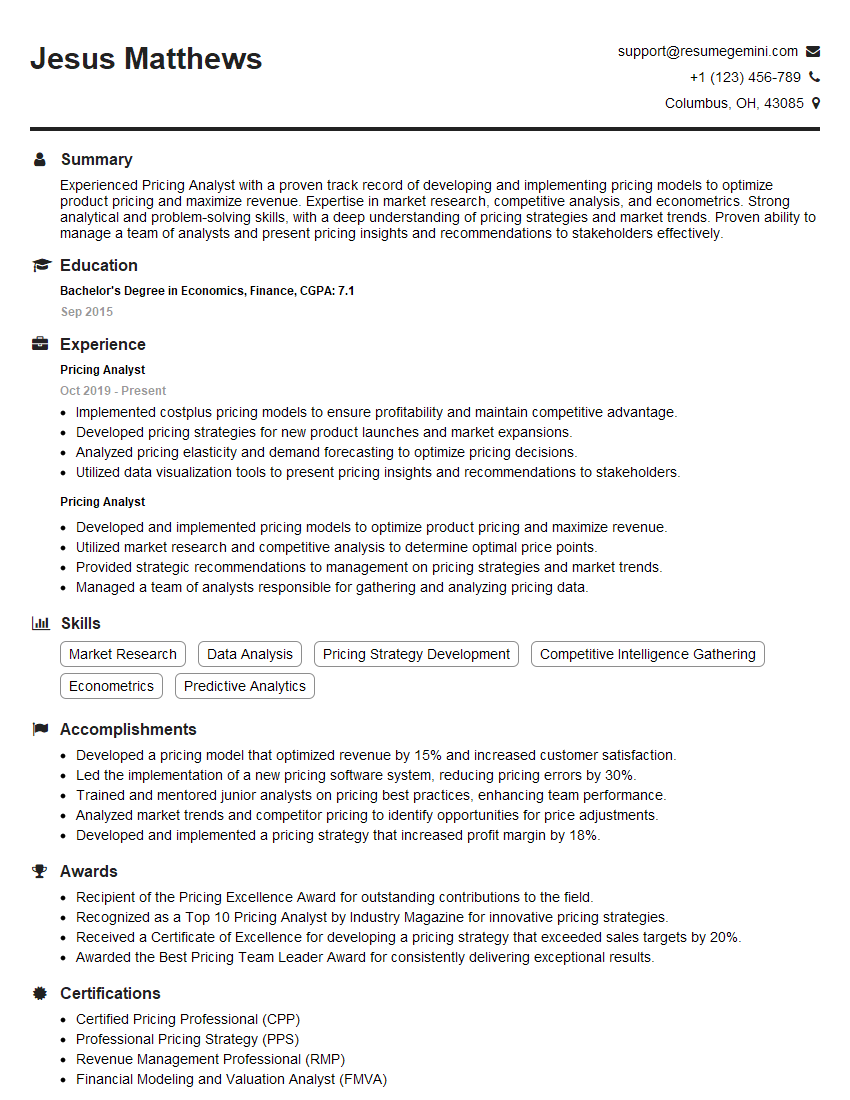
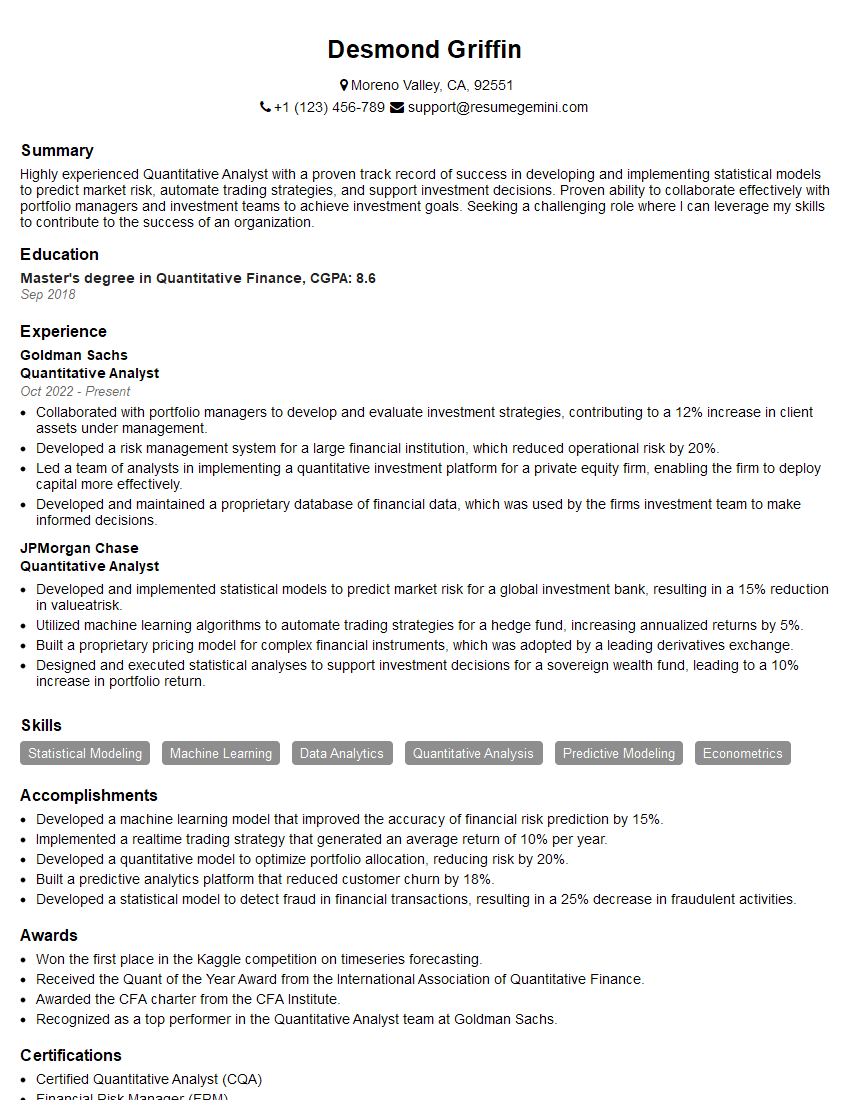
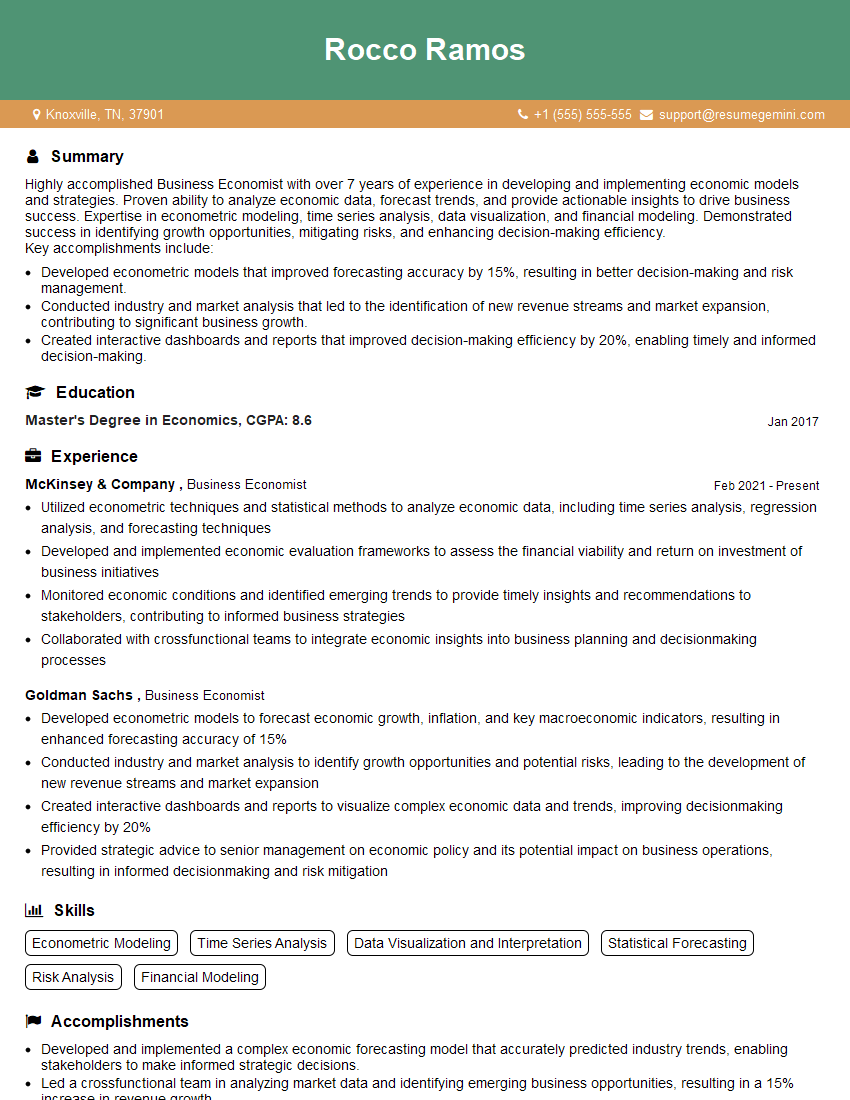
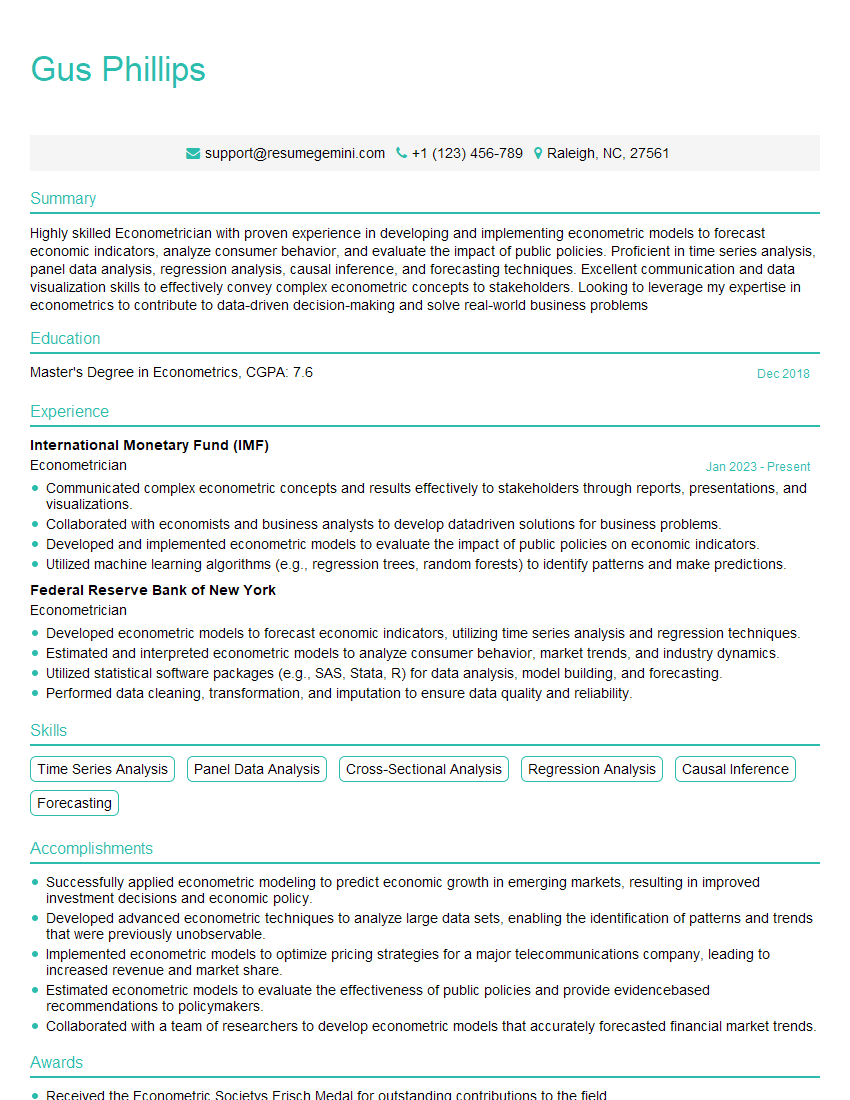
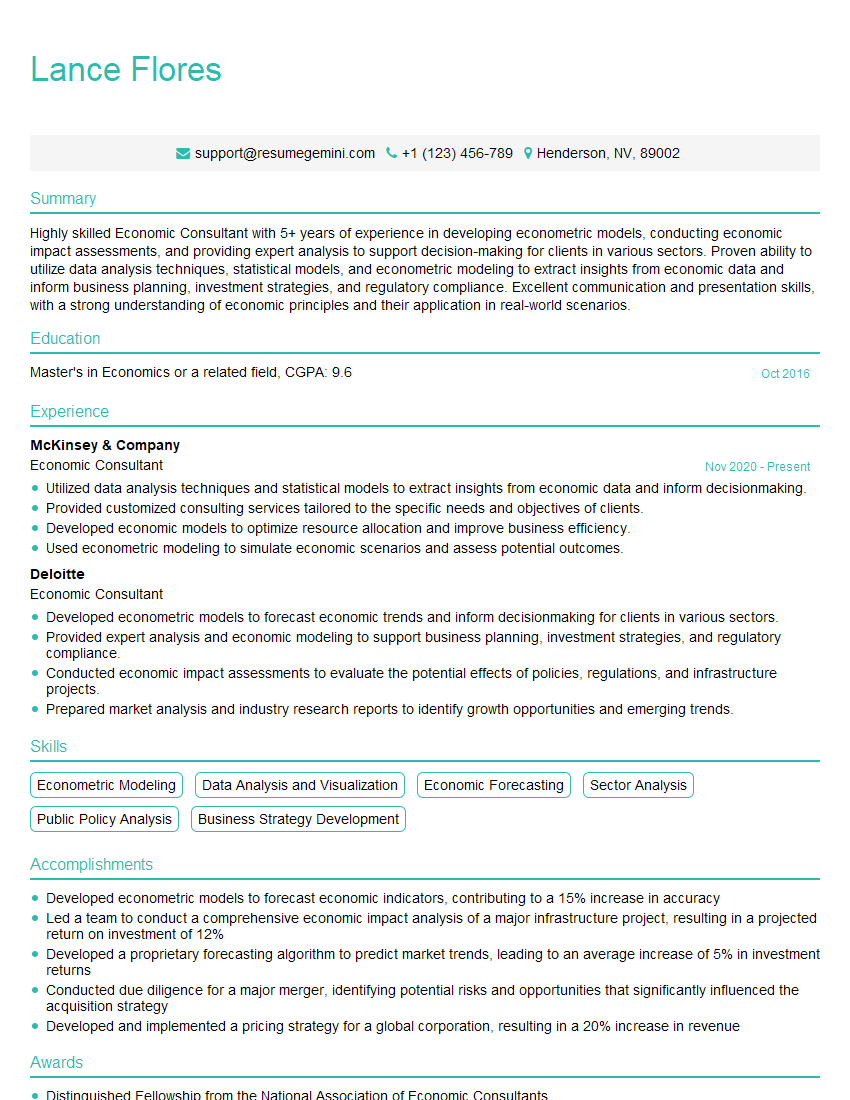
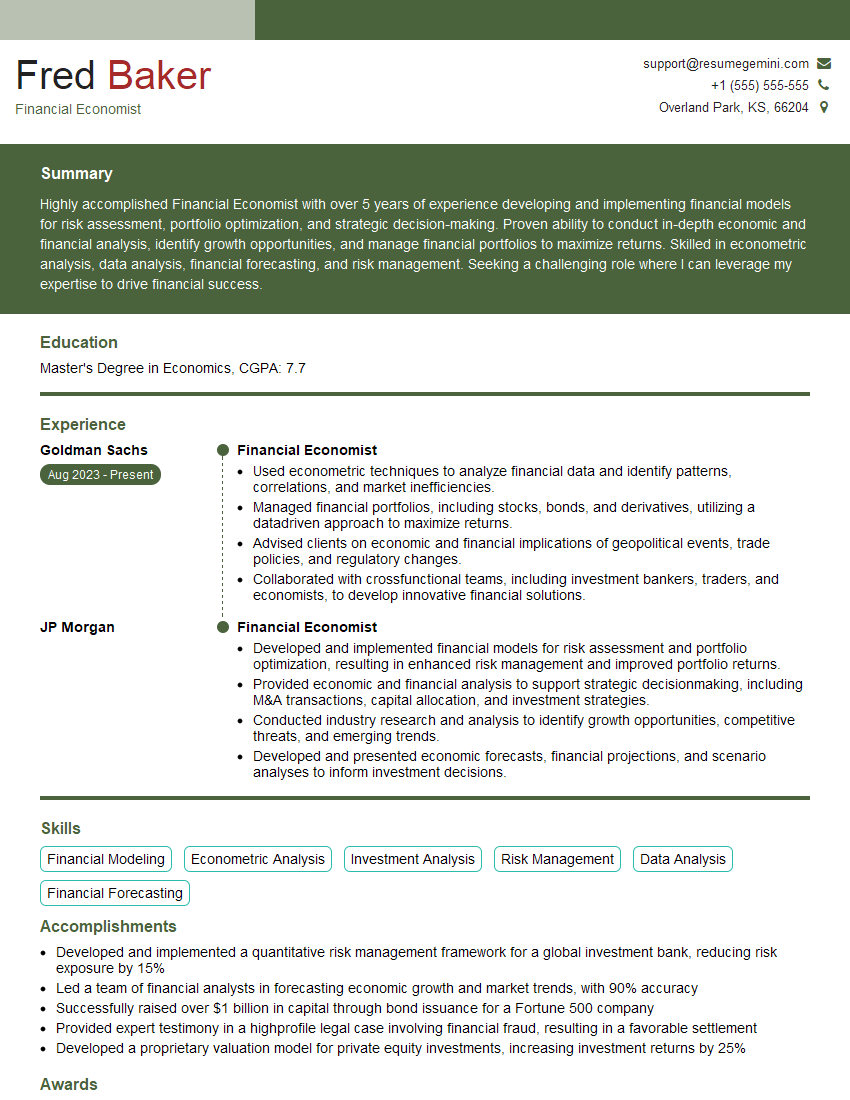
Mastering Economic Data Analysis opens doors to exciting and impactful careers in research, consulting, finance, and government. A strong foundation in these techniques significantly enhances your employability and allows you to contribute meaningfully to critical economic discussions. To increase your job prospects, creating an ATS-friendly resume is crucial. ResumeGemini is a trusted resource that can help you build a professional and impactful resume, maximizing your chances of landing your dream role. We provide examples of resumes tailored to Economic Data Analysis to help you get started.

Explore more articles
Users Rating of Our Blogs
Share Your Experience
We value your feedback! Please rate our content and share your thoughts (optional).
What Readers Say About Our Blog
To the interviewgemini.com Webmaster.
Very helpful and content specific questions to help prepare me for my interview!
Thank you
To the interviewgemini.com Webmaster.
This was kind of a unique content I found around the specialized skills. Very helpful questions and good detailed answers.
Very Helpful blog, thank you Interviewgemini team.