Feeling uncertain about what to expect in your upcoming interview? We’ve got you covered! This blog highlights the most important Electrical Wiring (Basic) interview questions and provides actionable advice to help you stand out as the ideal candidate. Let’s pave the way for your success.
Questions Asked in Electrical Wiring (Basic) Interview
Q 1. What are the different types of wire used in residential wiring?
Residential wiring utilizes several types of wire, each chosen based on its application and the current it needs to carry. The most common include:
- Copper Conductors: These are the most prevalent, offering excellent conductivity. You’ll find them in various gauges (thicknesses), with smaller gauges carrying less current. For example, 14-gauge wire is common for lighting circuits, while heavier 12-gauge wire is used for outlets that might draw more power (like appliances).
- Aluminum Conductors: Less common now than in the past due to concerns about oxidation and connection issues, aluminum wire is still sometimes found in older homes. It’s lighter than copper but requires special connectors and careful installation techniques to prevent problems.
- NM-B (Romex): This is a widely used non-metallic sheathed cable. It’s a common sight in most houses, often containing two hot wires, a neutral wire, and a ground wire all enclosed within a plastic sheath. This makes installation quicker and simpler.
- BX (Armored Cable): BX cable consists of conductors encased in a flexible metal sheath for added protection. It is often used in areas where there’s a higher risk of physical damage, such as basements or garages.
- MC Cable (Metal-Clad): Similar to BX, MC cable has conductors encased in a metal sheath for protection. However, the metal sheath is smoother and less flexible. It’s frequently used in commercial settings but can be seen in residential projects as well.
The choice of wire type depends on local codes, the amperage requirements of the circuit, and the specific application. It’s crucial to always use the correct gauge and type of wire for a safe and functional electrical system.
Q 2. Explain the purpose of a ground wire.
The ground wire is a crucial safety feature in electrical systems. Its primary purpose is to provide a path for fault currents to flow back to the source (the electrical panel), preventing dangerous voltages from appearing on metal surfaces. Imagine a scenario where the hot wire in a lamp touches the metal casing. Without a ground wire, the metal casing would become energized and could shock anyone who touches it. However, with a ground wire, the fault current flows through that wire to the ground, tripping the circuit breaker and protecting you.
In simpler terms, the ground wire acts as a safety net, ensuring that if something goes wrong, the electricity is safely directed away from you. This prevents electrical shock and potentially fire hazards.
Q 3. What is the difference between AC and DC current?
AC (Alternating Current) and DC (Direct Current) are two fundamental types of electrical current, differing primarily in how the electrons flow:
- AC Current: The electrons flow back and forth periodically, changing direction many times per second. This is the type of electricity that powers most homes and businesses. The frequency of this change is typically 50 or 60 Hertz (Hz), meaning the electrons change direction 50 or 60 times per second. This is advantageous for long-distance transmission because the voltage can be easily transformed to higher or lower values.
- DC Current: The electrons flow in only one direction. This is the type of current produced by batteries and solar panels. DC current is generally more stable than AC current.
Think of it like this: AC is like a wave, oscillating back and forth, while DC is like a river, constantly flowing in one direction. They both serve different purposes and have unique properties.
Q 4. How do you identify a hot, neutral, and ground wire?
Identifying hot, neutral, and ground wires is essential for safe electrical work. Here’s how:
- Hot Wire(s): Typically black, red, or sometimes blue, these wires carry the electrical current from the source to the device. They are the “live” wires, carrying voltage that can cause an electric shock.
- Neutral Wire: Usually white or gray, this wire completes the circuit by providing a return path for the current back to the source. It’s still electrically live, though the voltage is closer to 0.
- Ground Wire: Always bare copper or green, this wire provides a path for fault currents to flow to the ground, protecting you from electric shock.
Caution: Always use a non-contact voltage tester to verify the status of wires before working on any electrical circuit. Never rely solely on color coding, as it may be incorrect in certain installations.
Q 5. What is the purpose of a circuit breaker?
A circuit breaker is a safety device designed to protect an electrical circuit from damage caused by overcurrents or short circuits. It acts as an automatic switch that interrupts the flow of electricity when the current exceeds a predetermined threshold. This prevents overheating of wires, potential fires, and damage to appliances.
Imagine a circuit breaker as a fuse that automatically resets. When an overload or short circuit occurs, the circuit breaker trips, interrupting the electricity flow. You then reset the breaker by turning it back on, thus restoring power. If it trips frequently, it usually means there’s a problem with the circuit or appliances connected to it and needs investigation.
Q 6. What are the common causes of electrical shorts?
Electrical shorts, or short circuits, occur when a current takes an unintended path with significantly lower resistance than the designed circuit path. This results in a large and dangerous current flow, which can cause overheating, melting of wires, and even fires. Common causes include:
- Damaged Insulation: Worn, frayed, or punctured insulation on wires allows the hot wire to come into contact with the neutral wire or ground wire, creating a short circuit.
- Loose Connections: Poorly connected wires can create high resistance and generate heat, eventually leading to a short circuit.
- Water Damage: Water entering electrical wiring can degrade insulation, creating a path for current to leak, causing shorts.
- Overloaded Circuits: Connecting too many appliances to a single circuit can overload it, generating excessive heat and leading to shorts.
- Faulty Appliances: Internal shorts within appliances can cause unexpected high current flow and create a short circuit in the home’s wiring.
Regular inspection of your wiring and appliances is essential to prevent short circuits and the associated risks.
Q 7. Explain the concept of electrical resistance.
Electrical resistance is the opposition to the flow of electric current. It’s measured in ohms (Ω). Think of it like friction in a pipe carrying water – the more friction, the harder it is for the water to flow. Similarly, the higher the resistance in a wire, the harder it is for the electrons to flow through it.
Factors affecting resistance include the material (copper has lower resistance than aluminum), length (longer wires have higher resistance), cross-sectional area (thicker wires have lower resistance), and temperature (higher temperatures increase resistance). Resistance is crucial because it determines how much current will flow through a circuit for a given voltage (Ohm’s Law: V = IR).
In practical terms, a higher resistance in a wire can cause it to overheat due to energy loss. This is why using the correct gauge wire for a given amperage is important. Incorrect wire sizing can lead to excessive heat, potential fire hazards, and premature failure of the wiring.
Q 8. Describe the process of installing a light fixture.
Installing a light fixture involves several key steps, all performed with the power OFF and verified with a non-contact voltage tester. First, you need to locate the electrical box in the ceiling or wall where the fixture will be mounted. Ensure the box is securely fastened. Next, carefully disconnect the existing fixture’s wires (if replacing an old fixture). It’s crucial to label or take photos to remember how the wires were connected. Then, connect the new fixture’s wires to the house wiring according to the fixture’s instructions and electrical codes; typically, this will involve connecting the hot (usually black), neutral (usually white), and ground (usually bare copper or green) wires. Use wire connectors to secure these connections and ensure they are snug. After the wiring is completed, carefully mount the fixture to the electrical box, following the manufacturer’s instructions. Finally, replace the cover plate and switch on the power to test the fixture. Remember to always turn off the power at the breaker before starting any electrical work!
Example: Let’s say you’re replacing a simple ceiling light. The old fixture might have a black wire (hot), a white wire (neutral), and a bare copper wire (ground). The new fixture will have matching wires. You’d connect the black to black, white to white, and ground to ground, using appropriate wire connectors. If you’re unsure about any wiring connections, consult a qualified electrician.
Q 9. How do you test for voltage?
Testing for voltage is crucial for safety before working on any electrical circuit. The most common and safest method is using a non-contact voltage tester. These testers detect the presence of voltage without requiring physical contact with the wire. Simply hold the tester near the wire; if the voltage is present, the tester will illuminate or beep. For more precise voltage measurements, a multimeter is used. This device is more versatile, providing voltage, current, and resistance readings. To use a multimeter for voltage testing, you must set it to the appropriate voltage range (usually AC volts for household circuits) and then carefully probe the wires with the multimeter’s leads. Remember to always use caution and adhere to safety procedures.
Example: Before replacing a light switch, you’d use a non-contact tester to verify that the power is off at the switch. If the tester does not indicate voltage, it’s a good initial check, but always double-check at the breaker box. A multimeter can be used to confirm the exact voltage of a circuit after power is reapplied.
Q 10. What are the safety precautions when working with electricity?
Safety is paramount when working with electricity. Here are some crucial safety precautions:
- Always turn off the power: Before working on any electrical circuit, always turn off the power at the breaker box. Double-check with a non-contact voltage tester to ensure the power is off.
- Use insulated tools: Use insulated screwdrivers, pliers, and other tools to prevent electrical shock.
- Wear appropriate personal protective equipment (PPE): This includes safety glasses to protect your eyes, rubber gloves to protect your hands, and possibly safety shoes.
- Avoid working in wet conditions: Water conducts electricity and increases the risk of shock.
- Never work alone: It is always safer to have another person present in case of an emergency.
- Understand electrical symbols and diagrams: This will help you identify the various components and connections in a circuit.
- Follow all relevant electrical codes and regulations: This is essential for your safety and the safety of others.
Example: Imagine you’re working on a wiring project in a damp basement. You would want to use insulated tools, wear rubber gloves, and perhaps a rubber mat to stand on. You should also have someone else present.
Q 11. What are the different types of electrical boxes?
Electrical boxes serve as enclosures to protect wiring connections. Several types exist:
- Metal boxes: These are durable and provide excellent protection against damage. They are typically used for most residential applications.
- Plastic boxes: These are lighter and less expensive than metal boxes but may not offer the same level of protection.
- Old work boxes: These are designed to be installed in existing walls or ceilings without requiring extensive modifications.
- New work boxes: These are installed during construction or remodeling, allowing for more secure mounting.
- Gang boxes: These are larger boxes that can accommodate multiple devices or circuits (e.g., multiple switches or outlets).
Example: A typical light switch would be installed in a single-gang metal box, while a location with multiple switches might use a 2-gang or 3-gang box. Old work boxes are crucial for renovations where cutting large holes in the wall isn’t feasible.
Q 12. What are the common types of electrical conduits?
Electrical conduits protect wires from physical damage and environmental factors. Common types include:
- Rigid metal conduit (RMC): Heavy-duty, durable, and provides excellent protection. Often used for industrial applications.
- Intermediate metal conduit (IMC): Lighter and less expensive than RMC, suitable for many residential and commercial installations.
- Electrical metallic tubing (EMT): Also known as thinwall conduit, it’s lightweight and easy to bend, commonly used in residential construction.
- Flexible metal conduit (FMC): Used for connecting devices or making short runs where rigid conduit is impractical.
- Plastic conduits (PVC): Lightweight and corrosion-resistant, often used in underground applications or in areas with high moisture.
Example: EMT is a popular choice for residential wiring because of its ease of installation and cost-effectiveness. RMC might be used in a factory setting for greater protection from potential mechanical damage.
Q 13. How do you terminate wires in a junction box?
Terminating wires in a junction box involves securely connecting wires together using appropriate wire connectors. The process generally involves:
- Stripping the insulation: Use a wire stripper to carefully remove the insulation from the ends of the wires, exposing the bare copper. Be careful not to nick the copper strands.
- Twisting the wires: Carefully twist together the wires of the same type (hot to hot, neutral to neutral, ground to ground).
- Inserting into the wire connector: Push the twisted wires into a wire connector, ensuring all strands are firmly inside.
- Ensuring a secure connection: Make sure the connector is tightly closed and that the wires are not easily pulled out. Use the correct size connector for the number of wires and their gauge.
Example: You’re connecting two black (hot) wires in a junction box. You’d strip about ½ inch of insulation from each wire, twist them together, and insert them into a wire connector designed for that gauge of wire, then ensure the connection is tight.
Q 14. Explain the concept of Ohm’s Law.
Ohm’s Law describes the relationship between voltage (V), current (I), and resistance (R) in an electrical circuit. It states that V = I * R. In simpler terms: Voltage is equal to the current multiplied by the resistance. Voltage is the electrical potential difference, current is the flow of electrons, and resistance is the opposition to the flow of current.
Example 1: Imagine a circuit with a 12-volt battery (V = 12V) and a resistor with 4 ohms of resistance (R = 4Ω). Using Ohm’s Law, we can calculate the current: I = V / R = 12V / 4Ω = 3A. The current flowing through the circuit is 3 amperes.
Example 2: Let’s say you have a circuit with a known current of 2 amps (I = 2A) and a resistance of 6 ohms (R = 6Ω). We can calculate the voltage: V = I * R = 2A * 6Ω = 12V. The voltage across the resistor is 12 volts.
Ohm’s Law is fundamental in electrical calculations and is used extensively in circuit design and troubleshooting.
Q 15. What is the purpose of a GFCI outlet?
A Ground Fault Circuit Interrupter (GFCI) outlet is a life-saving device designed to protect people from electrical shock. It works by constantly monitoring the current flowing through the hot and neutral wires. If there’s even a tiny imbalance – indicating a potential ground fault, like a leak to earth perhaps through a person touching a faulty appliance – the GFCI instantly trips, cutting off the power.
Think of it like a super-sensitive circuit breaker that reacts to minute current differences. This is crucial in areas like bathrooms, kitchens, and outdoors, where the risk of accidental contact with water and electricity is high. A standard circuit breaker only reacts to large current overloads, which is not enough to protect against ground faults.
For example, if you’re using a hair dryer in the bathroom and it develops a fault, the GFCI will quickly cut the power before you get shocked. Without it, you could experience a potentially fatal electrical shock.
Career Expert Tips:
- Ace those interviews! Prepare effectively by reviewing the Top 50 Most Common Interview Questions on ResumeGemini.
- Navigate your job search with confidence! Explore a wide range of Career Tips on ResumeGemini. Learn about common challenges and recommendations to overcome them.
- Craft the perfect resume! Master the Art of Resume Writing with ResumeGemini’s guide. Showcase your unique qualifications and achievements effectively.
- Don’t miss out on holiday savings! Build your dream resume with ResumeGemini’s ATS optimized templates.
Q 16. What is the difference between a series and parallel circuit?
The difference between series and parallel circuits lies in how the components are connected and how the electricity flows.
- Series Circuit: In a series circuit, components are connected end-to-end, forming a single path for the current to flow. The current is the same throughout the entire circuit. If one component fails, the entire circuit breaks.
- Parallel Circuit: In a parallel circuit, components are connected across each other, creating multiple paths for current to flow. The voltage is the same across each component, but the current divides among the branches. If one component fails, the others continue to function.
Imagine a simple analogy: A series circuit is like a single lane road – if one car breaks down, traffic stops. A parallel circuit is like a multi-lane highway – if one lane is blocked, traffic can still flow on the others.
Most household wiring utilizes parallel circuits. This allows each appliance to receive the full voltage and operate independently, without affecting the others. A series circuit isn’t practical for household use, as a single faulty bulb would plunge the entire house into darkness!
Q 17. How do you read an electrical schematic?
Reading an electrical schematic requires understanding its symbols and conventions. Schematics use standardized symbols to represent different electrical components, such as switches, outlets, lights, and wires. The arrangement of symbols illustrates how components are interconnected.
Start by identifying the main power source, usually indicated by a battery symbol or a line indicating AC power. Trace the path of the wires to see how they connect various components. Look for any symbols representing protective devices like circuit breakers or fuses. Pay attention to any notes or annotations on the schematic that might clarify specific aspects.
For example, a circle with a cross inside represents a fuse, a line with a switch symbol signifies a controlled circuit, and a wavy line represents a connection to ground. Practice is key! Familiarity with the common symbols will make reading schematics easier. Many resources online offer detailed guides on electrical symbols.
Q 18. What is the purpose of a wire nut?
A wire nut is a small plastic cap used to securely connect multiple wires together in an electrical junction box. It creates a mechanically sound and electrically safe connection, preventing loose wires that could cause shorts or fires.
The wire nut’s design allows it to grip the wires firmly, ensuring a strong and reliable connection. Before installing a wire nut, it is crucial to strip the insulation from the wire ends and make sure the connection is neat and without any stray wires. Using the correct size wire nut for the number and gauge of wires is essential for a safe connection. Different sizes are available to accommodate various combinations of wire types and numbers.
Imagine trying to connect several wires by just twisting them together – it’s unreliable, unsafe, and prone to failing. A wire nut provides a much more secure and safer alternative, a critical aspect of professional electrical work and code compliance.
Q 19. What are the different types of switches?
Several types of switches are used in electrical wiring, each serving a specific purpose:
- Single-pole switch: Controls a light or other appliance from one location.
- Double-pole switch: Controls two circuits from one location, often used for larger appliances or 240V circuits.
- Three-way switch: Allows controlling a light or appliance from two different locations. Often seen in hallways or staircases.
- Four-way switch: Used in conjunction with three-way switches to control a light or appliance from three or more locations.
- Dimmer switch: Controls the brightness of a light fixture.
The choice of switch depends on the specific application. A single-pole switch suffices for most lighting circuits, while three-way and four-way switches are needed for more complex control schemes. Dimmer switches offer added functionality for controlling light intensity.
Q 20. How do you troubleshoot a faulty circuit?
Troubleshooting a faulty circuit requires a systematic approach. Begin by ensuring your safety – always de-energize the circuit before working on it by switching off the breaker or unplugging the appliance.
Step-by-step troubleshooting:
- Identify the problem: Is a light not working? Is there a blown fuse? Has a breaker tripped?
- Check the breaker or fuse: Look for tripped breakers or blown fuses, replace the fuse (only with the correct rating), and reset the breaker. If it trips again immediately, there is a more serious issue.
- Inspect the wiring: Check for loose connections, damaged insulation, or any signs of overheating. Look for discoloration or burning smells.
- Test the outlet or switch: Use a voltage tester to verify that power is reaching the outlet or switch. If no voltage is present, there’s a break in the circuit. If there is voltage, the problem is likely the appliance or fixture itself.
- Test the appliance or fixture: Try replacing the appliance or fixture with a known good one to isolate the problem.
If you are not confident performing these tasks, call a qualified electrician. Electrical work can be hazardous; safety should always be the priority.
Q 21. What tools are essential for basic electrical wiring?
Essential tools for basic electrical wiring include:
- Voltage tester: To check for the presence of voltage before working on any electrical circuit.
- Wire strippers/cutters: To remove insulation from wires and cut wires to the correct length.
- Screwdrivers (Phillips and flathead): For tightening screws on outlets, switches, and junction boxes.
- Pliers (needle-nose and lineman’s): For gripping and bending wires.
- Wire nuts: To connect multiple wires together.
- Electrical tape: To insulate splices or connections.
- Fish tape or wire snake: To pull wires through walls or ceilings.
- Level: To ensure that outlets and switches are mounted straight.
- Voltage Meter (Multimeter): More advanced testing, to measure voltage, current, and resistance.
Remember, safety is paramount. Always use the proper tools and techniques, and if you’re uncertain about any aspect of electrical work, consult a qualified electrician.
Q 22. Explain the importance of proper grounding.
Proper grounding is crucial for electrical safety. It provides a low-resistance path for fault currents to flow back to the source, preventing dangerous voltage buildup on exposed metal parts. Imagine a faulty appliance – if it’s not properly grounded, the metal casing could become energized, potentially causing a fatal shock. Grounding essentially creates a safety net, diverting stray current away from you and into the earth, preventing electric shock.
A properly grounded system ensures that if a short circuit occurs, the excess current will flow to the ground rather than through a person or causing a fire. This is achieved through a ground wire, typically bare copper, connected to a grounding rod driven into the earth. This rod provides a pathway for the fault current to flow safely into the ground.
Q 23. What are the NEC code requirements for residential wiring?
The National Electrical Code (NEC) is a comprehensive set of regulations for electrical installations in the United States. For residential wiring, the NEC dictates numerous requirements focusing on safety and preventing hazards. Key aspects include:
- Branch Circuit Wiring: Specifies wire gauge requirements based on amperage, the number of outlets per circuit, and the use of GFCI (Ground Fault Circuit Interrupter) protection in areas like bathrooms and kitchens.
- Grounding: Mandates the use of grounding conductors for safety, preventing electrical shocks. Every metal enclosure must be grounded.
- Overcurrent Protection: Requires circuit breakers or fuses to protect wiring from overheating and potential fires, sized appropriately to the circuit’s amperage.
- Wiring Methods: Sets standards for installation methods, specifying requirements for conduits, cable types (like Romex), and proper fastening techniques.
- Outlet Placement: Defines spacing requirements for receptacles to ensure convenient access in various areas of the home.
Compliance with the NEC is essential for obtaining permits, ensuring safe installations, and protecting homeowners and occupants from electrical hazards. It’s not just about following rules, but about safeguarding lives and property.
Q 24. Describe the different types of wiring methods (e.g., Romex, conduit).
Several wiring methods exist, each with its pros and cons. Two common examples are:
- Romex (NM-B cable): This is a non-metallic sheathed cable commonly used in residential wiring. It’s relatively easy to install because it’s pre-assembled, containing insulated conductors and a ground wire within a single outer sheath. However, it’s more susceptible to damage than conduit.
- Conduit (metallic or non-metallic): Conduit is a raceway, either metal or plastic pipe, which protects the wires inside from physical damage and environmental factors. It allows for more flexibility in adding or replacing wires later, and offers better protection against fire and mechanical damage. Installation is more complex, requiring more time and expertise.
Other methods include armored cable (AC) and surface mount wiring. The best method depends on the specific application, building codes, and the environment.
Q 25. How do you calculate the amperage of a circuit?
Calculating circuit amperage is crucial for choosing the correct circuit breaker and wiring. The basic formula is based on the total power (wattage) drawn by the connected devices. Here’s how:
- Determine the wattage of each device on the circuit (found on the device’s label).
- Add up the wattage of all devices. This gives the total power consumption.
- Divide the total wattage by the voltage (typically 120V in North America). This will yield the amperage (A).
For example, if you have three devices – a 100W lamp, a 500W microwave, and a 150W television – the total wattage is 750W. Dividing 750W by 120V gives approximately 6.25A. You’d want to use a circuit breaker rated higher than this, but never lower (e.g., a 15A breaker). Always consider a safety margin.
Note: You must also account for the inrush current, the momentary surge of current when a device is initially turned on.
Q 26. What is the difference between a single-pole and double-pole switch?
The key difference lies in the number of circuits they control. A single-pole switch controls a circuit from one location, turning it on or off. A double-pole switch controls two circuits simultaneously from one location, often used for switching both ‘hot’ wires of a 240V circuit (like in some electric ranges).
Think of a single-pole switch like a light switch in your house. You flip it once to turn the light on or off. A double-pole switch is like controlling two lights at once with a single switch; both will switch on or off together.
Q 27. What is a wire gauge and how does it affect current carrying capacity?
Wire gauge refers to the diameter of a wire. It’s expressed using a number – the lower the gauge number, the thicker the wire. A thicker wire (lower gauge) can carry more current without overheating. This is because a larger cross-sectional area offers less resistance to current flow.
For example, 12-gauge wire is commonly used for general-purpose 15-amp circuits in residential settings, while 14-gauge wire is used for 15-amp circuits, 10-gauge for 30-amp circuits, and so on. Using a wire gauge too small for the amperage can lead to overheating, potentially causing fires. The NEC provides tables that specify the appropriate gauge for different amperages and applications.
Q 28. Explain the procedure for connecting a three-way switch
Connecting a three-way switch allows you to control a light (or other load) from two different locations. This involves two three-way switches and the light fixture. Each three-way switch has three terminals: two common terminals and one traveler terminal. Here’s a simplified process:
- Identify the terminals: Usually, one common terminal is different in color or screw size.
- Run wiring to the light: One wire from the power source to the common terminal of one three-way switch. Another wire connects the light fixture and the common terminal of the second three-way switch.
- Connect the traveler wires: The traveler wires (usually black and red) connect the traveler terminals of the two switches. They criss-cross between the two switches.
- Connect the power source: A hot wire is connected to the common terminal of the first three-way switch, and a neutral and ground wire are connected to the light fixture.
- Test the circuit: After wiring, carefully test the circuit to ensure it functions correctly.
The proper wiring sequence is critical. Incorrect wiring will result in the light not working correctly. Consult wiring diagrams to understand the specific terminal connections. Always disconnect the power supply before working on the switches.
Key Topics to Learn for Electrical Wiring (Basic) Interview
- Understanding Electrical Circuits: Mastering series and parallel circuits, including calculating voltage, current, and resistance using Ohm’s Law. Practice applying these concepts to real-world scenarios.
- Wiring Diagrams and Schematics: Learn to interpret and understand basic wiring diagrams, including identifying common symbols and components. Practice drawing simple circuits from descriptions.
- Electrical Safety Practices: Thoroughly understand and be able to articulate safe working practices, including lockout/tagout procedures, proper use of personal protective equipment (PPE), and recognizing potential hazards.
- Common Wiring Methods: Familiarize yourself with different wiring methods, such as NM (Romex) cable, conduit wiring, and junction box installation. Understand the proper techniques and code requirements for each.
- Basic Electrical Tools and Equipment: Demonstrate knowledge of common tools used in electrical wiring, such as wire strippers, voltage testers, and multimeters. Be prepared to discuss their proper usage and safety precautions.
- Electrical Codes and Regulations (NEC): Gain a fundamental understanding of relevant electrical codes and regulations (e.g., National Electrical Code – NEC) to ensure safe and compliant installations. Focus on the basic requirements for residential wiring.
- Troubleshooting Basic Electrical Problems: Develop problem-solving skills to identify and address common issues in basic electrical circuits, such as open circuits, short circuits, and faulty components.
Next Steps
Mastering the fundamentals of Electrical Wiring (Basic) opens doors to a wide range of exciting career opportunities, from residential installations to industrial settings. A strong foundation in these concepts will significantly boost your employability and career trajectory. To help you land your dream job, creating a compelling and ATS-friendly resume is crucial. ResumeGemini is a trusted resource that can help you build a professional resume tailored to the specific requirements of Electrical Wiring (Basic) roles. We provide examples of resumes specifically designed for this field, making it easier for you to showcase your skills and experience effectively. Take the next step and craft a resume that highlights your potential – your future self will thank you!
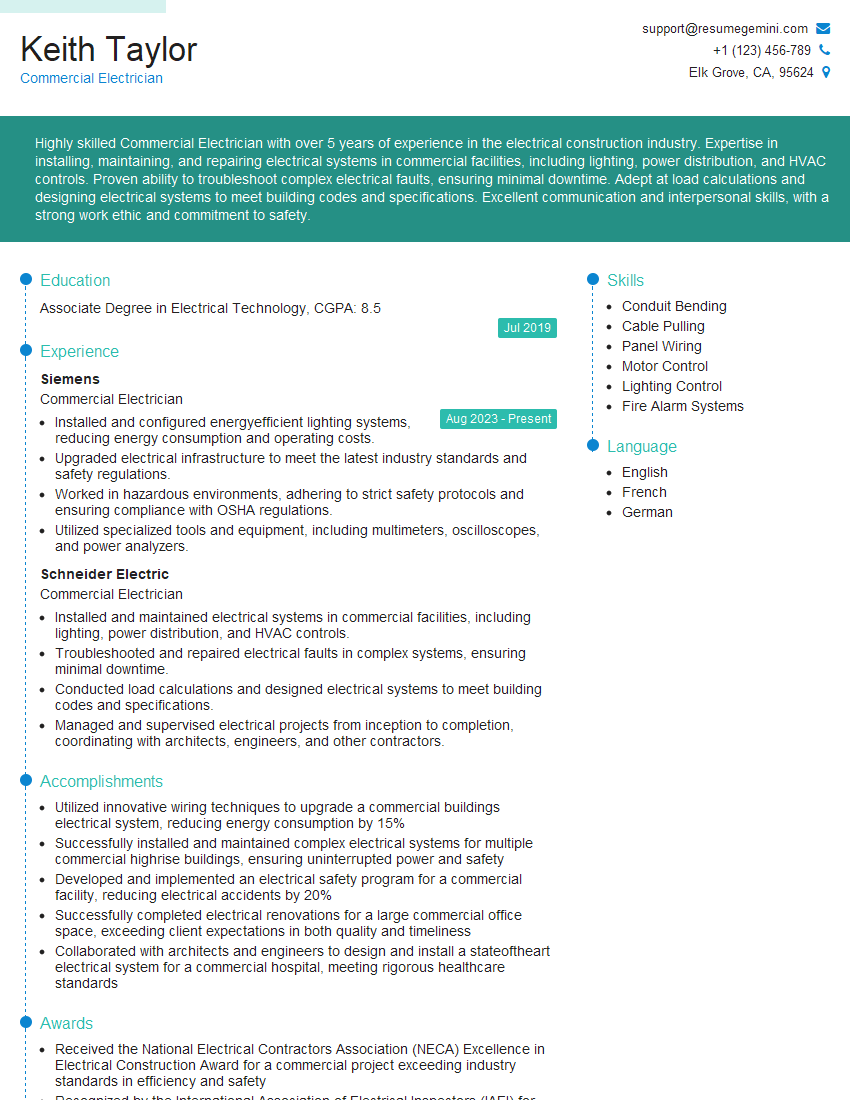
Commercial Electrician Resume Sample
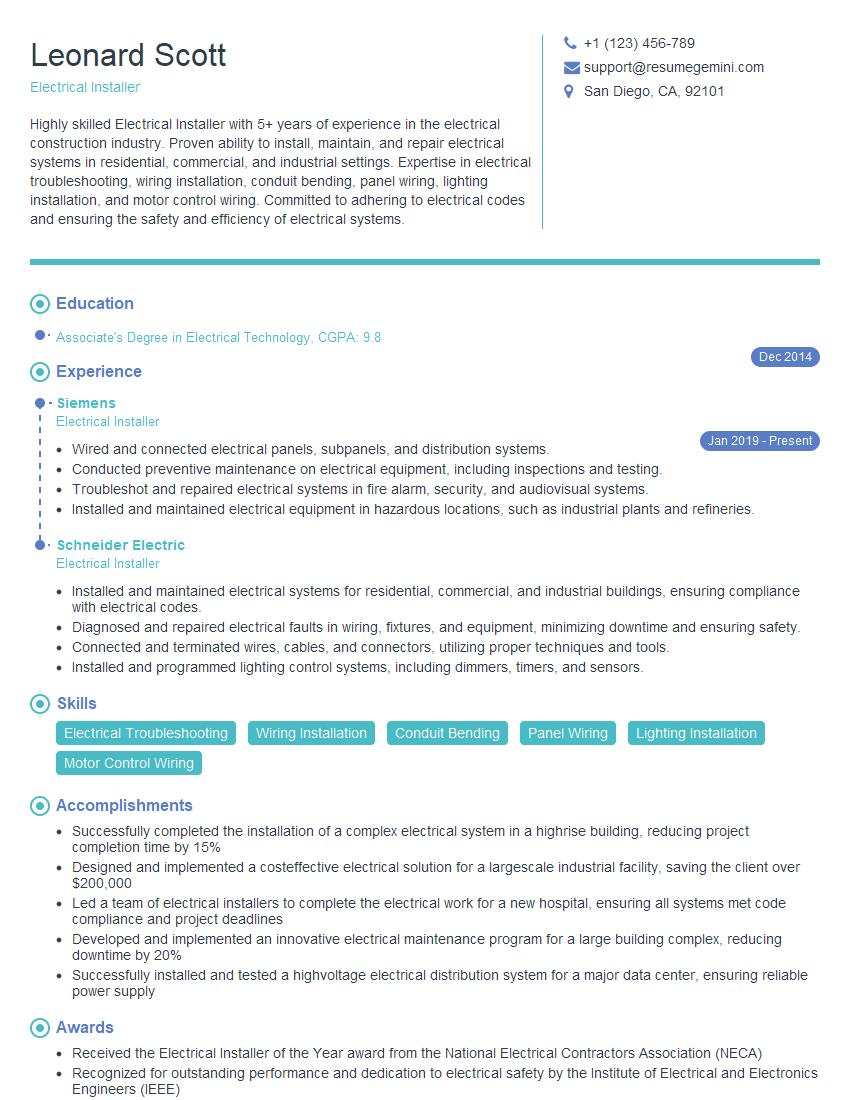
Electrical Installer Resume Sample
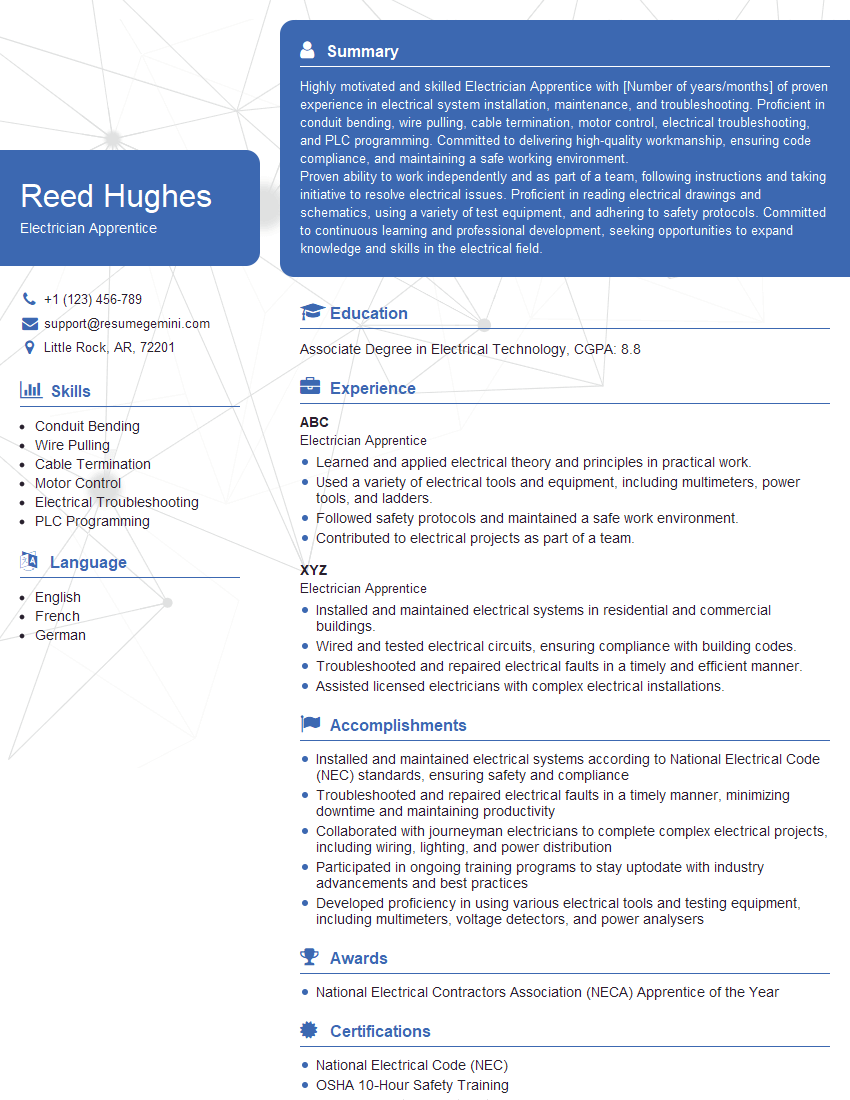
Electrician Apprentice Resume Sample
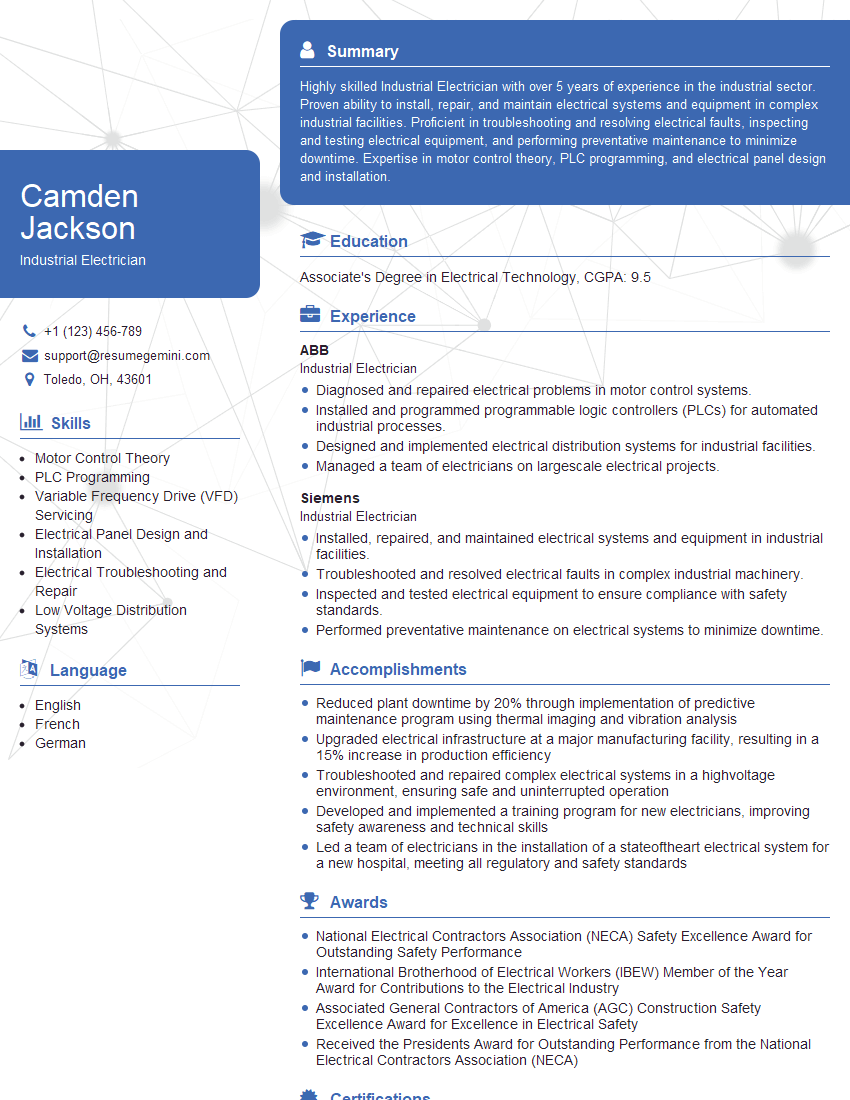
Industrial Electrician Resume Sample
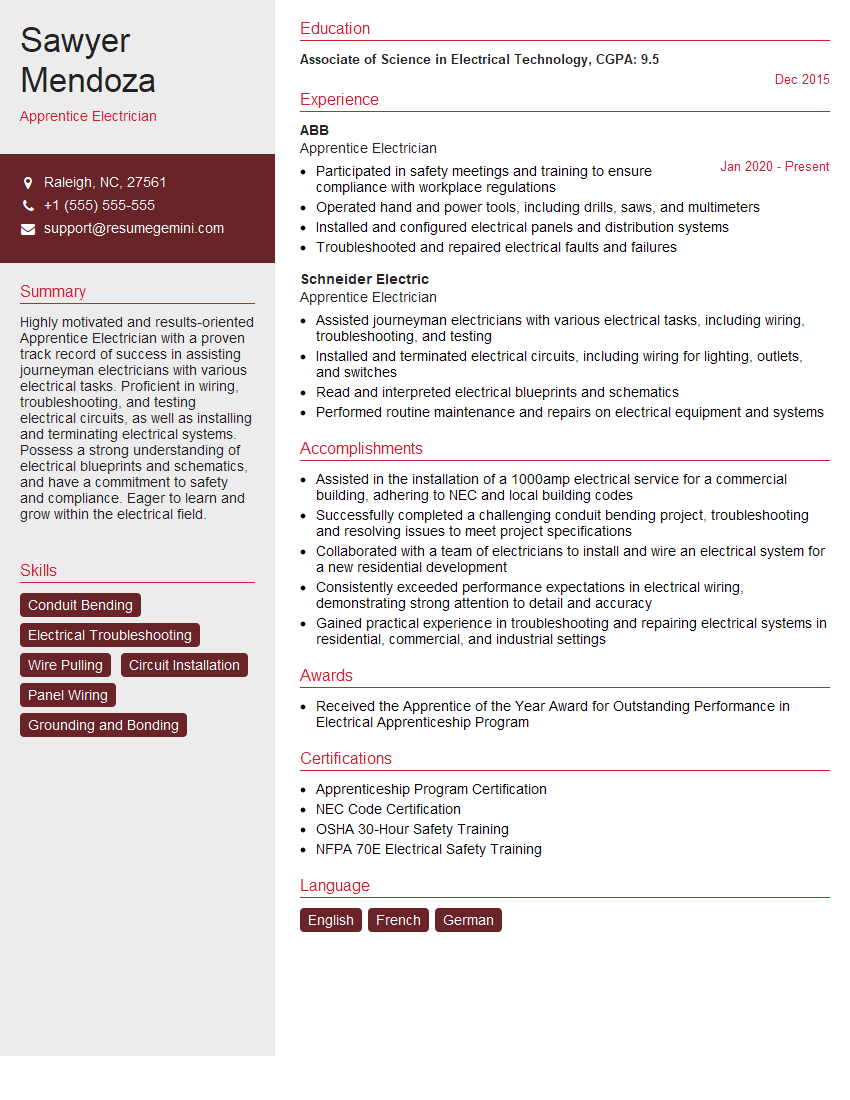
Apprentice Electrician Resume Sample
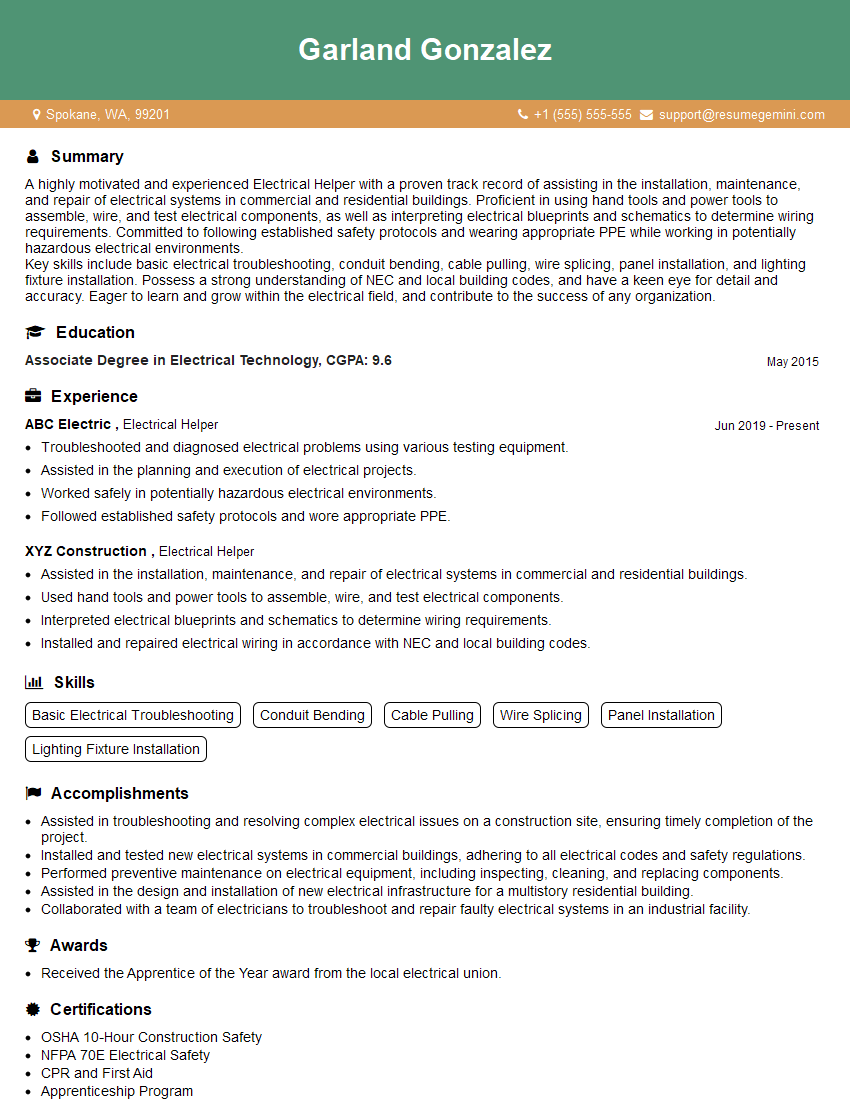
Electrical Helper Resume Sample

Electrical Maintenance Technician Resume Sample
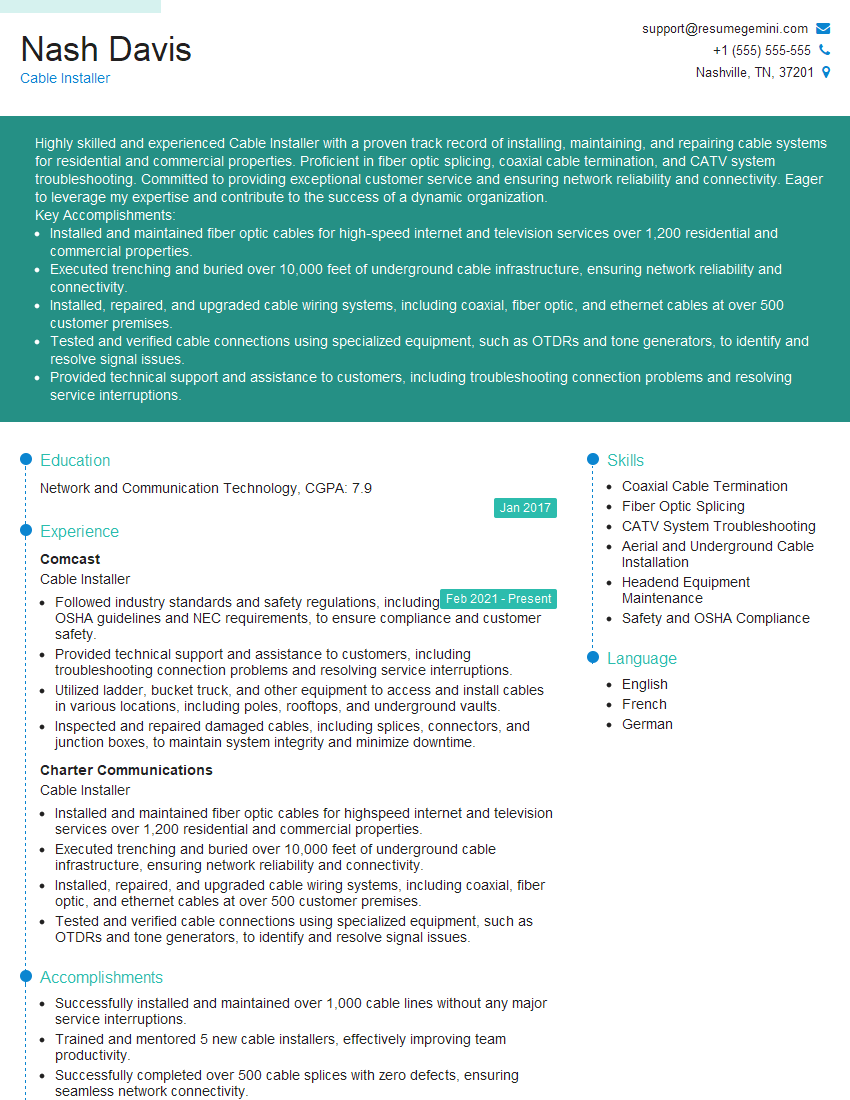
Cable Installer Resume Sample
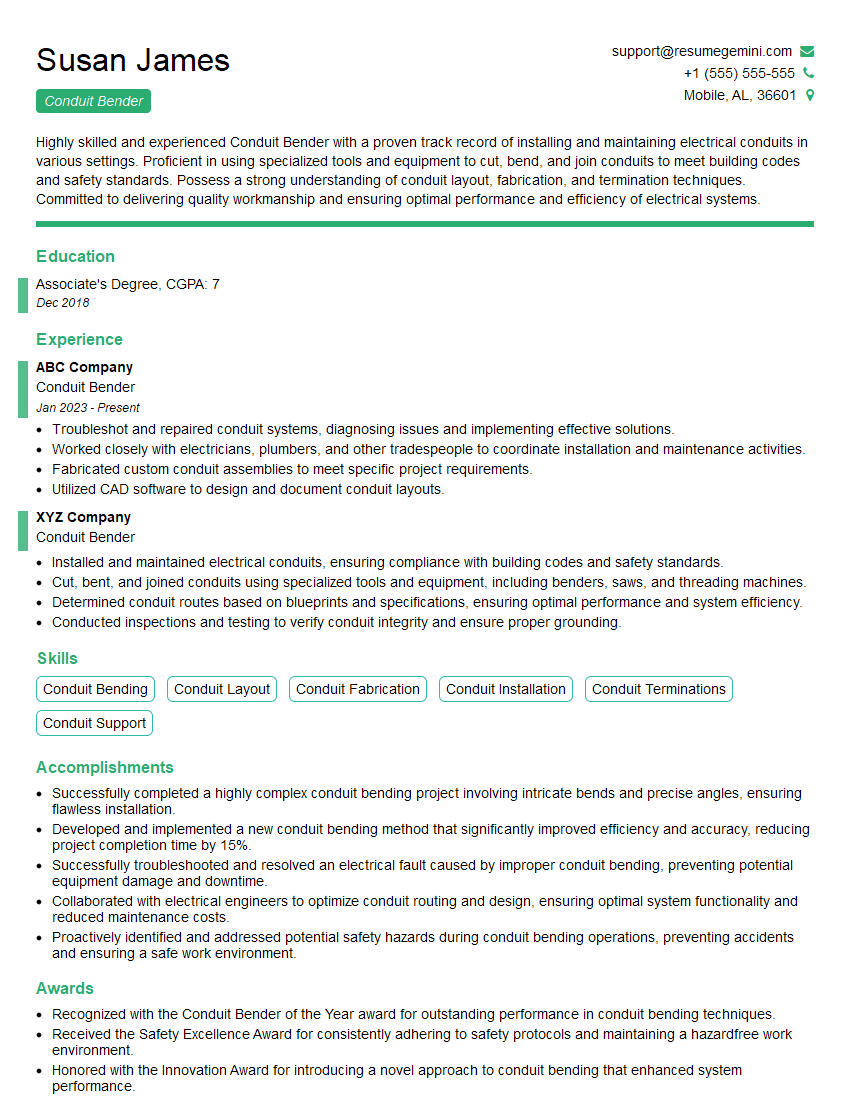
Conduit Bender Resume Sample
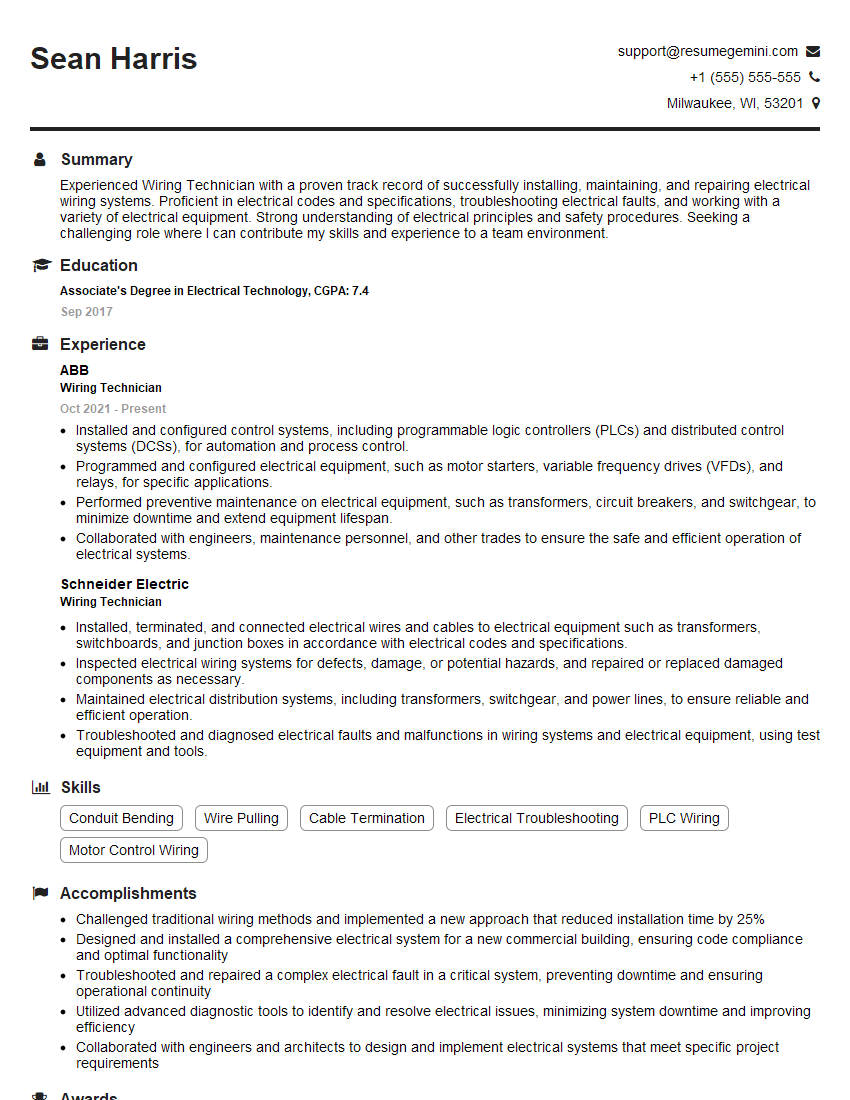
Wiring Technician Resume Sample
Explore more articles
Users Rating of Our Blogs
Share Your Experience
We value your feedback! Please rate our content and share your thoughts (optional).
What Readers Say About Our Blog
To the interviewgemini.com Webmaster.
Very helpful and content specific questions to help prepare me for my interview!
Thank you
To the interviewgemini.com Webmaster.
This was kind of a unique content I found around the specialized skills. Very helpful questions and good detailed answers.
Very Helpful blog, thank you Interviewgemini team.