Feeling uncertain about what to expect in your upcoming interview? We’ve got you covered! This blog highlights the most important Ability to Perform Statistical Data Analysis and Process Control interview questions and provides actionable advice to help you stand out as the ideal candidate. Let’s pave the way for your success.
Questions Asked in Ability to Perform Statistical Data Analysis and Process Control Interview
Q 1. Explain the difference between descriptive and inferential statistics.
Descriptive statistics summarize and describe the main features of a dataset. Think of it as creating a snapshot of your data. It involves calculating measures like the mean, median, mode, standard deviation, and creating visualizations like histograms and box plots to understand the data’s distribution and central tendency. Inferential statistics, on the other hand, goes a step further. It uses sample data to make inferences or predictions about a larger population. We use inferential statistics to test hypotheses, estimate parameters, and make generalizations about the population based on our sample. For example, if we survey 1000 people about their voting preferences, descriptive statistics would tell us the percentage of people who prefer each candidate in *that sample*. Inferential statistics would allow us to estimate, with a certain level of confidence, the voting preferences of the entire electorate (the population) based on that sample.
In short: Descriptive statistics describes the ‘what is’ in your data; inferential statistics attempts to infer the ‘what might be’ in the larger population.
Q 2. What are the key assumptions of a t-test?
The t-test, a common inferential statistical test, relies on several key assumptions:
- Independence of observations: Each data point should be independent of the others. This means one data point shouldn’t influence another. For example, if you’re measuring the effect of a drug, you shouldn’t use the same person multiple times in your study.
- Normality of data (approximately): The data within each group being compared should be approximately normally distributed, especially for smaller sample sizes. While slight deviations are often tolerable, severely skewed or non-normal data can invalidate the results. Transformations (like log transformations) can sometimes help address non-normality.
- Homogeneity of variances (for independent samples t-test): If comparing two independent groups, the variances (spread) of the data in those groups should be roughly equal. This assumption is less critical if sample sizes are large and equal. Tests like Levene’s test can assess this assumption.
- Random sampling: The data should be sampled randomly from the population of interest to ensure the sample accurately represents the population and avoid bias.
Violations of these assumptions can lead to inaccurate or unreliable t-test results. Alternative non-parametric tests (like the Mann-Whitney U test) are available if assumptions are severely violated.
Q 3. Describe the Central Limit Theorem and its importance in statistical inference.
The Central Limit Theorem (CLT) is a cornerstone of statistical inference. It states that the distribution of sample means (or averages) from a large number of random samples of any population, regardless of the population’s distribution, will approximate a normal distribution as the sample size increases. The mean of this distribution of sample means will be equal to the population mean, and its standard deviation (called the standard error) will be equal to the population standard deviation divided by the square root of the sample size.
Importance in Inference: The CLT’s power lies in its ability to justify using normal-based statistical tests (like t-tests and z-tests) even when the underlying population data isn’t normally distributed. Because the distribution of sample means tends towards normality, we can use these tests to make reliable inferences about the population mean, even with a non-normal population. This is crucial because many real-world datasets don’t perfectly follow a normal distribution. For example, if we were measuring customer satisfaction scores, the scores might not be perfectly normally distributed, but the average satisfaction scores from many samples would likely be close to a normal distribution if the sample sizes were reasonably large. This allows us to perform hypothesis tests related to the overall average satisfaction score.
Q 4. How do you handle missing data in a dataset?
Missing data is a common challenge in data analysis. The best approach depends on the nature and extent of the missing data and the goals of the analysis. Here are several strategies:
- Deletion: This involves removing observations (rows) or variables (columns) with missing values. This is simple but can lead to bias if the missing data is not Missing Completely at Random (MCAR). Listwise deletion removes the entire row; Pairwise deletion only removes data from calculations where it’s missing.
- Imputation: This involves filling in missing values with plausible estimates. Methods include:
- Mean/Median/Mode Imputation: Replacing missing values with the mean, median, or mode of the observed values for that variable. Simple but can distort the distribution and underestimate variability.
- Regression Imputation: Predicting missing values based on a regression model using other variables in the dataset. More sophisticated than simple imputation but assumes a linear relationship.
- Multiple Imputation: Creating multiple plausible imputed datasets and combining results to account for uncertainty in the imputation.
- Model-based approaches: Certain statistical models, like multiple imputation and some Bayesian models, are designed to handle missing data directly, incorporating the uncertainty associated with missing values into the analysis.
Before handling missing data, it’s critical to understand *why* the data is missing. Is it completely random, or is there a pattern? The Missing Completely at Random (MCAR), Missing at Random (MAR), and Missing Not at Random (MNAR) framework helps determine the appropriate approach. Incorrect handling of missing data can lead to biased and unreliable results.
Q 5. Explain the concept of statistical significance.
Statistical significance refers to the probability that an observed result is not due to random chance alone. In simpler terms, it tells us whether the observed effect is likely real or just a fluke. A statistically significant result suggests that there is evidence to reject the null hypothesis (a statement of ‘no effect’ or ‘no difference’). It’s important to note that statistical significance does *not* necessarily imply practical significance (meaningfulness or importance in the real world). A small effect might be statistically significant in a very large study, but it might not be meaningfully important.
For example, imagine testing a new fertilizer. If the yield difference between the fertilized and unfertilized plants is statistically significant, it suggests the fertilizer *does* have an effect. However, even if statistically significant, the yield increase might be so small as to not be economically beneficial for farmers.
Q 6. What is the p-value and how is it interpreted?
The p-value is the probability of obtaining results as extreme as, or more extreme than, the observed results, assuming the null hypothesis is true. In simpler terms, it quantifies the strength of evidence *against* the null hypothesis. A small p-value (typically less than a pre-determined significance level, often 0.05) indicates strong evidence against the null hypothesis, leading us to reject the null hypothesis. A large p-value suggests that there’s not enough evidence to reject the null hypothesis.
Interpretation: A p-value of 0.03 means there’s a 3% chance of observing the obtained results (or more extreme) if there were actually no effect. It’s crucial to remember that a p-value doesn’t tell us the probability of the null hypothesis being true. It only tells us the probability of the data, given the null hypothesis is true. Misinterpreting the p-value is a common mistake.
Q 7. What are Type I and Type II errors?
Type I and Type II errors are potential mistakes made in hypothesis testing.
- Type I error (False Positive): This occurs when we reject the null hypothesis when it is actually true. In other words, we conclude there is an effect when there isn’t one. This is like a false alarm. The probability of making a Type I error is denoted by alpha (α), which is often set at 0.05.
- Type II error (False Negative): This occurs when we fail to reject the null hypothesis when it is actually false. In other words, we conclude there is no effect when there actually is one. This is like a missed detection. The probability of making a Type II error is denoted by beta (β). The power of a test (1-β) is the probability of correctly rejecting a false null hypothesis.
Analogy: Imagine a medical test for a disease. A Type I error would be diagnosing someone as having the disease when they don’t (false positive). A Type II error would be failing to diagnose someone who actually has the disease (false negative).
Q 8. Explain the difference between correlation and causation.
Correlation and causation are two distinct concepts in statistics. Correlation simply indicates a relationship between two variables; they tend to change together. Causation, however, implies that one variable *directly influences* or *causes* a change in another. Just because two things are correlated doesn’t mean one causes the other.
Think of it this way: Ice cream sales and crime rates might be positively correlated – both increase during the summer. However, eating ice cream doesn’t *cause* crime, and vice-versa. A third, confounding variable (hot weather) influences both.
A classic example is the correlation between shoe size and reading ability in children. Larger shoe size correlates with better reading ability, but clearly, bigger feet don’t cause better reading! Age is the confounding variable here.
Q 9. What are some common methods for outlier detection?
Outlier detection is crucial for ensuring the accuracy and reliability of statistical analyses. Outliers are data points that significantly deviate from the rest of the data. Several methods exist for identifying them:
- Visual inspection: Creating histograms, box plots, or scatter plots can visually highlight outliers.
- Z-score method: This calculates how many standard deviations a data point is from the mean. Data points with a Z-score exceeding a threshold (e.g., 3 or -3) are considered outliers.
- Interquartile Range (IQR) method: This method uses the difference between the 75th percentile (Q3) and 25th percentile (Q1) of the data. Points outside the range Q1 – 1.5*IQR and Q3 + 1.5*IQR are flagged as potential outliers.
- DBSCAN (Density-Based Spatial Clustering of Applications with Noise): This algorithm groups data points based on density, identifying outliers as points that don’t belong to any cluster.
The choice of method depends on the dataset’s characteristics and the context of the analysis. It’s important to investigate outliers to understand their cause – they might indicate errors in data collection, genuine extreme values, or a need to refine the model.
Q 10. Describe different types of data distributions (normal, skewed, etc.).
Data distributions describe how data points are spread across a range of values. Common types include:
- Normal distribution (Gaussian): This is a symmetrical bell-shaped curve where the mean, median, and mode are equal. Many natural phenomena follow this distribution (e.g., height, weight).
- Skewed distributions: These are asymmetrical. A positively skewed distribution has a long tail to the right (mean > median > mode), while a negatively skewed distribution has a long tail to the left (mean < median < mode).
- Uniform distribution: All values within a given range have equal probability. Think of rolling a fair six-sided die – each number has a 1/6 chance of appearing.
- Bimodal distribution: This has two distinct peaks, suggesting the presence of two subgroups within the data.
Understanding the distribution is essential for choosing appropriate statistical tests and interpreting results. For instance, many statistical tests assume a normal distribution. If the data is heavily skewed, transformations (like taking the logarithm) might be needed.
Q 11. Explain the concept of confidence intervals.
A confidence interval provides a range of values within which a population parameter (like the mean) is likely to fall, with a certain level of confidence. For example, a 95% confidence interval means that if we were to repeat the study many times, 95% of the calculated intervals would contain the true population parameter.
It’s expressed as a point estimate (e.g., the sample mean) ± a margin of error. The margin of error depends on factors like the sample size, the standard deviation of the sample, and the desired confidence level. A larger sample size generally leads to a smaller margin of error and a narrower confidence interval.
Imagine you’re polling voters before an election. You might find that 55% support candidate A, with a 95% confidence interval of 52% to 58%. This means you’re 95% confident that the true percentage of voters supporting candidate A lies between 52% and 58%.
Q 12. How do you choose the appropriate statistical test for a given dataset and research question?
Selecting the appropriate statistical test depends heavily on the research question, the type of data (categorical, continuous, etc.), the number of groups being compared, and the assumptions about the data distribution.
Here’s a simplified framework:
- Comparing means of two groups: t-test (if data is normally distributed and variances are similar), Mann-Whitney U test (if data is not normally distributed).
- Comparing means of three or more groups: ANOVA (if data is normally distributed), Kruskal-Wallis test (if data is not normally distributed).
- Analyzing relationships between two variables: Pearson correlation (if data is normally distributed), Spearman correlation (if data is not normally distributed).
- Analyzing categorical data: Chi-square test.
It’s crucial to check the assumptions of each test before applying it. Violating these assumptions can lead to inaccurate or misleading results. Consulting statistical resources or seeking expert advice is advisable when uncertainty exists.
Q 13. What are control charts and how are they used in process control?
Control charts are graphical tools used in statistical process control (SPC) to monitor process performance and identify potential sources of variation. They display data over time, allowing for the detection of trends, shifts, or patterns that indicate the process is going out of control.
Control charts typically have three horizontal lines:
- Center line: Represents the average process performance.
- Upper control limit (UCL): The upper bound of acceptable variation.
- Lower control limit (LCL): The lower bound of acceptable variation.
Points plotted outside these limits often signal that the process is out of control, requiring investigation and corrective action. Control charts help maintain process stability and consistency, minimizing defects and improving product quality.
For example, a manufacturing plant might use control charts to track the weight of a product. If the weight consistently falls outside the control limits, it indicates a problem with the manufacturing process that needs to be addressed.
Q 14. Explain the difference between X-bar and R charts.
Both X-bar and R charts are used in SPC to monitor the central tendency and variability of a process, but they focus on different aspects.
- X-bar chart: Monitors the average (mean) of a process. It tracks the central tendency over time. Points plotted on the X-bar chart represent the average of subgroups of data collected at regular intervals.
- R chart: Monitors the range (difference between the highest and lowest values) within each subgroup. It shows the variability within subgroups over time. A high R indicates increased variability.
These charts are often used together. The X-bar chart shows if the process average is shifting, while the R chart indicates whether the variability is increasing. If either chart shows points outside the control limits, it signifies a need to investigate the underlying causes of the process instability.
Q 15. Describe the principles of Six Sigma methodology.
Six Sigma is a data-driven methodology aimed at minimizing defects and improving process efficiency. Its core principle revolves around reducing variation to achieve near-perfection. Imagine a target: Six Sigma strives to get almost all shots within the bullseye, minimizing those that land outside. This is achieved through a structured approach that involves defining, measuring, analyzing, improving, and controlling processes. The ‘Six Sigma’ itself refers to a statistical measure representing a process capable of producing only 3.4 defects per million opportunities (DPMO).
It emphasizes a systematic approach to problem-solving, using statistical tools to identify and eliminate sources of variation. This ensures consistent process outputs that meet or exceed customer expectations. This focus on data and statistical analysis differentiates Six Sigma from other quality improvement methods. Key principles include customer focus, data-driven decision making, process optimization, and continuous improvement.
Career Expert Tips:
- Ace those interviews! Prepare effectively by reviewing the Top 50 Most Common Interview Questions on ResumeGemini.
- Navigate your job search with confidence! Explore a wide range of Career Tips on ResumeGemini. Learn about common challenges and recommendations to overcome them.
- Craft the perfect resume! Master the Art of Resume Writing with ResumeGemini’s guide. Showcase your unique qualifications and achievements effectively.
- Don’t miss out on holiday savings! Build your dream resume with ResumeGemini’s ATS optimized templates.
Q 16. What are DMAIC and DMADV?
DMAIC and DMADV are two crucial phases within the Six Sigma framework, representing distinct approaches to process improvement. DMAIC is used for improving existing processes, while DMADV is used for designing new ones.
- DMAIC (Define, Measure, Analyze, Improve, Control): This is the most widely used Six Sigma methodology, focusing on improving existing processes.
- Define: Clearly define the project’s goals, scope, and customer requirements.
- Measure: Collect data to understand the current process performance, identifying key metrics.
- Analyze: Analyze the data to identify the root causes of variation and defects.
- Improve: Implement solutions to address the root causes and improve process performance.
- Control: Implement controls to maintain the improved process performance and prevent regression.
- DMADV (Define, Measure, Analyze, Design, Verify): This methodology is employed when designing new processes or products from scratch.
- Define: Define the project’s goals, scope, and customer requirements.
- Measure: Identify critical-to-quality (CTQ) characteristics and potential failure modes.
- Analyze: Develop and evaluate potential process designs to meet CTQ requirements.
- Design: Select and optimize the best process design to meet the requirements.
- Verify: Verify the effectiveness of the new process design through testing and validation.
Think of DMAIC as fixing a leaky faucet (improving an existing process), while DMADV is like designing a brand-new plumbing system (creating a new process).
Q 17. Explain the concept of process capability indices (Cp, Cpk).
Process capability indices (Cp and Cpk) are statistical measures used to determine whether a process is capable of consistently meeting specified requirements. They assess how well the process’s natural variation fits within the customer’s tolerance limits.
- Cp (Process Capability): Measures the potential capability of a process based on its inherent variation, irrespective of its centering. It essentially tells you how much process variation exists relative to the specification width. A Cp value of 1 or greater is generally considered acceptable.
- Cpk (Process Capability Index): Takes into account both the process variation and its centering (or lack thereof) relative to the target value. It assesses whether the process is centered within the specification limits and what the capability is given the current process centering. A Cpk value of 1.33 or greater is generally considered good.
For instance, if you’re manufacturing bolts, Cp would show you how much the bolt diameter varies regardless of whether the average diameter is on target. Cpk would tell you if the average diameter is within the acceptable range and whether the variation is acceptable given the current average diameter. Both Cp and Cpk are crucial for making informed decisions about process improvement and ensuring consistent product quality.
Q 18. How do you identify and analyze process variation?
Identifying and analyzing process variation involves employing a range of statistical tools and techniques to understand the sources of variability affecting a process.
Common methods include:
- Control Charts: These charts visually display data over time, showing process variation and identifying trends or shifts in the process mean. Different types of control charts exist (X-bar and R chart, X-bar and s chart, etc.) catering to various data types and objectives.
- Histograms: These provide a visual representation of the frequency distribution of process data, illustrating the shape and spread of the distribution. This helps in understanding the central tendency and the degree of variation present.
- Box Plots: Similar to histograms, box plots provide a concise way to visualize the distribution of the data, including the median, quartiles, and outliers.
- Pareto Charts (discussed further below): Used to identify the vital few factors contributing to most of the problems.
- Cause-and-Effect Diagrams (Fishbone Diagrams): Used to visually organize potential causes of a problem, facilitating systematic brainstorming and root cause identification.
By systematically collecting and analyzing data using these tools, you can pinpoint the major sources of variation and prioritize improvement efforts. For example, a control chart might reveal that a specific machine is introducing unwanted variation into a manufacturing process, while a histogram might reveal that the process consistently produces outputs outside of the desired tolerance.
Q 19. What is Pareto analysis and how is it used in process improvement?
Pareto analysis is a decision-making technique used to identify the ‘vital few’ factors that contribute to the majority of problems. It’s based on the Pareto principle (also known as the 80/20 rule), which suggests that 80% of effects come from 20% of causes. This principle applies broadly, from process improvement to sales analysis.
In process improvement, Pareto analysis helps by:
- Prioritizing efforts: It highlights the most impactful areas to focus improvement efforts on, maximizing the return on investment.
- Targeting root causes: By identifying the vital few factors, it guides investigation toward the most significant contributors to defects.
- Measuring progress: Tracking the reduction in the ‘vital few’ allows for quantifying improvements over time.
For example, in a manufacturing process, a Pareto chart might reveal that 80% of defects are caused by only two machines out of ten. This allows engineers to focus their efforts on fixing these machines, which will result in a greater overall impact. The process involves collecting data, categorizing defects, and presenting the results in a bar graph, where factors are ordered from most frequent to least frequent.
Q 20. Explain the concept of root cause analysis.
Root cause analysis (RCA) is a systematic approach to identifying the underlying causes of problems or defects. It goes beyond treating symptoms to discover the fundamental reasons behind them. Think of it as diagnosing an illness – you don’t just treat the fever; you identify the underlying infection.
Several techniques are used for RCA, including:
- 5 Whys: Repeatedly asking ‘why’ to peel back layers of explanation, eventually reaching the root cause.
- Fishbone diagrams (Ishikawa diagrams): Visually mapping out potential causes of a problem, categorized by factors such as people, methods, machines, materials, environment, and measurements.
- Fault tree analysis: A top-down approach that models how various failures can combine to result in a specific event.
The goal of RCA is not just to fix the immediate problem but to prevent recurrence. For example, if a product fails due to a broken component, RCA might reveal that the failure was caused by inadequate material selection, insufficient quality control, or incorrect assembly procedures. Addressing these root causes prevents future failures and improves overall process reliability.
Q 21. What are some common tools used for statistical data analysis (e.g., R, Python, Minitab)?
Many powerful statistical software packages are used for data analysis in process control and Six Sigma. Here are some popular options, each with its strengths:
- R: A free, open-source language and environment for statistical computing and graphics. It’s extremely versatile, offering extensive libraries for statistical modeling, data visualization, and more. It requires more programming knowledge than other options, but its power and flexibility make it a favorite for experienced analysts.
- Python: A general-purpose programming language with powerful libraries like Pandas, NumPy, and Scikit-learn. It’s becoming increasingly popular for data science tasks due to its readability, extensive ecosystem, and broad application beyond statistical analysis.
- Minitab: A commercial statistical software package specifically designed for quality improvement and process control. It’s user-friendly with a point-and-click interface, making it ideal for those less familiar with programming. It offers excellent capabilities for control charts, process capability analysis, and other Six Sigma tools.
- JMP: Another commercial software package geared towards statistical discovery. It is particularly strong in visualization and exploratory data analysis.
The choice of tool often depends on factors like project requirements, user expertise, budget constraints, and the availability of specialized features. For example, R’s flexibility might be preferred for complex modeling tasks, while Minitab’s user-friendly interface could be better suited for a team with less statistical programming experience.
Q 22. Describe your experience with statistical software packages.
Throughout my career, I’ve extensively used a variety of statistical software packages, each suited to different tasks. My core competency lies in R and Python, utilizing packages like ggplot2 and dplyr in R for data visualization and manipulation, and pandas, scikit-learn, and statsmodels in Python for data analysis, machine learning, and statistical modeling. I’m also proficient in SAS and SPSS, particularly for larger datasets and established statistical procedures often used in regulated industries. My experience extends to specialized packages such as control charts packages for process monitoring and time series analysis libraries for forecasting. The choice of software depends heavily on the project’s specific needs and the available resources.
For instance, when working with a large clinical trial dataset, SPSS’s built-in capabilities for handling missing data and performing complex ANOVA tests proved invaluable. Conversely, for a more exploratory data analysis project involving predictive modeling, Python’s flexibility and extensive libraries offered a more efficient workflow.
Q 23. How do you interpret regression analysis results?
Interpreting regression analysis results involves understanding the relationships between a dependent variable and one or more independent variables. The key outputs to focus on are the coefficients, R-squared, p-values, and any diagnostic plots. The coefficients represent the change in the dependent variable for a one-unit change in the independent variable, holding all other variables constant. The R-squared value indicates the proportion of variance in the dependent variable explained by the model. P-values assess the statistical significance of each coefficient, indicating whether the relationship between the independent and dependent variables is likely due to chance or a real effect. Diagnostic plots, such as residual plots, help assess the assumptions of the model, like linearity and homoscedasticity (constant variance of errors).
For example, in a model predicting house prices (dependent variable) based on size and location (independent variables), a positive coefficient for ‘size’ suggests that larger houses tend to have higher prices. A high R-squared indicates the model explains a significant portion of the price variation. Low p-values for the coefficients support the statistical significance of these relationships. Examining residual plots would help identify any potential outliers or violations of model assumptions that may need to be addressed.
Q 24. How do you validate a statistical model?
Model validation is crucial to ensure a statistical model’s reliability and generalizability. It involves assessing how well the model performs on unseen data and checking if the model assumptions are met. This typically involves splitting the data into training and testing sets. The model is trained on the training set and then evaluated on the testing set to gauge its predictive performance. Key metrics for validation include things like RMSE (Root Mean Squared Error), MAE (Mean Absolute Error), and AUC (Area Under the Curve) depending on the model type. Furthermore, cross-validation techniques, such as k-fold cross-validation, can provide more robust estimates of model performance by training and testing on multiple subsets of the data.
Beyond predictive performance, it’s also essential to assess the model’s assumptions. For instance, in linear regression, we check for linearity, independence of errors, homoscedasticity, and normality of residuals. Violations of these assumptions can impact the model’s reliability, and addressing them is important. Techniques like residual plots and statistical tests can help in detecting these violations.
Q 25. Explain your experience with hypothesis testing.
Hypothesis testing forms the backbone of many statistical analyses. It involves formulating a null hypothesis (a statement of no effect) and an alternative hypothesis (a statement of an effect), then using data to determine whether there’s enough evidence to reject the null hypothesis in favor of the alternative. This process involves selecting an appropriate statistical test based on the data type and research question (e.g., t-test, ANOVA, chi-squared test). The test produces a p-value, representing the probability of observing the data if the null hypothesis were true. If the p-value is below a pre-determined significance level (usually 0.05), we reject the null hypothesis, concluding there is statistically significant evidence to support the alternative hypothesis.
For example, in a clinical trial comparing a new drug to a placebo, the null hypothesis might be that there’s no difference in effectiveness between the drug and the placebo. A t-test could be used to compare the average treatment outcomes between the two groups. A low p-value would indicate that the observed difference is unlikely due to chance, suggesting the new drug is more effective.
Q 26. Describe a situation where you had to identify and solve a process control problem.
In a previous role, we experienced a significant increase in the defect rate of a manufacturing process. To address this, I implemented a comprehensive process control strategy. Initially, I collected data on various process parameters and defects. Using control charts (specifically, X-bar and R charts), I monitored the process’s stability and identified periods of instability. Statistical Process Control (SPC) tools such as the X-bar and R chart showed that a specific machine was the source of the issue. By analyzing the data further, we isolated the root cause to inconsistent temperature settings in that machine. After correcting the temperature settings and implementing routine monitoring, we saw a marked decrease in the defect rate and a more stable process, verified through subsequent control charts. The application of SPC resulted in a significant cost reduction by preventing further defects and waste.
Q 27. How would you explain complex statistical concepts to a non-technical audience?
Explaining complex statistical concepts to a non-technical audience requires clear, concise language and relatable analogies. Instead of using jargon, I focus on illustrating concepts using everyday examples. For instance, explaining regression analysis can be done by comparing it to fitting a line through a scatter plot of data points – the line represents the model’s prediction, and how closely the points cluster around the line reflects the model’s accuracy. Similarly, p-values can be explained as the probability of observing results by chance, and a low p-value implies the results are unlikely due to mere chance. Using visuals, such as charts and graphs, is also extremely beneficial in conveying statistical findings clearly. Keeping explanations simple and focusing on the practical implications of the results is essential for non-technical audiences.
Q 28. What are your strengths and weaknesses in statistical data analysis and process control?
My strengths lie in my ability to translate complex statistical problems into actionable insights, and my experience with a wide range of statistical software and techniques. I excel at designing experiments, analyzing data, and communicating findings effectively to both technical and non-technical stakeholders. I’m adept at identifying and solving problems, always striving for innovative and efficient solutions. My understanding of both descriptive and inferential statistics, along with my practical experience in process control, allows me to make data-driven decisions.
A potential area for growth is my experience with Bayesian statistics. While I have a foundational understanding, I aim to deepen my expertise in this area to broaden my analytical toolkit and further enhance my problem-solving capabilities.
Key Topics to Learn for Ability to Perform Statistical Data Analysis and Process Control Interview
- Descriptive Statistics: Understanding measures of central tendency (mean, median, mode), dispersion (variance, standard deviation), and their interpretation in the context of process data.
- Inferential Statistics: Applying hypothesis testing (t-tests, ANOVA) and confidence intervals to draw conclusions about process performance and identify significant differences.
- Regression Analysis: Building and interpreting linear and multiple regression models to understand relationships between process variables and outcomes, predicting future performance.
- Control Charts: Understanding and applying various control charts (e.g., X-bar and R charts, p-charts, c-charts) to monitor process stability and identify assignable causes of variation.
- Process Capability Analysis: Assessing the ability of a process to meet specified requirements using Cp, Cpk, and other capability indices. Understanding the implications for process improvement.
- Design of Experiments (DOE): Familiarizing yourself with basic DOE principles and their application in identifying key factors influencing process output and optimizing process parameters.
- Statistical Software Proficiency: Demonstrating practical experience with statistical software packages like Minitab, R, or JMP – showcasing your ability to perform analysis and interpret results effectively.
- Problem-Solving using Statistical Methods: Articulate your approach to analyzing process data, identifying root causes of variation, and implementing effective solutions. Prepare examples from your experience.
- Data Quality and Management: Discuss the importance of data integrity, cleaning and transformation techniques, and handling missing data in statistical analysis.
Next Steps
Mastering statistical data analysis and process control is crucial for career advancement in many fields, opening doors to higher-paying roles and increased responsibility. A well-crafted resume is your first impression – make it count! An ATS-friendly resume increases your chances of getting your application noticed. ResumeGemini is a trusted resource to help you build a professional, impactful resume that highlights your skills and experience effectively. We provide examples of resumes tailored specifically to highlight expertise in statistical data analysis and process control, to give you a head start. Take the next step towards your dream career today.
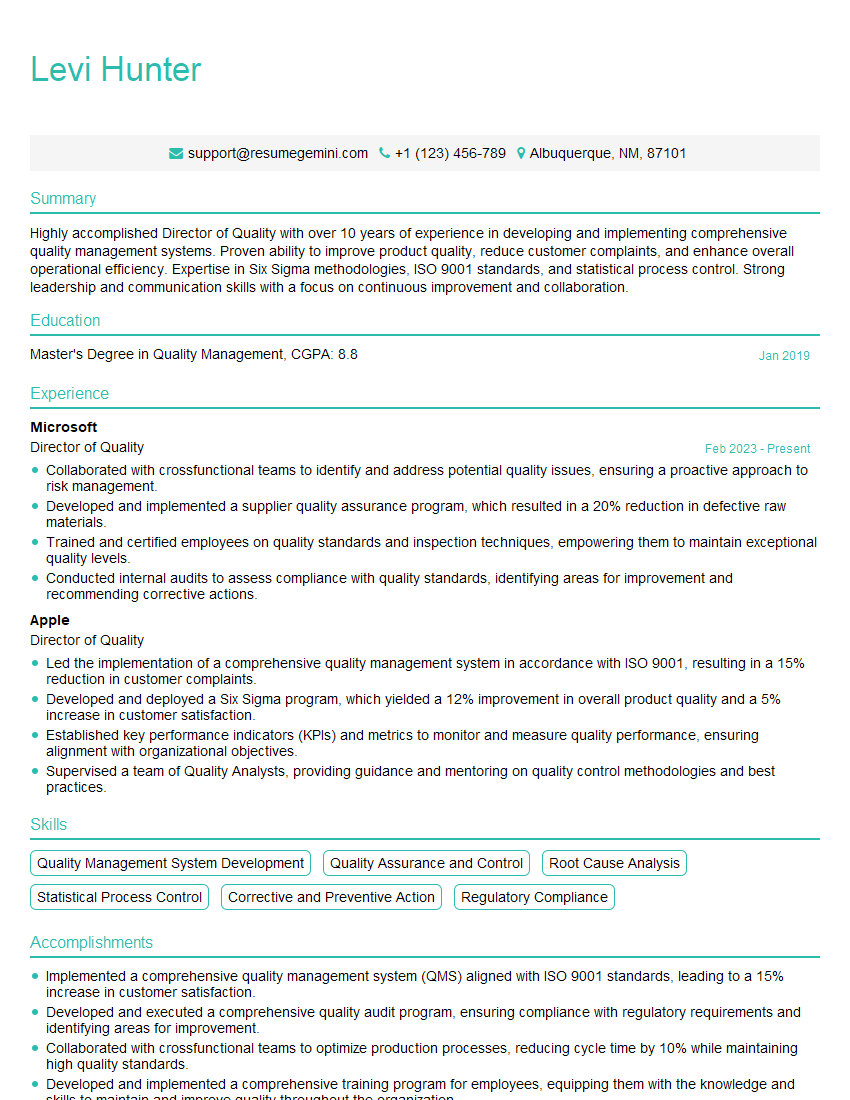
Director of Quality Resume Sample

Reliability Engineer Resume Sample
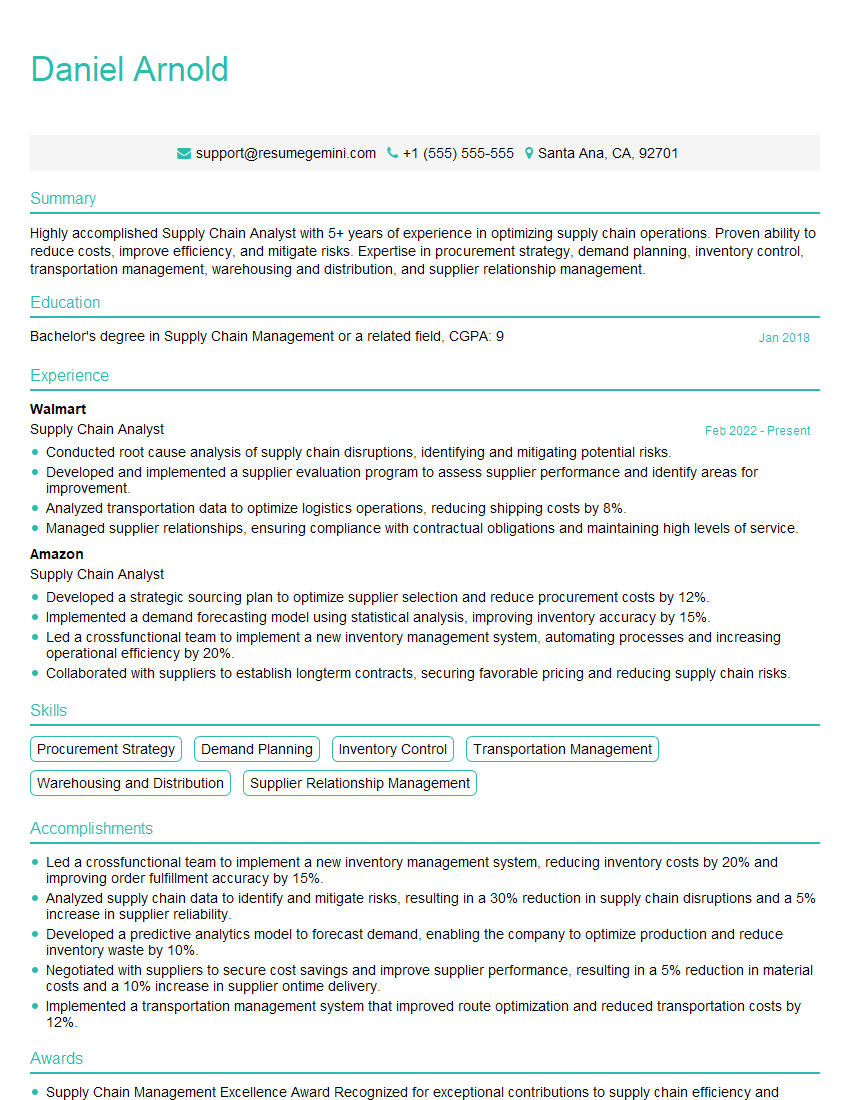
Supply Chain Analyst Resume Sample

Data Analyst Resume Sample

Quantitative Analyst Resume Sample

Data Scientist Resume Sample

Quality Engineer Resume Sample
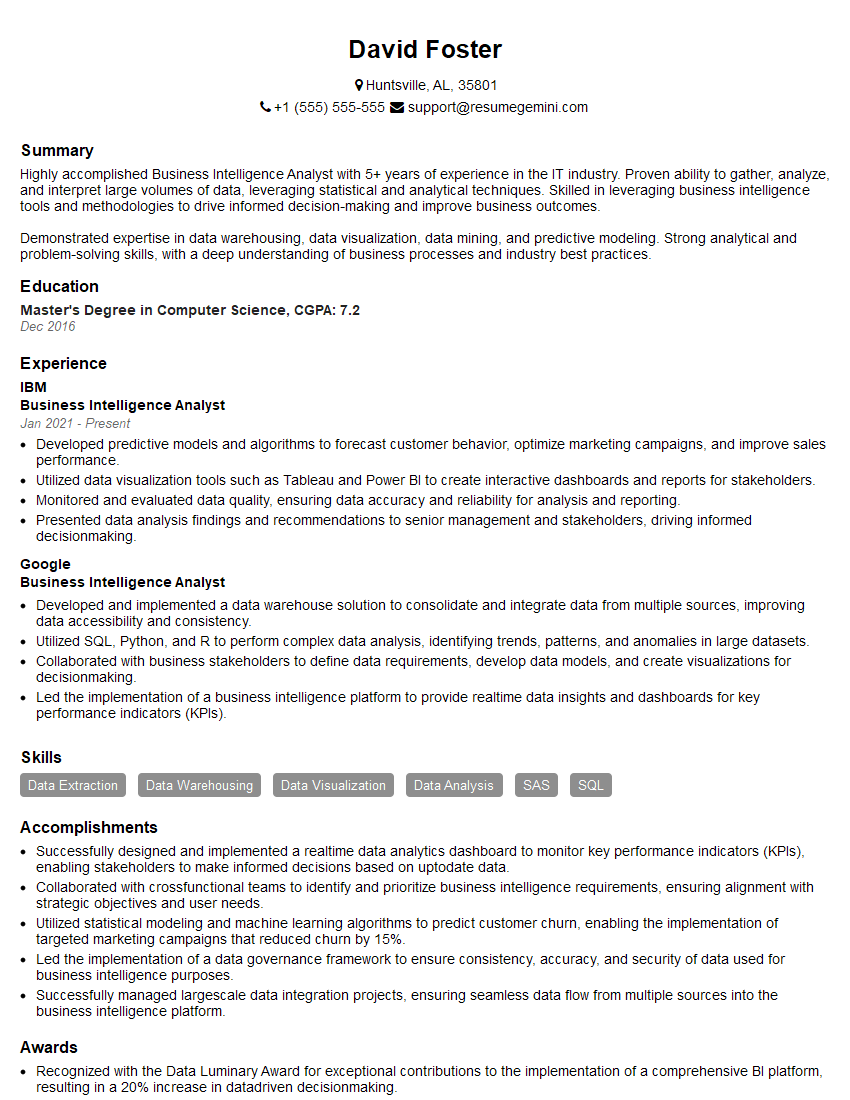
Business Intelligence Analyst Resume Sample

Operations Research Analyst Resume Sample

Process Control Engineer Resume Sample
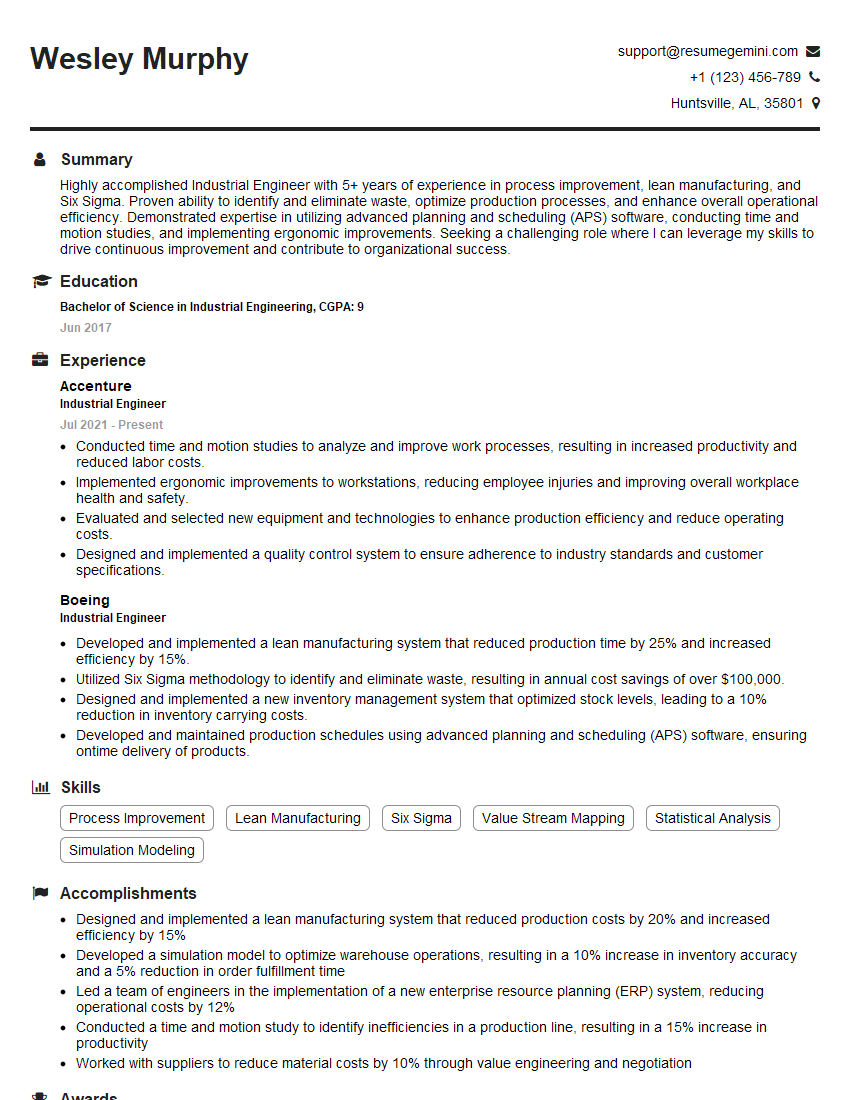
Industrial Engineer Resume Sample

Manufacturing Engineer Resume Sample

Quality Control Specialist Resume Sample

Control Systems Engineer Resume Sample

Senior Quality Engineer Resume Sample

Lead Data Scientist Resume Sample
- Director of Quality
- Reliability Engineer
- Supply Chain Analyst
- Data Analyst
- Quantitative Analyst
- Data Scientist
- Quality Engineer
- Business Intelligence Analyst
- Operations Research Analyst
- Process Control Engineer
- Industrial Engineer
- Manufacturing Engineer
- Quality Control Specialist
- Control Systems Engineer
- Senior Quality Engineer
- Lead Data Scientist
Explore more articles
Users Rating of Our Blogs
Share Your Experience
We value your feedback! Please rate our content and share your thoughts (optional).
What Readers Say About Our Blog
To the interviewgemini.com Webmaster.
Very helpful and content specific questions to help prepare me for my interview!
Thank you
To the interviewgemini.com Webmaster.
This was kind of a unique content I found around the specialized skills. Very helpful questions and good detailed answers.
Very Helpful blog, thank you Interviewgemini team.