The thought of an interview can be nerve-wracking, but the right preparation can make all the difference. Explore this comprehensive guide to Application of Joint Compound and Tape interview questions and gain the confidence you need to showcase your abilities and secure the role.
Questions Asked in Application of Joint Compound and Tape Interview
Q 1. What types of joint compound are you familiar with, and what are their applications?
Joint compound, also known as drywall compound, comes in several types, each suited for different applications. The primary distinction lies in their setting time and texture.
- All-Purpose Compound: This is the workhorse, ideal for most applications. It offers a good balance of working time and drying speed, making it suitable for both taping and topping coats.
- Lightweight Compound: Lighter than all-purpose, it’s excellent for ceilings and large areas, reducing strain on the applicator. It’s typically used for topping coats due to its slightly longer drying time.
- Setting-Type Compound: This compound sets up rapidly, allowing for quicker finishing. It’s useful for situations where speed is essential, but requires more skill to avoid premature setting.
- Topping Compound: This smooth, fine-textured compound is specifically designed for the final coat, resulting in a flawless, paintable surface. It’s usually applied after the taping compound to achieve the desired level of smoothness.
For example, on a large commercial project, I might use lightweight compound for the initial coats on the ceilings to minimize arm fatigue, then finish with a topping compound for a perfectly smooth surface ready for paint.
Q 2. Describe the process of applying joint compound to a butt joint.
Applying joint compound to a butt joint (where two drywall sheets meet edge-to-edge) requires precision and attention to detail. The goal is to create a seamless transition, invisible once painted.
- Prepare the Joint: Ensure the edges of the drywall are flush. Any gaps should be filled with additional compound before taping.
- Apply the Tape: Use a self-adhesive fiberglass drywall tape, pressing it firmly into the joint to ensure good adhesion. Smooth out any air bubbles.
- First Coat: Apply a thin, even layer of joint compound over the tape, feathering the edges out about 2-3 inches onto the drywall surface. This embeds the tape and prevents it from showing through the finished surface.
- Dry and Sand: Allow the compound to dry completely. Then, carefully sand the area smooth using a sanding sponge or block, removing any excess compound and creating a smooth transition.
- Second Coat (Optional): For a truly flawless finish, apply a second, thinner coat of compound, feathering the edges again. Allow to dry and sand.
- Third Coat (Topping): For a perfect, professional result, a third coat of topping compound is applied, creating a very smooth surface, ready for painting.
Think of it like baking a cake – you need multiple layers to achieve a perfect outcome. Each coat of joint compound builds upon the last to provide a durable, smooth finish.
Q 3. Explain the different techniques for taping drywall seams.
Taping drywall seams is crucial for creating a smooth, paintable surface. Several techniques exist, depending on the type of joint and desired finish.
- The ‘One-Coat’ Method (for Narrow Joints): This involves directly applying a thin layer of compound over the tape in one go, pressing firmly to embed the tape. It works best with narrow joints where minimal build-up is needed.
- The ‘Two-Coat’ or ‘Three-Coat’ Method (for Wider Joints): The most common method, this involves applying multiple thin coats, allowing each to dry before sanding. The additional coats create better coverage and build-up, allowing for the creation of smooth transitions. The last coat is typically a finishing coat.
- Using a Knife: A 6-inch knife is usually employed for the taping process, applying thin and even layers of compound.
- Using a Taper: A drywall taper is a tool that helps ensure that the compound is spread evenly and smoothly, reducing the amount of sanding that is required.
Choosing the right technique depends on the joint’s width and the desired level of smoothness. I often use the two-coat method for most jobs, ensuring a strong base and a flawless finish.
Q 4. How do you achieve a smooth, seamless finish with joint compound?
Achieving a smooth, seamless finish with joint compound requires patience and attention to detail. It’s not a race, but a process of building layers to perfection.
- Thin Coats: Apply thin coats of compound, allowing each to dry completely before sanding. Thick coats are more likely to crack and require more sanding.
- Proper Feathering: Carefully feather the edges of each coat to ensure a smooth transition into the surrounding drywall. This prevents noticeable ridges or bumps.
- Thorough Sanding: Use fine-grit sandpaper (120-grit or higher) and sand gently to avoid creating more imperfections. A sanding block helps maintain even pressure and prevent accidental scratches.
- High-Quality Tools: Using high-quality knives and sanding tools make a huge difference in the end result.
- Multiple Coats: Consider three or more coats for the best finish. The more coats you apply, the easier it becomes to obtain a flawless finish. The first coat is for taping, the second for smoothing, and the third is your finishing compound.
Imagine sculpting clay: you don’t create a perfect form in one go. You build and refine, layer by layer, until you achieve your desired result. Joint compound application is similar; it’s a process of gradual refinement.
Q 5. What tools and equipment are essential for efficient joint compound application?
The right tools make all the difference in achieving a professional finish. Here’s what’s essential:
- Drywall Knives: 6-inch, 8-inch, and 12-inch knives are standard for applying compound and smoothing out the seams.
- Putty Knives: Smaller knives are useful for filling small holes and cracks.
- Sanding Block and Sandpaper: Use various grits of sandpaper (120-grit, 150-grit, 220-grit) for sanding between coats. A sanding block provides even pressure, ensuring a smooth finish without creating dips or grooves.
- Drywall Tape: Fiberglass self-adhesive tape is preferred for its strength and flexibility.
- Mixing Bucket and Stirring Tool: A 5-gallon bucket is common for mixing compound. A good paint mixer or a drill with a mixing paddle ensures proper consistency.
- Utility Knife: For cutting the drywall tape to the desired length.
- Drop Cloths and Protective Gear: To protect your work area and yourself from dust and debris.
Investing in good quality tools is an investment in efficiency and a superior finished product. Cheap tools can result in wasted time, frustration, and an unsatisfactory outcome.
Q 6. How do you prepare the drywall surface before applying joint compound?
Preparing the drywall surface is as crucial as the compound application itself. Proper prep work leads to a much smoother, more professional-looking final product.
- Clean the Surface: Remove any dust, debris, or loose particles from the drywall. A shop vacuum is helpful for this.
- Fill any Holes or Gaps: Use a suitable filler (like spackle) for any nail holes or imperfections before taping.
- Prime the Surface (Optional): Priming helps improve adhesion and can prevent the compound from being absorbed by the drywall, leading to a more even finish. This is especially helpful for porous drywall or if multiple coats are anticipated.
- Check for Loose Pieces: Before applying the compound, make sure the drywall is securely fastened to the studs. Loose areas can lead to cracking after finishing.
Think of it as preparing a canvas before painting. A clean, well-prepared surface makes the application process much easier and results in a superior finished product.
Q 7. What are the common problems encountered during joint compound application, and how do you address them?
Several problems can occur during joint compound application. Knowing how to address them is essential for success.
- Cracking: This usually happens due to thick coats, improper drying time, or movement in the drywall. Apply thinner coats, allow sufficient drying time, and ensure the drywall is securely fastened.
- Bubbles or Air Pockets: These arise from insufficient pressure during application or from air trapped under the tape. Ensure firm pressure while applying compound and tape.
- Uneven Texture: This is often a result of uneven application or insufficient sanding. Use a sanding block for even pressure and ensure thorough sanding between coats.
- Sanding Through: This happens when you sand too aggressively or use too coarse sandpaper. Use fine grit sandpaper and sand gently.
- Compound Not Drying: This can be caused by high humidity or low temperature. Ensure proper ventilation and appropriate temperature conditions.
Troubleshooting involves careful observation and understanding the root cause. Often, a little patience and attention to detail can correct these issues, leading to a perfect finish.
Q 8. Explain the importance of proper drying time between coats of joint compound.
Proper drying time between coats of joint compound is crucial for achieving a smooth, crack-free finish. Think of it like baking a cake – you wouldn’t add frosting before the cake is fully baked, right? Similarly, applying a new coat before the previous one is dry will lead to cracking, peeling, and an uneven surface. The drying time depends on factors like the type of compound, humidity, and air circulation. Generally, you should allow at least 4-6 hours for setting compound to dry before applying another coat, and possibly longer in humid conditions. Always follow the manufacturer’s instructions on the product packaging for specific drying times. If you rush the process, you’ll end up spending more time fixing mistakes later. Ignoring drying times is a common mistake among novice drywall finishers. This leads to a substantial increase in the labor time required to correct any imperfections.
Q 9. How do you handle different types of drywall corners?
Handling drywall corners requires different approaches depending on the corner type. For inside corners, you typically use a corner bead, a metal or plastic L-shaped profile that provides a sharp, clean edge. Applying joint compound over the bead creates a strong, durable corner. For outside corners, you can use either a corner bead or a different technique, such as applying two coats of compound and creating a smooth, rounded edge with a corner trowel. The choice depends on the desired aesthetic and project requirements. Some projects might call for sharper corners which use the bead, while others might favor the softer, rounded aesthetic obtained without a bead. Always ensure the corner bead is properly secured and sits flush with the drywall before applying the compound. This prevents inconsistencies and weakens the structure if not applied correctly.
Q 10. What is the difference between setting compound and topping compound?
Setting compound and topping compound are both used in drywall finishing, but they have different purposes and properties. Setting compound, sometimes called all-purpose compound, is designed for the initial coats of the taping process. It’s thicker and stronger, providing good adhesion to the drywall and tape, and creating a stable base for subsequent coats. Topping compound, however, is thinner and designed for the final coat, producing a super smooth, paintable surface. It’s easier to sand and provides a superior finish. Think of setting compound as the foundation, and topping compound as the finishing touch. Using the wrong compound at each stage will compromise both the smoothness and durability of the final finish.
Q 11. How do you clean your tools after finishing?
Cleaning your tools immediately after finishing is essential for maintaining their lifespan and preventing compound from hardening. For most of my projects, this means I rinse the tools with water as soon as the job is complete. Then, I thoroughly wash the tools using warm soapy water. For stubborn compound, I’ll soak the tools for a few minutes before scrubbing. Once clean, I dry the tools completely before storing them to prevent rust. Ignoring this process results in wasted tools and increases the labor time required to correct the damages caused by improperly cleaned equipment.
Q 12. Describe your experience with various taping methods (e.g., paper tape, fiberglass tape).
I have extensive experience with both paper tape and fiberglass tape. Paper tape is a traditional choice, and it’s relatively inexpensive and easy to use. It requires a few coats of compound to ensure a smooth finish. Fiberglass tape, on the other hand, is more durable and less likely to show through the final coat. This also implies less coats of compound need to be applied, increasing efficiency. My choice between the two depends on the project’s specific needs and budget constraints. For example, in high-moisture areas, I would always opt for fiberglass tape due to its superior resistance to moisture-related damage. Also, in situations that require extra durability, fiberglass is the better choice for high traffic areas.
Q 13. How do you ensure the proper consistency of joint compound?
Achieving the proper consistency of joint compound is vital for a successful finish. The compound should be smooth and easily spreadable without being too thin or too thick. Too thin, and it won’t cover effectively, leaving a visible surface. Too thick, and it’ll be difficult to work with, leading to an uneven texture. I generally follow the manufacturer’s instructions for mixing, but I also rely on my experience to gauge the consistency visually and by feel. A good trick is to use a mud pan to mix, which makes it easy to see if it is consistent and not clumpy. A well-mixed compound will allow for an even application. Consistent compound mixture allows a professional finish, which speeds up the process and avoids the additional time of fixing imperfections.
Q 14. What is your experience with applying joint compound to different types of surfaces (e.g., drywall, plaster)?
My experience extends to applying joint compound to both drywall and plaster surfaces. While the process is similar, there are some key differences. Drywall is more porous, so it absorbs moisture from the compound more quickly. Plaster, on the other hand, is denser and can require a different approach to achieve a smooth finish. It often requires additional coats of compound to even out the finish. For both surfaces, proper surface preparation is crucial. This includes cleaning the surface and addressing any imperfections. Also, the type of compound chosen for the job is important for both surfaces as well. Different compounds are more suited for different surfaces. Failing to prepare the surface properly can lead to an inconsistent finish.
Q 15. How do you manage large projects efficiently?
Managing large drywall finishing projects efficiently requires meticulous planning and execution. I start by breaking down the project into smaller, manageable tasks. This involves a detailed assessment of the scope of work, including square footage, the type of drywall, the complexity of the design, and the number of coats required. Then, I create a detailed schedule, allocating specific timeframes for each stage: taping, mudding (applying joint compound), sanding, and priming. This schedule incorporates buffer time to account for unforeseen delays. Efficient material management is crucial; I always order materials in advance to avoid work stoppages. Finally, effective communication with the project team and clients ensures everyone is on the same page, preventing conflicts and misunderstandings. For example, on a recent large commercial project, this phased approach allowed us to complete the drywall finishing of a 20,000 sq ft space on time and within budget.
- Detailed Task Breakdown: Dividing the project into manageable sections allows for easier tracking of progress and resource allocation.
- Scheduled Timeframes: Prevents delays and keeps the project on track.
- Material Management: Avoids project slowdowns due to material shortages.
- Effective Communication: Ensures everyone is informed and aligned.
Career Expert Tips:
- Ace those interviews! Prepare effectively by reviewing the Top 50 Most Common Interview Questions on ResumeGemini.
- Navigate your job search with confidence! Explore a wide range of Career Tips on ResumeGemini. Learn about common challenges and recommendations to overcome them.
- Craft the perfect resume! Master the Art of Resume Writing with ResumeGemini’s guide. Showcase your unique qualifications and achievements effectively.
- Don’t miss out on holiday savings! Build your dream resume with ResumeGemini’s ATS optimized templates.
Q 16. How do you achieve a consistent level of finish across different projects?
Achieving a consistent finish across different projects relies heavily on maintaining standardized techniques and utilizing quality materials. Consistency begins with the preparation. I always ensure the drywall is properly primed and that any imperfections are thoroughly repaired before applying the first coat of joint compound. I use the same type and brand of joint compound across all projects whenever possible to maintain predictable results. My application technique is also consistent; I apply thin, even coats and allow adequate drying time between each coat to prevent cracking. Regularly checking my work with a consistent light source helps me identify any inconsistencies early on. Finally, I use consistent sanding techniques, ensuring a smooth and even surface. For example, I always use a 120-grit sandpaper for the initial sanding and a finer grit for subsequent sanding. This standardized approach ensures that whether I’m working on a small residential project or a large commercial one, the end result is consistently high-quality.
Q 17. Describe your experience with different types of knives and trowels used in drywall finishing.
My experience encompasses a wide range of knives and trowels. For taping, I prefer a 6-inch taping knife for its maneuverability and precision. For applying joint compound, I use a variety of sizes depending on the area and stage of the process. A 6-inch knife is suitable for initial coats, while wider knives, such as 8, 10, or even 12-inch ones, are utilized for broader areas and feathering out the compound. I also use a variety of trowels, including flexible and rigid options. Flexible trowels are useful for reaching tight corners and curves, while rigid trowels are better for large, flat areas. The choice of tool depends on the specific task, but maintaining sharp and clean tools is essential for a smooth, professional finish. A dull knife will leave ridges and create imperfections, significantly affecting the overall finish quality. Regular sharpening and cleaning are therefore part of my standard practice.
Q 18. How do you identify and repair imperfections in the drywall surface before finishing?
Identifying and repairing drywall imperfections before finishing is a critical step in achieving a flawless result. I begin by carefully inspecting the entire surface for any nail pops, cracks, holes, or seams that require attention. Nail pops are addressed by carefully tapping them back in and filling the gap with spackle, then sanding smooth. Cracks are repaired by cleaning out any loose material and then filling them with joint compound, feathering the edges to blend seamlessly with the surrounding surface. Holes are filled similarly, ensuring the compound is applied in layers to avoid shrinkage. Once these repairs are made, the entire surface is lightly sanded to create a smooth base for finishing. Careful attention to this preparatory phase ensures a much more efficient and effective application of the finishing compound and prevents future issues. I often use a bright task light, angled to catch any irregularities.
Q 19. What is your experience with different types of drywall, and how does this impact your finishing technique?
My experience includes working with various types of drywall, including standard ½ inch, ½ inch moisture-resistant, and ⅝ inch fire-resistant boards. Each type presents unique challenges and requires adjustments to my finishing technique. For example, moisture-resistant drywall often has a denser surface, requiring slightly more pressure and careful application of compound to achieve a smooth finish. Fire-resistant drywall can be more difficult to sand, requiring extra care to avoid damaging the surface. Understanding these variations allows me to adapt my technique and select appropriate tools and compounds for optimal results. Knowing the type of drywall also helps determine the best approach for dealing with potential issues, such as the increased risk of cracking with thinner boards.
Q 20. Explain your process for dealing with nail pops during finishing.
Dealing with nail pops effectively requires a combination of careful attention and appropriate techniques. I first identify the nail pops – these are usually noticeable as small bulges or depressions in the drywall surface. The next step is to carefully drive the nail further into the drywall using a hammer and nail set tool. Avoid hammering too hard to prevent causing further damage. Next, I apply spackle over the affected area, ensuring to fill the hole completely. After allowing the spackle to dry completely, I use a sanding sponge or sandpaper to create a smooth transition with the surrounding surface. If the nail pop is significant, I might use a joint compound instead of spackle for a stronger repair, followed by sanding once dry. Multiple coats may be needed, allowing each to dry completely before sanding to achieve a smooth, flush surface.
Q 21. How do you ensure the longevity of your finished product?
Ensuring the longevity of my finished product involves paying close attention to every stage of the process. Proper preparation is key; ensuring the drywall is clean and free from dust and debris before applying the compound is vital. I use high-quality joint compound and always allow adequate drying time between coats. This prevents cracking and ensures a strong, durable finish. Proper sanding is crucial to create a smooth surface that is less prone to damage. Finally, priming the finished surface before painting provides an additional layer of protection. By following these steps, I can ensure that the finished drywall is resistant to cracking, chipping, and other forms of damage, resulting in a durable and long-lasting result. It’s like building a solid foundation – if the base is strong, the entire structure will last longer.
Q 22. What safety measures do you employ when using joint compound?
Safety is paramount when working with joint compound. My safety practices begin with proper personal protective equipment (PPE). This includes wearing a dust mask, specifically an N95 respirator, to prevent inhaling the fine dust generated during sanding. Safety glasses protect my eyes from flying debris. Gloves prevent skin irritation from the compound, and long sleeves and pants offer further protection. I always ensure adequate ventilation in the workspace, using fans or opening windows to disperse dust. Finally, I maintain a clean and organized work area to prevent tripping hazards, and I’m meticulous about proper cleanup afterwards to avoid slip hazards.
Beyond PPE, I follow all manufacturer instructions on the joint compound itself, paying attention to any specific safety warnings or precautions. I also make sure my tools are in good working order – a dull knife, for example, requires more force and increases the risk of injury.
Q 23. What are your experience levels in applying joint compound on ceilings?
I have extensive experience applying joint compound to ceilings. This involves a different technique than wall application, requiring a more controlled approach to prevent sagging. I’m proficient in applying both thin coats for skim coating and thicker coats for larger repairs. I’m comfortable working with various tools, including trowels of different sizes and knife angles, to achieve smooth, even surfaces. On larger projects I understand the importance of working in sections and allowing each coat to dry properly before proceeding to avoid cracking.
One project I recall involved a particularly high ceiling in a large commercial space. By strategically working from a scaffold, pre-mixing the compound, and using wider trowels, I efficiently and cleanly finished the project, maintaining consistent quality throughout.
Q 24. What is your experience in using automated tools for applying joint compound?
While I’m highly skilled in manual application, I also have experience with automated tools such as hopper guns for applying joint compound. These tools are invaluable on large-scale projects, significantly increasing efficiency and reducing labor costs. However, operating these tools requires a different skill set, focusing on consistent pressure, proper feed rate, and managing the compound flow to prevent over-application or drips. My experience includes calibrating the machine for different compound consistencies, cleaning and maintaining the equipment, and understanding its limitations.
I’ve found that the best results come from a combination of automated and manual techniques. For instance, a hopper gun can quickly cover large, flat areas, while manual finishing is still necessary for detailed work and to achieve a perfectly smooth finish.
Q 25. Describe a time you had to troubleshoot a problem during the drywall finishing process. What was the problem and how did you solve it?
During a recent project, we encountered significant cracking in the mud after the initial coat had dried. The problem stemmed from applying the compound too thickly in areas with slight imperfections in the drywall. This led to stress points as the compound dried and shrunk, causing the cracking. To solve this, I first carefully removed the cracked areas using a utility knife. Then, we applied several thinner coats of compound, allowing each coat to thoroughly dry before the next application. This approach allowed for better adhesion and reduced the stress on the compound as it dried. We also made sure to address the underlying drywall imperfections before proceeding with subsequent coats. The final finish was flawless.
Q 26. What is your knowledge of different types of finishing techniques, such as skim coating?
I’m well-versed in various finishing techniques, including skim coating, which involves applying thin coats of joint compound to create a smooth, even surface over the drywall. This is often used to create a flawless finish, especially when the drywall itself isn’t perfectly flat. I’m also experienced in applying different types of joint compound, such as all-purpose, lightweight, and setting compounds, each with specific properties and applications. Understanding these properties, and how they interact with different substrates and environmental conditions, is crucial for achieving desired results.
Beyond skim coating, my knowledge extends to techniques like taping, bedding, and feathering, all critical for creating professional-looking drywall finishes. I understand the importance of proper tool selection and techniques for each phase of the process.
Q 27. Describe your experience with working on large scale commercial projects?
I’ve worked on numerous large-scale commercial projects, including office buildings, retail spaces, and apartment complexes. These projects demanded efficient and effective management of materials, labor, and timelines. My experience working on these projects highlights my ability to manage large quantities of joint compound, coordinate with other trades, maintain quality control across vast areas, and adhere to strict deadlines.
A recent example involved the drywall finishing of a multi-story office building. This required careful planning, coordination with other contractors (like the electricians and plumbers), and precise execution to meet the project’s demanding schedule. We successfully completed the project on time and within budget, delivering a high-quality finish that met the client’s specifications.
Q 28. How do you work as part of a team to get a finishing project completed on time and within budget?
Teamwork is fundamental to successful project completion. On a finishing project, effective communication and coordination are key. I believe in clear roles and responsibilities, ensuring everyone understands their tasks and how they contribute to the overall goal. I’m proactive in identifying potential issues and working collaboratively with team members to find solutions. My approach involves regular progress checks, open communication, and a commitment to supporting my colleagues. This collaborative approach ensures the project stays on schedule and within budget.
For example, on a recent project, one team member fell slightly behind schedule due to an unexpected issue. By assisting them with their tasks and re-allocating some responsibilities, we were able to keep the project on track. This demonstrates my ability to work effectively within a team, adjusting to unexpected circumstances and maintaining a positive, solution-oriented approach.
Key Topics to Learn for Application of Joint Compound and Tape Interview
- Understanding Joint Compound Types: Learn the differences between all-purpose, lightweight, and setting-type compounds. Know their respective applications and limitations.
- Tape Selection and Application: Master the techniques for applying various types of tape, including paper, fiberglass, and mesh tape. Understand when to use each type for optimal results.
- Surface Preparation: Explore the crucial steps involved in preparing surfaces before applying joint compound and tape, including cleaning, priming, and patching.
- Application Techniques: Develop a strong understanding of the proper techniques for applying joint compound, including feathering, embedding tape, and achieving smooth, even coats. Practice different tools and methods.
- Troubleshooting Common Issues: Learn to identify and solve problems like cracking, sagging, and uneven surfaces. This demonstrates practical problem-solving skills.
- Finishing Techniques: Understand sanding techniques for achieving a perfectly smooth finish, ready for painting. Learn about different grits and sanding tools.
- Health and Safety: Familiarize yourself with appropriate safety measures, including dust control, personal protective equipment (PPE), and proper cleanup procedures.
- Tools and Equipment: Become proficient with various tools used in the application process, such as knives, trowels, and sanding tools. Understand their proper use and maintenance.
- Understanding Drywall Types: Know the differences in drywall types and how this impacts joint compound and tape selection and application.
- Estimating Materials: Develop the skill to accurately estimate the amount of joint compound and tape needed for a given project.
Next Steps
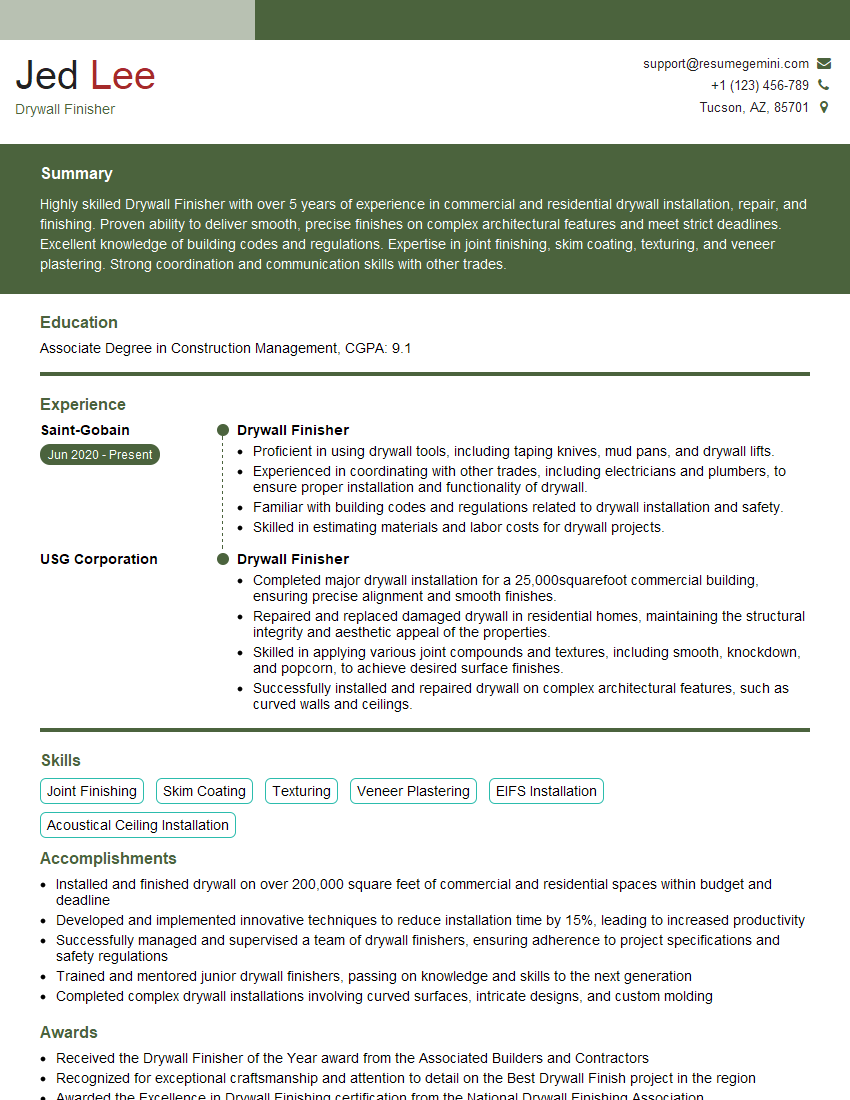
Mastering the application of joint compound and tape is crucial for career advancement in construction and related fields. It demonstrates practical skills and attention to detail, highly valued by employers. To significantly boost your job prospects, create a compelling, ATS-friendly resume that highlights your abilities. ResumeGemini is a trusted resource to help you build a professional resume that showcases your skills effectively. Examples of resumes tailored to the Application of Joint Compound and Tape are available to help guide you.
Explore more articles
Users Rating of Our Blogs
Share Your Experience
We value your feedback! Please rate our content and share your thoughts (optional).
What Readers Say About Our Blog
To the interviewgemini.com Webmaster.
Very helpful and content specific questions to help prepare me for my interview!
Thank you
To the interviewgemini.com Webmaster.
This was kind of a unique content I found around the specialized skills. Very helpful questions and good detailed answers.
Very Helpful blog, thank you Interviewgemini team.