Feeling uncertain about what to expect in your upcoming interview? We’ve got you covered! This blog highlights the most important Built and repaired forms interview questions and provides actionable advice to help you stand out as the ideal candidate. Let’s pave the way for your success.
Questions Asked in Built and repaired forms Interview
Q 1. Explain your experience with different form building technologies (e.g., HTML, JavaScript, specific form builders).
My experience with form building technologies spans a wide range, from foundational HTML and JavaScript to sophisticated form builders. I’m proficient in crafting forms using pure HTML, leveraging its semantic elements like <form>, <input>, <select>, and <textarea> for maximum browser compatibility and fine-grained control. I also extensively use JavaScript to add dynamic behavior, validation, and asynchronous operations. For instance, I’ve used JavaScript to implement real-time feedback on form fields, preventing submission if critical data is missing or invalid. Beyond this, I’ve worked with various form builders like JotForm, Typeform, and Gravity Forms, understanding their strengths and limitations in different contexts. For example, while form builders offer a rapid prototyping approach, custom HTML and JavaScript provide greater flexibility and control for complex interactions and integrations.
Specifically, I’ve built forms for diverse purposes, from simple contact forms to complex multi-step registration processes with conditional logic and payment gateways. My choice of technology depends heavily on the project’s complexity, the required integration with other systems, and the overall performance needs.
Q 2. Describe your process for debugging and repairing broken forms.
My debugging process for broken forms is systematic and follows a tiered approach. First, I examine the browser’s developer console for JavaScript errors, network requests, and warnings. These often provide immediate clues to the problem’s location. For example, a common issue is a missing or incorrect API endpoint for form submission, resulting in a network error. Next, I use the browser’s developer tools to inspect the form’s HTML and CSS, ensuring the structure is correct and that styles aren’t interfering with form elements’ functionality. If the issue stems from client-side JavaScript, I’ll employ debugging techniques like setting breakpoints and stepping through the code to identify the faulty logic.
If the problem is on the server-side, I’ll consult server logs and error reports. I’m comfortable using various debugging tools, depending on the server-side technology involved. For instance, I’ve used logging frameworks to track data flow and identify where errors occur in server-side form processing. Finally, I thoroughly test the repaired form across different browsers and devices to ensure consistent functionality and responsiveness.
Q 3. How do you ensure form data integrity and security?
Ensuring form data integrity and security is paramount. For data integrity, I implement robust client-side validation using JavaScript to catch errors before submission. This includes checks for required fields, data type validation (e.g., ensuring email addresses are correctly formatted), and range restrictions. On the server-side, I perform further validation to prevent malicious or improperly formatted data from reaching the database. This is crucial because client-side validation can be bypassed. Input sanitization is another key aspect; I always sanitize all user inputs to prevent injection attacks (like SQL injection or cross-site scripting).
For security, I employ HTTPS to encrypt data transmitted between the client and server. I also implement measures to prevent cross-site request forgery (CSRF) attacks by using CSRF tokens. Sensitive data like passwords are always hashed using strong, one-way hashing algorithms before storage, ensuring that even if the database were compromised, the passwords wouldn’t be easily retrievable. Furthermore, I adhere to best practices for data privacy and comply with relevant regulations (e.g., GDPR).
Q 4. What are your preferred methods for testing form functionality and usability?
My preferred methods for testing form functionality and usability involve a multi-pronged approach. I start with unit testing individual form components using JavaScript testing frameworks like Jest or Mocha. These tests ensure that each part of the form functions correctly in isolation. Then, I move on to integration testing, verifying that all components work together seamlessly. This often includes automated tests to simulate user interactions and check for proper data handling.
Usability testing involves user feedback. I conduct user testing sessions with representative users to observe their interactions with the form and identify any usability issues, such as unclear instructions or confusing layouts. The results from these tests inform iterative improvements to the form’s design and functionality, ensuring a positive user experience.
Q 5. How do you handle complex form logic and conditional fields?
Handling complex form logic and conditional fields involves careful planning and the strategic use of JavaScript. I often use a combination of JavaScript’s conditional statements (if, else if, else) and event listeners to dynamically show and hide fields based on user selections. For example, if a user selects a specific option from a dropdown menu, I might use JavaScript to display additional fields relevant to that option while hiding others. This ensures a streamlined and user-friendly experience.
For more intricate logic, I sometimes employ JavaScript frameworks like React or Vue.js, which facilitate the management of complex state and UI updates. These frameworks offer component-based architectures, making it easier to build and maintain large and complex forms.
Q 6. Explain your experience with integrating forms with databases and APIs.
I have significant experience integrating forms with databases and APIs. My approach typically involves using server-side technologies like Node.js, Python (with frameworks like Django or Flask), or PHP. I interact with databases (such as MySQL, PostgreSQL, or MongoDB) using database drivers or ORMs (Object-Relational Mappers). The form data is submitted to the server, where it’s validated, sanitized, and then inserted or updated in the database. APIs are used to integrate with external services, such as payment gateways, email services, or CRM systems. I use RESTful API principles to ensure proper data exchange between the form and these external services.
For example, I’ve integrated forms with payment gateways like Stripe or PayPal to process online payments, and with email services like SendGrid or Mailchimp to send automated email notifications. The choice of specific technology depends on the project’s requirements and the technologies already in use within the overall system.
Q 7. Describe a time you had to troubleshoot a particularly challenging form issue.
One particularly challenging form issue I encountered involved a complex multi-step form with extensive conditional logic and asynchronous API calls. The issue manifested as intermittent form submission failures, without any clear error messages. The problem was initially difficult to diagnose due to the asynchronous nature of the API calls and the intricate conditional logic.
My troubleshooting involved meticulous logging of all API requests and responses, as well as using the browser’s network tools to meticulously inspect the flow of data. After carefully examining the logs and network traffic over several hours, I discovered a subtle race condition: one API call occasionally completed before another, leading to data inconsistency and causing the submission failure. The solution involved implementing proper asynchronous programming techniques, including promises and async/await, ensuring the proper sequencing of API calls. This resulted in a robust and reliable form that consistently submitted data correctly.
Q 8. What are some common form design best practices you follow?
Form design is crucial for user experience. My approach focuses on clarity, efficiency, and accessibility. I prioritize a user-centered design, starting with thorough user research to understand their needs and expectations.
- Clear and Concise Labeling: Every field should have a clear and concise label explaining its purpose. Avoid jargon and use plain language. For example, instead of “DOB,” use “Date of Birth.”
- Logical Flow and Grouping: Fields should be grouped logically and presented in a natural order, mirroring the user’s thought process. Related fields should be clustered together visually.
- Progressive Disclosure: Avoid overwhelming users with too many fields at once. Use progressive disclosure to reveal fields only when necessary, improving the initial impression.
- Visual Hierarchy: Use visual cues like size, color, and spacing to guide users’ eyes and highlight important information. This improves scannability and reduces cognitive load.
- Consistent Design: Maintain consistency in styling, labeling, and input types throughout the form. This helps users understand the form’s structure and easily navigate it.
For example, in a user registration form, I would group personal information (name, address) separately from login credentials (username, password) to make the form less daunting and easier to complete.
Q 9. How do you prioritize bug fixes in a form development project?
Prioritizing bug fixes involves a blend of severity, impact, and frequency. I typically use a system that combines urgency and importance, often visualized using a matrix.
- Severity: This assesses the impact of the bug on the user experience (e.g., critical error preventing form submission, minor visual glitch).
- Impact: This considers the number of users affected and the potential consequences (e.g., data loss, security vulnerability).
- Frequency: How often does this bug occur? A frequent minor bug might take precedence over a rare, but critical one.
I employ a ticketing system (like Jira or Trello) to track and manage bugs, assigning priority levels based on this assessment. Critical bugs that block functionality or compromise security are addressed immediately. Less severe bugs are prioritized based on their impact and frequency, often considering a balance between immediate fixes and planned updates.
Imagine a form with a bug that prevents users from submitting data – this is a critical, high-priority fix. A minor visual misalignment might be less urgent, placed in a later sprint.
Q 10. Explain your familiarity with different form validation techniques.
I’m proficient in a variety of form validation techniques, both client-side (using JavaScript) and server-side (using server-side languages).
- Client-Side Validation: This provides immediate feedback to the user, preventing submission of invalid data. JavaScript is typically used, often with libraries like jQuery Validate, to check for data types, required fields, and length restrictions.
//Example JavaScript validation: if (document.getElementById('email').value == '') { alert('Please enter your email'); return false; } - Server-Side Validation: This is crucial as a security measure, as client-side validation can be easily bypassed. Server-side code validates all data again before processing. This ensures data integrity and prevents malicious input.
- Regular Expressions: I use regular expressions (regex) to validate complex patterns like email addresses, phone numbers, and postal codes. Regex offers flexible and powerful validation capabilities.
A robust validation strategy uses both client-side and server-side validation, offering a layered approach. Client-side validation enhances the user experience by providing quick feedback, while server-side validation ensures data security and integrity.
Q 11. How do you ensure forms are accessible to users with disabilities?
Accessibility is paramount. I adhere to WCAG (Web Content Accessibility Guidelines) to ensure forms are usable by people with disabilities.
- Semantic HTML: Using appropriate HTML elements (e.g.,
for labels,for email fields) enhances accessibility for screen readers. - ARIA Attributes: These provide additional information to assistive technologies, improving understanding of form elements. For example,
aria-required="true"indicates a required field. - Keyboard Navigation: Forms must be fully navigable using only the keyboard. Proper tab order and focus management are essential.
- Sufficient Color Contrast: Adequate color contrast between text and background ensures readability for users with low vision.
- Alternative Text for Images: Images used in forms require descriptive alternative text to convey information to screen readers.
For instance, I’d ensure that all form elements have clear labels, and that error messages are clearly communicated to users with screen readers.
Q 12. What are your experience with responsive form design?
Responsive form design adapts forms to various screen sizes and devices (desktops, tablets, smartphones). This is achieved using flexible layouts, often employing CSS media queries.
- Fluid Layouts: Using percentages instead of fixed pixel widths for form elements allows them to resize gracefully on different screens.
- Flexible Grids: Grid systems (like Bootstrap or Flexbox) provide a structured way to arrange form elements responsively.
- Mobile-First Approach: Designing for smaller screens first ensures that the form is functional and usable on mobile devices, then scaling up to larger screens.
- Testing on Different Devices: Thorough testing on various devices and browsers is crucial to ensure a consistent user experience.
In practice, I often use media queries to adjust form layouts. For instance, I might stack form fields vertically on smaller screens, while arranging them horizontally on larger screens to optimize space.
Q 13. How do you optimize forms for performance and speed?
Optimizing forms for performance and speed involves minimizing HTTP requests and optimizing the code for efficiency.
- Minification and Compression: Reducing the size of CSS and JavaScript files improves load times.
- Caching: Leveraging browser caching for static assets (images, CSS, JavaScript) reduces server load and speeds up page loading.
- Lazy Loading: Loading images and other assets only when they are needed (visible in the viewport) improves initial load time.
- Efficient JavaScript: Writing efficient JavaScript code and avoiding unnecessary DOM manipulations can significantly improve performance.
- Server-Side Optimization: Ensuring the server is properly configured and optimized to handle form submissions efficiently is also crucial.
For example, I would minimize the number of external JavaScript libraries used and optimize image sizes to reduce page load time and improve user experience.
Q 14. Explain your understanding of different form submission methods (e.g., POST, GET).
Form submission methods, POST and GET, determine how data is sent from the client to the server.
- GET: Data is appended to the URL as query parameters. It’s suitable for simple forms and retrieving data. GET requests are visible in the browser’s address bar, limiting their use for sensitive information.
- POST: Data is sent in the request body, hidden from the user. It’s ideal for submitting sensitive data (like passwords) and larger amounts of information. POST requests are more secure than GET requests.
The choice depends on the context. A simple search form might use GET, while a user registration form (containing passwords) should always use POST for security reasons.
Q 15. How do you handle user input validation to prevent errors?
Robust user input validation is paramount to prevent errors and ensure data integrity. It’s like building a strong foundation for your house – you wouldn’t start construction without a solid base. I employ a multi-layered approach, starting with client-side validation using JavaScript to provide immediate feedback to the user. This prevents unnecessary server requests for invalid data. For example, I might use JavaScript to check if an email field contains a valid ‘@’ symbol and a top-level domain. However, client-side validation alone isn’t sufficient; server-side validation is crucial to ensure data security and integrity. Server-side validation uses the server-side language (like Python, PHP, or Node.js) to re-check all input before it’s processed or stored in the database. This prevents malicious users from bypassing client-side checks. A common strategy is to use regular expressions to enforce specific input formats (e.g., ensuring phone numbers adhere to a particular pattern). Furthermore, data type validation confirms that inputs match the expected type (integer, string, date, etc.). Finally, I often incorporate database constraints to prevent invalid data from being stored, acting as a last line of defense. Imagine it as having multiple security systems in place, creating a highly reliable process.
Career Expert Tips:
- Ace those interviews! Prepare effectively by reviewing the Top 50 Most Common Interview Questions on ResumeGemini.
- Navigate your job search with confidence! Explore a wide range of Career Tips on ResumeGemini. Learn about common challenges and recommendations to overcome them.
- Craft the perfect resume! Master the Art of Resume Writing with ResumeGemini’s guide. Showcase your unique qualifications and achievements effectively.
- Don’t miss out on holiday savings! Build your dream resume with ResumeGemini’s ATS optimized templates.
Q 16. Describe your experience with form automation and workflow integration.
My experience with form automation and workflow integration spans several projects. In one instance, I automated a complex customer onboarding process using a combination of form builder tools and workflow automation software. The forms collected essential client data, which was then automatically routed to different departments based on pre-defined rules. For example, new customer applications went to the sales team, while billing inquiries were directed to the finance department. This significantly reduced manual processing, leading to faster turnaround times and improved efficiency. I’ve also integrated forms with CRM systems (like Salesforce or HubSpot), allowing data collected from forms to be directly populated into customer profiles. This eliminates duplicate data entry and ensures data consistency across different systems. Another project involved integrating forms with payment gateways to process online transactions seamlessly. The automation here included automated email confirmations and receipt generation. Choosing the right tools depends on the specific requirements of the project, but generally, I work with form builders that provide APIs and have integrations with popular workflow automation platforms and CRMs.
Q 17. What tools and technologies do you use for version control in form development?
Version control is essential for collaborative form development and ensuring a smooth process. I primarily use Git for version control, employing a branching strategy to manage different features and bug fixes concurrently. Each feature or bug fix gets its branch, and once thoroughly tested, it’s merged into the main branch. This allows for parallel development without affecting the stability of the main codebase. For example, we might have a `feature/new-payment-gateway` branch to implement a new payment integration without interfering with the ongoing development of other form features. We also make use of a collaborative platform like GitHub or GitLab, facilitating code reviews and simplifying the merge process. This allows for multiple team members to work on a project concurrently without stepping on each other’s toes. The platform provides a history of all changes, allowing easy rollbacks if necessary. Tools like GitHub or GitLab also allow for efficient bug tracking, helping us maintain a clean and manageable codebase across different versions of the forms.
Q 18. How do you manage and maintain large or complex form systems?
Managing large or complex form systems requires a structured approach. It’s like managing a large city – you need efficient systems to prevent chaos. I utilize modular design principles to break down large forms into smaller, manageable components. This improves maintainability and makes it easier to identify and fix issues. I also use a component-based architecture, where reusable form elements are created and stored in a central repository. This promotes consistency and reduces redundancy. Think of it as having pre-fabricated building blocks that you can easily assemble to construct complex forms. Database design is also critical; well-structured databases prevent data redundancy and improve query performance. Regular database maintenance and optimization are essential. Finally, comprehensive documentation is key, detailing the structure and functionality of the form system. This ensures everyone understands how it works, facilitating future maintenance and updates. Using automated testing also ensures the system continues to function as intended even after updates or changes. The combination of these strategies makes managing and maintaining large or complex forms significantly more manageable.
Q 19. Describe your experience with different form field types and their applications.
My experience encompasses a wide range of form field types, each with specific applications. Simple text fields are fundamental, used for collecting names, addresses, or any free-form text. Number fields ensure numeric input, while date pickers provide convenient date selection. Dropdown lists offer pre-defined options, improving user experience and data consistency, e.g., for selecting a country or state. Checkboxes allow multiple selections, while radio buttons restrict users to a single choice. Text areas allow for longer input, perfect for comments or descriptions. File upload fields enable users to submit documents, while rich text editors allow users to format text using bold, italics, headings, etc. Specialized fields like credit card input fields with security features also fall into this category. The choice of field type depends on the specific needs of the form and the type of data being collected. The right field type enhances user experience and data quality.
Q 20. How do you handle form errors and provide useful feedback to the user?
Handling form errors effectively and providing useful feedback to the user is crucial. Poor error handling leads to frustration and a negative user experience. I focus on providing clear and concise error messages that explain precisely what went wrong. For example, instead of a generic “Invalid input,” a better message would be “Please enter a valid email address.” Error messages should be displayed prominently near the offending field and use a consistent style. I also use visual cues, like highlighting error fields with red borders, to guide users’ attention. Client-side validation prevents errors from happening in the first place. However, thorough server-side validation, as explained earlier, is essential for security and handling edge cases. If a serious error occurs during submission (e.g., database error), I provide a user-friendly message, perhaps offering a contact email or suggesting the user try again later. A well-designed error handling system prevents frustration and ensures users can complete forms successfully.
Q 21. Explain your experience with A/B testing forms to improve conversion rates.
A/B testing forms is a powerful technique for optimizing conversion rates. It’s like experimenting with different recipes to find the one that yields the best results. I use A/B testing to compare different versions of forms to see which performs better in terms of completion rates, submission rates, and overall user experience. For example, I might test two versions of a form: one with a shorter form length and the other with a longer version containing additional questions. By tracking key metrics like form abandonment rates and completion times, we can determine which design leads to higher conversions. We can also A/B test different call-to-action buttons, form layouts, or even field ordering to determine the most effective approach. Tools like Google Optimize or other A/B testing platforms allow for controlled experiments and statistical analysis to ensure results are reliable and not just random variations. The insights gained from A/B testing inform design decisions, ensuring forms are as effective as possible at achieving their objectives.
Q 22. How do you ensure the security of sensitive data collected through forms?
Securing sensitive data collected through forms is paramount. It involves a multi-layered approach encompassing technical safeguards, robust processes, and adherence to relevant regulations like GDPR and CCPA.
- HTTPS Encryption: All forms should be served over HTTPS, encrypting data in transit between the user’s browser and the server. This prevents eavesdropping on sensitive information.
- Input Validation: Strictly validate all user inputs on the server-side to prevent injection attacks (like SQL injection or cross-site scripting). This involves checking data types, lengths, and formats, and sanitizing inputs before using them in database queries or displaying them on the page.
- Secure Storage: Store collected data in encrypted databases, using strong passwords and encryption keys. Regularly back up this data and implement access control measures to restrict access to authorized personnel only.
- Data Minimization: Only collect the data absolutely necessary. The less data you store, the less you have to secure.
- Regular Security Audits: Conduct regular security assessments to identify and address vulnerabilities. This can involve penetration testing or vulnerability scanning.
For example, imagine an online application form for a loan. Without HTTPS, an attacker could intercept the application data, including the applicant’s financial information. Proper input validation would prevent a user from injecting malicious code into the form fields.
Q 23. Explain your experience with different form analytics platforms.
My experience spans several form analytics platforms, each offering unique strengths. I’ve worked extensively with Google Analytics, which provides comprehensive data on form submissions, including completion rates, drop-off points, and user demographics. This allows for optimizing form design and identifying areas for improvement.
I’ve also used dedicated form analytics tools like Formstack and Typeform, which offer more granular insights into specific form interactions, such as individual field performance and user behavior within the form itself. These tools often integrate seamlessly with CRM systems, providing a holistic view of the customer journey.
For instance, using Google Analytics, I identified a high drop-off rate on a particular field in an e-commerce checkout form. After analyzing the data, I redesigned the field to be more user-friendly, leading to a significant improvement in conversion rates.
Q 24. How do you approach the design of user-friendly and intuitive forms?
Designing user-friendly forms involves a human-centered approach, focusing on clarity, conciseness, and ease of use. This involves careful consideration of the user experience (UX).
- Clear Instructions: Provide unambiguous instructions to guide users through the process.
- Logical Flow: Arrange fields in a logical order that mirrors the user’s thought process.
- Appropriate Field Types: Use the most appropriate field types (e.g., dropdown menus for choices, date pickers for dates) to improve usability.
- Progressive Disclosure: Break down complex forms into smaller, manageable sections to avoid overwhelming the user.
- Visual Hierarchy: Use visual cues like headings, subheadings, and white space to improve readability and guide the user’s eye.
- Error Handling: Provide clear and helpful error messages if a user makes a mistake.
For example, instead of a single, lengthy text field for an address, using separate fields for street address, city, state, and zip code makes the form much easier to fill out. Similarly, using clear labels and providing real-time validation can prevent common errors and frustration.
Q 25. Describe your experience with deploying and maintaining forms in different environments.
I have extensive experience deploying and maintaining forms in various environments, from simple static HTML forms to complex, dynamic forms integrated with backend systems. This includes experience with different hosting platforms and technologies.
- Cloud Hosting: I’ve deployed forms on cloud platforms like AWS, Azure, and Google Cloud, leveraging their scalability and reliability to handle varying levels of traffic.
- On-Premise Deployment: I’ve also deployed forms on on-premise servers, requiring more hands-on management of the infrastructure.
- Content Management Systems (CMS): I’m proficient in integrating forms into various CMS platforms like WordPress, Drupal, and others, utilizing their built-in form features or custom plugins.
- Version Control: I always use version control systems (like Git) to track changes, ensuring easy rollback capabilities and collaborative development.
For instance, when deploying forms to a high-traffic e-commerce website, a cloud-based solution offers the necessary scalability to handle peak demand. Regular monitoring and maintenance ensure optimal performance and prevent downtime.
Q 26. How familiar are you with form security best practices and common vulnerabilities?
I am intimately familiar with form security best practices and common vulnerabilities. My expertise includes understanding and mitigating risks associated with:
- Cross-Site Scripting (XSS): Preventing malicious scripts from being injected into forms and executed on the client-side.
- SQL Injection: Preventing attackers from manipulating database queries through form inputs.
- Cross-Site Request Forgery (CSRF): Protecting against unauthorized actions performed on behalf of a logged-in user.
- Session Hijacking: Implementing secure session management to prevent unauthorized access to user accounts.
- Data Breaches: Implementing robust data encryption and access control measures.
I employ a defense-in-depth strategy, combining various security measures to minimize vulnerabilities. Regular security audits and penetration testing are crucial aspects of maintaining a secure form environment.
Q 27. What are your experiences with integrating forms with CRM or other enterprise systems?
Integrating forms with CRM and enterprise systems is a key aspect of my work. I’ve successfully integrated forms with various CRMs, including Salesforce, HubSpot, and Zoho, using their APIs or custom integrations.
This integration allows for automatic data transfer from forms directly into the CRM, eliminating manual data entry and improving data accuracy. For instance, a lead generation form on a company website can automatically create new leads in Salesforce, complete with contact details and other relevant information. This seamless data flow streamlines business processes and improves efficiency.
I’ve also worked with other enterprise systems, such as ERP and marketing automation platforms, using similar integration techniques. The specific methods depend on the systems involved, but typically involve APIs, webhooks, or ETL processes.
Q 28. How do you handle large volumes of form submissions and maintain system performance?
Handling large volumes of form submissions requires a robust and scalable infrastructure. My approach involves several strategies:
- Database Optimization: Employing efficient database design and query optimization techniques to ensure fast data retrieval and processing.
- Load Balancing: Distributing the workload across multiple servers to prevent overload and maintain performance.
- Caching: Caching frequently accessed data to reduce database load.
- Asynchronous Processing: Processing form submissions asynchronously using message queues or background processes to prevent blocking the main application thread.
- Scalable Infrastructure: Using cloud-based solutions that can easily scale up or down based on demand.
For example, a high-volume online survey might receive thousands of submissions within a short period. By using a combination of asynchronous processing and a scalable database, we can ensure that all submissions are processed efficiently without impacting system performance or user experience.
Key Topics to Learn for Built and Repaired Forms Interview
- Form Design Principles: Understanding user experience (UX) and user interface (UI) best practices for creating intuitive and efficient forms. Consider accessibility standards and responsive design.
- Data Validation Techniques: Implementing client-side and server-side validation to ensure data integrity and prevent errors. Explore different validation methods and their trade-offs.
- Database Integration: Connecting forms to databases for data storage and retrieval. Understanding different database technologies and their interaction with forms is crucial.
- Form Security Best Practices: Protecting against common vulnerabilities like SQL injection and cross-site scripting (XSS) attacks. Learn about secure coding practices and input sanitization.
- Form Submission and Handling: Efficiently managing form submissions, handling errors gracefully, and providing user feedback. Explore different submission methods (e.g., AJAX, traditional POST).
- Troubleshooting and Debugging: Identifying and resolving common issues related to form functionality, data validation, and database interactions. Developing effective debugging strategies is essential.
- Specific Technologies and Frameworks: Familiarity with relevant technologies and frameworks used in building and repairing forms (e.g., specific form builders, JavaScript libraries, backend languages).
- Testing and Quality Assurance: Understanding the importance of thorough testing to ensure form functionality, usability, and security. Explore different testing methodologies.
- Maintenance and Updates: Strategies for maintaining and updating forms over time, addressing bug fixes, and adapting to changing requirements.
Next Steps
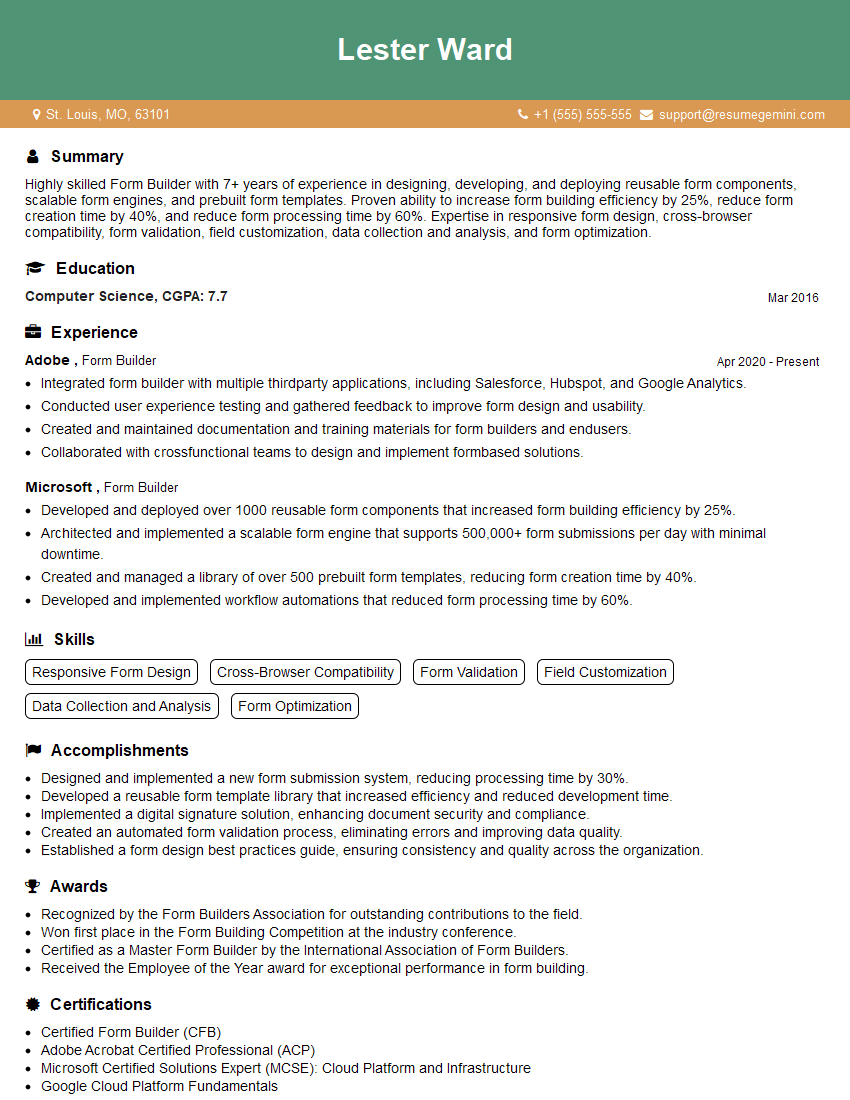
Mastering the skills related to building and repairing forms is crucial for career advancement in many technical fields. A strong understanding of these concepts demonstrates valuable problem-solving abilities and attention to detail, highly sought after by employers. To significantly enhance your job prospects, focus on crafting an ATS-friendly resume that clearly highlights your relevant skills and experience. ResumeGemini is a trusted resource that can help you build a professional and impactful resume. Examples of resumes tailored to the Built and Repaired Forms field are available to help you get started.
Explore more articles
Users Rating of Our Blogs
Share Your Experience
We value your feedback! Please rate our content and share your thoughts (optional).
What Readers Say About Our Blog
To the interviewgemini.com Webmaster.
Very helpful and content specific questions to help prepare me for my interview!
Thank you
To the interviewgemini.com Webmaster.
This was kind of a unique content I found around the specialized skills. Very helpful questions and good detailed answers.
Very Helpful blog, thank you Interviewgemini team.