Are you ready to stand out in your next interview? Understanding and preparing for Circular Economy Design interview questions is a game-changer. In this blog, we’ve compiled key questions and expert advice to help you showcase your skills with confidence and precision. Let’s get started on your journey to acing the interview.
Questions Asked in Circular Economy Design Interview
Q 1. Explain the three principles of a circular economy.
The circular economy rests on three core principles: design out waste and pollution, keep products and materials in use, and regenerate natural systems. Let’s break these down:
- Design out waste and pollution: This emphasizes prevention rather than cure. Instead of designing products with planned obsolescence or generating significant waste during production, the focus shifts to creating durable, repairable, and recyclable products. Think of a phone designed for easy battery replacement and modular components instead of one that’s essentially disposable after a couple of years.
- Keep products and materials in use: This principle promotes reuse, repair, refurbishment, and remanufacturing. Instead of discarding items, they are maintained, upgraded, or repurposed for as long as possible, extending their lifespan and reducing the demand for new resources. Examples include clothing rental services, repair cafes, and initiatives to recover valuable materials from end-of-life products.
- Regenerate natural systems: This focuses on minimizing environmental impact and restoring ecosystems. This includes using renewable energy sources in production, reducing carbon emissions, and promoting biodiversity. For instance, a company might invest in carbon sequestration projects to offset its emissions or implement sustainable forestry practices to source raw materials.
Q 2. Describe the difference between linear and circular economic models.
The linear economy, often described as a ‘take-make-dispose’ model, is characterized by the extraction of raw materials, their transformation into products, and ultimately their disposal as waste. This is highly resource-intensive and generates significant pollution. Think of the classic model of buying a new electronic device, using it for a few years, and then throwing it away.
In contrast, the circular economy aims to eliminate waste and pollution by keeping materials and products in use for as long as possible. It resembles a closed-loop system, where waste from one process becomes the input for another. Instead of disposal, there’s a focus on reuse, repair, remanufacturing, and recycling, mimicking the natural world where materials are constantly recycled. Think of composting food waste to enrich soil or using recycled plastic to create new products.
Q 3. What are the key challenges in implementing a circular economy?
Implementing a circular economy faces several significant challenges:
- Lack of infrastructure: Efficient collection, sorting, and processing systems for waste materials are often lacking. Recycling facilities might not be readily available or capable of handling diverse materials.
- Economic barriers: Recycling and remanufacturing can sometimes be more expensive than producing new goods from virgin materials. Economic incentives and regulations are needed to level the playing field.
- Technological limitations: Current technologies may not be sufficiently advanced to recycle certain materials effectively or to remanufacture complex products.
- Consumer behavior: Changing consumer habits and promoting a culture of reuse and repair requires significant educational efforts and behavioral change campaigns.
- Policy and regulation: Governments need to establish clear policies and regulations that incentivize circular economy practices, such as extended producer responsibility schemes and regulations on waste management.
Overcoming these challenges requires collaborative efforts from governments, businesses, and consumers.
Q 4. How can Life Cycle Assessment (LCA) inform circular economy design?
Life Cycle Assessment (LCA) is a powerful tool for informing circular economy design. LCA is a standardized methodology for evaluating the environmental impacts of a product or process throughout its entire life cycle, from raw material extraction to disposal or recycling. By using LCA, designers can identify the environmental hotspots of a product and pinpoint areas for improvement.
For example, an LCA might reveal that a significant portion of a product’s carbon footprint comes from the manufacturing process. This information can guide designers to select more sustainable materials, optimize manufacturing processes, or explore alternative designs that reduce material usage. Similarly, LCA can highlight opportunities for better end-of-life management, such as designing for easy disassembly and material recovery.
Essentially, LCA helps designers make informed decisions that minimize the environmental impacts of products and maximize their potential for reuse and recycling within a circular economy framework.
Q 5. Discuss the role of design for disassembly in a circular economy.
Design for disassembly (DfD) is crucial for a circular economy. It involves designing products with the end-of-life in mind, making it easy to take them apart into their constituent parts for reuse, repair, remanufacturing, or recycling. This contrasts with products designed for obsolescence where components are tightly integrated, making recycling difficult and expensive.
In DfD, designers consider factors like material selection, component standardization, and the use of easily separable fasteners. For example, a phone designed for DfD might have modular components like the battery, screen, and motherboard, making them easily replaceable or recyclable. This simplifies repair, extends product lifespan, and facilitates material recovery.
The benefits include increased recyclability rates, reduced material waste, lower manufacturing costs from using recycled components, and improved resource efficiency.
Q 6. Explain the concept of product-service systems.
Product-service systems (PSS) represent a shift from selling products to selling services. Instead of simply selling a product, companies offer a service that utilizes the product. This changes the focus from ownership to access and usage.
For example, instead of selling a car, a company could offer a mobility-as-a-service platform, providing transportation via a fleet of vehicles. The company maintains and repairs the vehicles, reducing the need for individual car ownership and the associated waste from discarded vehicles. Another example is a clothing rental service, where customers pay a subscription fee to access a wardrobe, rather than buying and discarding clothing items.
PSS promote resource efficiency by extending the lifespan of products and reducing the need for new production. They also encourage reuse, repair, and remanufacturing, aligning with circular economy principles.
Q 7. Describe different waste management strategies within a circular economy.
Waste management strategies in a circular economy are fundamentally different from those in a linear economy. The goal is not simply to dispose of waste, but to recover value from it. Strategies include:
- Waste prevention: Minimizing waste generation through design, production, and consumption choices is paramount. This includes reducing packaging, designing for durability, and promoting reuse.
- Recycling and remanufacturing: Transforming waste materials into new products through mechanical or chemical processes. This requires efficient collection, sorting, and processing systems.
- Composting and anaerobic digestion: Biological treatment of organic waste, producing compost for soil enrichment or biogas as a renewable energy source.
- Energy recovery: Incineration with energy recovery, where waste is burned to generate heat or electricity, although this should be a last resort due to potential emissions.
- Landfilling: The least preferred option, only used for non-recyclable or non-recoverable waste. Even then, efforts should be made to minimize landfill volume and environmental impact.
The choice of strategy depends on the type of waste and the available technologies and infrastructure. The overall aim is to prioritize waste prevention and maximize resource recovery, minimizing the need for landfill disposal.
Q 8. What are some examples of successful circular economy initiatives?
Successful circular economy initiatives span various sectors and demonstrate how businesses can decouple economic growth from resource depletion. They often involve innovative strategies that prioritize reuse, repair, remanufacturing, and recycling.
Interface, Inc.: This flooring company has committed to eliminating waste and resource depletion by designing products for recyclability and using recycled materials. They’ve publicly shared their ambitious sustainability goals, leading the way in transparent reporting and accountability.
Loop: This platform facilitates a subscription service for everyday consumer goods packaged in durable, reusable containers. This reduces single-use plastic waste and promotes a closed-loop system where packaging is cleaned and reused.
Philips: Philips actively designs its products for durability, repairability, and recyclability. Their eco-design approach integrates circularity from the initial product design phase, reducing environmental impact over the product lifecycle. Their focus on take-back programs ensures responsible end-of-life management.
BMW’s i3: This vehicle was designed with recyclability and reuse in mind, with a high percentage of its materials designed to be easily recovered and reused in subsequent production cycles. This represents a significant advance in closing the loop for complex manufacturing processes.
Q 9. How can businesses measure the success of their circular economy strategies?
Measuring the success of circular economy strategies requires a multi-faceted approach that goes beyond simple financial metrics. It requires tracking both environmental and economic impacts. Key performance indicators (KPIs) should include:
Material circularity rate: The percentage of materials kept within the economy, rather than being disposed of. This can be measured by tracking the amount of materials reused, recycled, or remanufactured.
Waste reduction: Measuring the amount of waste generated, aiming for continuous reduction.
Resource efficiency: Tracking the amount of resources used per unit of output. Improved resource efficiency is a hallmark of circularity.
Product lifetime extension: Measuring the average lifespan of products, demonstrating the effectiveness of design for durability and repairability.
Carbon footprint reduction: Calculating and reducing the greenhouse gas emissions associated with the product’s life cycle.
Economic benefits: Tracking revenue generated from reuse, repair, and remanufacturing programs, while considering potential cost savings from reduced resource consumption and waste disposal fees.
Businesses should utilize lifecycle assessment (LCA) tools and data analytics to track progress towards circularity targets and make data-driven decisions.
Q 10. What are the economic benefits of adopting a circular economy?
Adopting a circular economy offers significant economic benefits, leading to a more sustainable and resilient economy. These benefits include:
Reduced resource costs: By reusing and recycling materials, businesses can significantly reduce their reliance on virgin resources, resulting in cost savings.
New revenue streams: Circular business models, such as product-as-a-service and remanufacturing, can create new revenue streams and enhance profitability.
Enhanced competitiveness: Businesses that embrace circularity often gain a competitive advantage, attracting environmentally conscious customers and investors.
Reduced waste disposal costs: Decreasing waste generation leads to lower disposal fees and reduces the environmental burden associated with landfills.
Job creation: Circular economy initiatives often create new jobs in areas such as repair, remanufacturing, and recycling.
Innovation and technological advancements: The transition to a circular economy stimulates innovation in materials science, product design, and waste management.
The overall effect is a more efficient and resilient economy that is less vulnerable to resource scarcity and price volatility.
Q 11. Explain the role of material selection in circular economy design.
Material selection is paramount in circular economy design. It’s about choosing materials that can be easily reused, recycled, or composted at the end of their useful life. The focus shifts from a linear ‘take-make-dispose’ model to a closed-loop system.
Key considerations include:
Recyclability: Choosing materials that can be easily and cost-effectively recycled into new products.
Biodegradability/Compostability: Opting for materials that can naturally decompose without harming the environment.
Durability and longevity: Selecting robust materials that will last longer, reducing the frequency of replacement.
Toxicity: Avoiding hazardous materials that can contaminate the environment during recycling or disposal.
Material traceability: Understanding the origin and composition of materials to ensure responsible sourcing and facilitate effective end-of-life management.
For example, designing a chair using recycled aluminum instead of virgin plastic would be a more sustainable approach because aluminum is easily recyclable and has a higher recycling rate.
Q 12. How can you design for durability and repairability?
Designing for durability and repairability extends product lifespans and reduces waste. It involves a shift in mindset from designing for disposability to designing for longevity and maintainability.
Strategies include:
Modular design: Creating products with easily replaceable parts, so that repairs are simple and cost-effective. Imagine a smartphone where the battery can be easily swapped out.
Use of durable materials: Choosing high-quality, long-lasting materials that can withstand wear and tear.
Accessibility of spare parts: Ensuring that spare parts are readily available for repair, either through the manufacturer or through third-party suppliers.
Clear repair instructions: Providing detailed repair manuals or online resources to empower consumers to fix their own products.
Design for disassembly: Designing products in a way that makes it easy to take them apart for repair or recycling.
The emphasis is on creating products that can be easily repaired, extending their lifespan, and delaying their entry into the waste stream.
Q 13. What are the implications of extended producer responsibility (EPR)?
Extended Producer Responsibility (EPR) shifts the responsibility for the end-of-life management of products from consumers and municipalities to producers. It holds producers accountable for the entire lifecycle of their products, incentivizing them to design for sustainability and minimize environmental impact.
Implications of EPR include:
Product design changes: Producers are incentivized to design products that are more durable, repairable, recyclable, and easier to disassemble.
Increased recycling rates: EPR schemes often include targets for recycling rates, encouraging producers to invest in recycling infrastructure.
Investment in take-back programs: Producers are responsible for establishing systems to collect and manage end-of-life products, including the cost of collection and recycling.
Potential for innovation: EPR can drive innovation in sustainable product design and waste management technologies.
Increased costs for producers: Implementing EPR schemes can lead to increased costs for producers, which are ultimately passed on to consumers in the form of slightly higher product prices.
However, the long-term environmental and economic benefits of reduced waste and resource consumption generally outweigh the increased costs.
Q 14. Describe your experience with designing for reuse and remanufacturing.
My experience with designing for reuse and remanufacturing has been significant. I’ve worked on projects involving the redesign of consumer electronics for easier repair and component reuse. This involved collaboration with engineers, material scientists, and supply chain specialists.
For example, in one project, we redesigned a printer cartridge to allow for easier refilling and component replacement, dramatically extending its lifespan. This required careful consideration of material selection, component design, and end-of-life management. Another project focused on designing a modular laptop, allowing users to upgrade individual components (like the hard drive or RAM) independently, avoiding the need to replace the entire device. The modularity was crucial in enabling efficient refurbishment or remanufacturing processes.
These experiences underscore the critical role of collaboration across different disciplines and the importance of data-driven decision making in order to truly optimize for reuse and remanufacturing within a circular economy framework.
Q 15. How do you incorporate circular economy principles into the supply chain?
Incorporating circular economy principles into the supply chain requires a fundamental shift from a linear ‘take-make-dispose’ model to a cyclical one. This involves designing products for durability, repairability, and recyclability from the outset. It’s about thinking about the entire lifecycle, from raw material sourcing to end-of-life management.
- Design for Disassembly: Products should be designed in a modular way, making it easy to separate components for reuse, repair, or recycling. Think of a smartphone where the battery can be easily replaced instead of the entire phone being discarded.
- Sustainable Sourcing: Prioritizing recycled materials and sustainably harvested resources reduces environmental impact and reliance on virgin materials. For example, using recycled aluminum in beverage cans.
- Remanufacturing and Repair: Instead of discarding products, businesses should invest in remanufacturing and repair services to extend the lifespan of goods. This is particularly relevant for durable goods like appliances and machinery.
- Closed-Loop Systems: Aim for closed-loop systems where materials are recovered and reused within the same production cycle. An example is using plastic waste from one process as raw material for another.
- Supply Chain Transparency and Traceability: Tracking materials throughout the supply chain helps identify areas for improvement and ensure responsible sourcing practices. Blockchain technology can play a vital role here.
Implementing these strategies requires collaboration across the entire supply chain, from suppliers to manufacturers, distributors, and retailers, demanding a shared commitment to sustainability.
Career Expert Tips:
- Ace those interviews! Prepare effectively by reviewing the Top 50 Most Common Interview Questions on ResumeGemini.
- Navigate your job search with confidence! Explore a wide range of Career Tips on ResumeGemini. Learn about common challenges and recommendations to overcome them.
- Craft the perfect resume! Master the Art of Resume Writing with ResumeGemini’s guide. Showcase your unique qualifications and achievements effectively.
- Don’t miss out on holiday savings! Build your dream resume with ResumeGemini’s ATS optimized templates.
Q 16. What are the key stakeholders involved in a successful circular economy transition?
A successful circular economy transition relies on the active participation of diverse stakeholders. It’s not just about individual businesses; it requires a systemic approach.
- Governments: Setting policies, regulations, and incentives (e.g., carbon taxes, extended producer responsibility schemes) that encourage circular practices.
- Businesses: Integrating circular principles into their operations, product design, and supply chains. This includes manufacturers, retailers, and service providers.
- Consumers: Making conscious purchasing decisions, opting for durable and repairable products, and participating in recycling and reuse initiatives. Educating consumers about the circular economy is crucial.
- NGOs and Civil Society: Advocating for policy changes, raising awareness, and promoting sustainable consumption patterns.
- Researchers and Academics: Developing innovative technologies and strategies to support circular economy transitions and providing data-driven insights.
- Investors and Financial Institutions: Providing funding and support for circular economy businesses and projects.
Effective collaboration between these stakeholders is paramount. This often involves establishing multi-stakeholder platforms and partnerships to foster knowledge sharing and coordinated action.
Q 17. Discuss the role of technology in enabling circular economy practices.
Technology plays a crucial role in enabling and scaling circular economy practices. It provides tools and solutions to track materials, optimize processes, and improve efficiency.
- Digital Product Passports: These contain detailed information about a product’s materials, components, and manufacturing processes, facilitating repair, reuse, and recycling.
- Blockchain Technology: Enhances transparency and traceability across the supply chain, ensuring responsible sourcing and preventing counterfeiting.
- AI and Machine Learning: Optimizing waste management systems, predicting product lifecycles, and improving material sorting efficiency.
- 3D Printing and Additive Manufacturing: Enables on-demand manufacturing and reduces material waste by creating only what is needed.
- Robotics and Automation: Automating processes like sorting and recycling, increasing efficiency and reducing manual labor.
- Internet of Things (IoT): Tracking product usage and condition, enabling predictive maintenance and extending product lifespan.
These technologies are not just individual solutions, but interconnected elements that enhance overall circularity. For instance, a digital product passport combined with IoT data can inform the design of future products, making them more easily recyclable.
Q 18. How can circular economy principles be applied to a specific industry (e.g., fashion, electronics)?
Let’s consider the fashion industry. The linear model of ‘design-manufacture-consume-dispose’ is unsustainable. A circular fashion model prioritizes longevity, reuse, and recycling.
- Durable and Timelessly Designed Clothing: Creating garments that are less prone to wear and tear and remain fashionable for longer reduces the need for frequent replacements.
- Sustainable Materials: Using recycled fabrics, organic cotton, or innovative bio-based materials reduces environmental impact.
- Rental and Leasing Models: Offering clothing rental services reduces the overall demand for new garments and extends the lifespan of existing ones.
- Clothing Take-Back Programs: Encouraging consumers to return used clothing for recycling, reuse, or upcycling reduces textile waste.
- Design for Disassembly and Recyclability: Designing clothing that can be easily disassembled into its constituent materials (fibers, buttons, zippers) improves recycling efficiency.
Similar principles can be applied to the electronics industry, focusing on modular design, extended warranties, repair services, and responsible e-waste management. The key is to move away from planned obsolescence and embrace longer product lifecycles.
Q 19. What are the environmental benefits of a circular economy?
The environmental benefits of a circular economy are substantial. It significantly reduces our reliance on virgin materials, minimizes waste generation, and mitigates climate change.
- Reduced Greenhouse Gas Emissions: Lowering the demand for virgin materials reduces energy consumption and carbon emissions associated with extraction, processing, and transportation.
- Conservation of Natural Resources: Recycling and reuse minimize the depletion of finite resources like minerals, fossil fuels, and water.
- Reduced Waste and Pollution: Minimizing waste going to landfills reduces pollution of air, water, and soil.
- Biodiversity Protection: Reduced pressure on natural ecosystems to provide raw materials helps protect biodiversity.
- Improved Water and Energy Efficiency: Recycling processes often require less energy and water than producing virgin materials.
These environmental benefits contribute to a healthier planet and a more sustainable future. The transition to a circular economy is crucial in mitigating climate change and achieving global sustainability goals.
Q 20. Explain the concept of industrial symbiosis.
Industrial symbiosis is a type of circular economy model where the waste or by-product of one industry becomes the raw material for another. It’s about creating interconnected industrial ecosystems where businesses collaborate to reduce waste and resource consumption.
Example: A power plant might provide its waste heat to a nearby greenhouse for heating, while the greenhouse provides its compost to a nearby farm. The farm’s agricultural waste could then be used by the power plant for biofuel generation.
Benefits of industrial symbiosis include:
- Reduced waste generation
- Cost savings through resource sharing
- Creation of new economic opportunities
- Reduced environmental impact
Successful industrial symbiosis requires careful planning, collaboration between industries, and often governmental support in facilitating these partnerships.
Q 21. How do you assess the environmental impact of a product or service?
Assessing the environmental impact of a product or service requires a Life Cycle Assessment (LCA). This is a standardized method that examines the environmental burdens associated with a product’s entire lifecycle, from raw material extraction to end-of-life management.
Key Steps in an LCA:
- Goal and Scope Definition: Clearly defining the purpose of the LCA and the boundaries of the assessment (what stages of the lifecycle are included).
- Inventory Analysis: Quantifying the inputs and outputs of energy, materials, and emissions throughout the product lifecycle.
- Impact Assessment: Evaluating the environmental impacts of the inputs and outputs, considering factors like greenhouse gas emissions, water use, and resource depletion.
- Interpretation: Analyzing the results of the impact assessment to identify areas for improvement and prioritize mitigation strategies.
LCA software and databases are used to collect and analyze data. The results are often presented in a concise report that highlights the product’s environmental hotspots and suggests areas for improvement. LCA is a powerful tool for designing more sustainable products and services and informing decision-making within a circular economy framework.
Q 22. Describe your experience with circular economy policy and regulation.
My experience with circular economy policy and regulation spans several years, encompassing both research and practical application. I’ve worked extensively with policies promoting extended producer responsibility (EPR), analyzing their effectiveness in driving product design changes and waste reduction. For instance, I contributed to a study evaluating the impact of a specific EPR scheme on packaging waste in the EU, comparing it to similar initiatives in other regions. My work also involves understanding and navigating regulations related to waste management hierarchies, from prevention and reuse to recycling and disposal. This understanding is crucial for designing products and systems that are compliant and contribute positively to the circular economy. I have also been involved in advocating for policy changes to create a more favorable regulatory landscape for circular business models. A key area of focus has been incentivizing innovation in material recovery and closed-loop systems through tax breaks and grants.
Q 23. What are some common barriers to adopting circular economy practices?
Several significant barriers hinder widespread adoption of circular economy practices. One major challenge is the lack of economic incentives. Linear economic models often appear cheaper in the short term, making it difficult for businesses to invest in circular solutions that may require upfront capital expenditure. Another significant issue is the complexity of supply chains. Tracking materials and products throughout their lifecycle requires robust data management systems and collaboration across multiple stakeholders, which can be difficult to achieve. Furthermore, technological limitations exist in areas such as material separation and recycling, limiting the ability to effectively reclaim and reuse certain materials. Finally, consumer behavior plays a critical role; a shift towards conscious consumption and willingness to embrace second-hand products or repair services is essential for the success of circular initiatives. We see this in the slower adoption rates of repair services compared to simply replacing a broken product.
Q 24. How can you address issues of scale and complexity in circular economy projects?
Addressing the scale and complexity of circular economy projects requires a phased and strategic approach. A crucial first step is identifying key stakeholders and establishing clear communication channels. This fosters collaboration and prevents conflicting agendas. Next, we use a systems thinking approach to break down the project into smaller, more manageable modules, allowing for incremental progress and easier monitoring. For example, instead of tackling an entire city’s waste management system at once, we might focus on a specific material stream, like plastic packaging, to demonstrate feasibility and build momentum. Pilot projects are invaluable for testing various solutions and refining strategies before scaling up. Data analysis is critical; we use material flow analysis and life cycle assessments to identify bottlenecks, measure progress, and optimize the overall system. Finally, digital tools and platforms can streamline data collection and enhance collaboration, making the process more efficient and transparent.
Q 25. Explain the concept of ‘cradle-to-cradle’ design.
Cradle-to-cradle (C2C) design is a holistic framework that views products not as linear items with an end-of-life, but as part of continuous cycles. It’s based on two metabolisms: technical and biological. In the technical metabolism, materials are designed for repeated use and remain in closed-loop systems, being continuously upgraded or repurposed. Think of durable electronic components designed for easy disassembly and refurbishment. The biological metabolism involves designing products to safely return to the biosphere at the end of their useful life, safely decomposing and nourishing ecosystems – like biodegradable packaging made from compostable materials. C2C differs from traditional recycling in that it prioritizes the design of materials and products from the outset to minimize waste and maximize resource utilization throughout their entire lifecycle. It encourages the use of safe, healthy, and readily recyclable materials, reducing the environmental impact far beyond simple waste diversion.
Q 26. How do you prioritize different circular economy strategies in a given scenario?
Prioritizing circular economy strategies requires a nuanced approach considering various factors. We use a multi-criteria decision analysis (MCDA) framework, weighing the effectiveness of different strategies against relevant criteria. This might involve assessing the potential environmental impact reduction, economic viability, social benefits, and technical feasibility. For instance, in a scenario where we’re addressing plastic waste, we would consider strategies like improved recycling infrastructure (high technical feasibility, moderate environmental impact), reducing plastic consumption through alternative packaging (high environmental impact, moderate technical feasibility), and promoting product stewardship and extended producer responsibility (moderate technical and environmental impact, high social impact). The weighting assigned to each criterion will depend on the specific context and stakeholders’ priorities. We might prioritize initiatives with high environmental impact reductions in regions with severe pollution or focus on economically viable options in developing economies. The decision process is iterative and involves stakeholder consultation to ensure broad acceptance and successful implementation.
Q 27. Describe your experience with data analysis and modeling related to circular economy.
My experience with data analysis and modeling in the circular economy is extensive. I regularly utilize material flow analysis (MFA) to track the movement of materials throughout the economy, identifying areas of waste generation and resource inefficiency. Life cycle assessment (LCA) helps evaluate the environmental impacts of products and processes across their entire lifecycle, providing insights into potential areas for improvement. We use statistical modeling to predict future waste generation scenarios and assess the effectiveness of different intervention strategies. For example, I have used linear regression to model the relationship between consumer behavior and waste generation, and agent-based modeling to simulate the dynamics of a closed-loop system. Data visualization is crucial for communicating findings to stakeholders, influencing policy decisions, and driving action. Software such as SimaPro for LCA and specialized MFA software is routinely used for data analysis. The ability to interpret data and translate it into actionable insights is essential for effective circular economy projects.
Q 28. What are your thoughts on the future of circular economy design?
The future of circular economy design is incredibly promising, driven by technological advancements and evolving societal values. We are likely to see a rapid growth in the development of innovative materials with enhanced recyclability and biodegradability. Advances in artificial intelligence and machine learning will improve material sorting and recycling technologies, enhancing efficiency and enabling the recovery of previously unrecyclable materials. The integration of digital technologies through blockchain and IoT will improve traceability and transparency in supply chains, enhancing accountability and facilitating the implementation of closed-loop systems. I foresee a growing focus on product-service systems, where manufacturers provide services rather than just products, extending product lifespans and promoting reuse and repair. Additionally, consumer behavior will continue to shift towards circularity; an increase in conscious consumption, preference for sustainable products, and participation in collaborative consumption models will drive the adoption of circular economy principles. Addressing climate change and resource scarcity will only accelerate this shift. The future of circular economy design will be increasingly collaborative, data-driven, and technologically advanced, leading to a more sustainable and resilient economy.
Key Topics to Learn for Circular Economy Design Interview
- Design for Disassembly: Understanding the principles of designing products for easy disassembly and component reuse, minimizing waste at the end-of-life stage. Practical application: Analyzing product lifecycles and identifying opportunities for material recovery.
- Material Selection & Lifecycle Assessment (LCA): Evaluating the environmental impact of different materials throughout their entire lifecycle, from extraction to disposal. Practical application: Choosing sustainable materials and minimizing the carbon footprint of products.
- Circular Business Models: Exploring different business models that support circularity, such as product-as-a-service, leasing, and sharing economies. Practical application: Designing business strategies that prioritize resource efficiency and minimize waste generation.
- Waste Management & Recycling Technologies: Familiarizing yourself with various waste management and recycling technologies, including mechanical, chemical, and biological recycling methods. Practical application: Identifying appropriate recycling solutions for specific materials and waste streams.
- Sustainable Packaging Design: Designing packaging that minimizes environmental impact and promotes reusability, recyclability, or compostability. Practical application: Developing packaging solutions that reduce plastic waste and utilize recycled materials.
- Industrial Symbiosis & Closed-Loop Systems: Understanding the principles of industrial symbiosis and designing closed-loop systems where the waste of one process becomes the input for another. Practical application: Developing collaborative solutions that maximize resource efficiency across industries.
- Life Cycle Thinking & Design for Durability: Focusing on designing products for longevity and durability, extending their lifespan and delaying the need for replacement. Practical application: Applying design principles to improve product robustness and resilience.
- Circular Economy Policy & Legislation: Understanding relevant policies and regulations related to waste management, resource efficiency, and circular economy initiatives. Practical application: Incorporating policy considerations into design and business strategies.
Next Steps
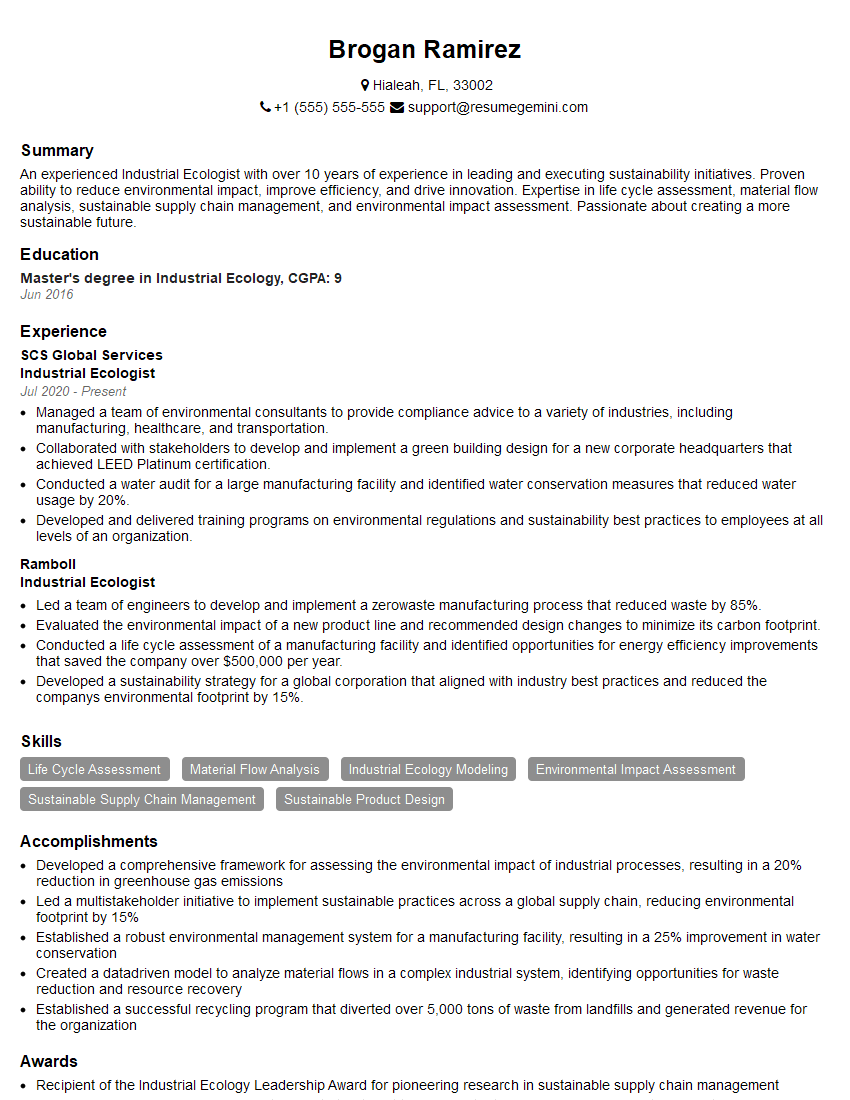
Mastering Circular Economy Design principles significantly enhances your career prospects in a rapidly evolving and environmentally conscious job market. It demonstrates your commitment to sustainability and your ability to develop innovative and responsible solutions. To maximize your job search success, creating an ATS-friendly resume is crucial. ResumeGemini is a trusted resource that can help you build a compelling and effective resume, highlighting your skills and experience in a way that appeals to both Applicant Tracking Systems and human recruiters. Examples of resumes tailored to Circular Economy Design are available to further guide your preparation.
Explore more articles
Users Rating of Our Blogs
Share Your Experience
We value your feedback! Please rate our content and share your thoughts (optional).
What Readers Say About Our Blog
To the interviewgemini.com Webmaster.
Very helpful and content specific questions to help prepare me for my interview!
Thank you
To the interviewgemini.com Webmaster.
This was kind of a unique content I found around the specialized skills. Very helpful questions and good detailed answers.
Very Helpful blog, thank you Interviewgemini team.