Preparation is the key to success in any interview. In this post, we’ll explore crucial Counseling Groups interview questions and equip you with strategies to craft impactful answers. Whether you’re a beginner or a pro, these tips will elevate your preparation.
Questions Asked in Counseling Groups Interview
Q 1. Describe your experience facilitating different types of counseling groups (e.g., support, psychoeducational, skills-building).
My experience encompasses facilitating a wide range of counseling groups, each with unique goals and dynamics. I’ve led support groups for individuals coping with grief, chronic illness, or significant life transitions. These groups prioritize emotional support, shared experiences, and mutual validation. I’ve also facilitated psychoeducational groups focusing on specific topics like anxiety management, stress reduction techniques, or healthy communication skills. These groups combine education with practical exercises and group discussion. Finally, I’ve conducted skills-building groups where members learn and practice specific coping mechanisms, such as assertiveness training or conflict resolution strategies. These groups involve role-playing, feedback, and structured activities to foster skill development. For instance, in a grief support group, I might guide members through sharing their experiences, validating their feelings, and exploring coping strategies. In a psychoeducational group focused on anxiety, I would integrate evidence-based techniques like relaxation exercises and cognitive restructuring. In a skills-building group centered on communication, the sessions might revolve around role-playing different communication styles and providing constructive feedback.
Q 2. What theoretical orientations inform your approach to group counseling?
My approach to group counseling is informed by several theoretical orientations, primarily psychodynamic, cognitive-behavioral (CBT), and humanistic perspectives. The psychodynamic lens helps me understand the unconscious processes impacting group dynamics and individual behaviors. I look for recurring patterns and themes in communication and interactions to help group members gain self-awareness. CBT principles guide my work by focusing on identifying and modifying maladaptive thoughts and behaviors. For example, I help members challenge negative thought patterns and develop more constructive coping strategies. The humanistic perspective emphasizes self-acceptance, personal growth, and the inherent capacity for change. I create a safe and supportive environment that fosters self-discovery and empowers members to take ownership of their healing process. Integrating these approaches allows me to offer a comprehensive and nuanced understanding of each group member’s unique needs and challenges.
Q 3. How do you establish and maintain group cohesion and therapeutic alliance?
Building and maintaining group cohesion and the therapeutic alliance are crucial for successful group therapy. I start by establishing clear group guidelines and expectations, emphasizing respect, confidentiality, and active participation. Early in the group process, I facilitate activities that encourage members to get to know each other, share their goals, and identify commonalities. This helps build rapport and a sense of belonging. Throughout the group’s duration, I actively monitor group dynamics, intervening when necessary to address conflicts or power imbalances. I also create opportunities for members to provide each other with support and feedback. I model empathy, active listening, and respectful communication. For example, I might begin a group by having members share a brief self-introduction and what they hope to gain from the group experience. Throughout the sessions, I consistently reinforce positive interactions, encouraging members to offer each other praise and support. Addressing any issues immediately and ensuring everyone feels heard and respected enhances the alliance and fosters cohesion.
Q 4. Explain your methods for managing disruptive group members.
Managing disruptive group members requires a sensitive and proactive approach. First, I try to understand the root cause of the disruptive behavior – is it due to anxiety, resistance, or a deliberate attempt to control the group? I might address the behavior directly but gently, reminding the member of the group guidelines and the importance of respectful communication. If the behavior persists, I might have a private conversation with the individual to explore their concerns and help them find more constructive ways of expressing themselves. In severe cases, where the behavior is harmful or significantly disrupts the group, I might need to set stricter limits, or even recommend individual therapy or removal from the group if it’s in the best interest of the group’s safety and therapeutic environment. For example, if a member consistently monopolizes the conversation, I might gently redirect their attention to other members, giving them opportunities to speak. If a member becomes verbally abusive, I will address this directly, outlining the consequences of such behavior, while being sensitive to the underlying emotions driving the outburst.
Q 5. How do you address confidentiality concerns within a group setting?
Confidentiality is a cornerstone of group therapy, but it’s important to understand that it’s not absolute. I explicitly discuss confidentiality limits at the beginning of the group, explaining that while I’m obligated to maintain confidentiality to the best of my ability, there are exceptions. These exceptions include situations where there’s a risk of harm to self or others, mandated reporting requirements (e.g., child abuse), or court orders. This upfront discussion helps set realistic expectations and promotes trust among members. I encourage members to share only what they feel comfortable sharing, and I remind them that they can always choose not to disclose certain information. It is crucial to continuously reinforce confidentiality and trust during group sessions to create a space where members feel safe enough to share their personal experiences.
Q 6. What are your strategies for handling conflict within a group?
Conflict is inevitable in group settings, and it can actually be a valuable opportunity for growth. My approach involves facilitating constructive conflict resolution. I encourage members to express their feelings and perspectives respectfully, while actively listening to each other. I might use mediation techniques, helping members reframe their perspectives and find common ground. The goal is not to eliminate conflict but to help members manage it effectively and learn from it. For instance, if a disagreement arises between two members, I might encourage them to explain their viewpoints using “I” statements, focusing on their own feelings and experiences rather than blaming the other person. I might also help the group explore the underlying issues fueling the conflict and brainstorm potential solutions together.
Q 7. Describe your approach to group member selection and assessment.
Group member selection and assessment are critical steps in ensuring a successful group experience. I use a combination of methods, including screening interviews, questionnaires, and review of relevant information (if available). The interviews allow me to assess individuals’ readiness for group therapy, their understanding of the group’s purpose, and their potential to benefit from the group setting. Questionnaires provide additional information about their experiences, coping skills, and treatment goals. Ultimately, my goal is to create a group with a mix of individuals who share common needs and goals, yet also bring a diversity of perspectives and experiences. I look for individuals who are willing to participate actively, respect group guidelines, and commit to the process. This careful selection process significantly enhances the likelihood of a positive and productive group experience. If a member becomes unsuitable for the group (due to unforeseen circumstances or non-compliance with the group’s guidelines), I will work with them to determine alternative options for therapy or support.
Q 8. How do you create a safe and inclusive environment for diverse group members?
Creating a safe and inclusive environment in a diverse group is paramount. It’s about fostering a sense of belonging where every member feels respected, valued, and empowered to participate authentically. This begins with a clear articulation of group norms and expectations from the outset, emphasizing respect, confidentiality, and empathy.
- Pre-group screening and member selection: Carefully considering the group’s composition to ensure a balance of personalities and needs while mitigating potential conflict. For instance, avoiding placing individuals with directly opposing viewpoints in an early-stage group.
- Explicitly addressing diversity: Acknowledging and normalizing the differences in backgrounds, experiences, and perspectives within the group. This could involve dedicated sessions focused on cultural awareness or identity exploration.
- Establishing ground rules collaboratively: Involving members in creating a code of conduct ensures shared ownership and promotes a sense of agency. This helps establish boundaries around communication styles, respectful disagreement, and addressing microaggressions.
- Continuously monitoring the group dynamic: Paying close attention to nonverbal cues and power dynamics, intervening when necessary to address any imbalances or instances of exclusion. This might involve redirecting conversation to include quieter members or challenging biases that emerge.
- Providing culturally sensitive interventions: Adapting therapeutic approaches to suit the specific needs and cultural backgrounds of group members. This requires ongoing learning and self-reflection on one’s own biases and limitations. For example, understanding the nuances of communication styles across cultures.
For example, in a group with members from different cultural backgrounds, I would dedicate time early on to discussing cultural differences and how they might impact communication styles and group interaction. This creates a space for understanding and prevents misunderstandings from escalating into conflict.
Q 9. Explain your understanding of group dynamics and stages of group development.
Group dynamics refer to the complex interplay of interpersonal relationships, power structures, and communication patterns within a group. Understanding these dynamics is crucial for effective facilitation. Group development typically follows distinct stages, though the pace and intensity vary significantly.
- Forming: Members are tentative, polite, and focused on getting to know each other. There’s a dependence on the leader for structure and direction.
- Storming: Conflict and tension emerge as members assert their personalities and preferences. Power struggles and disagreements are common.
- Norming: The group establishes shared norms, expectations, and roles. Cohesion develops as members begin to trust each other.
- Performing: The group is highly functional, collaborative, and focused on achieving its goals. Members are comfortable with their roles and can work independently and interdependently.
- Adjourning: The group concludes its work. Members may experience a range of emotions, including sadness, relief, and accomplishment.
For example, during the storming phase, I might use interventions such as promoting active listening or facilitating structured conflict resolution techniques to help members navigate disagreements constructively. In the performing phase, I could focus on empowering members to lead discussions and take ownership of the group process.
Q 10. How do you adapt your facilitation style to different group needs and contexts?
Adapting my facilitation style depends on various factors including the group’s composition, goals, and the presenting issues. It’s about being flexible and responsive to the group’s evolving needs.
- Directive vs. Non-directive: Some groups benefit from more structure and guidance from the facilitator (directive), while others prefer a more collaborative and self-directed approach (non-directive). The choice depends on the members’ experience levels, the complexity of the issues, and the group’s overall maturity.
- Cognitive-Behavioral Therapy (CBT) vs. Psychodynamic: The theoretical orientation informing the group’s focus also influences the facilitation style. A CBT-oriented group may focus on skill-building and behavioral change through structured exercises and assignments, while a psychodynamic group may explore deeper emotional themes and past experiences through free-flowing discussion and interpretation.
- Addressing individual needs: A skilled facilitator pays attention to individual members’ needs and adjusts their approach accordingly. This could involve offering individual support, setting boundaries, or making referrals to other services.
- Active listening and empathy: Regardless of the style, active listening and empathetic understanding are always essential. I adapt my communication style to effectively reach each member, being mindful of cultural differences and individual communication styles.
For example, in a group focused on social anxiety, I would use more directive techniques, such as role-playing and structured exercises to help members practice social skills. In contrast, a group exploring grief and loss might benefit from a more non-directive approach, allowing members to share their experiences at their own pace.
Q 11. What are your methods for evaluating the effectiveness of group therapy?
Evaluating the effectiveness of group therapy involves a multi-faceted approach that goes beyond simply assessing member satisfaction. I use a combination of methods:
- Pre- and post-group assessments: Using standardized questionnaires or measures to assess members’ symptoms, functioning, and well-being before and after the group concludes. This allows for quantitative data on changes over time.
- Process recordings and supervision: Regularly reviewing session recordings or notes with a supervisor to identify areas for improvement in facilitation and group dynamics. This provides valuable feedback and contributes to continuous professional development.
- Member feedback: Collecting qualitative data through individual feedback sessions, group discussions, or anonymous surveys. This provides insight into members’ experiences and perceptions of the group’s helpfulness.
- Outcome measures specific to group goals: For example, if the group’s goal is to improve communication skills, I might track improvements in members’ assertive communication abilities as measured by self-report or observation.
- Qualitative data analysis: Analyzing member narratives, themes, and patterns that emerge from group discussions and interactions. This often reveals deeper insights into the group’s processes and outcomes.
For instance, if a group focuses on anger management, I would use standardized measures of anger and aggression before and after the intervention. I would also track the frequency of anger-related incidents reported by members. The qualitative data would provide additional insight into how the group impacted the members’ coping mechanisms and overall quality of life.
Q 12. How do you address countertransference in group counseling?
Countertransference refers to the therapist’s unconscious emotional reactions to the client, often stemming from their own unresolved issues or past experiences. In group settings, this can manifest in various ways, impacting the therapeutic process and potentially hindering the group’s progress.
- Self-awareness and reflection: Regular self-reflection and supervision are essential to identify and manage countertransference. This involves critically examining my own emotional responses and reactions to group members.
- Seeking supervision: Discussing my feelings and experiences with a supervisor provides an objective perspective and helps me to develop strategies for addressing countertransference issues effectively.
- Maintaining professional boundaries: This is vital in preventing countertransference from interfering with therapeutic objectivity. Clear boundaries are crucial in all interactions within the group setting.
- Using process comments: I might use process comments to address dynamics within the group that may be activating my countertransference reactions, bringing such patterns to the group’s awareness for collaborative exploration.
- Consultations: If countertransference is significantly impacting my ability to facilitate the group, consulting with colleagues or experts is important to ensure appropriate intervention strategies are in place.
For example, if I find myself becoming overly protective of a particular member, I would reflect on why this is happening and explore potential countertransference issues with my supervisor. This process prevents my personal biases from affecting my interactions with the members and the overall group dynamics.
Q 13. How do you handle ethical dilemmas that arise in group settings?
Ethical dilemmas are inevitable in group counseling. Addressing them requires careful consideration of ethical codes, legal guidelines, and professional responsibility. My approach involves:
- Consultation: Seeking advice from colleagues, supervisors, or ethical review boards to gain alternative perspectives and ensure informed decision-making.
- Prioritizing client well-being: Always placing the best interests of the group members at the forefront when weighing options. This involves careful consideration of potential risks and benefits to each individual.
- Confidentiality and disclosure: Balancing confidentiality with the legal and ethical obligations to report certain information (e.g., child abuse, threats of harm). Clear communication regarding confidentiality limits is crucial from the beginning of the group.
- Documentation: Maintaining thorough records of decisions made and rationale behind them. This provides a clear audit trail and helps justify actions taken in case of legal or ethical challenges.
- Balancing group needs and individual needs: Sometimes the needs of individual members may conflict with the overall group goals. It is crucial to find a balance that minimizes harm while promoting the growth of all involved.
For example, if a member discloses a plan to harm someone, I would have to weigh my ethical obligation to maintain confidentiality against my legal duty to protect potential victims. This necessitates carefully considering all the relevant factors, potentially including consulting with legal counsel and mental health authorities.
Q 14. Describe your experience with co-facilitation of group therapy.
Co-facilitation offers many advantages in group therapy, particularly in diverse and complex groups. My experience with co-facilitation has highlighted the value of shared expertise, complementary styles, and enhanced support for members.
- Shared expertise: Co-facilitation allows for a broader range of therapeutic expertise to be brought to bear on the group’s needs. For example, one facilitator might specialize in CBT while the other has a background in psychodynamic therapy.
- Balanced perspectives: Having two facilitators can provide different perspectives on group dynamics and individual members’ experiences, reducing the risk of bias or overlooking crucial aspects of the group process.
- Mutual support and supervision: Co-facilitators can provide each other with support, feedback, and supervision during and after sessions. This contributes to both professional and personal well-being.
- Enhanced safety and containment: The presence of two facilitators can create a greater sense of safety and security for members, particularly when dealing with sensitive or challenging issues. Two facilitators can provide a wider range of support to members.
- Addressing countertransference: The second facilitator can provide an objective perspective, helping the other to manage countertransference and maintain professional boundaries.
In a previous co-facilitated group, my colleague’s expertise in trauma-informed care complemented my strengths in CBT. This allowed us to address both the emotional processing and skill-building needs of the members effectively. The collaborative process enhanced the overall quality of the therapeutic intervention and allowed for a broader range of support to be provided.
Q 15. What are your strategies for dealing with a member’s termination from a group?
Member termination from a group can be challenging, but a thoughtful approach minimizes disruption and supports both the departing member and the remaining group. My strategy involves a three-step process:
- Understanding the reasons for leaving: I initiate a private conversation with the departing member to understand their reasons. This might involve exploring unresolved issues, unmet needs, or external stressors. This conversation is crucial for providing appropriate closure and, if possible, addressing any concerns before they leave. For example, if a member feels unheard or unsupported, I can address that directly, or suggest alternative coping mechanisms.
- Preparing the group: I prepare the remaining group members for the departure, emphasizing the importance of respecting the member’s decision and avoiding speculation. I encourage open expression of feelings, providing a safe space for sadness, anger, or other emotions related to the loss of a group member. I emphasize that group dynamics will shift and that it is normal to feel some disorientation. A helpful analogy here is that of a team member leaving a sports team – there’s adjustment needed, but the game goes on.
- Facilitating closure: Depending on the context and the group’s dynamics, I might facilitate a brief discussion about the member’s contribution to the group. This allows for appropriate acknowledgment and helps the group process their feelings. It’s important to keep this focused and respectful, avoiding potentially harmful gossip or blame. It’s also crucial to ensure that the remaining members do not dwell on this single event, and refocus the group’s attention on the present work and objectives.
Career Expert Tips:
- Ace those interviews! Prepare effectively by reviewing the Top 50 Most Common Interview Questions on ResumeGemini.
- Navigate your job search with confidence! Explore a wide range of Career Tips on ResumeGemini. Learn about common challenges and recommendations to overcome them.
- Craft the perfect resume! Master the Art of Resume Writing with ResumeGemini’s guide. Showcase your unique qualifications and achievements effectively.
- Don’t miss out on holiday savings! Build your dream resume with ResumeGemini’s ATS optimized templates.
Q 16. How do you balance individual needs with the needs of the group as a whole?
Balancing individual needs with the group’s overall needs is a cornerstone of effective group therapy. It’s a delicate dance that requires constant attention and skilled facilitation. I approach this through a multi-faceted approach that prioritizes both individual and collective well-being:
- Setting clear group norms: From the outset, we collaboratively establish group norms that emphasize respect, confidentiality, and shared responsibility. This provides a framework for addressing individual needs within the group context. For instance, we might agree to respect speaking times or have a system for addressing individual concerns in a way that doesn’t dominate group discussions.
- Individualized attention within a group setting: I make sure to offer individualized attention and support, but always in a way that’s relevant to the group. This might include direct feedback, suggesting individual activities to build certain skills, or offering referrals for additional support outside the group setting. I also find ways to link individual concerns to common themes within the group, highlighting the connections and normalizing experiences.
- Prioritizing safety and inclusivity: This is paramount. If an individual’s needs create conflict or distress within the group, I carefully intervene to facilitate a resolution, and create a space that is both inclusive and respectful of everyone’s needs. If a group member’s issue causes a strong disruption, this member might be encouraged to work through their issue in a one-on-one session before bringing it back to the group.
Ultimately, I strive to create an environment where individuals feel seen and heard, while simultaneously fostering a sense of community and shared purpose.
Q 17. Describe your understanding of informed consent in the context of group therapy.
Informed consent in group therapy is crucial and extends beyond a simple signature on a form. It’s an ongoing process built on transparency and mutual understanding. It encompasses:
- Nature and purpose of group therapy: Potential members need a clear understanding of the group’s structure, goals, methods, and the therapist’s role. I explain what will be expected of them and the potential benefits and risks associated with participation. This also includes understanding the nature of confidentiality and its limitations (e.g., mandated reporting).
- Confidentiality limitations: I explicitly outline the limits of confidentiality, such as mandated reporting of child abuse or imminent harm to oneself or others. This ensures that members are fully aware of the potential exceptions and that they have the option of making an informed decision.
- Risks and benefits: Group therapy, while beneficial, also presents potential risks, including the potential for emotional discomfort, triggering of past trauma, and the possibility of disclosure of personal information. I carefully explain these risks and weigh them against the potential benefits in the context of the specific group format.
- Right to withdraw: Members must understand they have the right to withdraw from the group at any time without penalty. This is emphasized throughout the therapy process, reiterating their agency and autonomy.
- Ongoing dialogue: Informed consent isn’t a one-time event. It’s an ongoing process. I continuously assess members’ understanding and willingness to participate throughout the group’s duration.
This holistic approach ensures members are empowered to make conscious choices about their participation in a therapy setting and understand the implications of it.
Q 18. What techniques do you use to encourage active participation among group members?
Encouraging active participation requires creating a safe, supportive, and engaging environment. My techniques include:
- Establishing a welcoming atmosphere: I actively work to create an environment where members feel comfortable sharing their thoughts and feelings. This includes employing active listening, empathy, and validating their experiences. Small acts, like using members’ names frequently, can foster a sense of belonging and make individuals feel heard.
- Using structured activities: Carefully designed exercises, role-playing, or creative activities can stimulate participation, especially among more reserved members. This can be as simple as a shared journal or a guided meditation. These activities offer opportunities for self-expression even when verbal participation feels difficult.
- Modeling active listening and participation: I model respectful listening and active participation myself, providing a demonstration for what it looks and feels like. This can also be an opportunity to role-model healthy communication and conflict resolution.
- Providing positive reinforcement: I regularly acknowledge and appreciate members’ contributions, both large and small. This encourages continued engagement and strengthens the sense of community.
- Addressing resistance directly (but gently): If a member is consistently disengaged, I address this in a private conversation, exploring potential barriers to participation and working collaboratively to overcome them. It’s important to be respectful and understand underlying reasons, rather than just labeling members as passive or resistant.
By utilizing a combination of these strategies, I strive to create an environment where all members feel comfortable, safe and empowered to fully participate.
Q 19. How do you manage the power dynamics within a group?
Power dynamics are inherent in any group setting, and group therapy is no exception. Managing these dynamics effectively is critical to maintaining a healthy and productive group. My approach involves:
- Promoting egalitarianism: I work actively to minimize power imbalances. This includes consciously addressing instances of dominance or silencing of quieter voices. This can involve using techniques like token systems for equal talking times or gently redirecting overly dominant group members.
- Establishing clear ground rules: Collaborative development of group norms ensures that all members are aware of their rights and responsibilities, promoting a greater sense of fairness. I often discuss concepts of healthy boundaries and respect during the beginning of group therapy.
- Addressing power dynamics directly: When power imbalances become apparent, I address them directly and transparently with the group, facilitating a discussion about the impact of these dynamics on the group’s functioning. This process involves active listening to everyone’s perspectives and working towards a common understanding and solution.
- Modeling appropriate behavior: I model respectful communication and challenge any expressions of dominance or control, both subtle and overt. This helps create a sense that power is shared and is not dependent on an individual or on particular roles within the group.
- Self-reflection on my own potential influence: I regularly reflect on my own potential impact on the group dynamics, being mindful of my own biases and power as a therapist. Regular supervision helps keep me aware of my own influence and potential biases.
Through a proactive and thoughtful approach, I strive to create a therapeutic environment where all members feel safe and respected.
Q 20. How do you utilize supervision in your group therapy practice?
Supervision is an essential component of my group therapy practice. I view it as a vital tool for maintaining ethical standards, enhancing my clinical skills, and ensuring the well-being of my clients. My supervisory sessions provide opportunities to:
- Process challenging group dynamics: I regularly discuss complex group interactions, member behaviors, and my own responses as a therapist. This helps me gain a fresh perspective and devise more effective interventions. For example, if a conflict arises that I’m having difficulty managing, my supervisor can offer alternative strategies or identify blind spots in my own approach.
- Review ethical considerations: I discuss ethical dilemmas and obtain guidance on maintaining confidentiality and navigating challenging situations involving multiple individuals. My supervisor helps me weigh different ethical considerations and to understand the professional implications of my actions.
- Enhance my facilitation skills: My supervisor offers feedback on my group facilitation techniques, such as my questioning strategies, interventions, and overall approach. They will suggest areas for improvement or offer strategies to better assist my client group.
- Manage my own countertransference: Supervision provides a safe space to explore my personal reactions to group members and group processes, helping me to manage my countertransference and maintain objectivity. This is essential for providing effective and ethical therapy.
- Gain continuous learning: Regular supervision allows for ongoing professional development and knowledge expansion, helping me to stay current on best practices in group therapy.
Supervision is not just about problem-solving; it’s also about continuous professional growth and development, ensuring that I provide high-quality care.
Q 21. Describe your experience documenting group sessions and progress.
Accurate and comprehensive documentation of group sessions and progress is crucial for ethical practice, client safety, and potential legal considerations. My documentation approach includes:
- Process notes: I keep detailed process notes of each session, summarizing key events, interactions, themes, and my interventions. These notes focus on the group as a whole, rather than focusing on individual members. I note significant events and changes within the group dynamic and identify any areas of concern or progress.
- Individual progress notes (when appropriate): While the focus is on the group, in some cases, additional notes might be made on particular clients if there is an important event or concern regarding that specific client that may not be relevant to the group as a whole. This must, of course, comply with the group’s confidentiality rules.
- Summary reports: For instance, I often write summary reports for insurance purposes or for referrals to other services. These reports focus on the overall functioning of the group and any significant progress observed.
- Use of a standardized format: My documentation adheres to a consistent format, ensuring that key information is easily accessible and readily available for review. Consistency in my documentation method is crucial for efficiency and also improves the accuracy of the documentation.
- Regular review and updating: I regularly review my documentation to ensure its accuracy and completeness. This ensures continuity in my care and a better chance of seeing important trends, changes and areas of concerns.
My goal is to create a comprehensive record that accurately reflects the therapeutic journey of the group, while upholding the confidentiality of all members. This includes making sure to use appropriate terminology and avoid potentially stigmatizing language. Using a consistent and clear format also protects me and my client’s interests.
Q 22. What are your strategies for addressing resistance in group members?
Resistance in group therapy is common and often a sign that a member is struggling with the process or the material being discussed. My approach focuses on understanding the root of the resistance, rather than confronting it directly.
Gentle Inquiry: I begin by empathetically exploring the member’s hesitancy. For example, I might say, “I notice you haven’t been participating much today. Is there something you’re feeling uncomfortable with?”
Collaboration: I work collaboratively with the resistant member to find ways to address their concerns. This might involve adjusting the group’s focus, providing individual support, or suggesting alternative ways for them to engage.
Normalization: I normalize the experience of resistance, reminding the group that it’s a natural part of the therapeutic process. This can reduce shame and encourage more open communication.
Exploring Underlying Issues: I help the member connect their resistance to potential underlying issues, such as fear of vulnerability, past trauma, or mistrust. For instance, if a member consistently avoids sharing personal experiences, we could explore their past experiences with judgment or betrayal.
For example, if a member consistently arrives late and leaves early, I might gently inquire if there are scheduling conflicts or anxieties preventing full participation. This approach allows me to work with the member to find solutions, making them an active participant in addressing their resistance.
Q 23. How do you promote self-disclosure and risk-taking within a group?
Promoting self-disclosure and risk-taking requires building a safe and trusting therapeutic environment. It’s a gradual process built on the foundation of rapport and empathy.
Establishing Group Norms: From the outset, we establish clear guidelines around confidentiality, respect, and empathy. This provides a secure base for members to explore vulnerable aspects of themselves.
Modeling Vulnerability: I model appropriate self-disclosure, sharing relevant personal experiences (while maintaining professional boundaries) to demonstrate vulnerability and encourage others to do the same.
Positive Reinforcement: I actively reinforce and appreciate members who participate, even in small ways. This positive feedback encourages further engagement.
Skill Building: We might practice communication skills, such as assertive communication or active listening, to build confidence in expressing oneself.
Processing: We frequently process members’ experiences, exploring their feelings and reactions following a disclosure. This helps normalize emotional responses and validate their vulnerability.
Imagine a group member struggling to share a difficult childhood memory. Through active listening, empathy, and validation, we create a space where they feel safe to gradually disclose, fostering a sense of empowerment and connection.
Q 24. Describe your understanding of the legal and ethical considerations of group counseling.
Legal and ethical considerations are paramount in group counseling. They encompass confidentiality, informed consent, duty to warn, and maintaining professional boundaries.
Confidentiality: While absolute confidentiality is impossible in a group setting, I emphasize the importance of respecting members’ privacy and maintaining the confidentiality of their disclosures to the best of my ability. I clearly explain the limits of confidentiality at the outset.
Informed Consent: Members must be fully informed about the group’s purpose, structure, procedures, and the therapist’s role before joining. This involves providing a detailed informed consent document that they sign.
Duty to Warn: If a member poses a serious threat of harm to themselves or others, I have a legal and ethical obligation to take appropriate action, which might involve contacting authorities or the individual’s family.
Dual Relationships: I avoid dual relationships, such as socializing or engaging in business transactions with members outside of the group setting, to maintain professional boundaries.
Competence: I only work with groups I am adequately trained and experienced to lead, ensuring I possess the skills necessary to address the specific needs of the group members.
For example, I might explain that although I will strive to maintain confidentiality, there are exceptions, such as mandated reporting of child abuse or threats of self-harm. Transparency about these limitations is critical for building trust and ethical practice.
Q 25. How do you maintain professional boundaries in a group setting?
Maintaining professional boundaries in a group setting is crucial to prevent blurring roles and ensuring the safety and well-being of all members.
Emotional Detachment: While empathy is vital, I maintain a professional emotional distance to avoid getting overly involved in members’ personal lives.
Self-Disclosure: My self-disclosure is limited and only used therapeutically, to model vulnerability or build rapport when appropriate.
Physical Contact: I avoid physical contact with members, unless it is clinically necessary (e.g., assisting someone in distress) and always done in a way that’s appropriate and professional.
Social Media: I do not connect with members on social media to maintain clear boundaries.
Gifts: I would politely decline gifts from members to avoid even the appearance of a non-professional relationship.
Maintaining these boundaries fosters a clear professional relationship, allowing the group to focus on the therapeutic work.
Q 26. What are the limitations of group therapy, and how do you address them?
Group therapy, while beneficial, has limitations. Addressing these limitations is key to effective practice.
Power Dynamics: Certain members might exert undue influence over the group, silencing others or creating an uneven power dynamic. I address this by actively facilitating equal participation and addressing any bullying or dominance.
Confidentiality Concerns: As mentioned, absolute confidentiality is not possible. This limitation requires careful management and clear communication with group members.
Group Cohesion Issues: Groups may struggle with cohesion, resulting in cliques or conflict. I address this through group-building activities and facilitating open communication about group dynamics.
Not Suitable for All: Group therapy isn’t suitable for all individuals. Some might not benefit from the group setting due to social anxiety, severe mental illness, or specific trauma.
Limited Individual Attention: Group therapy provides less individual attention than individual therapy. I address this by providing individual sessions when necessary, or making referrals to individual therapists when appropriate.
Recognizing these limitations and adapting my approach accordingly ensures that the group experience is both beneficial and safe.
Q 27. Describe your experience working with groups experiencing specific challenges (e.g., trauma, addiction).
I have extensive experience working with groups experiencing trauma and addiction. These groups require specialized therapeutic approaches.
Trauma Groups: In trauma groups, a primary focus is on creating a safe and validating environment where members can process their experiences at their own pace. Techniques such as EMDR (Eye Movement Desensitization and Reprocessing) or somatic experiencing may be incorporated. Building trust and establishing clear boundaries are paramount.
Addiction Groups: Addiction groups often involve relapse prevention planning, developing coping mechanisms, and fostering peer support. Utilizing evidence-based practices like motivational interviewing and cognitive behavioral therapy (CBT) is essential. Accountability and mutual support are key elements.
For example, in a trauma group, I prioritize establishing a sense of safety and trust before exploring traumatic memories. In an addiction group, I would focus on developing relapse prevention plans and building a supportive community that encourages recovery.
Q 28. How do you ensure the safety and well-being of group members?
Ensuring the safety and well-being of group members is my top priority. This involves proactive measures and careful monitoring throughout the group process.
Pre-Group Screening: I conduct thorough pre-group screenings to assess members’ suitability for the group and to identify any potential risks.
Establishing Safety Rules: Clear rules and expectations around respect, confidentiality, and appropriate behavior are established and reinforced throughout the group sessions.
Active Monitoring: I actively monitor group dynamics, paying close attention to verbal and nonverbal cues that might indicate distress or conflict.
Conflict Resolution: I’m skilled in conflict resolution strategies, helping members manage disagreements constructively and safely.
Crisis Intervention: I’m prepared to implement crisis intervention procedures if a member experiences a significant emotional crisis during the group session.
Referrals: I will provide referrals to individual therapy or other specialized services if a member requires more intensive support.
For example, if a member expresses suicidal ideation, I would immediately implement my crisis protocol, which may involve contacting emergency services or referring the member to appropriate mental health professionals.
Key Topics to Learn for Counseling Groups Interview
- Group Dynamics and Stages of Group Development: Understand Tuckman’s stages (forming, storming, norming, performing, adjourning) and their implications for group leadership and facilitation.
- Theoretical Frameworks for Group Counseling: Explore various theoretical approaches (e.g., psychodynamic, cognitive-behavioral, humanistic) and their application in different group settings (e.g., support groups, therapy groups).
- Ethical Considerations in Group Counseling: Master the ethical dilemmas specific to group work, such as confidentiality, member conflicts, and appropriate boundaries.
- Group Cohesion and Member Participation: Learn strategies to foster a sense of belonging, encourage active participation, and address challenges related to member engagement.
- Leadership Styles and Facilitation Techniques: Examine different leadership styles (e.g., autocratic, democratic, laissez-faire) and develop practical facilitation skills to manage group processes effectively.
- Addressing Difficult Group Behaviors: Develop strategies for managing disruptive behaviors, conflict resolution, and addressing sensitive issues within the group context.
- Assessment and Evaluation of Group Progress: Understand methods for evaluating group effectiveness, measuring member outcomes, and providing feedback.
- Cultural Competence and Diversity in Group Counseling: Explore the importance of cultural sensitivity and addressing diversity within group settings.
Next Steps
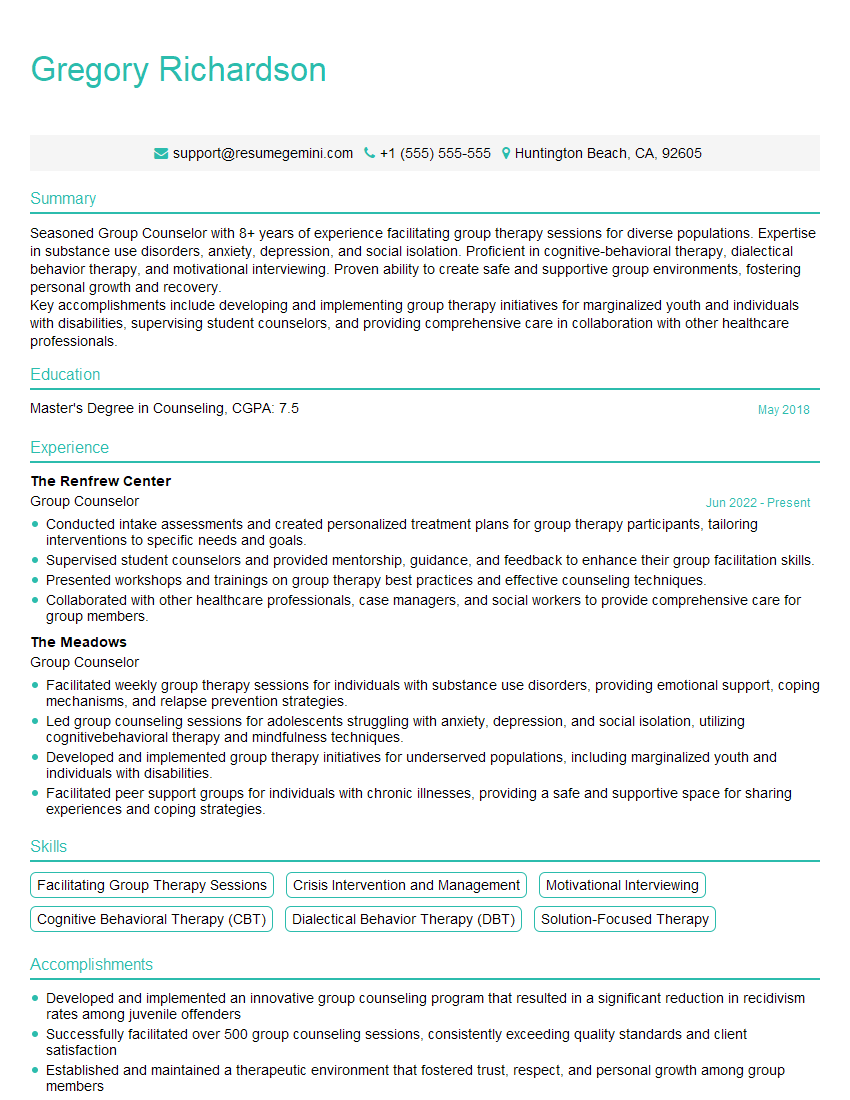
Mastering the intricacies of Counseling Groups significantly enhances your career prospects in the mental health field, opening doors to diverse and rewarding opportunities. A strong resume is crucial for showcasing your expertise and securing your desired position. Building an ATS-friendly resume is essential to get your application noticed. We highly recommend using ResumeGemini to craft a compelling and effective resume. ResumeGemini provides a user-friendly platform and offers examples of resumes tailored to Counseling Groups to help you present your skills and experience in the best possible light.
Explore more articles
Users Rating of Our Blogs
Share Your Experience
We value your feedback! Please rate our content and share your thoughts (optional).
What Readers Say About Our Blog
To the interviewgemini.com Webmaster.
Very helpful and content specific questions to help prepare me for my interview!
Thank you
To the interviewgemini.com Webmaster.
This was kind of a unique content I found around the specialized skills. Very helpful questions and good detailed answers.
Very Helpful blog, thank you Interviewgemini team.