Every successful interview starts with knowing what to expect. In this blog, we’ll take you through the top Data Warehousing and Data Management interview questions, breaking them down with expert tips to help you deliver impactful answers. Step into your next interview fully prepared and ready to succeed.
Questions Asked in Data Warehousing and Data Management Interview
Q 1. Explain the difference between a Data Warehouse and a Data Lake.
Data warehouses and data lakes are both used for storing large amounts of data, but they differ significantly in their approach. Think of a data warehouse as a meticulously organized library, with books (data) categorized and readily accessible for specific research purposes (reporting and analysis). A data lake, on the other hand, is more like a vast, unorganized warehouse where all kinds of data are stored in their raw format – imagine a giant storage room with boxes of all shapes and sizes.
Data Warehouse: A data warehouse is a centralized repository of structured and integrated data from various sources, designed specifically for analytical processing. Data is typically transformed, cleaned, and organized before being loaded into the warehouse. This makes querying and reporting significantly faster and easier. It’s schema-on-write, meaning the structure is defined before data is loaded.
Data Lake: A data lake is a centralized repository that stores raw data in its native format. It supports various data types (structured, semi-structured, and unstructured) and doesn’t require pre-defined schemas. Data is processed and analyzed on demand, offering greater flexibility but often requiring more complex processing steps. It’s schema-on-read, meaning the structure is defined when the data is queried.
Key Differences Summarized:
- Structure: Data warehouse: structured; Data lake: schema-on-read
- Data Type: Data warehouse: Primarily structured; Data lake: Structured, semi-structured, and unstructured
- Processing: Data warehouse: Data is processed before loading; Data lake: Data is processed on demand
- Querying: Data warehouse: Faster querying; Data lake: Slower querying (often)
- Cost: Data warehouse: Typically more expensive initially due to transformation; Data lake: Lower upfront costs, but potentially higher processing costs later
Q 2. Describe the ETL process. What are the key challenges in ETL?
ETL stands for Extract, Transform, Load – the process of collecting data from various sources, converting it into a usable format, and loading it into a target system, such as a data warehouse. Imagine it as a sophisticated data pipeline.
Extract: This phase involves connecting to various data sources (databases, flat files, APIs, etc.) and extracting the required data. This could involve using database connectors, APIs, or even web scraping techniques.
Transform: This is where the magic happens. Data is cleaned, transformed, and standardized. This includes handling missing values, data type conversions, data cleansing, deduplication, and potentially enriching the data with additional information.
Load: Finally, the transformed data is loaded into the target system (data warehouse). This could involve bulk loading, incremental loading, or real-time loading depending on the requirements.
Key Challenges in ETL:
- Data Volume and Velocity: Processing massive datasets in a timely manner can be challenging.
- Data Quality: Inconsistent data formats, missing values, and inaccuracies require robust data cleaning and validation mechanisms.
- Data Integration: Combining data from multiple sources with different formats and structures can be complex.
- Data Governance and Compliance: Ensuring data quality, security, and compliance with regulations.
- Scalability and Performance: The ETL process needs to scale to handle growing data volumes and changing business requirements.
- Maintenance and Monitoring: Ongoing maintenance, monitoring, and optimization of the ETL process are crucial.
Q 3. What are the different types of data warehouses?
Data warehouses come in various types, each with its own strengths and weaknesses. The choice depends on factors like data volume, query complexity, and budget.
1. Operational Data Store (ODS): An ODS is a staging area that holds operational data for short-term analysis and reporting. Think of it as a temporary holding place for data before it’s fully processed for the data warehouse.
2. Enterprise Data Warehouse (EDW): An EDW is a centralized repository designed to store and manage data from various operational systems across an entire organization. This is typically the largest and most comprehensive type of data warehouse.
3. Data Mart: A data mart is a smaller, focused subset of an EDW tailored to a specific department or business unit. For example, a marketing data mart would contain only marketing-related data.
4. Data Warehouse Appliances: These are pre-configured hardware and software solutions designed to simplify data warehouse deployment and management. They often include optimized ETL tools and query engines.
5. Cloud-Based Data Warehouses: Services like Amazon Redshift, Snowflake, Google BigQuery, and Azure Synapse Analytics offer scalable and cost-effective data warehousing solutions in the cloud.
Q 4. Explain dimensional modeling. What are star schemas and snowflake schemas?
Dimensional modeling is a technique for organizing data in a data warehouse to facilitate efficient querying and analysis. It focuses on structuring data around business dimensions and facts. Imagine it as organizing your data into easily digestible categories for reporting purposes.
Star Schema: A star schema is the most basic form of dimensional modeling. It consists of a central fact table surrounded by multiple dimension tables. The fact table contains the measures (numerical data points), while the dimension tables provide context to the measures. Think of a star with a central point (fact table) and many arms (dimension tables).
Example: A fact table might contain sales data (e.g., sales amount, quantity sold), while dimension tables might include product, time, customer, and location information.
Snowflake Schema: A snowflake schema is an extension of the star schema where dimension tables are further normalized into sub-dimension tables. This improves data redundancy and storage efficiency but might make querying slightly more complex. Think of a snowflake where the arms themselves branch out into smaller arms.
Example: In the previous example, the customer dimension table could be further broken down into sub-tables for customer demographics, contact details, and customer purchase history.
Q 5. What are the different types of fact tables and dimension tables?
In dimensional modeling, fact tables and dimension tables play distinct roles.
Fact Tables: Fact tables store numerical data, often aggregated measurements about a business process. There are different types:
- Transaction Fact Table: Records individual transactions (e.g., each sale).
- Accumulation Fact Table: Accumulates values over time (e.g., running total of sales).
- Periodic Snapshot Fact Table: Records values at a specific point in time (e.g., daily sales).
Dimension Tables: Dimension tables contain descriptive attributes providing context for the numerical data in the fact table. They can also be categorized, though less formally:
- Conformed Dimensions: Used consistently across multiple fact tables.
- Junk Dimensions: Used to store less important attributes (flags, codes) to avoid cluttering the fact table.
- Degenerate Dimensions: Dimensions that contain attributes from the fact table itself and are not used for analysis. These attributes are often identifiers.
Q 6. How do you handle data quality issues in a data warehouse?
Data quality is paramount in a data warehouse. Addressing data quality issues involves a multi-faceted approach.
1. Data Profiling: Analyze the data to identify data quality issues such as missing values, inconsistencies, duplicates, and outliers.
2. Data Cleansing: Cleanse the data by handling missing values (imputation, removal), correcting inconsistencies, and removing duplicates.
3. Data Validation: Implement rules and constraints to ensure data integrity during ETL and after loading.
4. Data Standardization: Standardize data formats, units of measurement, and codes to ensure consistency across different data sources.
5. Master Data Management: Implement a master data management (MDM) system to manage and maintain consistent data for critical entities such as customers and products.
6. Data Monitoring: Continuously monitor data quality to detect and address any emerging issues. This can involve using data quality monitoring tools.
7. Data Governance: Establish clear data governance policies, processes, and roles to ensure data quality and compliance.
Q 7. Explain different data warehousing architectures.
Data warehousing architectures vary depending on business needs, data volume, and budget. Here are a few common ones:
1. Centralized Architecture: All data is stored in a single data warehouse. This is simple but can be challenging to scale.
2. Decentralized Architecture (Data Marts): Separate data marts are created for different business units. This improves performance and scalability but can lead to data inconsistency.
3. Hybrid Architecture: Combines centralized and decentralized approaches to balance the advantages of both. This often involves having a central EDW with several smaller data marts.
4. Hub-and-Spoke Architecture: A central data warehouse acts as a hub, while smaller data marts (spokes) are connected to it. Data is replicated or integrated from the hub to the spokes.
5. Federated Architecture: Data is stored in multiple independent data sources, and a layer of abstraction is used to unify access and querying. This architecture avoids data duplication.
The choice of architecture significantly impacts cost, performance, scalability, and maintainability. A well-designed architecture is crucial for a successful data warehouse implementation.
Q 8. What are some common performance tuning techniques for data warehouses?
Performance tuning in data warehouses is crucial for ensuring efficient query processing and optimal user experience. Slow query response times can severely impact business operations reliant on timely data analysis. Techniques focus on improving query execution speed, reducing resource consumption, and optimizing data access.
Indexing: Properly indexing tables is paramount. Think of an index as a book’s index – it allows for faster lookups. We need to carefully choose which columns to index, considering query patterns. Over-indexing can hinder performance as well, as it adds overhead during data modifications.
Query Optimization: Analyzing query execution plans to identify bottlenecks is crucial. Tools like query analyzers can help visualize query execution, pinpointing slow-running steps. Optimizations might include rewriting queries, adding hints, or using materialized views.
Data Partitioning: Dividing large tables into smaller, more manageable chunks can drastically improve query performance. Partitioning allows for parallel processing and focusing on relevant subsets of data. This is akin to organizing a massive library into smaller sections for easier navigation.
Materialized Views: These pre-computed views store results of complex queries, speeding up repetitive queries. Imagine a pre-calculated summary report; it’s much faster to access than recalculating the entire report every time.
Hardware Upgrades: Sometimes, upgrading hardware such as adding more RAM, faster CPUs, or SSDs is necessary to handle increased data volume or query complexity. This is a more expensive solution but can be crucial for extreme performance needs.
Data Compression: Reducing the storage size of data can improve I/O performance, leading to faster query execution. This is like zipping a large file before sending it; it reduces the time it takes to transmit.
Q 9. Describe your experience with various ETL tools (e.g., Informatica, Talend, Matillion).
My experience spans several ETL (Extract, Transform, Load) tools, each with its strengths and weaknesses. I’ve worked extensively with Informatica PowerCenter, Talend Open Studio, and Matillion ETL.
Informatica PowerCenter: This is a robust, enterprise-grade tool offering powerful transformation capabilities and excellent scalability. I’ve used it for large-scale data integration projects, leveraging its advanced features like mappings, workflows, and data quality rules. Its strength lies in its mature feature set and support for complex data transformations.
Talend Open Studio: A more open-source and user-friendly option, Talend is ideal for projects requiring a quicker setup and faster prototyping. I’ve used it for smaller projects and proof-of-concept work, appreciating its ease of use and open-source nature. However, its scalability might not match Informatica for extremely large data volumes.
Matillion ETL: This cloud-native ETL tool is specifically designed for cloud data warehouses like Snowflake and Amazon Redshift. I’ve found it particularly beneficial for projects within these environments, appreciating its seamless integration and optimized performance within the cloud platform. It’s user-friendly and simplifies data transformation for cloud-based data warehouses.
The choice of tool depends heavily on project requirements, budget, existing infrastructure, and team expertise. Each tool provides a different balance between power, usability, and cost.
Q 10. How do you ensure data security in a data warehouse environment?
Data security in a data warehouse is paramount. A breach can have significant financial and reputational consequences. A multi-layered approach is crucial.
Access Control: Implementing role-based access control (RBAC) is fundamental. This ensures that only authorized users can access specific data and perform certain actions. We assign roles based on job responsibilities, minimizing exposure.
Data Encryption: Encrypting data both in transit (e.g., using SSL/TLS) and at rest (e.g., using database-level encryption) protects against unauthorized access even if a breach occurs. This is like using a strong lock on a valuable safe.
Network Security: Securing the network infrastructure through firewalls, intrusion detection systems, and regular vulnerability scans is crucial to prevent unauthorized access attempts. This protects the entire environment from external threats.
Data Masking and Anonymization: For sensitive data, techniques like masking (replacing sensitive data with non-sensitive substitutes) and anonymization (removing identifying information) are used to minimize exposure while allowing for data analysis. This is akin to blurring faces in a photo.
Regular Audits and Monitoring: Regular security audits and continuous monitoring of system logs and access patterns are crucial to detect and respond to security incidents promptly. This proactive approach is vital in preventing serious breaches.
Compliance: Adherence to relevant data privacy regulations such as GDPR, CCPA, etc., is mandatory. We need to understand and comply with all relevant regulations in order to maintain security and legal compliance.
Q 11. Explain the concept of data governance and its importance in data warehousing.
Data governance is the framework of policies, processes, and standards designed to ensure the effective and efficient management of data throughout its lifecycle. In data warehousing, it’s paramount for ensuring data quality, accuracy, consistency, and compliance. Think of it as the rules of the road for data.
Data Quality: Data governance ensures data quality through processes like data cleansing, validation, and standardization. Poor data quality can lead to flawed insights and wrong business decisions.
Data Consistency: Governance enforces consistent definitions and usage of data across the organization. Inconsistent data definitions can lead to confusion and inaccuracies.
Compliance: It helps in meeting regulatory requirements around data privacy and security. Non-compliance can lead to severe penalties.
Data Security: Governance policies establish security protocols for data access, storage, and transmission. This is vital for protecting sensitive information.
Metadata Management: Governance includes managing metadata (data about data) to understand data origins, quality, and relationships. This is crucial for effective data management.
Without strong data governance, data warehouses can become repositories of inaccurate, inconsistent, and unusable data, rendering them worthless for business intelligence.
Q 12. What are the key performance indicators (KPIs) you would monitor for a data warehouse?
Key Performance Indicators (KPIs) for a data warehouse focus on its effectiveness and efficiency. These can be broadly categorized into performance, availability, and data quality metrics.
Query Response Time: Measures the time taken to execute queries. Longer response times indicate performance bottlenecks.
Data Load Time: Tracks the time taken to load data into the warehouse. Slow load times can delay reporting and analysis.
Storage Utilization: Monitors the amount of storage used by the warehouse. High utilization might indicate a need for storage expansion.
Data Freshness: Measures how up-to-date the data in the warehouse is. Stale data provides inaccurate insights.
Error Rate: Tracks the number of data errors or inconsistencies detected. High error rates indicate problems with data quality.
User Satisfaction: Gathering feedback from users about the warehouse’s usefulness and performance can provide valuable insights for improvement.
System Uptime: Measures the percentage of time the data warehouse is operational. High downtime impacts availability and access.
These KPIs provide crucial insights into the health and performance of the data warehouse, allowing for proactive identification and resolution of issues.
Q 13. How do you handle data redundancy in a data warehouse?
Data redundancy, the presence of duplicate data, is a common challenge in data warehousing. It consumes unnecessary storage space, complicates data management, and can lead to inconsistencies. Handling it requires a strategic approach.
Data Modeling: A well-designed data model is crucial. Normalization techniques, such as the use of primary and foreign keys, help in minimizing redundancy by structuring data efficiently. This is like organizing a filing cabinet to avoid duplicate documents.
Data Cleansing: Identifying and removing duplicate records during the ETL process is essential. This requires sophisticated data matching and deduplication techniques. This is like cleaning out a messy closet, discarding identical items.
Slowly Changing Dimensions: Handling changes in dimensional data (e.g., customer address changes) requires specific techniques to manage updates without creating redundant records. These techniques track historical changes while maintaining data integrity.
Data Consolidation: Merging data from multiple sources into a single, consistent view eliminates redundancy across different systems. This centralizes data, preventing duplication.
By implementing these strategies, we can significantly reduce data redundancy and ensure that the data warehouse contains accurate, consistent, and efficiently stored information.
Q 14. What are some common data warehouse design patterns?
Data warehouse design patterns provide reusable solutions for common design challenges. They help improve efficiency, scalability, and maintainability.
Star Schema: A fundamental pattern, it consists of a central fact table surrounded by dimension tables. Fact tables hold numerical data (e.g., sales), while dimension tables provide context (e.g., customer, product, time). It is simple, intuitive, and easy to query.
Snowflake Schema: An extension of the star schema, it normalizes dimension tables further into smaller, related tables. This reduces data redundancy and improves query performance for specific dimensions, but can increase query complexity.
Data Vault: A more complex pattern suited for highly evolving data environments. It emphasizes preserving historical data and tracking changes over time. This pattern prioritizes auditability and adaptability.
Hub-Spoke Model: A pattern for handling slowly changing dimensions and integrating multiple data sources. The hub represents the central entity, while spokes contain attributes and changes over time. It is designed to handle evolving data structures.
The choice of pattern depends on the specific needs of the data warehouse and the characteristics of the data being integrated. The star schema is common for its simplicity; others are applied when specific needs require more advanced structures.
Q 15. Explain your experience with cloud-based data warehousing solutions (e.g., Snowflake, AWS Redshift, Azure Synapse Analytics).
My experience with cloud-based data warehousing solutions is extensive, encompassing Snowflake, AWS Redshift, and Azure Synapse Analytics. I’ve leveraged each platform for various projects, appreciating their unique strengths. For instance, with Snowflake, I’ve worked on projects requiring massive scalability and near-instantaneous query performance. Its serverless architecture proved invaluable for handling unpredictable workloads and significantly reducing infrastructure management overhead. A particular project involved migrating a large on-premise data warehouse to Snowflake, resulting in a 70% reduction in query execution times. With AWS Redshift, I’ve utilized its integration with other AWS services, such as S3 for cost-effective data storage and EC2 for compute optimization. One notable project involved building a real-time data pipeline using Redshift and Kinesis, providing near real-time business insights. Finally, with Azure Synapse Analytics, I’ve appreciated its versatility and integration with the broader Azure ecosystem. A key project involved using Synapse’s serverless SQL pools for ad-hoc querying and its dedicated pipelines for efficient data ingestion from various sources. In all cases, choosing the right cloud solution depended on the specific business needs, considering factors like scalability requirements, budget constraints, and existing infrastructure.
Career Expert Tips:
- Ace those interviews! Prepare effectively by reviewing the Top 50 Most Common Interview Questions on ResumeGemini.
- Navigate your job search with confidence! Explore a wide range of Career Tips on ResumeGemini. Learn about common challenges and recommendations to overcome them.
- Craft the perfect resume! Master the Art of Resume Writing with ResumeGemini’s guide. Showcase your unique qualifications and achievements effectively.
- Don’t miss out on holiday savings! Build your dream resume with ResumeGemini’s ATS optimized templates.
Q 16. How do you perform data validation and cleansing?
Data validation and cleansing are crucial steps to ensuring data quality. My approach involves a multi-stage process. First, I perform data profiling to understand the data’s characteristics – its distribution, data types, missing values, and potential inconsistencies. This often involves using tools that automatically scan data and generate summary statistics. Next, I implement data cleansing techniques. This includes handling missing values (imputation or removal), correcting inconsistencies (e.g., standardizing date formats or correcting spelling errors), and removing duplicates. I often use SQL queries for this, leveraging functions like ISNULL(), CASE statements, and ROW_NUMBER(). For example, to handle missing values in a ‘city’ column, I might use: UPDATE MyTable SET City = 'Unknown' WHERE City IS NULL;. Finally, I perform data validation to verify that the cleansed data meets predefined quality rules. This involves implementing checks for data type constraints, range checks, and referential integrity. I use both automated checks within the database (constraints, triggers) and custom scripts (Python, SQL) to ensure comprehensive validation. It’s important to document these validation rules clearly, creating a comprehensive data quality checklist.
Q 17. Describe your experience with SQL and its use in data warehousing.
SQL is the cornerstone of my data warehousing work. My expertise extends beyond basic SELECT statements to encompass complex queries involving window functions, common table expressions (CTEs), and stored procedures. In data warehousing, I use SQL for data loading (INSERT INTO ... SELECT ...), transformation (using CTEs and window functions to calculate aggregates, ranks, and running totals), and data extraction (creating views and stored procedures for reporting and analysis). For example, I’ve used window functions to calculate running totals of sales by product category: SELECT product_category, sales, SUM(sales) OVER (PARTITION BY product_category ORDER BY sales_date) AS running_total FROM SalesData;. I also frequently use SQL to perform data quality checks, as mentioned before. My proficiency includes optimizing SQL queries for performance, utilizing indexing strategies, and understanding query execution plans to identify and resolve bottlenecks.
Q 18. How do you troubleshoot performance issues in a data warehouse?
Troubleshooting performance issues in a data warehouse requires a systematic approach. I begin by identifying the slow-performing queries using query monitoring tools provided by the database system (e.g., query plans in Redshift, Snowflake’s query history). Then, I analyze the query execution plan to identify bottlenecks – whether it’s a missing index, inefficient joins, or poorly written queries. I leverage query profiling tools to pinpoint specific parts of the query that are consuming the most resources. For instance, a full table scan instead of an index seek can drastically impact performance. I then implement appropriate solutions, including creating indexes, optimizing joins (e.g., using appropriate join types), rewriting inefficient queries, and partitioning large tables for improved query performance. If the issue persists, I investigate the hardware resources – CPU, memory, and I/O – and explore solutions like adding more resources or optimizing the database configuration.
Q 19. What is data profiling, and why is it important?
Data profiling is the process of automatically analyzing data to understand its characteristics. It provides insights into data types, data quality, and potential issues. Key aspects include identifying data distributions, identifying missing values, and recognizing outliers. Think of it like a ‘health check’ for your data. It’s crucial because it provides a clear picture of the data’s quality before it’s used for analysis or reporting. Identifying issues early through data profiling helps to prevent inaccurate results and wasted time down the line. It’s especially important in data warehousing because data from various sources is consolidated, and data profiling helps identify and reconcile inconsistencies. Without data profiling, you’re essentially working blind, potentially relying on inaccurate or incomplete data for critical decisions. I often use specialized data profiling tools that provide automated reports and visualizations, giving a quick overview of data characteristics.
Q 20. Explain your experience with different database management systems (DBMS).
My experience with DBMS spans several relational and NoSQL databases. With relational databases, I’m proficient in Oracle, MySQL, PostgreSQL, and SQL Server. I understand the nuances of each system’s features, performance characteristics, and administration. For example, I’ve optimized query performance in Oracle using indexing strategies and materialized views. I’ve also managed database security and access control in various systems. In the realm of NoSQL databases, I’ve worked with MongoDB and Cassandra, understanding their use cases and applying them to projects where scalability and flexibility are prioritized. My experience includes designing and implementing database schemas, optimizing database performance, and troubleshooting database issues across different platforms. Choosing the right DBMS depends on the specific application. For highly structured data with transactional requirements, relational databases are often preferred. For unstructured data or applications requiring high scalability, NoSQL solutions are frequently the better choice.
Q 21. How do you ensure data consistency across different data sources?
Ensuring data consistency across different data sources is a major challenge in data warehousing. My approach involves a combination of techniques. First, I establish a clear data governance framework, defining data standards and rules for data quality and consistency. This includes defining data types, naming conventions, and business rules. Second, I implement data integration techniques, using ETL (Extract, Transform, Load) processes to consolidate data from multiple sources into a consistent format. This may involve data transformation steps to standardize data values, handle missing values, and resolve inconsistencies. Third, I utilize data quality checks at various stages of the ETL process, including data validation rules, constraints, and referential integrity checks to ensure consistency. Fourth, I leverage data reconciliation techniques to identify and resolve discrepancies between data sources. This may involve comparing data values across sources and creating reconciliation reports. Finally, I use metadata management to track data lineage and understand the origin of data, enabling efficient tracing and resolution of inconsistencies. This comprehensive approach ensures that the data warehouse maintains a consistent and reliable view of the business data.
Q 22. Describe your experience with data visualization tools (e.g., Tableau, Power BI).
Data visualization is crucial for deriving insights from complex datasets. My experience spans several years using industry-leading tools like Tableau and Power BI. I’ve used Tableau extensively to create interactive dashboards and reports, leveraging its drag-and-drop interface and powerful visualization capabilities to present complex data in a clear and concise manner. For instance, I once used Tableau to build a dashboard monitoring key performance indicators (KPIs) for a retail client, enabling them to track sales trends, inventory levels, and customer demographics in real-time. This improved their decision-making process significantly.
Power BI, on the other hand, excels in its integration with Microsoft’s ecosystem. I’ve utilized its robust data modeling features and DAX (Data Analysis Expressions) to create custom calculations and visualizations tailored to specific business needs. In one project, I used Power BI to develop a comprehensive report analyzing customer churn, identifying key factors contributing to churn, and visualizing those factors using interactive charts and maps. This led to the implementation of targeted retention strategies.
In both cases, my focus was always on selecting the appropriate tool for the specific task, considering factors such as data volume, required visualizations, and the overall project goals. I’m proficient in designing visually appealing and informative dashboards that facilitate data-driven decision-making.
Q 23. What is a Slowly Changing Dimension (SCD) and its types?
A Slowly Changing Dimension (SCD) is a technique used in data warehousing to handle changes in dimensional attributes over time. Imagine tracking customer information; a customer’s address might change, but we need to retain a history of their addresses. SCDs allow us to preserve this historical data without creating data redundancy or inconsistencies.
There are several types of SCDs:
- Type 1: Overwrite: The old value is simply overwritten with the new one. This is the simplest approach but loses historical data. It’s suitable for situations where historical data isn’t essential.
- Type 2: Add New Row: A new row is added for each change in the attribute. This preserves the full history, allowing analysts to see how the attribute evolved over time. This approach is commonly used for attributes like customer address or employee title.
- Type 3: Add a separate column: A new column is added to store the new value, along with a column indicating the validity period of each value. This approach provides historical context while maintaining the original structure of the table. It’s useful when tracking a limited number of historical changes.
- Type 4 (Hybrid): This combines features of Type 2 and Type 3. It’s often designed for larger data sets to improve performance and minimize storage demands.
Choosing the right SCD type depends on the specific business requirement and the desired level of historical detail. Type 2 is often preferred for its comprehensive historical tracking, while Type 1 is simpler but comes at the cost of losing historical context. Type 3 can offer a good balance between simplicity and historical retention, though database design can become more complex.
Q 24. How do you handle large datasets in a data warehouse environment?
Handling large datasets in a data warehouse requires a strategic approach encompassing several techniques. Simply increasing server resources isn’t always the most efficient or cost-effective solution. The key is to optimize data processing, storage, and querying.
- Data Partitioning: Dividing the data into smaller, manageable chunks based on time, geography, or other relevant criteria. This improves query performance by focusing on the relevant partition.
- Data Compression: Reducing the storage space required and improving query speeds. Various compression techniques are available, each with its own trade-offs in terms of compression ratio and processing overhead.
- Indexing: Creating indexes on frequently queried columns to speed up data retrieval. Proper index selection is crucial, as poorly chosen indexes can actually slow down performance.
- Data Summarization and Aggregation: Creating pre-calculated aggregates (e.g., sums, averages) to reduce the computational burden during query processing. This can dramatically improve the response time for complex queries.
- Materialized Views: Pre-computed results of complex queries, stored as tables for faster retrieval. This is particularly beneficial for frequently executed reports.
- Distributed Databases or Cloud Solutions: For exceptionally large datasets, consider using distributed databases (like Hadoop or Snowflake) or cloud-based data warehousing services (like Amazon Redshift or Google BigQuery) to scale horizontally and distribute the processing load.
In practice, I often combine several of these techniques. For example, I might partition the data by year and month, apply compression, create indexes on key columns, and implement materialized views for frequently accessed reports. The optimal strategy depends on the specific characteristics of the data and the typical query patterns.
Q 25. What is the difference between OLTP and OLAP systems?
OLTP (Online Transaction Processing) and OLAP (Online Analytical Processing) systems serve fundamentally different purposes:
- OLTP: Designed for high-volume, short-duration transactions. Think of systems handling online banking, e-commerce transactions, or point-of-sale systems. They focus on data integrity and transaction speed. Data is typically normalized to minimize redundancy.
- OLAP: Designed for analytical processing of large amounts of data, supporting complex queries and reporting. Data warehouses are classic examples of OLAP systems. They focus on providing comprehensive historical data for analysis, often denormalized to improve query performance.
Here’s a table summarizing the key differences:
| Feature | OLTP | OLAP |
|---|---|---|
| Purpose | Transaction Processing | Analytical Processing |
| Data Volume | Relatively low | Relatively high |
| Query Type | Simple, short transactions | Complex, multi-dimensional queries |
| Data Structure | Normalized | Denormalized |
| Concurrency | High | Low |
| Performance Metrics | Transaction speed | Query response time |
In a nutshell, OLTP systems are for doing things, while OLAP systems are for understanding what has been done.
Q 26. Explain your experience with Agile methodologies in data warehousing projects.
My experience with Agile methodologies in data warehousing projects has been extensive and highly positive. The iterative nature of Agile, with its emphasis on collaboration and frequent feedback, is particularly well-suited for the complex and evolving nature of data warehousing projects. Instead of a rigid, waterfall approach, Agile allows for flexibility and adaptation to changing requirements.
I’ve actively participated in Scrum teams, utilizing sprints to deliver incremental value. Each sprint involves detailed planning, daily stand-ups to track progress and identify roadblocks, sprint reviews to demonstrate progress to stakeholders, and sprint retrospectives to identify areas for improvement. This iterative approach allows for continuous feedback and course correction, minimizing risks and ensuring alignment with business objectives. The use of tools like Jira for task management and collaboration has further enhanced the effectiveness of our Agile processes.
Working in an Agile environment has resulted in greater stakeholder engagement, more frequent delivery of tangible results, improved quality through continuous testing and refinement, and a more adaptable and responsive project delivery process. It has significantly reduced the risk of delivering a large-scale data warehouse solution that fails to meet evolving business needs.
Q 27. Describe a challenging data warehousing project you worked on and how you overcame the challenges.
One particularly challenging project involved migrating a legacy data warehouse to a cloud-based solution. The legacy system was outdated, poorly documented, and contained inconsistencies. The initial challenge was data quality; the data was fragmented across multiple sources and contained significant errors and inconsistencies. Another hurdle was the need for minimal downtime during the migration process.
To address the data quality issue, we implemented a robust data cleansing and validation process. This involved developing automated scripts to detect and correct data errors, as well as establishing data quality rules and metrics. We prioritized high-quality data by creating a data quality control team responsible for reviewing and approving data changes. To minimize downtime, we employed a phased migration strategy, migrating data incrementally to the cloud while keeping the legacy system operational. We also implemented comprehensive testing and rollback plans to mitigate risks.
Throughout the project, we leveraged Agile methodologies, conducting regular sprint reviews and retrospectives to identify and address issues promptly. Open communication with stakeholders ensured transparency and buy-in throughout the process. Successful completion of this project demonstrated my ability to manage complex technical challenges, improve data quality, and deliver projects under tight constraints. The migration ultimately resulted in improved performance, scalability, and cost savings.
Key Topics to Learn for Data Warehousing and Data Management Interview
- Data Modeling: Understand dimensional modeling (star schema, snowflake schema), ER diagrams, and data modeling best practices. Consider practical applications like designing a data warehouse for e-commerce sales data.
- ETL Processes: Master Extract, Transform, Load (ETL) principles, including data extraction methods, data transformation techniques (e.g., data cleansing, data validation), and efficient loading strategies. Explore real-world scenarios involving large datasets and data quality challenges.
- Data Warehousing Architectures: Familiarize yourself with different data warehouse architectures (e.g., cloud-based, on-premise), including their advantages and disadvantages. Think about how to choose the right architecture for a specific business need.
- SQL and Data Querying: Develop advanced SQL skills, including writing complex queries, optimizing query performance, and understanding indexing strategies. Practice writing queries to analyze data from a hypothetical data warehouse.
- Data Governance and Security: Understand data governance principles, data security best practices, and compliance regulations (e.g., GDPR). Consider the implications of data breaches and how to prevent them.
- Data Integration and Big Data Technologies: Explore different data integration techniques and familiarize yourself with big data technologies (e.g., Hadoop, Spark) and their role in data warehousing. Think about how these technologies can handle massive datasets efficiently.
- Performance Tuning and Optimization: Learn techniques to optimize data warehouse performance, including query optimization, indexing, and data partitioning. Consider case studies where performance bottlenecks were identified and resolved.
Next Steps
Mastering Data Warehousing and Data Management significantly boosts your career prospects, opening doors to high-demand roles with excellent compensation. A strong understanding of these concepts positions you as a valuable asset to any organization dealing with large datasets. To maximize your chances, invest time in crafting an ATS-friendly resume that showcases your skills and experience effectively. ResumeGemini is a trusted resource to help you build a professional and impactful resume that gets noticed. They provide examples of resumes tailored specifically to Data Warehousing and Data Management roles to help guide you.
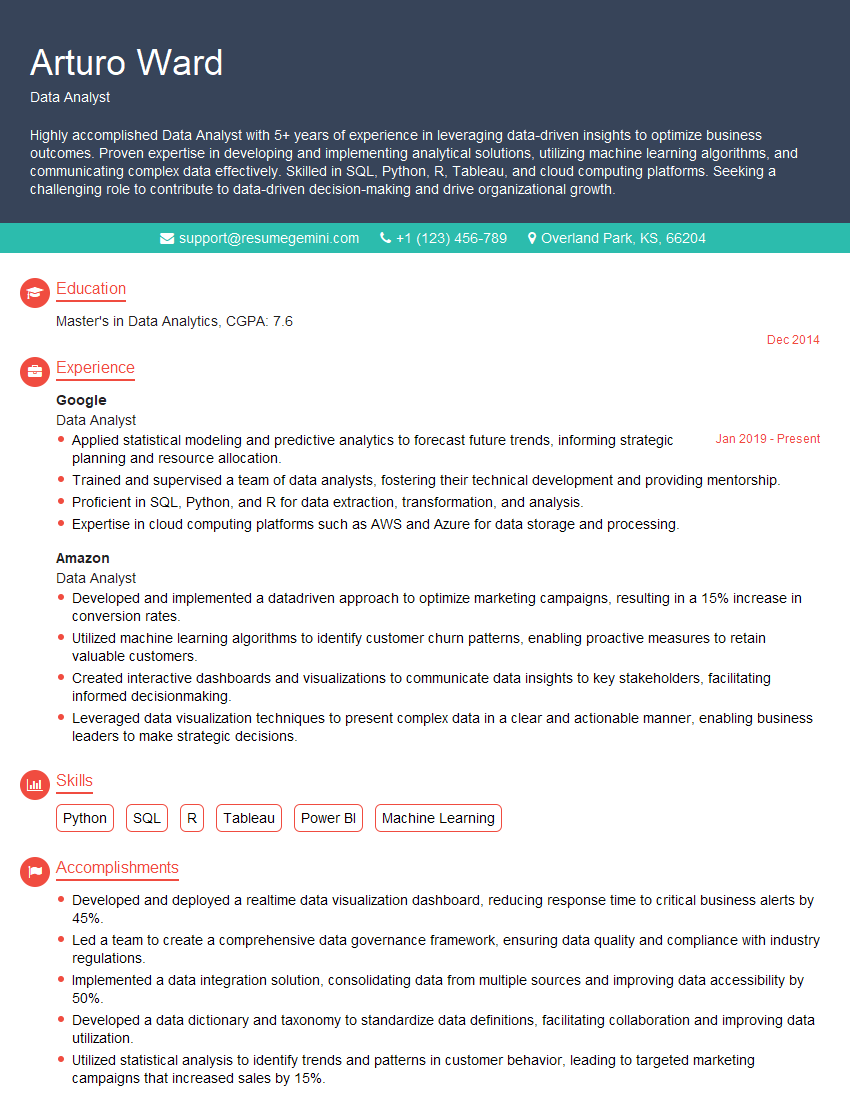
Data Analyst Resume Sample
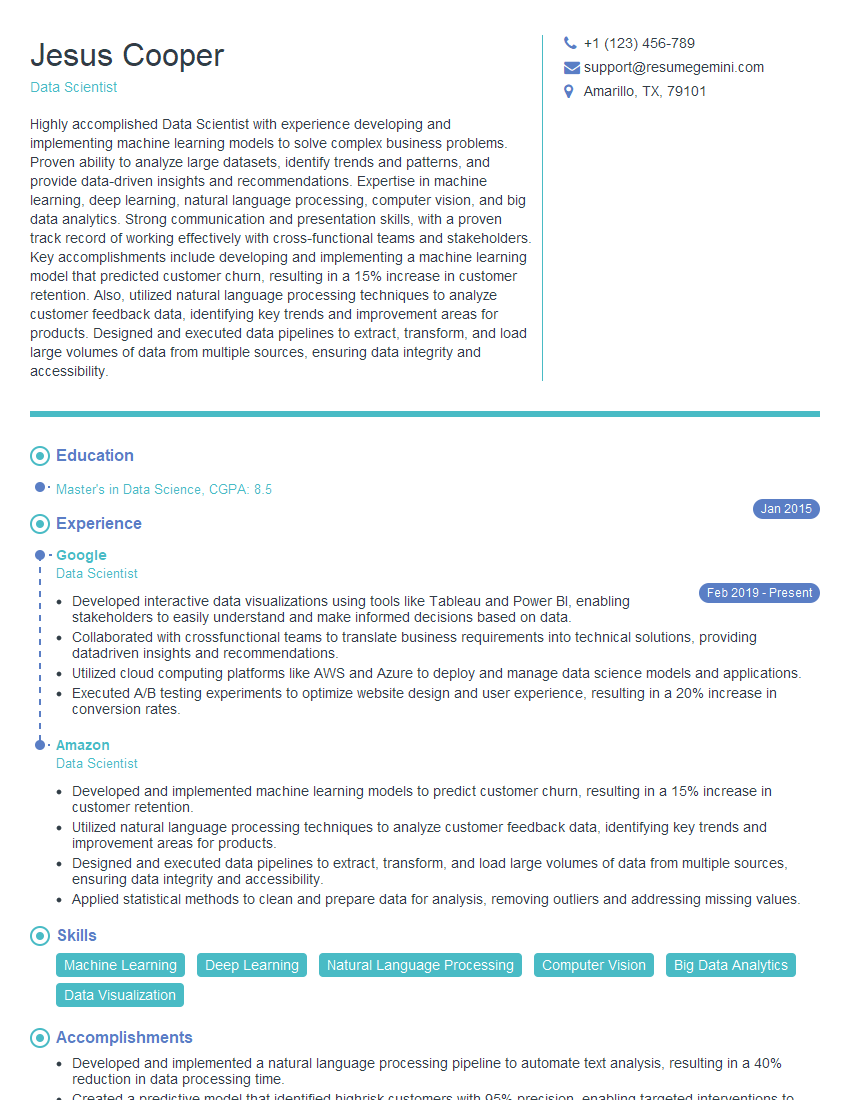
Data Scientist Resume Sample
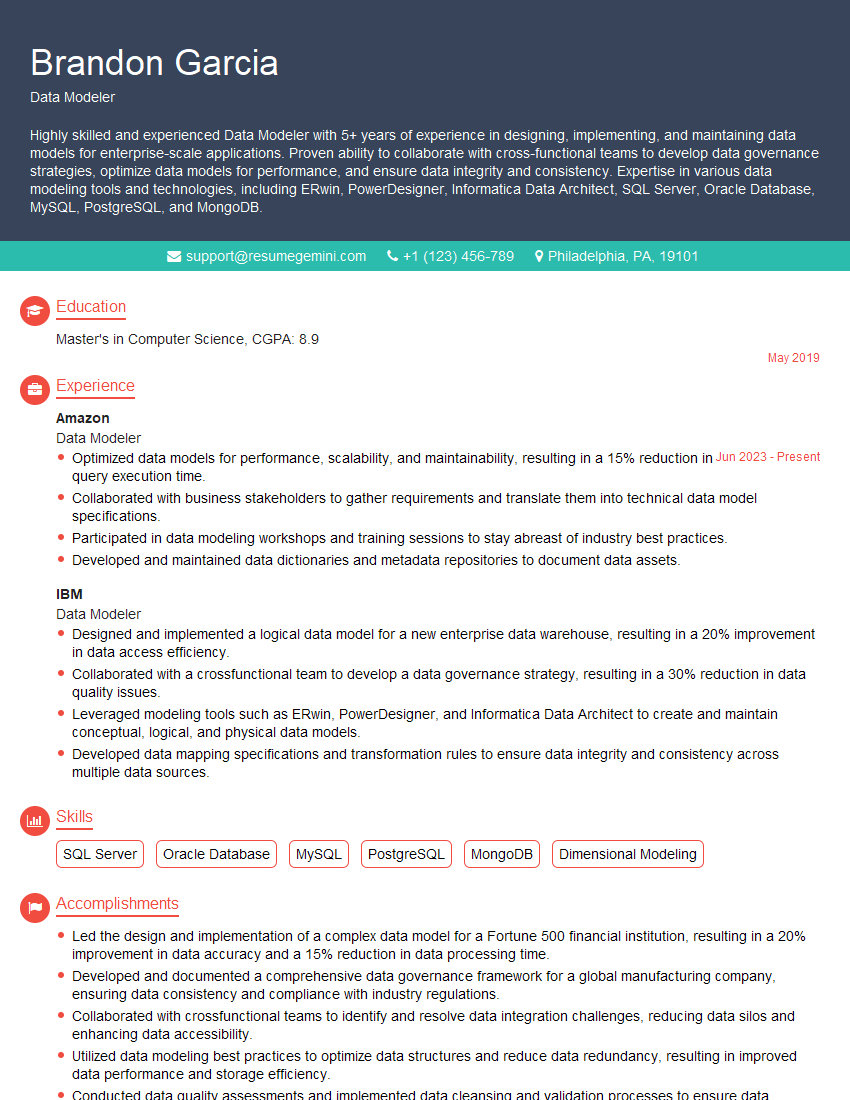
Data Modeler Resume Sample
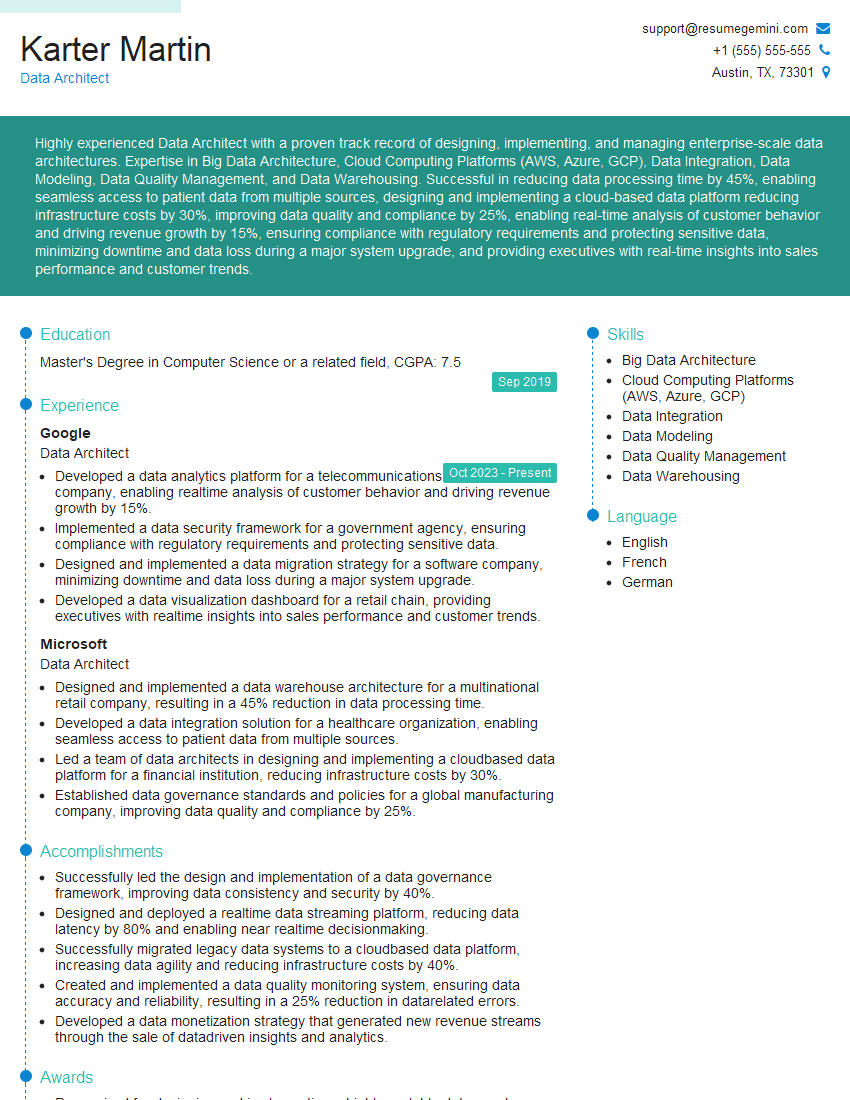
Data Architect Resume Sample
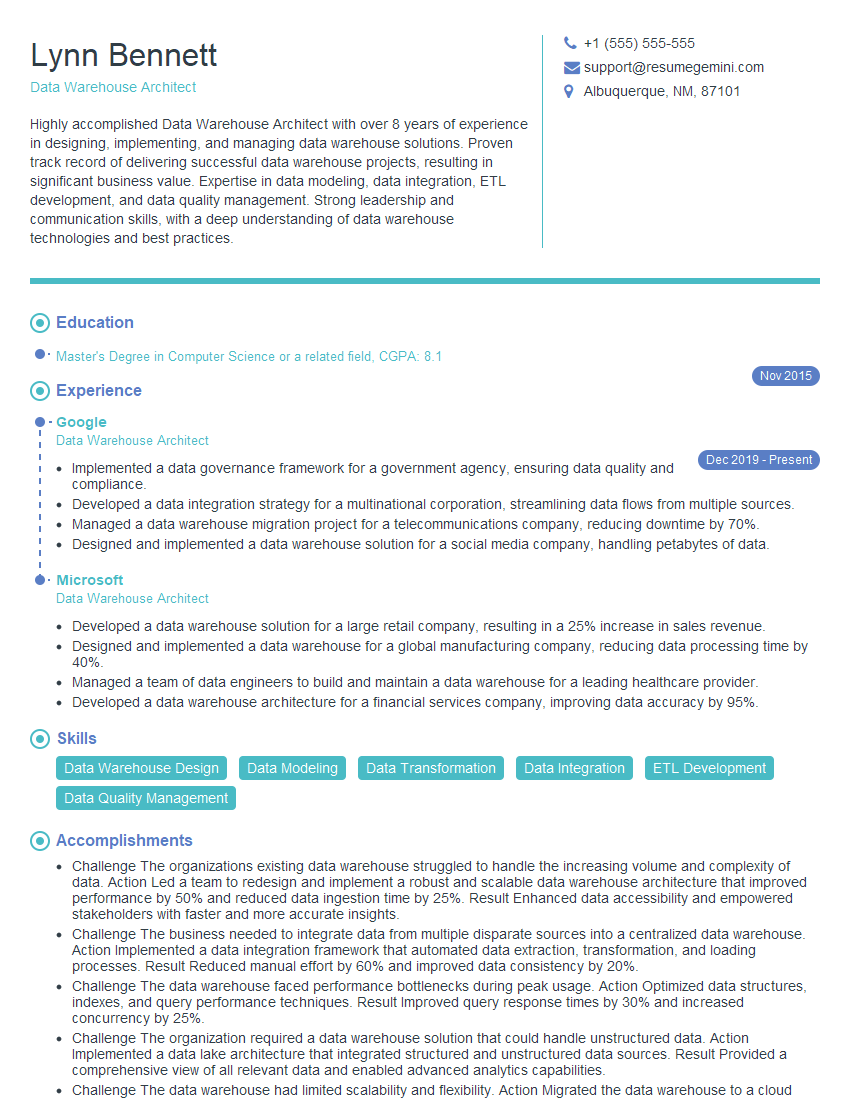
Data Warehouse Architect Resume Sample
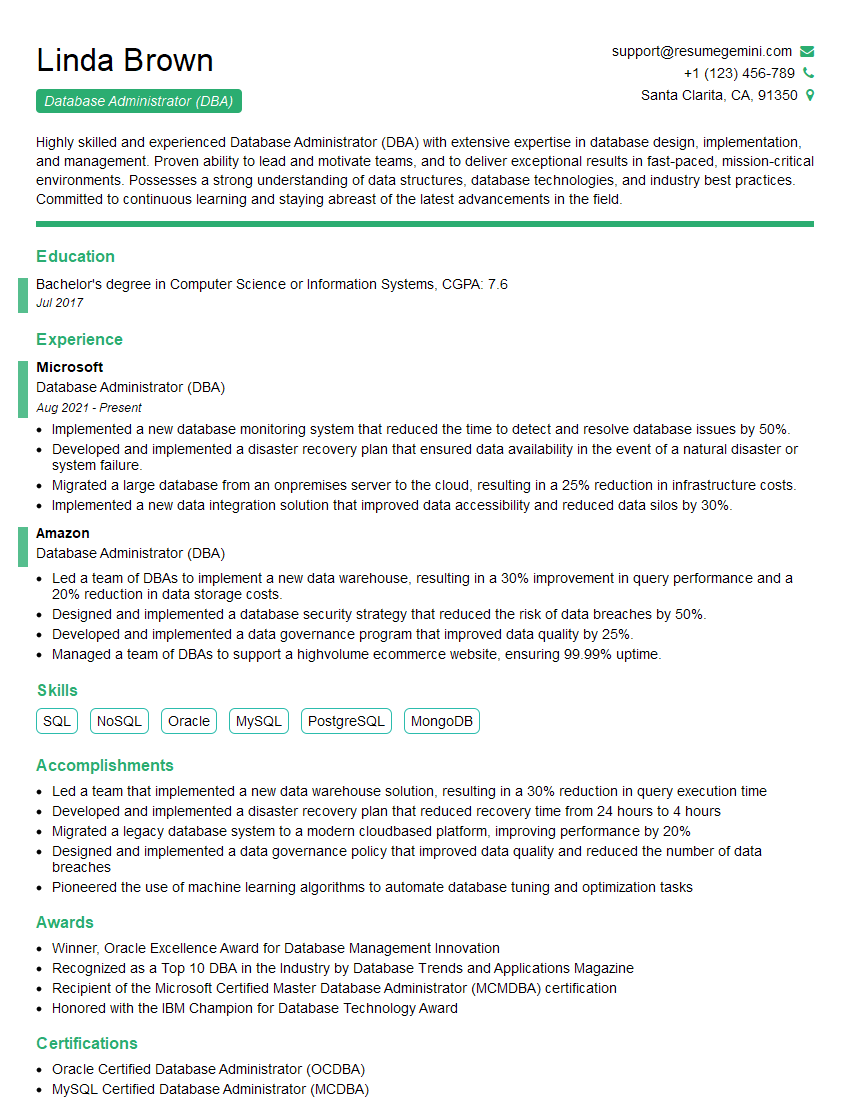
Database Administrator (DBA) Resume Sample
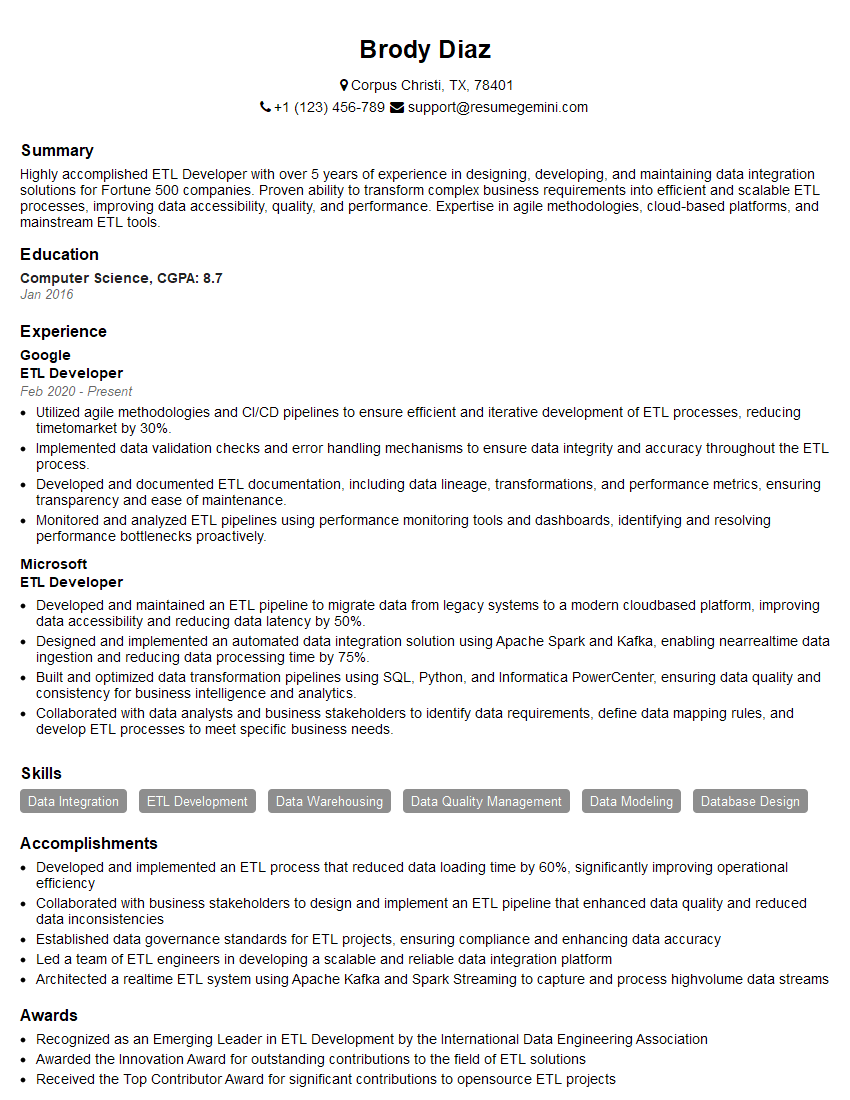
ETL Developer Resume Sample
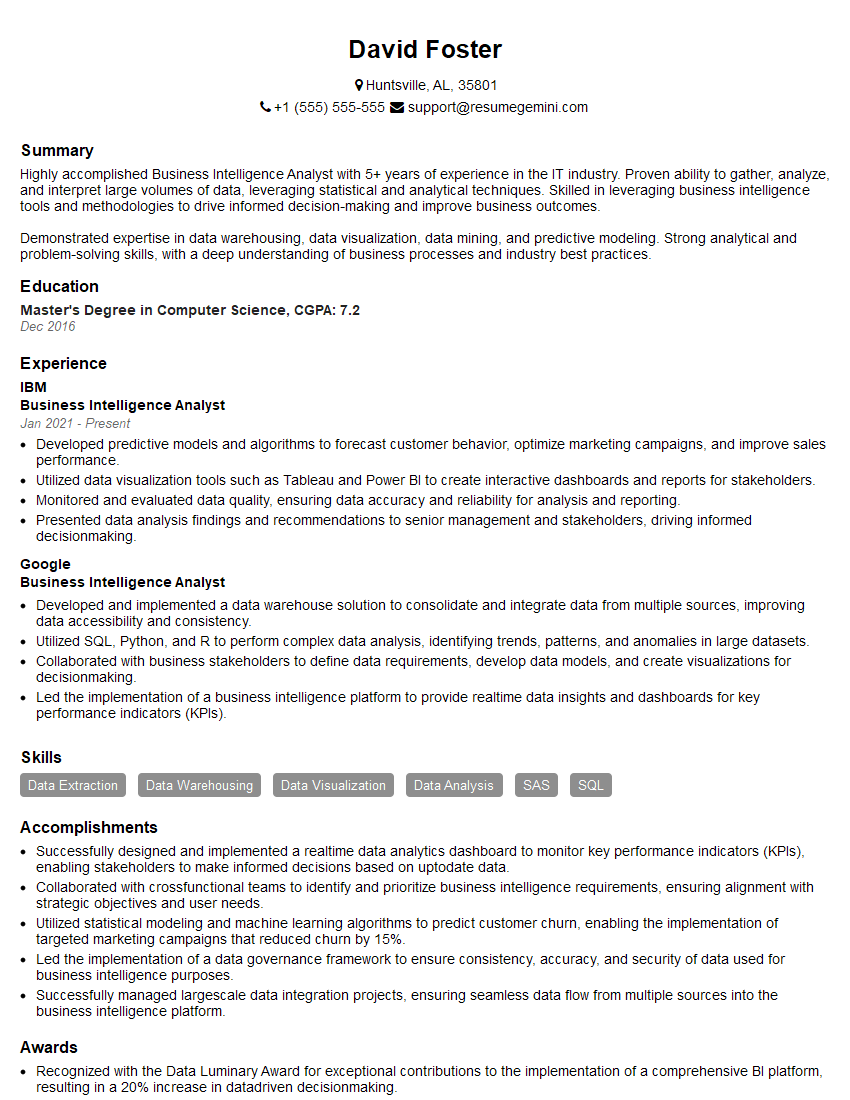
Business Intelligence Analyst Resume Sample
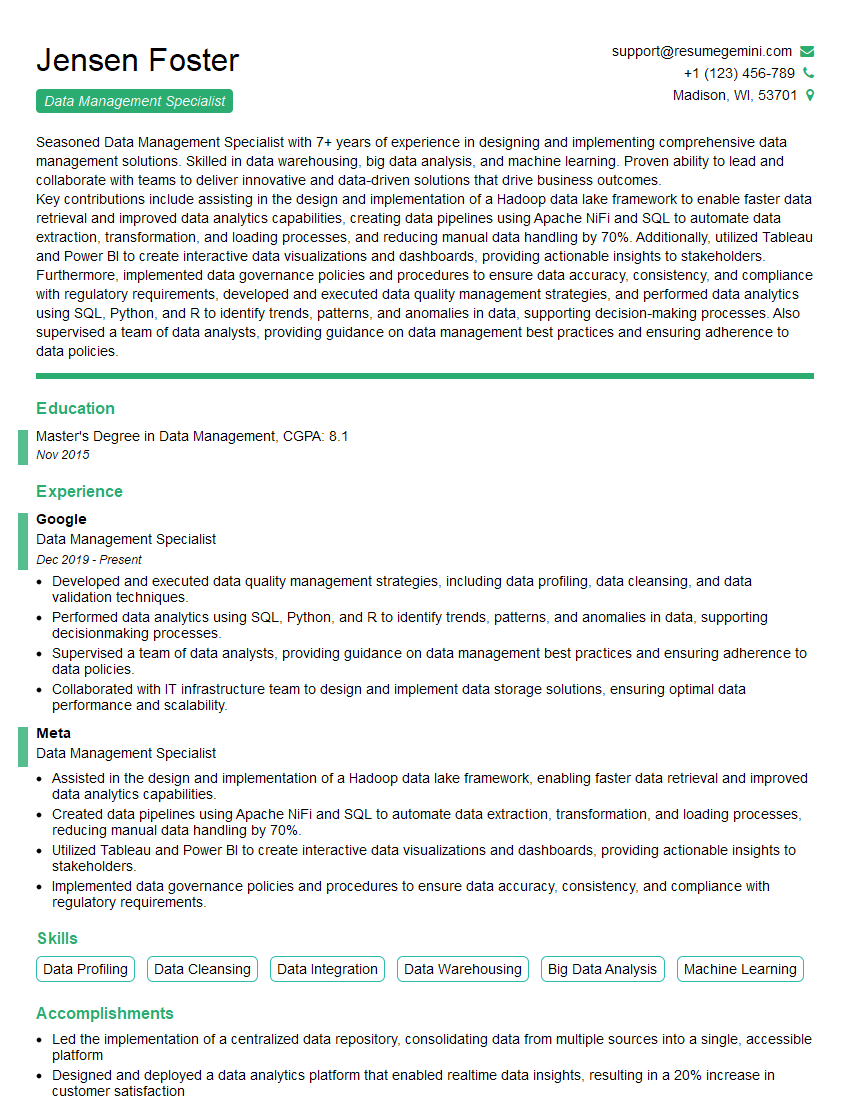
Data Management Specialist Resume Sample
Explore more articles
Users Rating of Our Blogs
Share Your Experience
We value your feedback! Please rate our content and share your thoughts (optional).
What Readers Say About Our Blog
To the interviewgemini.com Webmaster.
Very helpful and content specific questions to help prepare me for my interview!
Thank you
To the interviewgemini.com Webmaster.
This was kind of a unique content I found around the specialized skills. Very helpful questions and good detailed answers.
Very Helpful blog, thank you Interviewgemini team.