Preparation is the key to success in any interview. In this post, we’ll explore crucial Drywall Ceiling Installation interview questions and equip you with strategies to craft impactful answers. Whether you’re a beginner or a pro, these tips will elevate your preparation.
Questions Asked in Drywall Ceiling Installation Interview
Q 1. What types of drywall are commonly used for ceiling installations?
For ceiling installations, the type of drywall chosen depends largely on the project’s requirements and budget. However, some types are more common than others.
- 1/2-inch Type X Fire-Rated Drywall: This is a popular choice for residential and commercial projects, offering good fire resistance and strength. It’s a workhorse and a reliable option for most situations.
- 5/8-inch Type X Fire-Rated Drywall: Used where higher fire resistance is needed, such as in buildings with stricter fire codes or in areas with higher fire risk. It’s thicker and heavier, offering more substantial protection.
- Moisture-Resistant Drywall (Greenboard): Ideal for bathrooms, kitchens, and other areas prone to moisture. The green color is a key identifier, and it resists water damage better than standard drywall.
- Standard Drywall (1/2-inch): While less common for ceilings due to its lower strength compared to Type X, it might be used in less demanding applications, such as a small, low-traffic area. However, Type X offers better long-term durability for the same cost in most cases.
The choice often comes down to balancing budget, fire codes, and the environment’s potential for moisture damage. I always consult local building codes before making a final decision.
Q 2. Explain the process of measuring and cutting drywall for a ceiling.
Accurately measuring and cutting drywall for a ceiling is crucial for a seamless finish. It’s like a tailor making a perfect suit – precision matters!
- Measure the Ceiling: Measure the length and width of the ceiling area to determine the required drywall sheet sizes. It’s best to measure multiple times to eliminate errors.
- Calculate Sheet Quantities: Consider standard sheet dimensions (typically 4 feet x 8 feet or 4 feet x 12 feet). Factor in waste and cut overlaps for a precise quantity estimation. It’s always good practice to order a few extra sheets in case of mistakes or unexpected damages.
- Mark and Cut: Using a pencil, carefully mark the cut lines on the drywall sheets according to your measurements. A sharp utility knife and a straight edge (like a long metal ruler or a drywall square) are essential for clean, straight cuts. Score the face paper first, then snap the sheet along the score line.
- Use Appropriate Tools: Employ a T-square or speed square to ensure 90-degree cuts, crucial for proper fit and a neat finish. A drywall lift is invaluable for safely handling large sheets.
- Safety First: Always wear safety glasses and gloves to protect yourself from sharp edges and dust.
For complex ceiling designs, creating detailed templates beforehand and carefully transferring those markings to the drywall will ensure accurate cuts and minimise wasted material. This is particularly important when dealing with angled or vaulted ceilings.
Q 3. Describe your experience with different types of ceiling joists.
My experience encompasses various types of ceiling joists, each posing unique challenges and requiring specific installation techniques.
- Wood Joists: These are the most common type, offering good strength and relatively easy workability. I’ve worked with various sizes, from standard 2x4s to larger 2x6s or 2x8s, depending on span and load requirements. Proper spacing and support are crucial for stability.
- Metal Joists (Steel or Trusses): These are frequently found in newer constructions and offer superior strength and span capabilities. However, they require special attention during fastening, as the screw penetration and type needs to be appropriate for the metal composition.
- Open-Web Trusses: These engineered wood trusses provide a lightweight and efficient solution but demand careful handling and placement to avoid damage. Their design can require specific fastening approaches to ensure proper support and avoid damaging the web structure.
Understanding the structural characteristics of each joist type is essential for choosing the right fasteners and ensuring a secure and safe drywall installation. For instance, the screw length and type must be carefully chosen to ensure proper penetration without causing damage to the joist. For metal joists, using self-tapping screws is crucial.
Q 4. How do you ensure proper alignment and levelness during drywall ceiling installation?
Maintaining proper alignment and levelness is paramount for a professional-looking and structurally sound ceiling. Think of it as building a foundation – a slightly off-kilter base will lead to problems later.
- Establish a Level Baseline: Before installing the first sheet, establish a perfectly level reference line along one wall using a laser level or a water level. This provides a consistent guide for the entire installation.
- Use a Drywall Lift: Safely lifting and positioning drywall sheets is critical. A drywall lift prevents strain and ensures accurate placement, helping to maintain levelness.
- Check Level Frequently: Throughout the installation, regularly check the levelness of each sheet using a level. Minor adjustments can be made by carefully pressing or tapping the sheet into place while the adhesive is still wet.
- Utilize Shims: If minor discrepancies exist between the ceiling joists and the level line, use shims (thin wood pieces) to create a level surface before installing the drywall.
- Work in Sections: It is best to work section by section, ensuring each area is level before moving to the next. It’s easier to correct small inconsistencies than to fix large issues that arise from neglecting small details.
Consistent use of a level and careful attention to detail throughout the process are key. Never hesitate to use shims – these are your friends in achieving a perfect, level ceiling.
Q 5. What are the common methods for fastening drywall to ceiling joists?
The method for fastening drywall to ceiling joists depends on the type of joist and personal preference, but the goal is always a secure, stable installation.
- Screws: These are the most common fastening method. Drywall screws, specifically designed for drywall, are used. They come in various lengths, and the appropriate length depends on the thickness of the drywall and the depth of the joist. The screw should penetrate into the joist by roughly half its length. Over-tightening should always be avoided.
- Nails: While less common now, ring shank nails can be used, but screws are generally preferred for their superior holding power and reduced risk of cracking the drywall. The nails must be driven using a nail gun and appropriate safety glasses are essential.
- Adhesive: Some installers use construction adhesive in conjunction with screws for added strength and improved sound insulation. This is particularly useful in areas with higher vibration levels.
Regardless of the method, proper spacing between fasteners is essential (around 6 inches to 8 inches on center). This is particularly important for ceilings because the drywall is hanging rather than supported horizontally.
Q 6. What safety precautions do you take when working at heights on ceiling installations?
Safety is paramount when working at heights. It’s not just about following regulations – it’s about going home safe to my family.
- Fall Protection: Always use a properly secured harness and fall arrest system, especially when working above 6 feet. I never compromise on this.
- Proper Scaffolding: If using a scaffold, ensure it’s stable and properly erected according to manufacturer instructions. I regularly inspect it and maintain it in peak condition.
- Secure Work Area: Clear the area below of any obstructions and warn others of the work taking place. This prevents accidents from unexpected drops or other obstacles.
- Appropriate Footwear: Always wear sturdy work boots with good traction, and never work at heights with loose or inappropriate footwear.
- Use a Drywall Lift: This device assists with handling large drywall sheets, reducing the risk of injury from strain or dropped materials.
Complacency is the biggest enemy of safety. I’ve seen firsthand the consequences of shortcuts, and I never take safety for granted. I always adhere to all OSHA regulations and employ best practices.
Q 7. Describe your experience with taping and mudding drywall ceilings.
Taping and mudding are the finishing touches, transforming a raw drywall ceiling into a smooth, paintable surface. It’s a process that requires patience and attention to detail.
- Taping: Apply drywall tape over the seams and joints, embedding it into the mud (joint compound) to create a seamless transition. A taping knife is used to embed the tape effectively and remove excess mud. Proper taping prevents cracks and allows for a smooth finish.
- First Coat of Mud: Apply a thin, even coat of joint compound over the taped seams, feathering the edges to blend seamlessly with the surrounding drywall. Avoid over-application, which can lead to cracking.
- Second Coat of Mud: Once the first coat has dried (usually overnight), apply a second coat to further smooth the surface. This coat helps hide imperfections and provide a smoother base for the next steps.
- Sanding: Once dry, use sandpaper to carefully smooth out any bumps or ridges. Use a sanding pole for overhead work to avoid strain. Always wear a dust mask!
- Additional Coats as needed: For a perfect finish, more coats of mud and sanding may be required until you achieve a smooth, flawless surface.
I’ve found that taking the time for proper taping and multiple coats of mud pays off massively in the final appearance. A little extra effort yields a far superior result compared to trying to cut corners. It’s about achieving that flawless finish that’s both aesthetically pleasing and structurally sound.
Q 8. What are the different types of joint compound used in drywall finishing?
Joint compound, also known as drywall mud, comes in several types, each suited for different stages of drywall finishing. The most common are:
- All-purpose compound: This is a versatile option suitable for most applications, offering a good balance of working time and drying speed. It’s ideal for the initial taping and bedding of drywall tape.
- Lightweight compound: Lighter than all-purpose, it’s easier to spread and sand, reducing fatigue, especially on larger projects. It’s often preferred for the final coats.
- Setting-type compound: This compound sets up quickly, allowing for faster completion of the process. However, it requires a more experienced hand as it has a shorter working time.
- Topping compound: This is a very fine compound used for the final coat, producing a smooth, paintable surface. It’s formulated for exceptional sanding properties.
Choosing the right compound depends on factors like the project size, the desired finish, and your personal preference. For instance, I often use lightweight compound for the final coat on large ceiling projects to minimize the sanding effort.
Q 9. How do you achieve a smooth and seamless finish on drywall ceilings?
Achieving a smooth, seamless finish on drywall ceilings requires meticulous attention to detail and a systematic approach. It’s a multi-step process:
- Proper taping: Apply the drywall tape correctly, embedding it firmly into the mud to create a strong, even base. Using a taping knife to embed the tape is crucial for preventing ridges.
- Multiple coats of compound: Apply several thin coats of joint compound, allowing each coat to dry completely before applying the next. This prevents cracking and ensures a smooth surface. The thinner the coat, the easier it is to sand and avoid imperfections.
- Careful sanding: Sand each coat thoroughly with progressively finer grit sandpaper. Always sand in a consistent direction to avoid creating uneven textures. Using a pole sander on ceilings saves time and effort.
- Priming: Before painting, prime the ceiling with a high-quality drywall primer. This seals the surface, creating a uniform base for the paint and improving paint adhesion.
Think of it like baking a cake – multiple thin layers create a better final product than one thick layer which would be prone to cracking.
Q 10. What tools and equipment are essential for efficient drywall ceiling installation?
Efficient drywall ceiling installation requires a range of tools and equipment. These include:
- Drywall lift: For lifting and positioning large sheets of drywall to the ceiling.
- Measuring tape and pencil: For accurate measurements and marking.
- Utility knife: For cutting drywall sheets to size.
- Drywall screws and screwdriver (or drill): For securely fastening the drywall to the framing.
- Taping knives (various sizes): For applying joint compound.
- Putty knife: For filling minor nail holes and imperfections.
- Sanding pole and sandpaper (various grits): For sanding the joint compound.
- Primer and paint: For preparing and finishing the ceiling.
- Safety glasses and dust mask: To protect yourself from debris and dust.
Having the right tools readily available significantly improves efficiency and quality of work.
Q 11. Describe your experience with various drywall finishing techniques (e.g., skim coating, corner bead installation).
My experience encompasses a wide array of drywall finishing techniques. Skim coating, for instance, involves applying a thin coat of joint compound over an existing surface to create a smooth, even finish. This is frequently used to repair minor imperfections or prepare surfaces for painting. I’ve used this technique extensively on ceilings with slight undulations or imperfections in the drywall.
Corner bead installation is crucial for protecting corners from damage. I’m proficient in installing both inside and outside corner beads, using a bead applying tool to ensure a clean, professional finish and the correct amount of compound. Properly applied corner bead prevents cracking and chipping at these vulnerable points.
I’ve worked on projects ranging from simple repairs to extensive new constructions, honing my skills in various techniques to achieve high-quality results.
Q 12. How do you handle imperfections or damage to drywall ceilings during installation?
Handling imperfections or damage during installation requires a methodical approach:
- Assessment: Carefully assess the extent of the damage. Small holes can be patched with joint compound, while larger holes may require replacement sections of drywall.
- Repair: Use the appropriate techniques to repair the damage. For minor damage, joint compound and careful sanding will suffice. For larger holes, cut out the damaged section and replace it with a new piece of drywall, ensuring it is properly fastened and taped.
- Finishing: Once the repair is complete, feather the edges of the joint compound seamlessly into the surrounding area. Multiple thin coats are key here to avoid unevenness.
- Sanding and priming: Sand the repaired area until smooth and apply primer before painting to achieve a uniform finish.
A crucial aspect is ensuring a seamless blend with the surrounding area – you want the repair to be invisible once complete.
Q 13. Explain your experience with different types of ceiling textures.
I’ve worked with various ceiling textures, each offering a unique aesthetic:
- Orange peel: A popular choice, this texture provides a subtle, slightly bumpy finish.
- Popcorn: A heavier texture, often found in older homes, offers good sound absorption but can be challenging to repair.
- Knockdown: This texture involves applying a thicker coat of compound and then using a knockdown knife to create a textured effect. The degree of texture can be adjusted.
- Smooth: A classic, clean look that requires meticulous attention to detail during finishing.
The choice of texture depends on client preference and the overall design aesthetic of the space. My experience allows me to apply each texture consistently and professionally.
Q 14. How do you manage and resolve conflicts or challenges within a team during drywall ceiling installation?
Conflict resolution in a team setting relies on open communication and a collaborative spirit. I approach conflicts by:
- Active listening: I ensure everyone feels heard and understood, creating a safe space to express concerns.
- Identifying the root cause: Focusing on the underlying issue rather than personalities ensures a solution that addresses the problem effectively.
- Finding common ground: Collaboratively seeking solutions that satisfy the needs of all involved parties.
- Mediation (if necessary): If a solution can’t be reached directly, I’ll work with team members to facilitate a resolution through respectful dialogue and compromise.
Ultimately, a positive and productive work environment is achieved through clear communication, mutual respect, and a shared commitment to completing the project to a high standard.
Q 15. Describe your experience with troubleshooting common drywall installation problems.
Troubleshooting drywall installation issues requires a systematic approach. I start by carefully examining the problem area, identifying the root cause before jumping to solutions. Common problems include improper fastening, leading to loose or bulging drywall; uneven surfaces causing gaps or cracking; and poor taping and mudding resulting in unsightly seams.
For example, if I find a section of the ceiling sagging, I’d first check the framing for adequate support. Was the spacing between joists correct? Are there any weak or damaged joists? If the framing is sound, I would investigate whether the drywall itself is appropriately fastened – perhaps the screws aren’t long enough or are improperly spaced. I then address the root cause before re-securing or replacing the affected drywall.
Another frequent issue is cracking along seams. This often points to movement in the structure, perhaps due to settling, thermal expansion, or inadequate joint compound. To resolve this, I assess the severity of the crack and then apply the appropriate repair method: If it’s a minor crack, I might simply re-tape and mud the seam. For larger cracks, additional reinforcement might be necessary, including the use of drywall mesh tape.
Career Expert Tips:
- Ace those interviews! Prepare effectively by reviewing the Top 50 Most Common Interview Questions on ResumeGemini.
- Navigate your job search with confidence! Explore a wide range of Career Tips on ResumeGemini. Learn about common challenges and recommendations to overcome them.
- Craft the perfect resume! Master the Art of Resume Writing with ResumeGemini’s guide. Showcase your unique qualifications and achievements effectively.
- Don’t miss out on holiday savings! Build your dream resume with ResumeGemini’s ATS optimized templates.
Q 16. What is your experience with installing soundproof drywall ceilings?
Soundproofing drywall ceilings involves using specialized materials and techniques to minimize sound transmission. My experience includes installing resilient channels, which decouple the drywall from the framing, significantly reducing noise transfer. I’m also proficient in installing dense drywall such as soundproof drywall or mass-loaded vinyl (MLV) underlayment. The MLV acts as a barrier to airborne noise, providing additional sound dampening.
A recent project involved a home theater where the client prioritized sound isolation. We utilized double layers of 5/8-inch soundproof drywall, separated by resilient channels and MLV. The result was a marked improvement in sound reduction, creating a dedicated quiet space. The key to effective soundproofing is paying close attention to detail – sealing all gaps and cracks to prevent sound leakage is crucial. This includes around electrical boxes, pipes, and other penetrations in the ceiling.
Q 17. How do you ensure proper ventilation during and after drywall ceiling installation?
Proper ventilation is critical during and after drywall installation to prevent moisture buildup, which can lead to mold growth and drywall damage. During installation, ensuring adequate air circulation within the work area is important, particularly in confined spaces. I use fans to exhaust moisture from the air and prevent it from being trapped behind the drywall.
After installation, depending on the climate and the building’s overall ventilation system, I would typically recommend that the HVAC system be run to circulate air and help to dry out the newly installed drywall. In humid environments or projects with high moisture content from the installation process, using dehumidifiers can be beneficial to accelerate the drying process and mitigate potential moisture-related issues.
Q 18. Explain your understanding of building codes related to drywall installation.
I have a thorough understanding of building codes related to drywall installation, including those related to fire resistance, impact resistance, and moisture resistance. These codes vary by location, so I always consult the relevant local codes for each project to ensure compliance. For example, in areas with high fire risk, the codes might specify the type and thickness of drywall required for fire-rated assemblies. Similarly, codes dictate the proper fastening methods and spacing to ensure structural integrity.
I’m particularly aware of codes related to accessibility requirements. For instance, I know how to install drywall in compliance with ADA guidelines for ceiling heights and clearances. Staying up-to-date with building code changes is a constant priority for me, often achieved by attending continuing education courses and regularly reviewing updated code books.
Q 19. Describe your experience with using specialized tools for drywall installation (e.g., lift systems, power tools).
My experience with specialized drywall installation tools is extensive. I’m proficient in using various power tools, including drywall saws, lift systems, and screw guns. Using a lift system is particularly helpful for safely and efficiently installing drywall ceilings, reducing the risk of injury and improving productivity. These lift systems allow for single-person installation of large sheets of drywall, eliminating the need for multiple workers.
I also utilize specialized screw guns that are designed for drywall installation. These tools provide consistent screw depth and prevent over-driving, which can cause drywall damage. Power saws enable quick and accurate cutting of drywall to size, and I employ various blades based on the material being cut and the type of cut needed. My skill with these tools ensures accuracy, safety, and overall efficiency in the installation process.
Q 20. How do you maintain a clean and organized worksite during drywall ceiling installation?
Maintaining a clean and organized worksite is paramount for efficiency and safety. Before starting, I carefully plan the layout, ensuring easy access to materials and minimizing unnecessary movement. I use designated areas for storing tools, scrap materials, and debris. Proper disposal of waste is crucial, and I use appropriate containers for different types of waste, including recycling whenever possible.
During the process, I regularly sweep and clear debris from the work area. I protect finished surfaces using drop cloths and masking tape. My team and I are trained to follow a ‘clean as you go’ approach, preventing clutter from building up. A clean worksite minimizes trip hazards, reduces the risk of accidents, and facilitates efficient workflow.
Q 21. What are your methods for preventing drywall cracking and sagging?
Preventing drywall cracking and sagging involves a multi-faceted approach starting with proper preparation. Ensuring the framing is sound and properly spaced is critical. Using the correct length and type of screws for the thickness of the drywall ensures that each sheet is adequately fastened. I also take care to avoid overdriving screws, which can create stress points leading to cracking.
Careful taping and mudding are crucial. Using appropriate joint compound and ensuring a smooth, even application minimizes stress points. Avoiding excessive pressure during the taping and mudding process also helps prevent cracking. Finally, in instances where there are potential movement issues within the structure, the use of flexible joint compound or specialized crack-resistant tape can add significant protection against cracking and sagging.
Q 22. Describe your experience with different types of insulation used in conjunction with drywall ceilings.
My experience encompasses a wide range of insulation types used in conjunction with drywall ceilings. The choice of insulation depends heavily on factors like budget, desired R-value (a measure of thermal resistance), and environmental considerations. Common types include:
- Fiberglass batts: These are readily available, relatively inexpensive, and easy to install. They’re suitable for most residential applications and offer good thermal performance. I frequently use these in standard ceiling applications, ensuring proper fitting to avoid gaps and maximize their effectiveness.
- Spray foam insulation: This offers superior air sealing and a higher R-value per inch compared to fiberglass. It’s particularly useful in areas requiring high energy efficiency or where air leakage is a concern. I’ve used spray foam in projects aimed at maximizing energy savings, often in conjunction with higher-performance drywall.
- Blown-in cellulose: This is a recycled material offering good insulation properties and is ideal for filling irregular spaces or hard-to-reach areas. I’ve found it useful in renovations where accessing the ceiling cavity is challenging.
- Rigid foam boards: These are excellent for thermal breaks and are often used in conjunction with other insulation types. I’ve incorporated them in projects demanding superior sound dampening or where significant temperature fluctuations are expected.
Selecting the right insulation is crucial for achieving the desired level of thermal comfort and energy efficiency. I always consider the specific project requirements before making a decision.
Q 23. How do you calculate the quantity of drywall needed for a ceiling project?
Calculating drywall quantity requires careful measurement and consideration of waste. Here’s my step-by-step approach:
- Measure the ceiling area: Accurately measure the length and width of the ceiling in feet. For complex shapes, break the ceiling into smaller, easily measurable sections.
- Calculate the square footage: Multiply the length by the width to determine the total square footage (length x width = square footage).
- Account for waste: Drywall comes in standard sheet sizes (typically 4′ x 8′ or 4′ x 12′). I generally add 5-10% to the calculated square footage to account for cuts, waste, and potential damage. The percentage depends on the complexity of the ceiling and the number of cuts required; more complex ceilings require a higher percentage.
- Convert to sheet quantity: Divide the total square footage (including waste) by the square footage of a single sheet (32 square feet for a standard 4′ x 8′ sheet). Round up to the nearest whole number since you can’t buy fractions of a sheet.
Example: A ceiling measuring 12ft x 15ft has an area of 180 square feet. Adding 10% for waste (18 square feet), the total needed is 198 square feet. Dividing by 32 square feet/sheet results in approximately 6.2 sheets, so I would order 7 sheets.
Q 24. Explain your experience working with blueprints and specifications for ceiling installations.
Working with blueprints and specifications is fundamental to successful ceiling installation. I’m proficient in interpreting architectural drawings, electrical plans, and HVAC schematics. I look for crucial details like:
- Ceiling height and dimensions: These determine the quantity of drywall needed and the type of lift equipment required.
- Location of fixtures and obstructions: This guides cutting and placement of the drywall sheets to avoid damaging these elements. I carefully mark these locations on my own copies of the blueprints.
- Specific drywall requirements: Blueprints often specify the type of drywall (e.g., fire-resistant, moisture-resistant), thickness, and finish. I ensure adherence to these specifications.
- Structural details: Understanding the framing layout is essential for proper attachment and ensuring structural integrity. I often verify measurements against the actual framing.
I always maintain a complete set of blueprints on-site and cross-reference them throughout the installation process. Any discrepancies are immediately flagged and discussed with the project supervisor.
Q 25. How do you manage your time and prioritize tasks during a drywall ceiling project?
Time management and prioritization are critical for efficient drywall ceiling projects. My approach involves:
- Detailed planning: I create a detailed schedule outlining tasks, timelines, and resource allocation. This includes sequencing tasks logically (e.g., insulation before drywall).
- Task breakdown: Complex tasks are broken down into smaller, manageable units, making progress more visible and less overwhelming.
- Prioritization based on dependencies: Tasks with dependencies (e.g., installing electrical boxes before drywall) are prioritized to maintain a smooth workflow.
- Regular progress monitoring: I regularly check the project progress against the schedule, identifying and addressing potential delays proactively. This often involves daily briefings with the team.
- Communication: Maintaining open communication with the project team and stakeholders ensures everyone is aligned and any potential issues are addressed promptly.
I find that using a digital project management tool, along with visual aids like Gantt charts, significantly improves time management and task prioritization. This allows me to efficiently manage resources and complete projects on time and within budget.
Q 26. What are your strategies for maintaining quality control throughout the drywall installation process?
Maintaining quality control is paramount. My strategies include:
- Careful material selection: I meticulously inspect all materials upon delivery, ensuring they meet specifications and are free from defects. This helps prevent issues later in the project.
- Precise measurements and cutting: Accurate measurements and precise cutting techniques minimize waste and ensure a clean, professional finish. I use high-quality tools and regularly check their calibration.
- Proper fastening: Using the right fasteners and ensuring proper spacing is crucial for secure attachment and preventing drywall damage. I consistently check fastener placement and ensure that there’s no visible bowing or sagging of the drywall.
- Regular inspections: I conduct regular inspections at various stages of the project to identify and rectify any issues promptly. This avoids accumulating small problems that become major ones.
- Cleanliness and safety: Maintaining a clean and organized workspace ensures efficient work and minimizes risks of accidents or material damage.
My commitment to quality extends beyond just the visual aspect. It’s about ensuring the longevity and structural integrity of the finished ceiling.
Q 27. Describe your experience working in various environments (residential, commercial, industrial).
I’ve worked in a variety of settings, each presenting unique challenges and demands:
- Residential: These projects often involve smaller spaces, tighter deadlines, and a higher degree of client interaction. The focus is typically on aesthetics and meeting specific client preferences.
- Commercial: Commercial projects are usually larger in scale and involve stricter codes and regulations. They require meticulous planning, efficient coordination with other trades, and adherence to deadlines.
- Industrial: Industrial settings often involve working with specialized materials and equipment. Safety is paramount, and the focus is on functionality and durability.
Adaptability is key. I’ve learned to adjust my techniques and approach based on the specific demands of each environment. For example, my communication style might differ between a residential client and a commercial construction manager.
Q 28. How do you stay up-to-date with the latest advancements and best practices in drywall ceiling installation?
Staying current in this field is crucial. I utilize several methods:
- Industry publications and websites: I regularly read trade magazines and online resources to keep abreast of new materials, techniques, and best practices.
- Professional development courses and workshops: Attending workshops and seminars allows me to learn from experienced professionals and gain hands-on experience with new technologies.
- Networking with peers: Exchanging ideas and experiences with colleagues helps identify emerging trends and challenges.
- Manufacturer training programs: Many manufacturers offer training programs on their products and installation techniques. This provides valuable insights into the latest innovations.
- Online forums and communities: Participating in online discussions and forums allows for continuous learning and problem-solving.
Continuous learning ensures I’m equipped to deliver the highest quality work and leverage the most effective and efficient methods. I aim to be at the forefront of industry advancements.
Key Topics to Learn for Drywall Ceiling Installation Interview
- Understanding Ceiling Plans & Blueprints: Interpreting architectural drawings to accurately determine materials and installation procedures.
- Material Selection & Estimation: Choosing appropriate drywall types, fasteners, and joint compound based on project specifications and calculating material quantities.
- Framing & Furring Techniques: Proper installation of metal or wood framing systems for various ceiling designs, including suspended ceilings.
- Drywall Hanging & Fastening: Techniques for accurately cutting, lifting, and securing drywall sheets to the framing, ensuring proper alignment and minimizing waste.
- Taping & Finishing: Applying joint compound, taping seams, and sanding for a smooth, professional finish. Understanding different taping techniques (e.g., flat, corner).
- Troubleshooting Common Issues: Identifying and addressing problems such as uneven ceilings, cracks, and nail pops during and after installation.
- Safety Procedures & Regulations: Adhering to safety protocols related to working at heights, handling materials, and using power tools.
- Tools & Equipment Knowledge: Familiarity with various tools used in drywall installation, including measuring tools, cutting tools, and finishing tools.
- Understanding different Ceiling Types: Knowledge of various ceiling types (e.g., flat, vaulted, cove) and their specific installation requirements.
- Quality Control & Inspection: Understanding the importance of quality control measures and how to identify imperfections in the finished product.
Next Steps
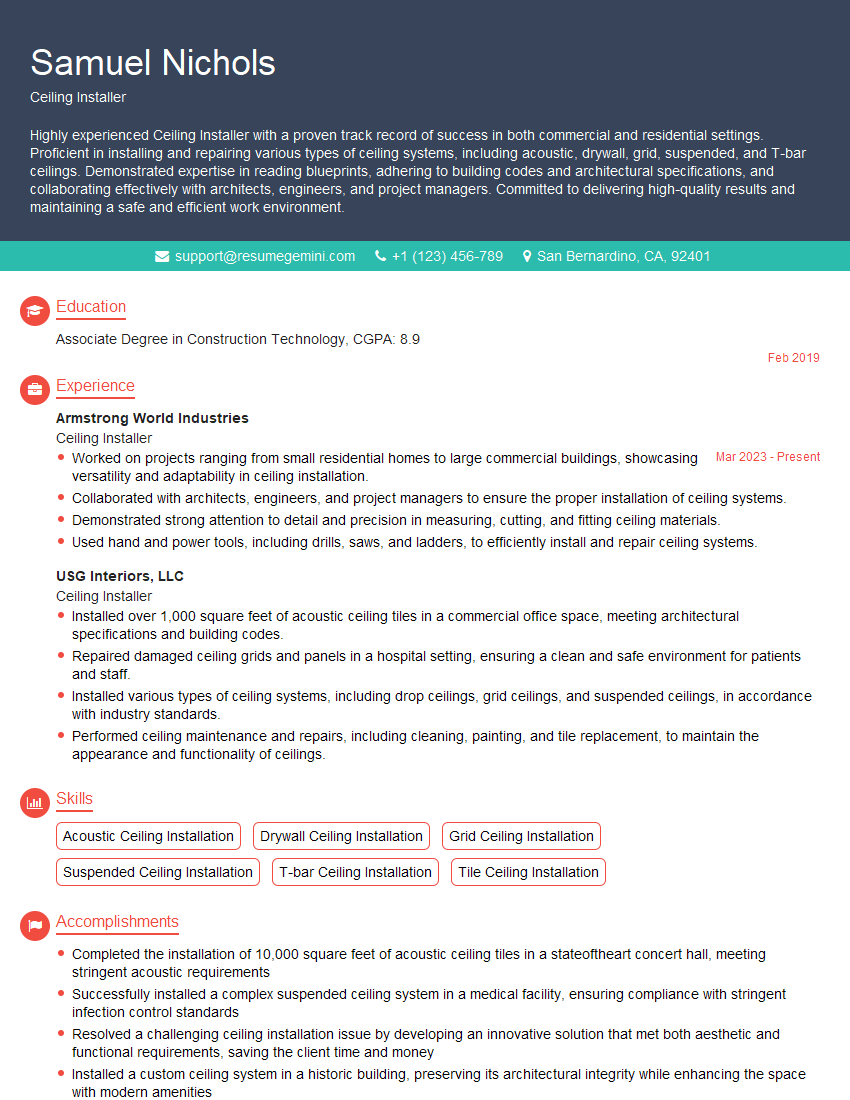
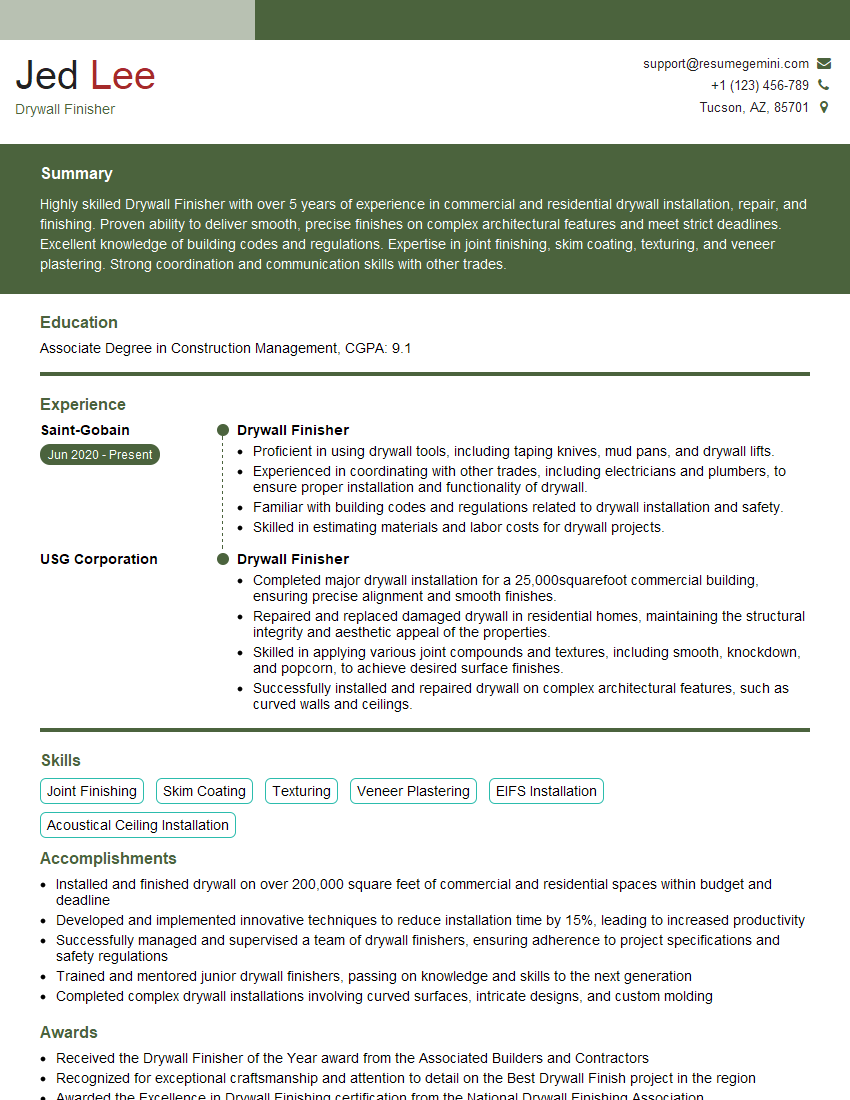
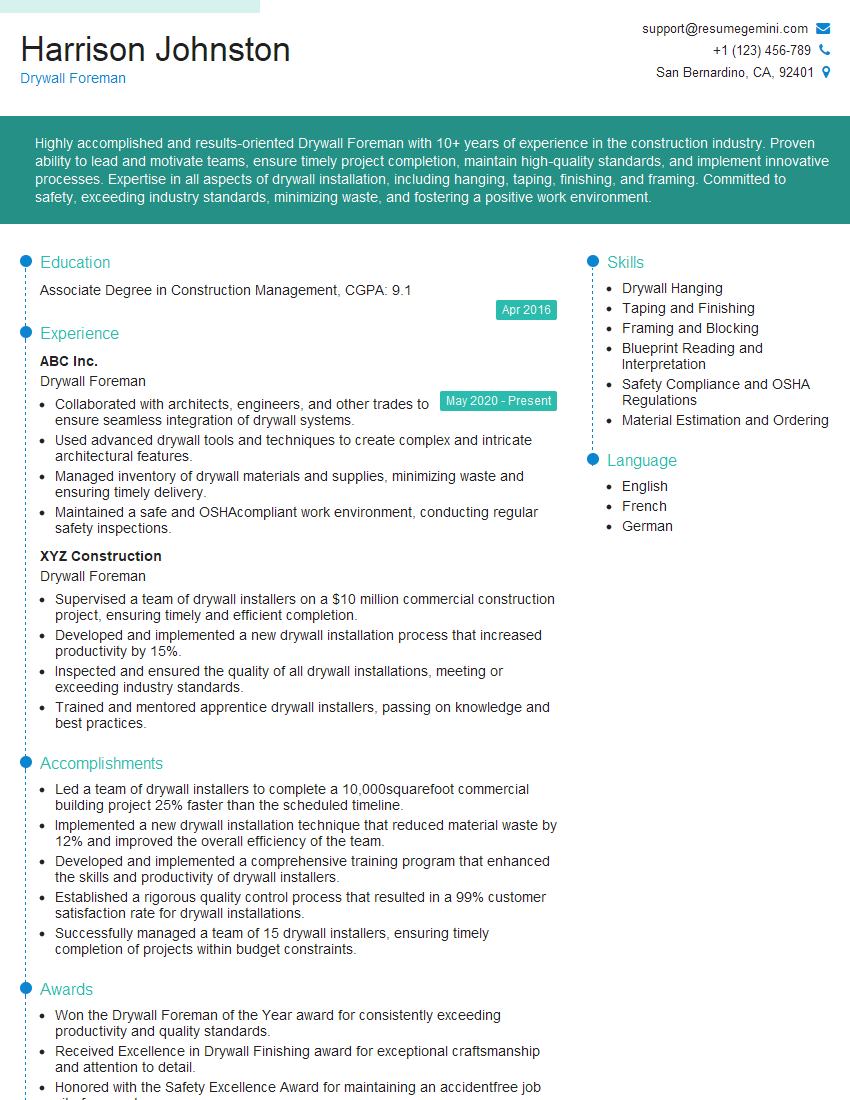
Mastering Drywall Ceiling Installation opens doors to rewarding careers with excellent growth potential. As you advance your skills, your earning potential and job opportunities will increase significantly. To maximize your chances of landing your dream job, creating a strong, ATS-friendly resume is crucial. ResumeGemini is a trusted resource that can help you build a professional resume that showcases your abilities effectively. We provide examples of resumes tailored to Drywall Ceiling Installation to guide you in crafting a compelling application that highlights your qualifications. Invest the time to build a resume that reflects your expertise – it’s an investment in your future.

Explore more articles
Users Rating of Our Blogs
Share Your Experience
We value your feedback! Please rate our content and share your thoughts (optional).
What Readers Say About Our Blog
To the interviewgemini.com Webmaster.
Very helpful and content specific questions to help prepare me for my interview!
Thank you
To the interviewgemini.com Webmaster.
This was kind of a unique content I found around the specialized skills. Very helpful questions and good detailed answers.
Very Helpful blog, thank you Interviewgemini team.