Unlock your full potential by mastering the most common Drywall patching and repair interview questions. This blog offers a deep dive into the critical topics, ensuring you’re not only prepared to answer but to excel. With these insights, you’ll approach your interview with clarity and confidence.
Questions Asked in Drywall patching and repair Interview
Q 1. What types of drywall are you familiar with and their applications?
Drywall, also known as gypsum board, comes in various types, each suited for different applications. The most common are:
- Standard Drywall (1/2 inch): This is the workhorse of drywall, perfect for most interior walls and ceilings. It’s readily available and cost-effective.
- 5/8 inch Drywall: Used where extra strength and sound dampening are needed, such as in hallways, apartment walls, or home theaters. It provides better resistance to impact and sound transmission.
- Moisture-Resistant (MR) Drywall: Specifically designed for areas prone to moisture like bathrooms and kitchens. It has a green-colored core and is treated to resist mold and mildew growth.
- Fire-Resistant (FR) Drywall: Often used in areas requiring higher fire safety standards, such as around fireplaces or in commercial buildings. It’s typically a pink or purple color and contains fire-retardant additives.
- Water-Resistant (WR) Drywall: Offers superior moisture resistance compared to MR drywall, particularly beneficial in areas exposed to high humidity and potential water damage.
Choosing the right type depends on the specific project requirements. For example, I wouldn’t use standard drywall in a shower, but I’d happily use 5/8 inch drywall in a room adjacent to a noisy neighbor to improve soundproofing.
Q 2. Describe the process of patching a small hole in drywall.
Patching a small hole, say less than an inch in diameter, is a straightforward process. Think of it like filling a small pothole. First, you’ll need to ensure the hole is clean and free of loose debris. Then, apply a small amount of lightweight all-purpose joint compound (mud) directly over the hole, slightly feathering the edges to blend with the existing wall. Let it dry completely, sand smooth, and prime before painting.
Step-by-step:
- Clean the hole thoroughly.
- Apply a thin layer of joint compound, feathering the edges.
- Let it dry completely (usually several hours).
- Sand the patch smooth using fine-grit sandpaper.
- Prime the area to ensure proper paint adhesion.
- Paint the patched area.
This simple patch is ideal for small nail holes or minor damage. For larger holes, a different approach is necessary.
Q 3. How do you repair a larger hole in drywall, requiring more than a simple patch?
Repairing larger holes requires more than a simple patch. It’s like putting a new section of road in rather than filling a small crack. We’ll need to create a backing to support the new drywall patch. For holes larger than a few inches, a piece of scrap drywall will be cut to size, fitting snugly into the hole. This backing provides stability and a surface to adhere the finishing compound.
Step-by-step:
- Cut out any damaged drywall, creating clean, straight edges.
- Cut a piece of scrap drywall to fit the hole, slightly larger than the opening.
- Secure the patch using construction adhesive and/or screws.
- Apply several layers of joint compound, allowing each layer to dry completely before applying the next. This process often involves taping the seams with drywall tape for a seamless finish.
- Sand smooth after each layer dries, achieving a flawless surface.
- Prime and paint.
For extremely large holes, multiple layers might be necessary to achieve the desired level of strength and a flat surface before painting.
Q 4. Explain the taping and mudding process for drywall finishing.
Taping and mudding are crucial for achieving a seamless, professional-looking finish after patching or installing new drywall. It’s a multi-step process involving applying drywall tape over seams and joints, then covering it with multiple layers of joint compound, sanding between each layer to create a perfectly smooth surface.
Process:
- Taping: Apply self-adhesive fiberglass tape over the seams or joints.
- First Coat: Apply a thin coat of joint compound over the tape, embedding it completely and feathering the edges.
- Drying and Sanding: Allow the first coat to dry completely, then sand with fine-grit sandpaper.
- Second Coat (and subsequent coats): Apply additional coats of joint compound, sanding between each coat until the surface is smooth and blends seamlessly with the surrounding drywall. Multiple coats ensure strength and prevent cracks.
The key is patience and attention to detail. Rushing the process can lead to imperfections, so let each layer dry fully before sanding.
Q 5. What tools and materials are essential for drywall repair?
The essential tools and materials for drywall repair vary based on the project’s scale, but generally include:
- Drywall Knife (6”, 8”, 12”): For cutting and applying joint compound.
- Putty Knife (flexible): For smaller patches and reaching tight corners.
- Drywall Tape (Fiberglass): To cover seams and create strong joints.
- Joint Compound (Mud): All-purpose or lightweight, depending on the needs.
- Sandpaper (various grits): For smoothing surfaces (e.g., 100, 150, 220 grit).
- Sanding Block or Sponge: For even sanding.
- Measuring Tape and Pencil: For accurate measurements and markings.
- Utility Knife: For cutting drywall.
- Primer: To seal the surface before painting.
- Safety Glasses and Dust Mask: Essential for personal protection.
Having the right tools ensures efficient and high-quality work. For instance, a wider knife is faster for larger areas, while a flexible putty knife is ideal for corners.
Q 6. How do you prepare the surface before applying drywall compound?
Surface preparation is crucial for successful drywall repair. A poorly prepared surface will result in a weak patch that can crack or peel. The process involves cleaning and ensuring the surface is sound.
Preparation steps:
- Clean the Area: Remove any loose debris, dust, or old paint that might interfere with adhesion.
- Remove Loose Material: Scrape away any loose or crumbling drywall to create a solid base.
- Prime (if necessary): Prime bare drywall or previously painted surfaces to enhance adhesion of the joint compound. This is especially important on previously painted areas.
- Ensure Stability: If the hole is large, ensure the drywall backing is secure before applying compound to prevent cracking.
The better the preparation, the better the results. Skipping steps like cleaning or priming can lead to adhesion issues and affect the longevity of your repair.
Q 7. What are the different types of drywall compounds and their uses?
Different types of drywall compounds, or ‘mud,’ are designed for specific purposes. The most common are:
- All-Purpose Compound: A versatile option suitable for most applications, offering a good balance of strength and workability.
- Lightweight All-Purpose Compound: Easier to sand and dries faster than standard all-purpose compound. Excellent for smaller repairs and finishing.
- Taping Compound: Specifically designed for taping joints, providing a strong bond with the tape and setting up nicely for subsequent coats of all-purpose compound.
- Setting-type Compound: Sets up quickly, making it ideal for rapid repairs, but can be more difficult to work with and require more skill.
Choosing the right compound is vital. For instance, I wouldn’t use setting-type compound for a large patch because it sets too quickly, making it hard to create a smooth finish. Lightweight all-purpose compound is my go-to for most patching jobs because of its ease of use and sanding.
Q 8. How do you achieve a smooth, seamless finish after patching?
Achieving a seamless finish after patching drywall requires meticulous attention to detail and the right techniques. It’s like baking a cake – you need the right ingredients and the perfect recipe for a flawless result.
First, you need to ensure the patch is perfectly flush with the surrounding wall. This involves using a high-quality compound, applying thin coats, and allowing ample drying time between each coat. Too much compound at once will crack and shrink, ruining your smooth finish.
Next, sanding is crucial. Start with coarser grit sandpaper (around 80-100 grit) to remove larger imperfections and gradually move to finer grits (up to 220 grit) for a perfectly smooth surface. Always sand in the direction of the light to avoid creating scratches visible under certain lighting conditions. Finally, a light misting of water before the final sanding helps to prevent dust and leaves a superior surface for painting.
After sanding, carefully prime the patched area before painting. This ensures proper adhesion of the paint and prevents uneven absorption which could lead to noticeable patches.
Q 9. How do you match existing drywall texture when patching?
Matching existing drywall texture is a crucial part of any successful patch job. Think of it as a puzzle – you need to perfectly blend the pieces to make the whole picture invisible.
The approach depends entirely on the existing texture. For simple smooth walls, the process is relatively straightforward, focusing on achieving a perfectly flat, sanded surface as mentioned before. However, textured walls demand more finesse. You might need to use specialized tools like a knockdown knife, sponge, or a texture spray to recreate the specific pattern of the surrounding wall.
For example, if the wall has a ‘knockdown’ texture, you’ll need to apply the compound, then use a knockdown knife to create a similar pattern by lightly dragging it across the surface. Experiment on a scrap piece of drywall first to practice the technique and find the right amount of pressure and technique for matching the existing texture. For more complex textures, you may need to source texture matching products and even consider having a professional complete this work.
Q 10. Describe your experience with repairing damaged drywall corners.
Repairing damaged drywall corners requires specialized techniques and materials. Corner bead is essential here—it provides a strong, straight edge and prevents cracking in a high-impact area, much like a reinforcement bar in concrete.
My process typically begins with removing any loose or damaged drywall around the corner. Then, I carefully install the corner bead, ensuring it’s perfectly aligned and firmly attached. I use drywall screws and adhesive to secure it, paying special attention to ensuring it’s flush with the wall. Multiple layers of drywall compound are applied, carefully feathering the edges to blend seamlessly with the wall. This often requires multiple applications and sanding to achieve a smooth finish.
I’ve worked on a variety of corner repairs, from minor nicks and scratches to extensive damage caused by impacts. In cases of significant damage, I might need to replace a section of the drywall completely to maintain structural integrity. One recent job involved a severely damaged corner in a high-traffic hallway. I successfully repaired it using this method, and the client was thrilled with the result—it looked as good as new!
Q 11. How do you handle cracks in drywall?
Cracks in drywall can indicate underlying structural issues, so it’s vital to approach them systematically. A simple hairline crack might just need filling and painting, but larger cracks could signify more serious problems like foundation settling.
My first step is always to assess the crack’s size, depth, and cause. A small crack can be addressed by carefully cleaning the area, applying a flexible compound designed for crack repair (to prevent re-cracking), and sanding smooth. Wider cracks might require opening them slightly (V-notching) to create a wider area for the compound to adhere to. This prevents the compound from cracking or falling out.
For larger, more significant cracks, especially those that show signs of movement, I might recommend consulting a structural engineer to rule out foundation problems. Repairing the crack without addressing the root cause is a waste of time and resources; it’ll likely reappear. The goal is not just to hide the crack but to properly address the underlying issue.
Q 12. What are the common causes of drywall damage?
Drywall damage has several common causes, often stemming from everyday occurrences or underlying structural issues.
- Impact Damage: This is the most frequent cause, resulting from moving furniture, dropped objects, or accidental bumps.
- Water Damage: Leaks from pipes, roofs, or appliances can cause significant damage, leading to swelling, discoloration, and mold growth.
- Structural Issues: Foundation settling, shifting soil, or inadequate framing can create cracks and stress on the drywall.
- Age and Wear: Over time, drywall can become brittle and prone to cracking, especially in areas with frequent temperature fluctuations.
- Improper Installation: Poorly installed drywall is more susceptible to damage and cracking.
Understanding these common causes allows for a more proactive approach to both preventing damage and implementing appropriate repairs.
Q 13. How do you repair water-damaged drywall?
Water-damaged drywall is a serious issue that requires immediate attention, as it can lead to mold growth and structural problems. It’s not enough just to patch the surface—you must deal with the cause of the damage first.
The first step is to identify and address the source of the leak. Once the source is fixed, all water-damaged drywall must be removed. This might involve cutting out larger sections, depending on the extent of the damage. This is vital to prevent mold problems later on.
After removing the affected drywall, the area needs to be thoroughly dried and treated with a mold inhibitor. Then, new drywall is installed, ensuring proper insulation and vapor barriers where necessary. The repair should then be finished with appropriate joint compound, sanding and priming before painting. In severe cases where structural issues exist, a professional contractor experienced in water damage restoration should be consulted.
Q 14. Explain your process for repairing drywall around electrical outlets.
Repairing drywall around electrical outlets requires extra caution, and safety must always come first. Always switch off the power at the breaker box before starting any work near electrical wiring or outlets.
My process involves carefully removing the outlet cover plate. Then, I gently remove the outlet itself from the electrical box. This might require loosening the screws securing the outlet, but I always double-check that the power is off to ensure my safety. If there’s any damage to the drywall behind the outlet, I’ll carefully patch it, taking care not to damage the wiring. It’s important to ensure the area is completely dry and cured. Then, I reinstall the outlet, making sure it’s securely fastened, and then carefully replace the cover plate.
This careful approach ensures that the electrical system remains safe and functional while the repair looks neat and professional. I always emphasize the importance of electrical safety to clients and clearly indicate any situation where I deem a qualified electrician to be necessary.
Q 15. How do you handle damaged drywall around windows and doors?
Damaged drywall around windows and doors requires careful attention to detail. The key is to ensure a seamless blend with the existing wall. I start by assessing the damage – is it a small crack, a larger hole, or water damage? This dictates my approach. For small cracks, a simple patching compound and careful sanding might suffice. For larger holes, I’ll need to cut out the damaged section, creating a clean, square opening. This ensures a solid base for the repair. Then I’ll install a backing of drywall to support the patch, ensuring a secure and even surface. I prefer using fiberglass tape for its strength and flexibility around curves. Once the tape is embedded and the compound is applied and dried, I’ll carefully sand to a smooth finish, feathering the edges to create an invisible repair. Finally, I’ll prime and paint to match the existing wall perfectly.
For example, if I encounter water damage, I’ll first address the source of the moisture to prevent further damage. After ensuring the area is completely dry, I might need to replace a larger section of drywall, adding a vapor barrier to prevent future water damage. Remember, proper preparation is key for a lasting repair around sensitive areas like windows and doors.
Career Expert Tips:
- Ace those interviews! Prepare effectively by reviewing the Top 50 Most Common Interview Questions on ResumeGemini.
- Navigate your job search with confidence! Explore a wide range of Career Tips on ResumeGemini. Learn about common challenges and recommendations to overcome them.
- Craft the perfect resume! Master the Art of Resume Writing with ResumeGemini’s guide. Showcase your unique qualifications and achievements effectively.
- Don’t miss out on holiday savings! Build your dream resume with ResumeGemini’s ATS optimized templates.
Q 16. What safety precautions do you take while performing drywall repairs?
Safety is paramount in any drywall repair project. I always start by wearing appropriate personal protective equipment (PPE), including safety glasses to protect my eyes from dust and debris, a dust mask or respirator to prevent inhaling drywall dust (which can be harmful), and work gloves to protect my hands. I also ensure the work area is well-lit and free of obstructions to prevent tripping or falls. When using power tools like a sanding machine, I always make sure to wear hearing protection to reduce noise-induced hearing loss. For larger projects, I use proper fall protection if working at heights and always ensure proper ventilation to mitigate the effects of dust and fumes. Before starting any electrical work, I always turn off the power to the affected area to avoid the risk of electric shock.
I treat every project as a potential hazard and consistently prioritize safety to ensure both my own well-being and the safety of those around me. A safe workplace is an efficient workplace.
Q 17. Describe your experience with different drywall finishing techniques.
My experience encompasses a wide range of drywall finishing techniques. I’m proficient in applying different types of joint compound, from lightweight all-purpose compounds for smaller repairs to heavier compounds for larger, more demanding jobs. I can apply the compound using various tools, including knives of different widths, ensuring a smooth and even finish. I’m skilled in creating a variety of joint finishes – from a simple, flat finish to more advanced techniques such as a textured finish to match existing walls. I know when to use different techniques such as taping, coating, and sanding depending on the desired outcome. I’m also skilled in using specialized tools to achieve specific textures or effects, such as using a hawk and knife for large areas or a taping knife for detailed work. I’ve worked on various projects, from simple patching to more intricate jobs involving multiple coats and advanced finishing techniques, consistently striving for a flawless result.
For instance, I’ve worked on projects requiring a ‘knockdown’ texture, where the compound is applied thickly and then carefully ‘knocked down’ with a special tool to create a textured surface. Conversely, I’ve also worked on projects demanding a smooth, flawless finish requiring multiple coats and meticulous sanding to achieve a seamless blend.
Q 18. How do you troubleshoot common drywall patching problems?
Troubleshooting drywall patching problems often involves carefully analyzing the problem. Common issues include cracks reappearing, uneven surfaces, or poor adhesion. Cracks reappearing often indicate movement in the wall; addressing the underlying structural issue is crucial, not just patching the symptom. Uneven surfaces are typically due to insufficient sanding or uneven compound application; multiple thin coats are generally better than one thick coat. Poor adhesion may be caused by using the wrong compound, not properly preparing the surface, or applying the compound in unsuitable conditions (e.g., too cold or humid). I would typically investigate these potential causes systematically to pinpoint the source of the problem and implement the necessary correction. For example, if cracks keep reappearing, I would inspect the framing for movement or weakness.
I approach troubleshooting methodically, asking myself questions like: What type of compound was used? Was the surface properly cleaned and primed? Were the instructions followed correctly? Answering these questions helps me determine the cause and the appropriate remedy. Documenting the steps I take helps me avoid repeating mistakes in future projects.
Q 19. How do you determine the appropriate compound consistency for different applications?
The consistency of the joint compound is crucial for achieving a successful repair. Too thick, and it’s difficult to apply smoothly; too thin, and it lacks the necessary strength. The desired consistency varies depending on the application. For taping, a thinner consistency is ideal for easy application and to avoid creating bumps under the tape. For topping coats, a slightly thicker consistency offers better fill and coverage. I judge consistency by the way the compound flows off the knife. For taping, it should be smooth and spread easily, whilst for topping, it needs to have more body. I always mix small batches to avoid wasted material. I’ll adjust the water content, adding it incrementally until I reach the desired consistency for the specific task. Always mix thoroughly to prevent lumps.
Experience allows me to intuitively judge the correct consistency, but for larger or particularly critical projects, I might test a small amount on a scrap piece of drywall to ensure I have the right mix before starting the main work.
Q 20. What are the limitations of different drywall repair methods?
Different drywall repair methods have their limitations. For example, simple patching is only suitable for small holes and cracks. Larger holes require more extensive repairs involving cutting out the damaged section and installing a backing. Certain methods may not be suitable for areas with high humidity or moisture, and in such cases, specialized moisture-resistant compounds and techniques are necessary. Textured finishes can successfully camouflage minor imperfections, but they might not be appropriate for areas requiring a perfectly smooth finish. In addition, some repair methods might not be suitable for specific types of drywall, like those with a different core composition.
Understanding these limitations is critical for choosing the right method for a given situation. For instance, attempting a simple patch on a large hole will likely result in an unsatisfactory and unstable repair. Therefore, thorough assessment of the damage and the specific environment is paramount in selecting the most appropriate repair method.
Q 21. How do you manage a large-scale drywall repair project?
Managing a large-scale drywall repair project requires careful planning and organization. I’d start by conducting a thorough assessment of the damage, creating a detailed plan outlining the scope of work, required materials, and timeline. This would involve creating a detailed layout of the affected areas, determining the type of repairs needed, and calculating the quantities of materials, tools, and labor required. I’d create a schedule of work, breaking down the project into smaller, manageable tasks, and allocate resources accordingly. I would ensure effective communication and collaboration with all team members. A clear chain of command, regular progress checks, and appropriate safety measures will be established and maintained. I’d ensure proper waste disposal, adhering to all environmental regulations. Quality control is essential, with regular inspections to ensure the work meets the required standards.
For example, on a large-scale project involving an entire apartment building, I would divide the project into sections or floors, assigning teams to each area. This would allow for parallel work streams, accelerating the overall project completion time. Throughout the process, I’d maintain clear documentation, including daily reports, material usage logs, and a record of any issues or challenges encountered. Proper documentation is key for project accountability and financial tracking.
Q 22. Describe your experience with different types of drywall textures.
My experience with drywall textures is extensive, encompassing the most common types found in residential and commercial settings. Understanding texture is crucial for achieving seamless repairs. Here are a few examples:
- Orange Peel: This is a very common texture, characterized by small, roughly spherical bumps. Matching this texture requires careful application of the compound and a specific technique to mimic the size and distribution of the existing texture. I typically use a knockdown knife for this, varying the pressure to control the texture.
- Knockdown: Similar to orange peel, but the peaks of the texture are ‘knocked down’ with a tool, resulting in a smoother, less pronounced texture. Achieving a perfect match here involves understanding the degree of knockdown; it’s a balance between smoothness and texture.
- Skip Trowel: This texture is created by dragging a trowel across the mud in a less controlled manner, creating more prominent and irregular peaks and valleys. Matching this requires a more artistic approach, often involving multiple passes with the trowel and a practiced hand.
- Smooth: While seemingly simple, achieving a perfectly smooth finish requires exceptional skill and attention to detail. It necessitates multiple coats of compound, careful sanding, and careful feathering to avoid creating any visible imperfections.
I’ve worked with many other textures over the years, and I always take detailed notes and photos to ensure a precise match during repairs. Each project presents its unique challenges, and successfully matching existing textures is a true testament to a skilled drywall finisher.
Q 23. How do you clean up after completing a drywall repair job?
Clean-up is a critical aspect of any professional drywall repair job. It’s just as important as the repair itself; a messy jobsite reflects poorly on the quality of the work. My clean-up process is meticulous and always includes these steps:
- Removal of Debris: I meticulously remove all drywall dust and debris using a shop vacuum with a HEPA filter. This is crucial for capturing fine dust particles, which can cause respiratory problems and settle on other surfaces.
- Surface Cleaning: After vacuuming, I use a damp cloth or sponge to wipe down all surfaces, removing any remaining dust or compound residue. I pay special attention to floor surfaces, door frames, and windowsills.
- Waste Disposal: All waste materials, including drywall scraps, compound buckets, and sanding materials, are properly bagged and disposed of according to local regulations (more on this below).
- Final Inspection: A final walkthrough ensures the area is spotless and ready for the client.
I take pride in leaving a work area cleaner than I found it. It shows professionalism and respect for the client’s property.
Q 24. What are the proper disposal methods for drywall waste?
Proper disposal of drywall waste is crucial for environmental reasons and adherence to local regulations. Drywall contains gypsum, which is not easily biodegradable. My process follows these guidelines:
- Separate Waste Streams: I always separate drywall scraps from other construction debris. This simplifies recycling and reduces landfill waste.
- Recycling: Many municipalities offer drywall recycling programs. I contact my local waste management authority to confirm availability and drop-off locations. Often, clean scraps can be reused for smaller projects.
- Landfill Disposal (as a last resort): If recycling isn’t an option, I ensure drywall scraps are properly bagged and disposed of at a licensed landfill that accepts this type of material. I would never simply dump it.
Compliance with waste disposal regulations is not only environmentally responsible but also a legal requirement. Ignoring these procedures can lead to significant fines.
Q 25. What is your experience with using specialized tools, like a taping knife or a drywall sander?
I am proficient in using a wide range of specialized drywall tools. My experience includes:
- Taping Knives: I use a variety of taping knives, from 4-inch knives for initial taping to 12-inch knives for broader applications. Selecting the appropriate knife size is key to achieving smooth, even coats of joint compound. I understand how to use different angles and pressure to achieve the best results for different textures.
- Drywall Sanders: I utilize both manual and electric drywall sanders. The manual sanding block is ideal for smaller areas and for getting into tight corners. The electric sander, however, provides efficiency for larger areas, but requires careful control to avoid creating sanding marks and scratches.
- Putty Knives: Various sizes are essential for applying compound accurately, removing excess material, and achieving precise finishes. I’m comfortable with all kinds of putty knives, from flexible ones to more rigid ones.
- Other Tools: Beyond these, I am experienced with tools like joint compound mixing tools, corner rollers for taping inside corners, and various types of spatulas for creating different textures.
Understanding the appropriate tools for each task, and maintaining them properly, is crucial for creating high-quality drywall repairs.
Q 26. How do you ensure the repaired area is properly primed and painted?
Proper priming and painting are essential for the longevity and appearance of any drywall repair. I always ensure these steps are followed:
- Surface Preparation: Before priming, the repaired area must be completely dry and free of dust and debris. Any imperfections are addressed before the next step.
- Primer Application: I apply a high-quality primer designed for drywall, ensuring full coverage of the repaired area. This prevents the underlying patch from showing through the final paint coat and provides a uniform surface for painting.
- Paint Application: Once the primer is dry, I apply the appropriate paint, matching the existing wall color as closely as possible. Multiple thin coats are better than one thick coat, ensuring complete coverage and a professional finish.
- Feathering: This crucial step ensures a seamless blend between the patched area and surrounding wall. Careful attention is paid to creating a smooth, gradual transition, thereby making the repair virtually invisible.
Choosing the right primer and paint is essential. Using a high-quality product guarantees a long-lasting result and avoids problems like peeling or cracking.
Q 27. How do you estimate the time and materials needed for a drywall repair project?
Estimating time and materials is a critical skill for any drywall professional. My approach is systematic and incorporates the following steps:
- Assessment of Damage: I carefully assess the size and nature of the damage. This includes determining the area requiring repair, the depth of the damage, and the complexity of the texture match.
- Material Calculation: Based on the assessment, I estimate the quantity of joint compound, primer, paint, and other necessary materials. I always overestimate slightly to account for unforeseen circumstances.
- Time Estimation: Experience allows me to accurately estimate the time required for each stage of the process: preparation, patching, sanding, priming, and painting. I factor in potential delays and complications.
- Contingency Planning: I always build a buffer into both the time and material estimates. This ensures I am prepared for unexpected issues and can deliver the project on time and within budget.
Accurate estimation is vital for providing clients with realistic quotes and managing the project effectively.
Q 28. What is your experience with working on various building materials alongside drywall?
Drywall repair often involves working alongside various other building materials. My experience includes working with:
- Wood: Repairing damaged areas around window and door frames often requires working with wood. I’m skilled in ensuring a proper seal and smooth transition between the drywall and wood surfaces.
- Plaster: I have experience working with older plaster walls, understanding the unique challenges and repair techniques required for this material. Repairing plaster requires different techniques and materials than drywall.
- Concrete: In some situations, drywall repair might involve working with concrete, such as around basement walls. I am familiar with appropriate methods for ensuring a secure and lasting bond.
- Metal Stud Framing: A solid understanding of metal framing is essential for identifying and addressing framing issues that could compromise the integrity of the repair.
The ability to work effectively with various materials ensures a holistic approach to repairs, leading to durable and aesthetically pleasing results. It shows adaptability and a comprehensive understanding of construction practices.
Key Topics to Learn for Drywall Patching and Repair Interviews
- Understanding Drywall Types: Familiarize yourself with different drywall types (e.g., standard, fire-resistant, moisture-resistant) and their properties. Knowing the right material for a specific job is crucial.
- Surface Preparation Techniques: Master the art of preparing the damaged area. This includes cleaning, removing loose debris, and ensuring a smooth, stable base for patching.
- Patching Methods: Learn various patching techniques for different sized holes and damage types, from small nail holes to larger sections requiring compound layering and sanding.
- Compound Application and Finishing: Understand the proper techniques for applying drywall compound, including feathering edges for a seamless finish. Practice achieving a smooth, paintable surface.
- Sanding and Finishing Techniques: Master the use of sanding tools and techniques to achieve a perfectly smooth surface ready for paint. This requires understanding grit selection and avoiding sanding through the patch.
- Tool Knowledge and Maintenance: Demonstrate familiarity with common tools used in drywall repair (putty knives, sanding tools, mixing buckets) and their proper maintenance.
- Problem-Solving and Troubleshooting: Be prepared to discuss common problems encountered during drywall repair (e.g., cracking, uneven surfaces, improper drying) and how to effectively troubleshoot and resolve them.
- Safety Procedures and Regulations: Highlight your understanding of relevant safety procedures, including proper use of personal protective equipment (PPE) and adherence to workplace safety regulations.
- Estimating and Costing: For more advanced roles, demonstrate your ability to estimate materials and labor costs for various drywall repair projects.
Next Steps
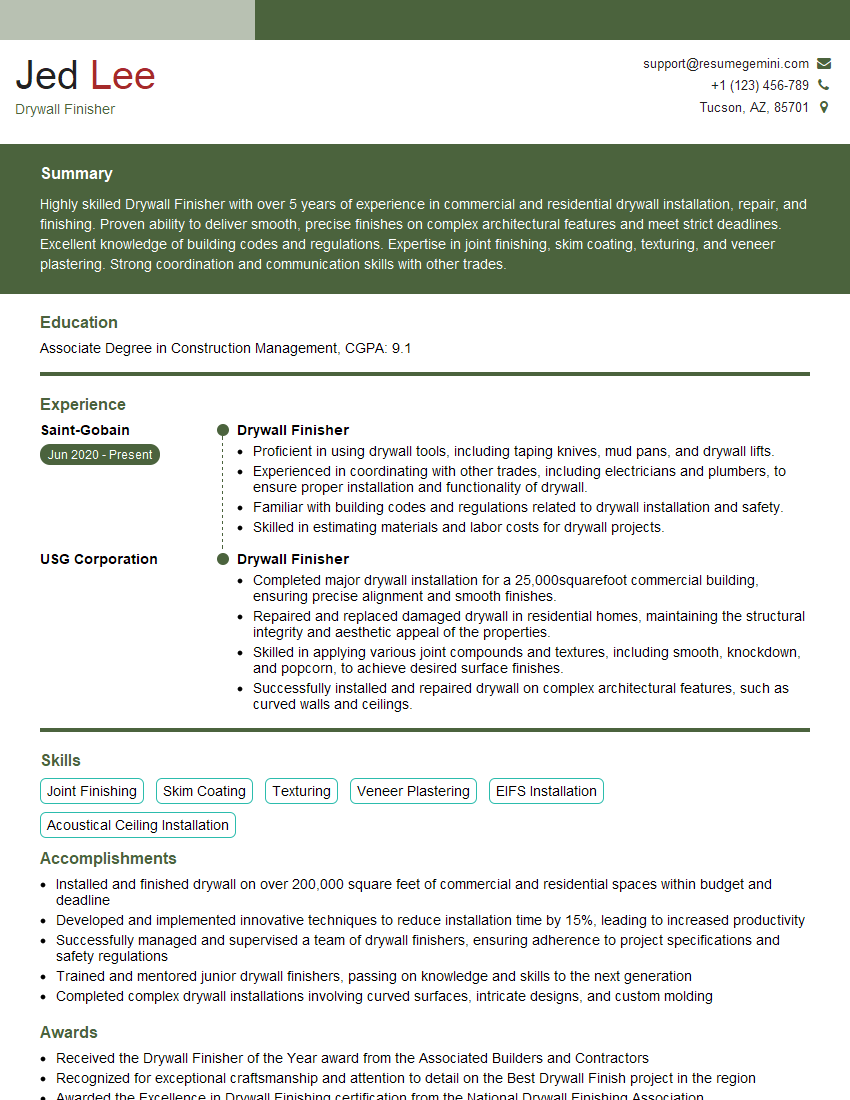
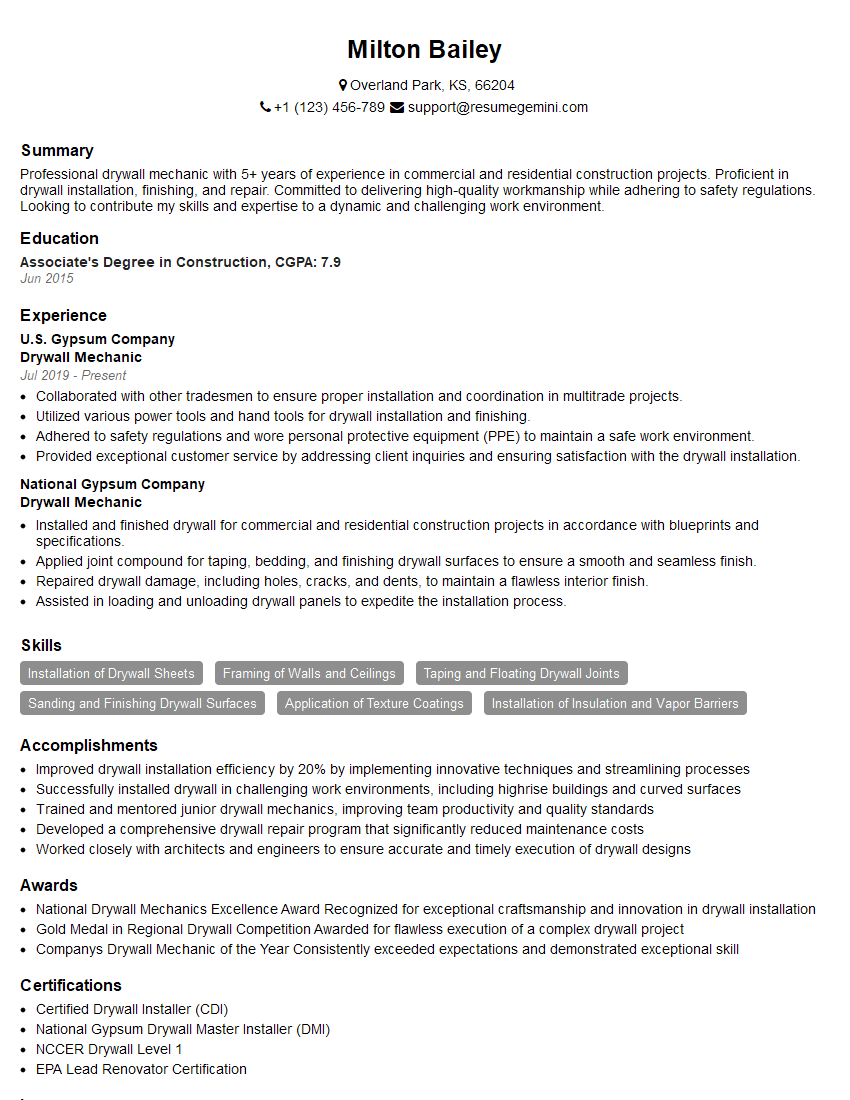
Mastering drywall patching and repair opens doors to a rewarding career with excellent growth potential. This skill is highly sought after in construction, renovation, and property maintenance fields, offering opportunities for specialization and advancement. To maximize your job prospects, it’s vital to create a strong, ATS-friendly resume that highlights your abilities effectively. ResumeGemini is a trusted resource to help you build a professional resume that gets noticed. We provide examples of resumes tailored specifically to drywall patching and repair to guide you.

Explore more articles
Users Rating of Our Blogs
Share Your Experience
We value your feedback! Please rate our content and share your thoughts (optional).
What Readers Say About Our Blog
To the interviewgemini.com Webmaster.
Very helpful and content specific questions to help prepare me for my interview!
Thank you
To the interviewgemini.com Webmaster.
This was kind of a unique content I found around the specialized skills. Very helpful questions and good detailed answers.
Very Helpful blog, thank you Interviewgemini team.