Unlock your full potential by mastering the most common DWDM Technology interview questions. This blog offers a deep dive into the critical topics, ensuring you’re not only prepared to answer but to excel. With these insights, you’ll approach your interview with clarity and confidence.
Questions Asked in DWDM Technology Interview
Q 1. Explain the principles of Dense Wavelength Division Multiplexing (DWDM).
Dense Wavelength Division Multiplexing (DWDM) is a technology that significantly increases the capacity of optical fibers by transmitting multiple wavelengths of light simultaneously over a single fiber. Imagine a highway with only one lane – that’s a single-wavelength system. DWDM is like adding many lanes to that highway, each carrying a different wavelength of light, all travelling at the same time. Each wavelength carries an independent data stream, dramatically increasing the overall bandwidth.
The principle lies in using multiple lasers, each emitting light at a slightly different wavelength within a specific optical window. These wavelengths are carefully spaced to avoid interference. Specialized optical components like multiplexers combine these wavelengths into a single fiber, and demultiplexers separate them at the receiving end. The close spacing of wavelengths is what makes it ‘dense,’ allowing for a very large number of channels within a limited spectral range.
For example, a typical DWDM system might use 80 or even more wavelengths, each carrying 10 Gbps or 40 Gbps of data. This translates to terabits per second (Tbps) of total capacity over a single fiber, compared to a few gigabits per second (Gbps) with traditional single-wavelength systems.
Q 2. What are the advantages of DWDM over traditional wavelength-division multiplexing (WDM)?
DWDM offers several key advantages over traditional WDM:
- Higher Capacity: DWDM utilizes much closer wavelength spacing, leading to significantly more channels and a higher overall capacity per fiber. Traditional WDM systems had wider spacing between wavelengths, limiting the number of channels.
- Cost-Effectiveness: By leveraging existing fiber infrastructure and increasing its capacity, DWDM provides a cost-effective solution for expanding network bandwidth. Laying new fiber is expensive and time-consuming; DWDM avoids this.
- Longer Reach: Advanced DWDM systems, with the help of optical amplifiers, can transmit signals over much longer distances before requiring regeneration, reducing the need for intermediate repeaters.
- Scalability: DWDM systems are highly scalable, allowing for easy upgrades and additions of wavelengths as bandwidth demands increase. This makes them adaptable to future network growth.
In essence, DWDM offers a superior blend of capacity, cost-efficiency, and reach compared to traditional WDM, making it the preferred technology for long-haul and metro optical networks.
Q 3. Describe different modulation formats used in DWDM systems and their trade-offs.
Several modulation formats are used in DWDM systems, each with its trade-offs:
- On-Off Keying (OOK): This is the simplest format, where light is either on or off representing a binary 1 or 0. It’s simple to implement but less spectrally efficient and susceptible to noise.
- Binary Phase-Shift Keying (BPSK): BPSK uses the phase of the light wave to encode data, offering better spectral efficiency than OOK. It’s a good compromise between simplicity and performance.
- Quadrature Phase-Shift Keying (QPSK): QPSK uses four different phases to represent data, further improving spectral efficiency compared to BPSK. It offers higher data rates but is more sensitive to noise and requires more complex signal processing.
- Higher-order Modulation Formats (e.g., 16-QAM, 64-QAM): These formats use more phases and amplitudes to encode data, achieving very high spectral efficiency. However, they are much more sensitive to noise and impairments, requiring advanced signal processing techniques and sophisticated equipment.
The choice of modulation format depends on the desired balance between data rate, spectral efficiency, and tolerance to noise and impairments. Higher-order modulation is often employed in high-capacity long-haul networks where spectral efficiency is paramount, but simpler formats might be sufficient for shorter-reach or lower-capacity applications.
Q 4. Explain the role of optical amplifiers in DWDM systems.
Optical amplifiers play a crucial role in DWDM systems by compensating for signal loss due to attenuation in the optical fiber. Over long distances, the light signal weakens significantly, making it difficult to receive a clear signal at the destination. Optical amplifiers boost the signal’s power, allowing it to travel much farther without the need for frequent regeneration. This is crucial for cost-effectiveness and scalability in long-haul DWDM networks.
They work by adding photons (light particles) to the signal, thereby increasing its intensity. This is done without converting the optical signal into an electrical signal, thereby avoiding the bottlenecks and signal degradation associated with optoelectronic conversion.
Imagine a relay race – each runner (optical amplifier) boosts the baton (optical signal) before passing it to the next runner, allowing the baton to reach the final destination.
Q 5. What are the different types of optical amplifiers used in DWDM networks?
Two main types of optical amplifiers are commonly used in DWDM systems:
- Erbium-doped fiber amplifiers (EDFAs): These are the most prevalent type and are particularly well-suited for the C-band (1530-1565 nm) and L-band (1570-1610 nm) wavelengths commonly used in DWDM. EDFAs amplify the signal by stimulating emission of light from erbium ions doped into a special type of optical fiber.
- Raman amplifiers: Raman amplifiers use the Raman scattering effect to amplify the signal. They are more flexible than EDFAs and can be used to amplify a wider range of wavelengths, but they typically require higher pump power.
The choice between EDFA and Raman amplifiers depends on several factors, including the wavelength range, required amplification, and cost constraints. Often, a hybrid approach employing both types is used to optimize performance and efficiency.
Q 6. How does dispersion affect DWDM transmission, and how is it mitigated?
Dispersion in optical fibers is a phenomenon that causes different wavelengths of light to travel at slightly different speeds. This leads to signal distortion and broadening over long distances, impacting the quality of the received signal in a DWDM system. Think of a group of runners starting a race at the same time, but some running faster than others – they’ll arrive at the finish line at different times, making it difficult to judge who won.
Mitigation strategies include:
- Dispersion-compensating fibers (DCFs): These fibers have opposite dispersion characteristics to standard fibers, effectively canceling out the dispersion effects. They are often spliced into the transmission line to compensate for the dispersion of standard fibers.
- Dispersion-compensating modules (DCMs): These are compact modules containing DCFs or other dispersion-compensating elements that can be easily added to the system.
- Digital Signal Processing (DSP): Advanced DSP techniques can be used to correct for dispersion effects in the received signal. This method is becoming increasingly important in high-capacity DWDM systems.
Careful design and implementation of these mitigation techniques are crucial for ensuring high-quality transmission in DWDM systems, especially over long distances.
Q 7. Explain the concept of chromatic dispersion and its impact on DWDM systems.
Chromatic dispersion is a specific type of dispersion caused by the variation in the refractive index of the optical fiber with wavelength. Different wavelengths of light travel at slightly different speeds within the fiber, leading to pulse broadening and ultimately, signal degradation. This is especially problematic in DWDM systems because multiple wavelengths are transmitted simultaneously, and their differential delays due to chromatic dispersion can lead to interference and data loss.
Imagine sending a bunch of differently colored marbles down a slightly uneven slide. The marbles will arrive at the bottom at slightly different times, causing them to bunch up or spread out. This is similar to how chromatic dispersion affects different wavelengths in an optical fiber.
The impact on DWDM systems is significant, as it limits the maximum transmission distance and the achievable data rate. Mitigation strategies, as discussed in the previous answer (using DCFs, DCMs, and DSP), are essential to overcome the limitations imposed by chromatic dispersion and enable high-capacity long-haul DWDM transmission.
Q 8. What is polarization-mode dispersion (PMD), and how does it impact DWDM transmission?
Polarization-Mode Dispersion (PMD) is a phenomenon in optical fibers where two polarization states of light travel at slightly different speeds. Imagine sending two identical twins down a slightly uneven slide; one might reach the bottom just a fraction of a second before the other. This difference in arrival time, caused by the fiber’s imperfections, leads to pulse broadening and ultimately limits the transmission distance and data rate in a DWDM system. In DWDM, where many wavelengths are multiplexed onto a single fiber, PMD affects each wavelength independently, leading to inter-symbol interference and errors in the received signal. The impact of PMD is more pronounced at higher data rates and longer transmission distances. For instance, a small PMD value might be tolerable for 10G transmission over short distances, but becomes a significant problem for 400G over long-haul links.
Q 9. Describe different methods for compensating for chromatic dispersion and PMD.
Chromatic dispersion and PMD are compensated for using different techniques. Chromatic dispersion, caused by the different speeds of different wavelengths of light, is typically compensated using Dispersion Compensating Fibers (DCFs). These specialized fibers have the opposite dispersion characteristics to the transmission fiber, effectively canceling out the dispersion. Another method is using digital signal processing (DSP) techniques, where algorithms in the transceiver compensate for the dispersion effects in the received signal. PMD, on the other hand, is more challenging to compensate. One common approach uses Polarization Mode Dispersion Compensators (PMDCs) which are devices containing sections of fiber with adjustable polarization properties that are used to align and equalize the arrival times of the two polarization modes. Similar to chromatic dispersion, DSP techniques can also be applied to mitigate the effects of PMD. Advanced techniques combine both fiber-based and DSP-based compensation for optimal performance.
Q 10. Explain the concept of optical signal-to-noise ratio (OSNR) and its importance in DWDM systems.
Optical Signal-to-Noise Ratio (OSNR) is a crucial metric in DWDM systems, representing the ratio of the optical signal power to the noise power in the optical signal. Think of it like listening to music: a high OSNR means the music (signal) is loud and clear, while a low OSNR means the music is drowned out by background noise (noise). In DWDM, noise can come from various sources, including amplified spontaneous emission (ASE) noise from optical amplifiers, and it degrades the quality of the transmitted signal. A low OSNR leads to bit errors and ultimately impacts the system’s performance. Maintaining a sufficient OSNR is essential to ensure reliable transmission; the required OSNR threshold depends on the transmission rate, modulation format, and the desired bit error rate.
Q 11. What are the key performance indicators (KPIs) for a DWDM network?
Key Performance Indicators (KPIs) for a DWDM network include:
- Bit Error Rate (BER): The number of bit errors per bit transmitted. A lower BER indicates better performance.
- Optical Signal-to-Noise Ratio (OSNR): As explained earlier, this measures the signal quality.
- Availability: The percentage of time the network is operational.
- Latency: The delay in signal transmission.
- Throughput: The amount of data transmitted per unit of time.
- Error-free seconds (EFS): a measure of continuous error-free operation.
- Mean Time Between Failures (MTBF): The average time between equipment failures.
Q 12. How does optical add/drop multiplexing (OADM) work in a DWDM network?
Optical Add/Drop Multiplexing (OADM) allows selective addition and removal of optical signals from a DWDM wavelength multiplexed signal without the need to demultiplex the entire signal. Imagine a highway with multiple lanes (wavelengths); an OADM acts like an on-ramp and off-ramp, allowing specific vehicles (optical signals) to join or leave the highway without affecting the other traffic. This is achieved using wavelength-selective switches controlled either electronically or optically. This greatly enhances flexibility and reduces the cost of DWDM networks. An OADM allows for granular network control, making it possible to add or drop specific wavelengths in a specific location, optimizing network resources and adding flexibility.
Q 13. Describe the function of an optical transceiver in a DWDM system.
An optical transceiver is the crucial interface between an optical fiber network and the electronic equipment. It converts electrical signals into optical signals for transmission and vice versa at the receiving end. In a DWDM system, the transceiver performs several important functions, including:
- Modulation and Demodulation: Converting electrical data into an optical signal and vice-versa.
- Wavelength Selection: Selecting a specific wavelength for transmission or reception.
- Optical Power Control: Adjusting the power of the transmitted signal to optimize performance.
- Digital Signal Processing (DSP): Compensating for signal impairments like dispersion and noise.
Q 14. Explain the difference between coherent and direct-detect optical transmission.
The main difference between coherent and direct-detect optical transmission lies in how the receiver processes the received optical signal. In direct-detect systems, the receiver simply measures the power of the received optical signal. It’s like measuring the brightness of a light bulb. This is simpler and less expensive, but it’s limited in its ability to handle signal impairments. Coherent detection, on the other hand, utilizes more complex techniques to measure the amplitude, phase, and polarization of the received optical signal. It’s like analyzing the light wave in detail. This approach allows for more sophisticated signal processing and compensation for impairments, enabling higher data rates and longer transmission distances. Coherent transmission systems are typically used in high-capacity long-haul DWDM networks, while direct-detect systems are commonly used in shorter-reach and lower-capacity applications. An analogy would be comparing a basic radio receiver (direct detection) with a sophisticated satellite receiver (coherent detection) which can receive weaker signals and withstand interference more effectively.
Q 15. What are the challenges associated with long-haul DWDM transmission?
Long-haul DWDM transmission, while offering immense bandwidth capacity over vast distances, faces several significant challenges. These challenges primarily stem from the inherent limitations of optical fiber and the need to maintain signal integrity across hundreds or even thousands of kilometers.
- Fiber Nonlinearities: As optical signals travel long distances, various nonlinear effects like Stimulated Raman Scattering (SRS) and Stimulated Brillouin Scattering (SBS) can distort the signal, leading to power loss and inter-channel interference. This is especially problematic at higher data rates and with dense wavelength division multiplexing.
- Chromatic Dispersion: Different wavelengths of light travel at slightly different speeds in optical fiber, causing pulse broadening and ultimately signal degradation. This effect becomes more pronounced over longer distances and at higher bit rates.
- Polarization Mode Dispersion (PMD): The polarization of light can change as it travels through the fiber, causing signal distortion. This is a random effect, making it difficult to compensate completely.
- Attenuation: Optical signals lose power as they travel through the fiber due to absorption and scattering. This necessitates the use of optical amplifiers at regular intervals along the transmission path, adding complexity and cost.
- Component Limitations: The quality and performance of optical components like lasers, modulators, and receivers are crucial. Any limitations or imperfections in these components can impact the overall system performance and limit the reach of the DWDM system.
- Environmental Factors: External factors such as temperature fluctuations and physical stress on the fiber can affect signal quality and require robust system design to mitigate these effects.
Addressing these challenges often involves employing sophisticated techniques like dispersion compensation, coherent detection, and advanced signal processing algorithms. The choice of optical fiber type (e.g., single-mode, dispersion-shifted) also plays a vital role in optimizing performance.
Career Expert Tips:
- Ace those interviews! Prepare effectively by reviewing the Top 50 Most Common Interview Questions on ResumeGemini.
- Navigate your job search with confidence! Explore a wide range of Career Tips on ResumeGemini. Learn about common challenges and recommendations to overcome them.
- Craft the perfect resume! Master the Art of Resume Writing with ResumeGemini’s guide. Showcase your unique qualifications and achievements effectively.
- Don’t miss out on holiday savings! Build your dream resume with ResumeGemini’s ATS optimized templates.
Q 16. Describe various network topologies used in DWDM networks (e.g., ring, mesh).
DWDM networks can employ various topologies, each with its own advantages and disadvantages. The choice of topology depends on factors such as network size, geographical layout, and required redundancy.
- Ring Topology: In a ring topology, nodes are connected in a closed loop. This provides redundancy because if one link fails, traffic can be rerouted in the opposite direction. This is a simple and cost-effective solution for smaller networks, but scalability can be a limitation.
- Mesh Topology: A mesh topology offers multiple paths between nodes, providing high redundancy and scalability. This is ideal for larger, complex networks where failure of a single link shouldn’t disrupt the entire system. However, mesh networks are more complex to manage and require more equipment.
- Star Topology: A central hub connects to all other nodes. Simple to manage, but a failure at the central hub brings down the whole network. Less common in large-scale DWDM deployments.
- Tree Topology: Hierarchical structure with a root node branching out to multiple lower-level nodes. Combines aspects of star and mesh topologies, suitable for geographically dispersed networks.
Many real-world DWDM networks are hybrid topologies, combining elements of ring and mesh to balance redundancy, scalability, and cost-effectiveness. For example, a large metropolitan area network might have a mesh topology within the city center and ring topologies connecting outlying areas.
Q 17. Explain the concept of optical path protection and restoration in DWDM networks.
Optical path protection and restoration are critical mechanisms for ensuring high availability and reliability in DWDM networks. They provide automatic failover in case of fiber cuts or equipment failures, minimizing service disruption.
- Optical Path Protection (1+1 Protection): This involves having two separate paths for the same optical signal. One path is the working path, and the other is the protection path. If the working path fails, the traffic is automatically switched to the protection path. This is a simple and effective approach but requires twice the fiber capacity.
- Optical Path Protection (1:N Protection): A single protection path is shared by multiple working paths. This is more efficient in terms of fiber usage but requires careful design to avoid conflicts.
- Optical Path Restoration: Restoration involves identifying a new path for the failed traffic dynamically after the failure has occurred. This is more complex than protection but offers greater flexibility and efficiency in utilizing network resources.
Both protection and restoration schemes leverage control plane protocols to detect failures and initiate the switching or rerouting process. The specific mechanisms used depend on the vendor’s implementation and the network’s requirements.
Imagine a scenario where a fiber cut disrupts internet service in a city. If the DWDM network uses optical path protection, the traffic would be automatically switched to the backup path, minimizing downtime. Without these mechanisms, significant service interruptions would occur.
Q 18. How does SONET/SDH integrate with DWDM systems?
SONET/SDH (Synchronous Optical Network/Synchronous Digital Hierarchy) provides a standardized framing and multiplexing structure for digital signals, while DWDM provides the physical transmission layer using multiple wavelengths of light on a single fiber. They work together seamlessly to offer a robust and efficient transport solution.
SONET/SDH equipment typically terminates at a DWDM node, where the electrical signals are converted to optical signals for transmission over the DWDM network. At the receiving end, the process is reversed. The SONET/SDH layer handles the framing, error correction, and other aspects of the digital signal, while the DWDM layer handles the transmission of the optical signals over long distances.
This integration is essential for providing a reliable and scalable infrastructure for high-bandwidth services such as video streaming, VoIP, and high-speed data transfer. It is like having a strong container (SONET/SDH) to reliably package data to send on a high-speed highway (DWDM).
Q 19. What are the security considerations in DWDM networks?
Security in DWDM networks is crucial to protect sensitive data transmitted over long distances. Several security considerations must be addressed:
- Physical Security: Protecting fiber infrastructure from unauthorized access and physical damage is paramount. This involves measures like securing cable routes, using tamper-evident seals, and regular fiber patrols.
- Optical Security: Preventing eavesdropping and unauthorized access to the optical signals involves techniques like encryption of optical signals and using secure optical components.
- Network Security: Secure network management protocols and access control mechanisms are necessary to prevent unauthorized access and configuration changes to the DWDM equipment. This includes robust authentication and authorization procedures.
- Data Security: End-to-end encryption of the data payload, independent of the DWDM layer, is crucial to protect sensitive information.
The increasing use of coherent transmission in DWDM systems presents new security challenges, requiring the development of advanced optical security techniques.
Q 20. Explain the role of different DWDM network management systems.
DWDM network management systems (NMS) are essential for monitoring, controlling, and managing the complex DWDM network infrastructure. They provide a centralized view of the network’s operational status and performance. Key roles include:
- Performance Monitoring: Continuously monitoring key parameters such as optical signal power, bit error rate (BER), and optical signal-to-noise ratio (OSNR) to identify potential problems before they impact service quality.
- Fault Management: Detecting and isolating faults quickly and efficiently, using alarms and sophisticated diagnostics. This is crucial for minimizing service disruption.
- Configuration Management: Centralized management of the configuration of DWDM equipment, allowing for remote changes and updates to network parameters.
- Security Management: Implementing and enforcing security policies to protect the network from unauthorized access and attacks.
- Provisioning and Activation: Enabling automated provisioning of new services and activation of wavelengths.
Modern DWDM NMS often employ software-defined networking (SDN) principles to provide increased agility and automation in network management.
Q 21. Describe different types of DWDM equipment (e.g., mux/demux, transponders).
DWDM systems utilize a variety of specialized equipment to accomplish wavelength multiplexing, demultiplexing, and signal processing.
- Optical Multiplexer/Demultiplexer (Mux/Demux): These components combine (multiplex) and separate (demultiplex) multiple wavelengths of light onto and off a single optical fiber. Different technologies exist, such as arrayed waveguide gratings (AWGs) and thin-film filters.
- Optical Transponders: These devices convert electrical signals from SONET/SDH or Ethernet into optical signals for transmission over the DWDM network, and vice-versa at the receiving end. They often include functions like optical amplification, modulation, and signal processing.
- Optical Amplifiers: These devices compensate for optical signal loss due to attenuation in the fiber. Different types exist, such as Erbium-doped fiber amplifiers (EDFAs) and Raman amplifiers.
- Dispersion Compensation Modules (DCMs): These components compensate for the effect of chromatic dispersion in the optical fiber, ensuring that signals arrive at the receiver without significant pulse broadening.
- Optical Line Terminals (OLTs): These are typically used in access networks and handle the optical transmission and reception of signals to and from end-user equipment.
The specific types and configuration of DWDM equipment depend on the network’s capacity, distance, and performance requirements. For instance, a long-haul network will require more optical amplifiers and potentially more sophisticated dispersion compensation than a metropolitan area network.
Q 22. What are the common troubleshooting techniques for DWDM networks?
Troubleshooting DWDM networks requires a systematic approach, combining optical testing with network management tools. It often involves identifying the point of failure and isolating the problem to a specific component.
- Optical Power Monitoring: Checking optical signal levels at various points using Optical Power Meters (OPMs) is crucial. Low power levels indicate attenuation or losses, while high power levels might suggest problems like laser over-modulation. We look for consistent signal degradation across multiple wavelengths.
- Optical Spectrum Analyzer (OSA): This provides a detailed spectral view of the signal, revealing issues like crosstalk, channel interference, or laser degradation. Identifying unexpected peaks or dips can pinpoint the problem.
- Bit Error Rate (BER) Testing: Measuring BER helps identify errors in data transmission. High BER indicates problems with the transmission quality, potentially stemming from faulty equipment or fiber issues.
- Network Management System (NMS): A well-configured NMS provides real-time monitoring of the network, including optical performance parameters. Alarms triggered by the NMS can indicate failures or potential problems before they impact service.
- OTDR (Optical Time Domain Reflectometer) Testing: OTDRs are invaluable for locating faults along the fiber. They create a visual representation of the fiber, highlighting events like breaks, splices, or connector issues.
- Troubleshooting Steps: Start with the simplest checks like power supplies and cable connections, moving gradually towards more complex components like transceivers and optical amplifiers. Documentation and testing reports are essential for tracking and resolving issues effectively.
For example, if we observe low power levels on a specific wavelength at a particular node, we might investigate the optical amplifier serving that wavelength, inspect the optical connectors, or even check for fiber degradation using an OTDR.
Q 23. How does fiber optic cable type affect DWDM transmission performance?
The fiber optic cable type significantly impacts DWDM transmission performance, primarily influencing the distance over which signals can be transmitted without significant attenuation.
- Single-Mode Fiber (SMF): SMF has a smaller core diameter, allowing for longer transmission distances with minimal signal degradation. This is the standard for long-haul DWDM systems due to its low attenuation and ability to support high bit rates. We utilize SMF in most long-haul applications to maximize transmission reach.
- Multi-Mode Fiber (MMF): MMF has a larger core diameter but suffers from higher attenuation and modal dispersion, which limits its effective distance for DWDM. It’s more suited for shorter-distance applications.
The difference lies in the mode of light propagation. In SMF, light travels predominantly in a single mode, minimizing modal dispersion. In MMF, light travels in multiple modes, leading to modal dispersion, which distorts the signal and limits transmission distance. Choosing the correct fiber type is paramount for system design, determining the overall reach and performance of the DWDM network. Improper selection can lead to signal loss and increased costs.
Q 24. Explain the differences between different types of optical fibers (e.g., single-mode, multi-mode).
The key difference between single-mode and multi-mode fiber lies in their core size and the number of light paths they support. This fundamentally affects their performance in DWDM systems.
- Single-Mode Fiber (SMF): SMF has a very small core diameter (around 9 microns) and supports only a single mode of light propagation. This significantly reduces modal dispersion, resulting in lower signal attenuation and enabling long-haul transmission. It’s ideal for DWDM applications needing high bandwidth over long distances.
- Multi-Mode Fiber (MMF): MMF has a larger core diameter (typically 50 or 62.5 microns) and allows multiple modes of light to propagate simultaneously. This leads to modal dispersion—different modes travel at different speeds, causing signal distortion. MMF is suitable for shorter distances and lower bandwidth applications; not generally preferred for DWDM.
Think of it like this: single-mode is like a single-lane highway – all cars travel at the same speed. Multi-mode is like a multi-lane highway with cars traveling at different speeds – causing traffic congestion (dispersion).
Q 25. Discuss the impact of fiber attenuation on DWDM signal strength.
Fiber attenuation refers to the loss of optical power as light travels through the fiber optic cable. This loss is a critical factor affecting DWDM signal strength.
Attenuation is primarily caused by absorption and scattering of light within the fiber. The amount of attenuation depends on several factors, including the fiber type, wavelength, and environmental conditions. As the signal travels, its power gradually reduces. This attenuation limits the transmission distance; eventually, the signal becomes too weak to be reliably detected. To combat this, DWDM systems use optical amplifiers periodically spaced along the transmission path to boost the signal strength before it falls below the acceptable threshold. The required spacing between amplifiers is determined by the attenuation characteristics of the fiber.
For example, a high-attenuation fiber might require more frequent amplification compared to a low-attenuation fiber, influencing the cost and complexity of the DWDM network. Accurate attenuation budgeting is crucial during the design phase to ensure adequate signal strength over the entire link.
Q 26. What are the emerging trends and technologies in DWDM?
Several emerging trends and technologies are shaping the future of DWDM, pushing the boundaries of capacity and reach.
- Coherent Optics: Coherent detection techniques offer superior spectral efficiency, allowing for higher data rates and longer reach compared to direct-detection systems. They are essential for modern high-capacity DWDM networks.
- Space-Division Multiplexing (SDM): SDM aims to increase capacity by transmitting multiple independent signals simultaneously through a single fiber, using multiple cores or spatial modes. This is still evolving but shows significant potential for future DWDM systems.
- Software-Defined Networking (SDN) and Network Function Virtualization (NFV): SDN and NFV bring greater flexibility and programmability to DWDM networks, enhancing network management and automating various tasks.
- Advanced Modulation Formats: Higher-order modulation formats (e.g., 16QAM, 64QAM) increase the spectral efficiency, allowing more data to be transmitted within the same wavelength.
- Photonic Integrated Circuits (PICs): PICs offer a compact and cost-effective approach to integrate various optical components, improving the performance and reducing the size of DWDM transceivers and other components.
These trends are not independent; they often work together to create more powerful and efficient DWDM systems. For example, coherent optics combined with advanced modulation formats and SDM can achieve tremendous capacity increases in long-haul networks.
Q 27. Explain your experience with DWDM network design and implementation.
I have extensive experience in DWDM network design and implementation, spanning various projects from metro to long-haul applications. My expertise encompasses all phases, from initial requirements gathering and system architecture design to deployment and ongoing maintenance.
My work includes:
- Optical Link Budget Calculations: Performing detailed link budget calculations to determine the required optical power levels, amplifier spacing, and other critical parameters to guarantee sufficient signal strength over the transmission distance. This includes considering fiber attenuation, connector losses, and component margins.
- Network Topology Design: Designing optimal network topologies, including ring, mesh, and point-to-point architectures, to meet the specific requirements of each project. This involves analyzing factors like redundancy, scalability, and cost-effectiveness.
- Equipment Selection: Selecting appropriate DWDM equipment based on performance requirements, budget, and future scalability needs. This includes transceivers, multiplexers/demultiplexers, optical amplifiers, and network management systems.
- Deployment and Commissioning: Leading and managing the deployment and commissioning of DWDM networks, including the installation, testing, and integration of various components. This involves meticulous testing and troubleshooting to ensure seamless operation.
- Network Monitoring and Maintenance: Developing and implementing procedures for ongoing network monitoring and maintenance to ensure consistent performance and proactive identification of potential issues. We use performance monitoring tools and establish procedures for fault management.
I am proficient in using various optical testing equipment and network management tools, ensuring that the implemented DWDM networks meet the required performance targets and maintain high availability.
Q 28. Describe a challenging DWDM problem you solved and how you approached it.
One challenging project involved troubleshooting a significant performance degradation in a long-haul DWDM network. Initial diagnostics indicated high bit error rates (BER) on multiple wavelengths, accompanied by unusual signal power fluctuations. The problem was intermittent, making diagnosis difficult.
My approach was methodical:
- Systematic Testing: We started with a comprehensive survey of the entire network, systematically checking optical power levels, BER, and using OTDR testing to pinpoint potential fiber issues. We initially focused on the reported segments.
- Environmental Factors Consideration: Recognizing the intermittent nature of the problem, we examined potential environmental factors, such as temperature fluctuations affecting fiber performance or potential external interference sources.
- OSA Analysis: Using an Optical Spectrum Analyzer (OSA), we identified unexpected interference patterns that revealed the culprit – unexpected crosstalk between wavelengths due to a faulty optical amplifier that wasn’t initially flagged by the NMS. It was a subtle defect only noticeable under specific load conditions.
- Targeted Replacement: Once the faulty amplifier was identified, we proceeded with its replacement, followed by rigorous testing. This effectively resolved the issue, restoring network performance and stability. A post-replacement system analysis revealed improved signal quality and stability across the spectrum.
This experience underscored the importance of using a multi-pronged approach, combining careful testing, in-depth analysis, and a consideration of environmental factors when troubleshooting complex DWDM networks. Thorough documentation and detailed analysis reports are also crucial for efficient problem-solving and future reference.
Key Topics to Learn for DWDM Technology Interview
- Optical Fiber Basics: Understanding fiber types (single-mode, multi-mode), attenuation, dispersion, and their impact on DWDM system performance.
- Wavelength Division Multiplexing (WDM): Grasping the core concept of combining multiple wavelengths onto a single fiber, increasing bandwidth capacity. Explore CWDM and DWDM differences.
- Optical Amplifiers (EDFA, Raman): Learn the principles of operation and applications of different optical amplifiers in long-haul DWDM systems. Understand their role in compensating for signal loss.
- Optical Components: Familiarize yourself with key components like optical transceivers, multiplexers/demultiplexers, and optical filters. Understand their functions and specifications.
- DWDM Network Architecture: Study different network topologies (ring, mesh), and the role of Optical Add/Drop Multiplexers (OADMs) in network design.
- Optical Signal Processing: Gain a basic understanding of concepts like dispersion compensation, chromatic dispersion, and polarization mode dispersion (PMD) and their mitigation techniques.
- Network Management and Monitoring: Explore the importance of monitoring DWDM systems for performance optimization and fault detection. Familiarize yourself with common monitoring parameters.
- Practical Applications: Research real-world examples of DWDM technology deployment in long-haul telecommunications, cable television, and data center interconnect.
- Troubleshooting and Problem Solving: Develop your ability to analyze network issues, identify potential causes, and propose solutions in a DWDM environment. Consider common failure points and their diagnosis.
Next Steps
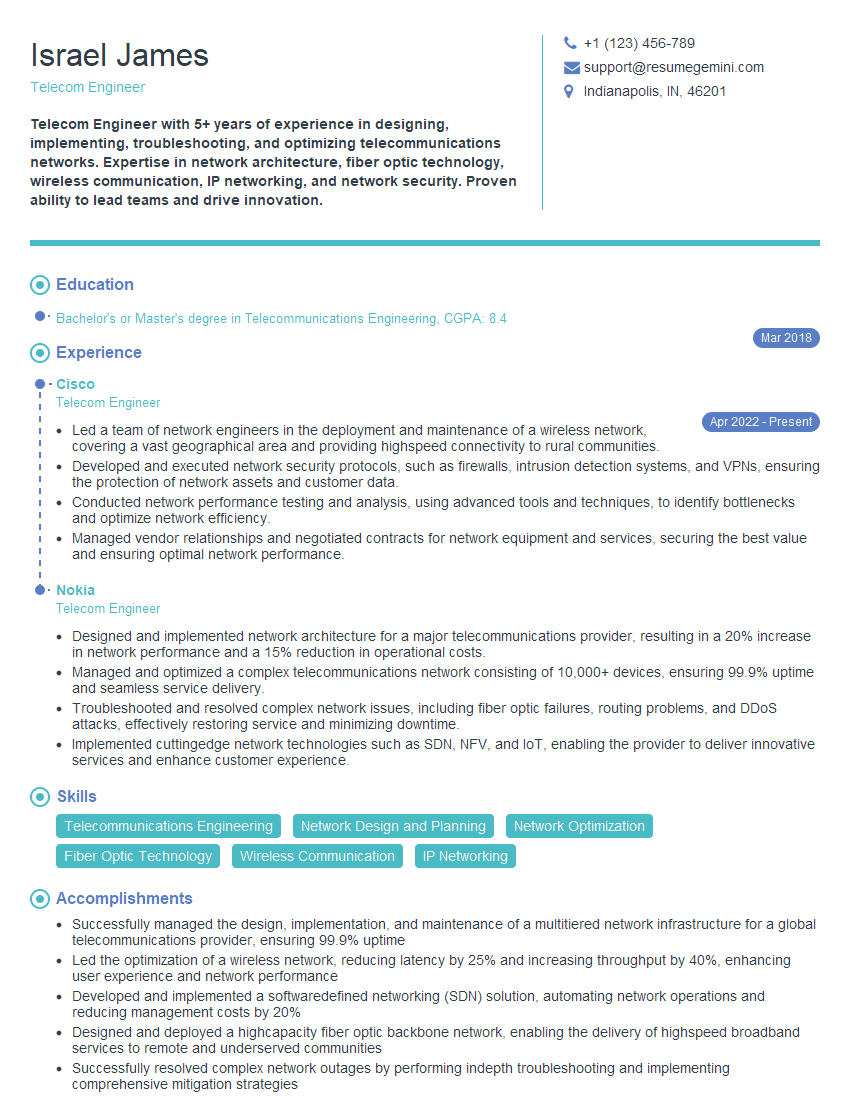
Mastering DWDM technology opens doors to exciting career opportunities in the rapidly expanding field of telecommunications and data networking. High demand for skilled DWDM engineers translates to competitive salaries and excellent growth potential. To maximize your job prospects, creating an ATS-friendly resume is crucial. ResumeGemini is a trusted resource that can help you build a professional and impactful resume tailored to the specific requirements of DWDM-related roles. Examples of resumes optimized for DWDM Technology are available to guide your resume building process. Invest time in crafting a compelling resume to showcase your skills and experience effectively; it’s your first impression with potential employers.




Explore more articles
Users Rating of Our Blogs
Share Your Experience
We value your feedback! Please rate our content and share your thoughts (optional).
What Readers Say About Our Blog
To the interviewgemini.com Webmaster.
Very helpful and content specific questions to help prepare me for my interview!
Thank you
To the interviewgemini.com Webmaster.
This was kind of a unique content I found around the specialized skills. Very helpful questions and good detailed answers.
Very Helpful blog, thank you Interviewgemini team.