Interviews are more than just a Q&A session—they’re a chance to prove your worth. This blog dives into essential Electrical Panel Maintenance interview questions and expert tips to help you align your answers with what hiring managers are looking for. Start preparing to shine!
Questions Asked in Electrical Panel Maintenance Interview
Q 1. Explain the importance of lockout/tagout procedures during electrical panel maintenance.
Lockout/Tagout (LOTO) procedures are absolutely critical for electrical panel maintenance. They’re designed to prevent accidental energization of equipment during servicing, protecting technicians from potentially fatal electrical shocks. Think of it like this: before working on any part of the electrical system, we must effectively ‘turn off’ the power and ensure it stays off. This involves visually inspecting the circuit breaker to confirm the ‘off’ position, then applying a lock and a tag with clear identification of the worker and the reason for the lockout. This prevents anyone else from inadvertently switching the power back on while work is in progress. The LOTO process ensures that only the authorized person working on the panel can remove the lock and tag, completely eliminating the possibility of accidental energization.
A common example is working on a faulty circuit breaker in a commercial building. Before touching any wire or component, a LOTO procedure would be followed, locking out the main breaker supplying power to that section of the building. This prevents any possibility of the power being restored accidentally while the maintenance is in progress, thus reducing risk of electric shock or arc flash.
Q 2. Describe the different types of electrical panels and their applications.
Electrical panels come in various types, each suited for specific applications. The most common are:
- Panelboards: These are smaller panels, often found in residential and smaller commercial buildings. They distribute power to individual circuits within a building.
- Switchboards: These are larger, more complex panels often found in industrial settings or large commercial buildings. They typically manage larger power distribution needs and frequently incorporate protective devices such as circuit breakers and fuses of much higher amperage than panelboards.
- Motor Control Centers (MCCs): These panels are specifically designed to control and protect electric motors. They’re often used in industrial applications where multiple motors need to be managed efficiently and safely.
- Load Centers: Primarily used in residential settings, these panels typically contain circuit breakers and sometimes a main service disconnect.
The choice of panel depends on the power requirements, the number of circuits, and the overall electrical load of the building or facility. For example, a small office might use a panelboard, while a manufacturing plant would likely require a switchboard and several MCCs.
Q 3. How do you identify and troubleshoot a faulty circuit breaker?
Identifying a faulty circuit breaker involves a systematic approach. First, visually inspect the breaker for signs of damage – scorch marks, excessive heat discoloration, or visible arcing. A tripped breaker will be in the ‘off’ position. If the breaker repeatedly trips, this indicates an overload or short circuit on the circuit it protects. You should then investigate the connected load to pinpoint the cause. Use a voltage tester to ensure the power supply to the panel is indeed off before proceeding. If you are unsure of a circuit’s contents, do not attempt to troubleshoot it without the proper safety precautions and knowledge; call a qualified electrician.
To troubleshoot further, one may use a multimeter to check for continuity in the circuit wiring, or by inspecting outlets and appliances on the specific circuit for faults. If you detect a short circuit, it’s crucial to identify and repair the short before resetting the breaker to prevent damage to equipment or injury.
Q 4. What are the safety precautions when working with high-voltage electrical panels?
Working with high-voltage electrical panels demands the utmost caution. Safety is paramount! Always follow these crucial steps:
- Lockout/Tagout: This is non-negotiable. Properly lock out and tag out the panel before any work begins.
- Personal Protective Equipment (PPE): Wear appropriate PPE, including insulated gloves, safety glasses, arc flash protective clothing (depending on the voltage), and safety shoes.
- Trained Personnel: Only qualified and trained personnel with a deep understanding of high-voltage systems should work on these panels.
- Proper Tools: Use insulated tools designed for high-voltage applications.
- Arc Flash Hazard Analysis: A thorough arc flash hazard analysis should be conducted to determine the appropriate PPE and safety procedures.
- Emergency Procedures: Ensure that emergency procedures, including first aid and emergency response, are well-established and understood by everyone involved.
Remember, high-voltage work is extremely dangerous. If you’re not fully trained and equipped, don’t attempt it. Always prioritize safety!
Q 5. Explain the process of replacing a faulty circuit breaker in an electrical panel.
Replacing a faulty circuit breaker requires careful and systematic steps. Begin by following lockout/tagout procedures to de-energize the circuit. Then, carefully remove the faulty breaker. Most breakers are easily removed; often there’s simply a clip or a release mechanism to push to disengage the circuit breaker from the busbar. Carefully note the amperage and any other markings on the breaker to ensure the replacement is identical. Install the new breaker, ensuring it’s securely fastened in place and makes good contact with the busbars. After verifying the replacement is correctly in place, and has firmly engaged, remove the lock and tag to restore power, but ONLY after you’ve thoroughly checked all connections and confirmed the new breaker is operating correctly. Finally, document the replacement and the date in your maintenance log.
Q 6. How do you test the integrity of grounding in an electrical panel?
Testing grounding integrity is crucial for safety. A proper ground path ensures that fault currents flow safely to the earth, preventing dangerous voltage buildup and protecting equipment and people. You would typically use a clamp meter or a dedicated earth ground tester to measure the ground resistance. A low resistance reading indicates a good ground connection; high resistance suggests a problem that needs to be addressed. The testing methodology might include measuring the voltage drop across the ground conductor or using a specialized ground resistance tester. Any significant deviations from the acceptable resistance range indicate a faulty grounding system and should be addressed immediately. This test needs to be conducted by someone with proper training.
Q 7. What are the common causes of electrical panel overheating?
Electrical panel overheating is a serious issue that can lead to fires and equipment damage. Several factors contribute to this:
- Loose Connections: Loose connections create resistance, generating heat. Regular tightening of connections is crucial.
- Overloaded Circuits: Drawing more current than a circuit is designed for causes excessive heating. This is often due to too many appliances operating simultaneously on the same circuit.
- Faulty Wiring: Damaged or improperly sized wiring can overheat. Inspect for any signs of damage.
- Defective Circuit Breakers: A malfunctioning circuit breaker might not trip properly, allowing excessive current flow and heat buildup.
- Poor Ventilation: Insufficient airflow around the panel can trap heat and contribute to overheating.
- Environmental Factors: Extreme ambient temperatures can add to the heat stress on the electrical panel.
Regular inspection and maintenance are key to preventing overheating. Addressing any loose connections, overloaded circuits, or faulty components will mitigate the risks.
Q 8. Describe your experience with preventive maintenance on electrical panels.
Preventive maintenance on electrical panels is crucial for ensuring safety and preventing costly failures. My experience encompasses a comprehensive approach, starting with a thorough visual inspection, followed by tightening connections, checking for corrosion, and verifying the functionality of all components. I meticulously inspect bus bars for signs of overheating or damage, and I carefully test the operation of circuit breakers and fuses, ensuring they trip at the correct amperage. I also document all findings and maintenance activities performed, creating a detailed history for future reference. For example, in a recent project at a manufacturing facility, I identified loose connections on several breakers that, if left unchecked, could have led to arcing and potential fires. Tightening these connections eliminated the risk and prevented a costly downtime event. Regular maintenance schedules, tailored to the specific load profile and environment of the panel, are vital – think of it as a regular checkup for your home’s electrical system, preventing major issues down the line.
Q 9. How do you interpret electrical panel schematics and diagrams?
Interpreting electrical panel schematics and diagrams is fundamental to my work. I begin by understanding the legend, which defines symbols used for various components such as circuit breakers, fuses, bus bars, and wiring. I then trace the power flow from the main breaker to individual circuits, paying close attention to the amperage ratings of each circuit and the types of loads they serve. I use these diagrams to identify the proper components to troubleshoot during maintenance or repairs and to plan upgrades or modifications to the panel safely. Think of it like reading a map for an electrical system; you need to understand the symbols and layout to navigate the system effectively. For instance, if a specific area of a building experiences frequent power outages, examining the schematic helps identify the problematic circuit or overloaded branch in a systematic fashion.
Q 10. What are the common signs of an overloaded electrical panel?
An overloaded electrical panel is a serious safety hazard. Common signs include frequently tripping circuit breakers, a warm or hot panel, burnt or discolored wiring around breakers, a buzzing or humming sound emanating from the panel, and flickering lights. In one instance, I encountered a panel where the breakers were consistently tripping due to a significantly increased load from recently installed machinery. This highlighted the need for a panel upgrade to handle the higher current demand. Addressing these symptoms promptly is essential because an overloaded panel can lead to fires, electrical shocks, and equipment damage. It’s like your home’s electrical system trying to handle more than it can; it’s crucial to identify the overload and address the root cause before something more serious happens.
Q 11. Explain the difference between a fuse and a circuit breaker.
Fuses and circuit breakers both protect electrical circuits from overcurrent, but they operate differently. A fuse is a one-time device; once it blows due to an overcurrent event, it must be replaced. A circuit breaker, on the other hand, is a reusable device. When an overcurrent occurs, it trips, interrupting the power flow. Once the problem is resolved, the breaker can be reset and restored. Think of a fuse as a sacrificial device, while a circuit breaker is more like a switch that can be toggled on and off. The choice between a fuse and a circuit breaker often depends on the application and the level of protection required. For example, fuses are commonly found in older installations or in applications where fast-acting protection is paramount, while circuit breakers are standard in modern electrical panels for their ease of use and reset capability.
Q 12. How do you perform a visual inspection of an electrical panel?
A visual inspection is the first step in any electrical panel maintenance. This involves carefully examining all components, including bus bars, wires, circuit breakers, and fuses, for any signs of damage, corrosion, overheating, or loose connections. I look for discoloration, charring, or any physical signs of wear. I ensure that all connections are secure and that there is adequate spacing between components to prevent overheating. I also check for proper labeling of circuits and components. The visual inspection is like a quick check of your health; catching small issues early prevents bigger problems later. I’d thoroughly document any findings, including photos, to have a record of the panel’s condition.
Q 13. What are the regulations and codes you follow when working on electrical panels?
Safety is paramount when working on electrical panels. I strictly adhere to the National Electrical Code (NEC) and all relevant local regulations. This includes using appropriate personal protective equipment (PPE), such as insulated gloves, safety glasses, and arc flash protective clothing. I follow lockout/tagout procedures to ensure the panel is de-energized before commencing any work. All work is performed following established safety protocols, ensuring all tasks are completed to minimize potential hazards. Non-compliance with these codes can result in serious injury or even death, so I make sure to always err on the side of caution. For example, before I even touch a panel, it is completely de-energized and locked out, verified using a voltmeter to ensure there is no residual voltage.
Q 14. Describe your experience with different types of bus bars.
I have experience with various types of bus bars, including copper, aluminum, and copper-clad aluminum. The choice of bus bar material depends on the application’s current capacity and environmental conditions. Copper bus bars offer excellent conductivity but are more expensive than aluminum. Aluminum bus bars are lighter and less expensive, but they have a higher resistance and require careful installation to prevent corrosion. Copper-clad aluminum bus bars combine the advantages of both materials. Understanding the properties of each type is critical for selecting the appropriate bus bar for a specific application and ensuring long-term performance and safety. For instance, in high-current applications, copper bus bars might be preferred for their superior conductivity and lower resistance, while aluminum might be suitable for lower-current applications where cost is a primary concern.
Q 15. How do you handle a situation where a circuit breaker keeps tripping?
A circuit breaker tripping repeatedly signals an overload or short circuit. It’s crucial to systematically investigate the cause rather than simply resetting the breaker repeatedly, as this could damage equipment or create a fire hazard.
My approach involves a multi-step process:
- Identify the Circuit: First, determine which circuit is tripping. This is usually indicated by the breaker’s position and possibly by the location of affected lights or appliances.
- Reduce the Load: Unplug all non-essential appliances and devices connected to that circuit. If the breaker holds after this, the problem lies in an overloaded circuit, and you need to redistribute the load across different circuits.
- Inspect for Faulty Appliances: Check each appliance on the circuit for any signs of damage, such as frayed cords, sparking plugs, or unusual heating. If an appliance is faulty, it must be repaired or replaced before the circuit can be safely used.
- Check for Short Circuits: Examine the wiring and connections within the circuit for any signs of damage or loose connections. Look for bare wires touching each other, signs of overheating, or water damage. Short circuits require immediate professional attention.
- Check for Overcurrent Condition: Ensure the circuit breaker is rated appropriately for the connected load. A higher capacity breaker might be needed, but only a qualified electrician can assess and implement this change.
- Professional Assessment: If you can’t identify the problem after completing these steps, it’s crucial to call a qualified electrician to prevent potential hazards.
For instance, in one case, a client’s kitchen circuit kept tripping. After systematically checking, we found a faulty garbage disposal motor drawing excessive current. Replacing the motor solved the issue.
Career Expert Tips:
- Ace those interviews! Prepare effectively by reviewing the Top 50 Most Common Interview Questions on ResumeGemini.
- Navigate your job search with confidence! Explore a wide range of Career Tips on ResumeGemini. Learn about common challenges and recommendations to overcome them.
- Craft the perfect resume! Master the Art of Resume Writing with ResumeGemini’s guide. Showcase your unique qualifications and achievements effectively.
- Don’t miss out on holiday savings! Build your dream resume with ResumeGemini’s ATS optimized templates.
Q 16. What are the potential hazards associated with working on electrical panels?
Working on electrical panels presents significant hazards, including:
- Electric Shock: This is the most immediate and potentially lethal danger. Even seemingly de-energized panels can retain dangerous residual voltage.
- Arc Flash: A sudden, high-energy electrical arc can cause severe burns, blindness, and even death. These are extremely powerful and unpredictable events.
- Falls: Working at heights to access panels can lead to falls if proper safety measures like scaffolding and harnesses are not implemented.
- Burns: Contact with hot components or arc flash can result in severe thermal burns.
- Electrocution: This involves the passage of electric current through the body, potentially causing cardiac arrest or other life-threatening consequences.
To mitigate these hazards, I always follow strict safety protocols:
- Lockout/Tagout (LOTO): This procedure ensures the panel is completely de-energized and locked to prevent accidental re-energization.
- Personal Protective Equipment (PPE): This includes arc flash suits, safety glasses, insulated tools, and rubber gloves rated for the voltage level.
- Proper Training and Certification: Ongoing training is essential to remain up-to-date on safety standards and techniques.
Q 17. Explain the process of upgrading an existing electrical panel.
Upgrading an electrical panel is a complex task that should only be undertaken by a qualified electrician. It’s typically necessary when a panel is outdated, overloaded, or doesn’t meet current code requirements.
The process usually involves:
- Assessment: Determining the existing panel’s capacity, the current load, and future power needs.
- Permitting: Obtaining the necessary permits from local authorities.
- Disconnection: Safely disconnecting the power supply to the old panel.
- Installation: Installing the new panel in accordance with the National Electrical Code (NEC).
- Wiring: Carefully connecting the existing wiring to the new panel.
- Testing: Thoroughly testing the new panel to ensure it’s functioning correctly.
- Inspection: Scheduling an inspection by the local authority to verify compliance with code.
Example: I recently upgraded a 100-amp panel to a 200-amp panel for a residential customer who was adding several energy-intensive appliances. This involved careful planning to ensure adequate service capacity and adherence to all safety regulations.
Q 18. How do you determine the amperage rating required for a specific circuit?
Determining the correct amperage rating for a circuit depends on the total power consumption of the appliances and devices that will be connected to it. The formula used is:
Amperes (A) = Watts (W) / Volts (V)However, you must also consider safety factors and code requirements:
- Calculate Total Wattage: Add up the wattage of all the appliances and devices that will share a circuit. Check the appliance nameplates for wattage ratings.
- Voltage: In most homes in North America, the voltage is 120V for standard circuits.
- Safety Factor: Add a 25% safety factor to your total wattage to account for potential future load increases or unexpected demand spikes.
- NEC Requirements: Consult the NEC for specific guidelines on circuit sizing and breaker selection for different types of loads.
- Breaker Selection: Choose a circuit breaker with an amperage rating that matches or slightly exceeds the calculated amperage to ensure it won’t overload.
For example, a circuit with a microwave (1200W), a refrigerator (500W), and a toaster (1000W) requires: (1200W + 500W + 1000W) * 1.25 / 120V ≈ 21.9A. A 20-amp breaker would be suitable for this circuit.
Q 19. How do you troubleshoot problems with a faulty ground fault circuit interrupter (GFCI)?
Troubleshooting a faulty GFCI (Ground Fault Circuit Interrupter) involves a systematic approach to pinpoint the source of the problem:
- Test the GFCI Receptacle: Use the built-in test button to confirm the GFCI is functioning. If the test button doesn’t trip the breaker, the GFCI itself may be faulty.
- Check for Loose Connections: Examine the wiring connections to the GFCI outlet for any loose wires or corroded terminals. Loose connections can disrupt the GFCI’s ability to detect ground faults.
- Inspect Downstream Wiring and Appliances: Check all wiring and appliances connected to the GFCI circuit for signs of damage or water intrusion. The fault may originate elsewhere in the circuit.
- Reset the GFCI: Attempt to reset the GFCI by pressing the reset button. If it trips immediately after, there’s a persistent fault in the circuit that needs attention.
- Test Other GFCIs on the Circuit: If there are multiple GFCI outlets on the circuit, test each one independently. The problem may be with a specific outlet or with a downstream fault.
- Voltage Testing: Using a voltmeter to check the voltage at various points in the circuit can help isolate the point of the fault.
- Replace the GFCI Outlet: If other troubleshooting steps fail, replacing the GFCI receptacle is often the most effective solution.
Example: A GFCI in a bathroom repeatedly tripped. After systematic checks, we discovered a faulty hairdryer with a short circuit in its internal wiring, causing the GFCI to shut off.
Q 20. Describe your experience with arc flash safety and mitigation.
Arc flash safety is paramount in electrical panel maintenance. An arc flash is a dangerous and potentially fatal event caused by a sudden release of electrical energy. Mitigation involves a layered approach:
- Arc Flash Hazard Analysis: Conducting a study to determine the potential arc flash incident energy levels for specific equipment. This analysis informs the appropriate PPE selection.
- Personal Protective Equipment (PPE): Wearing appropriate PPE, including arc flash suits rated for the calculated incident energy, is mandatory.
- Lockout/Tagout (LOTO): This procedure ensures that equipment is de-energized and locked out before any work begins. It helps prevent accidental energization.
- Energy Reduction Strategies: Implementing measures to reduce the likelihood of arc flash events. This includes proper grounding, maintaining equipment in good condition, and regularly inspecting electrical systems for faults.
- Training and Awareness: Ensuring that all personnel involved in electrical work are properly trained on arc flash hazards and safety procedures. Regular training refreshes knowledge of safety protocols.
In my experience, I’ve performed several arc flash risk assessments and implemented corrective measures like improving grounding, replacing outdated equipment and employing best practices during maintenance tasks. My work always prioritizes worker safety.
Q 21. What is your experience with different types of panelboard enclosures?
I have extensive experience with various types of panelboard enclosures, each offering different levels of protection and suitability for specific environments:
- Metal Enclosures: These offer the highest level of protection against physical damage, environmental factors, and electrical hazards. They’re common in industrial settings and areas with high risk.
- NEMA-Rated Enclosures: These enclosures are classified according to their ability to withstand environmental factors such as dust, water, and corrosion. The NEMA rating indicates the level of protection.
- Indoor vs. Outdoor Enclosures: Outdoor enclosures are designed to withstand harsh weather conditions, including rain, snow, and extreme temperatures.
- Wall-Mounted vs. Free-Standing Enclosures: Wall-mounted enclosures save space, while free-standing enclosures are usually more spacious and suitable for larger systems.
In one project, we used NEMA 3R rated enclosures for an outdoor substation to ensure protection from weather and potential impact damage. The choice of enclosure always depends on the specific requirements of the application and the need for safety and reliability.
Q 22. How do you maintain accurate records of electrical panel maintenance?
Maintaining accurate records for electrical panel maintenance is crucial for safety, compliance, and predictive maintenance. I utilize a digital, cloud-based system that allows for easy access and collaboration. This system allows me to meticulously document every aspect of panel maintenance, from the date and time of service to specific tasks performed, parts replaced, and any observed anomalies. For each panel, I create a detailed history file including:
- Inspection Dates: Recording the date and time of each routine inspection and any emergency repairs.
- Maintenance Performed: A thorough description of all tasks completed, including tightening connections, cleaning terminals, and testing circuit breakers.
- Parts Replaced: Listing the specific part numbers and quantities of any components that were replaced, along with their condition (e.g., faulty, worn).
- Test Results: Including readings from thermal cameras, insulation resistance testers, and other diagnostic tools, with detailed notes on any deviations from accepted standards.
- Photographs: Visual records of the panel’s condition before, during, and after maintenance.
- Signatures and Approvals: Electronic signatures from both the technician and the client acknowledging the completed work.
This system allows for easy generation of reports for audits or insurance purposes, and the historical data helps predict potential issues and schedule preventative maintenance proactively. Think of it like a detailed medical history for your electrical system – it allows us to understand its past, predict its future, and ensure its optimal health.
Q 23. What software or tools do you use to diagnose electrical panel issues?
Diagnosing electrical panel issues requires a combination of specialized tools and software. Beyond the standard multimeters and clamp meters, I utilize:
- Infrared Thermal Cameras: These cameras detect heat signatures, allowing me to identify overheating components, loose connections, and potential fire hazards before they become serious problems. For example, a slightly loose connection might show up as a slightly warmer area, alerting me to a potential problem before it leads to a catastrophic failure.
- Insulation Resistance Testers (Meggers): These instruments measure the insulation resistance of wiring and components, identifying potential shorts or grounds that could lead to electrical shocks or fires. I use this to check the integrity of the wiring and ensure the safety of the panel.
- Power Quality Analyzers: These sophisticated devices measure voltage sags, surges, and harmonics, identifying power quality issues that might be stressing the panel or causing equipment malfunctions. These subtle voltage fluctuations can sometimes cause unexpected problems that are hard to diagnose without specific testing.
- Software Packages: While I don’t rely heavily on dedicated software for diagnosis, I use software to manage the data collected from my testing tools, generating reports and analyzing trends over time. This is essential for preventative maintenance scheduling.
Combining these tools and my experience allows me to perform a comprehensive diagnosis and recommend appropriate solutions for various electrical panel issues, ensuring the safety and reliability of the system.
Q 24. Explain your understanding of NEC (National Electrical Code) requirements for electrical panels.
The NEC (National Electrical Code) provides a comprehensive set of safety standards for electrical installations. My understanding of the NEC regarding electrical panels encompasses several key areas:
- Panel Sizing and Load Calculations: Ensuring the panel’s amperage rating is sufficient for the connected loads, preventing overloads and potential fires. This involves careful load calculations and adherence to the NEC’s requirements for service capacity.
- Wiring Methods and Protection: Correctly sizing and installing conductors, circuit breakers, and other protective devices to safeguard the panel and its connected equipment. This includes using appropriate wire types and ensuring proper grounding.
- Grounding and Bonding: Implementing proper grounding and bonding techniques to protect against electrical shocks and prevent damage to equipment. This critical aspect ensures safety and avoids dangerous electrical hazards.
- Arc Flash Mitigation: Understanding and implementing procedures to minimize the risk of arc flash incidents, which can cause severe burns and injuries. This includes appropriate personal protective equipment (PPE) and adherence to safety procedures.
- Clearance and Space Requirements: Adhering to the NEC’s specifications for clearances around the panel to allow for proper ventilation, access for maintenance, and to prevent accidental contact.
Staying updated on the latest NEC revisions is critical for ensuring compliance and maintaining the highest safety standards. I regularly attend industry training and actively review the NEC to remain proficient and current with changes in the codes.
Q 25. How do you ensure compliance with OSHA regulations when working on electrical panels?
OSHA (Occupational Safety and Health Administration) regulations are paramount when working on electrical panels. My adherence to these regulations involves:
- Lockout/Tagout Procedures: Always following strict lockout/tagout procedures to de-energize the panel completely before performing any work, preventing accidental energization and electrical shocks. This involves a clear and verified process to ensure the power is completely disconnected before anyone touches any part of the electrical system.
- Personal Protective Equipment (PPE): Consistent use of appropriate PPE, including insulated gloves, eye protection, and arc flash suits, depending on the task and voltage level. This is critical to protecting against electrical shock, burns, and other injuries.
- Safe Work Practices: Maintaining a safe working environment, including proper lighting, clear pathways, and keeping the workspace organized. This minimizes trip hazards and potential dangers.
- Training and Certification: Ensuring I possess the necessary training and certifications to work on electrical panels safely and competently. This involves regular updates to my qualifications and a commitment to ongoing safety training.
- Hazard Communication: Clearly communicating potential hazards to coworkers and making sure everyone understands safety procedures before beginning any tasks. A clear communication process is essential to maintaining a safe environment for everyone.
OSHA compliance is not just a set of rules; it’s a mindset that prioritizes safety above all else. I approach each job with a thorough risk assessment and execute every step with meticulous care to protect myself and others.
Q 26. Describe your problem-solving skills in relation to complex electrical panel issues.
My approach to solving complex electrical panel issues is systematic and data-driven. I follow a structured approach:
- Gather Information: Begin by collecting all relevant information from the client, including the nature of the problem, any previous maintenance records, and the history of the panel. This allows for a comprehensive understanding of the context.
- Visual Inspection: Perform a thorough visual inspection of the panel, looking for any obvious signs of damage, loose connections, or overheating. This is often the first step in identifying potential problems.
- Diagnostic Testing: Use the appropriate diagnostic tools (as described in question 2) to identify the root cause of the problem. This helps move beyond superficial observations to pinpoint the exact source of the issue.
- Analysis and Interpretation: Analyze the test data and interpret the results, considering the NEC and other relevant regulations. This is where experience and understanding of electrical principles come into play.
- Develop Solutions: Develop a plan to address the identified problem, considering factors such as safety, cost, and downtime. Multiple solutions are often considered before choosing the most appropriate one.
- Implementation and Verification: Implement the solution, and then verify that it has corrected the problem. This involves retesting and verification that the system is working correctly.
- Documentation: Thoroughly document all findings, actions, and results. Detailed documentation is crucial for future reference and for ongoing maintenance.
Recently, I encountered a panel experiencing intermittent power outages. By systematically following this process, I identified a corroded neutral bus bar as the culprit. Replacing the bar resolved the issue, demonstrating the effectiveness of a structured approach.
Q 27. What is your experience with testing and commissioning new electrical panels?
Testing and commissioning new electrical panels is a critical process to ensure proper functionality and safety. My experience includes:
- Pre-Installation Checks: Verifying that all components of the panel (circuit breakers, busbars, metering equipment, etc.) are properly labeled, undamaged and meet the specifications outlined in the project documentation.
- Wiring Verification: Carefully inspecting the wiring connections, ensuring they are correctly installed according to the panel’s schematic and NEC requirements. This often involves using a continuity tester to verify proper connectivity.
- Functional Testing: Testing each circuit breaker individually to verify its proper operation and trip point. This includes testing for both overload and short-circuit protection.
- Grounding and Bonding Tests: Measuring grounding resistance to verify the effectiveness of the grounding system. Proper grounding is essential for safety.
- Insulation Resistance Testing: Measuring the insulation resistance of all wiring to identify any potential shorts or grounds. This is a critical safety check.
- Load Testing: Simulating the expected loads on the panel to verify its ability to handle the required current without overheating or tripping circuit breakers. This simulates real-world conditions.
- Documentation and Sign-Off: Creating comprehensive documentation of the testing process, including test results, photographs, and any corrective actions taken. This includes creating a sign-off sheet which certifies the panel is ready for service.
Thorough testing and commissioning of new panels ensure that the system is safe, reliable, and operates as intended, protecting both the equipment and the people who use it.
Key Topics to Learn for Electrical Panel Maintenance Interview
- Electrical Safety Regulations and Codes: Understanding and adhering to relevant safety standards (e.g., NEC) is paramount for safe and compliant work practices. This includes lockout/tagout procedures and personal protective equipment (PPE) usage.
- Panel Component Identification and Function: Thorough knowledge of circuit breakers, fuses, busbars, metering devices, and other panel components, including their functionalities and interdependencies. Be prepared to discuss troubleshooting scenarios related to malfunctioning components.
- Preventive Maintenance Procedures: Discuss routine inspection, cleaning, and testing procedures for maintaining optimal panel performance and preventing failures. This includes understanding the importance of thermal imaging and infrared testing.
- Troubleshooting and Diagnostics: Be ready to explain your approach to diagnosing panel problems, including using multimeters, ammeters, and other diagnostic tools. Describe your systematic troubleshooting methodology.
- Panel Upgrades and Modifications: Discuss your experience (if any) with upgrading panels, increasing capacity, or modifying existing circuits. This includes understanding load calculations and capacity planning.
- Documentation and Reporting: Explain your approach to maintaining accurate records of panel inspections, maintenance, and repairs. Discuss the importance of clear and concise reporting to supervisors.
- Advanced Panel Technologies: Familiarize yourself with smart panels, remote monitoring systems, and other emerging technologies in electrical panel management. This demonstrates a proactive approach to professional development.
Next Steps
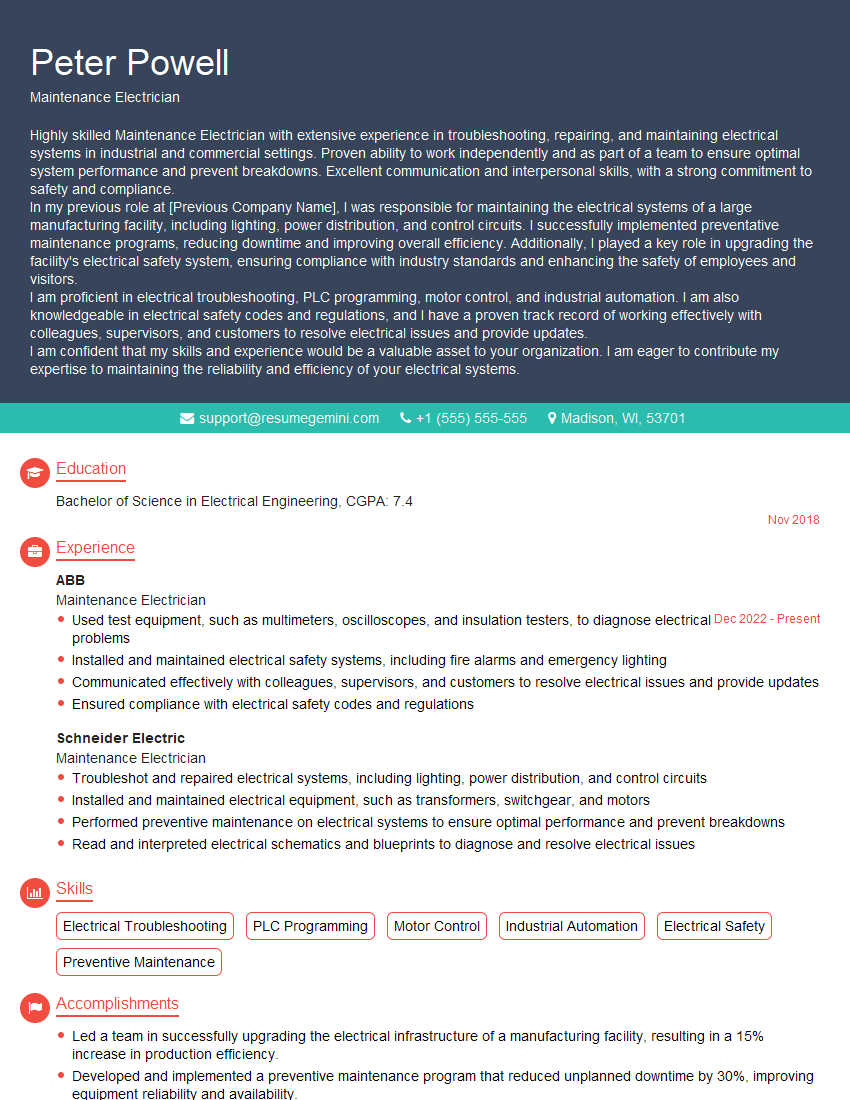
Mastering Electrical Panel Maintenance opens doors to a rewarding career with excellent growth potential. Proficiency in this area is highly valued, offering opportunities for advancement and increased earning capacity. To maximize your job prospects, create a strong, ATS-friendly resume that highlights your skills and experience effectively. ResumeGemini is a trusted resource to help you build a professional and impactful resume. They offer examples of resumes tailored specifically to Electrical Panel Maintenance to help you get started. Invest time in creating a compelling resume – it’s your first impression on potential employers.
Explore more articles
Users Rating of Our Blogs
Share Your Experience
We value your feedback! Please rate our content and share your thoughts (optional).
What Readers Say About Our Blog
To the interviewgemini.com Webmaster.
Very helpful and content specific questions to help prepare me for my interview!
Thank you
To the interviewgemini.com Webmaster.
This was kind of a unique content I found around the specialized skills. Very helpful questions and good detailed answers.
Very Helpful blog, thank you Interviewgemini team.