Feeling uncertain about what to expect in your upcoming interview? We’ve got you covered! This blog highlights the most important Energy Efficiency and Building Performance interview questions and provides actionable advice to help you stand out as the ideal candidate. Let’s pave the way for your success.
Questions Asked in Energy Efficiency and Building Performance Interview
Q 1. Explain the principles of energy auditing.
Energy auditing is a systematic process of assessing a building’s energy consumption to identify areas of inefficiency and potential for improvement. Think of it as a comprehensive ‘energy checkup’ for your building. It involves a detailed examination of energy usage patterns, equipment performance, and building systems to pinpoint opportunities for cost savings and environmental benefits.
The process typically begins with data collection, including utility bills, building plans, and equipment specifications. This data is then analyzed to understand energy flows and pinpoint areas of high consumption. Next, on-site inspections are carried out to verify data accuracy and identify any physical issues contributing to energy waste. Finally, a report is generated outlining findings, recommended improvements, and estimated cost savings. The goal is to create a roadmap for energy efficiency upgrades.
Q 2. Describe different methods for conducting energy audits.
Energy audits can be conducted using a variety of methods, each with its strengths and weaknesses:
- Walk-through audits: These are less expensive and involve a visual inspection of the building and its systems. They’re ideal for quickly identifying obvious energy-wasting issues, like broken windows or inefficient lighting. However, they lack the depth of more comprehensive methods.
- Level I audits: These are more detailed and involve a review of utility bills and building plans to estimate energy usage and identify potential savings. They often involve some on-site observations but don’t include extensive testing.
- Level II audits: These are the most comprehensive audits, involving detailed on-site measurements of energy consumption, building systems performance, and air leakage. They use specialized equipment to collect data and generate a thorough report of energy-saving opportunities.
- Energy Modeling: This sophisticated technique uses computer software to simulate building energy performance. It’s valuable for analyzing complex systems and predicting the impact of proposed energy efficiency improvements. It’s often integrated into Level II audits.
The choice of method depends on factors like budget, time constraints, and the complexity of the building.
Q 3. What are the key performance indicators (KPIs) used to measure building energy efficiency?
Key Performance Indicators (KPIs) for building energy efficiency are crucial for tracking progress and demonstrating the effectiveness of improvements. Some common KPIs include:
- Energy Use Intensity (EUI): This measures energy consumption per square foot of building area (kWh/ft² or kWh/m²). A lower EUI indicates better energy efficiency.
- Carbon Footprint: This measures the amount of greenhouse gas emissions associated with building operations (typically expressed in tons of CO2 equivalent).
- Return on Investment (ROI): This assesses the financial return from energy efficiency investments, considering initial costs and long-term savings.
- Simple Payback Period: This is the time it takes for cost savings from an energy efficiency measure to offset its initial cost.
- Energy Star Score: A standardized rating system that scores buildings based on their energy efficiency compared to similar buildings. A higher score indicates better performance.
Selecting the most relevant KPIs depends on the specific goals and priorities of the building owner.
Q 4. How do you analyze building energy data to identify areas for improvement?
Analyzing building energy data involves a multi-step process. First, data is collected from various sources such as utility bills, building management systems (BMS), and metering equipment. This data is then cleaned and organized. Next, it’s analyzed using statistical methods to identify trends, anomalies, and correlations. For example, we might compare energy consumption patterns to occupancy schedules to determine if there’s unnecessary energy use during unoccupied periods. Data visualization tools are essential for effectively presenting insights. Techniques like regression analysis can identify relationships between energy use and various factors (e.g., weather, equipment operation). Finally, energy modeling can be used to simulate different scenarios and determine the potential impact of energy efficiency upgrades.
For instance, if we see a consistent spike in energy consumption during certain hours, we might investigate if there’s equipment running unnecessarily or if there’s a problem with the HVAC system during that time.
Q 5. What are the benefits and drawbacks of different energy efficiency technologies (e.g., solar, geothermal)?
Various energy efficiency technologies offer different benefits and drawbacks:
- Solar Photovoltaic (PV):
- Benefits: Reduces reliance on the grid, low operating costs, environmentally friendly.
- Drawbacks: High initial cost, intermittency (depends on sunlight), space requirements.
- Geothermal Heat Pumps:
- Benefits: High efficiency, consistent performance throughout the year, reduced carbon emissions.
- Drawbacks: High initial cost, requires land for ground loops, potential groundwater contamination risks if not properly installed.
- LED Lighting:
- Benefits: Significantly lower energy consumption compared to incandescent or fluorescent lights, longer lifespan.
- Drawbacks: Higher initial cost than some older technologies, potential for glare or color rendering issues if not selected carefully.
The optimal choice depends on factors like climate, building design, budget, and energy goals. A comprehensive energy audit can help determine the most cost-effective and suitable technologies for a specific building.
Q 6. Explain the concept of building envelope and its role in energy efficiency.
The building envelope is the outer shell of a building, including walls, roof, windows, doors, and foundation. It acts as a barrier between the interior and exterior environments. Its primary role in energy efficiency is to minimize heat transfer (both heat loss in winter and heat gain in summer). A well-designed and properly constructed building envelope is crucial for reducing energy consumption for heating and cooling. Think of it as a thermos for your building – it keeps the inside temperature stable and prevents energy from escaping or entering unnecessarily.
Improving the building envelope might involve adding insulation, replacing windows with high-performance glazing, sealing air leaks, or improving the thermal mass of the building. These improvements can significantly reduce energy use and improve indoor comfort.
Q 7. Describe your experience with building commissioning and retro-commissioning.
Building commissioning (Cx) is the process of verifying that building systems are designed, installed, and operated to meet the owner’s project requirements. It involves a systematic process of testing, adjusting, and balancing systems to ensure optimal performance. I’ve been involved in numerous Cx projects, from small office spaces to large industrial facilities, utilizing my expertise in energy efficiency to ensure that the building operates as intended, maximizing energy savings and occupant comfort. One notable project involved a large commercial building where Cx identified and resolved significant HVAC inefficiencies resulting in a 15% reduction in energy consumption.
Retro-commissioning (RCx) is similar to Cx but focuses on existing buildings. It involves identifying and correcting operational deficiencies in existing systems. I’ve led several RCx projects, leveraging data analysis and on-site testing to uncover hidden energy waste. In one instance, an RCx project in a hospital revealed faulty control sequences in their HVAC system that were unnecessarily cycling equipment, leading to excessive energy use. Correcting these issues resulted in a notable decrease in energy costs and improved indoor air quality. My experience in both Cx and RCx underscores my commitment to efficient and sustainable building operations.
Q 8. What are the key elements of a successful energy management plan?
A successful energy management plan requires a holistic approach, integrating various strategies to minimize energy consumption while optimizing building performance and occupant comfort. It’s not just about installing efficient equipment; it’s about creating a culture of energy consciousness.
- Energy Audits and Assessments: A thorough energy audit identifies areas of energy waste, providing a baseline for improvement and guiding subsequent actions. This involves analyzing energy bills, inspecting building systems, and potentially using specialized equipment like infrared cameras to detect thermal leaks.
- Data Monitoring and Analysis: Implementing a robust building management system (BMS) allows for real-time monitoring of energy usage. This data can be analyzed to identify trends, pinpoint inefficiencies, and track the effectiveness of implemented measures. Think of it like a fitness tracker for your building!
- Energy Efficiency Upgrades: This includes upgrades like high-efficiency HVAC systems, improved insulation, energy-efficient lighting, and smart thermostats. Prioritization should be based on factors like payback period and potential energy savings.
- Operational Improvements: Optimizing building operations is crucial. This might involve adjusting HVAC schedules, implementing occupancy sensors to turn off lights in unoccupied rooms, or educating building occupants on energy-saving practices.
- Regular Maintenance: Regular maintenance of all building systems is essential to ensure optimal performance and prevent equipment failures that can lead to energy waste. Think of it as preventative maintenance on your car – it prevents larger, more expensive problems down the line.
- Employee Engagement and Training: Engaging building occupants in energy conservation efforts is vital. Training programs and awareness campaigns can foster a sense of responsibility and encourage participation in energy-saving practices.
For example, a successful plan in a large office building might combine an energy audit revealing significant heat loss through windows, leading to the installation of new, high-performance glazing, coupled with a BMS to monitor the impact and adjust HVAC settings based on occupancy patterns.
Q 9. How do you calculate simple payback period for energy efficiency projects?
The simple payback period (SPP) is a crucial metric for evaluating the financial viability of energy efficiency projects. It tells you how long it takes for the cumulative energy cost savings to equal the initial investment cost.
Calculation:
SPP = Initial Investment Cost / Annual Energy Cost Savings
For example, if a new HVAC system costs $10,000 and is projected to save $2,000 annually on energy bills, the SPP is:
SPP = $10,000 / $2,000 = 5 years
This means it takes 5 years for the energy savings to recoup the initial investment. It’s important to consider that this is a simplified calculation and doesn’t factor in inflation, financing costs, or potential future energy price increases. More sophisticated analyses like life-cycle cost analysis are often preferred for a complete picture.
Q 10. Explain the concept of life-cycle cost analysis.
Life-cycle cost analysis (LCCA) provides a comprehensive economic evaluation of a building system or component over its entire lifespan, from initial design and installation to eventual replacement. Unlike simple payback, it takes into account all costs and savings associated with the asset.
Key Components:
- First Cost: Initial purchase and installation costs.
- Operating Costs: Energy consumption, maintenance, and repair costs over the asset’s lifetime.
- Replacement Costs: Cost of replacing the asset after its useful life.
- Salvage Value: The value of the asset at the end of its life.
- Discount Rate: A rate used to account for the time value of money (future savings are worth less than present savings).
Application: LCCA helps in making informed decisions by comparing the total costs of different options over their entire lifespan. For instance, comparing a less expensive but less efficient HVAC system with a more expensive, high-efficiency system. While the initial cost is higher for the high-efficiency system, its lower operating costs over its lifetime could result in a lower overall LCCA, making it the more economically viable option in the long run.
Q 11. What are the different types of insulation materials and their respective R-values?
Insulation materials are crucial for minimizing heat transfer in buildings. Their effectiveness is quantified by the R-value, which represents thermal resistance. Higher R-values indicate better insulation.
- Fiberglass: Common, cost-effective, and available in batts, rolls, or loose-fill form. R-values vary depending on thickness and density.
- Cellulose: Made from recycled paper, it’s a sustainable option with good insulation properties. R-values are comparable to fiberglass.
- Mineral Wool: Includes rock wool and slag wool, known for their fire resistance and sound dampening qualities. R-values vary by type and thickness.
- Polyurethane Foam: High R-value for its thickness, excellent for filling cavities and providing continuous insulation. Available in spray foam and rigid board forms.
- Polyisocyanurate (Polyiso): Rigid foam with a high R-value per inch, often used in roofing and wall applications. It usually has a reflective foil facing.
Example R-values (approximate and vary by product):
- Fiberglass batt (6 inches): R-19
- Cellulose (6 inches): R-21
- Spray polyurethane foam (2 inches): R-10
- Polyiso board (2 inches): R-10
The appropriate insulation material and R-value depend on factors like climate, building design, and budget. In cold climates, higher R-values are generally preferred for optimal energy savings.
Q 12. Explain the importance of proper HVAC system design and maintenance for energy efficiency.
HVAC (Heating, Ventilation, and Air Conditioning) systems are significant energy consumers in buildings. Proper design and maintenance are vital for energy efficiency and occupant comfort.
Design:
- Sizing: The HVAC system must be appropriately sized to meet the building’s heating and cooling needs. Oversized systems cycle on and off frequently, wasting energy, while undersized systems struggle to maintain comfortable temperatures.
- Zoning: Dividing the building into zones allows for independent climate control, reducing energy waste in unoccupied or less-used areas.
- Air Sealing and Ductwork: Properly sealed ducts and building envelope minimize air leakage, preventing energy loss and improving the system’s efficiency.
- High-Efficiency Equipment: Selecting high-efficiency HVAC equipment (e.g., heat pumps, variable refrigerant flow systems) is crucial for minimizing energy consumption.
Maintenance:
- Regular Filter Changes: Clogged filters restrict airflow, reducing efficiency and potentially damaging the system. Regular filter changes are essential.
- Coil Cleaning: Dirty evaporator and condenser coils reduce heat transfer efficiency. Regular cleaning improves performance.
- Preventative Maintenance: Regular inspections and servicing by qualified technicians can identify and address potential problems before they lead to major breakdowns and energy waste.
Proper HVAC design and maintenance are key elements in minimizing energy waste and maintaining a comfortable indoor environment. Neglecting these aspects can lead to significantly higher energy bills and reduced building performance.
Q 13. What are some common energy-saving measures for lighting systems?
Lighting accounts for a significant portion of building energy consumption. Implementing energy-saving measures can significantly reduce energy costs and environmental impact.
- High-Efficiency Lighting: Switching to LED lighting is a cost-effective way to significantly reduce energy consumption. LEDs consume less energy and have a much longer lifespan than traditional incandescent or fluorescent bulbs.
- Occupancy Sensors: These sensors automatically turn lights on when a room is occupied and off when it’s empty, preventing wasted energy in unoccupied spaces. Think of them as automatic light switches.
- Daylighting: Maximizing natural light through strategic window placement and design reduces the reliance on artificial lighting during daytime hours.
- Lighting Controls: Dimmers, timers, and other lighting controls allow for precise control over lighting levels, minimizing energy use based on need.
- Efficient Fixture Design: Selecting lighting fixtures with high efficacy (lumens per watt) and appropriate light distribution enhances energy efficiency.
For instance, a simple switch from incandescent bulbs to LEDs can reduce energy consumption by up to 75%, resulting in substantial cost savings over time.
Q 14. How do you integrate renewable energy sources into building design?
Integrating renewable energy sources into building design is a crucial step towards creating sustainable and energy-efficient structures. This integration requires careful planning and consideration of several factors.
- Photovoltaic (PV) Systems: Rooftop or building-integrated PV panels generate electricity directly from sunlight. The size and placement of the system are determined by energy demand and available sunlight.
- Solar Thermal Systems: These systems collect solar heat to provide hot water or space heating. They are particularly effective in sunny climates.
- Wind Turbines: Small-scale wind turbines can generate electricity, particularly suitable for buildings in windy locations. Careful consideration of noise and visual impact is essential.
- Geothermal Systems: These systems utilize the stable temperature of the earth to provide heating and cooling. They are energy-efficient and can reduce reliance on fossil fuels.
- Building Design Considerations: The building’s orientation, shading, and glazing play a significant role in optimizing renewable energy system performance. Passive design strategies, such as natural ventilation and daylighting, can also reduce reliance on active systems.
For example, a new office building might incorporate rooftop solar PV panels to offset a significant portion of its electricity demand, while a geothermal system provides efficient heating and cooling, minimizing reliance on grid electricity and fossil fuels. The integration requires careful consideration of local regulations, available resources, and building codes.
Q 15. What are your experiences with energy modeling software (e.g., EnergyPlus, eQUEST)?
I have extensive experience with various energy modeling software packages, including EnergyPlus and eQUEST. My expertise spans the entire modeling process, from project setup and data input (weather data, building geometry, construction details, HVAC systems) to running simulations, analyzing results, and generating insightful reports. EnergyPlus, being a whole-building energy simulation program, is particularly powerful for its detailed modeling capabilities and ability to handle complex building systems. I’ve used it extensively for tasks like optimizing building envelope designs, evaluating the impact of different HVAC strategies, and conducting life-cycle cost analyses. eQUEST, with its user-friendly interface and faster run times, has been invaluable for preliminary assessments and quick design iterations. For example, I recently used EnergyPlus to model a new high-rise office building, evaluating various façade designs to minimize energy consumption while maintaining occupant comfort. The results guided the selection of highly efficient glazing systems and optimized shading strategies, leading to significant cost savings over the building’s lifetime.
Career Expert Tips:
- Ace those interviews! Prepare effectively by reviewing the Top 50 Most Common Interview Questions on ResumeGemini.
- Navigate your job search with confidence! Explore a wide range of Career Tips on ResumeGemini. Learn about common challenges and recommendations to overcome them.
- Craft the perfect resume! Master the Art of Resume Writing with ResumeGemini’s guide. Showcase your unique qualifications and achievements effectively.
- Don’t miss out on holiday savings! Build your dream resume with ResumeGemini’s ATS optimized templates.
Q 16. Explain the concept of thermal bridging and its impact on energy performance.
Thermal bridging occurs when heat flows more easily through certain parts of a building’s envelope compared to others. Imagine a continuous pathway for heat – like a bridge – that bypasses the insulation. These pathways often occur where different building materials meet, such as at window frames, structural members (beams, columns), or where exterior walls meet the foundation. The impact on energy performance is significant because these thermal bridges create hotspots or cold spots, leading to increased heat loss in winter and heat gain in summer. This reduces the effectiveness of insulation and increases heating and cooling loads, resulting in higher energy consumption and increased operational costs. For instance, a poorly insulated steel beam running through an exterior wall will conduct heat readily, negating the insulation’s benefit in that area. Addressing thermal bridging typically involves using thermally-broken materials (e.g., insulated window frames, thermally broken steel connections), improving the insulation around the bridge, or using continuous insulation systems to minimize the pathways for heat transfer.
Q 17. Describe your understanding of building codes and energy standards (e.g., ASHRAE, IECC).
My understanding of building codes and energy standards, such as those developed by ASHRAE (American Society of Heating, Refrigerating and Air-Conditioning Engineers) and the IECC (International Energy Conservation Code), is comprehensive. I’m familiar with the requirements for energy efficiency in building design, construction, and operation. These codes and standards establish minimum performance levels for building envelopes, HVAC systems, lighting, and other energy-consuming elements. For example, the IECC sets prescriptive requirements for insulation levels, window U-values, and lighting power densities. ASHRAE standards, such as ASHRAE 90.1, provide more detailed performance-based requirements, allowing for greater flexibility in design while still achieving energy efficiency goals. I use these standards as a baseline for project design, ensuring compliance and exploring opportunities for exceeding minimum requirements to achieve higher levels of energy efficiency. Staying updated on the latest code changes and evolving best practices is crucial for designing energy-efficient and code-compliant buildings.
Q 18. How do you prioritize energy efficiency projects based on cost-effectiveness?
Prioritizing energy efficiency projects based on cost-effectiveness requires a systematic approach. I typically use a combination of techniques including lifecycle cost analysis (LCCA), simple payback period calculations, and return on investment (ROI) assessments. LCCA considers all costs associated with a project over its lifetime, including initial investment, maintenance, and energy savings. The payback period shows how long it takes for the energy savings to offset the initial investment. ROI measures the profitability of a project. I rank projects based on their ROI, prioritizing those with the highest returns within budget constraints. For instance, I might compare the cost-effectiveness of replacing outdated windows with high-performance glazing versus upgrading the HVAC system. By comparing their respective payback periods and ROI, a data-driven decision can be made about which project offers the best value.
Q 19. What is your familiarity with different building rating systems (e.g., LEED, BREEAM)?
I’m familiar with several leading building rating systems, including LEED (Leadership in Energy and Environmental Design) and BREEAM (Building Research Establishment Environmental Assessment Method). LEED, widely used in North America, offers a comprehensive framework for sustainable building design and construction, awarding points for various green building strategies, including energy efficiency. BREEAM, prevalent in Europe, provides a similar framework with a strong focus on environmental performance. I understand the criteria and requirements of these systems and can incorporate them into project design to achieve the desired rating levels. My experience includes developing strategies to meet LEED requirements for energy performance, including optimization of building envelope design, selection of high-efficiency HVAC systems, and implementing energy monitoring systems. I also understand how these rating systems influence the overall design decisions and material choices for achieving sustainability goals.
Q 20. Describe your experience with energy performance contracts.
I have significant experience with energy performance contracts (EPCs). These contracts typically involve a third party (often an energy services company) financing and implementing energy efficiency upgrades in a building, with the savings generated used to pay back the investment. My role typically includes conducting energy audits, developing detailed project proposals, overseeing the implementation of the upgrades, and verifying the energy savings achieved. A successful EPC requires careful planning and collaboration among various stakeholders. Key aspects include accurately estimating potential energy savings, selecting appropriate energy efficiency measures, and managing the risk associated with performance guarantees. I have experience negotiating EPC contracts, ensuring that the terms are favorable to the building owner while guaranteeing the performance outcomes. This includes detailed reporting and tracking to monitor the progress and the overall success of the energy efficiency improvements in relation to the agreed-upon savings.
Q 21. Explain the concept of daylight harvesting.
Daylight harvesting refers to the practice of using natural daylight to reduce or eliminate the need for electric lighting. Think of it as leveraging free, renewable energy from the sun. Effective daylight harvesting can significantly reduce energy consumption and operational costs, especially in buildings with large windows or skylights. Strategies for daylight harvesting include optimizing window placement and size, using light shelves to reflect daylight deeper into the space, and employing automated lighting control systems that dim or switch off electric lights when sufficient daylight is available. For example, a well-designed atrium can provide ample daylight to a multi-story building, significantly reducing the reliance on artificial lighting. Careful consideration of the building’s orientation, shading devices, and interior finishes is crucial to ensure that the daylight is evenly distributed and glare is minimized. Proper daylighting design needs to consider potential issues such as heat gain in summer and glare from direct sunlight.
Q 22. How do you approach identifying and resolving energy waste in a building?
Identifying and resolving energy waste in a building is a systematic process that begins with a thorough energy audit. This audit involves analyzing energy consumption patterns, identifying energy-intensive areas, and pinpointing potential sources of waste. Think of it like a detective investigating a crime scene – we need to gather evidence to understand the culprit.
- Data Collection: We start by collecting energy consumption data from utility bills, building management systems (BMS), and metering equipment. This data helps establish a baseline against which improvements can be measured.
- Site Inspection: A physical inspection is crucial. We visually inspect the building’s envelope (walls, roof, windows), HVAC systems, lighting, and appliances, looking for issues like air leaks, inefficient equipment, and improper operation.
- Energy Modeling: Using specialized software, we create energy models to simulate the building’s performance and predict the impact of different energy efficiency measures. This helps us prioritize interventions based on their potential return on investment.
- Implementation and Verification: After identifying cost-effective improvements, we implement them and then verify their effectiveness through post-implementation monitoring. This iterative process ensures that our solutions are truly delivering energy savings.
For example, in one project, we discovered significant energy loss through poorly sealed windows. By replacing them with high-performance windows, we achieved a 15% reduction in heating energy consumption.
Q 23. What are your experiences with building automation systems (BAS)?
Building Automation Systems (BAS) are the central nervous system of modern buildings, monitoring and controlling various building systems like HVAC, lighting, and security. My experience with BAS spans various platforms and protocols, from legacy systems to the latest cloud-based solutions. I’m proficient in programming, troubleshooting, and optimizing these systems to enhance energy efficiency and occupant comfort.
I’ve worked extensively with systems like Tridium Niagara, Schneider Electric EcoStruxure, and Johnson Controls Metasys. My expertise includes:
- Data Analysis: Extracting and interpreting data from BAS to identify trends, anomalies, and areas for improvement. For instance, identifying periods of high energy use outside normal operating hours can point to equipment malfunction or inefficient scheduling.
- System Optimization: Implementing strategies such as optimized HVAC scheduling, lighting control based on occupancy, and demand response programs. A recent project involved implementing a smart lighting system that reduced energy consumption by 20% by automatically dimming lights based on daylight availability and occupancy sensors.
- Integration: Integrating BAS with other building systems, such as renewable energy sources (solar PV) and energy storage, to create a holistic and efficient building energy management system.
Q 24. Describe your experience working with stakeholders to implement energy efficiency improvements.
Successfully implementing energy efficiency improvements requires effective stakeholder engagement. This includes building owners, occupants, facility managers, and contractors. My approach involves clear communication, data-driven decision-making, and collaborative problem-solving.
- Building Consensus: I begin by explaining the benefits of energy efficiency improvements – both financial and environmental – in a language everyone understands. This often involves presenting data in a clear and visually appealing manner.
- Addressing Concerns: Stakeholders may have concerns about upfront costs, disruption to operations, or occupant comfort. Addressing these concerns proactively through transparent communication and addressing potential downsides is crucial.
- Collaborative Approach: I foster a collaborative environment where stakeholders feel their input is valued. This might involve regular meetings, progress reports, and open forums for feedback.
- Incentivization: Identifying and leveraging financial incentives, such as rebates and tax credits, can significantly increase buy-in from stakeholders.
In a recent project, I successfully negotiated the implementation of a major energy efficiency upgrade by clearly demonstrating the project’s positive return on investment and minimizing disruption to building occupants during construction.
Q 25. Explain your understanding of different ventilation strategies and their impact on energy consumption.
Ventilation strategies play a critical role in indoor air quality and energy consumption. The goal is to maintain a healthy indoor environment while minimizing energy waste. Different strategies have varying impacts.
- Natural Ventilation: Utilizing natural forces like wind and stack effect to ventilate a building. This is energy-efficient but less controllable and relies on favorable climatic conditions. It’s highly effective in climates with consistent breezes and temperature differences.
- Mechanical Ventilation: Employing fans and ductwork to supply and exhaust air. This provides greater control over air quality and quantity but consumes energy. Types include:
- Exhaust Ventilation: Removing stale air from the building.
- Supply Ventilation: Introducing fresh air into the building.
- Balanced Ventilation: Simultaneously supplying fresh air and exhausting stale air, maintaining a constant air volume.
- Energy Recovery Ventilation (ERV): Transferring heat and moisture from exhaust air to incoming fresh air, significantly reducing energy consumption associated with heating or cooling the ventilation air. This is particularly effective in climates with large temperature swings.
Choosing the right ventilation strategy depends on factors like climate, building type, and occupancy density. For example, ERV is particularly suitable for climates with extreme temperatures, while natural ventilation can be sufficient for milder climates and smaller buildings.
Q 26. What are your experiences with demand-side management programs?
Demand-side management (DSM) programs focus on modifying energy consumption patterns to reduce peak demand and overall energy use. My experience includes designing and implementing DSM programs for various building types.
These programs involve strategies such as:
- Load Shifting: Shifting energy consumption from peak demand periods to off-peak periods, often through automated control systems. This can reduce demand charges significantly.
- Load Reduction: Reducing overall energy consumption through measures like improved equipment efficiency and behavioral changes. Examples include reducing lighting levels during low-occupancy periods and optimizing HVAC schedules.
- Demand Response: Actively responding to grid signals by temporarily reducing energy consumption during times of high demand. This may involve automatically adjusting HVAC setpoints or shedding non-critical loads.
For instance, I implemented a DSM program in a large office building that involved implementing a smart thermostat system and educating occupants about energy conservation. This resulted in a 12% reduction in peak demand and a 8% reduction in overall energy consumption.
Q 27. How do you stay up-to-date with the latest advancements in energy efficiency and building performance technologies?
Staying current in the rapidly evolving field of energy efficiency and building performance requires a multifaceted approach.
- Professional Organizations: Active membership in organizations like ASHRAE (American Society of Heating, Refrigerating and Air-Conditioning Engineers) and USGBC (U.S. Green Building Council) provides access to industry publications, conferences, and networking opportunities.
- Industry Publications and Journals: Regularly reading journals such as ASHRAE Journal and Energy and Buildings keeps me informed about the latest research, technologies, and best practices.
- Conferences and Workshops: Attending industry conferences and workshops allows for direct engagement with experts and the opportunity to learn about new technologies and approaches.
- Online Resources: Utilizing online platforms and databases, such as the DOE’s Building Technologies Office website, provides access to a vast amount of information, research reports, and case studies.
- Continuing Education: Actively pursuing continuing education courses and certifications ensures that my knowledge and skills remain up-to-date and relevant.
Q 28. Describe a time you had to troubleshoot a complex energy-related problem. What was your approach?
In one project, we faced a persistent issue with inconsistent heating in a large commercial building. The building’s HVAC system, a complex network of air handlers, chillers, and boilers, was failing to provide uniform temperatures throughout the building.
My troubleshooting approach was systematic:
- Data Analysis: We started by reviewing data from the BAS, looking for anomalies in temperature readings, airflow rates, and equipment operation.
- System Inspection: We conducted a thorough inspection of the HVAC equipment, checking for leaks, malfunctioning components, and improper settings.
- Component Testing: We performed individual component testing, isolating potential problem areas, to pinpoint the root cause of the heating inconsistencies.
- Simulation and Modeling: We used energy modeling software to simulate different scenarios and validate our hypotheses about the cause of the problem.
- Solution Implementation and Verification: Once we identified the faulty components (several dampers stuck in the wrong position), we implemented the necessary repairs and re-verified system performance. Post-repair monitoring confirmed uniform heating throughout the building.
This case highlights the importance of a methodical approach to troubleshooting, combining data analysis, physical inspection, and simulation to efficiently identify and resolve complex energy-related issues.
Key Topics to Learn for Energy Efficiency and Building Performance Interviews
- Building Envelope Performance: Understanding insulation, air sealing, window performance, and their impact on energy consumption. Practical application: Analyzing building plans to identify areas for improvement in thermal performance.
- HVAC Systems and Efficiency: Knowledge of various HVAC technologies (e.g., heat pumps, chillers, VRF systems), their operation, and energy efficiency metrics. Practical application: Evaluating the performance of existing HVAC systems and recommending upgrades for optimal efficiency.
- Energy Modeling and Simulation: Proficiency in using energy modeling software (e.g., EnergyPlus, eQUEST) to predict building energy performance and optimize designs. Practical application: Running simulations to compare different design options and identify the most energy-efficient solution.
- Renewable Energy Integration: Understanding the integration of renewable energy sources (e.g., solar PV, wind turbines) into building systems. Practical application: Designing a building with integrated renewable energy systems to minimize reliance on grid electricity.
- Building Codes and Standards: Familiarity with relevant building codes, energy standards (e.g., LEED, ASHRAE), and compliance requirements. Practical application: Ensuring a building design meets or exceeds energy efficiency standards.
- Data Analysis and Reporting: Ability to collect, analyze, and interpret energy consumption data to identify areas for improvement and track progress. Practical application: Developing energy performance reports and presenting findings to stakeholders.
- Commissioning and Retro-commissioning: Understanding the process of commissioning and retro-commissioning buildings to ensure optimal performance. Practical application: Developing and executing a commissioning plan for a new or existing building.
- Life Cycle Cost Analysis (LCCA): Ability to perform LCCA to evaluate the long-term cost-effectiveness of different energy efficiency measures. Practical application: Justifying the investment in energy efficiency upgrades based on LCCA results.
Next Steps
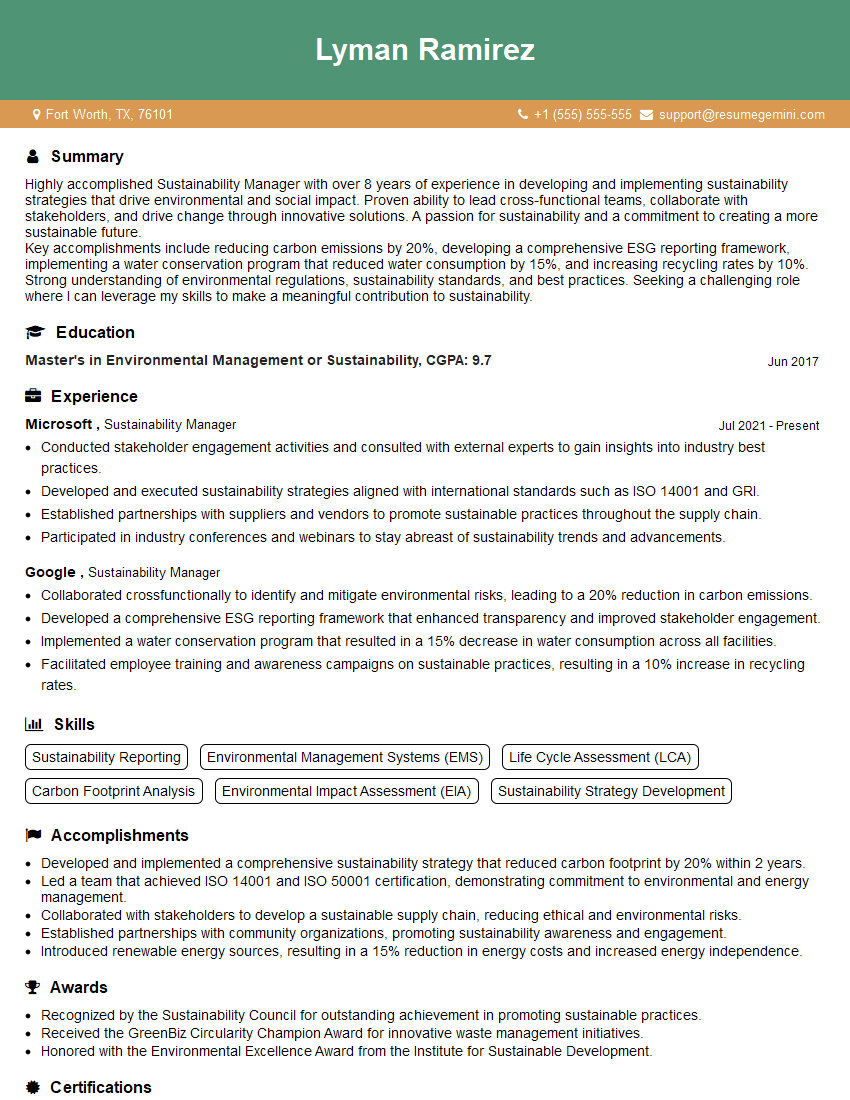
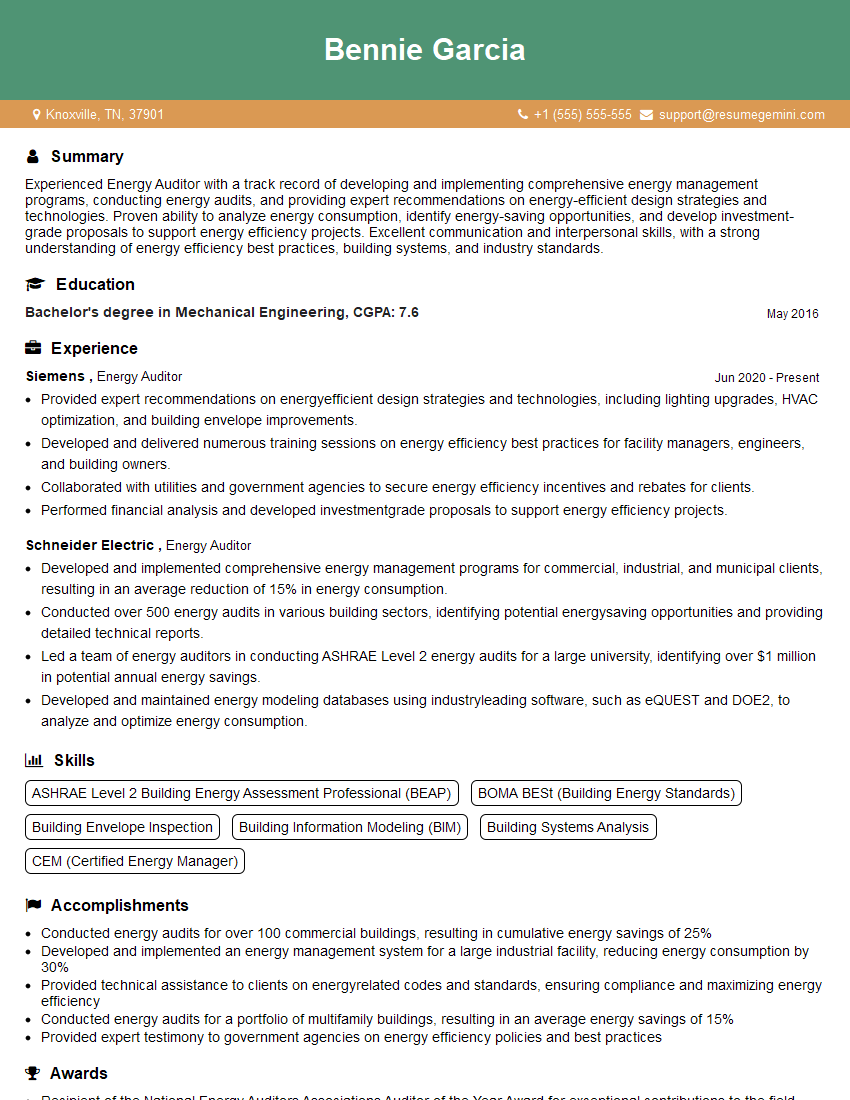
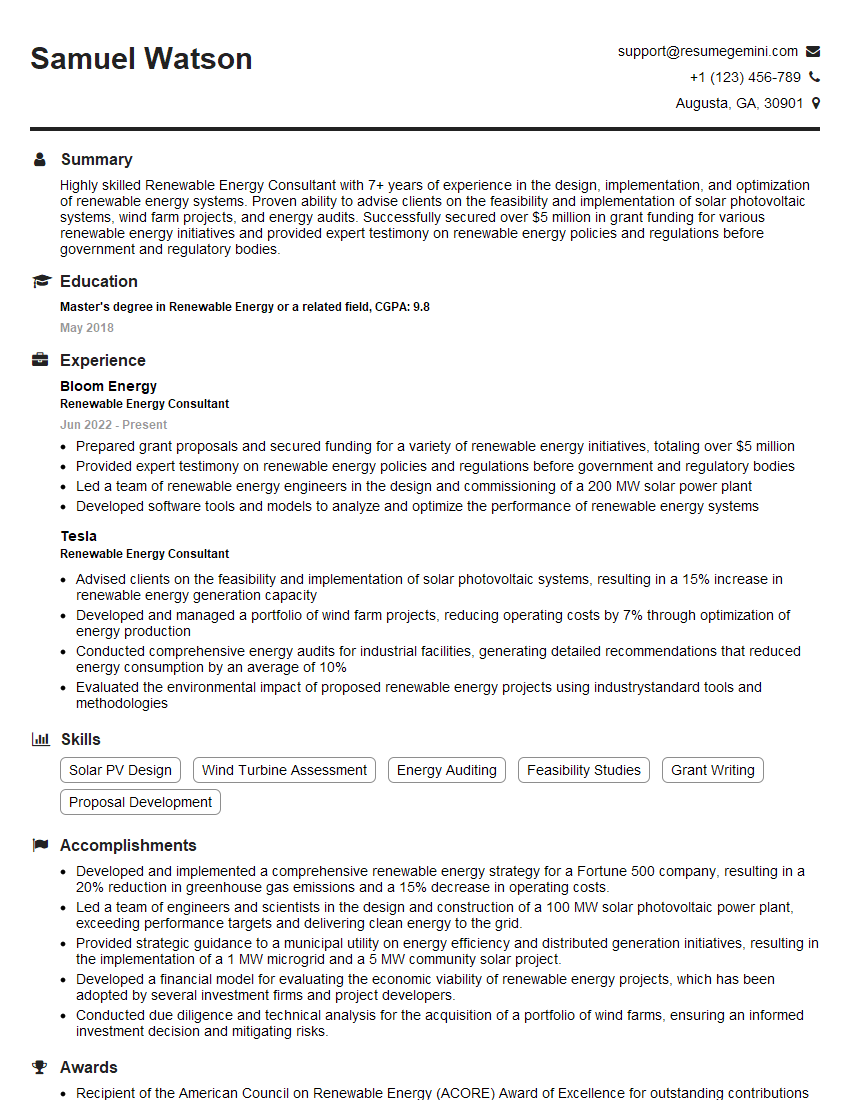
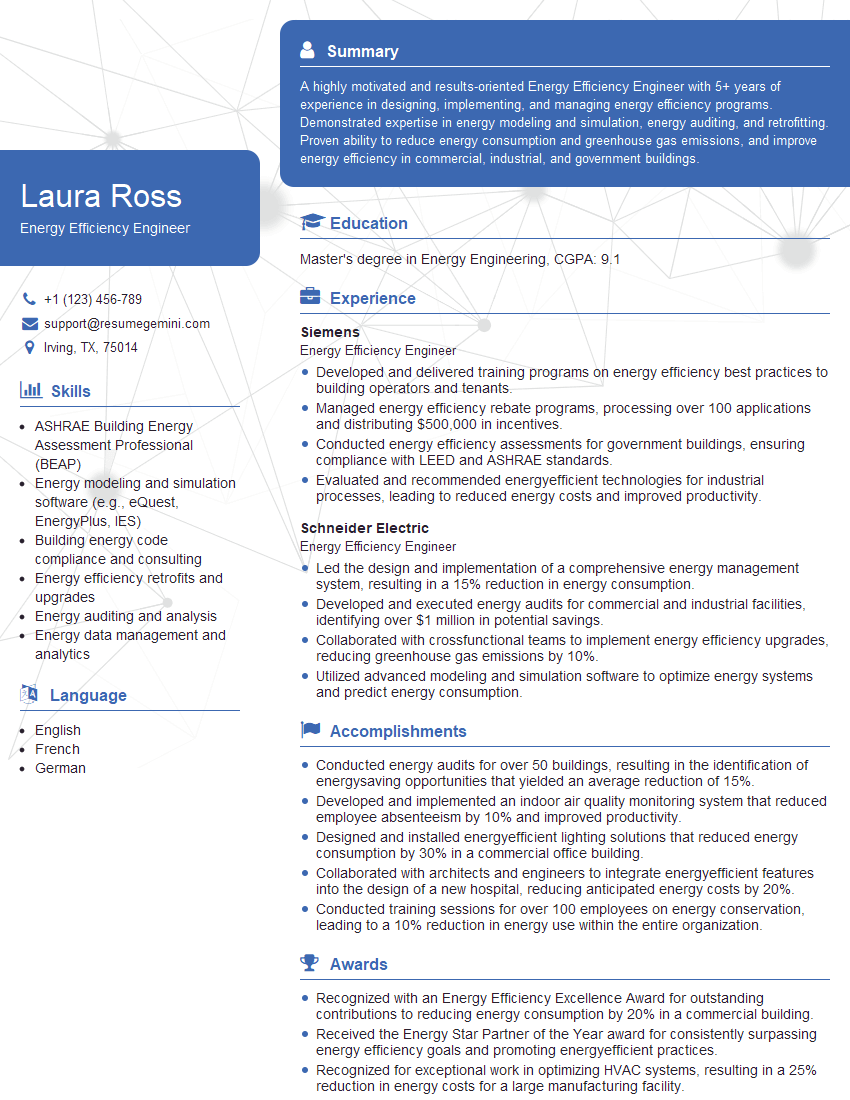
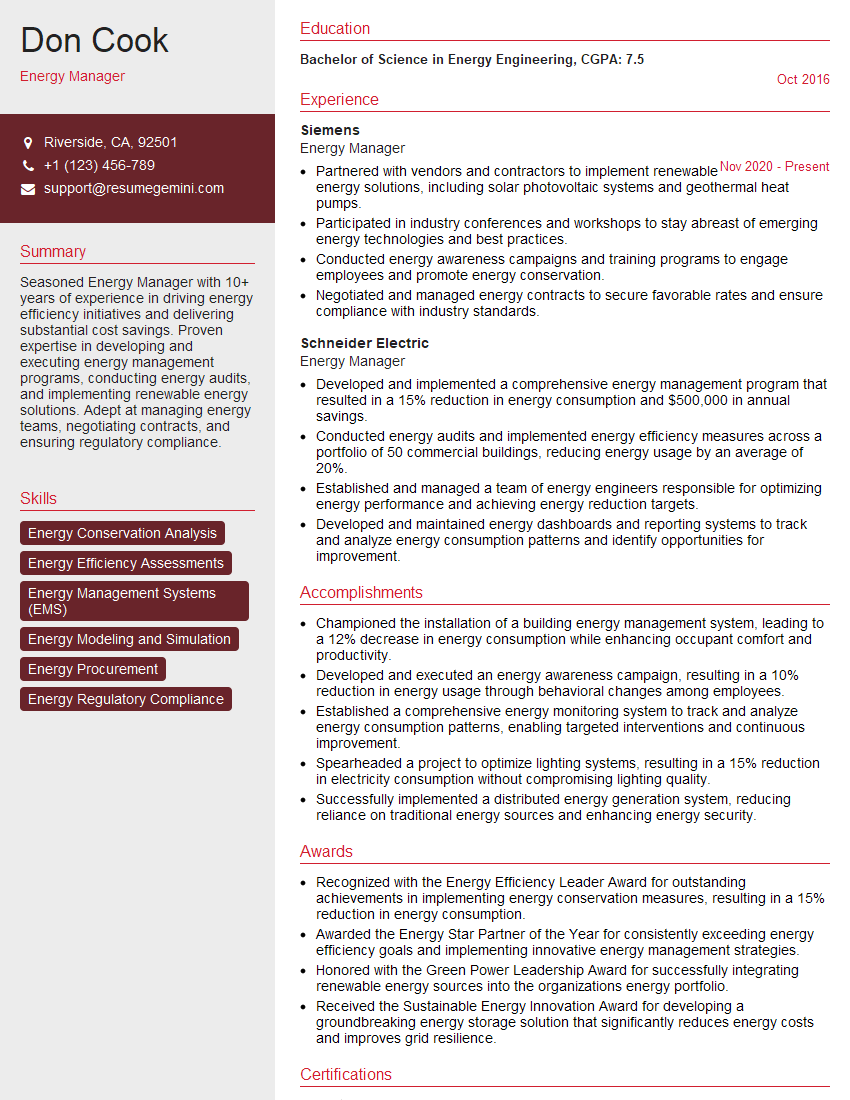
Mastering Energy Efficiency and Building Performance opens doors to exciting and impactful careers in a growing field. To stand out, a strong, ATS-friendly resume is crucial. ResumeGemini is a trusted resource to help you craft a compelling resume that showcases your skills and experience effectively. They provide examples of resumes tailored to Energy Efficiency and Building Performance to guide you. Take the next step in your career journey – create a resume that highlights your expertise and helps you secure your dream role.

Explore more articles
Users Rating of Our Blogs
Share Your Experience
We value your feedback! Please rate our content and share your thoughts (optional).
What Readers Say About Our Blog
To the interviewgemini.com Webmaster.
Very helpful and content specific questions to help prepare me for my interview!
Thank you
To the interviewgemini.com Webmaster.
This was kind of a unique content I found around the specialized skills. Very helpful questions and good detailed answers.
Very Helpful blog, thank you Interviewgemini team.