Every successful interview starts with knowing what to expect. In this blog, we’ll take you through the top Familiar with a variety of Machining Operations and Techniques interview questions, breaking them down with expert tips to help you deliver impactful answers. Step into your next interview fully prepared and ready to succeed.
Questions Asked in Familiar with a variety of Machining Operations and Techniques Interview
Q 1. Explain the difference between subtractive and additive manufacturing.
Subtractive and additive manufacturing represent fundamentally different approaches to creating parts. Subtractive manufacturing, encompassing processes like milling and turning, starts with a larger block of material and removes material to achieve the desired shape. Think of sculpting – you start with a large lump of clay and chip away until you have your final form. Additive manufacturing, or 3D printing, works conversely. It builds up a part layer by layer, starting from nothing and adding material until the final design is complete. This is akin to constructing a building – you start with a foundation and add floors and walls progressively.
In essence, subtractive manufacturing is a material removal process, while additive manufacturing is a material addition process. The choice between the two depends heavily on factors like part complexity, material properties, production volume, and cost.
Q 2. Describe your experience with various machining processes (e.g., milling, turning, drilling).
My experience spans a wide range of machining processes. I’ve extensively used milling machines for creating complex shapes and features, from simple planar surfaces to intricate contours. For instance, I recently used a 5-axis milling machine to create a highly detailed mold for a medical device component. Turning is another core competency; I’ve worked with lathes to produce cylindrical parts with high precision, including shafts and bushings. I’m proficient in various turning techniques, such as facing, grooving, and threading. Drilling is a fundamental operation I use regularly, from creating simple holes to more complex drilling patterns. I’ve worked with various drilling machines, ensuring accuracy and surface finish across diverse materials.
Beyond these core processes, I possess experience with grinding, honing, and lapping for achieving extremely fine surface finishes and tight tolerances. My expertise also extends to wire EDM (Electrical Discharge Machining) for intricate, hard-to-machine materials, and I’ve used various other special processes like laser cutting as needed. Each process demands a different level of skill and precision.
Q 3. What are the common types of cutting tools used in machining?
Cutting tools in machining are categorized broadly by their geometry and material. Common types include:
- End Mills: Used in milling, these have multiple cutting edges and create a variety of shapes.
- Drills: Used for creating holes. Types include twist drills, step drills, and core drills.
- Lathe Tools: Used in turning operations. They come in many profiles for various operations such as turning, facing, grooving, and threading.
- Milling Cutters: Diverse selection including face mills, slot drills, and shell end mills tailored to specific machining tasks.
- Reamer: Used to enlarge or finish already drilled holes to a precise size.
- Taps and Dies: Used for creating internal (taps) and external (dies) threads.
The material of the cutting tool is also crucial. High-speed steel (HSS), carbide, and ceramic are commonly used, each offering different properties in terms of hardness, wear resistance, and cutting speed.
Q 4. How do you select the appropriate cutting tool for a specific material and operation?
Selecting the right cutting tool is critical for efficiency and quality. The process involves considering several factors:
- Material to be machined: Hardness, machinability, and tendency to work harden are key considerations. Harder materials require harder cutting tools.
- Machining operation: Turning, milling, drilling, etc. Each operation requires specific tool geometries.
- Desired surface finish: A smoother finish may require a different tool geometry or material.
- Required tolerance: Tight tolerances necessitate tools and processes capable of high precision.
- Cutting conditions: Cutting speed, feed rate, and depth of cut influence tool wear and life.
For example, machining aluminum might use carbide tools for their speed and efficiency, while machining hardened steel would require more durable tools made from cemented carbide or even ceramic to avoid premature wear and breakage.
Q 5. Explain the concept of cutting speed, feed rate, and depth of cut.
Cutting speed (V), feed rate (f), and depth of cut (d) are fundamental parameters in machining that significantly affect the process outcome and tool life. Cutting speed is the surface speed of the workpiece as it passes the cutting tool (measured in meters per minute or feet per minute). Feed rate refers to the rate at which the tool advances into the workpiece (measured in mm/rev or inches/rev for turning or mm/min for milling). Depth of cut is the thickness of the material removed in a single pass (measured in mm or inches).
Think of it like carving wood: cutting speed is how fast your knife moves across the wood, feed rate is how far you move the knife with each stroke, and depth of cut is how deep you cut into the wood in each stroke. A balance is needed – too fast, and you’ll risk burning or breaking the tool; too slow, and the process will be inefficient.
Q 6. How do you calculate these parameters for a given machining operation?
Calculating these parameters requires considering material properties, tool geometry, and desired surface finish. There isn’t a single formula, as the calculations often involve looking up recommended cutting data in machinability handbooks or manufacturer’s data sheets based on the material and cutting tool used. However, basic relationships exist.
Cutting speed (V) is often calculated using the formula: V = (πDN)/1000 where D is the diameter of the workpiece and N is the rotational speed in RPM. Feed rate (f) and depth of cut (d) are chosen based on the desired material removal rate, surface finish, and tool life requirements. These choices frequently involve trial and error or reference to established cutting data for optimal results.
Modern CNC machines often have built-in calculators that can assist in determining the optimum cutting parameters for various materials and operations. Experience plays a significant role in refining these parameters to achieve desired results while maximizing efficiency and tool life.
Q 7. What are the different types of CNC machine tools?
CNC machine tools are categorized based on their primary function and axes of movement. Common types include:
- CNC Milling Machines: Used for a variety of milling operations, ranging from simple 3-axis machines to complex 5-axis machines capable of machining complex 3D shapes.
- CNC Lathes: Used for turning operations on cylindrical workpieces, offering various configurations like engine lathes, chucking lathes, and Swiss-type lathes.
- CNC Drilling Machines: Perform various drilling operations, including drilling, tapping, and reaming. They can range from simple single-spindle machines to complex multi-spindle machines.
- CNC Machining Centers: Versatile machines that combine multiple operations, such as milling, drilling, and tapping, in a single machine. These are particularly useful for complex parts.
- CNC Grinding Machines: Specialized for grinding operations, which involve removing very fine amounts of material to achieve precise dimensions and high surface finish.
Beyond these, there are specialized CNC machines such as EDM machines (Electrical Discharge Machining), laser cutting machines, and waterjet cutting machines. The choice of machine depends heavily on the part’s complexity, required precision, material properties, and production volume.
Q 8. Describe your experience with programming CNC machines (e.g., G-code, CAM software).
My experience with CNC programming encompasses both G-code and CAM software. I’m proficient in creating and modifying G-code programs manually, understanding the intricacies of each command, like feed rates (F), spindle speed (S), and coordinate movements (X, Y, Z). For example, I’ve successfully programmed complex 3D contours using G-code, requiring meticulous attention to toolpath optimization for efficient material removal and high-quality surface finishes. Beyond manual G-code, I’m highly experienced with various CAM software packages such as Mastercam and Fusion 360. These allow for automated toolpath generation from 3D models, significantly speeding up the programming process and reducing human error. In a recent project, I used Fusion 360 to program a complex five-axis milling operation, optimizing the toolpaths to minimize machining time and maximize surface quality. This involved selecting appropriate cutting tools, setting proper feed rates and depths of cut, and simulating the entire process virtually to identify and correct any potential collisions before actual machining.
Q 9. How do you troubleshoot common machining problems (e.g., tool breakage, surface finish issues)?
Troubleshooting machining problems requires a systematic approach. Let’s say I encounter tool breakage. My first step is to analyze the broken tool: Is the fracture clean, or is it indicative of excessive vibration or improper clamping? I’d then check the machine parameters – spindle speed, feed rate, depth of cut – to ensure they were within acceptable limits for the selected tool and material. If the problem persists, I’d examine the workpiece for any potential inconsistencies like hidden voids or inclusions that might cause unexpected stress. Surface finish issues, on the other hand, might stem from dull tools, improper cutting parameters (too high a feed rate or depth of cut), or insufficient coolant application. I’d systematically check each of these factors, starting with a visual inspection of the tool and then reviewing the machining parameters. If necessary, I’d adjust the parameters, change the tool, or optimize the cutting strategy to improve surface quality. For example, when facing a rough surface, I might switch to a finer-grain tool, reduce the feed rate, or increase the number of passes. A thorough understanding of material properties and machining principles is crucial in effective troubleshooting.
Q 10. What are the safety precautions you take while operating machinery?
Safety is paramount in machining. My routine begins with a thorough machine inspection, checking for loose parts, proper coolant levels, and ensuring all guards are securely in place. Before starting any operation, I always wear appropriate personal protective equipment (PPE), including safety glasses, hearing protection, and a shop coat. Long hair is always tied back. I never operate machinery while fatigued or under the influence of drugs or alcohol. I always ensure the workpiece is securely clamped to prevent movement during machining, and I use appropriate tooling for the material being machined. Furthermore, I’m trained to identify and respond to potential hazards such as coolant leaks, tool malfunctions, or machine malfunctions. Regular maintenance is crucial in preventing accidents, and I always follow the manufacturer’s instructions for operating and maintaining the equipment. For example, regular cleaning of chips and debris from the machine bed is essential to prevent accidents.
Q 11. How do you ensure dimensional accuracy and tolerance in your work?
Dimensional accuracy and tolerance are maintained through a combination of careful planning and execution. Starting with the engineering drawings, I meticulously plan the machining strategy, considering the sequence of operations and the potential for accumulating errors. I use precision tooling and carefully select cutting parameters to minimize dimensional variations. Regular inspection using precision measuring instruments is critical – I’ll check dimensions at various stages of the machining process. In addition, I utilize machine-specific features like tool length compensation and workpiece offsets to maintain accuracy. For example, if a feature is specified with a tight tolerance, I might implement a multiple-pass strategy with increasingly finer cuts to achieve the required precision. Post-machining, I would verify final dimensions using calibrated measuring equipment to confirm that the part falls within the specified tolerances.
Q 12. Explain your experience with various measuring instruments (e.g., calipers, micrometers).
I’m proficient in using a variety of measuring instruments, including vernier calipers, micrometers, dial indicators, and height gauges. Vernier calipers are frequently used for measuring external and internal dimensions, while micrometers offer greater precision for finer measurements. Dial indicators are excellent for checking surface flatness and roundness. Height gauges are valuable for precise measurements of height and depth. I understand the limitations and precision capabilities of each instrument and select the appropriate tool for the measurement task. For instance, when measuring a shaft diameter that requires high accuracy, a micrometer is preferred over a vernier caliper. Regular calibration of these instruments ensures accurate and reliable measurements, which is critical for maintaining dimensional accuracy in my work. I maintain detailed records of instrument calibrations.
Q 13. Describe your understanding of GD&T (Geometric Dimensioning and Tolerancing).
Geometric Dimensioning and Tolerancing (GD&T) is a language used to specify the precise geometry and tolerances of parts on engineering drawings. I’m well-versed in interpreting symbols like position, perpendicularity, flatness, and runout, understanding their implications for part functionality and assembly. For example, a positional tolerance symbol indicates the permissible deviation of a feature’s location from its ideal position. Understanding GD&T allows me to precisely manufacture parts that meet the specified requirements. It goes beyond simple plus/minus tolerances and considers the actual geometric relationships between different features on a part, crucial for ensuring proper fit and function in assemblies. This understanding is vital in planning machining operations and checking final part quality. Incorrect interpretation of GD&T symbols can lead to parts that fail to meet design specifications. I use GD&T compliant software to design and manufacture parts ensuring that the output is per the specified GD&T.
Q 14. How do you interpret engineering drawings and blueprints?
Interpreting engineering drawings and blueprints is a fundamental skill for any machinist. I begin by carefully reviewing the title block to understand the part’s purpose, material, scale, and revision level. Then, I systematically examine the views (orthographic projections), sections, and details to understand the part’s geometry and dimensions. I pay close attention to dimensions, tolerances, surface finishes, and material specifications. I look for any special notes or callouts that provide additional information. For example, surface finish symbols indicate the required roughness or smoothness of a surface. If any aspects are unclear or ambiguous, I don’t hesitate to ask clarifying questions from the design engineer. Accurate interpretation of drawings is crucial for producing parts that meet the design intent and ensuring the success of a manufacturing project. I always cross-reference different views to ensure a thorough understanding of the part geometry before starting any machining operations.
Q 15. How do you maintain and clean your machine tools?
Maintaining and cleaning machine tools is crucial for ensuring accuracy, longevity, and safety. It’s a multi-step process that begins with regular cleaning and progresses to more involved maintenance tasks.
- Daily Cleaning: This involves removing chips and debris from the machine bed, ways, and other surfaces using compressed air, brushes, and appropriate cleaning solvents. I always make sure to disconnect power before cleaning and follow all safety procedures. For example, I meticulously clean the chuck and spindle after each job to prevent buildup that could affect accuracy.
- Weekly Maintenance: This might include lubricating moving parts according to the manufacturer’s recommendations, checking for wear and tear on belts and pulleys, and inspecting coolant levels and quality. I once noticed a slight misalignment in a lathe’s ways during a weekly check, which allowed me to address it before it caused significant damage.
- Monthly Maintenance: More thorough inspections are performed, including checking for coolant leaks, tightening loose screws and bolts, and cleaning filters. I’ve found that keeping detailed logs of maintenance activities helps to identify potential problems early on.
- Preventative Maintenance: This involves scheduling routine servicing, such as replacing worn parts or performing complete overhauls based on the machine’s usage and manufacturer’s recommendations. This proactive approach minimizes downtime and maximizes machine lifespan. A great example is preemptive spindle bearing replacement to avoid costly unexpected breakdowns.
Proper cleaning and maintenance not only extend the life of the machine but also ensure consistent accuracy and reduce the risk of accidents.
Career Expert Tips:
- Ace those interviews! Prepare effectively by reviewing the Top 50 Most Common Interview Questions on ResumeGemini.
- Navigate your job search with confidence! Explore a wide range of Career Tips on ResumeGemini. Learn about common challenges and recommendations to overcome them.
- Craft the perfect resume! Master the Art of Resume Writing with ResumeGemini’s guide. Showcase your unique qualifications and achievements effectively.
- Don’t miss out on holiday savings! Build your dream resume with ResumeGemini’s ATS optimized templates.
Q 16. Explain your experience with different types of cutting fluids and their applications.
Cutting fluids, also known as coolants or lubricants, play a vital role in machining operations, influencing surface finish, tool life, and overall efficiency. My experience encompasses various types, each with specific applications:
- Water-Miscible Fluids: These are a blend of water and soluble oils, providing excellent cooling and lubrication. They’re common in many milling and turning operations. I’ve used these extensively for aluminum and steel machining, noticing improved surface finish and reduced tool wear compared to dry machining.
- Straight Oils: These are primarily used for heavier-duty machining, such as deep drilling or heavy-duty turning of tough materials. They offer superior lubrication but can be less effective at cooling compared to water-miscible fluids. I particularly recall using straight oils when machining high-strength steel alloys, where their excellent lubrication was essential for preventing tool breakage.
- Synthetic Fluids: These fluids are environmentally friendly and offer excellent performance in various applications. They often boast better corrosion protection and longer lifespan than traditional oils. My experience with synthetic fluids highlights their efficiency and long-term cost savings.
- Specialty Fluids: Specific fluids exist for different materials or operations, such as those designed for cryogenic machining or high-speed cutting. The selection always depends on the material, the machining process, and the desired outcome. I once needed to utilize a specialized fluid with extreme-pressure additives for machining a very hard nickel-based superalloy.
Choosing the right cutting fluid is a critical decision that impacts the efficiency and quality of the machining process. The selection process considers factors like material being machined, operation type, and environmental concerns. Regular monitoring of fluid condition is also vital for optimal performance.
Q 17. What are the advantages and disadvantages of different machining processes?
Various machining processes exist, each with its own set of advantages and disadvantages. Here’s a comparison of a few common methods:
- Milling:
- Advantages: Versatile, capable of producing complex shapes, high material removal rate.
- Disadvantages: Can be time-consuming for intricate parts, requires skilled operator, potential for chatter.
- Turning:
- Advantages: High material removal rate, precise dimensions, good surface finish achievable.
- Disadvantages: Limited to rotational parts, can be challenging to create complex profiles.
- Drilling:
- Advantages: Simple, relatively inexpensive, suitable for a wide range of materials.
- Disadvantages: Limited to hole creation, lower precision compared to milling or turning.
- EDM (Electrical Discharge Machining):
- Advantages: Capable of producing complex shapes in hard-to-machine materials, high accuracy.
- Disadvantages: Slow process, expensive equipment, requires specialized expertise.
The choice of machining process depends on factors such as the part geometry, material properties, required tolerance, production volume, and available resources. A good machinist understands the strengths and limitations of each process to select the most efficient and cost-effective method.
Q 18. Describe your experience with using a Coordinate Measuring Machine (CMM).
I have extensive experience using Coordinate Measuring Machines (CMMs) for precise dimensional inspection of machined parts. My experience includes both manual and automated CMM operation.
- Manual CMM Operation: This involves using a probe to manually touch specific points on the part, collecting data that is then used to create a digital representation of the part and compare it to the CAD model. I’ve used manual CMMs to verify the dimensions of intricate aerospace components, requiring a high degree of precision and attention to detail.
- Automated CMM Operation: Automated CMMs use robotic probes controlled by software to measure multiple points automatically, significantly increasing efficiency and reducing human error. I’ve utilized automated CMMs in high-volume production environments to ensure the consistency of machined parts.
- Software Proficiency: Proficiency in CMM software is essential for data analysis and report generation. I am familiar with several CMM software packages and am comfortable analyzing the results to identify any deviations from the specified tolerances.
CMMs are indispensable for ensuring the quality and accuracy of machined parts, offering a non-destructive method for comprehensive dimensional inspection.
Q 19. How do you perform quality control checks on machined parts?
Quality control checks on machined parts are crucial for ensuring that they meet the specified requirements. My approach is multi-faceted and includes:
- Visual Inspection: This initial step involves checking for any visible defects, such as scratches, burrs, or other surface imperfections.
- Dimensional Measurement: This uses tools like calipers, micrometers, and dial indicators to verify critical dimensions. For higher precision, CMMs are utilized.
- Functional Testing: For parts with specific functionalities, functional tests are essential. This might involve checking the fit, assembly, or operation of the part.
- Material Testing: In some cases, material testing, such as hardness testing or chemical analysis, is necessary to confirm material properties.
- Statistical Process Control (SPC): In high-volume production, SPC techniques are employed to monitor the machining process and identify any trends that might lead to out-of-tolerance parts.
A thorough quality control process ensures that only high-quality parts are delivered, minimizing rework, scrap, and potential customer issues.
Q 20. What is your experience with setting up and operating various types of jigs and fixtures?
Setting up and operating jigs and fixtures is a fundamental skill for efficient and accurate machining. My experience spans various types, including:
- Drill Jigs: These guide the drill bit to ensure accurate hole placement. I have experience designing and using various drill jigs, from simple bushing-type jigs to more complex designs incorporating multiple holes and features.
- Milling Fixtures: These hold the workpiece securely in place during milling operations, ensuring consistent accuracy and repeatability. I’m comfortable designing and using fixtures incorporating clamps, locators, and other elements to secure the workpiece effectively.
- Welding Fixtures: These fixtures hold the workpieces securely during the welding process, ensuring consistent weld quality and geometry. My experience extends to designing fixtures for both manual and automated welding processes.
- Inspection Fixtures: These fixtures are specifically designed to hold the workpiece for precise dimensional inspection. I am experienced in using inspection fixtures in conjunction with CMMs for efficient and accurate measurements.
The design and use of jigs and fixtures significantly improve efficiency and accuracy in machining processes, reducing the reliance on operator skill for consistent results.
Q 21. Describe your experience with different types of machine vises.
Machine vises are essential workholding devices for various machining operations. My experience includes several types:
- Parallel Visies: These are the most common type, offering parallel jaws for clamping workpieces securely. I frequently use these for milling, turning, and other operations requiring precise alignment.
- Rotary Visies: These allow for rotation of the workpiece, useful for operations requiring access to multiple sides. I have used these for complex milling setups where multiple angles of access were necessary.
- Hydraulic Visies: These offer greater clamping force compared to manual vises, allowing for secure holding of larger or more challenging workpieces. I’ve found these beneficial for machining large components.
- Air-operated Visies: These are often incorporated into automated machining systems for efficient and repeatable clamping. I’ve integrated these into CNC machining cells for higher productivity.
- Specialty Visies: These are designed for specific applications, such as holding odd-shaped workpieces or those with delicate surfaces. I’ve encountered scenarios where unique workholding solutions were required, necessitating the use of specialty vises.
The choice of vise depends on the workpiece material, size, shape, and the specific machining operation. Proper selection and setup of a vise are critical for ensuring accurate and safe machining.
Q 22. Explain your experience with different types of clamping systems.
My experience with clamping systems spans a wide range, from simple vise jaws to sophisticated hydraulic and pneumatic workholding solutions. The choice of clamping system depends heavily on the workpiece material, size, shape, and the machining operation itself.
- Vise Jaws: I’m proficient in using various vise jaws, including soft jaws for delicate parts and specialized jaws for irregular shapes. For instance, I’ve used soft jaws made of aluminum or polyurethane to prevent marring delicate aluminum castings during milling operations.
- Hydraulic Clamps: These offer precise and powerful clamping force, essential for large or complex parts. I’ve worked extensively with hydraulic chucks and fixtures, ensuring consistent and repeatable clamping during CNC machining. One project involved using a hydraulic chuck to hold a large steel forging while performing multiple turning operations.
- Pneumatic Clamps: These are faster and easier to integrate into automated systems. I’ve used pneumatic clamps in high-speed production environments, ensuring rapid cycle times without compromising workpiece security. A recent application involved a pneumatic clamping system on a robotic cell for automated part loading and unloading.
- Magnetic Clamps: These are very useful for ferrous materials, offering quick setup and strong holding power. I’ve used magnetic chucks for surface grinding operations, enabling fast workpiece changes and high material removal rates.
- Fixture Clamping: Designing and utilizing custom fixtures is crucial for complex parts. I have considerable experience designing and implementing fixtures that accommodate specific part geometries and machining requirements, including tombstone fixtures for high-efficiency milling.
Choosing the right clamping system is critical to ensure part accuracy, safety, and efficient machining. Poor clamping can lead to vibration, inaccuracies, and even workpiece damage.
Q 23. How do you deal with unexpected issues or breakdowns during machining operations?
Unexpected issues during machining are inevitable. My approach focuses on systematic troubleshooting and preventative measures.
- Immediate Action: The first step is always safety – ensuring the machine is powered down and the area is secured. Then, I carefully assess the situation, noting the nature of the problem (e.g., tool breakage, coolant leak, machine alarm).
- Diagnosis: Based on the observed problem, I use a combination of experience, machine diagnostics (error codes, sensor readings), and documentation to pinpoint the root cause. This often involves checking tool condition, workpiece setup, program parameters, and coolant levels.
- Problem Solving: Once the cause is identified, I implement the appropriate solution. This might involve replacing a broken tool, adjusting machine settings, correcting a programming error, or addressing a mechanical fault. I’m proficient in minor repairs and maintenance tasks.
- Documentation & Prevention: After resolving the issue, I thoroughly document the problem, its cause, and the solution implemented. This information is invaluable for preventing similar incidents in the future. I also review the process to identify potential improvements or preventative measures.
For example, a recent unexpected stoppage was caused by a clogged coolant filter. By swiftly identifying and replacing the filter, I minimized downtime and avoided potential damage to the machine.
Q 24. How familiar are you with different types of materials (e.g., steel, aluminum, plastics)?
My material knowledge encompasses a broad range of metals, plastics, and composites. Understanding material properties is critical for successful machining.
- Steels: I’m experienced with various steel grades, including low-carbon, high-carbon, stainless, and tool steels. I understand the differences in machinability, heat treatability, and the selection of appropriate cutting tools and parameters for each grade. For example, high-speed steel (HSS) tooling is suitable for many steels, while carbide inserts are often preferred for increased productivity when machining harder steels.
- Aluminum: I’m familiar with different aluminum alloys, their varying strengths, and tendencies to work-harden. Machining aluminum requires attention to chip control and avoidance of excessive heat generation.
- Plastics: My experience includes machining various thermoplastics and thermosets, requiring different cutting speeds, feeds, and tool geometries to prevent melting or chipping. I understand the importance of using appropriate coolants to avoid heat buildup.
- Other Materials: I have experience working with titanium, copper, brass, and various composites, each with its specific machining characteristics and challenges.
This knowledge extends to selecting appropriate tooling, cutting parameters, and coolants to optimize the machining process for each material and avoid potential problems, such as tool wear, surface defects, or part damage.
Q 25. What are your experience levels with manual and automatic tool changers?
I have significant experience with both manual and automatic tool changers (ATCs).
- Manual Tool Changers: I’m proficient in safely and efficiently changing tools on both manual machines (like milling machines and lathes) and CNC machines without ATCs. This involves understanding tool clamping mechanisms and safety procedures.
- Automatic Tool Changers: I’m familiar with a wide variety of ATCs, from simple drum-type changers to more complex carousel systems used on CNC machining centers. This includes understanding ATC operation, troubleshooting potential problems, and maintaining the ATC system.
ATCs drastically increase the efficiency of CNC machining operations by automating tool changes, reducing cycle times, and enabling complex parts with numerous operations to be machined in a single setup. In my experience, minimizing downtime during tool changes is paramount to maximizing productivity.
Q 26. What experience do you have with different types of surface finishes?
Achieving the desired surface finish is a critical aspect of machining. My experience covers a wide range of surface finishes, from rough to mirror-like.
- Roughing: This focuses on high material removal rates, often resulting in relatively coarse surface finishes. I know how to optimize cutting parameters and tool selection for efficient roughing operations.
- Finishing: This emphasizes achieving precise dimensions and fine surface finishes. This may involve using specialized finishing tools, optimized cutting parameters, and sometimes additional processes like polishing or honing.
- Specific Finishes: I understand how different machining parameters (cutting speed, feed rate, depth of cut) affect the resulting surface finish. I’m familiar with achieving specific surface roughness values (Ra) as specified in engineering drawings, employing techniques such as fine-finishing cuts, vibratory finishing, or electropolishing as needed.
For example, I’ve worked on projects requiring a Ra value of less than 0.8µm on a complex aluminum part, necessitating careful tool selection, optimized cutting parameters, and a multi-stage finishing process.
Q 27. Describe your proficiency with various CAD/CAM software packages (mention specific names).
My proficiency in CAD/CAM software is extensive. I’m highly experienced with industry-standard packages.
- Mastercam: I’m highly proficient in Mastercam, utilizing its capabilities for generating efficient and accurate toolpaths for milling, turning, and other machining operations. This includes using various strategies to optimize material removal, surface finish, and cycle time.
- SolidWorks CAM: I’m comfortable creating and modifying toolpaths within the SolidWorks CAM environment. Its integrated design and manufacturing capabilities streamline the workflow.
- Fusion 360: I use Fusion 360 for its ease of use and integrated design-manufacturing capabilities. It’s especially beneficial for rapid prototyping and less complex parts.
I can utilize these packages to design tooling, fixtures, and create CNC programs tailored to specific machining requirements and workpiece geometries. My expertise includes generating toolpaths optimized for minimizing cutting time, maximizing tool life, and achieving desired surface finishes.
Q 28. How do you stay updated on the latest advancements in machining technologies?
Staying current with the latest machining technologies is crucial for remaining competitive. I employ several strategies to achieve this.
- Industry Publications: I regularly read industry journals and magazines, staying informed about advancements in cutting tools, machine technology, and machining processes.
- Professional Organizations: I’m an active member of relevant professional organizations and attend industry conferences and trade shows. This provides opportunities to network with other professionals, learn from experts, and see the latest equipment and techniques in action.
- Online Resources: I utilize online resources such as webinars, tutorials, and technical papers to keep abreast of emerging technologies and best practices.
- Manufacturer Training: I participate in manufacturer training programs to enhance my skills with specific equipment or software.
- Hands-on Experience: The best way to learn is by doing. I actively seek opportunities to work with new technologies and refine my skills on the shop floor.
By consistently engaging with these resources, I maintain a high level of competence and adapt my skills to meet the demands of evolving machining technologies.
Key Topics to Learn for a Machining Operations and Techniques Interview
Ace your next interview by mastering these key areas of machining:
- Turning Operations: Understand lathe operation principles, cutting tool geometry, speeds and feeds calculation, and common turning techniques (facing, grooving, threading).
- Milling Operations: Grasp milling machine types, cutter selection, workpiece fixturing, and various milling methods (face milling, end milling, slotting).
- Drilling and Boring: Learn about drill bit selection, drilling techniques, speed and feed considerations, and the differences between drilling and boring operations.
- Grinding Operations: Understand grinding wheel selection, grinding parameters, surface finish control, and common grinding methods (cylindrical, surface, internal).
- Material Selection and Properties: Know the properties of common machining materials (steels, aluminum, plastics) and how material properties influence machining processes and tool selection.
- CNC Machining: Familiarize yourself with CNC programming fundamentals (G-code), machine operation, setup procedures, and troubleshooting common CNC issues.
- Tooling and Machining Processes: Gain a deep understanding of various cutting tools, their applications, and how to select appropriate tooling for specific machining tasks. Understand wear mechanisms and tool life.
- Safety Procedures and Practices: Be prepared to discuss standard safety procedures in a machining environment, including the proper use of PPE and machine safety features.
- Quality Control and Inspection: Understand the importance of quality control in machining and be familiar with common inspection methods used to ensure dimensional accuracy and surface finish.
- Troubleshooting and Problem-Solving: Practice diagnosing and resolving common machining problems, such as tool breakage, surface defects, dimensional inaccuracies, and machine malfunctions.
Next Steps
Demonstrating expertise in a variety of machining operations and techniques is crucial for career advancement in manufacturing and related fields. A strong understanding of these processes will significantly improve your job prospects and open doors to exciting opportunities. To highlight your skills effectively, create a resume that’s both comprehensive and Applicant Tracking System (ATS)-friendly. ResumeGemini can help you craft a professional and impactful resume tailored to the machining industry. We provide examples of resumes optimized for showcasing expertise in machining operations and techniques to help you create a winning application.

Manufacturing Manager Resume Sample

Production Supervisor Resume Sample
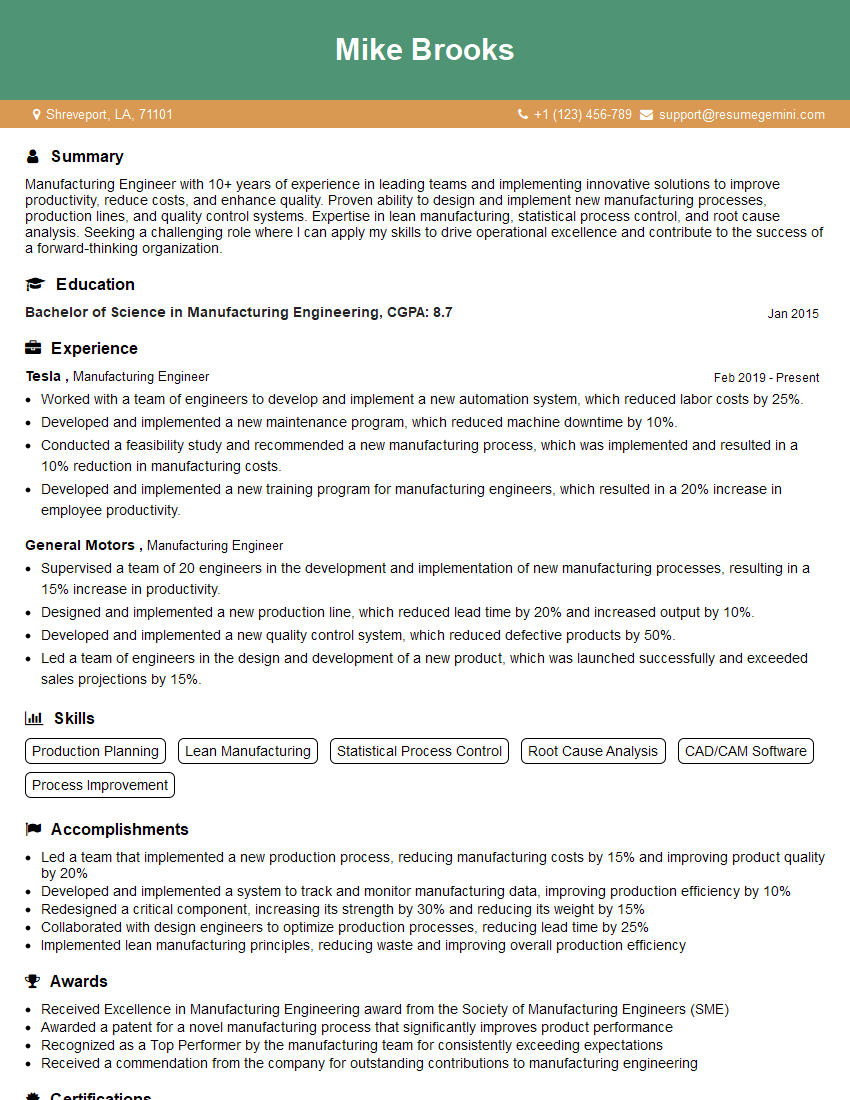
Manufacturing Engineer Resume Sample

Tooling Engineer Resume Sample

Machining Supervisor Resume Sample

Grinder Operator Resume Sample

Machinist Apprentice Resume Sample
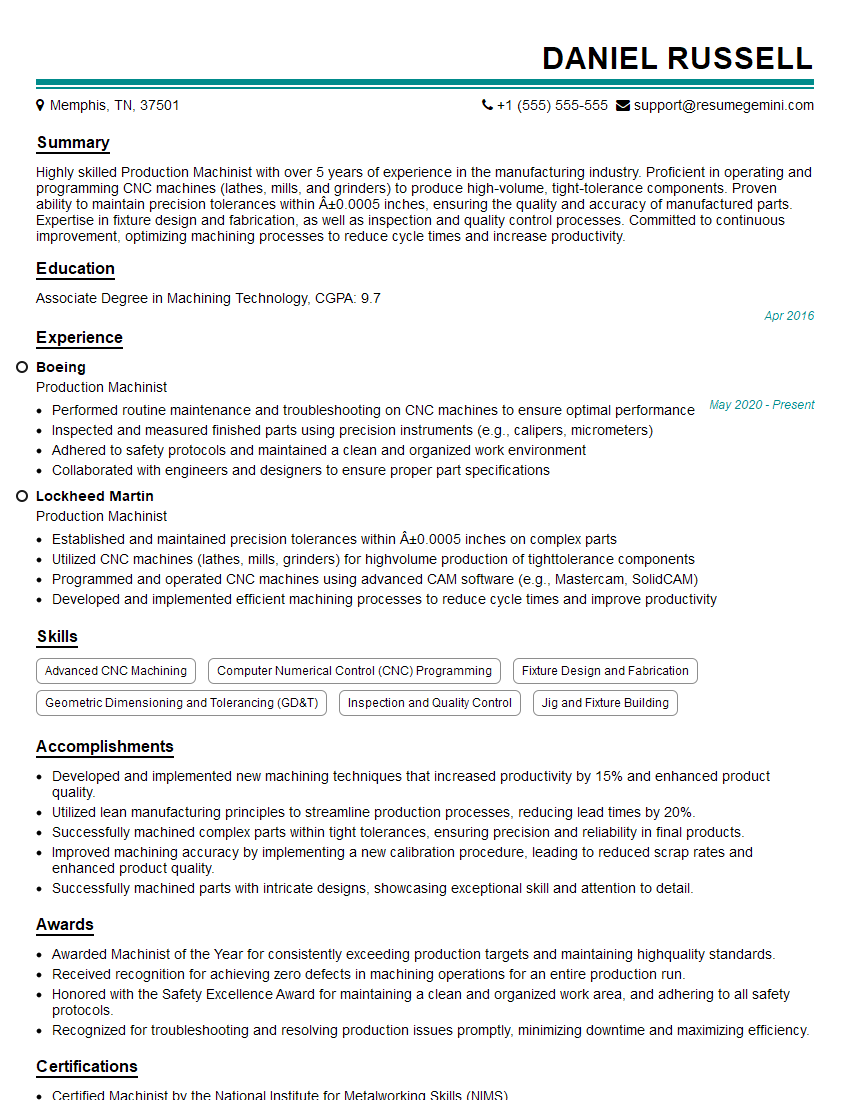
Production Machinist Resume Sample

Tool and Die Maker Resume Sample
Explore more articles
Users Rating of Our Blogs
Share Your Experience
We value your feedback! Please rate our content and share your thoughts (optional).
What Readers Say About Our Blog
To the interviewgemini.com Webmaster.
Very helpful and content specific questions to help prepare me for my interview!
Thank you
To the interviewgemini.com Webmaster.
This was kind of a unique content I found around the specialized skills. Very helpful questions and good detailed answers.
Very Helpful blog, thank you Interviewgemini team.