The thought of an interview can be nerve-wracking, but the right preparation can make all the difference. Explore this comprehensive guide to Financial Aid Guidance interview questions and gain the confidence you need to showcase your abilities and secure the role.
Questions Asked in Financial Aid Guidance Interview
Q 1. Explain the difference between need-based and merit-based financial aid.
Need-based and merit-based financial aid are two distinct approaches to providing students with financial assistance for higher education. Need-based aid is awarded based on a student’s demonstrated financial need, determined by comparing the cost of attendance to the family’s ability to pay (as measured by the Expected Family Contribution or EFC). The more limited a family’s resources, the greater the need-based aid they’ll receive. Merit-based aid, conversely, is awarded based on the student’s academic achievements, talents, or other exceptional qualities, regardless of financial need. A student with a high GPA or outstanding athletic abilities might receive merit-based aid even if their family can afford tuition.
Example: Imagine two students applying to the same university. Student A comes from a low-income family and has a good GPA. They are likely to receive significant need-based aid. Student B comes from a wealthy family and has an exceptional academic record. They might receive merit-based scholarships, even though they don’t demonstrate financial need.
Q 2. Describe the FAFSA process and its significance.
The Free Application for Federal Student Aid (FAFSA) is a crucial form that students and their families complete to apply for federal student aid. It’s the gateway to grants, loans, and work-study programs. The process involves gathering tax information, income details, and asset information for both the student and their parents (if the student is a dependent). The FAFSA data is used to calculate the student’s Expected Family Contribution (EFC), which is then used by colleges and universities to determine the amount of financial aid they’ll offer.
Significance: The FAFSA’s significance lies in its accessibility and its role in determining eligibility for federal financial aid. Completing the FAFSA unlocks opportunities for millions of students to pursue higher education who might otherwise not be able to afford it. It also streamlines the application process by centralizing the financial information needed by various institutions.
Q 3. What are the key components of a student’s financial aid package?
A student’s financial aid package typically consists of several key components:
- Grants: These are forms of financial aid that don’t need to be repaid. Examples include Pell Grants and institutional grants.
- Scholarships: These are also forms of gift aid (don’t have to be repaid), but are usually based on merit or specific criteria like academic achievement, athletic talent, or demonstrated need.
- Loans: These are borrowed funds that need to be repaid with interest after graduation or leaving school. There are federal loans (like subsidized and unsubsidized Stafford Loans) and private loans.
- Work-study: This program offers part-time jobs to students, allowing them to earn money to help pay for college expenses.
The proportions of each component vary significantly depending on the student’s financial need, academic record, and the specific financial aid policies of the institution.
Q 4. How do you calculate Expected Family Contribution (EFC)?
Calculating the Expected Family Contribution (EFC) is a complex process handled by the federal government through the FAFSA. It’s not a simple formula but rather a sophisticated algorithm that considers various factors. Key elements include:
- Parental income and assets: This includes both parents’ income from wages, salaries, and investments.
- Student’s income and assets: This includes any income or assets the student possesses.
- Family size: The number of people in the family affects the EFC.
- Number of family members in college: Having multiple family members in college simultaneously can influence the calculation.
The formula itself is not publicly available, but the FAFSA website uses a data entry system that feeds the information into a complex algorithm. The result is the EFC, which represents the family’s estimated contribution toward the cost of the student’s education. The lower the EFC, the higher the need-based aid the student is eligible for.
Q 5. What are the different types of federal student loans?
Federal student loans are a significant source of funding for higher education. Key types include:
- Subsidized Stafford Loans: The government pays the interest while the student is in school at least half-time, during grace periods, and during deferment.
- Unsubsidized Stafford Loans: Interest accrues while the student is in school, during grace periods, and during deferment. The student is responsible for paying this accumulated interest.
- Direct PLUS Loans: These loans are available to parents of dependent students and to graduate students. Credit checks are required.
Understanding the differences between these loan types, especially the implications of accrued interest, is critical for students and families to make informed borrowing decisions. Private loans are also available but generally carry higher interest rates and less favorable repayment terms.
Q 6. Explain the process of awarding grants and scholarships.
Awarding grants and scholarships often involves a multi-step process. For grants, eligibility is typically determined by the student’s financial need as calculated through the FAFSA. Institutions may have their own internal processes for determining which applicants receive grants. Scholarships, on the other hand, often have specific application requirements and criteria (academic merit, athletic ability, etc.). This process typically involves:
- Application submission: Students complete scholarship applications, which might include essays, transcripts, and letters of recommendation.
- Review and selection: Applications are reviewed by a committee based on the stated selection criteria.
- Notification: Selected students are notified of their award.
The competition for scholarships can be intense, and students are often encouraged to apply to multiple scholarships to increase their chances of receiving funding.
Q 7. How do you verify a student’s financial information?
Verifying a student’s financial information is crucial to ensure the accuracy of the financial aid award. This process typically involves:
- Document review: The financial aid office requests supporting documentation, such as tax returns, W-2 forms, and bank statements. This verifies the information provided in the FAFSA.
- Data matching: The institution compares the information provided by the student with data from the IRS and other sources.
- Selective verification: Some institutions randomly select a subset of applications for verification or focus on applications where there are discrepancies or inconsistencies in the information.
- Student and parent contact: The financial aid office may contact the student or their parents to clarify any inconsistencies or request additional documentation.
The verification process can take time and requires careful attention to detail from both the student and the institution. Failure to provide accurate and complete documentation can delay or jeopardize the awarding of financial aid.
Q 8. What are some common challenges faced by students in accessing financial aid?
Accessing financial aid can be a complex and challenging process for many students. Common hurdles include navigating the confusing application process itself, meeting stringent documentation requirements, understanding the different types of aid available (grants, loans, scholarships), and dealing with potential discrepancies in reported financial information.
- Complexity of the FAFSA: The Free Application for Federal Student Aid (FAFSA) can be overwhelming for students unfamiliar with financial terminology and forms. Many students struggle to correctly complete the form, leading to processing delays or errors.
- Document Procurement: Gathering necessary tax documents, bank statements, and other supporting documentation can be time-consuming and difficult, especially for students from low-income backgrounds or those with complex family financial situations.
- Understanding Aid Types: Differentiating between grants (free money), loans (money that must be repaid), and scholarships (merit-based aid) is crucial. Many students lack a clear understanding of the implications of each type of aid.
- Financial Aid Gaps: Even after receiving financial aid, many students still face significant unmet need. This gap between the cost of attendance and the total aid awarded can lead to debt, reduced course load, or even dropping out of school.
Q 9. How do you address discrepancies in a student’s financial aid application?
Addressing discrepancies in a student’s financial aid application requires a thorough and systematic approach. My first step is to identify the specific discrepancy. This might involve comparing the information provided on the FAFSA with supporting documentation, verifying income and asset information with tax returns or bank statements, and clarifying any inconsistencies with the student and their family.
Once the discrepancy is identified, I contact the student directly to clarify the information. Open communication is key. I explain the discrepancy and request necessary corrections or additional documentation. Depending on the nature of the discrepancy, I may need to contact the student’s parents or guardians. For example, if there’s a difference between reported income and the IRS data, I’ll verify the discrepancy with the student and request a corrected tax transcript.
In situations requiring further investigation, I may utilize various verification tools, including accessing the National Student Loan Data System (NSLDS) to verify previous loan history. I carefully document all communication and actions taken, maintaining meticulous records for audit purposes. Transparency and accuracy are paramount in maintaining the integrity of the financial aid process.
Q 10. Describe your experience with different financial aid software systems.
Throughout my career, I’ve worked extensively with several financial aid software systems, including CampusNexus Student, PowerFAIDS, and Banner. Each system has its unique features and functionalities. CampusNexus Student, for instance, is known for its robust reporting capabilities and streamlined workflow for processing aid packages. PowerFAIDS excels in its intuitive interface and efficient data management, making it easy to track student applications and progress. Banner, while sometimes perceived as less user-friendly, is a comprehensive system used by many large institutions and is well-integrated into their existing administrative infrastructure.
My experience with these systems extends beyond simple data entry. I’m proficient in using them to generate reports, analyze data, identify trends, and ultimately ensure accurate and timely disbursement of financial aid. I understand the importance of data integrity and compliance with federal regulations when using these systems. This includes regularly backing up data and following all security protocols.
Q 11. How do you stay updated on changes in financial aid regulations?
Staying current on financial aid regulations is crucial for ensuring compliance and providing accurate guidance to students. I accomplish this through a multi-pronged approach:
- Subscription to professional organizations: I maintain memberships with organizations like the National Association of Student Financial Aid Administrators (NASFAA) which provide regular updates, webinars, and publications on changes in federal and state regulations.
- Federal Student Aid website: I regularly consult the Federal Student Aid website, a primary source for official announcements and guidance on changes to the FAFSA, Title IV funding, and other relevant policies.
- Professional development: I actively participate in conferences, workshops, and training sessions offered by NASFAA and other relevant organizations to stay informed about the latest developments and best practices.
- Regulatory updates: I diligently monitor changes and updates issued by the U.S. Department of Education and other regulatory bodies related to financial aid.
Q 12. Explain your understanding of Title IV funding.
Title IV funding refers to federal funds made available to students through the Higher Education Act of 1965. This is the cornerstone of the federal student financial aid system. Title IV funds include grants, loans, and work-study programs. These funds are disbursed to eligible students based on demonstrated financial need and other eligibility criteria outlined in federal regulations.
Understanding Title IV is fundamental to my role. It’s important to know the eligibility requirements, the different programs under Title IV (like Pell Grants and Stafford Loans), and the regulations governing their disbursement and repayment. For example, I need to be aware of the annual and aggregate limits for Pell Grants, as well as the interest rates and repayment options for federal student loans. Any inaccuracies or non-compliance with Title IV regulations can lead to serious consequences for both the institution and the student.
Q 13. How do you handle appeals for financial aid?
Handling appeals for financial aid requires a careful and empathetic approach. My first step is to review the student’s original application and any supporting documentation to understand the basis for their appeal. This could range from a change in family circumstances (job loss, medical expenses) to an error in the initial application processing.
I then communicate with the student to gather additional information or clarification as needed. I carefully review all supporting documentation submitted with the appeal, ensuring its authenticity and relevance. Depending on the institution’s policies and the nature of the appeal, I may need to convene a financial aid committee to review the appeal. The decision is made based on the documented facts and the institution’s established appeal policy. The student is informed of the decision in writing, explaining the rationale behind it. The entire appeals process is meticulously documented, following established procedures to maintain transparency and accountability.
Q 14. What is your experience with professional judgment in financial aid?
Professional judgment in financial aid allows me to use my expertise to make adjustments to a student’s financial aid package based on extenuating circumstances not reflected in the standard FAFSA calculations. This involves using my professional expertise and understanding of financial aid regulations to assess unique situations that warrant consideration beyond the typical formula-based calculations.
For example, if a student experiences a significant unexpected financial hardship like a major illness in the family that dramatically impacts their household income, I can use professional judgment to adjust their financial aid package based on documented evidence of the hardship. This might involve requesting additional documentation such as medical bills or proof of income loss. This requires careful judgment, balancing compassion and fairness with adherence to regulations. Every professional judgment decision must be properly documented and justified to ensure that it aligns with both federal regulations and institutional policies.
Q 15. Describe your experience with communicating complex financial information to students and families.
Communicating complex financial aid information effectively requires empathy, patience, and a clear, concise approach. I start by assessing the student and family’s existing knowledge and tailoring my explanations accordingly. I avoid jargon and use relatable analogies to illustrate key concepts. For instance, explaining Expected Family Contribution (EFC) as a household’s estimated contribution to college costs, rather than delving directly into the complex formula, makes it more understandable. I always ensure there’s an opportunity for questions and provide written summaries of key information to reinforce understanding. I also utilize visual aids like charts and graphs to simplify data presentation. In one instance, I helped a family understand their financial aid award letter by breaking down the various components – grants, loans, and work-study – using a pie chart that visually represented the proportions of each. This visual representation significantly aided their comprehension and reduced anxiety about the process.
Career Expert Tips:
- Ace those interviews! Prepare effectively by reviewing the Top 50 Most Common Interview Questions on ResumeGemini.
- Navigate your job search with confidence! Explore a wide range of Career Tips on ResumeGemini. Learn about common challenges and recommendations to overcome them.
- Craft the perfect resume! Master the Art of Resume Writing with ResumeGemini’s guide. Showcase your unique qualifications and achievements effectively.
- Don’t miss out on holiday savings! Build your dream resume with ResumeGemini’s ATS optimized templates.
Q 16. How do you prioritize competing demands in a fast-paced financial aid office?
Prioritizing in a fast-paced financial aid office necessitates strong organizational skills and a clear understanding of deadlines and priorities. I utilize a combination of techniques, including prioritizing tasks based on urgency and impact. I employ a task management system, often a combination of a digital calendar and to-do list, to keep track of all deadlines, ensuring timely processing of applications, award letters, and responses to inquiries. I also effectively utilize my team, delegating tasks where possible and collaborating to ensure efficiency. For example, I may prioritize urgent requests for verification of financial information or appeal decisions over less immediate requests, ensuring students don’t miss crucial deadlines. Regularly reviewing my workload and adjusting priorities as needed is also critical in managing the dynamic nature of this role.
Q 17. Explain your experience with financial aid compliance regulations.
Compliance with financial aid regulations is paramount. My experience encompasses a thorough understanding of federal regulations like the Higher Education Act (HEA) and its associated programs, including Title IV funding. I’m familiar with the complexities of the Free Application for Federal Student Aid (FAFSA) process, verification procedures, and the regulations governing various types of student aid, including grants, loans, and work-study. I understand the importance of maintaining accurate records, adhering to data privacy protocols (FERPA), and regularly updating myself on any changes to the regulations. For example, I’ve successfully navigated several verification processes, ensuring that all necessary documentation was obtained and that the institution remained compliant with federal guidelines. This meticulous approach ensured that students received their accurate financial aid eligibility without jeopardizing the institution’s compliance status.
Q 18. How do you handle sensitive student information according to FERPA guidelines?
The Family Educational Rights and Privacy Act (FERPA) is crucial in protecting student information. I strictly adhere to FERPA regulations by only accessing and disclosing student information on a need-to-know basis and only to authorized personnel. This includes securing all electronic and physical documents containing student data. I never discuss a student’s financial aid information in public areas or with unauthorized individuals. When providing information to parents, I ensure I have the student’s consent or obtain it as per FERPA guidelines. For example, I would never leave a student’s financial aid file unattended, and I always utilize secure systems to transmit or store sensitive data. I regularly participate in professional development to stay updated on FERPA best practices and ensure continued compliance.
Q 19. What strategies do you use to assist students with maximizing their financial aid eligibility?
Maximizing financial aid eligibility involves a multifaceted approach. I begin by ensuring students and families complete the FAFSA accurately and on time. I also advise them on strategies to strengthen their financial aid profiles, such as exploring tax implications that could impact their EFC, and advising them on the best approach to reporting assets and income. I encourage students to explore all possible avenues of funding, including institutional scholarships, state grants, and private scholarships. I assist them with creating a comprehensive scholarship application strategy that includes tailoring resumes and essays to individual scholarship requirements. I guide them through the application process, ensuring they submit all necessary documents. For example, I helped one student secure an additional $5,000 in scholarships by carefully reviewing their eligibility for different programs, assisting with their application essays, and providing feedback on their personal statements.
Q 20. Describe your experience with various types of scholarships and their application processes.
My experience encompasses a wide range of scholarships, including merit-based, need-based, and those sponsored by various organizations, corporations, and foundations. I’m familiar with the application processes for each, understanding that they vary significantly in their requirements and deadlines. I advise students on identifying scholarships that align with their academic achievements, extracurricular activities, and financial needs. This includes assisting them with creating targeted scholarship search strategies using online databases and institutional resources. I then help them through the application process by reviewing their materials, ensuring they meet the scholarship criteria, and advising on compelling personal statements and essays. For example, I’ve worked with students to secure scholarships ranging from small institutional grants to large, competitive national scholarships, tailoring the application process to meet the individual requirements of each.
Q 21. How do you educate students on responsible borrowing of student loans?
Responsible borrowing of student loans is critical. I educate students on the importance of understanding the total cost of borrowing, including interest rates and repayment terms. I emphasize the long-term financial implications of student loan debt, explaining how it impacts future financial goals like purchasing a home or investing. I advise students on the different types of student loans – federal versus private – highlighting the benefits and drawbacks of each. We discuss creating a realistic repayment plan and explore options for managing debt, such as income-driven repayment programs. I also encourage students to borrow only what’s absolutely necessary and to prioritize grants and scholarships as the primary sources of funding. I use budgeting tools and workshops to help students develop realistic financial plans and incorporate loan repayment into their long-term financial goals. This comprehensive approach empowers students to make informed decisions about borrowing and navigate the complexities of student loan repayment effectively.
Q 22. What are your strategies for managing a high volume of financial aid applications?
Managing a high volume of financial aid applications requires a strategic approach that blends technology, efficient workflows, and a dedicated team. My strategy centers around automation, prioritization, and proactive communication.
Automation: I leverage financial aid management systems (FAMS) to automate tasks like data entry, document verification, and eligibility calculations. This frees up time for more complex cases and personalized student support. For example, using a FAMS with automated verification features can significantly reduce processing time for standard applications.
Prioritization: I prioritize applications based on deadlines (e.g., priority deadlines for scholarships), student need (e.g., students facing imminent housing insecurity), and completeness of submitted materials. A clear workflow, potentially using a ticketing system, allows for efficient tracking and prioritization.
Proactive Communication: I establish clear communication channels and timelines with applicants. This includes automated email reminders for missing documents and regular updates on application status. This reduces anxiety and ensures timely processing. For instance, a weekly email update summarizing application progress for batches of applications can greatly improve applicant satisfaction.
Teamwork: Finally, effectively managing a high volume requires teamwork. Clearly defined roles and responsibilities, regular team meetings, and cross-training ensure efficient workload distribution and consistent service quality.
Q 23. How would you address a situation where a student is struggling to meet their financial obligations?
When a student is struggling financially, a multifaceted approach is crucial. It involves understanding the root cause of the issue, exploring available resources, and developing a personalized plan.
Assessment: I begin by carefully reviewing the student’s financial aid package, expenses, and income. This may involve reviewing their budget and understanding their unforeseen circumstances, such as a job loss or medical emergency.
Resource Exploration: I then explore all potential resources. This could include emergency grants, loan deferments, payment plans, work-study opportunities, or external scholarships. I would also familiarize myself with local and national resources that might provide additional support.
Personalized Plan: Based on the assessment and available resources, I work with the student to develop a customized repayment plan or budget. This may involve short-term solutions, such as emergency grants, and long-term strategies, such as adjusting their course load or finding part-time employment.
Ongoing Support: I maintain ongoing contact with the student to monitor their progress, provide encouragement, and offer additional support as needed. This continuous engagement is vital for ensuring the student’s success.
For example, I once worked with a student whose family experienced a sudden financial setback. By exploring emergency grants, extending loan repayment terms, and connecting them with campus resources, we were able to ensure the student could continue their education without undue hardship.
Q 24. Describe your experience working with families from diverse socioeconomic backgrounds.
My experience working with families from diverse socioeconomic backgrounds has been extensive and incredibly rewarding. I recognize that financial aid is not just about numbers; it’s about understanding individual circumstances and providing tailored support.
Cultural Sensitivity: I am sensitive to cultural differences in financial literacy, communication styles, and family structures. I ensure my communication is clear, respectful, and avoids assumptions.
Resource Navigation: I am adept at navigating the complexities of various financial aid programs and am aware of the specific challenges faced by families from low-income backgrounds, including undocumented families or those with limited English proficiency.
Empathy and Understanding: I approach each interaction with empathy and a willingness to listen to the unique challenges faced by each family. This helps build trust and facilitates open communication.
Community Collaboration: I actively seek collaborations with community organizations that provide additional support to families in need. This might involve referrals to food banks, housing assistance programs, or other social services.
For example, I’ve assisted families who were unfamiliar with the FAFSA process, guiding them through each step and providing translation services when necessary.
Q 25. What is your approach to providing excellent customer service in a financial aid setting?
Excellent customer service in a financial aid setting is built on empathy, responsiveness, and clear communication. It’s about treating each student and family as a valued individual, understanding their unique needs and concerns.
Accessibility and Responsiveness: I prioritize accessibility and ensure multiple avenues for students to contact me, whether it’s through phone, email, or in-person appointments. I aim to respond to inquiries promptly and efficiently.
Clear and Concise Communication: I communicate financial aid information clearly and concisely, avoiding jargon and using plain language. I actively listen to students’ concerns and address them in a thoughtful and respectful manner.
Empathy and Patience: I understand that navigating the financial aid process can be stressful. I remain patient and empathetic, providing support and guidance to alleviate anxieties.
Follow-up: I consistently follow up with students, providing updates on their applications and offering assistance as needed. This demonstrates care and ensures a positive experience.
For instance, I always make sure to explain complex concepts in simple terms, use visual aids when appropriate, and answer questions thoroughly to ensure the student fully understands their options.
Q 26. How do you utilize data analysis to improve financial aid processes?
Data analysis plays a critical role in improving financial aid processes. I utilize data to identify trends, refine processes, and enhance decision-making.
Trend Identification: I analyze application data to identify trends in applicant demographics, eligibility, and unmet need. This information informs strategies for outreach and resource allocation.
Process Optimization: I use data to measure the efficiency of existing processes, identifying bottlenecks and areas for improvement. For example, analyzing processing times for different application types can highlight areas needing automation or streamlining.
Predictive Modeling: Advanced data analysis techniques, such as predictive modeling, can be used to forecast future demand and allocate resources more effectively.
Resource Allocation: Data analysis helps to optimize the allocation of financial aid resources, ensuring that funds are distributed equitably and efficiently to students with the greatest need.
For instance, by analyzing past data on application completion rates, we identified that a simplified application form significantly improved submission rates, leading to more efficient processing.
Q 27. Explain your understanding of different repayment plans for student loans.
My understanding of student loan repayment plans is comprehensive, encompassing the various options available to borrowers and their implications.
Standard Repayment Plan: This is the most common plan, requiring fixed monthly payments over 10 years. It offers the lowest total interest paid but may result in higher monthly payments.
Graduated Repayment Plan: Payments start low and gradually increase over time. This is attractive for borrowers anticipating higher income in the future but may lead to larger payments later.
Extended Repayment Plan: This plan extends the repayment period to up to 25 years, resulting in lower monthly payments but higher total interest paid.
Income-Driven Repayment (IDR) Plans: These plans link monthly payments to the borrower’s income and family size. Payments are typically lower, and any remaining balance may be forgiven after 20 or 25 years (depending on the plan), but this forgiveness is considered taxable income.
Pay As You Earn (PAYE) and Revised Pay As You Earn (REPAYE): Specific IDR plans with varying eligibility criteria and payment calculations.
I advise students to carefully consider their financial situation and future income projections when selecting a repayment plan. It’s crucial to understand the long-term implications of each option, including total interest paid and the potential for loan forgiveness.
Q 28. What are your experience and skills with using financial aid management systems?
I possess extensive experience and skills in utilizing financial aid management systems (FAMS). My proficiency encompasses various aspects, from data entry and processing to reporting and analysis.
System Proficiency: I am proficient in using various FAMS, including [mention specific systems if applicable, e.g., Banner, PeopleSoft, etc.]. My skills encompass data entry, application processing, document management, and reporting.
Data Integrity: I understand the importance of maintaining data integrity and accuracy within the system. I meticulously follow established procedures to ensure data quality.
Reporting and Analysis: I can generate reports and conduct analyses using FAMS data to track key metrics, identify trends, and inform decision-making. This could involve generating reports on application processing times, award amounts, or student demographics.
Troubleshooting: I am adept at troubleshooting system issues and resolving errors effectively. I can quickly identify and resolve problems, minimizing disruptions to the application process.
For example, in my previous role, I successfully implemented a new FAMS module that streamlined the verification process, resulting in a 20% reduction in processing time.
Key Topics to Learn for Financial Aid Guidance Interview
- Federal Student Aid Programs: Understanding the intricacies of FAFSA, Pell Grants, Stafford Loans, and other federal programs, including eligibility criteria and application processes. Practical application: Being able to explain these programs clearly to prospective students and their families.
- State and Institutional Aid: Knowledge of state-specific grant programs, institutional scholarships, and merit-based aid. Practical application: Advising students on how to maximize their aid package by exploring all available options.
- Financial Aid Packaging: Mastering the process of creating a comprehensive financial aid package that balances need-based and merit-based aid. Practical application: Demonstrating proficiency in calculating Expected Family Contribution (EFC) and awarding aid within institutional guidelines.
- Financial Literacy and Counseling: Understanding the importance of educating students and families about responsible borrowing and debt management. Practical application: Developing and delivering effective workshops or individual counseling sessions.
- Compliance and Regulations: Familiarity with federal and institutional regulations related to financial aid administration, including maintaining accurate records and adhering to ethical guidelines. Practical application: Troubleshooting compliance issues and ensuring accurate reporting.
- Technology and Software: Proficiency in using financial aid management software and databases. Practical application: Demonstrating efficiency in managing student data and processing aid applications.
- Problem-Solving and Communication: Ability to effectively communicate complex financial information to diverse audiences and resolve challenging situations involving students, families, and colleagues. Practical application: Handling sensitive situations with empathy and professionalism.
Next Steps
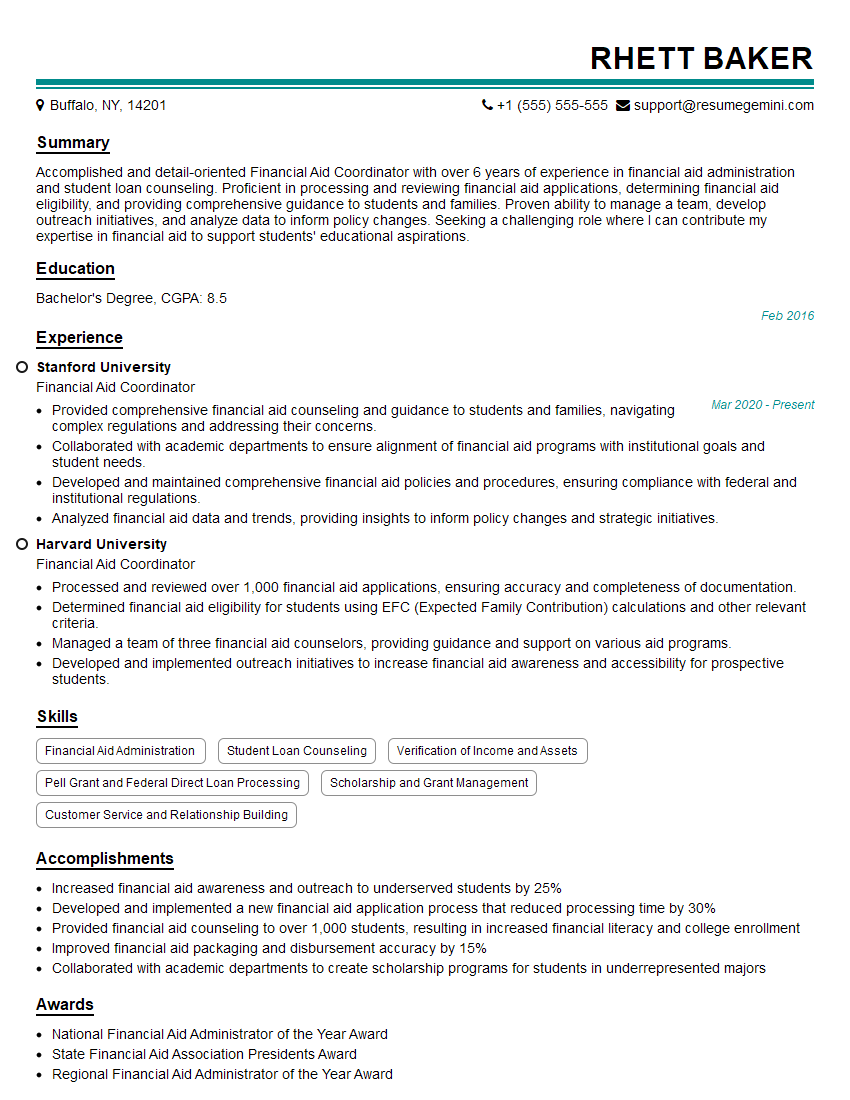
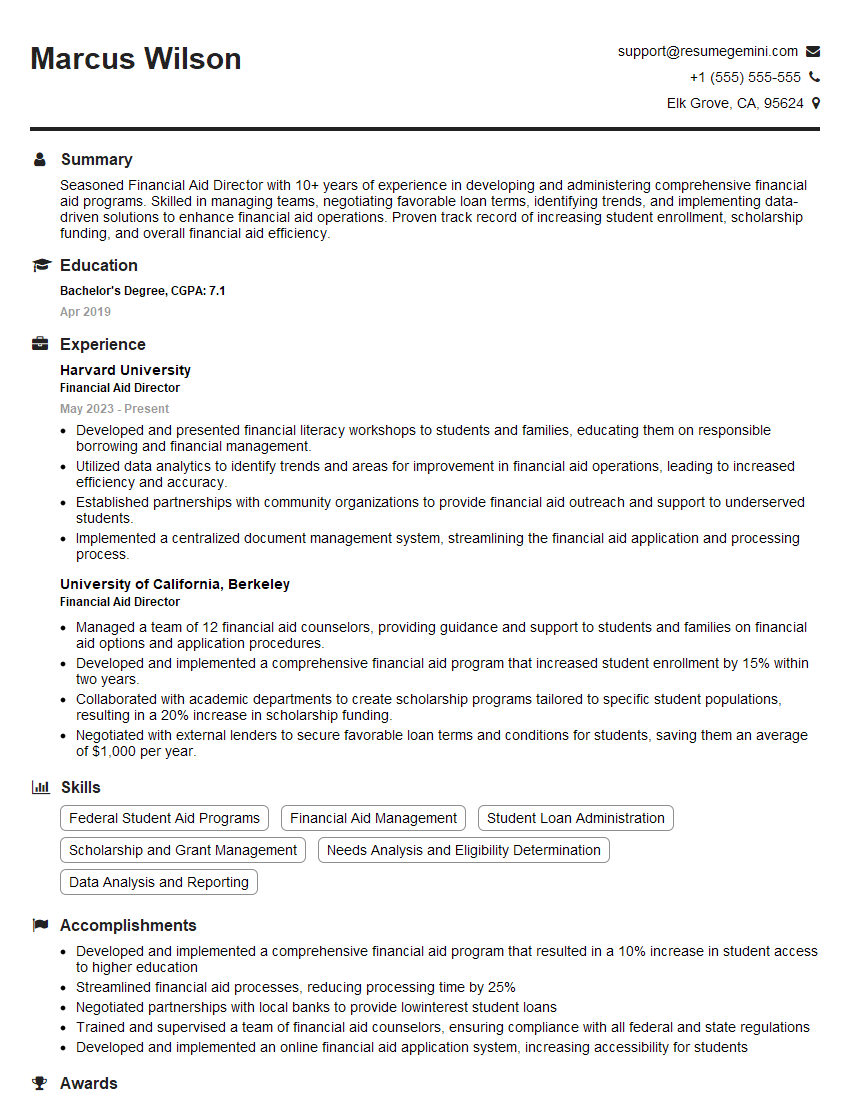
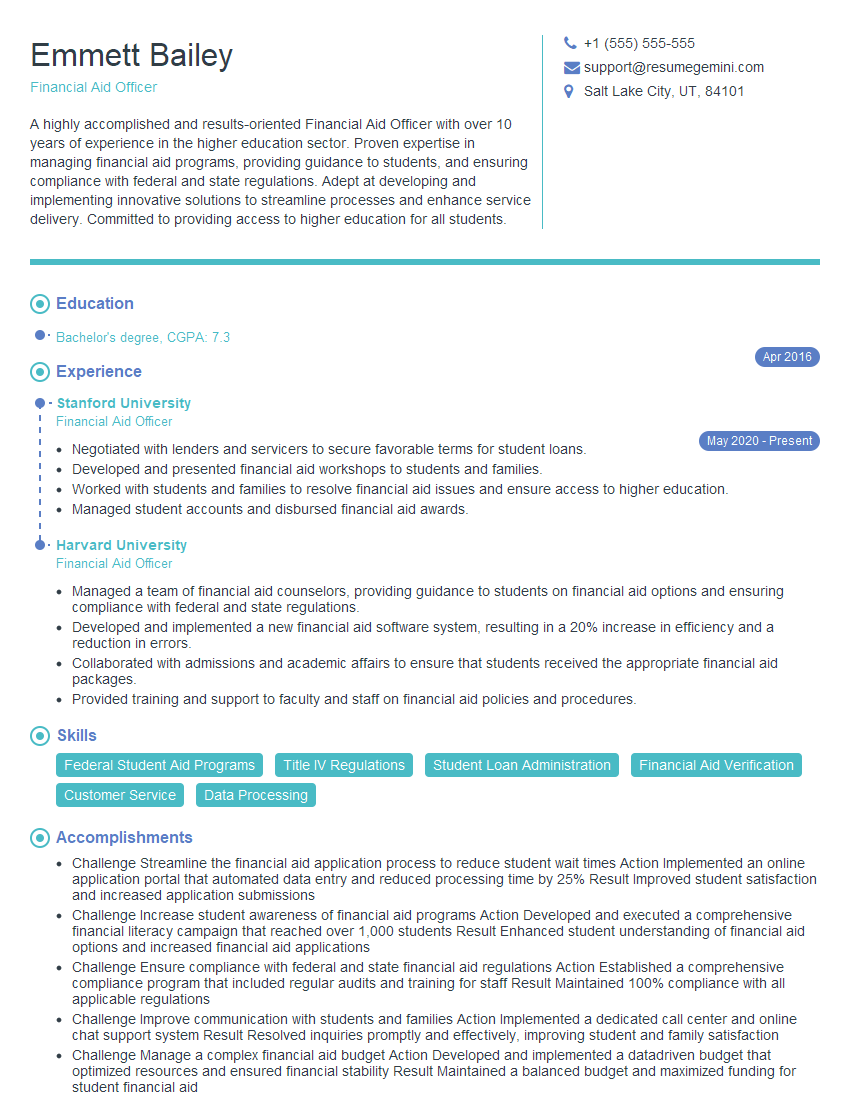
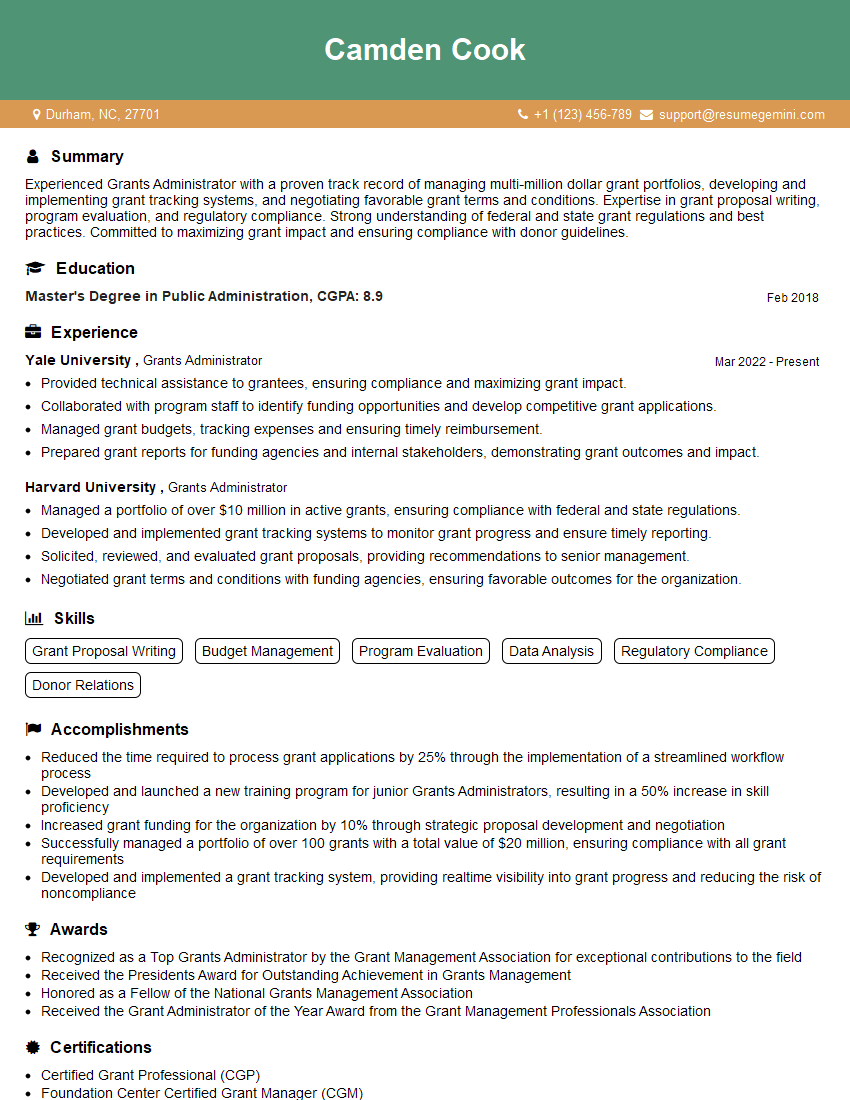
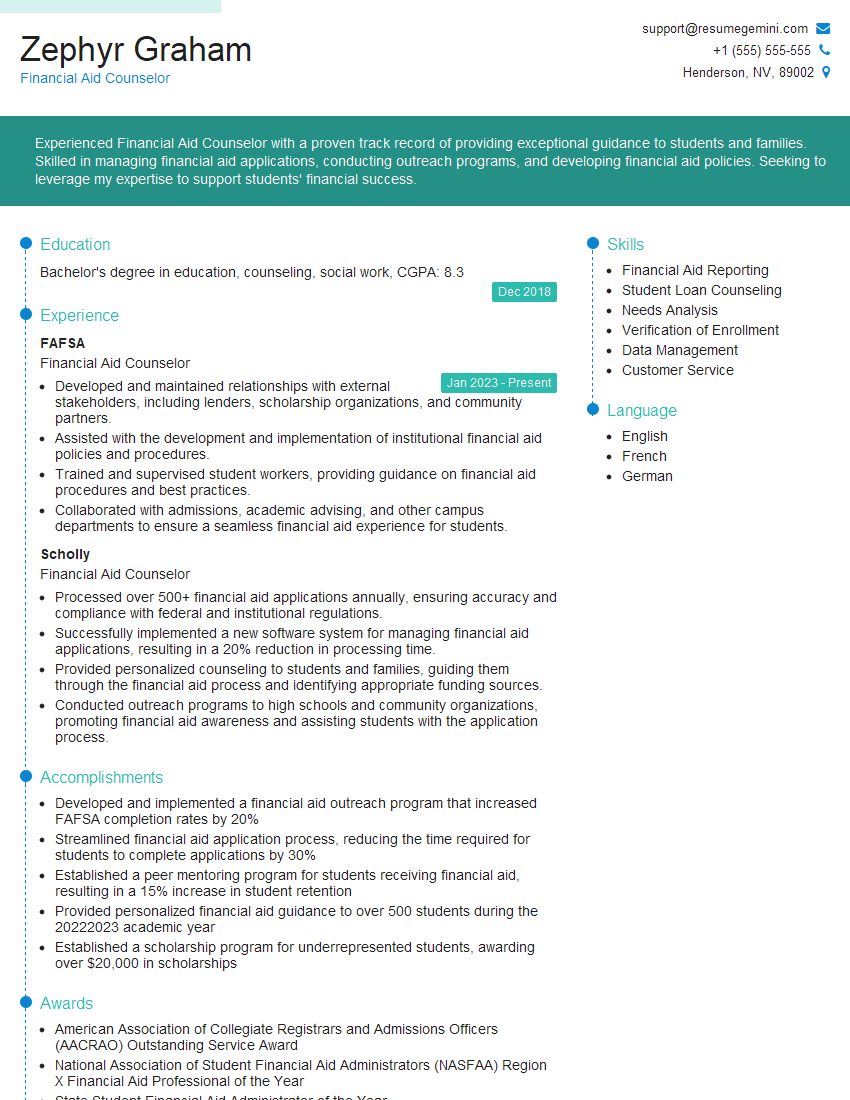
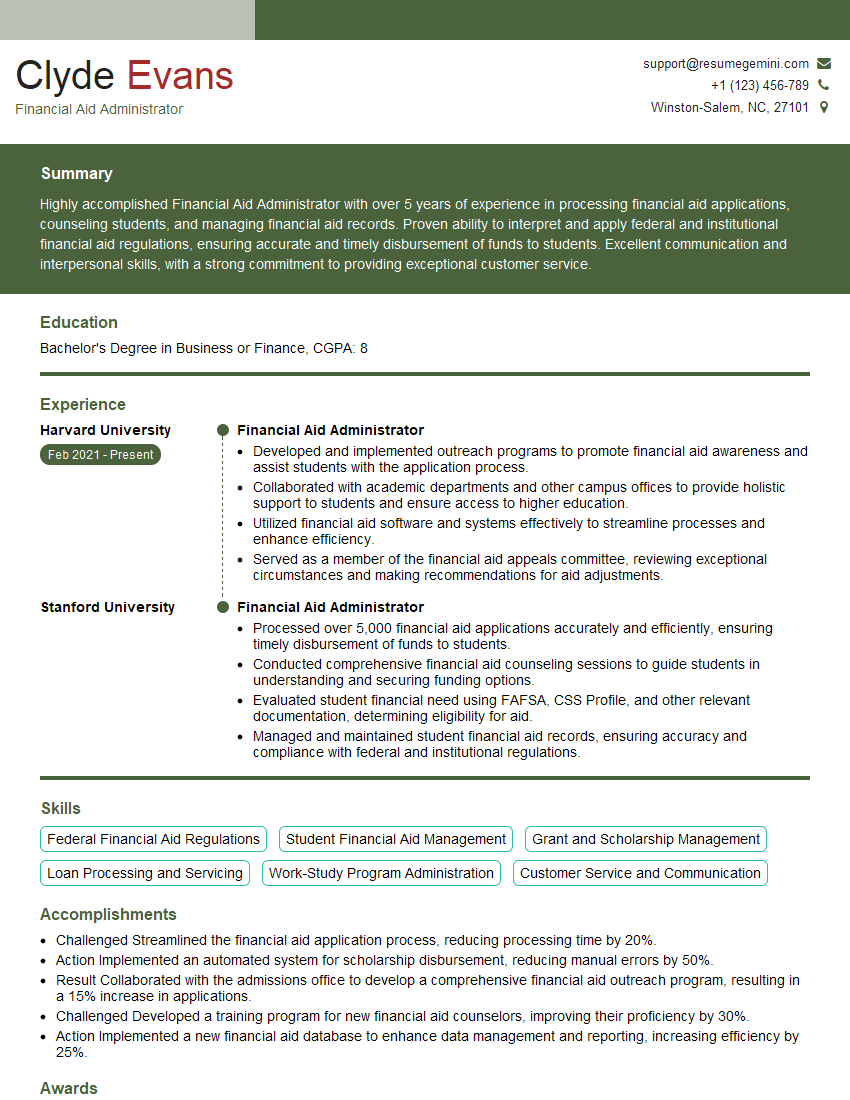
Mastering Financial Aid Guidance is crucial for a rewarding career offering significant opportunities for growth and impact. You’ll be instrumental in helping students access higher education, shaping their financial futures, and contributing to a more equitable educational landscape. To maximize your job prospects, creating a compelling and ATS-friendly resume is essential. We strongly recommend leveraging ResumeGemini to craft a professional resume that showcases your skills and experience effectively. ResumeGemini offers examples of resumes tailored to Financial Aid Guidance to help you get started. Investing time in building a strong resume will significantly enhance your chances of landing your dream role.
Explore more articles
Users Rating of Our Blogs
Share Your Experience
We value your feedback! Please rate our content and share your thoughts (optional).
What Readers Say About Our Blog
To the interviewgemini.com Webmaster.
Very helpful and content specific questions to help prepare me for my interview!
Thank you
To the interviewgemini.com Webmaster.
This was kind of a unique content I found around the specialized skills. Very helpful questions and good detailed answers.
Very Helpful blog, thank you Interviewgemini team.