Are you ready to stand out in your next interview? Understanding and preparing for Fireworks NFPA 1123 interview questions is a game-changer. In this blog, we’ve compiled key questions and expert advice to help you showcase your skills with confidence and precision. Let’s get started on your journey to acing the interview.
Questions Asked in Fireworks NFPA 1123 Interview
Q 1. Explain the key provisions of NFPA 1123.
NFPA 1123, Standard for the Manufacture, Transportation, Storage, Handling, and Use of Pyrotechnic Displays, is a comprehensive document outlining safety regulations for all aspects of fireworks, from manufacturing to the final display. It aims to minimize risks associated with fireworks by establishing clear guidelines for professionals and those involved in the industry. Think of it as a safety bible for the fireworks industry. Key provisions cover everything from the classification and storage of fireworks to the qualifications of fireworks technicians and the development of a robust emergency response plan.
- Fireworks Classification: The standard meticulously classifies fireworks based on their hazard potential, guiding safe handling and storage practices.
- Storage and Transportation: Detailed regulations ensure safe storage and transportation methods, limiting the risk of accidental ignition or damage.
- Personnel Qualifications: NFPA 1123 sets forth minimum qualifications for technicians, emphasizing training, experience, and competency.
- Display Site Safety: Stringent guidelines are established for choosing and preparing the display site, addressing factors such as proximity to buildings and potential hazards.
- Emergency Response Planning: The standard demands comprehensive emergency response plans, encompassing fire suppression, evacuation procedures, and medical assistance.
Q 2. Describe the different hazard classes of fireworks.
NFPA 1123 categorizes fireworks into different hazard classes based on their potential risks. Imagine it like a color-coded system for danger levels. Higher classes represent greater hazards, requiring more stringent safety measures. These classes are not arbitrary; they reflect the inherent danger of the fireworks’ components and their potential for causing harm.
- Class 1: These are the most hazardous fireworks, typically containing significant quantities of high explosives or exhibiting extreme sensitivity to shock or friction. Think of large aerial shells that create spectacular effects, but require extremely careful handling.
- Class 2: This class comprises fireworks with moderate hazard potential, such as smaller aerial shells or some ground-based effects. The risk is lower than Class 1, but precautions remain necessary.
- Class 3: These are considered lower-hazard fireworks, often including items like sparklers or small firecrackers. While still possessing inherent risks, these items generally pose less of a threat compared to Classes 1 and 2.
This classification system is crucial for determining appropriate storage, transportation, and handling procedures. A Class 1 firework will require far more stringent safety protocols than a Class 3 firework.
Q 3. What are the requirements for fireworks storage and transportation according to NFPA 1123?
NFPA 1123 dictates specific requirements for storing and transporting fireworks, emphasizing safety and preventing accidents. Improper storage can lead to catastrophic results, so these guidelines are paramount. Think of it as securing valuable and potentially dangerous materials – the stakes are incredibly high.
- Storage: Fireworks must be stored in designated, well-ventilated, fire-resistant structures, segregated by hazard class. Imagine a warehouse with separate, secure areas for each class of firework. Each storage area must be designed to prevent unauthorized access and potential ignition sources, like sparks or open flames.
- Transportation: Transportation requires specialized vehicles designed to safely carry fireworks, including proper packaging, secure fastening, and appropriate hazard placards. Think of a dedicated truck, with compartments ensuring different classes are separated and secured, and clearly marked to warn others of the potentially dangerous cargo. Drivers must also have specialized training.
Failure to adhere to these requirements can result in severe penalties, including fines and potential criminal charges, and more importantly, injuries and even fatalities.
Q 4. How do you ensure the safe handling of fireworks during a display?
Safe handling during a fireworks display is paramount; a single mistake can have devastating consequences. This requires meticulous planning, training, and adherence to strict procedures throughout the entire display. Imagine a well-orchestrated dance, where every step is precisely timed and flawlessly executed.
- Trained Personnel: Only qualified and experienced technicians should handle fireworks. Each member of the team should be thoroughly briefed on their responsibilities, emergency procedures, and the specific details of the display.
- Protective Equipment: Appropriate personal protective equipment (PPE), such as safety glasses, gloves, and fire-resistant clothing, must be worn at all times. This is non-negotiable. Safety should always be prioritized.
- Ignition Procedures: Safe ignition procedures, including the use of electrically fired systems, must be strictly followed to avoid accidental ignition or misfires. This includes regular checks on the firing system.
- Emergency Procedures: A clearly defined emergency response plan should be in place and thoroughly practiced, so everyone understands the steps to take in the event of an incident. Think of regular drills.
Every aspect of handling fireworks, from transportation to ignition, needs to be treated with the utmost care and precision. Safety is not just a guideline, it’s a fundamental requirement.
Q 5. What are the legal responsibilities of a fireworks technician?
Fireworks technicians bear significant legal responsibilities, encompassing safety, compliance, and liability. Their actions directly impact public safety and their negligence can have severe legal consequences. Think of them as entrusted with a powerful tool that requires both skill and responsibility.
- Compliance with NFPA 1123: Technicians are legally obligated to adhere strictly to all provisions of NFPA 1123 and any other relevant local, state, and federal regulations. Ignorance is not a defense.
- Proper Training and Certification: Maintaining proper certifications and ongoing training is crucial. Their skills and knowledge must be constantly updated to reflect the latest safety standards and best practices.
- Liability for Accidents: Technicians can be held legally liable for any accidents or injuries that occur due to negligence or failure to follow safety regulations. This can involve significant financial and legal repercussions.
- Permitting and Insurance: Obtaining the necessary permits and maintaining adequate insurance coverage are essential elements of legal compliance. This demonstrates responsibility and protects everyone involved.
The legal ramifications of non-compliance can be extremely severe, highlighting the importance of responsibility and commitment to safety.
Q 6. Detail the pre-show inspection procedures for a fireworks display.
Pre-show inspections are crucial for ensuring a safe and successful fireworks display. A thorough inspection minimizes the risk of malfunctions or accidents. Imagine a pilot performing a pre-flight check before taking off – the stakes are equally high here.
- Site Assessment: A comprehensive review of the firing site, including the launch area, observation areas, and surrounding environment, ensuring everything is correctly set up and safe.
- Equipment Check: A detailed inspection of all equipment, including firing systems, launch tubes, and safety devices, ensuring they are in perfect working order and properly installed.
- Fireworks Inspection: Careful examination of all fireworks to confirm they are undamaged, correctly identified, and stored according to NFPA 1123 guidelines.
- Weather Conditions: Assessing weather conditions, such as wind speed and direction, to determine if the display can proceed safely. High winds or other adverse conditions can necessitate a postponement or cancellation.
- Emergency Response Review: A final check of the emergency response plan to ensure all personnel are aware of their roles and responsibilities, and that all emergency equipment is readily accessible and functioning properly.
This pre-show inspection checklist is not optional; it’s an indispensable part of ensuring a safe and successful fireworks display.
Q 7. Explain the emergency response plan for a fireworks event.
A comprehensive emergency response plan is critical for mitigating risks associated with a fireworks display. This plan should address a range of potential emergencies, from minor incidents to major catastrophes. Imagine having a detailed roadmap to safely navigate unexpected events.
- Emergency Personnel: Identification and roles of trained emergency personnel, including first aid providers, fire suppression teams, and evacuation coordinators.
- Communication Systems: Clear communication channels for promptly reporting incidents and coordinating responses among all personnel and emergency services.
- Evacuation Procedures: Well-defined evacuation routes and procedures for safely evacuating spectators and personnel in case of an emergency.
- Medical Assistance: Provisions for immediate medical attention, including first aid supplies and a plan for transporting injured individuals to medical facilities.
- Fire Suppression: Availability of appropriate fire suppression equipment, including fire extinguishers, water sources, and potentially on-site fire trucks.
- Post-Incident Procedures: Detailed procedures for handling the aftermath of an incident, including securing the site, reporting the incident to authorities, and conducting a post-incident investigation.
This plan should be regularly reviewed, practiced, and updated to reflect any changes in the display or surrounding environment. Regular drills are vital to ensure everyone is prepared for a range of situations.
Q 8. What are the different types of ignition systems used in fireworks displays?
Fireworks displays utilize various ignition systems, all designed to initiate the pyrotechnic composition safely and reliably. The most common methods include:
- Electric Ignition: This is the industry standard for large-scale displays. Electric igniters, small wires with a sensitive explosive tip, are connected to a central firing system. This allows for precise, synchronized firing of multiple fireworks. Think of it like a sophisticated light switch controlling numerous bulbs – each bulb represents a firework.
- Fuse Ignition: While less common in large displays due to its lack of precision, fuse ignition remains relevant for smaller, simpler events. A fuse, a slow-burning cord, is manually lit and leads to the firework’s explosive charge. It’s like lighting a candle to light a larger candle – a very straightforward method.
- Remote Ignition Systems: This system enhances safety by allowing the firing of fireworks from a safe distance, often a remote control box. This prevents technicians from being close to the potential explosions.
The choice of ignition system depends on the size and complexity of the display, as well as safety considerations and budget. For a large, complex display, electric ignition with a remote firing system is almost always preferred.
Q 9. How do you calculate the safe shooting distance for a fireworks display?
Calculating the safe shooting distance for a fireworks display is crucial for public safety and is governed by NFPA 1123. It involves considering several factors, and there isn’t a single formula. The safe distance is determined by the type and quantity of fireworks used, as well as environmental conditions such as wind speed and direction. NFPA 1123 provides tables and guidelines to determine the minimum safe distances, which are typically based on the fireworks’ explosive power.
The process usually involves:
- Identifying the fireworks: Each firework is categorized by its size and explosive power.
- Consulting NFPA 1123: The standard provides charts and tables correlating firework size/classification with minimum safe distances.
- Considering environmental factors: Wind conditions can significantly impact the trajectory of firework debris; higher wind speeds necessitate larger safety zones.
- Establishing the safety perimeter: This zone must be clearly marked and secured to prevent unauthorized entry.
For example, a large aerial shell might require a much larger safe shooting distance than a smaller ground-based firework. It’s critical to err on the side of caution and use the maximum safe distance indicated within the guidelines.
Q 10. Describe the process for obtaining permits for a fireworks display.
Obtaining permits for a fireworks display varies significantly by location, but generally involves these steps:
- Identify the relevant authorities: This might involve local fire marshals, police departments, and potentially state or federal agencies depending on the scale of the event.
- Submit an application: Applications usually require detailed information about the display, including the type and quantity of fireworks, the location, the date and time, the names and qualifications of the fireworks technicians, a comprehensive safety plan, and proof of insurance.
- Provide a site plan: This needs to show the location of the firing area, the spectator viewing area, the safety perimeter, emergency exits, and any other relevant infrastructure.
- Undergo inspections: Authorities usually conduct inspections of the site and review the safety plan to ensure compliance with local regulations.
- Obtain necessary approvals: Once all requirements are met, the relevant authorities will issue a permit, which specifies the conditions under which the display can be held.
Failure to obtain the necessary permits can lead to significant fines and even legal action. It’s vital to start the permit process well in advance of the event date.
Q 11. What are the requirements for the training and certification of fireworks technicians?
NFPA 1123 outlines rigorous requirements for the training and certification of fireworks technicians. It emphasizes a combination of theoretical knowledge and practical skills. This generally involves:
- Formal training courses: These courses cover pyrotechnics theory, safety procedures, emergency response, and the safe handling and use of fireworks. Often offered by certified instructors or organizations.
- Practical experience: Technicians typically need to demonstrate proficiency in handling and setting up fireworks under supervision.
- Certification exams: Successful completion of both theoretical and practical assessments is needed to obtain certification. These exams are designed to assess the candidate’s competency and ensure they can safely operate in the field.
- Ongoing professional development: Many jurisdictions require continuing education to maintain certification, ensuring that technicians stay updated on the latest safety standards and techniques.
The specific requirements may vary across jurisdictions, but the overarching goal is to ensure that only highly skilled and thoroughly trained individuals are permitted to handle fireworks.
Q 12. How do you handle a malfunctioning firework during a display?
Handling a malfunctioning firework during a display requires swift and decisive action, prioritizing the safety of the audience and personnel. The standard operating procedure typically involves:
- Immediate cessation of the display: The firing system must be immediately shut down to prevent further misfires.
- Secure the area: The area around the malfunctioning firework needs to be immediately evacuated and secured to prevent accidental injury.
- Assess the situation: Determine the nature of the malfunction and assess the potential hazards.
- Follow established procedures: NFPA 1123 outlines specific procedures for handling various types of malfunctions, usually involving a controlled disposal or delay to allow the device to cool or burn out safely.
- Notify the authorities: Appropriate authorities should be notified as soon as possible, such as local fire departments, police, etc.
- Document the incident: A thorough record of the incident, including the type of malfunction, the steps taken, and any injuries or damage should be documented.
It’s critical to have a well-rehearsed emergency plan and trained personnel ready to respond to such situations. The safety of the public is paramount.
Q 13. What are the environmental considerations for fireworks displays?
Environmental considerations for fireworks displays are increasingly important due to concerns about air and water quality, noise pollution, and wildlife disturbance.
- Air Quality: Fireworks produce particulate matter and various chemical compounds, contributing to air pollution. Choosing low-smoke fireworks and avoiding displays in areas with poor air quality is crucial.
- Water Quality: The debris from some fireworks can contaminate water sources. Displays should be held away from sensitive aquatic environments.
- Noise Pollution: The loud noise from fireworks can impact wildlife and human populations. Limiting the number of fireworks and the timing of displays can mitigate this issue.
- Wildlife Impact: The loud noises and bright lights of fireworks can be stressful and even harmful to wildlife. Consider the timing and location of the event to minimize the impact on the local ecosystem.
Many jurisdictions are implementing regulations to minimize the environmental impact of fireworks displays, promoting the use of eco-friendly alternatives and sustainable practices.
Q 14. Explain the importance of pre-planning and risk assessment in fireworks events.
Pre-planning and risk assessment are absolutely fundamental to safe and successful fireworks events. Thorough planning helps to anticipate and mitigate potential hazards, ensuring the safety of the audience, personnel, and the surrounding environment.
A comprehensive risk assessment involves:
- Site selection: Choosing a suitable location considering factors such as proximity to buildings, flammable materials, and population density.
- Weather monitoring: Wind speed and direction are critical; high winds can cause debris to travel unpredictable distances.
- Emergency planning: Developing a detailed plan for handling emergencies, including accidents, malfunctions, and medical situations.
- Personnel training: Ensuring that all personnel are adequately trained and certified in handling fireworks and emergency response.
- Equipment inspection: Regularly inspecting all equipment, including firing systems, to ensure it’s in safe working order.
- Contingency planning: Developing backup plans for unforeseen circumstances, such as equipment failure or adverse weather.
Failing to adequately plan and assess risks can result in accidents, injuries, property damage, and legal consequences. A thorough approach to pre-planning and risk assessment is vital for ensuring a safe and successful fireworks display.
Q 15. What are the post-show cleanup procedures for a fireworks display?
Post-show cleanup after a fireworks display is crucial for safety and environmental responsibility. It’s not just about tidying up; it’s about ensuring no unexploded devices remain and preventing potential hazards. The process should be meticulously planned and executed.
Immediate Area Inspection: A thorough sweep of the immediate firing area is paramount. This involves visually inspecting for any unexploded fireworks, spent casings, or debris that could pose a fire risk. We use tools like long-handled tongs to collect items safely.
Debris Removal: All debris, including spent fireworks casings and packaging, should be carefully collected and disposed of according to local regulations. Often, this involves specialized disposal services due to the hazardous nature of the remnants.
Fire Prevention: A final check for any lingering embers or hot spots is essential. Water is readily available, and we may use thermal imaging cameras to ensure complete extinguishment. This step minimizes the risk of delayed ignition or fires.
Documentation: Complete documentation of the cleanup process, including any incidents or findings, is crucial for future reference and liability purposes.
Imagine a scenario where a single spent firework remains smoldering; this could easily reignite hours later, causing a significant incident. Meticulous cleanup prevents such catastrophes.
Career Expert Tips:
- Ace those interviews! Prepare effectively by reviewing the Top 50 Most Common Interview Questions on ResumeGemini.
- Navigate your job search with confidence! Explore a wide range of Career Tips on ResumeGemini. Learn about common challenges and recommendations to overcome them.
- Craft the perfect resume! Master the Art of Resume Writing with ResumeGemini’s guide. Showcase your unique qualifications and achievements effectively.
- Don’t miss out on holiday savings! Build your dream resume with ResumeGemini’s ATS optimized templates.
Q 16. What are the common causes of fireworks accidents?
Fireworks accidents, thankfully infrequent with proper precautions, typically stem from a few common causes. Understanding these is key to prevention.
Improper Handling and Use: This is the most prevalent cause. Inexperience, ignoring safety guidelines (like those in NFPA 1123), and modifying fireworks are common contributing factors. For example, attempting to re-light a malfunctioning firework is incredibly dangerous.
Malfunctioning Fireworks: Defective fireworks can unexpectedly explode prematurely or fail to launch correctly. This highlights the critical need for thorough inspection and sourcing from reputable suppliers.
Environmental Factors: Wind conditions are a major concern. Strong winds can carry spent fireworks or debris to unintended areas, causing damage or injury. Similarly, dry vegetation poses a fire hazard.
Inadequate Safety Precautions: Insufficient crowd control, a lack of designated safety zones, or the absence of appropriately trained personnel significantly increase the risk of accidents. Think of it like this: a well-organized and staffed event drastically reduces the chance of accidents compared to one that is not.
We emphasize rigorous training for our personnel, meticulous inspections of all fireworks, and stringent adherence to safety protocols to mitigate these risks. Safety is paramount.
Q 17. How do you mitigate the risks associated with wind conditions during a fireworks display?
Wind is a major risk factor in fireworks displays. Mitigation strategies focus on careful planning and observation.
Wind Monitoring: Continuous monitoring of wind speed and direction using anemometers is crucial. We establish wind speed limits and delay or cancel the show if these limits are exceeded.
Launch Direction: The firing direction should always be carefully selected to minimize the risk of wind carrying fireworks or debris toward populated areas. We often consider alternative launch sites if wind conditions are challenging.
Launch Timing: Displays might be delayed or even cancelled based on changing wind conditions. Real-time monitoring helps make informed decisions.
Emergency Procedures: Detailed emergency protocols, including procedures for wind-related incidents, must be in place and practiced regularly. This involves having a communication plan to inform the audience and emergency responders.
Imagine a scenario where a strong gust of wind pushes a firework sideways into a crowd. Our strategy aims to prevent such occurrences entirely. We always prioritize public safety.
Q 18. Describe the different types of fireworks and their associated hazards.
Fireworks are categorized into various types, each with its own associated hazards. Understanding these categories is fundamental to safe handling and operation.
Consumer Fireworks (Class C): These are readily available to the public but are still capable of causing injury if misused. Examples include sparklers, fountains, and small ground-based devices. The risk is primarily burns and minor injuries from misuse.
1.3G Fireworks: These are generally more powerful and require specialized training and licensing. Misuse can lead to serious burns and other injuries.
1.4G Fireworks: These are professional-grade fireworks requiring substantial expertise and licensing, with significantly increased potential for injury if mishandled. Large aerial shells and cakes fall into this category.
The hazards increase significantly with the power and complexity of the fireworks. A simple sparkler is far less dangerous than a large aerial shell, but even sparklers require careful handling to avoid burns.
Q 19. What are the regulations concerning the use of pyrotechnics in public spaces?
Regulations governing pyrotechnics in public spaces vary significantly depending on the jurisdiction (local, state, and federal). They are designed to ensure public safety and protect the environment.
Licensing and Permits: Most jurisdictions require licenses and permits for any public fireworks display. These permits often stipulate strict safety requirements and environmental considerations.
Safety Standards: Compliance with standards like NFPA 1123 is mandatory in many areas. This dictates aspects like safe distances, crowd control, and emergency planning.
Environmental Regulations: Some locations have specific regulations regarding the types of fireworks allowed and the disposal of pyrotechnic waste to minimize environmental impact. For instance, regulations may limit the use of fireworks that produce excessive air pollution.
Insurance: Many jurisdictions mandate liability insurance for fireworks displays to protect the event organizers and the public from potential financial losses.
Ignoring these regulations can lead to heavy fines, suspension of permits, and even criminal charges. We rigorously comply with all applicable regulations before, during, and after any display.
Q 20. Explain the role of a Fire Marshal in relation to fireworks displays.
The Fire Marshal plays a critical role in ensuring public safety during fireworks displays. Their responsibilities extend beyond simply attending; they are integral to the entire process.
Permitting and Inspection: The Fire Marshal typically reviews and approves permit applications, conducting thorough inspections of the planned display site and the fireworks themselves.
Safety Oversight: During the display, the Fire Marshal observes operations to verify compliance with safety regulations and established procedures. They can halt the show if safety concerns arise.
Emergency Response: The Fire Marshal is a key figure in coordinating the emergency response in case of any incidents.
Think of the Fire Marshal as the final safety check, ensuring all protocols are followed. Their presence and authority are crucial for ensuring a safe and successful event.
Q 21. How do you ensure compliance with all relevant local, state, and federal regulations?
Ensuring compliance with local, state, and federal regulations requires a multifaceted approach. This is not a single task, but a continuous process.
Thorough Research: We begin by conducting a comprehensive review of all applicable laws, ordinances, and regulations pertinent to our display location. We also identify relevant standards like NFPA 1123.
Documentation and Record Keeping: Meticulous record-keeping of all permits, licenses, safety plans, and inspection reports is vital. We document every step of the process.
Training and Expertise: All personnel involved in the fireworks display, from the firing crew to the cleanup team, receive extensive training on safety procedures, emergency response, and regulatory compliance. This means continuous education and updates.
Communication and Collaboration: Effective communication with local authorities, including the Fire Marshal, is critical. We proactively communicate our plans and address any concerns.
Compliance isn’t merely a box to tick; it’s a fundamental part of our commitment to public safety and the success of every fireworks event.
Q 22. Describe your experience with different types of fireworks ignition systems.
My experience encompasses a wide range of fireworks ignition systems, from traditional hand-lit fuses to sophisticated electronic firing systems. Hand-lit fuses, while simple, require meticulous attention to timing and safety. Electronic systems, however, offer precise control and synchronization, minimizing risk, especially in large displays. I’m proficient in using both types of systems, understanding their strengths and limitations.
- Hand-lit fuses: I’ve extensively worked with various fuse types, understanding burn rates and the importance of proper fuse length calculations to ensure safe timing. A common example is using quick-match for smaller fireworks and slower-burning fuses for larger shells.
- Electronic firing systems: My experience includes setting up and operating various electronic firing systems, from simple single-channel units to complex multi-channel systems with advanced features like sequencing and safety interlocks. This includes programming firing sequences, ensuring the system’s proper functioning, and troubleshooting any malfunctions. I’m familiar with the importance of redundant systems and backup power sources to maintain control.
Understanding the intricacies of each system is crucial for ensuring a safe and successful fireworks show. My training covers all aspects, from system selection based on the display’s complexity to proper maintenance and testing to prevent failures.
Q 23. How do you manage a fireworks crew effectively and safely?
Managing a fireworks crew effectively and safely demands a strong emphasis on leadership, communication, and unwavering adherence to NFPA 1123. I start by clearly defining roles and responsibilities, ensuring every member understands their tasks and the associated safety protocols. Open communication is key; I encourage my crew to voice concerns and immediately address any safety issues. Regular training sessions, including refresher courses on handling fireworks and emergency procedures, are vital.
Prior to any event, I conduct a thorough risk assessment, identifying potential hazards and implementing mitigation strategies. This includes establishing clear communication channels and designating specific individuals responsible for different aspects of the operation. During the show, I maintain a constant presence, monitoring the crew’s actions and ensuring compliance with established safety procedures. Post-show, a detailed debriefing session is conducted to identify areas for improvement and reinforce best practices.
Think of it like a well-oiled machine: each member has a specific role, and clear communication ensures smooth operation. A strong emphasis on respect and teamwork further cultivates a safe and productive environment.
Q 24. What are the different types of safety equipment used in handling fireworks?
Safety equipment is paramount in fireworks handling. The types of equipment vary depending on the task, but some essentials include:
- Protective clothing: This includes flame-resistant clothing, gloves, and eye protection to minimize the risk of burns or injuries from flying debris.
- Fire extinguishers: Various types are required, including those suitable for class B (flammable liquids) and class D (combustible metals) fires.
- First-aid kit: A well-stocked kit is vital for immediate treatment of minor injuries. Training in basic first aid and CPR is essential for crew members.
- Communication devices: Two-way radios are crucial for maintaining clear communication among crew members, especially during a large-scale display.
- Ignition devices: Safe and reliable ignition systems (as discussed previously) are crucial, and proper maintenance is key.
- Water sources: Adequate water sources, such as fire hoses or water trucks, are essential for controlling any fire.
The type and quantity of equipment will be determined by a thorough risk assessment, ensuring we are well-prepared for any scenario. Regular inspection and maintenance are non-negotiable to ensure equipment remains in optimal condition.
Q 25. How would you address a situation where a member of your crew violated safety procedures?
Addressing safety procedure violations is crucial for maintaining a safe work environment. My approach is centered on constructive feedback and education, not punishment. First, I would privately discuss the violation with the crew member, seeking to understand the cause of the infraction. Was it a misunderstanding, a lapse in concentration, or a lack of training? This conversation would be focused on learning from the mistake, not assigning blame.
Depending on the severity of the violation, I might implement additional training or refresher courses. For more serious breaches, a written warning might be necessary, documented within the company’s safety records. Consistent and persistent enforcement of safety regulations is key; it sets a precedent and maintains a culture of safety within the team. The goal is to correct the behavior and prevent future incidents, not to punish.
Q 26. Explain your experience with post-incident investigations related to fireworks.
Post-incident investigations are vital for learning from mistakes and preventing future occurrences. My experience includes leading several investigations, focusing on meticulous documentation, witness interviews, and a thorough review of all relevant procedures and equipment. The aim is to identify the root cause of the incident, not just the immediate cause. Were there underlying systemic issues? Was there a failure in communication? Could additional safety measures have prevented it?
I utilize a systematic approach, akin to a detective’s methodology. I carefully collect evidence, including photographs, videos, and any damaged equipment. This evidence is then analyzed to pinpoint the sequence of events, ultimately revealing the contributing factors. The findings are then used to revise safety protocols and implement corrective actions, enhancing future safety measures.
Q 27. How familiar are you with the latest amendments and updates to NFPA 1123?
I stay abreast of the latest amendments and updates to NFPA 1123 through regular review of the standard itself, industry publications, and participation in relevant professional development courses. I am very familiar with the recent changes concerning electronic firing systems, including their maintenance, testing, and safety protocols. I also actively follow updates related to the storage, transportation, and handling of various firework types and sizes.
Staying updated ensures our operations comply with the latest best practices and safety standards, minimizing risks and protecting the safety of my crew and the public. Continuous learning is paramount in this field, as new technologies and safety measures emerge.
Q 28. What are your strategies for maintaining a safe and efficient fireworks operation?
Maintaining a safe and efficient fireworks operation involves a multi-faceted approach. It begins with a thorough pre-show planning phase that incorporates a comprehensive risk assessment and development of detailed safety plans. This includes selecting appropriate equipment, ensuring adequate staffing, and establishing clear communication protocols. Regular training sessions for the crew and meticulous maintenance of equipment are crucial.
During the operation, constant monitoring is key. I utilize a layered approach to safety, building in multiple checks and balances at each stage of the process. Post-show debriefing sessions are essential for identifying areas for improvement, creating a continuous learning cycle. By fostering a safety-conscious culture, with clear communication and a team-oriented approach, we create an environment that allows for both safety and efficiency.
Key Topics to Learn for Fireworks NFPA 1123 Interview
- Fireworks Classification and Hazard Analysis: Understand the different classifications of fireworks (1.1, 1.2, 1.3G, etc.) and how to assess their associated hazards. Be prepared to discuss the practical implications of these classifications in a real-world setting.
- Storage and Transportation: Master the regulations surrounding the safe storage and transportation of fireworks. This includes understanding temperature control, distance requirements, and appropriate container specifications. Be ready to discuss potential scenarios and solutions for maintaining compliance.
- Ignition Systems and Firing Techniques: Demonstrate a thorough understanding of various ignition systems and their safe operation. Be able to discuss best practices for firing sequences and how to troubleshoot potential issues. This also includes understanding the role of pyrotechnic professionals and their certifications.
- Pre-show Inspection and Safety Procedures: Understand the importance of comprehensive pre-show inspections and the various safety procedures implemented to mitigate risks. Discuss practical examples of identifying and addressing potential hazards before a fireworks display.
- Emergency Response and Incident Management: Familiarize yourself with emergency protocols and procedures. Be prepared to discuss your approach to handling potential accidents or malfunctions during a fireworks display. This includes understanding the use of appropriate safety equipment and communication strategies.
- Post-show Procedures and Clean-up: Detail the procedures involved in safely dismantling and cleaning up the firing site after a fireworks display. This includes proper disposal of spent fireworks and potential environmental considerations.
- NFPA 1123 Code Interpretation and Application: Go beyond simple memorization – be able to apply the principles of NFPA 1123 to solve real-world problems and scenarios presented during the interview.
Next Steps
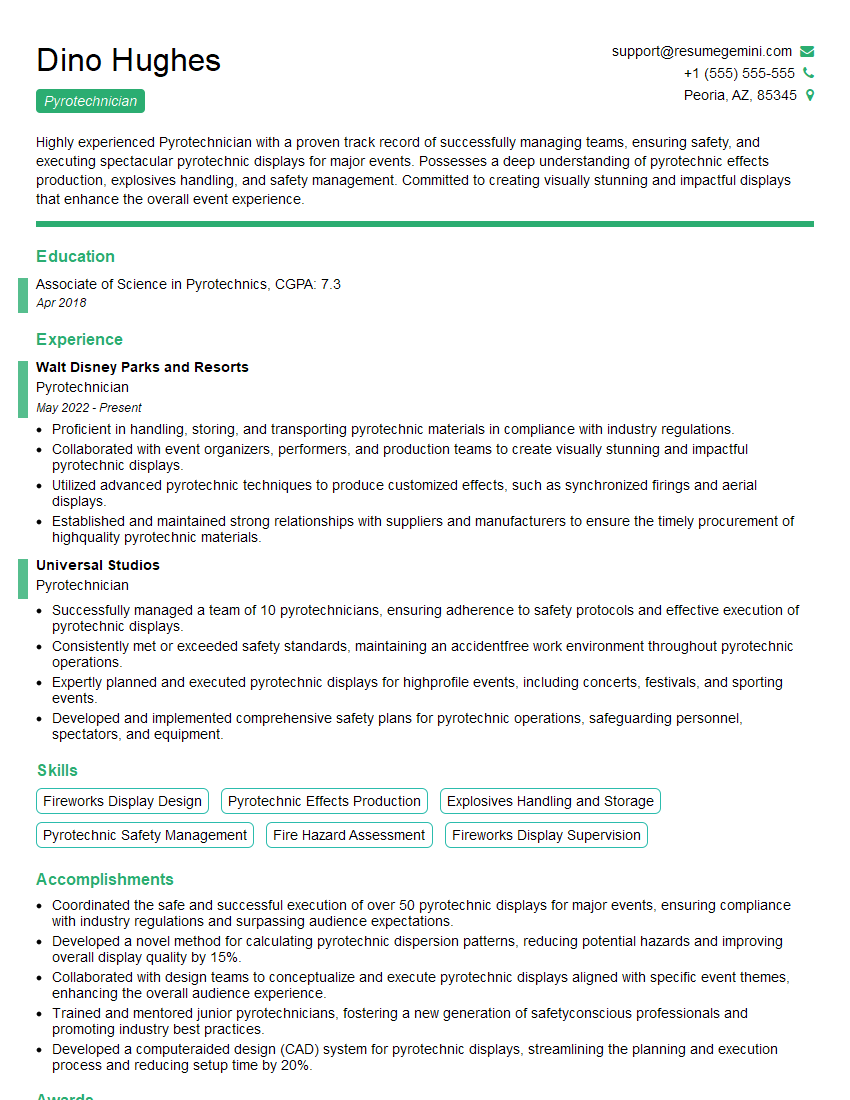
Mastering Fireworks NFPA 1123 demonstrates a commitment to safety and expertise in pyrotechnics, significantly enhancing your career prospects in this specialized field. An ATS-friendly resume is crucial for getting your application noticed by recruiters. To maximize your chances, consider using ResumeGemini to create a professional and impactful resume that highlights your skills and experience. ResumeGemini provides examples of resumes tailored to Fireworks NFPA 1123, guiding you through the process of crafting a winning application.
Explore more articles
Users Rating of Our Blogs
Share Your Experience
We value your feedback! Please rate our content and share your thoughts (optional).
What Readers Say About Our Blog
To the interviewgemini.com Webmaster.
Very helpful and content specific questions to help prepare me for my interview!
Thank you
To the interviewgemini.com Webmaster.
This was kind of a unique content I found around the specialized skills. Very helpful questions and good detailed answers.
Very Helpful blog, thank you Interviewgemini team.