Preparation is the key to success in any interview. In this post, we’ll explore crucial Gas Process Simulation interview questions and equip you with strategies to craft impactful answers. Whether you’re a beginner or a pro, these tips will elevate your preparation.
Questions Asked in Gas Process Simulation Interview
Q 1. Explain the different types of gas sweetening processes.
Gas sweetening removes acid gases, primarily hydrogen sulfide (H2S) and carbon dioxide (CO2), from natural gas. These gases are corrosive and harmful to the environment and downstream processing equipment. Several methods achieve this, each with its advantages and disadvantages:
- Amine Treating: This is the most common method. Amines, like monoethanolamine (MEA), diethanolamine (DEA), or methyldiethanolamine (MDEA), absorb H2S and CO2 from the gas stream. The rich amine solution is then regenerated by heating to release the acid gases. The choice of amine depends on factors like the gas composition, operating pressure, and desired level of sweetening. For instance, MDEA is preferred for selective CO2 removal, while MEA is more effective for high H2S concentrations.
- Physical Solvents: These solvents absorb acid gases based on solubility, not chemical reactions. They are often used when the acid gas partial pressure is high. Examples include Selexol and Rectisol processes. These processes are generally more energy-efficient than amine treating but less effective at low partial pressures.
- Membrane Separation: This method uses semi-permeable membranes to separate acid gases from the natural gas. It’s becoming increasingly popular for its lower energy consumption and smaller footprint compared to traditional methods, however, it may not be suitable for all applications, particularly when dealing with high acid gas concentrations or complex gas mixtures.
- Iron Sponge Process: This is a solid bed process that utilizes iron oxide to chemically react with and remove H2S. This method is often employed in smaller-scale operations and is particularly useful for removing trace amounts of H2S.
The selection of the appropriate sweetening process depends on factors such as gas composition, desired level of purity, operating costs, and environmental considerations. A detailed economic analysis is crucial for optimizing the choice.
Q 2. Describe the principles of gas dehydration.
Gas dehydration removes water vapor from natural gas. Water can cause corrosion, hydrate formation (ice-like plugs that block pipelines), and problems in downstream processing. The process relies on reducing the water partial pressure to a level below the dew point, thereby preventing condensation. Several methods are employed:
- Glycol Dehydration: This is the most common method. Triethylene glycol (TEG) is the most widely used desiccant. The wet gas contacts the glycol in an absorber, the glycol absorbs the water, and the dry gas proceeds to the downstream process. The rich glycol is then regenerated by heating to remove the water.
- Solid Desiccant Dehydration: This method utilizes solid desiccants like activated alumina or molecular sieves to adsorb water from the gas. The desiccant is periodically regenerated by heating or purging. This method is effective for achieving very low water content but requires periodic regeneration which might incur downtime and maintenance.
The choice between glycol and solid desiccant dehydration depends on the required water content, operating conditions, and capital/operating cost considerations. Glycol dehydration is often favored for larger-scale operations due to its continuous nature and lower capital investment, whereas solid desiccant dehydration can be preferable for achieving very low dew points or in situations where space constraints are significant. Accurate modeling of the thermodynamic equilibrium between gas and desiccant is critical in process simulation to optimize the design.
Q 3. What are the key components of a typical gas processing plant?
A typical gas processing plant comprises several key components that work together to process raw natural gas into marketable products. These include:
- Gas Receiving and Inlet Separation: This stage involves initial treatment to remove large particulates and liquids.
- Gas Sweetening: Removes H2S and CO2 (as described above).
- Gas Dehydration: Removes water vapor (as described above).
- Hydrocarbon Fractionation: Separates different hydrocarbons based on boiling points using fractionation columns to create various products, such as propane, butane, and natural gasoline.
- Sulfur Recovery Unit (SRU): Converts H2S removed during gas sweetening into elemental sulfur, a marketable byproduct.
- Compressor Trains: These are crucial for maintaining pressure and transporting gas efficiently throughout the plant.
- Heat exchangers and reboilers: Required for temperature management in various units, enhancing energy efficiency.
- Control systems: These play a vital role in monitoring and controlling the plant’s operation safely and efficiently.
The exact configuration and size of the plant depend heavily on the composition of the raw gas and the desired products. For example, a plant processing gas with a high NGL content (natural gas liquids) will require a more extensive fractionation section compared to a plant processing primarily methane.
Q 4. How do you model gas-liquid equilibrium in process simulation?
Gas-liquid equilibrium (GLE) modeling is fundamental in gas processing simulation. It describes the partitioning of components between the gas and liquid phases at equilibrium. Simulation software utilizes thermodynamic models (like Peng-Robinson, Soave-Redlich-Kwong, or cubic-plus-association (CPA) equations of state) to predict the equilibrium composition of each phase. These models employ parameters specific to the components involved. The software iteratively solves the equilibrium equations until the specified tolerances are met.
For example, in simulating a gas sweetening unit, the software uses a thermodynamic model to predict the solubility of H2S and CO2 in the amine solution at a given temperature and pressure. This information is critical to determine the required amine circulation rate, absorber size, and regenerator design. Accurate GLE prediction is essential for designing efficient and effective gas processing units. The selection of the most appropriate thermodynamic model often depends on the specific components and conditions.
Q 5. Explain the concept of thermodynamic properties and their importance in gas processing simulations.
Thermodynamic properties are crucial in gas processing simulations because they dictate the phase behavior of the gas mixture under different conditions. These properties include:
- Enthalpy: Represents the heat content of the gas and is essential for designing heat exchangers and reboilers.
- Entropy: Measures the disorder of the system and impacts the efficiency of thermodynamic processes.
- Gibbs Free Energy: Determines the spontaneity of phase transitions (like vapor-liquid equilibrium).
- Fugacity/Activity: Represents the effective partial pressure or concentration of a component in a mixture, crucial for accurately predicting phase equilibria.
- Density and Viscosity: Impact equipment sizing, pressure drop calculations, and pipeline design.
Accurate prediction of these properties ensures the simulation accurately reflects real-world conditions. Errors in thermodynamic properties can lead to significant deviations between the simulation results and actual plant performance. This can result in costly over-design or operational problems.
In practice, we often rely on software’s built-in thermodynamic databases and property packages. However, it is important to understand the limitations of different models and choose the most suitable one based on the specific application and component mixtures. For example, a specialized model may be needed when dealing with complex mixtures containing heavy hydrocarbons or polar components.
Q 6. Describe your experience using HYSYS or Aspen Plus.
I have extensive experience using both HYSYS and Aspen Plus for gas process simulation. In my previous role, I used HYSYS to model and optimize a large-scale natural gas processing plant, including gas sweetening, dehydration, and fractionation sections. This involved developing rigorous process models, performing sensitivity analyses to evaluate the impact of operating parameters on key performance indicators (KPIs) like recovery efficiency and energy consumption, and conducting detailed economic evaluations to support investment decisions. For instance, I used HYSYS to compare the performance of different amine solvents for gas sweetening, optimizing the selection based on a combination of technical and economic factors.
In another project, I utilized Aspen Plus to simulate the design of a cryogenic gas processing plant, focusing on the optimization of the refrigeration cycle and the prediction of product compositions and yields. This involved leveraging Aspen Plus’s capabilities in thermodynamic modeling and rigorous process simulation to accurately predict the plant’s performance under various operating scenarios. I also extensively used Aspen Plus’s data reconciliation and parameter estimation tools to refine the models based on available plant data.
My proficiency extends to developing custom thermodynamic models within both HYSYS and Aspen Plus when required for specialized applications involving unconventional gas mixtures or unique chemical components.
Q 7. How do you validate a process simulation model?
Validating a process simulation model is crucial to ensure its accuracy and reliability. This involves comparing the simulation results with real-world data to identify any discrepancies and refine the model accordingly. Several techniques are employed:
- Data Reconciliation: This involves adjusting plant data to remove inconsistencies and ensure mass and energy balances are satisfied. This cleaned-up data provides a more accurate baseline for model validation.
- Parameter Estimation: This involves adjusting model parameters to minimize the difference between simulated and measured values of key variables (temperatures, pressures, flow rates, compositions). This is often done iteratively using optimization algorithms.
- Comparison with Plant Data: Simulation results (e.g., compositions, flow rates, temperatures, pressures) are compared against historical plant data from steady-state operating conditions. Any significant deviations highlight areas needing improvement in the model.
- Sensitivity Analysis: Assessing the influence of different input parameters on simulation outcomes helps identify potential sources of error and understand model uncertainty.
- Verification of Sub-models: Individual components (e.g., absorber, regenerator, compressor) can be independently validated using simplified models or well-established correlations before integrating them into the overall process model.
A well-validated model provides confidence in its predictive capability, enabling informed decision-making regarding process design, optimization, and troubleshooting. The rigor of validation depends on the intended use of the model; models for preliminary screening might require less rigorous validation than those used for detailed design or operational support.
Q 8. What are the limitations of process simulation software?
Process simulation software, while powerful, has inherent limitations. These limitations stem from the inherent complexities of real-world systems and the need to simplify them for computational tractability. Think of it like building a miniature model of a gas processing plant – you can’t perfectly replicate every detail.
- Simplified Models: The software relies on simplified models for physical phenomena. For example, heat transfer is often modeled using simplified correlations rather than full Computational Fluid Dynamics (CFD) simulations, which are much more computationally expensive. This simplification can lead to deviations from reality.
- Thermodynamic Property Models: The accuracy of the simulation is heavily dependent on the Equation of State (EOS) used. No single EOS perfectly captures the behavior of all fluids under all conditions. Choosing the right EOS is crucial for accuracy.
- Data Uncertainty: The accuracy of the simulation is also limited by the accuracy of the input data, such as component compositions, temperature, and pressure. Inaccurate input data leads to inaccurate results. The garbage-in-garbage-out principle applies here.
- Computational Limits: Complex process simulations can be computationally intensive, requiring significant computing resources and time. This can limit the scope of simulations or require simplifying assumptions.
- Lack of Dynamic Behavior: Most steady-state simulators don’t directly model dynamic behavior (transient effects). While dynamic simulators exist, they are considerably more complex to use.
For example, using a simplified heat transfer model in a cryogenic distillation column might lead to inaccurate predictions of temperature profiles and product compositions. The selection of a suitable EOS is key for modeling the vapor-liquid equilibrium accurately; using the Peng-Robinson EOS might be appropriate for some hydrocarbon mixtures but not for others containing polar components.
Q 9. How do you handle uncertainties and sensitivities in process simulations?
Handling uncertainties and sensitivities is crucial for building reliable process simulations. It’s about acknowledging that our models are approximations and quantifying the impact of potential errors.
- Sensitivity Analysis: This systematically varies input parameters (e.g., feed composition, operating temperature) to observe the impact on key output variables (e.g., product purity, energy consumption). This helps identify the most influential parameters. Software packages typically offer tools to automate sensitivity analyses.
- Monte Carlo Simulation: This technique introduces randomness into the input parameters, drawing from probability distributions that reflect the uncertainty in each parameter. By running many simulations with different random inputs, we can generate a distribution of potential outcomes, providing a measure of the uncertainty in the predictions.
- Uncertainty Propagation: This systematically propagates uncertainties in the input parameters through the simulation model to estimate the uncertainty in the output parameters. This helps determine the confidence level in our predictions.
- Data Reconciliation: Before simulation, using measured data to adjust input parameters in order to reduce inconsistencies in measurements and improve the accuracy and reliability of the simulation.
For instance, in simulating a gas sweetening unit, we might perform a sensitivity analysis to determine the impact of variations in the feed gas composition on the required amount of absorbent. A Monte Carlo simulation could then be used to obtain a probability distribution of the absorbent requirement, reflecting the uncertainty in the feed gas composition.
Q 10. Explain the concept of process optimization and its application in gas processing.
Process optimization aims to find the best operating conditions (temperatures, pressures, flow rates, etc.) of a process to maximize profit or minimize costs, while meeting product specifications. It’s like fine-tuning a machine to run at peak efficiency.
In gas processing, optimization plays a vital role in:
- Maximizing Product Yield: Finding the optimal operating parameters for separators, absorbers, and fractionators to maximize the recovery of valuable products like natural gas liquids (NGLs).
- Minimizing Energy Consumption: Optimizing compressor and expander operations to reduce energy consumption, lowering operating costs.
- Reducing Emissions: Identifying operating conditions that minimize greenhouse gas emissions.
- Improving Safety: Ensuring that the operating conditions are within safe limits and reduce the risks of equipment failure.
Optimization techniques frequently used include linear programming, nonlinear programming, and dynamic programming. Software often integrates these techniques, enabling users to define objective functions (e.g., maximize profit) and constraints (e.g., maximum allowable pressure), then automatically find the optimal operating points.
For example, in a natural gas processing plant, optimization could be used to determine the optimal operating temperatures and pressures of the cryogenic distillation column to maximize the recovery of ethane and propane while minimizing energy consumption.
Q 11. How do you troubleshoot convergence issues in process simulations?
Convergence issues are a common headache in process simulations. They arise when the simulation fails to reach a stable solution. Imagine trying to balance a pencil on its tip – it’s unstable.
Troubleshooting strategies include:
- Check Input Data: Ensure the input data (compositions, temperatures, pressures, etc.) are accurate and consistent. Errors in input data can often lead to convergence failures.
- Adjust Convergence Parameters: Simulation software offers convergence parameters (e.g., tolerance, maximum iterations). Experiment with adjusting these settings, starting with small adjustments.
- Simplify the Model: If the model is extremely complex, try simplifying it by removing less significant components or simplifying unit operation models.
- Check for Infeasible Specifications: Make sure your specified design or operating parameters don’t create physical impossibilities.
- Choose a different Equation of State (EOS): The EOS used can impact convergence. Experimenting with different EOSs (e.g., switching from Peng-Robinson to Soave-Redlich-Kwong) can sometimes resolve convergence issues.
- Check for Cycling or Oscillations: Examine the convergence profiles for oscillating behavior. If oscillations are present, adjust the simulation parameters or the model itself to stabilize the solution.
- Use a Robust Solver: Some solvers are better at handling difficult convergence problems than others. Your simulation software might offer a choice of solvers. Experiment with different solvers.
For example, if a simulation of a gas dehydration unit fails to converge, you might first check for errors in the feed gas composition data. If this doesn’t resolve the issue, you might try adjusting the convergence tolerance or selecting a more robust solver. As a last resort, simplifying the model by using a less detailed absorber model might also help.
Q 12. Describe your experience with different equation of state models.
Equation of State (EOS) models are crucial for accurately predicting thermodynamic properties of gas mixtures in process simulations. They describe the relationship between pressure, temperature, and volume (or density).
- Cubic EOS (e.g., Peng-Robinson, Soave-Redlich-Kwong): These are widely used due to their relatively simple form and good accuracy for many hydrocarbon systems. They offer a balance between accuracy and computational efficiency. The choice between Peng-Robinson and Soave-Redlich-Kwong often depends on the specific application and the system being modeled.
- Virial EOS: These EOSs are based on the virial expansion of the compressibility factor and are particularly useful for low-pressure gas mixtures.
- SAFT (Statistical Associating Fluid Theory): This EOS is more complex but offers improved accuracy for systems containing polar molecules or associating fluids (e.g., water, alcohols). SAFT EOSs are computationally more intensive.
- Specialized EOSs: Specialized EOSs are available for specific systems or components, such as those for refrigerants or specific hydrocarbons, which might offer higher accuracy for that specific application.
The selection of an appropriate EOS is crucial for the accuracy of the simulation. For instance, in simulating a cryogenic distillation column, a cubic EOS like Peng-Robinson might be sufficient, while simulating a gas processing unit with significant amounts of water might necessitate the use of a more sophisticated EOS like SAFT.
Q 13. How do you model different types of compressors and expanders?
Modeling compressors and expanders accurately is crucial as they are energy-intensive components. Simulation software typically offers different levels of detail in modeling these units.
- Isentropic Efficiency: A simple approach is to specify the isentropic efficiency of the compressor or expander. This accounts for losses due to friction and other irreversibilities. The isentropic efficiency provides a direct link between the theoretical and actual work done by the equipment.
- Polytropic Efficiency: Offers a more detailed representation of the compression or expansion process. It takes into account the changes in the polytropic exponent of the gas.
- Detailed Models: Some software allows for more detailed modeling, incorporating considerations such as the compressor map (relationship between pressure ratio, flow rate, and efficiency), stage-wise compression, and inter-stage cooling.
For example, in simulating a gas pipeline compression station, a detailed compressor model incorporating the compressor map would be essential for accurate predictions of power consumption and discharge pressure. For a simpler simulation, using a constant isentropic efficiency might suffice.
Q 14. Explain your understanding of different types of heat exchangers used in gas processing.
Heat exchangers are ubiquitous in gas processing. The choice of heat exchanger type depends on factors such as temperature difference, pressure drop requirements, and the fluids involved.
- Shell and Tube Heat Exchangers: These are common, versatile, and relatively easy to model. They consist of a bundle of tubes inside a shell. Modeling often involves using correlations for heat transfer coefficients and pressure drop.
- Plate and Frame Heat Exchangers: These have a larger surface area-to-volume ratio, leading to higher heat transfer rates and smaller footprints. Modeling focuses on pressure drop across the plates, fouling factors, and the heat transfer coefficients.
- Air-Cooled Heat Exchangers: These use air as the cooling medium and are often used for large-scale applications. Modeling needs to take into account weather conditions and air flow rates.
- Plate and Fin Heat Exchangers: Efficient heat exchange for high surface area requirements, commonly used in cryogenic applications. These are generally modeled using sophisticated correlations accounting for the complex geometry and fin structures.
For example, in a cryogenic gas processing plant, plate-fin heat exchangers might be used for efficient cooling of gas streams due to their high surface area to volume ratio, while shell and tube heat exchangers could be utilized for less demanding heating duties. Accurate modeling considers fouling and pressure drop, crucial for maintaining performance and efficiency.
Q 15. What are the key performance indicators (KPIs) in gas processing?
Key Performance Indicators (KPIs) in gas processing are crucial metrics used to evaluate the efficiency, profitability, and safety of operations. They fall into several categories:
- Production KPIs: These focus on the quantity and quality of gas produced. Examples include gas production rate (MMscfd), liquids recovery (barrels per day), and natural gas liquids (NGL) yield. A higher production rate generally indicates better efficiency, but it needs to be balanced with quality and safety.
- Operational KPIs: These measure the efficiency and effectiveness of the processing plant. Examples include uptime (percentage of time the plant is operational), energy consumption (kWh per MMscfd), and water usage (gallons per MMscfd). Minimizing energy consumption translates directly into cost savings.
- Economic KPIs: These focus on the financial performance of the operation. Examples include operating costs per unit of gas produced, profit margins, and return on investment (ROI). A high ROI suggests a well-managed and profitable operation.
- Safety KPIs: These are paramount. Examples include total recordable incident rate (TRIR), lost time injury frequency rate (LTIFR), and environmental spills. Zero incidents is the ultimate goal, and continuous improvement in safety is essential.
- Environmental KPIs: These are increasingly important. Examples include greenhouse gas emissions (metric tons of CO2e), water discharge quality, and flaring rates. Minimizing environmental impact is crucial for sustainability and regulatory compliance.
The specific KPIs used will vary depending on the type of gas processing facility and its objectives. For instance, a plant focused on LNG production will emphasize liquefaction efficiency and LNG yield, whereas a plant focused on NGL extraction will prioritize those specific product rates. Regular monitoring and analysis of KPIs are essential for optimizing gas processing operations.
Career Expert Tips:
- Ace those interviews! Prepare effectively by reviewing the Top 50 Most Common Interview Questions on ResumeGemini.
- Navigate your job search with confidence! Explore a wide range of Career Tips on ResumeGemini. Learn about common challenges and recommendations to overcome them.
- Craft the perfect resume! Master the Art of Resume Writing with ResumeGemini’s guide. Showcase your unique qualifications and achievements effectively.
- Don’t miss out on holiday savings! Build your dream resume with ResumeGemini’s ATS optimized templates.
Q 16. How do you calculate the dew point and bubble point of a gas mixture?
The dew point and bubble point are crucial thermodynamic properties of a gas mixture, indicating phase transitions. Let’s define them and see how they are calculated:
Dew Point: The temperature at which the first drop of liquid forms when a gas mixture is cooled at constant pressure. At temperatures below the dew point, condensation occurs.
Bubble Point: The temperature at which the first bubble of vapor forms when a liquid mixture is heated at constant pressure. At temperatures above the bubble point, vaporization begins.
Calculation involves using an equation of state (EOS), like the Peng-Robinson or Soave-Redlich-Kwong EOS, along with a thermodynamic property package. These EOSs relate pressure, temperature, and composition to the molar volume. The calculation process iteratively adjusts temperature (for dew point) or pressure (for bubble point) until the specified phase condition is met (e.g., vapor fraction equals 1 for dew point). Software packages such as Aspen Plus, ProMax, and HYSYS are commonly used for these calculations. They contain extensive thermodynamic property databases, making these calculations straightforward.
Example: Let’s say you have a gas mixture of methane, ethane, and propane. You input the composition and pressure into a software package like Aspen Plus. The software then calculates the dew point temperature, for example, 25°C at 100 bar. This means that if you cool this gas mixture at 100 bar below 25°C, liquid will start to condense.
The accurate determination of dew and bubble points is critical for designing and operating gas processing facilities to avoid condensation issues in pipelines or ensuring complete vaporization in heaters.
Q 17. Describe different methods for predicting gas flow in pipelines.
Predicting gas flow in pipelines is crucial for design, operation, and optimization. Several methods exist, each with its strengths and limitations:
- Steady-State Methods: These methods assume that the flow conditions remain constant over time. The most common is using the Weymouth equation or similar correlations, which relate flow rate to pipeline diameter, pressure drop, and gas properties (like compressibility factor and temperature). These methods are simple but may not be accurate for transient flows.
- Transient Flow Simulation: These methods account for the changes in flow conditions over time, considering factors like compressor operation changes, pipeline startup/shutdown, and pressure variations. They often involve solving complex partial differential equations using numerical techniques and are best handled by specialized software.
- Computational Fluid Dynamics (CFD): This advanced technique solves the Navier-Stokes equations to model the flow field in detail. CFD provides highly accurate simulations but requires significant computational resources and expertise. It’s usually employed for complex pipeline geometries or situations where detailed flow patterns are essential.
- Empirical Correlations: These correlations are based on experimental data and simplify the calculations. They can be convenient for quick estimations but are often limited to specific flow regimes or conditions.
The choice of method depends on the specific application and desired accuracy. For basic design purposes, steady-state methods might suffice. However, for accurate prediction of flow behavior during dynamic situations or when dealing with complex pipe networks, transient simulation or CFD is preferred. Real-world applications often involve using specialized software such as OLGA, PipeSim, or similar tools that incorporate various correlations and numerical methods to efficiently solve gas flow problems.
Q 18. Explain the concept of hydraulic fracturing and its impact on gas production.
Hydraulic fracturing, or fracking, is a well stimulation technique used to enhance the permeability of shale and tight gas formations. It involves injecting a high-pressure fluid mixture (water, sand, and chemicals) into the formation to create fractures, allowing gas to flow more readily to the wellbore.
Impact on Gas Production: Fracking has revolutionized natural gas production, particularly from unconventional resources like shale gas. It unlocked vast reserves previously considered uneconomical to extract. The increased permeability resulting from fracturing significantly increases the production rate and the overall recovery of gas from these formations. This has led to a substantial increase in global natural gas supply, impacting energy markets and prices.
However, it’s crucial to acknowledge potential environmental concerns: Fracking can lead to water contamination, induced seismicity (earthquakes), and greenhouse gas emissions (methane leakage). Rigorous regulations and best practices are essential to mitigate these environmental impacts. The industry is constantly seeking ways to improve the environmental performance of hydraulic fracturing.
In summary, fracking has significantly increased natural gas production, contributing to energy security and economic growth. However, it must be implemented responsibly, with careful consideration of its potential environmental consequences.
Q 19. How do you account for the effects of pressure and temperature on gas properties?
Pressure and temperature significantly affect gas properties, such as density, viscosity, and compressibility. Accounting for these effects is essential for accurate gas processing simulation.
Methods for Accounting for Pressure and Temperature Effects:
- Equations of State (EOS): EOSs, like Peng-Robinson or Soave-Redlich-Kwong, are mathematical models that relate pressure, temperature, volume, and composition of a gas mixture. They are fundamental to capturing the impact of pressure and temperature changes on gas properties. These EOSs are implemented in process simulation software.
- Compressibility Factor (Z): The compressibility factor accounts for the deviation of real gas behavior from ideal gas law. Z is a function of pressure and temperature and is crucial for determining the density and volume of gases.
- Thermodynamic Property Packages: Process simulation software (Aspen Plus, HYSYS, ProMax) contain extensive thermodynamic property databases and correlations that automatically calculate gas properties as functions of pressure and temperature. These packages frequently employ advanced EOSs and correlations for superior accuracy.
Example: The density of a gas increases with increasing pressure and decreases with increasing temperature. An EOS can quantitatively predict this relationship, allowing engineers to accurately model the behavior of gas in pipelines, compressors, and other gas processing equipment. Ignoring the pressure and temperature dependencies will lead to inaccuracies in calculations and potential design flaws. The software handles these calculations automatically; however, a basic understanding of the underlying principles is essential for evaluating the results and interpreting their significance.
Q 20. How do you model the behavior of multi-component gas mixtures?
Modeling multi-component gas mixtures requires using methods that account for the interactions between different gas components. The key approaches include:
- Equations of State (EOS): As mentioned before, EOSs like Peng-Robinson or Soave-Redlich-Kwong are used to calculate the thermodynamic properties of multi-component mixtures. They account for intermolecular forces between different components, providing a more accurate representation than assuming ideal gas behavior.
- Activity Coefficients: For liquid phases, activity coefficients are used to account for deviations from ideality in the liquid phase behavior. Models like the Wilson, NRTL, or UNIQUAC equations are frequently used.
- Thermodynamic Property Packages: Process simulation software incorporates these EOSs and activity coefficient models in their thermodynamic property packages. These packages contain extensive databases of component properties and interaction parameters, making it relatively easy to model complex multi-component mixtures.
Example: Consider a natural gas stream containing methane, ethane, propane, and butane. Modeling this mixture accurately requires an EOS to predict its behavior under various conditions. The EOS considers the interaction between different components, which impacts the mixture’s density, enthalpy, and other properties. Using a simple ideal gas assumption would be significantly less accurate, especially at high pressures.
Accurate modeling of multi-component mixtures is crucial for optimizing gas processing unit design, sizing, and operation. For instance, accurately predicting the composition of the various streams is essential for proper design of separation units such as fractionators.
Q 21. Explain your experience with process safety in gas processing.
Process safety is paramount in gas processing, due to the inherent risks associated with handling high-pressure gases and flammable materials. My experience involves several key aspects:
- Hazard Identification and Risk Assessment: I have extensive experience conducting HAZOP (Hazard and Operability) studies, LOPA (Layer of Protection Analysis) assessments, and other risk assessment methodologies to identify potential hazards and their associated risks. This includes evaluating scenarios such as equipment failures, human error, and environmental factors.
- Safety Instrumented Systems (SIS): I’m familiar with the design, selection, and implementation of SIS to mitigate major hazards. This includes understanding the requirements for safety instrumented functions (SIFs) and ensuring compliance with industry standards like IEC 61511.
- Emergency Shutdown Systems (ESD): I have experience designing and analyzing ESD systems to ensure rapid and reliable shutdown in emergency situations. This includes selecting appropriate sensors, actuators, and control logic to minimize the impact of potential incidents.
- Safety Procedures and Training: I’m committed to developing and implementing clear and effective safety procedures, as well as providing comprehensive training to operational personnel to prevent accidents and ensure safe working practices.
- Compliance with Regulations: I have a strong understanding of relevant safety regulations and industry best practices to ensure compliance with all applicable codes and standards.
In a past project, I was involved in a HAZOP study for a large-scale gas processing plant. We identified several potential hazards, including uncontrolled releases of flammable gases and potential explosions. This led to design modifications and implementation of additional safety systems to significantly reduce the risks. Process safety is an ongoing effort, requiring continuous improvement and vigilance.
Q 22. How do you handle different types of impurities in natural gas?
Handling impurities in natural gas is crucial for producing marketable gas and protecting downstream equipment. Different impurities require different treatment methods. Common impurities include water, carbon dioxide (CO2), hydrogen sulfide (H2S), mercury, and hydrocarbons such as heavier alkanes.
- Water: Removed using dehydration techniques like glycol dehydration or membrane separation to prevent hydrate formation and corrosion. Glycol dehydration involves contacting the gas with a desiccant (glycol) which absorbs water. Membrane separation uses specialized membranes to selectively remove water vapor.
- CO2: Removed using absorption (using solvents like amines), adsorption (using solid adsorbents), or membrane separation. The choice depends on the CO2 concentration and desired purity. High CO2 concentrations often necessitate amine absorption, a process where the gas is contacted with a liquid amine that selectively dissolves CO2.
- H2S: A highly toxic and corrosive gas, requiring removal to meet environmental regulations and protect equipment. Common methods include amine absorption, Claus process (converting H2S to elemental sulfur), and iron sponge absorption (using iron oxide to bind H2S).
- Mercury: Removed using activated carbon adsorption or specialized filters. Even trace amounts can cause significant damage to downstream catalysts and equipment.
- Heavier Hydrocarbons: Separated using fractionation techniques, which utilize differences in boiling points to isolate the desired components. This can involve cryogenic separation at low temperatures.
The specific treatment strategy is tailored to the gas composition, desired product specifications, and economic factors. For example, a gas stream with high CO2 and H2S content might require a combination of amine absorption and a Claus plant for efficient and environmentally sound processing.
Q 23. Describe the different stages of a gas processing project, from design to commissioning.
A gas processing project unfolds in several key stages:
- Feasibility Study & Conceptual Design: This initial phase involves assessing the gas composition, reserves, location, and market demand. It results in a preliminary design and cost estimate, guiding decisions about proceeding with the project.
- Front-End Engineering Design (FEED): Detailed engineering design, including process simulation, equipment selection, and preliminary layouts. Detailed cost estimates are developed, and permits are applied for during this stage. This stage involves a lot of iterative process simulation to optimize the design and explore various scenarios.
- Engineering, Procurement, and Construction (EPC): This phase involves detailed engineering drawings, procurement of equipment and materials, and on-site construction. Rigorous quality control and safety measures are paramount. Process simulation models are continuously updated and validated based on the latest designs and equipment data.
- Commissioning: This stage involves testing and startup of the facility to ensure all equipment is operating as designed. This includes performance testing and optimization based on the simulation models. Calibration and adjustments are made to achieve optimal operating conditions.
- Operation & Maintenance: Ongoing operation, monitoring, and maintenance of the gas processing facility. Regular inspections and preventative maintenance ensure smooth operation and longevity. Process simulation can aid in troubleshooting and optimizing the facility throughout its operating life.
Each stage involves extensive collaboration between engineers from various disciplines, including process, mechanical, electrical, and instrumentation.
Q 24. What are the environmental considerations in gas processing?
Environmental considerations are crucial in gas processing. The industry must minimize its environmental footprint to meet regulatory requirements and ensure sustainable operations. Key aspects include:
- Greenhouse Gas Emissions: Reducing emissions of methane (a potent greenhouse gas) through leak detection and repair programs, and efficient process design. CO2 capture and storage technologies are gaining importance.
- Air Emissions: Controlling emissions of H2S, SOx, NOx, and other pollutants using efficient treatment technologies and emission monitoring. The use of low-NOx burners in process heaters is a prime example.
- Water Management: Minimizing water usage through efficient processes and wastewater recycling. Proper treatment and disposal of wastewater to meet environmental regulations are also critical.
- Waste Management: Proper management and disposal of solid waste, such as spent catalysts and filter materials, in an environmentally responsible manner.
- Land Use and Habitat Disturbance: Minimizing the impact on local ecosystems through careful site selection and mitigation measures. This can include minimizing land clearing and protecting sensitive habitats.
Environmental impact assessments (EIAs) are often required before project approval, and ongoing monitoring is needed to verify compliance with environmental regulations.
Q 25. How do you use simulation to improve efficiency and reduce costs in gas processing?
Process simulation plays a vital role in improving efficiency and reducing costs in gas processing. It allows engineers to:
- Optimize Process Design: Explore different process configurations and operating parameters to identify the most efficient and cost-effective design. For example, simulation can help determine the optimal number of stages in an absorption column or the ideal operating temperature and pressure for a cryogenic separation unit.
- Reduce Capital Expenditures (CAPEX): By optimizing the design, simulation can help reduce the size and cost of equipment. The ability to test different design options before construction significantly reduces the risks and costs associated with design errors.
- Reduce Operating Expenditures (OPEX): Simulation helps optimize operating conditions to minimize energy consumption, maximize product yield, and reduce waste. For instance, simulation helps determine the optimal operating conditions for minimizing the energy input to a compressor or optimizing the usage of solvents in an absorption unit.
- Improve Safety: Simulation allows engineers to evaluate the potential consequences of various scenarios (e.g., equipment failure) and implement safety measures to prevent accidents. This proactive approach minimizes risks and improves the overall safety of the facility.
- Troubleshooting and Optimization: Simulation helps diagnose problems in existing plants and optimize their performance. For example, by simulating an existing plant using process data, it is possible to identify bottlenecks and propose improvements to boost efficiency.
Software packages like Aspen HYSYS, ProMax, and UniSim Design are commonly used in the industry to perform these simulations.
Q 26. Explain the concept of process control and its role in gas processing.
Process control is the automation of process parameters to maintain optimal operating conditions and product quality. In gas processing, it involves using sensors, actuators, and control algorithms to regulate variables such as pressure, temperature, flow rates, and compositions.
The role of process control in gas processing is multifaceted:
- Maintaining Product Specifications: Ensuring consistent product quality by automatically adjusting process parameters to meet specific requirements (e.g., methane purity, H2S content).
- Optimizing Energy Consumption: Minimizing energy usage by automatically adjusting process conditions to achieve maximum energy efficiency.
- Improving Safety: Implementing safety interlocks and control systems to prevent hazardous situations and protect personnel and equipment. For example, automated shutdown systems prevent runaway reactions or equipment overpressure.
- Increasing Productivity: Maximizing production by maintaining the process at optimal operating conditions and minimizing downtime.
- Data Acquisition and Monitoring: Collecting and analyzing process data for performance evaluation, troubleshooting, and optimization.
Advanced control strategies, such as model predictive control (MPC), are increasingly employed to enhance process control efficiency and optimize performance across the entire facility.
Q 27. How do you integrate process simulation with other engineering disciplines?
Integrating process simulation with other engineering disciplines is crucial for successful gas processing projects. Effective integration ensures that all aspects of the project are aligned and work seamlessly together. This integration involves:
- Mechanical Engineering: Process simulation provides data on equipment sizing, operating conditions, and material requirements for mechanical engineers. This ensures that equipment is designed to withstand the required pressures, temperatures, and corrosive environments.
- Electrical Engineering: Process simulation helps determine the power requirements for various equipment, allowing electrical engineers to design appropriate power distribution systems.
- Instrumentation and Control Engineering: Process simulation data helps determine the type, location, and specifications of instruments and control systems. This ensures proper monitoring and control of process variables.
- Civil and Structural Engineering: Process simulation provides load data for the design of foundations, structures, and pipelines. This ensures the safe operation and stability of the plant structures.
- Safety Engineering: Process simulation helps assess the risks associated with different operating scenarios and enables the design of safety systems. HAZOP (Hazard and Operability Study) is a common methodology used to systematically identify potential hazards.
Data exchange between different engineering disciplines is commonly achieved through engineering databases and standardized data formats. Regular meetings and collaborative work sessions ensure that all disciplines work closely together throughout the project lifecycle.
Q 28. Describe your experience in creating and presenting technical reports and presentations.
Throughout my career, I’ve developed a strong ability to create and deliver clear, concise, and impactful technical reports and presentations. I’ve consistently used various tools and techniques to ensure that my communications are effective and well-received.
Examples of my experience include:
- Process simulation reports: I have prepared detailed reports documenting the results of process simulations, including flowsheets, equipment specifications, and economic analyses. These reports are crucial for decision-making during the design and optimization phases.
- Project proposals and presentations: I’ve developed proposals and presentations to secure funding for new projects, outlining the technical approach, economic justification, and environmental considerations.
- Technical presentations to clients and stakeholders: I’ve presented technical information to clients, engineers, and executives from various backgrounds, tailoring my communication style to ensure clarity and engagement. This often involves the use of visual aids such as graphs, charts, and animations.
- Troubleshooting reports and recommendations: I’ve documented troubleshooting efforts in existing facilities, analyzing process data and simulation results to identify problems and propose solutions.
My reports and presentations always focus on clarity, accuracy, and practical applications. I strive to use simple language, avoiding unnecessary jargon, and emphasizing the key findings and implications of my work. I’m comfortable using various presentation software and tools, such as Microsoft PowerPoint and specialized process simulation visualization software.
Key Topics to Learn for Gas Process Simulation Interview
- Thermodynamics of Gas Processes: Understanding concepts like enthalpy, entropy, and Gibbs free energy, and their application in gas processing simulations. This includes phase equilibrium calculations and the use of equations of state.
- Gas Process Equipment Modeling: Familiarize yourself with the simulation of various equipment like compressors, expanders, heat exchangers, separators, and absorption/stripping units. Understand their operating principles and limitations.
- Process Flow Diagrams (PFDs) and Piping and Instrumentation Diagrams (P&IDs): Interpreting and utilizing PFDs and P&IDs to understand process flow and equipment connections. This is crucial for building and validating simulation models.
- Simulation Software Proficiency: Demonstrate your expertise in using industry-standard simulation software (e.g., Aspen HYSYS, PRO/II, etc.). Focus on model building, steady-state and dynamic simulations, and result analysis.
- Process Optimization Techniques: Understanding optimization strategies to improve process efficiency, minimize energy consumption, and maximize product yield. This might include sensitivity analysis and optimization algorithms.
- Practical Applications: Be prepared to discuss real-world applications of gas process simulation, such as natural gas processing, refinery operations, and carbon capture. Highlight projects where you’ve utilized these skills.
- Troubleshooting and Problem-Solving: Practice identifying and resolving common issues encountered during simulation, such as convergence problems, model inconsistencies, and unexpected results. Showcase your analytical and debugging skills.
Next Steps
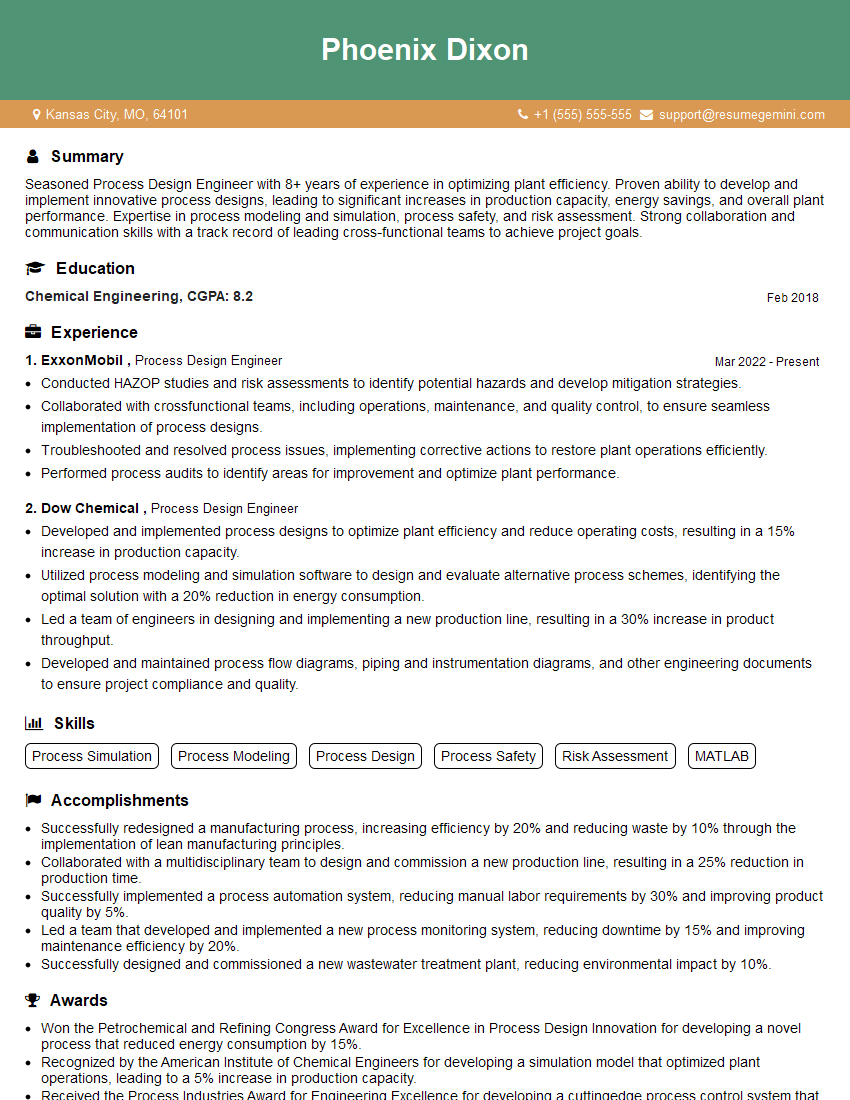
Mastering Gas Process Simulation opens doors to exciting career opportunities in the energy and process industries, offering challenges and rewards in a constantly evolving field. To maximize your job prospects, crafting an ATS-friendly resume is crucial. A well-structured resume highlights your skills and experience effectively, ensuring your application gets noticed. We recommend leveraging ResumeGemini to build a professional and impactful resume. ResumeGemini provides a user-friendly platform and offers examples of resumes tailored to Gas Process Simulation to help you present yourself in the best possible light. Take the next step toward your dream career – build your resume with ResumeGemini today!
Explore more articles
Users Rating of Our Blogs
Share Your Experience
We value your feedback! Please rate our content and share your thoughts (optional).
What Readers Say About Our Blog
To the interviewgemini.com Webmaster.
Very helpful and content specific questions to help prepare me for my interview!
Thank you
To the interviewgemini.com Webmaster.
This was kind of a unique content I found around the specialized skills. Very helpful questions and good detailed answers.
Very Helpful blog, thank you Interviewgemini team.