Interviews are opportunities to demonstrate your expertise, and this guide is here to help you shine. Explore the essential High voltage systems operation and maintenance interview questions that employers frequently ask, paired with strategies for crafting responses that set you apart from the competition.
Questions Asked in High voltage systems operation and maintenance Interview
Q 1. Explain the difference between AC and DC high voltage systems.
The fundamental difference between AC and DC high voltage systems lies in the nature of the current flow. AC, or alternating current, periodically reverses its direction, while DC, or direct current, flows continuously in one direction. This seemingly simple difference has profound implications for system design, operation, and maintenance.
AC High Voltage Systems: These are prevalent in power transmission and distribution networks. The ability to easily step up and down voltage using transformers is a major advantage. Think of it like a water pump that pushes and pulls water back and forth; the alternating pressure allows for efficient long-distance transport. However, AC systems are susceptible to phenomena like skin effect (current concentrating on the conductor’s surface) and inductive reactance, which necessitate careful design considerations.
DC High Voltage Systems: DC systems are increasingly popular, especially in long-distance transmission and renewable energy integration. They are more efficient over extremely long distances due to lower losses. Imagine a steady flow of water in a pipe – less energy is lost to friction. However, DC systems are more complex to manage voltage levels (requiring converters instead of transformers). Furthermore, fault detection and protection can be more challenging.
In essence, the choice between AC and DC high voltage systems depends on factors such as transmission distance, cost, and the specific application requirements.
Q 2. Describe the various types of high voltage insulators and their applications.
High voltage insulators are crucial components, preventing current leakage and ensuring safety. Various types exist, each suited to specific applications.
- Post Insulators: These are commonly used in transmission lines and substations. They are strong, durable, and designed to withstand high mechanical stresses along with electrical stresses. Think of them as strong, supportive pillars holding the conductors aloft.
- Strain Insulators: These are designed for high tensile loads at points where the lines change direction or experience significant tension. They are often used at the ends of spans or where extra support is needed.
- Suspension Insulators: These are commonly used in transmission lines, where multiple insulator units are strung together to increase the overall insulation strength. It’s like having a chain of links, each adding to the overall safety margin.
- Bushings: These insulators provide insulation where conductors pass through walls or tanks, providing electrical insulation while supporting the conductor.
- Cable Insulators: Used to insulate high voltage cables to prevent current leakage.
The choice of insulator depends on factors such as voltage level, environmental conditions, mechanical loading, and cost. For instance, polymeric insulators are increasingly favoured for their light weight and resistance to pollution compared to traditional porcelain insulators in certain regions.
Q 3. What are the safety precautions you would take while working on a high voltage system?
Safety is paramount when working with high voltage systems. A single mistake can have fatal consequences. The following are crucial safety precautions:
- Lockout/Tagout Procedures: Before any work commences, the system must be completely de-energized and locked out, with tags indicating who is working on it and the task involved. This prevents accidental re-energization.
- Proper Personal Protective Equipment (PPE): This includes insulated gloves, boots, safety glasses, and appropriate clothing. Regular inspection of PPE is vital.
- Grounding: Thorough grounding is essential to discharge any residual charge and prevent electrical shocks. This involves connecting the equipment to earth ground using specialized grounding equipment.
- Trained Personnel: Only trained and authorized personnel should work on high voltage systems. They must have comprehensive knowledge of safety procedures and emergency response protocols.
- Permit-to-Work System: A formal permit-to-work system ensures all necessary checks are done before commencement of work, highlighting potential hazards and mitigating them accordingly.
- Regular Inspections: Routine inspections and maintenance of equipment is critical to identify potential hazards before they result in incidents.
Remember, high voltage work is inherently dangerous. Adherence to strict safety protocols is non-negotiable.
Q 4. Explain the principle of operation of a high voltage circuit breaker.
High voltage circuit breakers are vital for protecting equipment and personnel from overloads and short circuits. Their principle of operation involves quickly interrupting the flow of high voltage current when a fault is detected.
Different types of circuit breakers exist, but most commonly, they work on the principle of using either arc quenching (interrupting the arc formed during a fault) or current interruption mechanisms (using vacuum or compressed gases). In a simplified model, when a fault current flows, the circuit breaker senses this through current transformers, triggering a mechanism to rapidly separate contacts, interrupting the current and creating an arc. The arc is then extinguished using various techniques like compressed air or vacuum interruption methods. The speed of operation is critical to limit the damage caused by the fault current.
Vacuum circuit breakers, for instance, employ a vacuum chamber to rapidly extinguish the arc. Oil circuit breakers utilize oil to cool and extinguish the arc, while SF6 (sulphur hexafluoride) circuit breakers use this gas, which is an excellent insulator and arc-quenching medium.
Q 5. What are the common causes of high voltage system faults?
High voltage system faults can arise from various causes, broadly categorized as:
- Insulation Failure: Degradation of insulators due to aging, environmental factors (pollution, humidity), or mechanical damage leads to flashovers and short circuits. Think of a worn-out hose – it leaks under pressure.
- Conductor Faults: These can include broken conductors, corrosion, or overheating, often caused by overloading or poor connections. A corroded pipe restricts water flow and can easily burst.
- Lightning Strikes: Direct lightning strikes can cause significant damage to transmission lines and substations, leading to insulation failure and equipment damage.
- Switching Surges: These are voltage spikes that occur during switching operations, causing stress on insulators and other equipment. Imagine a water hammer in a pipe system.
- External Factors: This includes things such as trees falling on lines, animals causing short circuits, or accidental damage from construction activities. These are unpredictable events with potential significant impact.
Effective maintenance, including regular inspections and condition monitoring, is crucial for minimizing the risk of high voltage system faults.
Q 6. How do you perform a high voltage cable test?
High voltage cable testing is critical to ensure their integrity and safety. It involves a series of tests, depending on the cable’s age and condition.
- Megger Test (Insulation Resistance Test): This test measures the insulation resistance of the cable using a megger, indicating the condition of the cable insulation. A low resistance indicates insulation degradation.
- Partial Discharge (PD) Test: This test detects partial discharges within the cable insulation, which are early signs of insulation breakdown. It helps to identify potential faults before they cause complete failure.
- Tan Delta Test: This test measures the dielectric loss tangent of the cable, indicating the quality of the insulation material. An increasing tan delta value suggests insulation deterioration.
- High Voltage AC or DC Test: This test applies a high voltage to the cable to check its ability to withstand high voltage stresses. It helps to detect weak points in the insulation.
The specific tests performed and the acceptance criteria depend on the cable’s voltage rating, age, and application. It’s crucial to follow relevant safety guidelines and use proper testing equipment and techniques. Always ensure the cable is completely de-energized and properly grounded before starting any testing procedure.
Q 7. Describe the different types of protective relays used in high voltage systems.
Protective relays are essential for detecting faults and initiating protective actions in high voltage systems. Different types are used based on the specific application:
- Overcurrent Relays: These detect excessive current flow, which is often indicative of a short circuit or overload. They operate by measuring the current and comparing it to a pre-set threshold.
- Differential Relays: These compare the current entering and leaving a protected zone. Any difference indicates an internal fault within the zone. They are highly sensitive and selective.
- Distance Relays: These measure the impedance of the line to detect faults based on the distance from the relay location. They are especially useful for long transmission lines.
- Ground Fault Relays: These detect ground faults, often caused by insulation failures. They are critical for protecting equipment and personnel from ground fault conditions.
- Busbar Protection Relays: These are used to protect busbars, crucial components in substations, from faults.
Modern protective relays often incorporate advanced features like digital communication, self-diagnosis, and sophisticated algorithms for enhanced protection and automation. The selection of the appropriate relay depends on the characteristics of the protected equipment and the type of faults that are likely to occur.
Q 8. What is the significance of grounding in high voltage systems?
Grounding in high voltage systems is absolutely crucial for safety and reliable operation. Its primary purpose is to provide a low-resistance path for fault currents to flow to the earth, preventing dangerous voltage buildup on exposed conductive parts. Imagine a scenario where a high-voltage conductor malfunctions and comes into contact with a metal structure. Without proper grounding, this could lead to a hazardous voltage on that structure, posing a significant risk to personnel and equipment. Grounding effectively diverts the fault current to the earth, tripping protective devices like circuit breakers and minimizing the risk of electrical shock or fire.
Different grounding methods exist, including solid grounding, resistance grounding, and reactance grounding, each chosen based on the specific characteristics of the system and the acceptable level of fault current. Proper grounding design involves selecting appropriate grounding conductors, electrodes, and connections to ensure low impedance and efficient current dissipation. Regular inspection and maintenance of grounding systems are vital to maintain their effectiveness and ensure continued safety.
Q 9. Explain the concept of surge protection in high voltage systems.
Surge protection in high-voltage systems is designed to mitigate the damaging effects of transient overvoltages caused by lightning strikes, switching operations, or other external events. These surges can reach extremely high amplitudes and cause equipment failure, insulation breakdown, and even fires. Surge protection devices (SPDs), commonly known as surge arresters, are strategically placed within the system to shunt these excessive voltages to ground, protecting valuable equipment.
SPDs typically employ metal-oxide varistors (MOVs) or gas discharge tubes (GDTs) that conduct significant current only when the voltage exceeds a predefined threshold. Think of them as safety valves in a pressure system – they remain inactive under normal operating conditions but rapidly open to protect the system during a surge. The selection of appropriate SPDs depends on factors like the system voltage, surge energy, and expected surge frequency. Proper coordination between SPDs and other protective devices is also important to ensure optimal performance and prevent damage to both the SPDs and the protected equipment.
Q 10. How do you troubleshoot a high voltage system fault?
Troubleshooting a high-voltage system fault requires a systematic and cautious approach, prioritizing safety above all else. The process typically begins with isolating the affected section of the system to prevent further damage or injury. Then, a careful inspection is carried out, including visual examination of insulators, connectors, and other components, looking for signs of arcing, burning, or physical damage.
Advanced diagnostic tools, such as high-voltage testers, insulation resistance meters, and partial discharge detectors, are employed to identify the precise location and nature of the fault. Detailed analysis of system parameters like voltage, current, and power factor can also provide valuable clues. Once the fault is identified, a repair plan is developed, taking into account safety procedures, access restrictions, and the necessary tools and equipment. After repairs are completed, thorough testing is conducted to ensure the system operates safely and reliably before re-energizing.
For example, a sudden trip of a circuit breaker might indicate a ground fault. We would first de-energize the section and then use a high voltage insulation tester to measure the insulation resistance of the affected cable or equipment to pinpoint the fault location. A methodical approach and detailed documentation throughout the process is crucial for efficient and safe troubleshooting.
Q 11. Describe the different types of high voltage transformers.
High-voltage transformers are categorized based on their application, design, and construction. Common types include power transformers, instrument transformers, and autotransformers. Power transformers are used for stepping up or stepping down voltage in power transmission and distribution systems. They are typically large, robust units designed for high power handling capabilities. Instrument transformers, including current transformers (CTs) and potential transformers (PTs), are used for measurement and protection purposes; they accurately scale down high voltages and currents for safe measurement by instruments.
Autotransformers are a type of transformer with a single winding, used for voltage regulation and transformation. They are generally smaller and less expensive than power transformers but offer less isolation. The choice of transformer type depends on factors like voltage levels, power rating, application requirements, and cost considerations. For instance, a substation might utilize a large power transformer to step down the transmission voltage to distribution levels, while numerous smaller instrument transformers will monitor the voltage and current throughout the system.
Q 12. What are the various types of high voltage switchgear?
High-voltage switchgear comprises the equipment used for switching, controlling, and protecting high-voltage circuits. This includes circuit breakers, isolators (disconnect switches), busbars, protective relays, and control panels. Circuit breakers are the primary protective devices, interrupting fault currents to prevent damage and ensure safety. Isolators are used for isolating sections of the system for maintenance or repairs; they are not designed to interrupt fault currents. Busbars provide the connection points for multiple circuits within the switchgear.
Different types of circuit breakers exist, including air-blast circuit breakers, oil circuit breakers, vacuum circuit breakers, and SF6 (sulfur hexafluoride) circuit breakers. The selection of the appropriate switchgear depends on factors such as voltage level, fault current capacity, environmental conditions, and maintenance requirements. For example, an air-insulated substation might use air-blast breakers, while a gas-insulated substation would employ SF6 circuit breakers for superior insulation properties and reduced maintenance.
Q 13. Explain the importance of regular maintenance in high voltage systems.
Regular maintenance is paramount for the safe and reliable operation of high-voltage systems. Preventive maintenance schedules help to identify and address potential problems before they escalate into major failures. This includes regular inspections of all components, including insulators, conductors, transformers, and switchgear, looking for signs of wear, tear, or damage. Tests are conducted to measure insulation resistance, partial discharge activity, and other critical parameters to ensure the system is within acceptable operating limits.
Proper maintenance ensures the longevity of equipment, reduces the risk of unplanned outages, and minimizes the potential for serious accidents. Consider the scenario of a cracked insulator. If not detected during routine inspection, this could lead to flashover and a significant system fault. A comprehensive maintenance program, including preventative measures, routine inspections, and corrective actions, is essential for maintaining the integrity and reliability of high-voltage systems. Detailed records and reports of all maintenance activities are important for tracking performance, planning future maintenance, and meeting regulatory requirements.
Q 14. What are the different types of high voltage testing equipment?
A range of specialized equipment is used for testing high-voltage systems. This includes high-voltage insulation testers to measure the insulation resistance of cables, transformers, and other components. Partial discharge (PD) detectors identify and locate insulation defects that may not be visible during visual inspection. High-voltage impulse generators simulate lightning surges to test the surge-withstand capability of equipment. Power factor meters are used to measure the power factor and identify the presence of insulation degradation.
Other important equipment includes: Digital multimeters for measuring voltage, current, and resistance; Ground resistance testers to verify the effectiveness of grounding systems; Temperature sensors to monitor operating temperatures and prevent overheating; and Specialized cameras and infrared imaging devices to detect hotspots and other anomalies. The choice of testing equipment depends on the specific test requirements and the type of equipment being tested. For example, testing a large power transformer may involve using a high-voltage impulse generator to assess its lightning protection, as well as a partial discharge detector to identify any developing weaknesses within the insulation system.
Q 15. Describe the process of commissioning a high voltage system.
Commissioning a high voltage system is a rigorous process ensuring it’s safe and performs as designed. It involves meticulous testing and verification at every stage, from initial inspection to final energization. Think of it as a thorough health check for a vital organ in a power grid.
- Pre-commissioning: This phase includes verifying the equipment against specifications, inspecting for any damage during transportation and storage, and completing all necessary documentation.
- System Assembly and Testing: Individual components are tested (e.g., transformers, circuit breakers, insulators) before integration. Insulation resistance tests are critical here to ensure no hidden weaknesses exist. We’d use a Megohmmeter for this.
- System Integration Testing: After assembly, the entire system is tested under controlled conditions. This includes high-voltage tests (often at significantly higher voltages than the operating voltage) to verify insulation integrity and protection system operation. Imagine stress-testing the system to find any weak points.
- Protection Relay Testing: Protection relays are the system’s nervous system— detecting faults and initiating protective actions. Thorough testing ensures they operate correctly and prevent catastrophic failures.
- Commissioning Report: All test results, observations, and corrective actions are documented in a comprehensive report, vital for future maintenance and troubleshooting.
- Energization: The final step, involving a gradual increase in voltage under close supervision, confirming the system’s smooth operation at the rated voltage.
For example, during the testing of a new substation, we might use a high-voltage impulse generator to simulate lightning strikes and verify the effectiveness of surge arresters. Failure at any stage necessitates rectification before proceeding.
Career Expert Tips:
- Ace those interviews! Prepare effectively by reviewing the Top 50 Most Common Interview Questions on ResumeGemini.
- Navigate your job search with confidence! Explore a wide range of Career Tips on ResumeGemini. Learn about common challenges and recommendations to overcome them.
- Craft the perfect resume! Master the Art of Resume Writing with ResumeGemini’s guide. Showcase your unique qualifications and achievements effectively.
- Don’t miss out on holiday savings! Build your dream resume with ResumeGemini’s ATS optimized templates.
Q 16. What are the common causes of high voltage cable failures?
High-voltage cable failures are often the result of a combination of factors, leading to significant downtime and repair costs. Think of it like the gradual weakening of a rope under repeated strain.
- Deterioration of Insulation: Over time, the insulation material (e.g., cross-linked polyethylene (XLPE) or ethylene propylene rubber (EPR)) degrades due to heat, moisture, and chemical attack. This weakens the insulation, making it vulnerable to breakdown.
- Mechanical Damage: External forces like rodent damage, excavation activities, or ground movement can physically damage cables, leading to insulation breaches.
- Thermal Overload: Excessive current flow due to overloading or faults can generate heat, exceeding the cable’s thermal rating and causing insulation failure. Imagine overloading a wire with too much electricity.
- Water Ingress: Water entering the cable can reduce insulation resistance, leading to partial discharge and ultimately failure. Water is a conductor and will cause havoc within a cable’s insulation.
- Manufacturing Defects: Faulty manufacturing processes can lead to flaws in the cable construction, making them prone to failures. It’s like a birth defect in a car engine.
Identifying the root cause is crucial for preventative maintenance. For instance, regular thermographic surveys can pinpoint overheated sections, preventing major failures.
Q 17. Explain the concept of arc flash hazard and its prevention.
An arc flash is a dangerous electrical explosion that occurs when an electrical fault causes a high-current arc. Imagine a mini-sun appearing, generating intense heat, light, and pressure. It’s incredibly dangerous.
The energy released in an arc flash can cause severe burns, hearing loss, and even death. Preventing this requires a multi-pronged approach:
- Engineering Controls: These are the most effective, focusing on minimizing the risk of faults. This includes proper grounding, insulation coordination, and the use of arc flash resistant equipment.
- Administrative Controls: This includes safety procedures, training, lockout/tagout procedures, and the implementation of safe work practices. This aspect is as crucial as the engineering aspects. Every technician needs detailed training on arc flash hazards.
- Personal Protective Equipment (PPE): Arc flash suits offer protection from the thermal and arc blast energy, but their effectiveness is limited. They’re the last line of defense.
Arc flash risk assessment is paramount. Software tools calculate incident energy levels, guiding the selection of appropriate PPE. The lower the incident energy, the safer the environment and less stringent the PPE requirements. It’s vital to regularly review and update risk assessments based on system changes.
Q 18. How do you interpret a high voltage system schematic diagram?
High voltage system schematic diagrams are like roadmaps for the power system. They show the interconnected components and their arrangement. Understanding them is vital for operation and maintenance.
Interpretation involves systematically identifying and understanding each symbol. For instance, a circle might represent a transformer, while a rectangle might signify a circuit breaker. The lines connecting these symbols represent the conductors. You’ll see voltage levels, equipment ratings, and protection systems depicted.
Understanding the flow of power and the protective devices is key. You need to trace the path of power from the source to the load and understand which relays would trip in different fault conditions. For example, a one-line diagram shows the simplified layout while a three-line diagram depicts all three phases. Detailed diagrams might show busbar configurations and instrument transformer locations.
A good understanding of electrical symbols and power system fundamentals is critical. Practicing reading many different schematics will build familiarity and confidence.
Q 19. Describe the different types of high voltage bushings.
High voltage bushings are essential components allowing for safe and reliable electrical connection between equipment inside a high voltage enclosure (like a transformer) and external cabling. Think of them as controlled entry points for electricity.
- Capacitor Bushings: These bushings use layers of insulating material and a capacitive structure to reduce stress. Common materials include porcelain or composite materials. Their capacitance helps to distribute the electrical stress more uniformly, making them very reliable.
- Oil-Filled Bushings: These use insulating oil as the primary dielectric. Oil provides excellent insulation but needs careful maintenance to prevent leakage and contamination.
- Solid Dielectric Bushings: These use solid insulating materials such as epoxy or silicone rubber. They are usually smaller and lighter than other types but may have limitations in terms of voltage rating.
- Gas-Filled Bushings: These bushings use a gas like SF6 (sulfur hexafluoride) as an insulator. This gas has very high dielectric strength, but environmental concerns limit their use nowadays.
The choice of bushing type depends on factors such as voltage level, environmental conditions, and maintenance requirements. For example, gas-filled bushings are suited for high voltages, but their use is increasingly restricted because of SF6’s environmental impact.
Q 20. What are the safety regulations for working on high voltage systems?
Safety regulations for working on high voltage systems are stringent and absolutely non-negotiable, prioritizing the prevention of accidents and fatalities. They’re in place to protect lives.
- Lockout/Tagout Procedures: Before any work, the system must be de-energized, and lockout/tagout procedures are meticulously followed to prevent accidental energization.
- Permit-to-Work Systems: Formal permits are required to authorize work on high voltage equipment, ensuring that all safety precautions are taken and that personnel are properly trained. This is especially important when multiple teams might work on the same system.
- Personal Protective Equipment (PPE): Appropriate PPE including insulated tools, safety glasses, and arc flash suits are mandatory.
- Grounding and Bonding: Proper grounding and bonding ensure that the equipment is safely grounded, preventing dangerous voltage surges.
- Training and Competence: Workers must receive adequate training and demonstrate competence before they’re permitted to work on high-voltage systems. Training requirements are specific and mandatory for each role.
- Emergency Response Plans: Clear emergency response plans must be in place, including procedures for dealing with arc flashes and electrical shocks. Regular drills reinforce preparedness and enhance response times.
Compliance with all relevant local and national safety regulations is critical. Violating safety regulations can lead to severe consequences, including fines, legal action, and injury or death.
Q 21. Explain the concept of voltage regulation in high voltage systems.
Voltage regulation in high voltage systems refers to the ability of the system to maintain a constant voltage at the load despite variations in load current or other disturbances. Think of it as maintaining a steady flow of water even when the taps are opened and closed.
Maintaining a stable voltage is crucial for equipment operation and power quality. Large voltage variations can damage sensitive equipment and affect the performance of electrical devices. The methods used involve:
- Tap-Changing Transformers: These transformers can adjust their turns ratio to compensate for voltage variations. This is a common and effective method for long transmission lines.
- Voltage Regulators: These devices automatically adjust the voltage by either boosting or reducing the voltage levels, maintaining a stable output. They’re the power system’s ‘fine-tuners’.
- Reactive Power Compensation: By adding or removing reactive power (capacitors or reactors), we can improve voltage regulation and reduce voltage drops on transmission lines. These are like ‘voltage stabilizers’.
- Automatic Voltage Regulators (AVRs): Found in generators and power systems, they maintain a stable voltage output despite changes in load conditions.
Effective voltage regulation techniques are critical for maintaining a stable and reliable power supply, preventing voltage sags and surges. It improves overall system efficiency and power quality.
Q 22. How do you calculate the voltage drop in a high voltage transmission line?
Calculating voltage drop in a high voltage transmission line involves considering several factors. The primary method uses the formula: Voltage Drop = I * Z, where ‘I’ is the line current and ‘Z’ is the line impedance. However, ‘Z’ isn’t a simple resistance; it’s a complex impedance comprising resistance (R) and reactance (X), both of which are frequency-dependent. For high voltage AC lines, the reactance is often dominant.
Breaking it down:
- Resistance (R): This accounts for the inherent resistance of the conductor material (e.g., copper or aluminum). It leads to power loss as heat (I²R losses).
- Reactance (X): This stems from the inductance of the line, which opposes changes in current flow. Inductance depends on the conductor geometry, spacing between conductors, and the line length.
- Impedance (Z): This is the vector sum of resistance and reactance: Z = √(R² + X²). Because R and X are at 90 degrees to each other (in a simple model), we use the Pythagorean theorem.
Practical Considerations: Calculating the exact impedance of a long transmission line is complex and often involves specialized software or calculation methods (e.g., Carson’s equations for ground effects). Simplified models using average impedance values per unit length are commonly employed for initial estimations. The line’s length significantly impacts the voltage drop, as does the current flowing through it. For example, a heavily loaded line during peak demand will experience a larger voltage drop than a lightly loaded line.
Example: Let’s say we have a transmission line with a resistance of 0.1 Ω/km and a reactance of 0.5 Ω/km. The line is 100 km long and carries a current of 1000 A. The total resistance is 10 Ω (0.1 Ω/km * 100 km), and the total reactance is 50 Ω (0.5 Ω/km * 100 km). The impedance Z = √(10² + 50²) ≈ 51 Ω. Therefore, the voltage drop is approximately 51,000 V (51 Ω * 1000 A). This is a simplification; actual calculations would be far more sophisticated.
Q 23. What are the environmental considerations for high voltage systems?
Environmental considerations for high voltage systems are paramount. They cover a wide spectrum, impacting both the environment and the system’s operational safety. Key considerations include:
- Electromagnetic Fields (EMF): High voltage lines generate EMF, which can potentially affect human health and nearby wildlife. Mitigation strategies involve careful line design, route selection (avoiding populated areas), and adhering to strict EMF emission limits.
- Visual Impact: Large transmission towers and extensive lines can be visually intrusive, affecting the aesthetics of landscapes and potentially impacting property values. Minimizing visual impact often involves careful route planning, using thinner conductors where feasible, and incorporating landscaping strategies.
- Right-of-Way Management: Maintaining a safe and clear right-of-way around transmission lines is crucial for preventing vegetation encroachment, which could lead to line faults and fires. Regular vegetation management programs are essential.
- Noise Pollution: Corona discharge from high voltage lines can generate audible noise, especially in wet weather. Careful conductor design and the use of corona rings can help mitigate this.
- Wildlife Impacts: Birds and other animals can be affected by contact with lines or induced electric fields. Bird diverters and other mitigation techniques are employed to minimize these risks.
- Climate Change: Extreme weather events (storms, heat waves) pose increasing threats to high voltage system integrity, necessitating robust designs that can withstand such conditions.
Example: The siting of a new high voltage transmission line near a bird sanctuary would require a comprehensive environmental impact assessment to address potential impacts on bird populations. Mitigation measures might include the use of bird diverters, taller towers, or alternative line routing.
Q 24. Explain the role of SCADA in high voltage system monitoring and control.
SCADA (Supervisory Control and Data Acquisition) systems play a vital role in monitoring and controlling high voltage systems. They provide a centralized platform for real-time monitoring of various parameters and enable remote control of substation equipment.
Key Functions:
- Real-time Monitoring: SCADA systems continuously monitor critical parameters such as voltage, current, power flow, temperature, and equipment status from numerous points across the transmission network.
- Alarm Management: They trigger alarms when any parameter deviates from pre-defined thresholds, allowing operators to quickly respond to potential issues.
- Remote Control: Operators can remotely control various substation equipment, such as circuit breakers, transformers, and tap changers, improving responsiveness to system disturbances.
- Data Logging and Reporting: SCADA systems log historical data, enabling analysis of system performance, trend identification, and predictive maintenance strategies.
- System Visualization: Through graphical user interfaces (GUIs), SCADA systems provide operators with a visual representation of the entire transmission network, facilitating efficient monitoring and control.
Example: If a fault occurs on a transmission line, SCADA would automatically detect the anomaly (e.g., low voltage, high current), trigger an alarm, and allow the operator to remotely isolate the faulty section using remote control of circuit breakers, limiting the extent of the outage and ensuring system stability. SCADA systems are essential for efficient operation, maintenance, and protection of high voltage transmission networks.
Q 25. Describe different types of high voltage arresters and their function.
High voltage arresters, also known as surge arresters, protect electrical equipment from transient overvoltages caused by lightning strikes, switching operations, or other disturbances.
Types:
- Metal Oxide Varistor (MOV) Arresters: These are the most common type, utilizing metal oxide semiconductor varistors that exhibit a non-linear voltage-current characteristic. When a surge occurs, the MOV’s resistance drops dramatically, diverting the surge current to ground.
- Silicon Carbide (SiC) Arresters: These use silicon carbide blocks as the surge-limiting element. They’re generally more robust and can handle higher surge currents than MOV arresters but might have a higher residual voltage.
- Gas Discharge Tube (GDT) Arresters: These employ a gas-filled gap that ionizes when a surge occurs, providing a low-resistance path to ground. They’re often used for lower voltage applications and are becoming less prevalent in high-voltage systems due to their limited energy absorption capacity.
Function: The primary function of all arresters is to limit the voltage transient to a level that the protected equipment can withstand. They must quickly clamp the voltage during a surge, then recover to their high-impedance state, preventing continuous current flow. Improperly functioning arresters can lead to significant damage or even system failure.
Example: A lightning strike near a substation could induce a high-voltage surge on the transmission lines. The MOV arresters connected to the substation transformers would clamp the surge voltage, preventing damage to the expensive equipment. After the surge dissipates, the arrester recovers to its normal high-impedance state.
Q 26. How do you ensure the safety of personnel working near high voltage equipment?
Ensuring personnel safety near high voltage equipment is of paramount importance. A multi-layered approach is essential:
- Lockout/Tagout Procedures: Before any work is performed on high voltage equipment, a rigorous lockout/tagout procedure must be followed to ensure the equipment is completely de-energized and isolated. This involves physically locking out the power source and tagging the equipment to indicate that it’s out of service.
- Permit-to-Work System: A formal permit-to-work system ensures that all necessary safety checks are completed and all personnel are aware of the risks before starting work.
- Protective Equipment: Personnel must use appropriate personal protective equipment (PPE), including insulated gloves, safety glasses, arc-flash suits (for higher voltages), and safety footwear.
- Training and Competency: All personnel working near high voltage equipment must receive thorough training on safety procedures, hazard awareness, and the use of PPE. Regular refresher training is essential.
- Grounding and Bonding: Proper grounding and bonding techniques are crucial to eliminate the risk of electrical shocks. This involves connecting the equipment to a known ground potential.
- Safety Audits and Inspections: Regular safety audits and inspections are vital to ensure that safety procedures are followed and that the equipment is in good working condition.
Example: Before performing maintenance on a high voltage circuit breaker, a team would follow a strict lockout/tagout procedure to de-energize the breaker and verify its isolation. They would then use appropriate PPE and grounding techniques before commencing the work. A safety supervisor would oversee the process to ensure adherence to safety regulations.
Q 27. Explain the process of insulating and testing high voltage equipment.
Insulating and testing high voltage equipment is a critical aspect of ensuring its safe and reliable operation. The process involves several steps:
Insulation:
- Material Selection: The choice of insulating material depends on the voltage level, environmental conditions, and the type of equipment. Common materials include porcelain, polymers (e.g., epoxy resin), and gases (e.g., SF6).
- Application: Insulation is applied to prevent electrical breakdown and protect personnel from contact with energized parts. This can involve coating, potting, or filling components with insulating materials.
- Quality Control: Strict quality control measures are essential to ensure the integrity of the insulation. This includes visual inspections, dielectric strength tests, and other relevant checks.
Testing:
- Dielectric Strength Tests: These tests assess the insulation’s ability to withstand high voltages without breaking down. A high-voltage test set is used to apply a controlled voltage to the insulation, and the breakdown voltage is measured.
- Partial Discharge (PD) Tests: These tests detect partial discharges within the insulation, which are indicative of potential insulation degradation. PD measurements can help identify insulation flaws before they lead to catastrophic failure.
- Insulation Resistance Tests: These tests measure the resistance of the insulation to the flow of leakage current. Low insulation resistance suggests degradation or contamination.
- Acceptance Testing: Before commissioning, the equipment undergoes a series of tests to ensure it meets the specified performance and safety requirements.
Example: A high voltage transformer undergoes a dielectric strength test at a voltage significantly higher than its operating voltage to verify the insulation’s integrity. Partial discharge tests are performed to detect any micro-discharges that might indicate insulation weaknesses. These tests, combined with regular maintenance and visual inspections, help ensure the long-term reliability and safety of the transformer.
Q 28. Describe the impact of harmonics on high voltage systems
Harmonics in high voltage systems are non-linear distortions of the sinusoidal waveform, which can have detrimental effects. They arise from non-linear loads such as rectifiers, variable speed drives, and power electronic devices increasingly present in modern power systems.
Impact:
- Overheating of equipment: Harmonics can cause increased current flow in transformers, cables, and other equipment, leading to overheating and potential failure.
- Increased losses: Harmonics increase energy losses in transformers and transmission lines.
- Resonance: Harmonics can interact with the system’s natural resonant frequencies, leading to voltage and current amplification, which can cause severe equipment damage.
- Malfunction of protective relays: Harmonics can interfere with the operation of protective relays, leading to incorrect tripping and potential system instability.
- Neutral conductor overloading: The presence of triplen harmonics (3rd, 9th, 15th, etc.) can cause significant overloading of the neutral conductor in three-phase systems.
Mitigation:
- Active and passive filters: These are used to reduce harmonic currents at their source or at the point of common coupling.
- Harmonic impedance control: Careful selection of equipment with low harmonic impedance can reduce the impact of harmonics.
- Load balancing: Distributing the load evenly among phases can help mitigate the effects of triplen harmonics on the neutral conductor.
- System design considerations: Incorporating harmonic mitigation strategies into the design phase of high voltage systems is essential to avoid future problems.
Example: A large industrial plant with many variable-speed drives may introduce significant harmonic distortion into the power system. The installation of harmonic filters can mitigate these effects, preventing overheating of equipment and ensuring reliable operation. Regular harmonic monitoring is also crucial for identifying potential problems early.
Key Topics to Learn for High Voltage Systems Operation and Maintenance Interviews
- Safety Procedures and Regulations: Understanding and applying relevant safety protocols, including lockout/tagout procedures, personal protective equipment (PPE) usage, and emergency response plans. This is paramount for any role in this field.
- High Voltage Equipment Operation: Gain a thorough understanding of the operation and function of various high-voltage equipment, including transformers, circuit breakers, insulators, and switchgear. Be prepared to discuss practical experience with these systems.
- Preventive Maintenance Strategies: Mastering preventive maintenance techniques, including inspection, testing, and troubleshooting of high-voltage equipment. Showcase your ability to identify potential problems before they become major issues.
- Troubleshooting and Diagnostics: Develop your skills in diagnosing faults and malfunctions within high-voltage systems using various diagnostic tools and techniques. Be ready to discuss your problem-solving approach.
- Protective Relaying and System Protection: Understand the principles of protective relaying and its crucial role in ensuring the safety and reliability of high-voltage systems. Be able to explain different protection schemes.
- Power System Analysis: Develop a solid understanding of power system analysis techniques, including load flow studies, fault calculations, and stability analysis. This is important for understanding system behavior and optimizing performance.
- Substation Design and Operation: Familiarize yourself with the design and operation of high-voltage substations, including busbar arrangements, grounding systems, and control systems. Be prepared to discuss different substation configurations.
- High Voltage Testing and Commissioning: Understanding the procedures and techniques involved in testing and commissioning high-voltage equipment and systems. This demonstrates your ability to ensure the systems are working correctly.
Next Steps
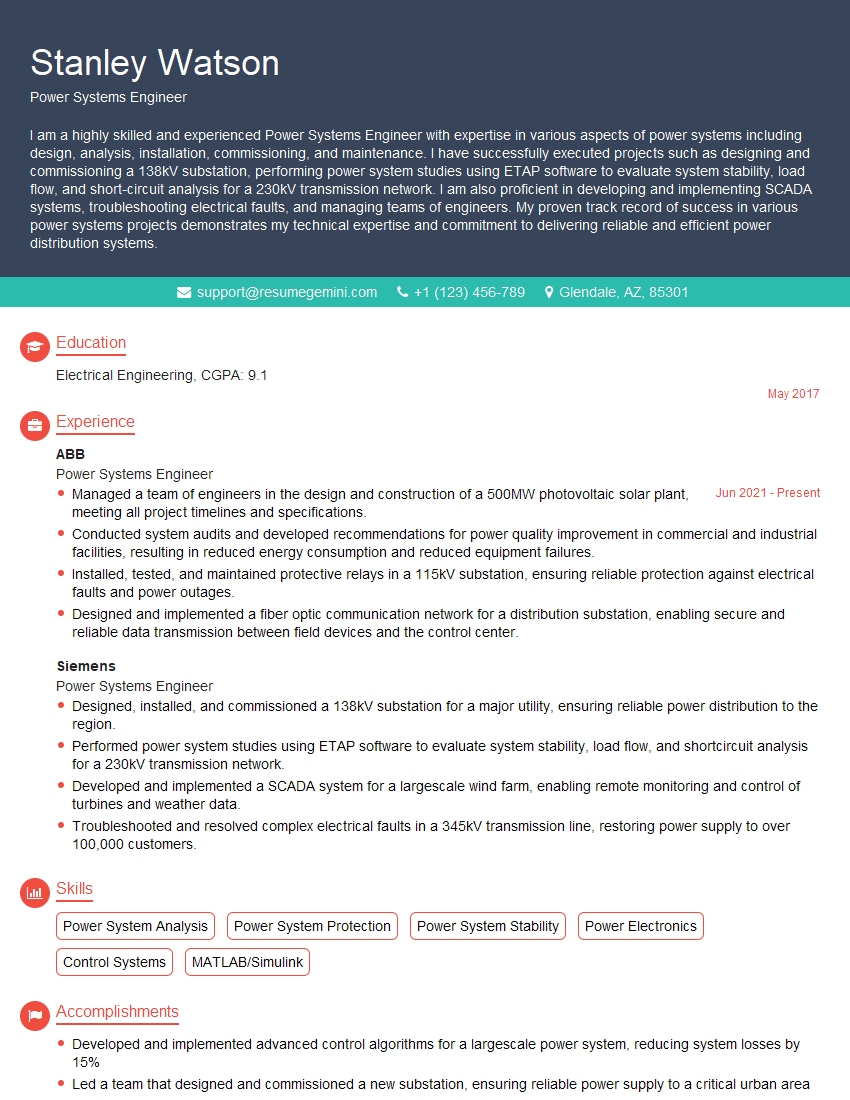
Mastering high-voltage systems operation and maintenance opens doors to a rewarding and impactful career, offering opportunities for advancement and specialization. To maximize your job prospects, invest time in crafting a compelling and ATS-friendly resume that highlights your skills and experience effectively. ResumeGemini is a trusted resource that can help you create a professional resume that stands out. They offer examples of resumes tailored specifically to high-voltage systems operation and maintenance roles, helping you present your qualifications in the best possible light. Take the next step towards your dream career – build a winning resume with ResumeGemini.
Explore more articles
Users Rating of Our Blogs
Share Your Experience
We value your feedback! Please rate our content and share your thoughts (optional).
What Readers Say About Our Blog
To the interviewgemini.com Webmaster.
Very helpful and content specific questions to help prepare me for my interview!
Thank you
To the interviewgemini.com Webmaster.
This was kind of a unique content I found around the specialized skills. Very helpful questions and good detailed answers.
Very Helpful blog, thank you Interviewgemini team.