Every successful interview starts with knowing what to expect. In this blog, we’ll take you through the top Hyperspectral Imagery interview questions, breaking them down with expert tips to help you deliver impactful answers. Step into your next interview fully prepared and ready to succeed.
Questions Asked in Hyperspectral Imagery Interview
Q 1. Explain the concept of hyperspectral imaging and its advantages over multispectral imaging.
Hyperspectral imaging captures images across a very wide range of the electromagnetic spectrum, producing hundreds of continuous spectral bands. Think of it like taking thousands of photographs simultaneously, each at a slightly different wavelength of light. Multispectral imaging, on the other hand, uses only a few, broader spectral bands, like the typical red, green, and blue (RGB) in a standard camera, or perhaps a few additional near-infrared bands.
The advantage of hyperspectral imaging is its significantly higher spectral resolution. This allows for a much more detailed analysis of the spectral signatures of different materials, enabling more precise identification and classification. For example, while multispectral imaging might be able to distinguish between vegetation and soil, hyperspectral imaging can differentiate between various types of vegetation, and even detect subtle variations in their health or stress levels based on their unique spectral fingerprints.
Imagine trying to identify different fruits in a basket. Multispectral imaging is like looking at the basket with your eyes – you can see the general colors and shapes, but you might have trouble telling apart similar-looking fruits. Hyperspectral imaging is like using a spectrometer to analyze the light reflected by each fruit – you can identify them based on their unique spectral signatures, even if they look similar to the naked eye.
Q 2. Describe different hyperspectral sensor types and their applications.
Hyperspectral sensors come in various forms, each with unique characteristics and applications. Some common types include:
- Imaging Spectrometers: These are typically whiskbroom or pushbroom scanners that acquire data across a wide swath. Whiskbroom scanners use a single detector and a rotating mirror to scan the scene, while pushbroom scanners use a linear array of detectors that capture an entire line of the scene simultaneously. These are widely used in airborne and satellite applications for large-scale mapping.
- Snapshot Hyperspectral Imagers: These utilize a two-dimensional array of detectors, enabling simultaneous acquisition of the entire scene. This increases speed significantly compared to scanning systems, but they usually have a lower spectral range and can be more expensive.
- Tunable Filters: These utilize a filter that can be tuned to select specific wavelengths, sequentially capturing the scene at different bands. They offer a balance between cost and spectral resolution, commonly found in laboratory settings.
Applications are diverse and span multiple fields:
- Precision Agriculture: Assessing crop health, identifying nutrient deficiencies, and optimizing irrigation.
- Environmental Monitoring: Studying pollution, detecting invasive species, and monitoring deforestation.
- Mineral Exploration: Identifying mineral deposits and assessing ore grade.
- Defense and Security: Target detection and identification, surveillance, and counter-terrorism.
- Medical Imaging: Cancer detection and tissue analysis.
Q 3. How does atmospheric correction impact hyperspectral data analysis?
Atmospheric correction is a crucial step in hyperspectral data analysis because the Earth’s atmosphere significantly alters the spectral signal recorded by the sensor. Various atmospheric components, such as water vapor, aerosols, and gases, absorb and scatter light, leading to distortions and inaccuracies in the measured reflectance values.
Without atmospheric correction, the spectral signatures of the target materials will be contaminated by atmospheric effects, making accurate analysis and interpretation very difficult. The process of atmospheric correction aims to remove or compensate for these atmospheric influences, resulting in a more accurate representation of the surface reflectance. Various atmospheric correction methods exist, ranging from simple empirical methods to sophisticated radiative transfer models. The choice of method depends on factors such as sensor characteristics, atmospheric conditions, and the desired accuracy.
For example, if you’re analyzing hyperspectral data of a forest to identify different tree species, atmospheric effects could mask the subtle spectral differences between them, making accurate identification impossible without proper correction.
Q 4. Explain the process of hyperspectral image preprocessing.
Hyperspectral image preprocessing is a critical step that prepares the raw data for further analysis. This typically involves several stages:
- Radiometric Correction: This addresses variations in sensor response and illumination conditions. Techniques include dark current subtraction, flat-field correction, and sensor calibration.
- Geometric Correction: This corrects geometric distortions in the image caused by sensor movement, terrain variations, and atmospheric effects. Techniques include orthorectification and georeferencing using ground control points.
- Atmospheric Correction: This removes or corrects for atmospheric effects as previously discussed.
- Data Alignment and Registration: If multiple hyperspectral images are used, they need to be aligned and registered spatially to allow for accurate comparison and analysis.
Proper preprocessing ensures the quality and accuracy of subsequent data analysis, reducing the chance of error in the final results. Think of it as cleaning and preparing the ingredients before starting to cook a meal.
Q 5. What are common noise reduction techniques used in hyperspectral imaging?
Hyperspectral data is often susceptible to noise from various sources. Common noise reduction techniques include:
- Median Filtering: A non-linear filter that replaces each pixel value with the median value of its neighboring pixels, effective in reducing impulse noise (salt and pepper noise).
- Gaussian Filtering: A linear filter that smooths the image by averaging pixel values using a Gaussian kernel, useful for reducing Gaussian noise.
- Wavelet Transform: A technique that decomposes the image into different frequency components, allowing for selective noise reduction in specific frequency bands.
- Principal Component Analysis (PCA): A dimensionality reduction technique that transforms the data into a new set of uncorrelated principal components, with the first few components containing most of the variance in the data. Noise often appears in the components with the least variance, allowing for its removal.
The choice of noise reduction technique depends on the type and level of noise present in the data. It’s important to strike a balance between noise reduction and preservation of important spectral information. Over-smoothing can blur fine details and affect the accuracy of further analysis.
Q 6. Describe various spectral unmixing algorithms and their strengths and weaknesses.
Spectral unmixing is a crucial technique in hyperspectral analysis that aims to decompose the mixed pixels (pixels containing multiple materials) into their constituent spectral components (endmembers) and their corresponding abundances. Several algorithms exist:
- Linear Spectral Unmixing (LSU): This assumes a linear mixing model, where the spectrum of a mixed pixel is a linear combination of the spectra of its constituent endmembers. It’s computationally efficient but can be inaccurate if the mixing is non-linear.
- Nonlinear Spectral Unmixing (NLSU): This accounts for nonlinear interactions between materials, offering improved accuracy in cases where LSU fails. However, NLSU algorithms are generally computationally more expensive and require more sophisticated methods to estimate endmembers.
- Fully Constrained Least Squares (FCLS): A popular LSU algorithm that enforces the constraints of non-negativity and sum-to-one on the abundance fractions. This ensures physically meaningful results.
- N-FINDR: A widely used endmember extraction algorithm that iteratively identifies the endmembers that maximize the volume of the simplex spanned by the endmember spectra in the spectral space.
The strengths and weaknesses of each algorithm depend on the specific application and the nature of the hyperspectral data. LSU is fast but assumes linear mixing. NLSU is more accurate for complex situations but computationally demanding. The choice of algorithm often involves a trade-off between computational cost, accuracy, and the assumptions made about the mixing model.
Q 7. How do you perform target detection and classification using hyperspectral data?
Target detection and classification in hyperspectral imagery involve identifying and categorizing specific objects or materials based on their spectral signatures. Several approaches can be employed:
- Pixel-Based Classification: Each pixel is classified independently based on its spectral information using methods like Support Vector Machines (SVMs), Random Forests, or Maximum Likelihood Classification. This is straightforward but sensitive to noise and mixed pixels.
- Object-Based Image Analysis (OBIA): This involves segmenting the image into meaningful objects and then classifying these objects based on their spectral and spatial characteristics. This approach is less sensitive to noise and mixed pixels compared to pixel-based methods.
- Spectral Angle Mapper (SAM): This measures the angle between the spectral signature of a pixel and the spectral signature of a known target. A smaller angle indicates a higher probability of the pixel belonging to the target class.
- Matched Filtering: This compares the spectral signature of a pixel with a reference spectrum and uses a correlation measure to assess similarity. It is useful for detecting specific targets with well-defined spectral signatures.
The best approach depends on factors such as the size and spectral variability of the target, the presence of noise and mixed pixels, and the computational resources available. Often a combination of techniques is used for optimal results. For instance, one might use OBIA to segment regions of interest, followed by pixel-wise classification within each segment using a suitable classifier like an SVM.
Q 8. Explain the concept of dimensionality reduction in hyperspectral data analysis.
Hyperspectral imagery generates data cubes with hundreds of spectral bands, leading to high dimensionality and computational challenges. Dimensionality reduction techniques aim to reduce this complexity while preserving essential information. Think of it like summarizing a lengthy novel into key plot points – you lose some detail but retain the core narrative.
Common methods include:
- Principal Component Analysis (PCA): This transforms the data into a new set of uncorrelated variables (principal components), ordered by the amount of variance they explain. We often retain only the top few components, capturing most of the data’s variability. It’s like finding the main ‘themes’ in your data.
- Minimum Noise Fraction (MNF): Similar to PCA, but it focuses on maximizing signal-to-noise ratio, making it particularly useful for noisy hyperspectral data. This is like removing background noise from an audio recording before extracting the music.
- Feature Selection: This involves choosing a subset of the original bands based on their relevance to the specific application. This is like choosing only the most relevant chapters in your novel, discarding less important ones.
The choice of method depends on the specific dataset and application. For instance, PCA is widely used for visualization and initial data exploration, while MNF is preferred when noise is a significant concern. Feature selection is often used when specific spectral features are known to be relevant to the target materials.
Q 9. What are the challenges associated with hyperspectral data storage and processing?
Hyperspectral data’s high dimensionality poses significant storage and processing challenges. Each pixel represents a spectrum with hundreds of values, resulting in massive datasets. Imagine trying to store and analyze thousands of high-resolution photographs simultaneously!
- Storage: Large datasets require substantial disk space and efficient storage solutions, often involving specialized hardware and data compression techniques. Cloud-based storage becomes crucial for managing truly massive datasets.
- Processing: Processing hyperspectral imagery requires powerful computing resources, often involving high-performance computing (HPC) clusters or parallel processing techniques. Analysis algorithms can be computationally intensive, demanding significant processing time.
- Data Transfer: Transferring large datasets can be slow and bandwidth-intensive, requiring efficient data transfer protocols and network infrastructure.
These challenges necessitate the use of efficient data formats, compression algorithms (e.g., JPEG 2000), and optimized processing techniques to handle the immense volume of data efficiently and effectively.
Q 10. Discuss various methods for hyperspectral data visualization.
Visualizing hyperspectral data is crucial for understanding and interpreting the information. Since we can’t directly ‘see’ hundreds of spectral bands, visualization techniques are essential.
- False-color composites: This is a classic approach where three selected bands are assigned to the red, green, and blue channels of a color image. Different band combinations highlight different features. It’s like choosing specific wavelengths to create a ‘false-color’ photo that enhances particular features of interest.
- Spectral profiles: These plots show the reflectance or radiance values across the entire spectral range for a single pixel, revealing the spectral signature of a material. It is a simple yet powerful way to understand the detailed spectral information at a specific location.
- Band ratios and indices: Ratioing or combining different bands can enhance specific features, improving visualization and interpretation. Vegetation indices like NDVI are a prime example, visualizing plant health by combining near-infrared and red bands.
- Dimensionality reduction visualizations: After applying PCA or other dimensionality reduction techniques, the resulting principal components can be visualized as false-color images or scatter plots, effectively reducing the complexity of the data.
The best visualization technique depends on the specific analysis goal. For quick exploration, false-color composites provide a general overview. Spectral profiles provide detailed spectral information at selected points, while dimensionality reduction visualizations help in extracting relevant information from high-dimensional data.
Q 11. Explain your experience with ENVI or other hyperspectral image processing software.
I have extensive experience with ENVI (the Environment for Visualizing Images), a leading software package for hyperspectral image processing. I’ve used it for various tasks, including data pre-processing (atmospheric correction, geometric correction), classification (supervised and unsupervised), and spectral unmixing. For example, in a recent project involving mineral mapping, I utilized ENVI’s spectral library and matching algorithms to identify different mineral types based on their unique spectral signatures.
Beyond ENVI, I’m also proficient in other software packages like ArcGIS and MATLAB, using them for specific tasks such as geospatial analysis and custom algorithm development. My experience encompasses various stages of hyperspectral data processing, from raw data handling to final product generation.
Q 12. How do you handle outliers and missing data in hyperspectral datasets?
Outliers and missing data are common issues in hyperspectral datasets. Outliers represent extreme values that deviate significantly from the expected range and could be due to sensor noise, atmospheric effects or genuine anomalies. Missing data arise from various factors, including sensor malfunctions or cloud cover.
Strategies for handling these issues include:
- Outlier detection and removal: Statistical methods like box plots or robust statistics can be used to identify and remove outliers. Sometimes, simple visual inspection of spectral profiles can identify extreme values.
- Missing data imputation: Methods include using the mean, median, or mode of the surrounding pixels. More sophisticated techniques like kriging or machine learning algorithms can be employed for more accurate imputation, especially for spatially correlated data.
- Robust statistical methods: Utilizing robust regression or classification algorithms that are less sensitive to outliers is crucial for analysis.
The best approach depends on the nature and extent of the outliers and missing data. In many cases, a combination of techniques is used to effectively handle these challenges. For example, we may first use robust methods to mitigate the effect of outliers, and then apply a suitable imputation technique for the missing data.
Q 13. Describe your experience with different spectral indices and their applications.
Spectral indices are mathematical combinations of different spectral bands designed to highlight specific features or phenomena. They’re invaluable tools for extracting meaningful information from hyperspectral data.
- Vegetation indices (NDVI, EVI, SAVI): These are widely used to assess vegetation health and biomass. NDVI (Normalized Difference Vegetation Index) is a classic example, combining near-infrared and red bands to highlight chlorophyll content.
- Water indices (NDWI, MNDWI): These indices are employed to map water bodies and assess water quality. For example, NDWI (Normalized Difference Water Index) is used for detecting water features.
- Soil indices: These are used to characterize soil properties, such as moisture content or organic matter.
My experience encompasses various spectral indices applications, from assessing crop health in precision agriculture to mapping water resources and monitoring environmental changes. In one project, we used a combination of vegetation and soil indices to analyze the effects of drought on agricultural fields. The results were used to guide irrigation strategies and optimize water usage. I’ve also worked extensively with custom indices, developed to address specific research questions. The choice of indices depends heavily on the application, and selecting appropriate indices is critical for achieving accurate and meaningful results.
Q 14. Explain the concept of spectral signatures and their use in material identification.
A spectral signature is a unique ‘fingerprint’ of a material, represented by its reflectance or radiance values across the electromagnetic spectrum. Each material interacts with light differently, resulting in a unique spectral pattern. This is analogous to how different musical instruments produce distinct sounds.
In material identification, spectral signatures are crucial. By comparing the spectral signature of an unknown material with a spectral library (a database of known materials’ signatures), we can identify or classify the material. For example, different minerals have distinct spectral signatures due to their unique chemical compositions. Similarly, various types of vegetation have unique spectral patterns reflecting their chlorophyll and water content.
Spectral matching algorithms are used to compare measured spectra with those in the library. These algorithms find the best match, indicating the most likely material. The accuracy of identification depends on the quality of the spectral library, the signal-to-noise ratio in the hyperspectral data, and the sophistication of the matching algorithm. This process is vital in many applications, from geological mapping and mineral exploration to precision agriculture and environmental monitoring.
Q 15. How do you assess the quality of hyperspectral data?
Assessing hyperspectral data quality involves a multifaceted approach, encompassing both the raw data and the subsequent processing steps. We look at several key aspects:
- Spectral Calibration and Accuracy: We evaluate the accuracy of wavelength calibration. Inconsistent or inaccurate wavelength registration can severely impact analysis. This often involves comparing our data to known spectral signatures of reference materials or using specialized software for correction.
- Spatial Resolution and Geometric Distortion: The spatial resolution dictates the level of detail. Higher resolution is generally better, but it comes with increased data size. Geometric distortions, like those caused by sensor movement, need to be corrected using techniques like orthorectification. We quantify these distortions using metrics like root mean square error (RMSE).
- Radiometric Calibration and Noise: Radiometric calibration ensures accurate reflectance or radiance values. Noise, present in all sensors, can be characterized and mitigated using various filtering techniques. We assess noise levels using metrics like signal-to-noise ratio (SNR) and analyze the noise’s spectral and spatial characteristics.
- Data Completeness and Consistency: Gaps or inconsistencies in the data, such as striping artifacts, can significantly affect analysis. We visually inspect the data and utilize algorithms to identify and potentially fill or remove affected areas.
- Atmospheric Correction: Atmospheric effects can significantly alter the spectral signatures. We carefully apply atmospheric correction algorithms, such as FLAASH or ATCOR, to remove these effects and improve data accuracy. The choice of algorithm depends on the specific atmospheric conditions.
For example, in a recent project involving vegetation mapping, we used a combination of visual inspection, SNR analysis, and atmospheric correction to identify and remove cloud cover and ensure the accuracy of the resulting vegetation indices.
Career Expert Tips:
- Ace those interviews! Prepare effectively by reviewing the Top 50 Most Common Interview Questions on ResumeGemini.
- Navigate your job search with confidence! Explore a wide range of Career Tips on ResumeGemini. Learn about common challenges and recommendations to overcome them.
- Craft the perfect resume! Master the Art of Resume Writing with ResumeGemini’s guide. Showcase your unique qualifications and achievements effectively.
- Don’t miss out on holiday savings! Build your dream resume with ResumeGemini’s ATS optimized templates.
Q 16. What are the ethical considerations related to the use of hyperspectral imagery?
Ethical considerations in using hyperspectral imagery are crucial. The high level of detail captured raises several concerns:
- Privacy: Hyperspectral imagery can reveal surprisingly detailed information about individuals and properties. Careful consideration of data anonymization and access control is necessary to prevent privacy violations. For example, identifying individuals in a crowd or detecting sensitive details within a building is a genuine concern.
- Bias and Fairness: Algorithms used to process and analyze hyperspectral data can inherit biases present in the training data, leading to unfair or discriminatory outcomes. For instance, if a land-use classification model is trained primarily on data from one specific region, it may perform poorly on data from diverse geographic locations, leading to inaccuracies.
- Security: The sensitive nature of hyperspectral data makes it a potential target for malicious actors. Robust security measures are necessary to protect the data from unauthorized access or manipulation.
- Transparency and Accountability: The use of hyperspectral imagery for decision-making should be transparent and accountable. It is important to clearly document the data sources, processing methods, and limitations of the analysis.
- Environmental Impact: While hyperspectral imagery can be valuable for environmental monitoring, the energy consumption associated with data acquisition and processing must be considered.
In my work, we adhere to strict ethical guidelines, including anonymizing data where possible, validating algorithms for bias, and ensuring data security through encryption and access control protocols.
Q 17. Describe your experience with machine learning techniques applied to hyperspectral data.
My experience with machine learning (ML) in hyperspectral data analysis is extensive. I’ve applied various techniques for different applications. Common methods include:
- Supervised Classification: Support Vector Machines (SVMs), Random Forests, and deep learning architectures like Convolutional Neural Networks (CNNs) are frequently employed for tasks like land cover classification or target detection. I’ve successfully used CNNs to classify different types of vegetation with high accuracy, leveraging the spectral and spatial information effectively.
- Unsupervised Classification: Methods like k-means clustering and spectral unmixing are useful for exploratory data analysis and identifying distinct spectral signatures within the data. I’ve used these techniques to discover previously unknown mineral compositions in geological surveys.
- Dimensionality Reduction: Hyperspectral data is high-dimensional. Techniques like Principal Component Analysis (PCA) and Linear Discriminant Analysis (LDA) are used to reduce dimensionality, improve computational efficiency, and enhance the performance of classification algorithms. This is especially crucial when dealing with very large datasets.
- Deep Learning: I have extensive experience using deep learning for tasks like spectral unmixing, anomaly detection, and hyperspectral image classification. I’ve explored various architectures such as 3D CNNs and recurrent neural networks, adapting them to the specific characteristics of hyperspectral data.
For example, in one project, we used a combination of PCA for dimensionality reduction and a Random Forest classifier to map urban land cover types with impressive accuracy. Another project involved utilizing a 3D CNN for the detection of subtle anomalies in hyperspectral imagery of agricultural fields, leading to early detection of crop stress.
Q 18. How would you approach a problem involving the classification of hyperspectral data with limited labeled samples?
Classifying hyperspectral data with limited labeled samples is a common challenge. Here’s a multi-pronged approach:
- Transfer Learning: Leverage pre-trained models from other domains or datasets with similar spectral characteristics. Fine-tune these models on the limited labeled data to adapt them to the specific task. This approach allows us to learn from a much larger dataset, even though it’s not perfectly suited to the specific application.
- Semi-Supervised Learning: Combine labeled and unlabeled data during training. Techniques like self-training and co-training can help improve classification performance by leveraging information from the unlabeled data. This is particularly effective when large amounts of unlabeled data are available.
- Active Learning: Strategically select the most informative samples to label. This iterative approach focuses on labeling data points that are expected to contribute most to improving the classifier’s accuracy. It avoids labeling data where a model is already confident.
- Data Augmentation: Generate synthetic data from existing labeled samples by applying transformations like spectral mixing or adding noise. This artificially increases the size of the training set, improving model robustness and generalization ability.
- Feature Extraction/Selection: Employ techniques to select the most discriminative spectral features or bands before classification. This helps reduce the dimensionality of the data and mitigate the effects of limited labeled samples.
In practice, I’d likely combine several of these strategies, selecting the optimal approach based on the specific dataset and application. For instance, in a recent project dealing with rare mineral detection, we used a combination of transfer learning and active learning to achieve satisfactory results with a very limited number of labeled samples.
Q 19. What are the limitations of hyperspectral imaging?
While hyperspectral imaging offers tremendous potential, it has limitations:
- High Dimensionality: The large number of spectral bands leads to computational challenges and the curse of dimensionality, requiring significant processing power and sophisticated algorithms.
- Data Acquisition Time: Acquiring hyperspectral data can be time-consuming, particularly for large areas. This makes real-time applications challenging.
- Cost: Hyperspectral sensors and processing software are often expensive, limiting accessibility.
- Data Volume and Storage: The massive amount of data generated requires substantial storage space and efficient data management strategies. Transferring and processing this much data can be a significant undertaking.
- Atmospheric Effects: Atmospheric conditions (e.g., clouds, aerosols) can significantly affect the quality of the data, requiring careful atmospheric correction.
- Computational Complexity: Advanced processing techniques, such as atmospheric correction and complex classification algorithms, demand considerable computational resources.
Despite these limitations, the unique capabilities of hyperspectral imaging often outweigh these challenges, particularly in applications where the detailed spectral information is crucial.
Q 20. Describe your experience working with different hyperspectral data formats.
My experience spans various hyperspectral data formats, including:
- ENVI .hdr/.dat: The industry-standard format, widely used for storing and processing hyperspectral data. I’m very familiar with its structure and capabilities.
- TIFF: Often used for storing multispectral and hyperspectral imagery, offering good compatibility and support across various software platforms. Specific tags within the TIFF structure are important to properly interpret and process the data.
- GeoTIFF: A georeferenced version of TIFF, adding spatial information crucial for geographic analysis and map integration. I frequently use GeoTIFFs for mapping and GIS applications.
- SpectraCube: I’m familiar with proprietary formats like SpectraCube, which sometimes include specialized metadata and calibration information.
- Raw sensor data: I’ve worked directly with raw data from various sensors, requiring specialized knowledge of sensor characteristics and pre-processing steps like radiometric calibration.
My experience allows me to seamlessly work with diverse data formats, adapting my processing workflow to optimize performance and maintain data integrity regardless of the source. The ability to convert between different formats and understand their specific characteristics is vital in our field.
Q 21. How do you validate the accuracy of your hyperspectral data analysis?
Validating the accuracy of hyperspectral data analysis is crucial. My validation strategies include:
- Ground Truth Data: Comparing analysis results (e.g., classification maps) against independently collected ground truth data. This involves on-site data collection, utilizing GPS and field measurements to verify the accuracy of our classifications.
- Independent Validation Datasets: Using separate datasets, not used during model training or development, to assess generalization performance. This helps avoid overfitting and provides an unbiased estimate of accuracy.
- Cross-Validation: Employing techniques such as k-fold cross-validation to estimate model performance reliably. This technique involves splitting the available data into multiple subsets and training and testing on different combinations to avoid bias from a single train-test split.
- Accuracy Metrics: Using appropriate metrics like overall accuracy, producer’s accuracy, user’s accuracy, and Kappa coefficient to quantify classification accuracy. The choice of metrics depends on the specific application and the balance between different error types.
- Error Analysis: Carefully analyzing classification errors to identify sources of uncertainty and improve future analyses. This is an essential iterative process.
- Uncertainty Quantification: Methods like bootstrapping or Bayesian approaches can quantify the uncertainty associated with our estimates, providing a more realistic representation of the model’s reliability.
For example, in a recent project focusing on precision agriculture, we utilized ground truth data collected from field surveys and independent validation datasets to assess the accuracy of our crop type mapping, achieving a Kappa coefficient above 0.85, indicating very good agreement between the predictions and the ground truth.
Q 22. Explain the concept of spatial resolution and its impact on hyperspectral data analysis.
Spatial resolution in hyperspectral imagery refers to the size of the smallest ground area represented by a single pixel in the image. Think of it like the resolution of a photograph – higher resolution means more detail. In hyperspectral imaging, this is crucial because it dictates how finely we can distinguish between different objects or features on the ground. A higher spatial resolution allows us to identify smaller objects and subtle variations within a scene, while a lower spatial resolution may blend these details together, leading to information loss.
For example, imagine analyzing a field of crops. High spatial resolution allows us to identify individual plants or small patches of disease, giving us precise information for targeted interventions. Low spatial resolution might only show the overall health of the field, masking localized problems. The impact on analysis is significant, as high spatial resolution increases data volume, requiring more processing power and potentially leading to more complex data analysis techniques, while low spatial resolution can limit the accuracy and detail of the analysis, potentially leading to misinterpretations.
Q 23. What is your experience with calibration and validation of hyperspectral sensors?
My experience with hyperspectral sensor calibration and validation is extensive. I’ve worked with both laboratory and field calibrations, using techniques like radiometric calibration (converting digital numbers to radiance), geometric correction (aligning the image to a map), and atmospheric correction (removing the effects of the atmosphere on the signal). Validation involves comparing the sensor data to ground truth data acquired through independent means like field spectrometry or laboratory measurements. This is vital to assess the accuracy and reliability of the sensor.
I’ve used various software packages such as ENVI and MATLAB to perform these calibrations and validations, and I’m familiar with different calibration targets (e.g., Spectralon panels) and validation methods (e.g., comparing spectral signatures of known materials). A specific project involved validating a new airborne hyperspectral sensor by comparing its measurements of a diverse set of vegetation types with ground-based spectral measurements. This rigorous process helped us to quantify the sensor’s accuracy and identify any systematic errors that needed to be corrected.
Q 24. How do you handle large hyperspectral datasets efficiently?
Handling large hyperspectral datasets efficiently requires a multi-pronged approach. First, data compression techniques are essential. Lossless compression methods are preferable to preserve data integrity, though lossy methods might be considered where appropriate. Secondly, using high-performance computing resources, such as cloud computing platforms (e.g., AWS, Google Cloud) or high-performance clusters, significantly speeds up processing. Thirdly, I leverage parallel processing techniques and algorithms to distribute the computational workload across multiple processors. Finally, optimizing code and using efficient data structures in programming languages like Python with libraries such as NumPy and SciPy is paramount.
For instance, I’ve worked with datasets exceeding 1 terabyte, which were managed using a combination of cloud storage for archival and distributed processing on a high-performance cluster to perform computationally intensive tasks like atmospheric correction and spectral unmixing. Employing these strategies drastically reduces processing time, from potentially weeks to days or even hours.
Q 25. Describe your experience with different types of hyperspectral applications (e.g., agriculture, geology, defense).
My hyperspectral applications experience spans diverse fields. In agriculture, I’ve utilized hyperspectral data to monitor crop health, identify nutrient deficiencies, and assess water stress. This involved developing algorithms to extract vegetation indices and classify crop types based on their spectral signatures. In geology, I’ve worked on mineral mapping projects, using hyperspectral imagery to identify different mineral assemblages and assess geological formations. This involved spectral unmixing techniques to separate the spectral contributions of different minerals.
In the defense sector, my experience includes target detection and identification. Hyperspectral imagery’s ability to distinguish materials based on their unique spectral fingerprints is highly valuable here. I’ve been involved in projects developing algorithms to detect camouflaged objects and identify specific materials from a distance. Each of these applications demonstrates hyperspectral imaging’s versatility and its powerful capabilities across various disciplines.
Q 26. Explain the concept of spectral libraries and their use in hyperspectral analysis.
Spectral libraries are collections of spectral signatures of known materials. Imagine them as a dictionary of spectral fingerprints for various substances. They are crucial in hyperspectral analysis because they provide a reference for identifying unknown materials in imagery. By comparing the spectral signature of a pixel in a hyperspectral image to the signatures in a spectral library, we can identify or classify the material present.
For instance, a spectral library might contain the spectral signatures of various types of vegetation, minerals, or man-made materials. During analysis, if a pixel’s spectral signature closely matches that of a specific mineral in the library, we can confidently identify the presence of that mineral. The accuracy of identification strongly depends on the quality and completeness of the spectral library used. Libraries can be created from laboratory measurements or from field-collected data.
Q 27. How would you design a hyperspectral experiment to address a specific research question?
Designing a hyperspectral experiment to address a specific research question involves a systematic process. It starts with clearly defining the research question and the hypotheses to be tested. Then, we determine the necessary spatial and spectral resolution, considering the scale and characteristics of the target materials. The next step is selecting the appropriate hyperspectral sensor, considering factors like its spectral range, spatial resolution, and operational platform (airborne, satellite, or handheld).
Following this, we need to plan data acquisition, including flight planning (if using airborne or satellite data), field sampling for ground truth data, and the timing of data acquisition (considering seasonal variations). Finally, a robust data processing and analysis plan is critical, specifying the algorithms and software to be used and how the results will be interpreted and validated. For example, if the research question is to monitor the health of a particular crop species, we would need a sensor with sufficient spatial resolution to resolve individual plants and a spectral range covering the key vegetation indices.
Q 28. What are your future aspirations in the field of hyperspectral imagery?
My future aspirations in hyperspectral imagery involve pushing the boundaries of what’s possible. This includes exploring the use of advanced machine learning techniques, such as deep learning, for more accurate and efficient analysis of hyperspectral data. I am particularly interested in developing novel algorithms for applications like precision agriculture, environmental monitoring, and medical diagnostics. Furthermore, I want to contribute to the development of more compact and affordable hyperspectral sensors, making this powerful technology accessible to a wider range of researchers and practitioners.
I’m also passionate about advancing the field through collaborations and knowledge sharing. I envision a future where hyperspectral technology is routinely used to address some of the world’s most pressing challenges, and I’m dedicated to playing a key role in making that vision a reality.
Key Topics to Learn for Hyperspectral Imagery Interview
- Fundamentals of Hyperspectral Imaging: Understand the principles behind acquiring and processing hyperspectral data, including spectral resolution, spatial resolution, and signal-to-noise ratio. Explore different sensor technologies and their limitations.
- Data Preprocessing and Calibration: Master techniques for atmospheric correction, geometric correction, and radiometric calibration. Know how to handle noise and artifacts in hyperspectral data.
- Spectral Analysis and Feature Extraction: Familiarize yourself with various spectral analysis methods, including spectral indices, band ratios, and dimensionality reduction techniques (e.g., PCA). Understand how to extract meaningful features from hyperspectral data for classification and analysis.
- Hyperspectral Image Classification: Explore different classification algorithms, such as supervised (e.g., Support Vector Machines, Random Forests) and unsupervised (e.g., K-means clustering) methods. Understand the strengths and weaknesses of each approach.
- Applications of Hyperspectral Imagery: Be prepared to discuss practical applications across various fields, such as precision agriculture, remote sensing, environmental monitoring, medical imaging, and materials science. Consider specific case studies and real-world examples.
- Challenges and Limitations: Demonstrate awareness of the challenges associated with hyperspectral imaging, including high dimensionality, computational cost, and the need for specialized software and expertise. Discuss potential solutions and mitigation strategies.
- Emerging Trends and Future Directions: Stay updated on the latest advancements in hyperspectral imaging technology, algorithms, and applications. Show your interest in the field’s ongoing development.
Next Steps
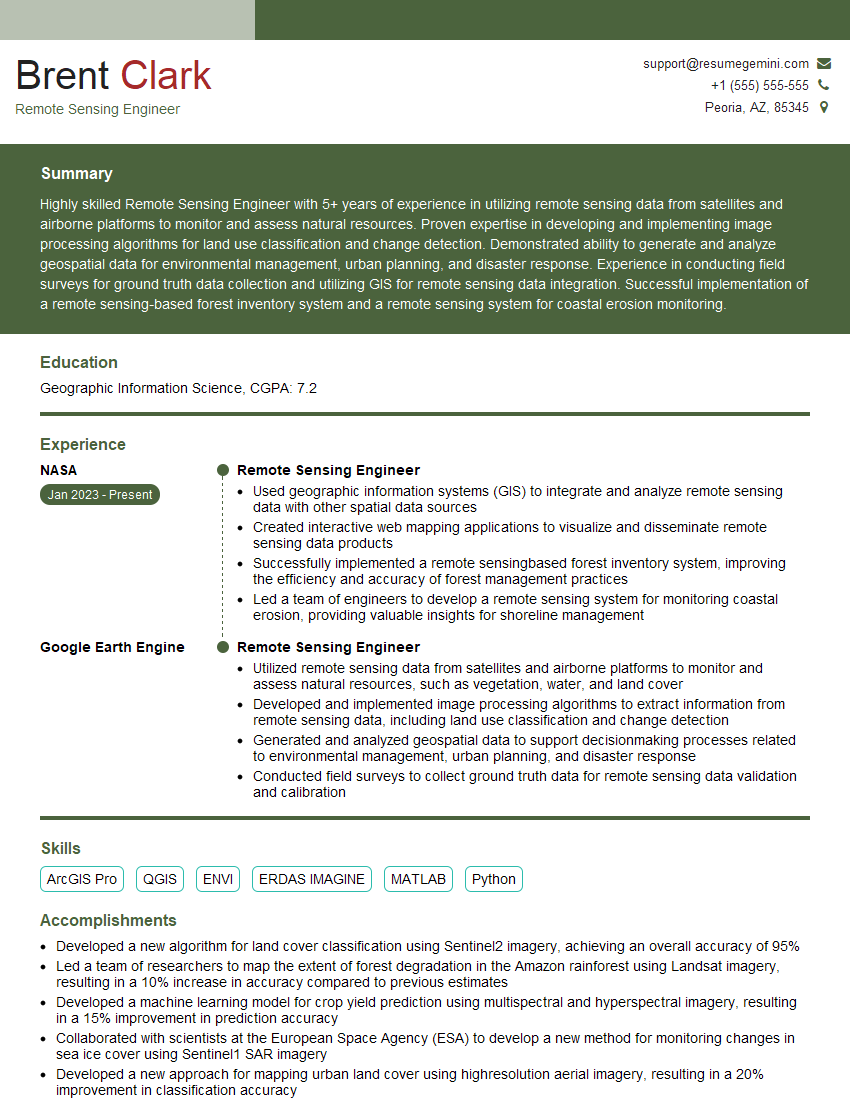
Mastering hyperspectral imagery opens doors to exciting and impactful careers in various high-tech sectors. To maximize your job prospects, creating a compelling and ATS-friendly resume is crucial. This is where ResumeGemini can be a valuable asset. ResumeGemini helps you craft a professional resume that highlights your skills and experience effectively, increasing your chances of landing your dream job. We provide examples of resumes tailored to the hyperspectral imagery field to guide you. Take the next step in your career journey – build a standout resume with ResumeGemini today!
Explore more articles
Users Rating of Our Blogs
Share Your Experience
We value your feedback! Please rate our content and share your thoughts (optional).
What Readers Say About Our Blog
To the interviewgemini.com Webmaster.
Very helpful and content specific questions to help prepare me for my interview!
Thank you
To the interviewgemini.com Webmaster.
This was kind of a unique content I found around the specialized skills. Very helpful questions and good detailed answers.
Very Helpful blog, thank you Interviewgemini team.