Cracking a skill-specific interview, like one for Inspection and Repair of Drywall Damage, requires understanding the nuances of the role. In this blog, we present the questions you’re most likely to encounter, along with insights into how to answer them effectively. Let’s ensure you’re ready to make a strong impression.
Questions Asked in Inspection and Repair of Drywall Damage Interview
Q 1. Describe your experience identifying different types of drywall damage.
Identifying drywall damage requires a keen eye and understanding of common issues. I start by visually inspecting the affected area, noting the type, size, and location of the damage. For instance, cracks can be categorized as hairline cracks (often from settling), larger stress cracks (indicating structural movement), or impact damage cracks (resulting from physical force). Holes can range from small punctures to significant breaches. Water damage manifests as discoloration, bubbling, or a soft, spongy texture. I also assess the surrounding area to identify potential underlying causes and the overall extent of the damage. For example, a seemingly minor crack might be a symptom of a larger foundation issue. My experience allows me to quickly differentiate between minor cosmetic problems and those that require more extensive repair or even structural evaluation.
- Hairline Cracks: Often cosmetic and repairable with spackle.
- Stress Cracks: Require investigation into the root cause, often structural movement.
- Impact Damage: Results from direct force and often needs patching or replacement.
- Water Damage: Requires careful assessment for mold and potential structural damage.
Q 2. Explain the process of assessing water damage to drywall.
Assessing water damage in drywall is crucial to prevent mold growth and structural problems. I begin with a thorough visual inspection, checking for discoloration (dark stains or water rings), bulging or softening of the drywall, and a musty odor. If discoloration is present, I carefully probe the affected area with a screwdriver to check for softness or hollowness indicating water absorption. Often, I’ll use a moisture meter to quantify the level of moisture within the drywall. Any moisture reading above 20% suggests significant water damage. Next, I determine the source of the water leak, which might necessitate the assistance of a plumber or other specialists. Once the source is identified and addressed, the damaged drywall needs to be removed and replaced, not just patched, to prevent future issues. I ensure proper drying and ventilation are implemented before any repairs begin.
Imagine finding a water-damaged section near a leaky pipe. Using a moisture meter, I find a reading of 35% in the drywall. This confirms significant water damage. I’ll then cut out the affected section, ensuring I remove the soaked material down to the studs, allowing for proper drying and remediation.
Q 3. How do you determine the extent of necessary drywall repairs?
Determining the extent of needed drywall repairs depends on several factors including the type and severity of the damage, the location of the damage, and the overall aesthetic goals. Minor cracks or small holes can often be repaired with spackling compound and sanding, while more extensive damage requires more significant intervention. For instance, a large hole might necessitate cutting out the damaged section, installing a backing, and then patching with drywall compound, followed by sanding and finishing. Water-damaged sections always require complete removal and replacement, regardless of apparent size. Large cracks may indicate structural issues that need professional assessment. I consider the cost and time implications of each repair method, weighing simple patching against potentially more complex and labor-intensive repairs.
For example, a small hole from a picture hook can be easily patched, while a large hole caused by a door swinging might require a complete piece of drywall to be replaced.
Q 4. What are the common causes of drywall cracks?
Drywall cracks have various causes, often stemming from movement or stress within the structure. Common causes include:
- Settling Foundation: The foundation settling unevenly puts stress on the walls, leading to cracks.
- Structural Movement: Shifting or settling of the house frame can also cause cracks, particularly in older houses.
- Poorly Installed Drywall: Incorrectly fastened or improperly taped drywall seams can lead to cracks later on.
- Impact Damage: Impact from furniture, doors, or other objects can create cracks or holes.
- Thermal Stress: Extreme temperature changes can expand and contract materials, causing stress cracks.
- Moisture Movement: Expansion and contraction of drywall due to moisture changes.
Identifying the root cause is crucial; simply patching a crack without addressing the underlying issue could lead to recurring problems.
Q 5. Describe your experience repairing holes in drywall.
My experience in repairing holes in drywall involves a methodical approach that prioritizes a strong, lasting repair. I begin by assessing the size and depth of the hole. Small holes can be filled directly with spackle or drywall compound. Larger holes require a more robust solution: I’ll often cut out a square or rectangular section around the hole, ensuring clean edges. A backing, such as a piece of wood or metal mesh, is then installed to provide support for the patch. I apply drywall compound in thin layers, allowing each layer to dry before adding more. Once completely dry, I sand the patched area smooth, ensuring a seamless transition with the surrounding drywall. Finally, I prime and paint to match the existing wall.
For example, a large hole from removing a built-in shelf might require this multi-step approach. Installing a piece of plywood behind the drywall repair will guarantee a durable patch that can handle future weight.
Q 6. What methods do you use to repair drywall seams?
Repairing drywall seams involves meticulously applying joint compound (also known as drywall mud) to ensure a smooth, invisible seam. I begin by ensuring the drywall sheets are properly aligned and fastened. I then apply the joint compound to the seam using a broad knife, creating a slightly feathered edge. The compound is allowed to dry completely before a second and potentially third coat is applied. Each layer is carefully feathered to blend seamlessly with the surrounding surface. After the final coat has dried, meticulous sanding is performed until the seam is completely smooth and even with the surrounding wall. The process is quite precise; avoiding too much compound to prevent cracks and ensuring sufficient coverage to prevent showing through are key to long-lasting repairs. This is followed by priming and painting to complete the repair.
Think of it like baking a cake – multiple thin layers produce a better, smoother finish than one thick layer.
Q 7. How do you prepare drywall surfaces for painting after repair?
Preparing drywall surfaces for painting after repair is crucial for a professional-looking finish. Once all repairs are complete and dry, I thoroughly sand the entire repaired area, using progressively finer grit sandpaper to create a smooth, even surface. Any remaining dust or debris is meticulously removed using a tack cloth or a damp sponge. The repaired area, and ideally the surrounding wall section, is then primed to provide a uniform surface for the paint to adhere to. Priming ensures better paint coverage and helps prevent the repaired areas from showing through. After the primer dries, the wall is ready for painting. The importance of proper preparation can’t be overstated; neglecting this can lead to imperfections and an unprofessional look, even with a high-quality paint.
Imagine a scenario where a newly-patched area sucks up paint unevenly. The careful prep of sanding and priming ensures that the paint goes on smoothly and the repaired area blends seamlessly with the rest of the wall.
Q 8. What tools and materials are essential for drywall repair?
Essential tools and materials for drywall repair depend on the extent of the damage, but a comprehensive kit should include:
- Hand tools: Utility knife, measuring tape, putty knife (various sizes), scraper, hammer, level.
- Power tools (optional but highly recommended for larger jobs): Drill, drywall saw, sanding tools (orbital sander or sanding block).
- Drywall materials: Drywall patches or sheets (matching the existing thickness and texture), drywall tape, joint compound (also known as mud), primer, paint (matching the existing wall color).
- Safety equipment: Safety glasses, dust mask (especially for sanding), work gloves.
For example, repairing a small hole only requires a putty knife, joint compound, and sandpaper. A larger hole, however, might need a drywall patch, and a significant amount of mudding and sanding.
Q 9. Describe your experience with different drywall textures.
My experience encompasses a wide range of drywall textures, from smooth to heavily textured. I’m familiar with various techniques used to create these textures, including:
- Smooth: This is the simplest texture, requiring minimal effort in repairs, mainly involving filling the damaged area and sanding it smooth.
- Orange peel: A common texture resembling the skin of an orange. Matching this requires careful application of the joint compound and the use of a knockdown knife or spray texture tool for a similar effect.
- Knockdown: This texture features peaks and valleys, created by applying a thicker coat of mud and then smoothing it with a knockdown knife. Repairing this requires attention to detail to replicate the height and spacing of the peaks and valleys.
- Popcorn/Acoustic: This older style texture requires specialized techniques and materials for repair, often involving applying a similar textured spray to the patched area.
Each texture presents unique challenges and demands specific approaches for seamless repairs. For instance, achieving a perfect match with a knockdown texture requires skill and practice in controlling the amount and application of the joint compound.
Q 10. How do you match existing drywall texture during repairs?
Matching existing drywall texture is crucial for a professional-looking repair. The process is highly dependent on the type of texture:
- Smooth: Simple sanding to achieve a seamless blend.
- Orange peel: Applying a thin coat of joint compound and using a specialized texture roller or spraying technique to replicate the texture.
- Knockdown: Applying joint compound, then using a knockdown knife to create peaks and valleys that mimic the existing texture. Practice is key to get the right consistency.
- Popcorn/Acoustic: This is the most challenging. Often, you need to carefully remove existing textured material adjacent to the damage and apply a new spray texture to the entire area for a consistent look. There are specialized spray cans or you might need to rent a texture sprayer.
In many cases, especially for textured walls, it’s better to work on a slightly larger area surrounding the damage to avoid creating a noticeable patch.
Q 11. Explain your process for repairing damaged drywall corners.
Repairing damaged drywall corners requires specialized techniques and materials. Corner bead is essential for strength and a clean finish.
- Assess the damage: Determine the extent of the damage and if the corner bead needs to be replaced.
- Prepare the area: Remove loose or damaged drywall, ensuring a clean and sound surface for repair.
- Install corner bead: Use appropriate corner bead (metal or plastic) and secure it with joint compound or screws, ensuring it’s perfectly aligned.
- Apply joint compound: Carefully apply multiple coats of joint compound over the corner bead, feathering the edges to blend seamlessly with the adjacent wall.
- Sand and prime: Sand the repaired area smooth, ensuring a consistent surface. Apply a coat of primer before painting.
Using a corner bead is vital for preventing future damage and maintaining the structural integrity of the corner. Improper installation of the corner bead will almost certainly result in future cracking.
Q 12. What are the safety precautions you take when performing drywall repairs?
Safety is paramount in drywall repair. My safety precautions include:
- Eye protection: Always wear safety glasses to protect against flying debris during sanding and cutting.
- Respiratory protection: A dust mask is essential, especially when sanding, to prevent inhaling fine drywall dust.
- Hand protection: Work gloves protect hands from cuts and abrasions caused by sharp tools and materials.
- Proper ventilation: Ensure adequate ventilation in the work area, especially when using spray texture or primers which may have fumes.
- Tool safety: Use tools according to manufacturer instructions and ensure they are in good working order. Always disconnect power tools before making adjustments.
Ignoring these precautions can lead to serious injuries. For example, inhaling drywall dust can cause respiratory problems, and eye injuries can result from flying debris during sanding.
Q 13. How do you handle drywall repairs in areas with existing mold?
Drywall repairs in areas with existing mold require a different approach, prioritizing safety and remediation. I would follow these steps:
- Safety First: Wear appropriate personal protective equipment (PPE), including an N95 respirator, gloves, and eye protection. Mold spores can be harmful to your health.
- Mold Remediation: Before starting any drywall repair, I would ensure the mold is properly remediated by a qualified professional. Simply patching over mold will only mask the problem, and future issues are guaranteed.
- Drywall Replacement: In most cases, damaged drywall affected by mold needs to be completely replaced, not just repaired. This helps eliminate the source of the mold problem.
- Proper Cleaning: After removal, the area needs thorough cleaning and disinfection to prevent mold regrowth.
- Repair and Prevention: Only after the mold remediation is complete would I begin the drywall repair, applying the same techniques as mentioned earlier, but with extra attention to preventing future mold growth.
Ignoring mold can lead to serious health issues. Professional mold remediation is always recommended before undertaking any repair work.
Q 14. What is your experience with drywall repairs in high-traffic areas?
High-traffic areas require extra durable repairs to withstand the constant wear and tear. My approach focuses on:
- Reinforcement: Using high-quality materials and ensuring a solid base before applying joint compound. This prevents cracking or damage that occurs in a high-traffic area.
- Careful Preparation: Thorough cleaning and preparation of the area to ensure the repair adheres well to the existing drywall.
- Multiple Coats: Applying multiple thin coats of joint compound instead of one thick coat increases the durability of the repair. This also leads to a smoother and more resistant surface.
- Durable Paint: Using a high-quality, durable paint that is resistant to scratches and scuffs. Consider using a semi-gloss or gloss finish which is easier to clean and more resilient than a flat finish.
For example, a repair in a hallway needs to be significantly more durable compared to a repair in a rarely used bedroom. I’d select different materials, apply additional reinforcement and choose the most durable paint finish depending on the location.
Q 15. Describe your experience with repairing fire-damaged drywall.
Repairing fire-damaged drywall is a specialized process requiring careful attention to safety and structural integrity. The extent of damage dictates the approach. Minor scorching might only need cleaning and repainting, but significant damage necessitates complete replacement. My experience involves assessing the damage—checking for weakened framing, smoke damage, and the presence of hazardous materials like asbestos. I always begin by ensuring the area is safe and properly ventilated. Then, I meticulously remove all compromised drywall, paying close attention to the edges to ensure a clean cut for the new drywall. This often involves using specialized tools to avoid further damage to the surrounding structure. Next, I inspect the framing for damage, replacing any charred or weakened members. Finally, I install new fire-rated drywall, using appropriate fasteners and ensuring proper joint taping and finishing for a seamless blend with the existing structure. For example, I once worked on a restaurant where a kitchen fire caused significant damage. We had to replace entire sections of wall, carefully managing the waste disposal to meet safety regulations for fire-damaged materials.
Career Expert Tips:
- Ace those interviews! Prepare effectively by reviewing the Top 50 Most Common Interview Questions on ResumeGemini.
- Navigate your job search with confidence! Explore a wide range of Career Tips on ResumeGemini. Learn about common challenges and recommendations to overcome them.
- Craft the perfect resume! Master the Art of Resume Writing with ResumeGemini’s guide. Showcase your unique qualifications and achievements effectively.
- Don’t miss out on holiday savings! Build your dream resume with ResumeGemini’s ATS optimized templates.
Q 16. How do you handle drywall repairs that involve asbestos abatement?
Handling asbestos-containing drywall requires strict adherence to safety regulations. Asbestos abatement is not something I perform myself; I’m a drywall professional, not an asbestos abatement specialist. When I encounter potentially asbestos-containing materials, my first step is to cease work immediately and contact a licensed and certified asbestos abatement contractor. I’ll fully cooperate with them, providing access and ensuring the area is properly secured according to their instructions. My role is to ensure the drywall is safely removed by the specialist and the area is properly cleaned before I begin the drywall repair. This is paramount to worker safety and regulatory compliance. For instance, I once encountered suspect material during a seemingly routine drywall repair in an older building. Immediately halting work and engaging an abatement specialist avoided potential health hazards and legal ramifications.
Q 17. How do you estimate the cost of drywall repair projects?
Estimating drywall repair costs involves a detailed assessment of the project’s scope. I typically begin with a thorough on-site inspection to determine the extent of damage. Factors influencing the cost include the area needing repair, type of drywall required (standard, moisture-resistant, fire-rated), material costs, labor hours, and any additional requirements like asbestos abatement. For example, a small hole repair might cost a few hundred dollars, including materials and labor. In contrast, a large-scale project involving extensive damage might cost thousands of dollars. I always provide a detailed breakdown of the estimate, specifying the individual components like material costs, labor charges, and any potential contingency for unforeseen issues. Transparent communication and clear pricing are key to building client trust.
Q 18. What is your experience with different types of drywall (e.g., moisture-resistant)?
I have extensive experience with various drywall types, including standard drywall, moisture-resistant drywall (MR drywall), and fire-resistant drywall (FR drywall). Each type has unique properties and applications. MR drywall is essential in bathrooms and kitchens to prevent moisture damage, while FR drywall is crucial in areas requiring fire protection. Selecting the correct type is fundamental to ensuring the project’s long-term success. For example, using standard drywall in a bathroom is a recipe for disaster, leading to mold growth and potential structural damage. My experience allows me to recommend and correctly install the appropriate type of drywall for each specific project’s needs.
Q 19. Explain the process for installing new drywall sections.
Installing new drywall sections is a precise process. I start by measuring and cutting the drywall to the exact size needed. Using a utility knife and a straight edge is essential for clean cuts. Then, I secure the drywall to the wall studs using appropriate screws, ensuring they’re evenly spaced and driven straight to avoid damage. The spacing depends on the type of drywall and the manufacturer’s recommendations. The screws need to be countersunk slightly below the surface to allow for joint compound application. After installation, I proceed to the taping and finishing stages, which are crucial for a smooth, seamless finish. Incorrect installation can lead to nail pops and poor adhesion, so precision is paramount. For instance, I recently installed new drywall sections in a basement renovation project, making sure to use moisture-resistant drywall and taking extra care with sealing all the joints.
Q 20. How do you ensure the repaired drywall is seamlessly integrated with the existing surface?
Seamless integration of repaired drywall with the existing surface is achieved through meticulous taping and finishing. I use joint compound (also known as mud) in multiple coats, carefully feathering the edges to blend seamlessly with the surrounding area. This process requires patience and attention to detail. Each coat is allowed to dry completely before applying the next, sanding to create a smooth surface between coats. After the final coat, I prime and paint the area, ensuring the repaired section blends perfectly with the existing wall. A properly executed repair is virtually invisible; the repaired section should have the same texture and color as the surrounding area. I use high-quality materials and specialized tools to ensure the best possible result. For example, I recently repaired a large section of damaged drywall in a living room, and after finishing, the repair was almost imperceptible.
Q 21. What are your methods for addressing nail pops in drywall?
Nail pops, where a nail head protrudes from the drywall surface, are common issues, often due to drywall movement or improper fastening. My approach starts with identifying the cause; is it movement in the framing, a poorly driven nail, or settling of the structure? I address the underlying cause before attempting repair. If it’s a loose nail, I carefully remove the nail, then re-secure the drywall using a new, properly sized screw. For more severe cases, I might use additional screws to add stability. After addressing the structural problem, I fill the hole with joint compound, allowing it to dry completely, sand it smooth, prime the area, and finally paint to match the surrounding area, ensuring the repair is invisible. Ignoring the underlying cause and just filling the hole is a temporary fix that often leads to recurrence of the problem. For example, in a recent project with recurring nail pops, I found the problem was inadequate framing support. Addressing this before repairing the drywall ensured a lasting solution.
Q 22. How do you diagnose and repair drywall damage caused by settling foundations?
Diagnosing and repairing drywall damage from settling foundations requires a methodical approach. First, I’d carefully inspect the affected areas, looking for consistent cracking patterns – often diagonal cracks radiating from corners or doors, or long, horizontal cracks along walls. These patterns are telltale signs of foundation movement. I’d then assess the severity of the damage; minor cracks might only require filling, while larger cracks may indicate more extensive structural issues requiring professional foundation repair before drywall work begins.
Repairing the drywall itself involves carefully removing loose or damaged sections of drywall. This often necessitates cutting back the cracked area beyond the visible damage to ensure a stable base for repair. I’d then clean the area, apply a bonding agent to improve adhesion, and fill the gaps with joint compound, feathering the edges to create a seamless transition. Finally, I’d sand and prime the repaired area before painting to match the existing wall.
For instance, I once worked on a house where settling had caused significant cracking around a doorway. After confirming the foundation was addressed by a structural engineer, I meticulously removed the damaged drywall, reinforced the area with appropriate backing, and rebuilt the section. The final result was a flawless repair, undetectable to the untrained eye.
Q 23. What is your experience with using joint compound?
My experience with joint compound is extensive, spanning many years and a wide variety of projects. I’m proficient in using different types of joint compound—from all-purpose compounds for general repairs to lightweight compounds for ceilings and areas requiring less weight. I understand the importance of applying the compound in thin coats to prevent cracking and ensure proper drying. I also know how to achieve a smooth, seamless finish through careful sanding and multiple coats, depending on the severity of the damage.
I’ve worked with both pre-mixed and powdered compounds, understanding the benefits and drawbacks of each. Pre-mixed compounds offer convenience but can sometimes have a shorter shelf life. Powdered compounds allow for better control over consistency but require more mixing. Knowing when to use each type is crucial for achieving the best results.
Q 24. Explain the importance of proper ventilation during drywall repair projects.
Proper ventilation is paramount during drywall repair, especially when using joint compound. Joint compound contains water, and inadequate ventilation can lead to slow drying, which can result in mold growth, cracking, and an uneven finish. Mold can be a serious health hazard, so preventing it is critical.
I always ensure adequate ventilation by opening windows and doors, or using exhaust fans to circulate air. This process helps the compound dry evenly and prevents trapped moisture. In larger projects, industrial-grade fans might be necessary. Ignoring this step can significantly impact the longevity and quality of the repair work, leading to costly rework.
Q 25. Describe your experience with using specialized tools for drywall repair (e.g., taping knives, mud pans).
I’m highly skilled in using specialized tools for drywall repair. My tool kit includes a variety of taping knives, from 2-inch to 12-inch blades, allowing me to work on different sized repairs with precision. I use mud pans to hold and easily access joint compound, which helps maintain a clean and organized workspace.
I understand the importance of using the right tool for the job; for example, narrower knives are better for initial taping, while wider knives are used for subsequent coats to achieve a smooth surface. I also frequently use sanding tools, from hand sanding blocks to electric sanders, to achieve a perfectly smooth finish without leaving visible sanding marks.
Q 26. How do you handle difficult or unusual drywall repair situations?
Handling difficult or unusual drywall repair situations requires creativity and problem-solving skills. For example, repairing damage caused by water leaks often involves removing damaged drywall sections, treating the underlying structure to prevent further damage, and potentially installing vapor barriers to prevent future moisture issues.
In cases involving significant damage, I may need to consult with structural engineers to ensure the repairs are structurally sound. I’ve had to improvise using various materials and techniques depending on the situation— from using mesh tape for added reinforcement in cracked areas to employing specialized primers for difficult surfaces.
One particularly challenging case involved repairing significant damage after a burst pipe. After mitigation and drying, I had to rebuild a large section of the wall, carefully matching the texture and paint to the existing wall. The end result was seamless and undetectable.
Q 27. Describe your experience working within a team on large drywall repair projects.
I have extensive experience working collaboratively on large drywall repair projects. Effective teamwork is essential in these scenarios; open communication, clear roles, and efficient coordination are key. I’m adept at working with other tradespeople, such as painters, electricians, and plumbers, to ensure a smooth and efficient workflow.
On large projects, we often utilize project management tools and strategies to track progress and ensure that tasks are completed on time and within budget. My focus is always on maintaining quality and consistency, even with large teams. I take pride in working effectively as part of a larger team.
Q 28. What are your strategies for maintaining efficiency and quality in drywall repair work?
Maintaining efficiency and quality in drywall repair involves a multi-pronged approach. First, proper planning and preparation are crucial; this includes accurate assessments of the damage, sourcing the right materials, and organizing the workspace effectively.
I emphasize using the appropriate tools for the job and optimizing workflows. I minimize wasted movement and prioritize careful work over speed. Regular quality checks throughout the process ensure that any mistakes are caught early, preventing more extensive rework. Finally, I proactively communicate with clients to manage expectations and address any concerns promptly, fostering trust and transparency.
Key Topics to Learn for Inspection and Repair of Drywall Damage Interview
- Types of Drywall Damage: Identifying different types of damage, such as cracks, holes, water damage, and impact damage. Understanding the causes behind each type is crucial.
- Inspection Techniques: Mastering visual inspection methods, using tools like moisture meters and stud finders to assess the extent of damage and potential structural issues. Practical application: Describing your systematic approach to a thorough inspection.
- Repair Methods: Knowing various repair techniques including patching, taping, mudding, sanding, and finishing. Understanding the appropriate method for different damage types.
- Material Selection: Choosing the right type of drywall, joint compound, and other materials for specific repairs. Knowing the properties and limitations of different products is essential.
- Safety Procedures: Highlighting safety protocols when handling tools, materials, and working at heights. This demonstrates responsibility and professionalism.
- Estimating and Costing: Developing the ability to accurately estimate the time and materials required for a repair job and providing a clear cost breakdown to clients.
- Troubleshooting: Demonstrating problem-solving skills, such as identifying and resolving unexpected issues during the repair process. Examples include dealing with uneven surfaces or hidden damage.
- Code Compliance: Familiarity with building codes and regulations related to drywall repairs, ensuring all work meets required standards.
Next Steps
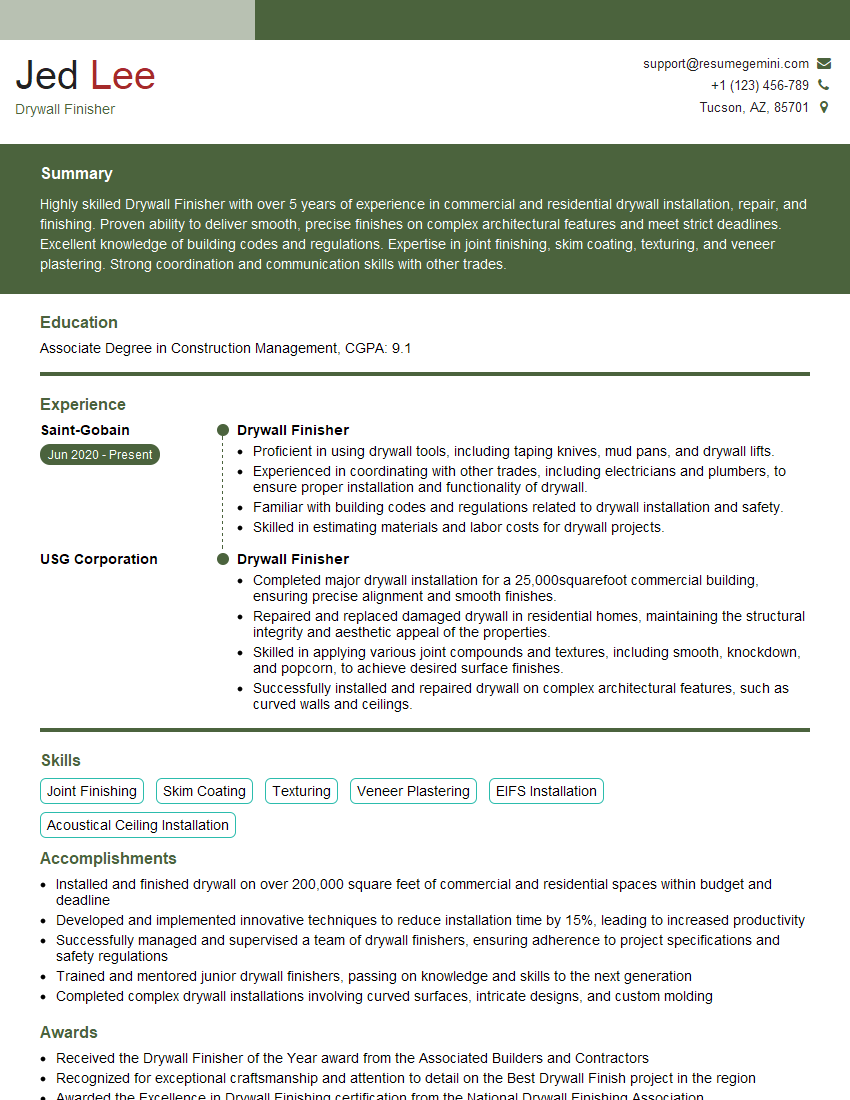
Mastering the inspection and repair of drywall damage opens doors to diverse opportunities within the construction and renovation industries, offering excellent career growth potential. A strong resume is your key to unlocking these opportunities. Creating an ATS-friendly resume is crucial for getting your application noticed. ResumeGemini is a trusted resource to help you build a professional and impactful resume that highlights your skills and experience effectively. Examples of resumes tailored to Inspection and Repair of Drywall Damage are available to guide you. Take the next step towards your dream career today!

Explore more articles
Users Rating of Our Blogs
Share Your Experience
We value your feedback! Please rate our content and share your thoughts (optional).
What Readers Say About Our Blog
To the interviewgemini.com Webmaster.
Very helpful and content specific questions to help prepare me for my interview!
Thank you
To the interviewgemini.com Webmaster.
This was kind of a unique content I found around the specialized skills. Very helpful questions and good detailed answers.
Very Helpful blog, thank you Interviewgemini team.