The thought of an interview can be nerve-wracking, but the right preparation can make all the difference. Explore this comprehensive guide to Installation of Cellular Antennas interview questions and gain the confidence you need to showcase your abilities and secure the role.
Questions Asked in Installation of Cellular Antennas Interview
Q 1. Explain the process of grounding a cellular antenna.
Grounding a cellular antenna is crucial for safety and optimal performance. It protects equipment and personnel from lightning strikes and prevents the build-up of static electricity, which can interfere with signal transmission. The process involves connecting the antenna’s ground terminal to a low-impedance earth ground using heavy-gauge copper wire. This ground connection should be as short and direct as possible to minimize resistance. Think of it like providing a safe path for electricity to escape to the earth rather than flowing through sensitive equipment.
Here’s a step-by-step guide:
- Identify the ground terminal: Locate the designated grounding point on the antenna and its mounting hardware. It’s often a threaded bolt or a specific terminal block.
- Run the ground wire: Use a suitable length of heavy-gauge (at least #6 AWG) bare copper wire. The wire should run directly to the ground, avoiding sharp bends.
- Connect to a ground rod: Drive a copper-clad ground rod at least 8 feet into the earth, ensuring good contact with the soil. Alternatively, connect to an existing building ground system if it meets the required impedance.
- Secure the connections: Use appropriate connectors (e.g., clamps, lugs) to create reliable and corrosion-resistant connections.
- Test the ground connection: Use a ground tester to verify the impedance of the ground connection. Ideally, the impedance should be less than 2 ohms.
Ignoring proper grounding can lead to equipment damage, signal degradation, and even serious injury.
Q 2. Describe different types of antenna mounts and their applications.
Antenna mounts play a vital role in determining antenna performance and longevity. The choice depends on the location, antenna type, and environmental conditions. Some common types include:
- Roof mounts: These are typically used for rooftop installations, offering good elevation and line-of-sight. They can range from simple brackets to more complex pole mounts, allowing for adjustments in tilt and azimuth.
- Wall mounts: Suitable for mounting antennas on buildings, offering a more discreet installation compared to rooftop mounts. They’re often simpler in design but need careful consideration for line-of-sight.
- Pole mounts: These are often utilized for tall antennas, allowing for increased height and range. They can be freestanding or mounted to existing structures and provide excellent adjustability.
- Tower mounts: Designed for installation on communication towers, offering substantial height and adaptability for complex antenna arrays. They are robust and designed to withstand harsh weather conditions.
- Hidden mounts: For aesthetics, some mounts allow for concealed placement within structures, often in attics or ceilings, albeit with potential for reduced signal strength.
For example, a remote cellular site might use a tower mount to maximize range, while a residential installation might utilize a simpler wall or roof mount.
Q 3. How do you ensure proper antenna alignment and optimization?
Proper antenna alignment and optimization are key to achieving optimal signal strength and quality. It involves accurately pointing the antenna toward the nearest cell tower and adjusting its tilt to account for terrain and tower height. Imagine a flashlight; you need to point it directly at the target to get the strongest beam.
The process typically involves:
- Identifying the cell tower: Use a signal-finding app or tower location map to pinpoint nearby cell towers.
- Using a signal meter or analyzer: These tools measure signal strength and quality, allowing for precise adjustments.
- Adjusting azimuth and tilt: Azimuth refers to the horizontal angle, while tilt is the vertical angle. These are adjusted using the antenna mount until maximum signal strength is achieved.
- Optimizing cable length and routing: Minimize cable losses by using high-quality coaxial cable and reducing its length. Proper cable routing is also important to prevent signal degradation.
- Using antenna modeling software: Sophisticated software can simulate signal propagation, aiding in predicting optimal antenna placement and alignment. This is particularly helpful in complex terrain.
Through iterative adjustments and monitoring, you refine the antenna’s position until the signal is maximized and performance is optimal.
Q 4. What safety procedures do you follow when working at heights?
Safety is paramount when working at heights during cellular antenna installations. Several measures are crucial:
- Fall protection: Always use appropriate fall protection equipment, including harnesses, lanyards, and anchor points. The safety of the person is the absolute priority and this should be the main focus.
- Proper training and certification: Only trained and certified personnel should work at heights, as it requires specialized knowledge and skills.
- Risk assessment: A thorough risk assessment should be performed before any work commences, identifying potential hazards and establishing control measures.
- Scaffolding or lifts: When possible, scaffolding or aerial lifts should be used instead of climbing directly on structures. If climbing is necessary, use appropriate climbing equipment.
- Weather conditions: Work should be halted if weather conditions (high winds, lightning, etc.) create unsafe conditions.
- Communication and observation: Maintain clear communication with ground crew and ensure a spotter is present when necessary.
- Personal Protective Equipment (PPE): Appropriate PPE should be worn at all times, including hard hats, safety glasses, and gloves.
Neglecting safety procedures can result in serious injuries or fatalities. Adhering to strict safety protocols should be the top priority in every high-altitude operation.
Q 5. What are the common causes of antenna signal interference?
Several factors can cause cellular antenna signal interference, reducing signal quality and strength. These can be categorized into environmental and man-made sources.
- Environmental factors: Heavy rain, snow, fog, and trees can absorb or scatter radio waves, attenuating the signal. Terrain features like hills and buildings can also block the signal.
- Man-made interference: Other electronic devices operating on similar frequencies can cause interference, including other wireless networks (Wi-Fi, Bluetooth), microwave ovens, and industrial equipment. Poorly grounded equipment or faulty cabling can also contribute to noise.
- Multipath fading: Radio waves reflecting off surfaces can create constructive and destructive interference, leading to signal fluctuations.
- Co-channel interference: Signals from different cell towers using the same frequency can overlap and cause interference. This is especially problematic in high-density areas.
For example, a strong microwave oven signal near an antenna can create significant interference, while heavy foliage can drastically reduce signal strength.
Q 6. How do you troubleshoot a weak cellular signal?
Troubleshooting a weak cellular signal requires a systematic approach, combining observation and testing.
- Check cable connections: Ensure that all cable connections between the antenna, the amplifier (if present), and the receiver are secure and properly terminated. Loose connections are a common culprit.
- Inspect antenna alignment: Verify the antenna is properly aligned with the cell tower using a signal meter or analyzer. Slight adjustments can sometimes make a significant difference.
- Examine the antenna itself: Check for physical damage to the antenna or its elements, which can impair its performance.
- Test the signal at different locations: If the problem is localized to a specific area, the issue might be related to the environment or obstacles obstructing the signal path.
- Check for interference: Identify and eliminate any potential sources of interference, such as other electronic devices or metal objects near the antenna.
- Consider signal amplification: If signal strength is consistently low, an amplifier might be necessary to boost the signal. But this must be properly integrated into the system.
- Analyze signal quality: Use a spectrum analyzer to check for noise or interference on the frequency used by the antenna. This helps pinpoint the type of signal degradation.
A methodical approach, beginning with simple checks and progressing to more advanced diagnostics, is essential in resolving weak cellular signal issues.
Q 7. Explain the difference between MIMO and SISO antenna systems.
MIMO (Multiple-Input Multiple-Output) and SISO (Single-Input Single-Output) are two fundamental antenna system architectures. The key difference lies in the number of antennas used for transmission and reception.
- SISO: A SISO system uses a single antenna for both transmission and reception. It’s simpler and less expensive but offers lower data rates and is more susceptible to signal degradation. Imagine talking on a single phone line; it’s simple but limited in capacity.
- MIMO: A MIMO system uses multiple antennas for both transmission and reception. This allows for higher data rates, improved signal quality, and increased range through spatial multiplexing and diversity techniques. It’s like having multiple phone lines simultaneously, enabling more efficient communication and resilience to interference.
MIMO systems, although more complex, are becoming increasingly prevalent in modern cellular networks due to their superior performance. The benefits of MIMO become increasingly noticeable in environments with high signal interference.
Q 8. What tools and equipment are essential for cellular antenna installation?
Cellular antenna installation requires a specialized toolkit. The essentials include tools for precise measurements and secure mounting, as well as testing equipment to verify performance.
- Measuring Tools: Tape measure, laser measure, level, angle finder – crucial for accurate positioning to maximize signal strength.
- Mounting Hardware: Various bolts, nuts, washers, and brackets specific to the antenna and mounting location (e.g., roof, tower, wall). This also includes specialized clamps and straps designed for different antenna types and materials.
- Hand Tools: Wrenches (various sizes), screwdrivers (Phillips and flathead), pliers, wire cutters/strippers, cable crimping tool – for assembling and securing connections.
- Safety Equipment: Hard hat, safety glasses, fall protection harness (for elevated installations), gloves (to prevent cuts and electrical shocks).
- Testing Equipment: Signal strength meter (power meter), spectrum analyzer (to identify interference), and a TDR (Time Domain Reflectometer) to check for cable faults.
- Communication Tools: Two-way radio or mobile phones for efficient communication among team members, especially during tower climbs.
For example, when mounting a panel antenna on a rooftop, precision laser measurement ensures proper alignment for optimal signal reception, while a level ensures the antenna is perfectly horizontal.
Q 9. Describe your experience with different antenna types (e.g., panel, omni-directional).
I have extensive experience installing various antenna types, each suited to different coverage needs.
- Omni-directional antennas: These radiate signals equally in all directions, ideal for providing coverage in a 360-degree radius. They are commonly used in situations where consistent coverage is needed across a wide area. I’ve used these in numerous projects, including deployments in rural areas with dispersed populations.
- Panel antennas: These antennas focus the signal in a specific direction, resulting in higher gain and longer range. They are commonly used in point-to-point applications or where signal needs to travel a significant distance. A recent project involved installing a high-gain panel antenna for a backhaul link between two cell towers, significantly improving data throughput.
- Sector antennas: These provide directional coverage within a specific sector (e.g., 60, 90, or 120 degrees). Ideal for covering areas where broader coverage isn’t necessary; for instance, in urban environments, these antennas are frequently deployed to target specific streets or neighborhoods.
The choice of antenna type depends heavily on the site survey data, which determines the optimal antenna placement and configuration for optimal coverage.
Q 10. How do you interpret antenna specifications (e.g., gain, beamwidth)?
Understanding antenna specifications is critical for successful installation.
- Gain (dBi): This indicates how effectively the antenna amplifies the signal. Higher gain means a stronger signal in the desired direction, but usually with a narrower beamwidth. For example, a 15dBi antenna will transmit a stronger signal than a 10dBi antenna.
- Beamwidth: This refers to the angle within which the antenna radiates its signal effectively. A narrower beamwidth (e.g., 30 degrees) provides greater signal strength in that direction, while a wider beamwidth (e.g., 90 degrees) offers broader coverage but lower gain. Imagine a spotlight (narrow beamwidth) versus a floodlight (wide beamwidth).
- Frequency Range: The frequency range (e.g., 700 MHz – 2700 MHz) specifies the frequencies the antenna can effectively transmit and receive. It’s crucial to match the antenna to the frequencies used by the cellular system.
- VSWR (Voltage Standing Wave Ratio): This indicates the impedance matching between the antenna and the transmission line. A low VSWR is desired (ideally close to 1:1) for efficient signal transmission. A high VSWR indicates impedance mismatch, leading to signal loss and potential damage to equipment.
Misinterpreting these specifications could result in suboptimal coverage or signal quality; consequently, meticulous attention to detail is vital.
Q 11. What safety regulations must be followed during antenna installation?
Safety is paramount in antenna installations. Strict adherence to regulations is non-negotiable.
- OSHA Regulations (or equivalent local regulations): These address fall protection, electrical safety, working at heights, and proper use of personal protective equipment (PPE).
- RF Safety: Exposure to radio frequencies must be kept below permissible limits. This involves understanding the antenna’s power output and maintaining safe distances during operation.
- Local Building Codes: Antenna installations must comply with local building codes and zoning regulations, regarding height restrictions, structural integrity, and visual impact.
- Permitting: Obtaining necessary permits from local authorities prior to commencing any work is mandatory.
For instance, tower climbs require thorough pre-job planning and briefing, the use of harnesses and other fall arrest systems, and constant communication between team members. We always have a spotter at ground level, ensuring the safety of the climber. I’ve personally been involved in numerous training sessions to reinforce these procedures.
Q 12. Explain the importance of proper cable management in antenna installations.
Proper cable management is vital for optimal antenna performance and system longevity.
- Signal Loss Reduction: Properly routed and secured cables minimize signal loss caused by bending, kinking, or external interference. Signal loss translates into reduced coverage and degraded signal quality.
- Water Ingress Prevention: Using appropriate cable sealing and weatherproofing techniques prevents water from entering the cable connections, protecting the equipment from damage.
- Physical Protection: Proper cable management safeguards cables from physical damage, such as abrasion or crushing. This is especially crucial in outdoor installations where cables may be exposed to the elements.
- Improved Aesthetics: Neatly organized cables enhance the overall aesthetic appearance of the installation, which can be particularly important in public spaces.
I always use cable ties, strain reliefs, and conduit where appropriate to secure cables, preventing damage and ensuring a professional installation. In one instance, a client specifically praised the neatness of our cable management, highlighting its impact on their overall system aesthetics.
Q 13. How do you test the performance of a newly installed antenna?
Testing ensures the newly installed antenna performs as expected.
- Signal Strength Measurement: A signal strength meter measures the received signal power at various locations within the coverage area. This verifies the antenna is providing adequate signal strength.
- Spectrum Analysis: A spectrum analyzer identifies any interference from other sources that might impact the performance of the newly installed antenna. This helps to identify and resolve potential signal degradation.
- Return Loss Measurement: This measures the amount of signal reflected back to the transmitter due to impedance mismatch. High return loss indicates poor impedance matching, hence inefficient signal transmission.
- VSWR (Voltage Standing Wave Ratio): Measured using a VSWR meter to assess impedance matching, as explained previously.
This step is crucial because, without testing, you can’t confirm the system is performing optimally. A recent project required multiple tests and adjustments to the antenna placement to achieve the required coverage area.
Q 14. Describe your experience with different types of coaxial cables.
Experience with different coaxial cables is crucial for optimizing performance and reliability. The choice depends on frequency, impedance, and environmental conditions.
- LMR-400: A low-loss cable suitable for higher frequencies and longer runs. Its superior performance helps reduce signal loss over long distances.
- LMR-240: Offers a good balance of performance and cost-effectiveness. I often use it for installations with moderate distance requirements.
- RG-58: A more cost-effective option, typically used for shorter runs. However, it exhibits higher signal loss at higher frequencies.
- Belden Cables: I frequently use Belden cables; they are known for their high quality and reliability. Specific Belden cable choices depend on the application requirements.
Choosing the wrong cable can lead to significant signal loss. For instance, using RG-58 for a long run of a 2.4 GHz antenna would result in significant signal degradation, while LMR-400 will provide better performance in the same scenario.
Q 15. What are the common challenges faced during cellular antenna installation?
Cellular antenna installation presents a unique set of challenges, often stemming from the interplay of environmental factors, technical complexities, and regulatory requirements. These challenges can be broadly categorized into logistical, technical, and environmental hurdles.
- Logistical Challenges: These include issues like access to the installation site (e.g., navigating difficult terrain, obtaining necessary permits), coordinating with other contractors working on the site, and managing equipment transport and storage. For instance, I once faced significant delays getting access to a rooftop site due to unexpected building maintenance.
- Technical Challenges: These encompass antenna alignment and optimization for optimal signal strength and coverage, dealing with RF interference from other sources (other antennas, electrical equipment), and ensuring the structural integrity of the antenna mount. Incorrect alignment, for example, can lead to significantly reduced signal quality, necessitating adjustments.
- Environmental Challenges: Weather conditions (extreme heat, cold, wind, rain, ice) can significantly impact installation efficiency and safety. I remember an installation being delayed for a week due to a severe storm that made accessing the tower unsafe.
Successfully navigating these challenges requires meticulous planning, a flexible approach, and a solid understanding of both the technical specifications and the site-specific conditions.
Career Expert Tips:
- Ace those interviews! Prepare effectively by reviewing the Top 50 Most Common Interview Questions on ResumeGemini.
- Navigate your job search with confidence! Explore a wide range of Career Tips on ResumeGemini. Learn about common challenges and recommendations to overcome them.
- Craft the perfect resume! Master the Art of Resume Writing with ResumeGemini’s guide. Showcase your unique qualifications and achievements effectively.
- Don’t miss out on holiday savings! Build your dream resume with ResumeGemini’s ATS optimized templates.
Q 16. How do you handle unexpected problems during an installation?
Unexpected problems are an inherent part of field work. My approach involves a methodical, problem-solving strategy focused on safety and effective resolution.
- Safety First: If the problem compromises safety, I immediately halt the work and re-evaluate the situation. This might involve contacting the relevant safety personnel or obtaining additional safety equipment.
- Assessment and Diagnosis: I thoroughly assess the problem to understand its root cause. This involves careful inspection, checking connection points, and verifying equipment functionality. I’ll often use diagnostic tools like a spectrum analyzer or network analyzer to pinpoint the issue.
- Problem Solving and Mitigation: Based on the diagnosis, I formulate a solution. This could involve troubleshooting a faulty cable, making adjustments to antenna alignment, or even calling in specialist support if needed. Documenting all steps is crucial.
- Communication: Maintaining clear and consistent communication with supervisors, clients, and other stakeholders is vital. I inform them of the issue, the proposed solution, and the expected timeline for resolution.
- Documentation: I meticulously document the unexpected problem, the steps taken to resolve it, and the outcome. This documentation serves as a record for future reference and helps in identifying trends or potential issues that might arise in subsequent installations.
For example, I once encountered unexpected high RF interference during a cell site build. Using my spectrum analyzer, I identified the source as a nearby microwave link. We worked collaboratively with the microwave link owner to mitigate the interference, successfully resolving the issue and ensuring signal quality.
Q 17. What is your experience with working on different types of towers?
My experience encompasses a wide range of tower types, including self-supporting towers (monopole, lattice), guyed towers, and building-mounted antennas. Each tower type presents unique challenges and requires specific installation techniques.
- Self-Supporting Towers: These towers are freestanding and require robust foundations and careful consideration of wind loading. Working at heights on these towers necessitates adhering to strict safety procedures and employing appropriate climbing and fall protection gear.
- Guyed Towers: These towers are supported by guy wires, adding complexity to the installation process. The guy wires need to be properly tensioned and secured to ensure stability. The installation process also requires extra care to avoid damaging the guy wires during antenna mounting.
- Building-Mounted Antennas: These installations often involve working on rooftops or in confined spaces, requiring specialized access equipment and adherence to building codes and safety regulations. Navigating the structural complexities of a building and ensuring secure mounting presents its unique set of challenges.
My expertise extends to all these types, enabling me to adapt my approach to different environments and tower configurations. Safety is my paramount concern regardless of the tower type.
Q 18. Explain your understanding of RF safety regulations.
RF safety regulations are crucial for protecting both installers and the public from the potential hazards of radio frequency radiation. My understanding encompasses several key areas:
- Exposure Limits: I’m familiar with the established exposure limits defined by organizations like the FCC (Federal Communications Commission) in the US or equivalent bodies in other countries. These limits specify the maximum permissible levels of RF radiation exposure over different time periods.
- Safety Procedures: I am proficient in implementing appropriate safety procedures during installation, including wearing personal protective equipment (PPE) like RF protective clothing where necessary and using RF measurement tools to monitor exposure levels. This includes understanding the safe distances to maintain during operation.
- Site Surveys and Risk Assessments: Before commencing any installation, I perform thorough site surveys and risk assessments to identify potential RF hazards and determine the necessary safety precautions. This includes understanding the power levels of the antennas.
- Documentation: All RF safety measures taken are meticulously documented as part of the installation process to ensure compliance with regulations and company policies. This might include calibration logs of measurement equipment and exposure level records.
Ignoring RF safety regulations can result in serious health consequences and legal liabilities. Therefore, safety is always my top priority during antenna installations.
Q 19. Describe your experience with using test equipment (e.g., spectrum analyzer).
I have extensive experience using various test equipment, including spectrum analyzers, signal generators, and power meters, to ensure optimal antenna performance and compliance with RF standards.
- Spectrum Analyzer: I use a spectrum analyzer to identify and quantify RF interference, measure the antenna’s frequency response, and verify that it operates within its allocated frequency band. This helps pinpoint sources of interference and determine the effectiveness of mitigation strategies.
- Signal Generator: A signal generator allows me to inject known signals into the antenna system to test its performance and linearity. This helps in verifying proper signal transmission and reception.
- Power Meter: Power meters are used to accurately measure the power output of the antennas, ensuring it aligns with the specifications and regulatory limits. This is a critical aspect of ensuring compliance and safety.
I regularly calibrate my test equipment to maintain accuracy and reliability of measurements. My proficiency in using this equipment is integral to ensuring quality installations and optimal antenna performance.
Q 20. How do you document the installation process?
Detailed documentation is essential for ensuring accountability, facilitating troubleshooting, and maintaining a history of the installation. My documentation process includes:
- Pre-Installation Documentation: This includes site survey reports, engineering drawings, equipment lists, and safety plans.
- Installation Documentation: This comprises detailed logs of all installation steps, equipment used, measurements taken (including RF levels), photographs, and any unexpected issues encountered and how they were resolved.
- Post-Installation Documentation: This consists of test results, antenna alignment data, as-built drawings, and a final report that summarizes the installation process and its results.
- Digital Record-Keeping: I utilize digital platforms and cloud storage to store and organize all documentation for easy access and retrieval. This ensures data integrity and longevity.
The comprehensive nature of my documentation provides a clear and complete record of the installation, which is valuable for future maintenance, troubleshooting, and regulatory compliance.
Q 21. What is your experience with site surveys for antenna placement?
Site surveys are crucial for determining the optimal location and orientation of cellular antennas to maximize coverage and minimize interference. My experience in conducting site surveys involves:
- Preliminary Site Assessment: This initial step involves reviewing maps, aerial imagery, and existing site information to gather preliminary data. I check for potential obstructions and analyze the surrounding environment.
- On-site Measurements: I perform on-site measurements using specialized equipment, including signal strength meters, spectrum analyzers, and RF propagation modeling software. This data helps determine the best antenna placement and orientation.
- Obstruction Analysis: I meticulously identify and analyze potential obstructions, such as buildings, trees, and hills, which can affect signal propagation. I assess their impact on signal strength and coverage.
- Regulatory Compliance: I ensure compliance with all relevant zoning regulations, building codes, and RF safety guidelines throughout the survey process.
- Reporting: The survey culminates in a comprehensive report that includes recommendations for antenna placement, equipment specifications, and any required structural modifications.
A well-executed site survey minimizes installation challenges, ensures optimal network performance, and reduces the likelihood of needing costly re-work later. For instance, a thorough site survey can prevent overlooking a significant obstruction, which would severely impact signal quality after installation.
Q 22. Explain your understanding of different frequency bands used in cellular networks.
Cellular networks utilize various frequency bands, each with its own characteristics affecting signal propagation and data capacity. Think of it like different lanes on a highway – each lane (frequency band) can handle a certain amount of traffic (data). Lower frequency bands, such as 700 MHz and 850 MHz, offer better coverage but lower data speeds. They’re like the wide, slow lanes of the highway, capable of reaching far distances but not handling much traffic at once. Higher frequency bands, like 3.5 GHz and above (including millimeter wave), provide much higher data speeds but have significantly shorter ranges and are more susceptible to obstacles like buildings and foliage. These are the fast lanes of the highway, handling lots of traffic, but shorter journeys. The choice of frequency band for a particular antenna deployment depends on the intended coverage area, desired data rates, and the overall network architecture. For example, a rural area might benefit from a 700 MHz deployment for wide coverage, while a dense urban area would utilize higher frequency bands for faster data in smaller areas.
- Low-band (700 MHz – 900 MHz): Excellent coverage, lower data speeds
- Mid-band (1.4 GHz – 2.6 GHz): Good balance of coverage and speed
- High-band (3.5 GHz and above): High data speeds, limited coverage
Q 23. How do you ensure compliance with building codes and regulations during installation?
Compliance with building codes and regulations is paramount during cellular antenna installations. This involves several key steps. First, I always thoroughly review local zoning ordinances and building codes, often obtaining permits well in advance. This ensures we’re installing the antenna in a legally permissible location and that it meets all height restrictions, setback requirements, and structural load specifications. Secondly, before any installation begins, I conduct a thorough site survey to identify potential conflicts with other structures or utilities. This often involves coordination with utility companies to avoid damage to underground lines and ensure safe working practices. Finally, throughout the installation process, I meticulously document every step, from initial site assessment to final testing and commissioning. This ensures compliance, but also serves as a valuable reference for future maintenance and upgrades. I also ensure all antenna installations adhere to safety standards, properly grounding equipment and using appropriate safety gear.
For example, I once had to adjust a planned antenna installation due to an unexpected underground gas line. A quick survey revealed the pipe’s location, and we adjusted the planned mounting position to ensure safe clearance. This careful approach prevented potential accidents and ensured compliance with local safety regulations.
Q 24. What is your experience with working on both macro and small cell deployments?
My experience encompasses both macro and small cell deployments. Macro cells are the traditional large-scale cell sites that provide broad coverage, often found on tall towers or rooftops. I’ve been involved in numerous projects, from the initial site survey and RF planning to the physical installation of the antennas, microwave links, and associated equipment. Small cell deployments, on the other hand, focus on smaller, localized coverage areas, typically deployed on streetlights, buildings, or utility poles. They’re crucial for increasing network capacity in high-density areas. Here, the focus is often on discreet installation, maintaining aesthetic appeal, and optimizing performance within a limited space. I have practical experience in installing various small cell types, including those integrated into existing infrastructure, such as lampposts, or more stand-alone deployments. This includes proper grounding, cabling, and integration with backhaul networks.
A recent project involved installing a series of small cells along a busy downtown street to improve 5G coverage. The challenge was integrating the small cells seamlessly into the existing urban landscape while maintaining high performance and minimal visual impact.
Q 25. Describe your familiarity with various antenna connectors and their applications.
My familiarity with antenna connectors is extensive. They’re the vital link between the antenna and the rest of the cellular network. I frequently work with N-type, TNC, and SMA connectors, each with its own characteristics and applications. N-type connectors are robust and commonly used for high-power applications in macro cell deployments. They’re reliable and designed for use in challenging environments. TNC connectors offer a twist-on design that’s quicker to connect and disconnect compared to N-type connectors. They are a good choice for applications requiring frequent connections and disconnections, often in lower-power scenarios. SMA connectors are smaller and more compact, frequently used in small cell deployments where space is at a premium. They are also suitable for higher frequency applications.
Choosing the right connector is critical. Using an incorrect connector can lead to signal loss, impedance mismatch, and ultimately, poor network performance. For example, using an SMA connector where an N-type is required would lead to a poor connection due to impedance mismatch.
Q 26. How do you manage your time effectively during multiple installations?
Managing time effectively during multiple installations requires meticulous planning and prioritization. I use project management tools to track tasks, deadlines, and resources across multiple sites. This involves carefully scheduling site visits, coordinating with various stakeholders, and optimizing the installation process to minimize downtime. Prioritization is key – focusing on the most critical installations first, or those with the tightest deadlines, ensuring a smooth workflow. Regular communication with clients and teams is vital to manage expectations and address any unforeseen challenges promptly. I also build in buffer time for unforeseen delays, which often occur in the field. Finally, I leverage technology to improve efficiency, using tools for remote monitoring and diagnostics to track progress and identify potential problems early.
In one instance, I managed three simultaneous small cell installations across a city. Through careful planning and communication, I completed all installations ahead of schedule, preventing delays in service launch.
Q 27. What are your strengths and weaknesses related to cellular antenna installation?
My strengths lie in my problem-solving skills, attention to detail, and ability to adapt to diverse situations. I have a knack for troubleshooting complex technical issues and finding efficient solutions. My methodical approach ensures compliance with all regulations and safety standards. I can quickly learn and adapt to new technologies and equipment. However, a potential area for improvement is delegation. As a senior installer, I often find myself handling tasks myself that could be delegated to others with proper training and guidance. I am actively working on improving my delegation skills to create more efficient and scalable operations within a team.
Key Topics to Learn for Installation of Cellular Antennas Interview
- Site Survey and Planning: Understanding site requirements, RF propagation principles, and regulatory compliance (e.g., zoning, building codes).
- Antenna Selection and Mounting: Choosing appropriate antenna types based on frequency, gain, and polarization; understanding various mounting techniques (rooftop, tower, wall).
- RF Cable and Connectorization: Proper cable selection, termination, and testing to minimize signal loss and ensure optimal performance; understanding impedance matching.
- Grounding and Lightning Protection: Implementing effective grounding systems to protect equipment and personnel from lightning strikes and electrical surges.
- Testing and Commissioning: Utilizing test equipment (e.g., spectrum analyzers, signal generators) to verify antenna performance, signal strength, and quality; troubleshooting installation issues.
- Safety Procedures and Regulations: Adhering to safety protocols during installation, working at heights, and handling potentially hazardous materials.
- Documentation and Reporting: Maintaining accurate records of the installation process, including diagrams, test results, and completion reports.
- Troubleshooting and Problem-Solving: Identifying and resolving common antenna installation problems, such as poor signal quality, interference, and equipment malfunctions.
- Different Antenna Technologies: Understanding the characteristics and applications of various antenna types (e.g., panel antennas, directional antennas, omni-directional antennas).
Next Steps
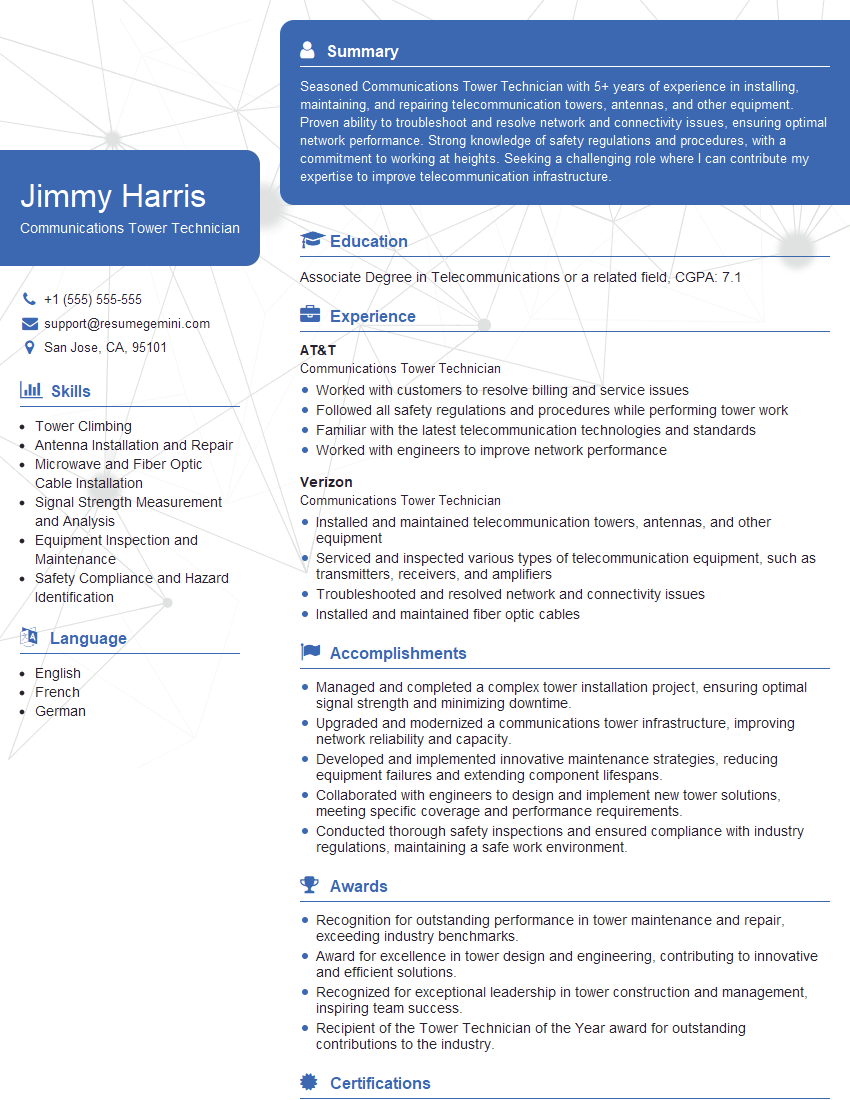
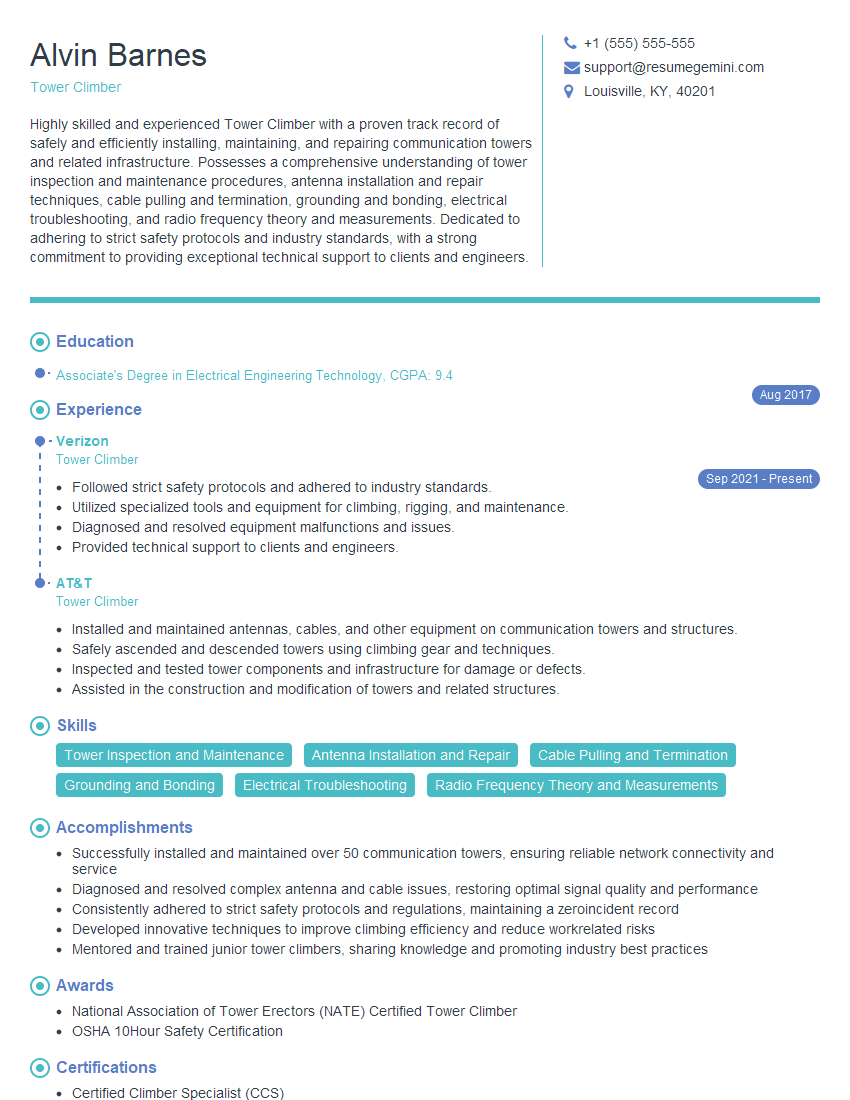
Mastering the installation of cellular antennas opens doors to exciting career opportunities in a rapidly growing field. Demonstrating your expertise through a strong resume is crucial for securing your dream job. Building an ATS-friendly resume significantly increases your chances of getting noticed by recruiters. We highly recommend using ResumeGemini to create a professional and impactful resume that highlights your skills and experience effectively. ResumeGemini provides examples of resumes tailored to Installation of Cellular Antennas, giving you a head start in crafting the perfect application.
Explore more articles
Users Rating of Our Blogs
Share Your Experience
We value your feedback! Please rate our content and share your thoughts (optional).
What Readers Say About Our Blog
To the interviewgemini.com Webmaster.
Very helpful and content specific questions to help prepare me for my interview!
Thank you
To the interviewgemini.com Webmaster.
This was kind of a unique content I found around the specialized skills. Very helpful questions and good detailed answers.
Very Helpful blog, thank you Interviewgemini team.