Interviews are more than just a Q&A session—they’re a chance to prove your worth. This blog dives into essential Installation of Drywall Ceilings interview questions and expert tips to help you align your answers with what hiring managers are looking for. Start preparing to shine!
Questions Asked in Installation of Drywall Ceilings Interview
Q 1. What types of drywall are commonly used for ceilings?
For ceilings, we typically use drywall specifically designed for its purpose. The most common type is 1/2-inch thick, but you might also see 5/8-inch for added sound dampening or where greater strength is needed, such as in areas with heavy HVAC systems. The type of drywall chosen often depends on the overall project requirements, budget and the desired finished look. For instance, moisture-resistant drywall (greenboard) would be the preferable choice in bathrooms or kitchens to prevent water damage. Standard drywall (usually white) is suitable for most other ceiling applications. Choosing the right drywall is a crucial first step towards a successful installation.
Q 2. Explain the process of installing drywall on a ceiling.
Ceiling drywall installation is a multi-step process requiring precision and teamwork. First, we carefully measure and cut the drywall sheets to fit the ceiling’s dimensions, leaving a little extra for trimming. Next, we lift the sheets into position, ensuring they are properly aligned with the ceiling joists. This is often a two-person job, especially for larger sheets. We secure the drywall to the joists using drywall screws, spaced appropriately. Once all the sheets are in place, we move onto the crucial stages of taping and mudding. Throughout the process, we always maintain a clean workspace to avoid damaging the finished product. Think of it like building a puzzle, but with precise measurements and careful handling.
Q 3. Describe different methods for fastening drywall to ceiling joists.
There are primarily two methods: screwing and nailing. Screwing is the preferred method because it offers a stronger, more secure hold and less risk of damaging the drywall. Drywall screws are self-tapping, designed to penetrate both the drywall and the wood of the ceiling joists effectively. Nailing, while faster in some instances, is generally avoided for ceilings because it can create a more brittle attachment point, leading to potential cracking or sagging over time. The screws are driven at an angle to better grip the joists and avoid creating pop-outs. Proper spacing of fasteners is crucial to prevent cracking – a general rule of thumb is to place screws every 6 to 8 inches along the edges and every 12 to 16 inches in between.
Q 4. How do you ensure proper alignment and levelness of drywall ceilings?
Achieving a perfectly level and aligned drywall ceiling requires careful planning and execution. We start by ensuring that the ceiling joists are themselves level. Any significant discrepancies need to be addressed before installing the drywall. During installation, we use a level to ensure each sheet is perfectly aligned. A laser level is a particularly helpful tool for large ceilings. For alignment, we typically start with a key sheet near a prominent reference point (a wall, corner etc.) ensuring it is perfectly aligned and level. Subsequent sheets are carefully matched to the first, maintaining consistent alignment across the whole ceiling. Any minor inconsistencies are addressed through careful trimming and filling during the mudding process.
Q 5. What tools and equipment are essential for drywall ceiling installation?
The tools needed for drywall ceiling installation are quite specific: A measuring tape and level (laser level is preferred), utility knife for cutting the drywall, a drywall square for accurate cuts, drywall screws (with a suitable drill bit), a drill (preferably cordless for mobility), a screwdriver (for smaller areas or manual screwing), a joint knife (for taping and mudding), a taping knife, mud pans, and finally a putty knife for finishing. Safety glasses and gloves are also crucial for protecting against debris and sharp objects. We must remember safety is always paramount.
Q 6. How do you handle uneven ceilings or difficult angles?
Uneven ceilings or angles require more skillful techniques. For uneven ceilings, we often use shims to create a level surface before installing the drywall. This ensures the drywall sits flush against the ceiling. For difficult angles or curved ceilings, we pre-cut the drywall sheets to match the desired shape, often creating templates to ensure accuracy. This may involve using a jigsaw or specialized tools for more intricate curves. Using flexible drywall can also be helpful in some circumstances. In cases of significant unevenness, we may even consider installing furring strips to create a more level base for the drywall. Patience and attention to detail are key to overcoming these challenges.
Q 7. Explain the process of taping and mudding drywall joints on ceilings.
Taping and mudding are crucial for achieving a smooth, seamless ceiling. We begin by applying drywall tape over all the seams and corners using a taping knife. Then, we apply thin layers of joint compound (mud) over the tape, feathering the edges to blend smoothly with the surrounding drywall. This process typically involves multiple coats, allowing each coat to dry completely before applying the next. Each coat is progressively wider, gradually blending the tape into the surface. We use different sized knives for applying the mud; larger knives for wider coverage and smaller knives for detail work. This is a time-consuming process requiring patience and precision. Once completely dry, sanding smooths out the surface, leaving the ceiling perfectly ready for painting. Think of it as sculpting the ceiling to perfection.
Q 8. Describe the different types of joint compound used for drywall finishing.
Joint compound, also known as drywall mud, comes in several types, each suited for different stages of drywall finishing. The most common are:
- All-Purpose Compound: This is a versatile option suitable for most applications, including taping, topping, and finishing. It offers a good balance of working time and drying speed.
- Lightweight Compound: Lighter than all-purpose compound, it’s easier to apply, especially on larger areas, reducing arm fatigue. It’s excellent for ceilings due to its reduced weight and is often used for the initial taping coats.
- Setting-Type Compound: This compound sets up quickly, allowing for faster finishing times. It’s ideal for repairs or situations where rapid drying is necessary. However, it requires a faster work pace as it dries quicker.
- Topping Compound: This is a fine-grade compound designed for the final coat. It produces a very smooth, easily sanded surface, resulting in a flawless finish. Its smooth consistency allows for minimal sanding effort.
Choosing the right compound depends on the project’s scope and your desired outcome. For instance, a large ceiling project might benefit from the ease of application provided by lightweight compound initially, followed by a topping compound for the final finish.
Q 9. How do you achieve a smooth, seamless finish on a drywall ceiling?
Achieving a smooth, seamless finish on a drywall ceiling requires meticulous attention to detail and a systematic approach. It’s a multi-step process, not a single action.
- Proper Taping: Use high-quality drywall tape and embed it perfectly into the joint compound, ensuring no air bubbles are trapped. Multiple thin coats are far better than one thick coat.
- Careful Feathering: Each coat of compound needs to be feathered out smoothly, blending seamlessly with the surrounding drywall. This prevents ridges and ensures a consistent surface.
- Multiple Coats: Apply several thin coats of compound, allowing each to dry completely before applying the next. This prevents cracking and ensures a perfectly flat surface. The last coat is crucial and should be a topping compound for a smooth final finish.
- Proper Sanding: Once the final coat is dry, sand the ceiling thoroughly using fine-grit sandpaper. Start with a coarser grit and finish with a very fine grit to eliminate any imperfections. Use a sanding pole to avoid uneven sanding and work in even strokes.
- Prime and Paint: Finally, apply a primer to seal the surface and enhance paint adhesion. Then, paint the ceiling to fully conceal the drywall work and achieve a professional finish.
Imagine the ceiling as a canvas – multiple thin layers carefully blended together will result in a smooth masterpiece, while a single, thick layer will lead to unevenness and imperfections.
Q 10. What are the safety precautions involved in drywall ceiling installation?
Drywall ceiling installation presents several safety hazards requiring careful attention. Key precautions include:
- Fall Protection: Always use appropriate fall protection, such as a harness and lifeline, when working at heights. This is paramount, as falls from ceilings can be deadly.
- Head Protection: Wear a hard hat to protect against falling objects, which are common on construction sites.
- Eye Protection: Safety glasses or goggles are essential to protect against dust and debris generated during cutting and sanding.
- Respiratory Protection: Drywall dust is a significant respiratory irritant. A dust mask, preferably an N95 respirator, is crucial for protecting against inhalation.
- Proper Lifting Techniques: Drywall sheets are heavy. Use proper lifting techniques and, whenever possible, enlist the help of a colleague to avoid strains or injuries.
- Sharp Tools: Be mindful of using sharp tools like utility knives and be sure to follow safe cutting practices. Keep tools clean and sharp, avoiding unnecessary pressure.
- Proper Scaffolding: Use stable and properly assembled scaffolding if working at heights; ensure it can support the weight of both workers and materials.
Safety should never be an afterthought. Proactive measures and a commitment to safety procedures ensure a safe and productive installation process.
Q 11. How do you prepare the ceiling surface before installing drywall?
Preparing the ceiling surface is crucial for a successful drywall installation. This involves:
- Cleaning: Remove any debris, dust, or cobwebs from the ceiling joists or framing. A clean surface ensures proper adhesion.
- Inspection: Check the framing for any irregularities, ensuring all joists are level and properly spaced according to building codes. Addressing these issues early prevents complications later.
- Repairing: Repair any damaged areas in the ceiling structure, ensuring a level and stable base. Use appropriate materials like wood patching or metal reinforcement as needed.
- Treating for Pests: If necessary, treat the framing or structure for any pest infestation to avoid future damage or compromising the installation’s structural integrity.
- Vapor Barrier: If required, install a vapor barrier (moisture barrier) to protect the insulation and the ceiling from moisture damage. This step is important for controlling humidity and preventing mold growth.
A well-prepared ceiling provides a solid foundation for the drywall installation, which significantly impacts the final product’s quality and longevity.
Q 12. Explain the importance of using proper safety equipment.
Using proper safety equipment isn’t just a regulation; it’s a life-saving necessity. It directly impacts the well-being of the installer and those around them. For example, ignoring fall protection and falling from a ladder is dangerous and costly. A single injury can halt the entire project and lead to substantial medical expenses, not to mention the potential for long-term health problems or even death. Similarly, neglecting respiratory protection can lead to long-term lung issues from inhaling drywall dust. The cost of replacement equipment is insignificant compared to the cost of a serious injury or health problem.
Investing in high-quality safety equipment is an investment in safety and productivity. It ensures a safe work environment, prevents injuries, and protects workers against long-term health issues, leading to a more efficient and successful project overall.
Q 13. Describe your experience working with different types of ceiling grids.
My experience includes working with various ceiling grid systems, including:
- Metal Grid Systems: These are the most common, offering durability and versatility. I’ve worked with various types and gauges of metal, including T-bar and other specialized systems for different ceiling designs.
- Wood Grid Systems: These offer a more aesthetic appearance, especially for traditional or rustic designs. However, they require more careful handling and are often more expensive. I have installed wood grids in projects demanding a specific look or feeling.
- Suspended Ceiling Systems: These are excellent for concealing wiring, plumbing, or insulation. My experience involves installing different types of suspended ceilings, carefully planning for access panels and ensuring proper support structures.
Each grid system presents unique installation challenges and requires specific knowledge of their components and installation procedures. Choosing the right system depends on the project’s requirements, aesthetic preferences, and budget. For example, a large commercial space might require a metal grid for its strength and affordability, while a residential project could use wood for a specific aesthetic.
Q 14. How do you manage waste materials during drywall installation?
Waste management is a crucial aspect of drywall installation and a critical component of responsible construction. My approach involves:
- Proper Disposal: I follow local regulations for disposing of drywall scraps and other construction debris. This might involve separate disposal for different waste materials, such as wood, metal, and drywall.
- Recycling: Many areas have programs for recycling drywall, reducing waste in landfills. I always explore local recycling options to minimize environmental impact.
- Material Optimization: Planning the layout carefully minimizes waste during the cutting process. Precise measurements and efficient cutting techniques help reduce scrap generation.
- Dust Containment: Using dust collection systems during cutting and sanding minimizes the spread of drywall dust, which can improve safety and reduce cleanup efforts.
- On-site Storage: Maintaining a clean and organized worksite ensures that waste materials are stored safely and properly until disposal or recycling.
Responsible waste management is crucial not only for environmental reasons but also for the smooth running of a project. A well-managed site leads to improved efficiency and fewer clean-up delays.
Q 15. What are the common problems encountered during drywall ceiling installation, and how do you troubleshoot them?
Drywall ceiling installation, while seemingly straightforward, presents several common challenges. Uneven ceilings are a frequent issue, leading to difficulties in achieving a smooth, level surface. This can stem from variations in the existing ceiling structure or improper framing. Another frequent problem is sagging, particularly with larger panels or when using lightweight drywall. Poorly secured drywall can result in cracking or popping sounds over time. Finally, improper taping and finishing techniques can leave noticeable seams and imperfections.
Troubleshooting these problems requires a systematic approach. For uneven ceilings, careful measuring and shimming before installation are crucial. Sagging can be prevented by using additional support furring strips, ensuring proper fastening, and selecting drywall with appropriate thickness. Cracking often points to insufficient support or movement in the structure, necessitating further reinforcement. Addressing finishing issues involves careful joint preparation, proper taping methods, and meticulous application of compound.
- Uneven Ceilings: Use a laser level to identify high and low points, and shim appropriately before installing the drywall.
- Sagging: Utilize more fasteners, potentially adding extra furring strips for support, and ensure the drywall is properly sized to minimize stress.
- Cracking: Investigate the underlying structure for movement or weak points; consider adding additional support.
- Poor Finishing: Practice proper taping and mudding techniques, applying thin coats and allowing ample drying time between each coat.
Career Expert Tips:
- Ace those interviews! Prepare effectively by reviewing the Top 50 Most Common Interview Questions on ResumeGemini.
- Navigate your job search with confidence! Explore a wide range of Career Tips on ResumeGemini. Learn about common challenges and recommendations to overcome them.
- Craft the perfect resume! Master the Art of Resume Writing with ResumeGemini’s guide. Showcase your unique qualifications and achievements effectively.
- Don’t miss out on holiday savings! Build your dream resume with ResumeGemini’s ATS optimized templates.
Q 16. How do you calculate the amount of drywall needed for a project?
Calculating the amount of drywall needed is essential for efficient project management and cost control. It involves a straightforward calculation, but accuracy is paramount to avoid waste or shortages. First, measure the length and width of the ceiling area to determine the total square footage. Then, account for any openings like light fixtures or vents by subtracting their respective areas from the total. Remember that drywall sheets typically come in 4′ x 8′ or 4′ x 12′ sizes. Therefore, divide the net square footage by the area of a single sheet to estimate the number of sheets required. It’s always wise to add an extra 5-10% to account for cuts, waste, and potential errors.
Example: A ceiling measures 12ft x 15ft. The total area is 180 square feet. If we have a 3 square foot opening for a vent, the net area becomes 177 square feet. A standard 4ft x 8ft sheet covers 32 square feet. 177/32 ≈ 5.5 sheets. Adding 10% for waste means we should order approximately 6 sheets.
Total Area = Length x Width
Net Area = Total Area - Area of Openings
Number of Sheets = Net Area / Area per Sheet
Q 17. Explain the process of cutting and fitting drywall around obstructions.
Cutting and fitting drywall around obstructions such as pipes, ductwork, or recessed lighting requires precision and careful planning. Accurate measurements are critical. First, trace the outline of the obstruction onto the drywall sheet. Use a utility knife or drywall saw to cut along the traced line. For curved obstructions, scoring the drywall lightly along the cut line before snapping it helps achieve a cleaner break. Always wear appropriate safety equipment, including gloves and eye protection. Once cut, test the fit before securing the drywall to the framing. Sometimes you need to make multiple cuts to achieve the best fit.
Example: When cutting around a circular light fixture, you might need to score the drywall from multiple points towards the center of the circle, ensuring that you are accurately fitting the drywall to the fixture.
- Accurate Measurement: Measure and trace the outline of the obstruction meticulously.
- Appropriate Tools: Use sharp utility knives or drywall saws for precise cuts.
- Multiple Cuts: For complex shapes, make multiple smaller cuts rather than attempting a single, large cut.
- Test Fitting: Always test-fit the cut pieces before securing them.
Q 18. How do you ensure the proper ventilation in a drywall ceiling?
Proper ventilation in a drywall ceiling is crucial to prevent moisture buildup, mold growth, and potential structural damage. While drywall itself doesn’t directly impact ventilation, the ceiling assembly as a whole does. Ensuring adequate attic ventilation is paramount; this typically involves soffit vents and ridge vents for proper air circulation. These vents allow for the escape of warm, moist air from the attic, preventing condensation on the underside of the drywall. In certain situations, dedicated exhaust fans may be installed in the ceiling to remove moisture from specific areas. It’s also important to seal any gaps or penetrations in the drywall to prevent air leakage, ensuring that the building’s overall ventilation system performs effectively.
Example: When installing a drywall ceiling in a bathroom, it is particularly important to ensure adequate ventilation to prevent moisture damage and mold growth. A dedicated bathroom exhaust fan is recommended in addition to adequate attic ventilation.
Q 19. Describe your experience working on large-scale drywall ceiling projects.
I have extensive experience working on large-scale drywall ceiling projects, including commercial spaces and high-rise buildings. One project involved installing drywall ceilings in a large shopping mall covering several hundred thousand square feet. This required meticulous planning, coordination with other trades, and a large team of skilled installers. We employed a phased approach, establishing designated work zones and maintaining a strict schedule. Efficient material handling and waste management were also vital. Another significant project included the renovation of a multi-story office building, involving the removal of old ceilings and installation of new ones. The safety precautions required, including fall protection and proper scaffolding, were strictly enforced.
These experiences have honed my skills in project management, team leadership, and problem-solving. I understand the logistical challenges of large-scale projects and how to ensure high-quality workmanship and safety.
Q 20. How do you work effectively as part of a team?
Effective teamwork is the cornerstone of successful drywall ceiling installation, particularly on larger projects. My approach involves open communication, clear role assignments, and mutual respect. I am always ready to assist colleagues, share my knowledge, and address concerns. I believe in fostering a collaborative environment where everyone feels valued and contributes their expertise. On the shopping mall project mentioned previously, efficient communication among the team, including foremen and installers, was crucial for managing the large-scale operation successfully. This included daily progress reports, regular meetings, and a clear chain of command. This ensured that tasks were completed efficiently and to the highest standard.
Q 21. Describe your experience with different types of drywall finishing techniques.
I am proficient in various drywall finishing techniques, from the traditional three-coat method to more modern techniques using all-purpose compounds. The three-coat method involves applying a thin coat of compound to the tape, followed by a second coat to feather the edges, and a final coat for a smooth finish. The all-purpose compound, on the other hand, often allows for a faster process by reducing the number of coats needed. I am familiar with techniques for achieving various finishes, including smooth, textured, and knockdown textures, depending on the project requirements. The selection of finishing techniques hinges on project specifications, personal preference, and the desired final aesthetic. The critical aspects of any finishing technique are meticulous application, even coats, and allowing sufficient drying time to avoid cracking or imperfections.
Q 22. How do you handle conflicts or disagreements on a job site?
Conflict resolution on a job site is crucial for efficient and harmonious teamwork. My approach is always to prioritize open communication and collaboration. First, I’ll listen carefully to all perspectives involved, ensuring everyone feels heard. Then, I’ll identify the root cause of the disagreement, separating the emotion from the issue. This might involve reviewing blueprints, checking measurements, or clarifying instructions. Once the problem is understood, I facilitate a brainstorming session to explore potential solutions collaboratively. We weigh the pros and cons of each option, selecting the most practical and efficient one. Finally, I ensure everyone is on the same page and understands the agreed-upon solution and their roles in its implementation. If the disagreement involves safety concerns, I immediately halt the work and involve the site supervisor to ensure compliance with regulations.
For example, I once had a disagreement with an electrician about the placement of a junction box in relation to a planned drywall section. By calmly discussing the situation, referencing the blueprints, and suggesting a slight adjustment to both our plans, we reached a solution that satisfied both parties and prevented any delays or rework.
Q 23. What is your experience with acoustic ceilings?
I have extensive experience with acoustic ceilings, having installed various types, including mineral fiber tiles, metal panels, and even custom-designed systems. My experience encompasses everything from understanding the specific acoustic requirements of a space – like a recording studio versus a busy office – to selecting and installing the appropriate materials and ensuring proper sound dampening. I’m familiar with different suspension systems, grid types, and the importance of proper sealing to prevent sound leakage. I understand how to integrate lighting and other fixtures seamlessly within the acoustic ceiling design, and I am knowledgeable about fire-rated and moisture-resistant options where necessary.
For instance, on a recent project in a recording studio, we utilized high-density mineral fiber tiles with a specialized grid system to achieve a specific reverberation time. The precision and attention to detail were crucial to ensuring optimal sound quality. I also understand the importance of proper edge treatment and sealing to minimize sound transfer.
Q 24. What are your strengths and weaknesses as a drywall installer?
My strengths as a drywall installer lie in my precision, efficiency, and problem-solving skills. I’m meticulous in my work, paying close attention to detail to ensure seamless finishes and straight lines. I’m adept at working independently and as part of a team, always prioritizing safety and quality. My efficiency comes from years of experience, allowing me to optimize my workflow and complete projects on time and within budget. I am also quick to identify and resolve potential problems before they escalate, preventing costly rework and delays.
My weakness, if I had to identify one, would be occasionally taking on too much responsibility. However, I’m actively working to delegate tasks more effectively and to communicate my workload more clearly to my supervisors. This allows for better time management and reduces the risk of burnout or sacrificing quality due to time constraints.
Q 25. How do you stay up-to-date with industry best practices and new technologies?
Staying current in the drywall installation industry requires a multi-faceted approach. I regularly attend industry conferences and workshops to learn about new products, techniques, and safety regulations. I actively participate in professional organizations such as [mention relevant organization, if applicable] and subscribe to industry-specific publications and online resources. I also actively network with other professionals in the field, exchanging insights and best practices. Furthermore, I’m always on the lookout for new technologies that can improve efficiency, safety, and the overall quality of my work, including exploring new tools and software.
For example, I recently attended a workshop on the installation of new lightweight drywall systems which significantly reduce labor time and improve project timelines.
Q 26. Describe a challenging drywall installation project and how you overcame the challenges.
One challenging project involved installing drywall ceilings in a historic building with uneven and sloping ceilings. The existing structure presented difficulties in achieving consistent levels and straight lines, and we had to work around existing architectural details and piping. The challenge was compounded by the need to maintain the historical integrity of the building while ensuring the new ceiling met current building codes. We overcame this by using a combination of careful planning, precise measurements, and specialized techniques. We created custom-designed framing systems to compensate for the uneven ceilings and employed skilled carpenters to ensure a stable and level substrate before installing the drywall. We used laser levels for precise alignment and employed skilled drywall finishers who addressed imperfections with meticulous taping and mudding. Through careful coordination and attention to detail, we delivered a stunning and structurally sound result, preserving the building’s historical charm while adhering to modern standards.
Q 27. What are your salary expectations?
My salary expectations are in line with the prevailing market rate for experienced drywall installers with my level of skill and expertise in the [mention your city/region] area. I am open to discussing a competitive compensation package that reflects my contributions and experience.
Q 28. Do you have your own tools and transportation?
Yes, I own all the necessary tools and equipment for drywall installation, including various saws, knives, taping tools, and lifting equipment. I also have reliable transportation to ensure punctual arrival at job sites.
Key Topics to Learn for Installation of Drywall Ceilings Interview
- Safety Procedures and Regulations: Understanding and adhering to OSHA standards, fall protection, and proper use of PPE (Personal Protective Equipment) are paramount.
- Framing and Structure: Knowledge of different framing techniques, including metal and wood studs, their spacing, and proper alignment for a stable ceiling grid.
- Drywall Selection and Handling: Familiarity with various types of drywall (e.g., moisture-resistant, fire-resistant), their properties, and safe handling techniques to prevent damage.
- Fastening and Attachment Methods: Proficiency in using different fasteners (screws, nails), understanding appropriate spacing and depth for secure installation, and recognizing signs of improper fastening.
- Taping and Finishing: Mastering the techniques of taping joints, applying compound, sanding, and priming for a smooth, professional finish. Understanding different joint compounds and their applications.
- Tools and Equipment: Familiarity with various tools used in drywall ceiling installation, including measuring tools, cutting tools, lifting equipment, and finishing tools. Understanding their proper maintenance and safe operation.
- Troubleshooting and Problem Solving: Ability to identify and address common installation problems such as uneven surfaces, damaged drywall, and improper fastening. Experience with repair techniques.
- Code Compliance and Building Codes: Understanding relevant building codes and regulations related to drywall ceiling installation in your region.
- Estimating and Budgeting: Ability to accurately estimate materials and labor costs for drywall ceiling projects.
- Teamwork and Communication: Highlighting experience working effectively with other tradespeople on construction sites.
Next Steps
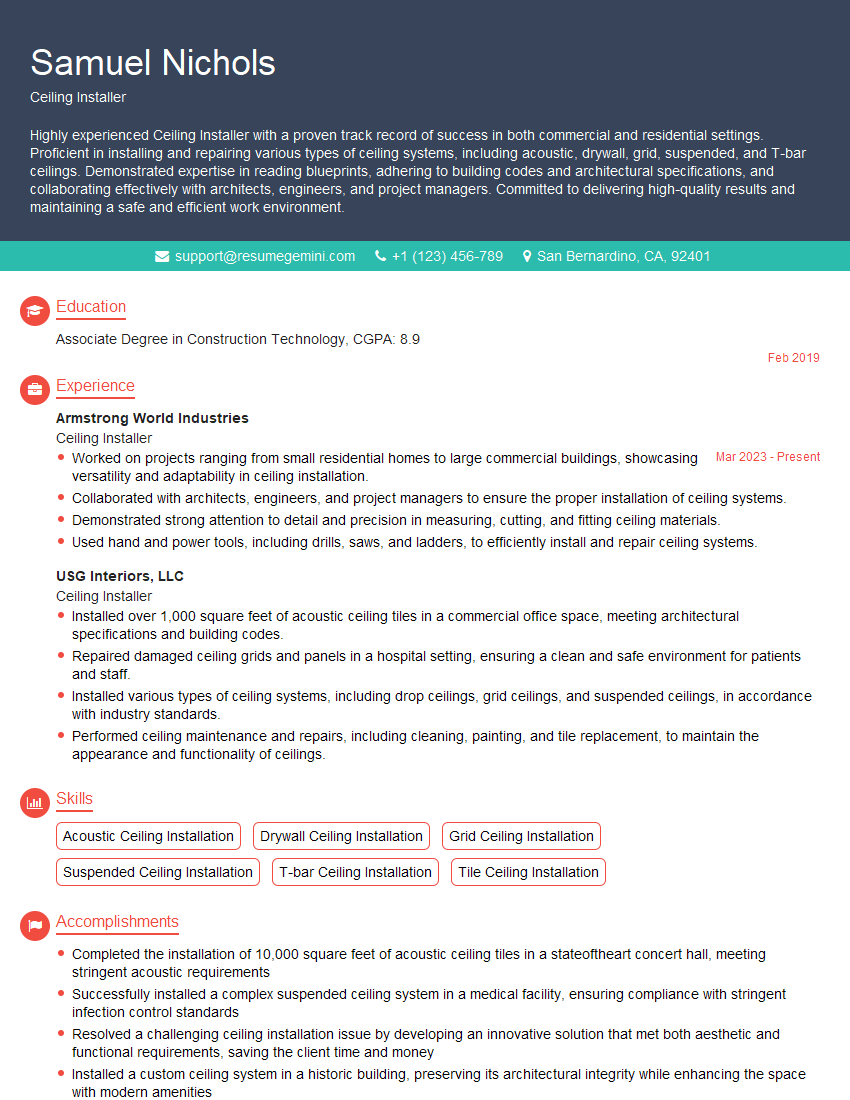
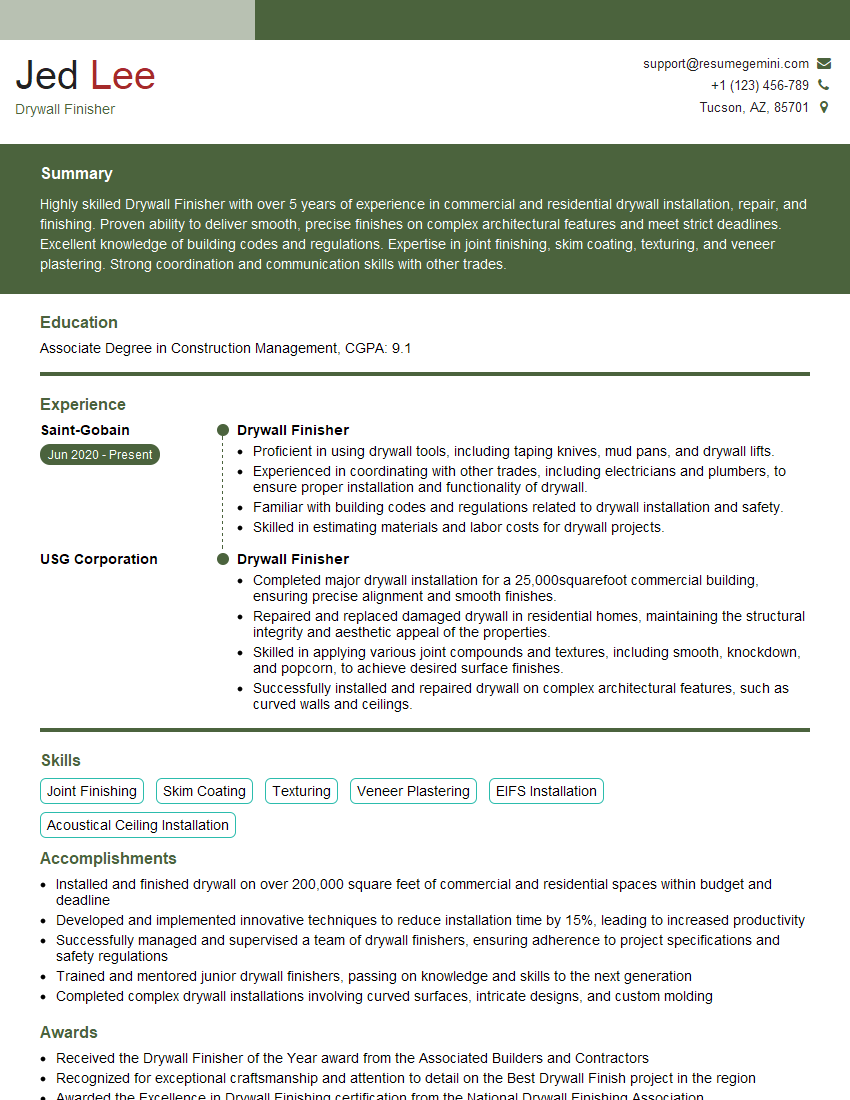
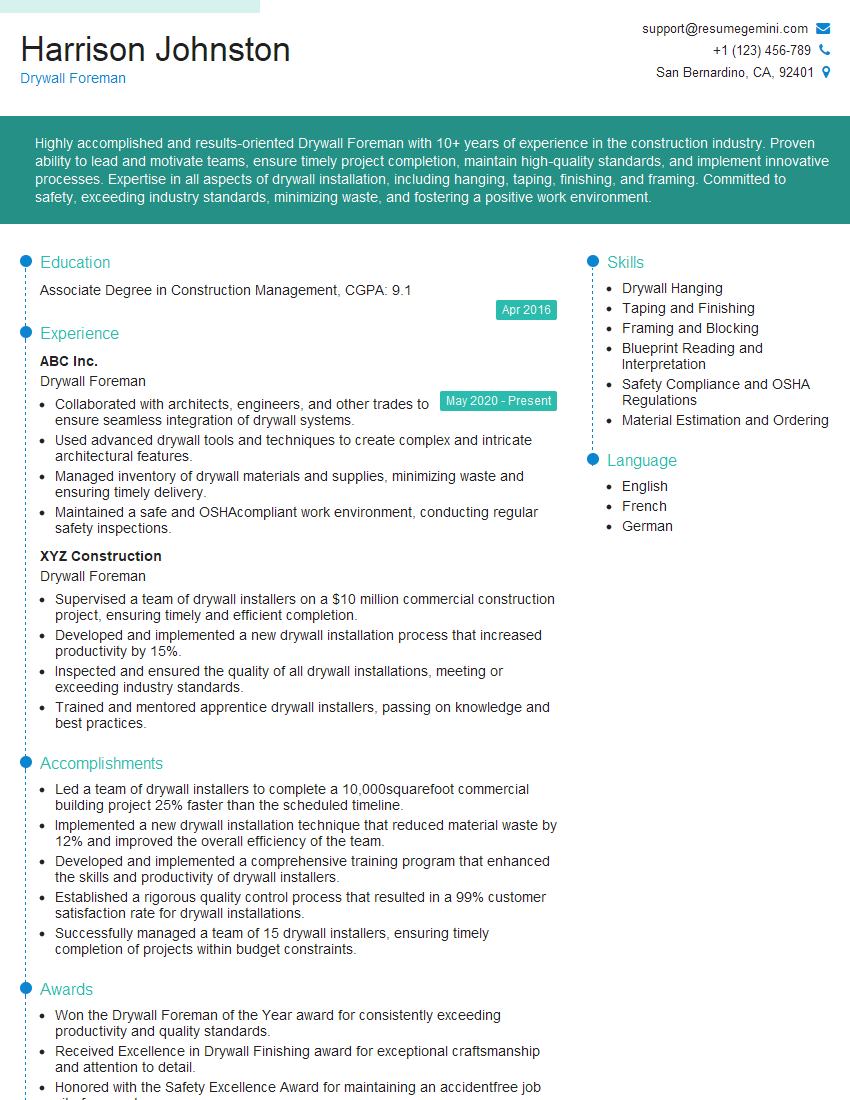
Mastering the installation of drywall ceilings opens doors to diverse and rewarding career opportunities within the construction industry, offering opportunities for advancement and specialization. A strong resume is crucial for showcasing your skills and experience to potential employers. Creating an ATS-friendly resume significantly increases your chances of getting noticed. ResumeGemini is a trusted resource that can help you build a professional and impactful resume. Examples of resumes tailored to Installation of Drywall Ceilings are available to help guide you in crafting a compelling application that highlights your expertise.
Explore more articles
Users Rating of Our Blogs
Share Your Experience
We value your feedback! Please rate our content and share your thoughts (optional).
What Readers Say About Our Blog
To the interviewgemini.com Webmaster.
Very helpful and content specific questions to help prepare me for my interview!
Thank you
To the interviewgemini.com Webmaster.
This was kind of a unique content I found around the specialized skills. Very helpful questions and good detailed answers.
Very Helpful blog, thank you Interviewgemini team.