Interviews are opportunities to demonstrate your expertise, and this guide is here to help you shine. Explore the essential Installation of Drywall Systems interview questions that employers frequently ask, paired with strategies for crafting responses that set you apart from the competition.
Questions Asked in Installation of Drywall Systems Interview
Q 1. Describe your experience with different types of drywall.
My experience encompasses a wide range of drywall types, each suited for different applications. Standard drywall, also known as gypsum board, is the most common, offering good fire resistance and sound dampening. I’ve worked extensively with moisture-resistant drywall (MR) in bathrooms and kitchens, recognizing its crucial role in preventing water damage. I’m also familiar with fire-resistant drywall (FR), often specified in high-traffic areas or around fireplaces for enhanced safety. Furthermore, I have experience with Type X drywall, which offers superior fire protection, and cement board, a heavy-duty option ideal for exterior applications and areas prone to high moisture. Each type has specific properties and requires appropriate handling and installation techniques.
For instance, while standard drywall is relatively easy to cut and install, working with cement board necessitates specialized tools and a bit more care due to its density and potential for breakage. Understanding these differences is crucial for ensuring the longevity and safety of the finished wall.
Q 2. Explain the process of hanging drywall.
Hanging drywall is a precise process that begins with preparation. First, I ensure the framing is perfectly square and plumb. Then, I carefully measure and cut the drywall sheets to the appropriate size, accounting for any door or window openings. Next, I lift and position each sheet against the framing, ensuring it’s flush against the studs. Using drywall screws, I attach the sheet, spacing screws approximately 6 inches apart and placing them within an inch of the edges to prevent cracking. I strategically use additional screws at the corners and around any cutouts. This methodical approach ensures the integrity and stability of the wall. Finally, I carefully trim any excess material before moving on to the next sheet.
For example, if installing drywall around a window, I’ll create accurate cutouts, ensuring they are not only precise for a clean look, but also strong enough to support the weight of the drywall and prevent breakage over time.
Q 3. How do you ensure proper alignment and spacing of drywall sheets?
Achieving proper alignment and spacing is paramount for a professional finish. I begin by establishing a straight baseline along the top of the wall using a laser level or a long level. This acts as a reference point for the first sheet, ensuring it’s perfectly plumb. Subsequent sheets are aligned using the already installed sheets and a combination of level and measuring tape, taking into account the standard 1/4 inch spacing between sheets for expansion and contraction. For larger rooms, I’ll use long straight edges to ensure consistent alignment across the entire wall. This precise approach prevents uneven joints and maintains structural integrity.
A simple but effective trick is to use thin wood shims to help hold the sheets in place and maintain consistent spacing. This process is like building with Lego; the precision of each piece determines the overall success of the build.
Q 4. What are the different types of drywall tape and when would you use each?
Several types of drywall tape cater to different needs. Paper tape is the most common and is ideal for most interior applications. It’s relatively inexpensive and easy to work with. Mesh tape, on the other hand, offers superior strength and is often preferred for larger joints or areas subject to movement. Fiberglass tape is another option that’s resistant to moisture and is suitable for high-humidity areas. The choice depends on the specific project requirements and the location of the wall.
For example, I’d typically use paper tape in a standard bedroom wall, but in a bathroom, I would opt for fiberglass tape for increased moisture resistance. The selection of tape isn’t just about aesthetics; it’s about structural integrity and longevity.
Q 5. Describe your taping and mudding techniques.
My taping and mudding techniques are refined over years of experience. After applying the tape, I embed it firmly into the joint using a wide putty knife. I then apply a thin coat of joint compound (mud), ensuring complete coverage of the tape and feathering the edges to blend seamlessly with the surrounding drywall. After the first coat dries, I apply additional coats, sanding lightly between each application to achieve a smooth surface. This process usually requires three to four coats, ensuring a professional, consistent finish. Each coat is thinner than the last. I always carefully clean up any excess mud to prevent build-up and maintain the smooth appearance.
Think of it like cake decorating: multiple thin layers create a flawless finish, while thick layers result in cracking and an uneven look.
Q 6. How do you achieve a smooth, flawless finish on drywall?
Achieving a flawless finish requires meticulous attention to detail and patience. The key is to apply thin, even coats of joint compound, allowing each coat to dry completely before sanding. I use a variety of sanding tools, from hand sanding blocks to electric sanders, depending on the size of the surface area. Proper sanding removes any imperfections and creates a smooth, even surface ready for painting. I pay close attention to detail, ensuring there are no ridges or lumps, and I use flexible sanding tools to effectively navigate corners. The final sanding is crucial to remove any tiny imperfections and create a perfectly smooth base for paint.
A common mistake is to rush the process; this will invariably lead to a bumpy finish that is hard to correct later. Patience and attention to detail are vital.
Q 7. What are the common issues encountered during drywall installation, and how do you address them?
Common issues include uneven framing, resulting in bowed or uneven walls; poor tape application leading to cracks or gaps; and improper sanding causing ridges or imperfections. I address uneven framing by carefully assessing the issue and using shims or additional framing to correct the problem before hanging the drywall. Poor tape application is addressed by removing the old tape and re-applying it correctly. Improper sanding is corrected through careful re-sanding, ensuring a smooth and uniform surface. In some cases, it may require applying additional mud and re-sanding to achieve the desired outcome.
For example, finding a bowed stud after the drywall is installed requires careful removal of the affected section, correction of the stud position, and then re-installation of the drywall. Identifying problems early and understanding their causes helps me provide an effective and lasting solution.
Q 8. How do you prepare surfaces for drywall installation?
Proper surface preparation is crucial for a successful drywall installation. Think of it like preparing a canvas for a masterpiece – a smooth, clean surface ensures the drywall adheres properly and provides a flawless finish. This involves several key steps:
- Cleaning: Thoroughly remove any loose debris, dust, dirt, grease, or old paint that could compromise adhesion. A stiff brush, vacuum, and possibly a pressure washer (for exterior walls) are useful tools.
- Repairing: Address any structural imperfections like cracks, holes, or uneven surfaces. This might involve patching with cement, filling holes with spackle, or shimming uneven areas. Allow ample drying time before proceeding.
- Priming (Optional but Recommended): Priming helps to seal porous surfaces, improves paint adhesion, and promotes even drywall application. This is particularly important with plaster or concrete substrates.
- Moisture Control: Ensure the surface is completely dry before installation. Excessive moisture can lead to mold growth and drywall damage. Use moisture meters to check for adequate dryness.
For example, on a particularly porous concrete wall, I’d use a penetrating primer to seal the surface before installing drywall, preventing moisture from wicking up and damaging the board.
Q 9. Explain your understanding of drywall fire codes and regulations.
Drywall fire codes and regulations are critical for building safety. They dictate the type of drywall used, its placement, and the required fire-resistant properties in different areas of a building. These regulations vary by location and building type but generally focus on limiting the spread of fire.
- Type X Fire-Rated Drywall: This type contains gypsum core with added fibers for enhanced fire resistance, typically mandated in areas like hallways, stairwells, and around fire-rated assemblies.
- Fire Barriers and Partitions: Codes specify the required thickness and type of drywall for fire-rated walls and partitions separating different areas of a building, often using double layers of Type X drywall.
- Penetration Firestopping: Any penetrations in fire-rated walls (like pipes or wiring) require firestopping materials to maintain the fire rating. This is a very important detail that often requires specialized training and materials.
- Local Codes: Always check local building codes and fire regulations before starting any project as requirements vary significantly by location. Failure to comply can result in significant fines and project delays.
In a recent project, I had to work with a Type X fire-rated drywall in a high-rise building’s stairwell. Understanding and complying with the specific local building code was paramount to project success and occupant safety.
Q 10. How do you handle corners and edges during drywall installation?
Handling corners and edges properly is key to a professional-looking drywall installation. These are areas prone to damage and require special attention:
- Inside Corners: Use corner beads or metal corner protectors to reinforce inside corners. These beads are installed before the drywall to create a neat, smooth corner that won’t dent or crack. Proper bedding and taping are essential for a smooth finish.
- Outside Corners: Outside corners can be finished with either corner beads or by carefully butting the drywall sheets together. Careful taping and mudding are vital to prevent cracking and create a clean edge.
- Edges: For edges not requiring corner beads, use drywall tape to cover the edges of the drywall. This tape is then covered with joint compound (mud) to create a seamless transition between sheets.
- Specialty Tools: Using tools such as corner rollers helps create a sharp, even finish on the corners, improving the overall aesthetic quality.
Imagine trying to finish a corner without corner bead – it’s highly likely to get damaged during the finishing process. Using corner beads provides strength and prevents chipping, offering a far superior finish.
Q 11. Describe your experience with different types of drywall finishing tools.
Drywall finishing requires a variety of specialized tools for achieving a smooth, professional finish. My experience includes using:
- Knives: Various sizes of taping knives (6”, 8”, 10”, 12”) for applying joint compound (mud) to create smooth transitions between drywall sheets.
- Putty Knives: For smaller patching and filling imperfections.
- Corner Rollers: For creating smooth, even corners.
- Sanding Tools: Handheld sanding blocks or power sanders for smoothing out the mud, ensuring a flawless finish. Using a pole sander for ceilings greatly improves speed and reduces fatigue.
- Joint Compound (Mud): Different types of mud are used for different stages of the finishing process, from the initial taping to the final sanding. All-purpose mud, lightweight mud, and setting-type mud each have their own uses and advantages.
I’ve found that a good quality 12” taping knife is crucial for applying even coats of mud, particularly on larger, flatter surfaces. It allows for greater control and efficiency.
Q 12. What are your preferred methods for repairing damaged drywall?
Repairing damaged drywall depends on the extent of the damage. Minor repairs are relatively simple, while larger holes require more involved techniques:
- Small Holes and Cracks: These can typically be patched using spackle or joint compound. Apply the compound, let it dry, and then sand smooth.
- Larger Holes: These require cutting out the damaged section of drywall and replacing it with a new piece. This involves measuring, cutting, and installing a new patch, followed by taping and mudding.
- Deep Gouges or Dents: These might require careful filling with compound or even shimming to restore the original surface profile.
- Water Damage: This often requires more extensive repair, sometimes necessitating removal of the damaged drywall and the installation of new, completely dried sections.
One time, I had to repair a large hole in a wall caused by a misplaced nail. I carefully cut out the damaged section, installed a patch, and used multiple layers of mud and sanding to achieve an invisible repair.
Q 13. How do you manage waste during drywall installation?
Waste management during drywall installation is crucial for environmental responsibility and efficiency. My approach includes:
- Careful Cutting: Precise cutting minimizes waste and ensures that materials are used as efficiently as possible.
- Scrap Material Reuse: Smaller pieces of drywall can sometimes be used for patching or other minor repairs instead of discarding them.
- Proper Disposal: Drywall waste is generally disposed of according to local regulations. This typically involves separating it from other construction debris and taking it to a designated recycling facility.
- Recycling: Many areas now offer recycling programs for drywall, reducing landfill waste. This is generally a more environmentally friendly option.
On a large-scale project, proper waste management can significantly reduce costs and environmental impact. Organizing scrap materials for reuse saves money on new materials, and efficient waste disposal minimizes environmental impact.
Q 14. What safety precautions do you take when working with drywall?
Safety is paramount in drywall installation. I always prioritize the following precautions:
- Personal Protective Equipment (PPE): This includes safety glasses to protect against flying debris, dust masks to prevent inhaling drywall dust, and work gloves to protect hands.
- Lifting Techniques: Drywall sheets are heavy. Using proper lifting techniques and assistance from others when necessary prevents injuries.
- Fall Protection: When working at heights, harness and fall protection systems are critical.
- Sharp Tools: Carefully handling knives and other sharp tools prevents cuts and injuries. Always keep tools sharp for efficient work.
- Dust Control: Using a HEPA vacuum to clean up dust minimizes respiratory hazards. Maintaining good ventilation is also essential.
I always emphasize the importance of wearing safety glasses. A small piece of debris in the eye can cause serious harm. Prioritizing safety ensures a safe and productive work environment for everyone.
Q 15. Explain your experience with drywall texture applications.
Drywall texture application is a crucial finishing step that significantly impacts the room’s aesthetic appeal and hides minor imperfections. My experience encompasses a wide range of textures, from the simple knockdown to more complex techniques like skip trowel and orange peel. I’m proficient in using various tools, including hopper guns for spray textures and trowels for hand-applied finishes. I understand the importance of achieving a consistent texture and knowing how to properly mix and apply the texture compound to avoid issues like sagging or cracking. For example, on a recent project, we used a knockdown texture in a large living area. Precise control of the trowel angle and pressure was key to ensuring a uniform finish across the vast surface area. Another instance involved a more intricate skip trowel texture where the spacing and depth of the trowel marks required meticulous attention to detail to create the desired effect.
Furthermore, I understand the importance of choosing the right texture for different room types and styles. A smooth finish might be preferred in a modern home, while a heavier texture like orange peel might be better suited for hiding imperfections in an older building. Preparing the surface properly, ensuring it’s clean and free from dust or debris is paramount, just as careful cleanup after application is needed to maintain the professionalism of the job.
Career Expert Tips:
- Ace those interviews! Prepare effectively by reviewing the Top 50 Most Common Interview Questions on ResumeGemini.
- Navigate your job search with confidence! Explore a wide range of Career Tips on ResumeGemini. Learn about common challenges and recommendations to overcome them.
- Craft the perfect resume! Master the Art of Resume Writing with ResumeGemini’s guide. Showcase your unique qualifications and achievements effectively.
- Don’t miss out on holiday savings! Build your dream resume with ResumeGemini’s ATS optimized templates.
Q 16. How do you work effectively as part of a team?
Effective teamwork is essential in drywall installation, where tasks often require multiple people. I prioritize clear communication, actively listening to my colleagues’ ideas and concerns. For instance, I ensure that everyone understands the project’s scope and individual roles before we start. I’m always willing to assist team members and readily share my knowledge and experience. On a recent job, one team member had trouble reaching a high section. Instead of just telling them how to reach it, I collaborated with them, holding the board securely while they positioned it correctly. This collaborative approach not only gets the job done efficiently, but it also fosters a positive and productive work environment. I also believe in respecting each member’s strengths, allowing them to excel in their areas of expertise while offering support and guidance where needed.
Q 17. Describe your experience with different types of drywall joints.
My experience encompasses various drywall joint types, each requiring a specific approach for proper finishing. These include butt joints, where two sheets meet end-to-end; corner joints, either inside or outside corners; and T-joints where one sheet intersects another. I’m well-versed in applying the correct taping and mudding techniques for each type. For butt joints, I ensure proper alignment and use a full-length bead of joint compound to achieve a seamless finish. Inside corners need special attention, employing corner bead and applying multiple coats of mud to create a neat, sharp edge. Outside corners, similarly, often require corner bead for reinforcement and a smooth, durable finish. I’ve worked with different types of tape, such as paper tape and mesh tape, adapting to various project requirements and preferences.
Understanding the behavior of different types of joints under stress is also critical. Butt joints, for example, might be more prone to cracking if not properly reinforced, requiring extra attention during the mudding process. Successfully dealing with these joints involves careful preparation, precise application of tape and compound, and the right amount of sanding to achieve a smooth, flawless surface.
Q 18. How do you measure and cut drywall sheets accurately?
Accurate measurement and cutting are fundamental for efficient and aesthetically pleasing drywall installation. I use measuring tapes and pencils to carefully mark dimensions on the drywall sheet, always double-checking my measurements to avoid mistakes. For straight cuts, I use a utility knife, guiding it along a straightedge for a clean cut. For more intricate cuts around windows and doors, I use a drywall saw or jab saw for precise work. I always ensure the cutting surface is stable to avoid any accidents.
For example, when cutting around an oddly shaped window, I prefer to create a template first using cardboard or similar material. I then trace the template onto the drywall, ensuring that my cuts align perfectly with the window frame. This technique ensures a precise and clean fit, minimizing any need for additional adjustments. Moreover, I’m skilled in creating various cuts including 45-degree angles for mitered joints, showcasing my precise measuring and cutting skills, leading to professional finishing.
Q 19. Explain your understanding of drywall acoustics.
Drywall acoustics play a significant role in a building’s overall sound quality. Thicker drywall sheets, for instance, offer better sound insulation. The type of drywall material also impacts sound transmission; denser materials are generally better at reducing noise. Understanding the principles of sound transmission and absorption is crucial. I’m familiar with strategies to improve acoustics, such as using sound-dampening drywall or installing resilient channels, which decouple the drywall from the framing to reduce sound transmission. In high-noise environments, like apartments or recording studios, employing such techniques is crucial for creating a comfortable and functional space.
Furthermore, I’m aware of the impact of joint gaps and air leaks on sound quality; properly sealed joints can significantly minimize unwanted noise transfer. My experience allows me to identify and address potential acoustic issues during the installation process, contributing to a well-insulated and soundproofed environment. For example, on a project in a multi-family dwelling, we utilized resilient channels in the partitions to minimize sound transmission between units, creating a more peaceful environment for occupants.
Q 20. How do you handle different types of drywall fasteners?
Drywall installation uses various fasteners, each with its purpose. I’m proficient in using drywall screws, which are the most common, and I understand the importance of choosing the right screw length and type depending on the drywall thickness and framing material. I also have experience with nails, though screws are generally preferred for their superior holding power and less likelihood of damaging the drywall. I’m also trained on using specialized fasteners for specific applications, such as self-tapping screws for metal framing.
A critical aspect is ensuring the correct depth of penetration. Over-driving screws can cause dimples and potential damage, while under-driving them compromises the structural integrity. Proper screw placement is also essential to minimize damage to the board and ensure even load distribution. For instance, on a large commercial project, we employed a specific type of screw designed for high-density drywall to ensure that the integrity of the construction wasn’t jeopardized in case of extreme loads or impacts.
Q 21. Describe your experience with using specialized tools for drywall installation (e.g., lift assist)
Using specialized tools significantly improves efficiency and safety in drywall installation. My experience includes using lift assist devices, which makes handling large drywall sheets much safer and easier for a single person or a smaller crew. These tools lessen the strain on the back and reduce the risk of injury. I also know how to use various other tools such as taping knives for smooth finishing, and corner rollers for even application of corner bead. Furthermore, I am familiar with power tools, like drywall saws that assist in creating neat and accurate cuts. I am experienced in utilizing all these tools safely and efficiently.
For instance, on a recent project involving large 16-foot-long sheets of drywall, the use of a lift assist device enabled us to quickly and easily install them, reducing both the labor cost and the risk of injury to the installation crew. The correct use of this tool is directly related to safety and the efficient flow of the project.
Q 22. What is your experience with installing drywall in various environments (e.g., high-humidity areas)?
My experience with drywall installation spans diverse environments, including high-humidity areas like bathrooms and kitchens. In these spaces, the key is to select the appropriate moisture-resistant drywall (often denoted as ‘MR’ or ‘MRT’). Standard drywall in high-humidity areas is a recipe for disaster; it will absorb moisture, leading to mold growth and structural damage. I’ve worked on projects where we’ve used specialized vapor barriers behind the drywall in particularly humid locations to create an additional layer of protection. Beyond material selection, proper ventilation is crucial. Ensuring adequate exhaust fans and proper sealing around plumbing fixtures prevents moisture buildup. I’ve also encountered situations where existing moisture damage needed to be remediated before new drywall could be installed. This often involves removing damaged sections, treating the affected area with anti-microbial solutions, and allowing it to dry completely before proceeding with the installation. Failing to address existing moisture issues will inevitably lead to recurrence of the problem.
Q 23. How do you identify and address moisture problems related to drywall?
Identifying moisture problems related to drywall involves a multi-pronged approach. Visual inspection is the first step. Look for signs like bubbling, discoloration (often dark staining), or soft spots in the drywall. A simple moisture meter can provide quantifiable readings to confirm suspicions. If there’s evidence of water damage, the source must be identified and addressed – a leaky pipe, faulty roof, or inadequate drainage. Often, I’ve discovered the root cause lies outside the drywall itself, such as a crack in the exterior wall or a drainage issue. Addressing the source of the problem is crucial because merely replacing the drywall without addressing the root cause is a temporary fix. Severe moisture problems may require professional help from plumbers, roofers, or even mold remediation specialists before drywall work can even begin.
Q 24. Explain your experience with troubleshooting drywall installation problems.
Troubleshooting drywall installation problems requires a systematic approach. I’ve encountered issues ranging from improperly fastened drywall (leading to sagging) to inconsistent joint compound application (resulting in uneven surfaces). For sagging, the problem often stems from using too few screws or screws that aren’t long enough to properly penetrate the framing. This requires removing the affected section, reinforcing the framing as needed, and reinstalling the drywall correctly. Uneven joint compound is usually a matter of technique; using the right tools (putty knife, taping knife) and applying multiple thin coats rather than one thick one prevents cracking and ensures a smooth finish. Another common issue is nail pops. These occur when nails used to fasten drywall are not set deep enough or the drywall itself hasn’t settled properly into the framing. Careful attention to detail during installation, ensuring proper screw placement and depth is key to avoid this. I always ensure my team follows best practices and is aware of the common pitfalls to avoid costly rework later on.
Q 25. How do you ensure quality control throughout the drywall installation process?
Quality control is paramount throughout the entire drywall installation process. This begins with verifying the materials are correct (appropriate type, thickness, etc.) and ensuring all tools are in good working order. During installation, I rigorously check for proper fastening, ensuring screws are spaced correctly and flush with the surface. Visual inspection throughout each step helps catch imperfections early. Regular quality checks ensure the work stays on track and standards are met. I often take photographs at key stages – before and after taping, after the first coat of mud, and after sanding – to document progress and provide a record for the client. Before painting, we perform a final walk-through to confirm the surface is perfectly smooth and ready for the next stage. This approach minimizes rework and ensures a professional finish.
Q 26. Describe your experience with reading and interpreting blueprints related to drywall installation.
Reading and interpreting blueprints is fundamental to my work. I’m proficient in deciphering architectural drawings to understand wall locations, types of drywall required (e.g., fire-rated), and the placement of electrical outlets, plumbing fixtures, and other elements that influence the drywall installation. I look for details like wall thickness, types of insulation used, and any special requirements or notes regarding fire resistance, soundproofing, etc. I always cross-reference the blueprints with the actual site conditions to identify any discrepancies or unforeseen challenges. This preparation significantly improves installation efficiency and minimizes potential errors during the process. For example, identifying the locations of electrical boxes in advance prevents damaging them during the installation.
Q 27. How familiar are you with different drywall finishing techniques (e.g., skim coating)?
I’m well-versed in various drywall finishing techniques, including skim coating. Skim coating involves applying a thin layer of joint compound over an existing surface to create a perfectly smooth finish. This is often necessary when repairing damaged drywall or achieving a flawless appearance before painting. Other techniques I regularly utilize include taping (applying joint compound over the seams between drywall panels), bedding (applying compound to the joints), and topping (applying a second layer of compound). Each technique requires specific tools and a good understanding of application methods to achieve a professional, consistent result. The key is to apply multiple thin coats instead of one thick coat. This allows for easier sanding and minimizes cracking. I also adjust my technique depending on the type of drywall, aiming for consistency and a final product that is both visually appealing and durable.
Q 28. What is your experience with using different types of joint compound?
My experience encompasses the use of various types of joint compound, each with its own properties and application. All-purpose compound is suitable for most applications; it’s a versatile choice for taping, bedding, and topping. Lightweight compounds are easier to sand but may require more coats. Setting-type compounds offer faster drying times, but need to be applied carefully to avoid rapid setting and cracking. I select the compound based on the project’s specific needs, considering factors like drying time, ease of sanding, and the desired level of smoothness. For instance, I might choose a lightweight compound for large areas to reduce sanding time and effort, or a setting-type compound for projects where a quick turnaround is required. Understanding the properties of each type allows me to optimize my work process and ensure high-quality results.
Key Topics to Learn for Installation of Drywall Systems Interview
- Understanding Drywall Types and Properties: Learn the differences between various drywall types (e.g., standard, fire-resistant, moisture-resistant) and their appropriate applications. Understand their strengths, weaknesses, and handling requirements.
- Framing and Preparation: Master the process of inspecting and preparing wall framing for drywall installation. This includes understanding proper spacing, nailing patterns, and addressing irregularities.
- Cutting and Measuring Techniques: Develop proficiency in accurately measuring and cutting drywall panels to fit various wall configurations and openings (doors, windows). Explore different cutting tools and methods.
- Fastening and Securing Drywall: Learn the correct techniques for fastening drywall to framing using screws or nails, ensuring proper spacing and penetration depth to avoid damage. Understand the importance of consistent fastening for a secure and flat finish.
- Taping and Finishing: Grasp the process of applying drywall tape and joint compound to create smooth, seamless transitions between panels and around openings. Understand the different stages of finishing (e.g., taping, coating, sanding).
- Safety Procedures and Regulations: Familiarize yourself with relevant safety regulations, proper use of tools and equipment, and best practices for preventing injuries on the job site.
- Troubleshooting Common Issues: Prepare to discuss common problems encountered during drywall installation (e.g., uneven surfaces, cracked panels, improper fastening) and how to effectively address them.
- Tools and Equipment Knowledge: Demonstrate familiarity with common tools used in drywall installation, including their proper usage and maintenance (e.g., measuring tapes, utility knives, drywall saws, screw guns, taping knives).
- Understanding Building Codes and Regulations: Be prepared to discuss relevant building codes and regulations related to drywall installation in your area. This demonstrates professionalism and adherence to standards.
Next Steps
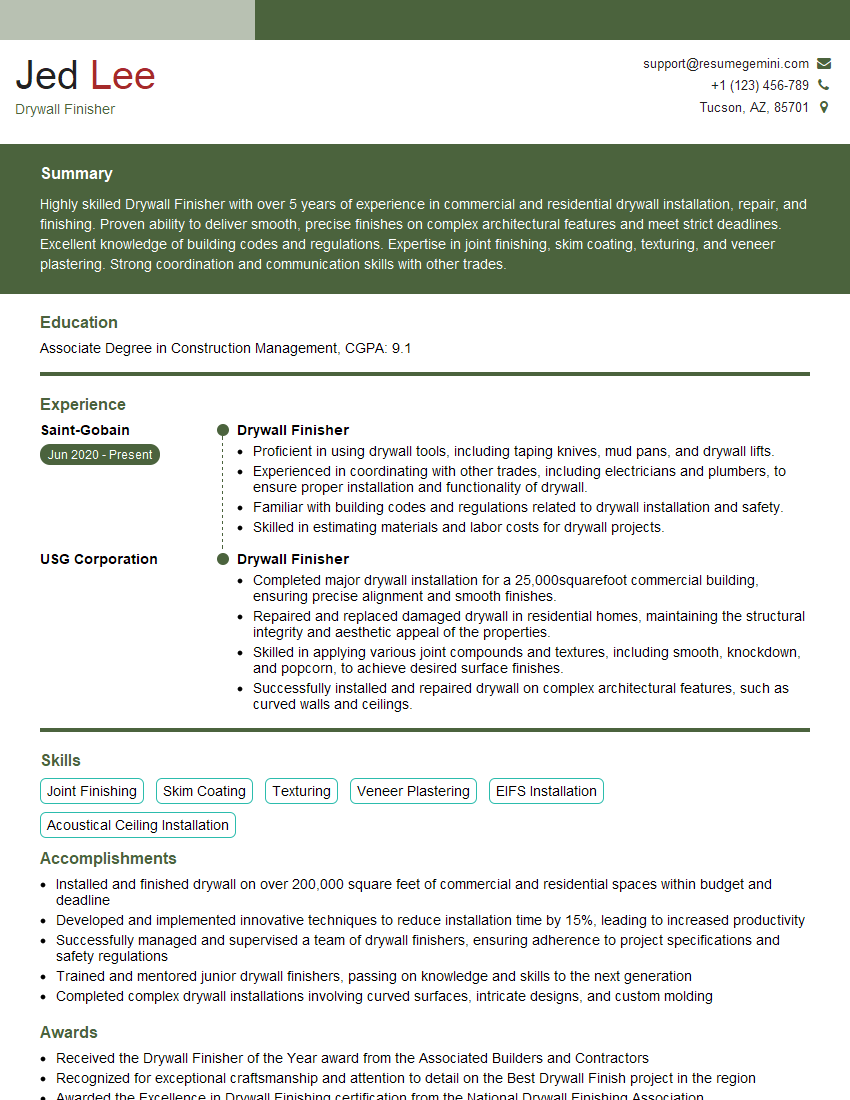
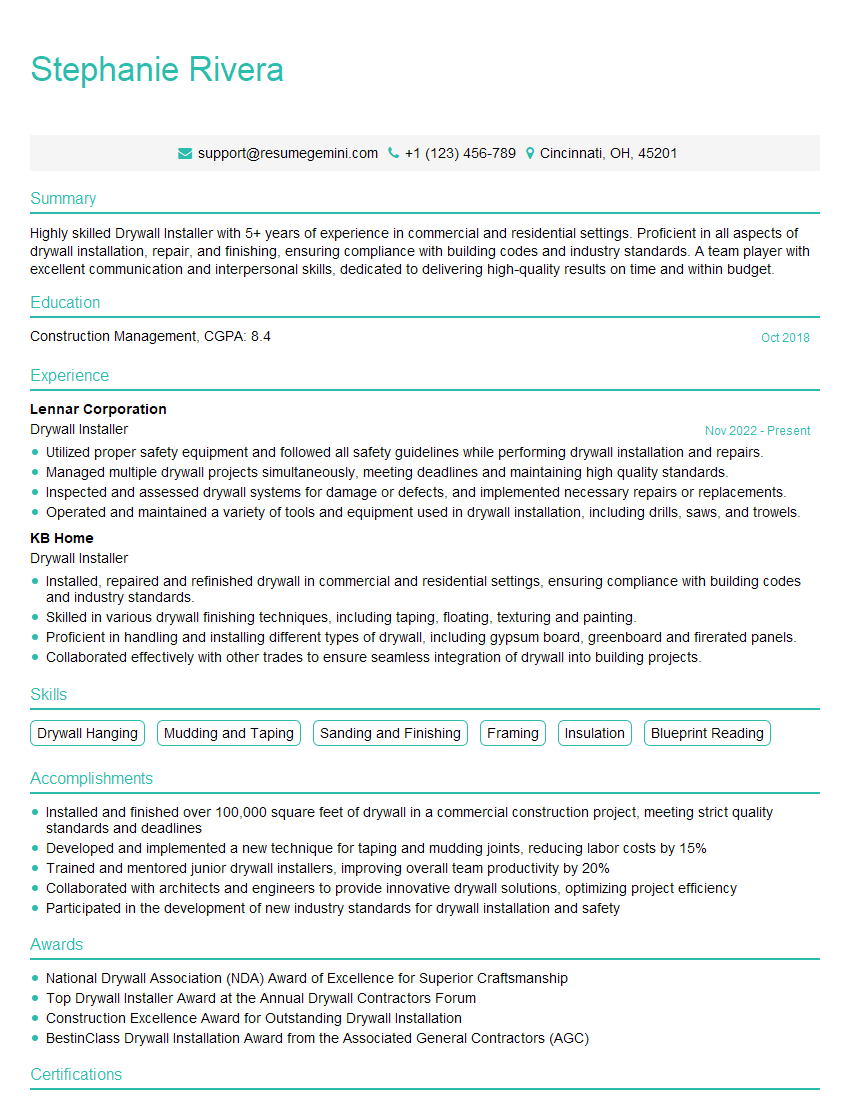
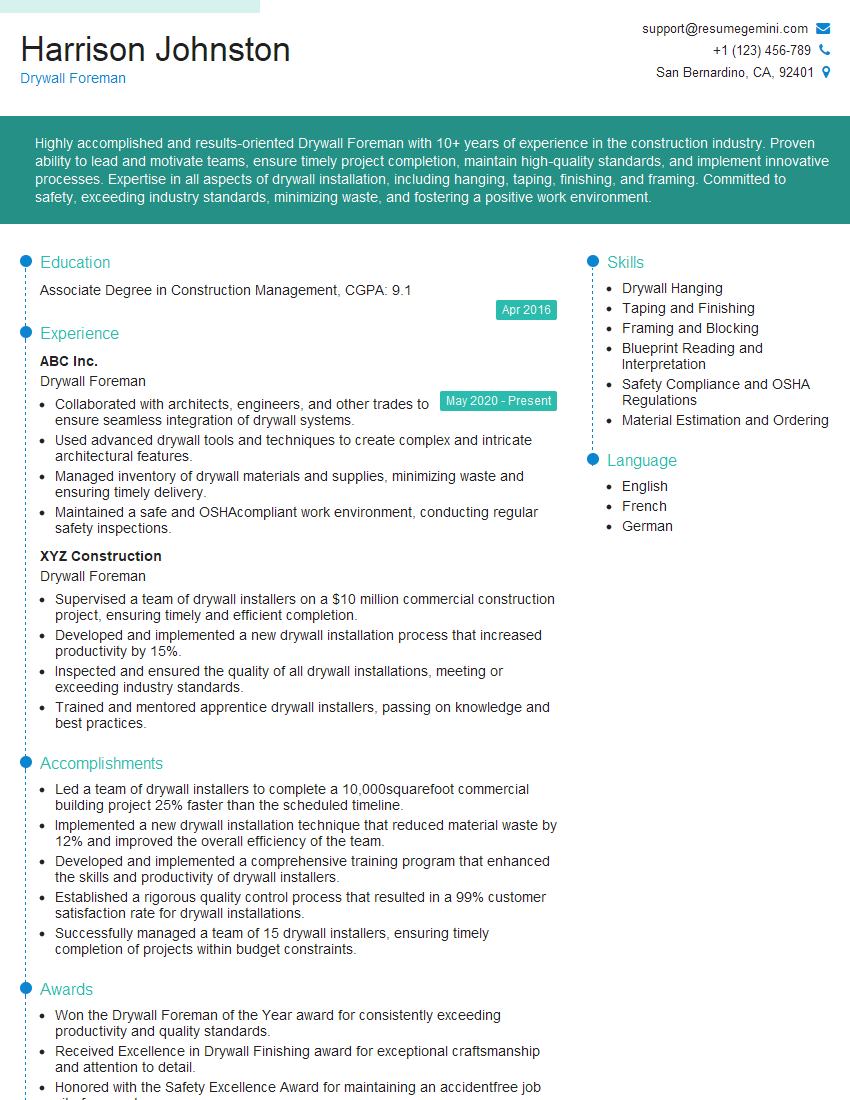
Mastering the installation of drywall systems opens doors to rewarding careers in construction and related fields, offering opportunities for advancement and specialization. A strong resume is crucial for showcasing your skills and experience to potential employers. Create an ATS-friendly resume to ensure your application gets noticed. ResumeGemini is a trusted resource to help you build a professional and impactful resume. Examples of resumes tailored to Installation of Drywall Systems are available to guide you.

Explore more articles
Users Rating of Our Blogs
Share Your Experience
We value your feedback! Please rate our content and share your thoughts (optional).
What Readers Say About Our Blog
To the interviewgemini.com Webmaster.
Very helpful and content specific questions to help prepare me for my interview!
Thank you
To the interviewgemini.com Webmaster.
This was kind of a unique content I found around the specialized skills. Very helpful questions and good detailed answers.
Very Helpful blog, thank you Interviewgemini team.