Interviews are opportunities to demonstrate your expertise, and this guide is here to help you shine. Explore the essential Knowledge of lighting design and principles interview questions that employers frequently ask, paired with strategies for crafting responses that set you apart from the competition.
Questions Asked in Knowledge of lighting design and principles Interview
Q 1. Explain the inverse square law of light.
The inverse square law of light describes the relationship between the intensity of light and the distance from the light source. Simply put, as you double the distance from a light source, the intensity of the light decreases by a factor of four. This is because the light spreads out over a larger area as it travels further. Imagine a balloon expanding; the same amount of air is spread thinner over a larger surface area.
Mathematically, it’s expressed as: E = I / d², where ‘E’ is illuminance (light intensity on a surface), ‘I’ is luminous intensity (light output from the source), and ‘d’ is the distance from the source. This law is crucial in lighting design, as it dictates how much light you’ll need at a given distance to achieve the desired illuminance.
For instance, if you need 50 lux (a unit of illuminance) on a surface 2 meters away from a light source, and you move that surface to 4 meters away, you’ll need four times the luminous intensity (200 lux) to maintain the same illuminance.
Q 2. What are the different types of light sources and their applications?
Light sources are broadly categorized into incandescent, fluorescent, LED, and high-intensity discharge (HID) lamps. Each has unique properties influencing its application.
- Incandescent: These traditional bulbs produce light by heating a filament until it glows. They offer warm, pleasant light but are energy-inefficient and have a short lifespan. Ideal for creating a cozy ambiance in smaller spaces like bedrooms.
- Fluorescent: These lamps use electricity to excite mercury vapor, producing ultraviolet (UV) light that then strikes a phosphor coating, generating visible light. They are energy-efficient and have a longer lifespan than incandescent, but the light quality can appear somewhat cooler and less pleasant.
- LED (Light Emitting Diode): LEDs are semiconductor devices that emit light when an electric current passes through them. They are highly energy-efficient, long-lasting, available in various color temperatures, and can be easily dimmed. Ideal for a wide range of applications, from general illumination to accent lighting.
- High-Intensity Discharge (HID): HID lamps, such as metal halide and high-pressure sodium, produce light by passing an electric arc through a gas or metal vapor. They offer high luminous efficacy (light output per watt) making them suitable for large areas like sports stadiums or street lighting. However, they require time to warm up and may not be as easily dimmable as LEDs.
Q 3. Describe the concept of color temperature and its impact on design.
Color temperature is a measure of the apparent color of a light source, expressed in Kelvin (K). It describes the light’s perceived warmth or coolness. Lower color temperatures (e.g., 2700K) produce warmer, more yellowish light, reminiscent of incandescent bulbs, often suitable for creating a relaxing atmosphere in residential settings. Higher color temperatures (e.g., 6500K) produce cooler, bluer light, similar to daylight, and are often used in commercial spaces where visual acuity is important.
The impact on design is significant. A warm color temperature can evoke feelings of comfort and intimacy, while a cool color temperature can create a more stimulating and focused environment. The choice of color temperature should align with the intended mood and functionality of the space. For example, a restaurant might use warm lighting in the dining area to promote relaxation and cooler lighting in the kitchen for efficient task performance.
Q 4. What are the key considerations for designing lighting for a retail space?
Designing lighting for retail spaces involves strategically combining different lighting techniques to enhance product visibility, create a desired atmosphere, and drive sales. Key considerations include:
- Product Emphasis: Accent lighting using spotlights or track lighting highlights key merchandise, drawing attention to specific items. Proper color rendering index (CRI) is crucial to ensure products are displayed accurately.
- Ambient Lighting: General illumination provides even light distribution throughout the store, creating a comfortable and welcoming environment.
- Task Lighting: This focuses light on specific tasks like checkout counters or fitting rooms, improving visibility and functionality.
- Energy Efficiency: Using energy-efficient lighting solutions like LEDs helps reduce operating costs.
- Brand Identity: Lighting design should complement the brand’s aesthetic and create a consistent visual identity.
- Vertical Illumination: This technique creates depth and showcases products from different angles, improving their visual appeal.
For example, a high-end clothing boutique might use warm-toned accent lighting to highlight textures and colors, while a supermarket would focus on bright, even ambient lighting to ensure product visibility.
Q 5. How do you calculate the illuminance level required for a specific area?
Calculating the required illuminance level involves considering several factors, including the type of activity, the visual task, and the ambient light conditions. Illuminance levels are typically measured in lux.
There are no single universal formulas. Illuminance requirements are specified in various lighting design standards and codes (like IES). These standards provide recommended illuminance levels for different applications. For example, a reading room needs significantly higher illuminance than a hallway. You’d need to consult relevant standards for your region and specific application.
The process generally involves:
- Identifying the task and its requirements: Consult lighting design standards to determine the recommended illuminance level (in lux).
- Assessing existing ambient light: Measure the existing ambient light level to determine how much additional lighting is needed.
- Calculating the total required luminous flux: This involves using the area to be illuminated and the required illuminance level.
- Selecting appropriate luminaires: Choose fixtures based on their luminous efficacy and light distribution patterns.
- Verifying the design through simulations or measurements: Lighting design software can help to predict the illuminance levels and refine the lighting layout.
Q 6. Explain the difference between direct and indirect lighting.
Direct lighting shines light directly onto the surface to be illuminated, while indirect lighting bounces light off the ceiling or walls before it reaches the surface. Both methods have their advantages and disadvantages.
- Direct Lighting: Offers higher efficiency in delivering light to the intended area but can create harsh shadows and glare. Examples include recessed downlights or spotlights.
- Indirect Lighting: Creates softer, more diffused light that’s less harsh on the eyes and reduces glare. However, it’s less efficient as some light is lost through reflection. Examples include cove lighting or uplights.
Often, a combination of direct and indirect lighting is used to create a balanced and visually appealing environment. Direct lighting can be used for task illumination, while indirect lighting provides comfortable ambient illumination.
Q 7. What are some common lighting design software programs you are familiar with?
I’m familiar with several lighting design software programs, each with its strengths and weaknesses. These include:
- Dialux evo: A widely used, free software for lighting simulations and calculations.
- Relux: Another popular software for professional lighting design, offering advanced features and integrations.
- Agilent’s LightTools: A more advanced, physics-based program ideal for detailed simulations and complex lighting systems.
- Autodesk Revit: While not solely a lighting design software, Revit incorporates lighting design capabilities and integrates well within a building information modeling (BIM) workflow.
The choice of software depends on the project’s complexity, budget, and personal preference. For simple projects, Dialux evo might suffice. For more complex simulations or large-scale projects, Relux or LightTools might be more appropriate. Revit is beneficial when working within a larger architectural or engineering team.
Q 8. Describe your experience with different types of dimming systems.
My experience with dimming systems spans a wide range of technologies, each with its own strengths and weaknesses. I’ve worked extensively with 0-10V dimming, a common analog system offering good control but susceptible to noise interference. This system works by varying the voltage signal sent to the luminaire, controlling the brightness. I’ve also utilized DALI (Digital Addressable Lighting Interface), a digital system allowing for individual control of fixtures and sophisticated scene setting. This is far more complex to set up than 0-10V but offers superior flexibility and programmability. More recently, I’ve incorporated wireless dimming systems like Zigbee and Z-Wave, particularly in retrofit projects where rewiring isn’t feasible. These wireless systems allow for convenient control and scalability but require careful consideration of network stability and compatibility. Finally, I’ve experimented with leading and trailing edge dimming systems, understanding their implications on the compatibility with specific lamp types. Trailing edge dimming, for example, is known to cause flickering in some LED lamps. The choice of dimming system always hinges on the project’s requirements, budget, and the type of lighting fixtures employed. For instance, a large commercial project might justify the investment in DALI for its precision and control capabilities, whereas a smaller residential project might benefit from the simpler and more cost-effective 0-10V approach.
Q 9. How do you incorporate sustainable practices into your lighting designs?
Sustainability is paramount in my lighting designs. I prioritize energy efficiency by specifying high-efficiency luminaires with high lumen output per watt (lm/W) ratings. This includes using LEDs, which offer significantly higher energy efficiency compared to traditional lighting sources like incandescent or fluorescent lamps. Beyond just the fixture itself, I carefully consider the lighting control strategy. For instance, implementing occupancy sensors and daylight harvesting systems can dramatically reduce energy consumption by ensuring lights are only on when and where needed. Choosing long-lasting, durable fixtures reduces the frequency of replacements and minimizes waste. I also focus on using recyclable materials and opting for fixtures with easily replaceable components. Furthermore, I assess the entire lifecycle of the lighting system, considering the embodied carbon associated with manufacturing and transportation of the fixtures. In recent projects, I’ve successfully integrated solar-powered lighting solutions, reducing reliance on the grid and minimizing the project’s environmental footprint.
Q 10. Explain the importance of light pollution control.
Light pollution control is crucial for preserving the night sky, protecting wildlife, and enhancing human well-being. Excessive artificial light at night (ALAN) has adverse effects on ecosystems, disrupting animal behaviour and navigation. It also impacts human health, potentially leading to sleep disorders and other health problems. From a design perspective, proper light pollution control involves careful fixture selection, limiting light trespass (unwanted spill of light beyond the intended area), and using appropriate shielding to direct light downwards. I often specify fixtures with low glare, dark sky compliant optics, and narrow beam angles to minimize unwanted upward light spill. Choosing the right color temperature is also important. Warmer color temperatures (2700K-3000K) are generally preferred for outdoor lighting to minimize disruptive effects on human circadian rhythms and wildlife. Think of it like this: a well-designed lighting scheme is like a spotlight, precisely illuminating the intended area, while poorly designed lighting is like a floodlight, washing out the surrounding environment and causing unnecessary light pollution.
Q 11. What are the challenges of designing lighting for a museum or art gallery?
Designing lighting for museums and art galleries presents unique challenges because the primary goal is to showcase the exhibits in the best possible light, both literally and figuratively. The lighting must be carefully calibrated to avoid glare, color distortion, and UV damage to sensitive artworks. I carefully select light sources with minimal UV and IR emissions, typically using specialized LED systems with adjustable color temperature and intensity. Precise control over the lighting levels is vital, often achieved through sophisticated dimming systems and individual fixture control. Accurate color rendering is another key consideration, ensuring that colors are displayed true-to-life. A high Color Rendering Index (CRI) is essential, ideally CRI 90 or higher, especially for displays with vibrant colors. Careful consideration must be given to the placement of lighting fixtures to avoid creating unwanted shadows or reflections. Finally, the lighting design should be aesthetically pleasing and enhance the visitor experience without distracting from the exhibits themselves. Often I use a combination of track lighting, spotlights, and ambient lighting to create a layered and dynamic lighting scheme, adaptable for different exhibition needs.
Q 12. How do you balance aesthetics and functionality in lighting design?
Balancing aesthetics and functionality is a core principle in lighting design. It’s about creating a space that is both beautiful and usable. For example, consider a restaurant setting. The lighting must provide sufficient illumination for diners to see their food and each other, meeting the functional need. However, the lighting should also create a warm and inviting atmosphere, enhancing the dining experience and contributing to the restaurant’s overall aesthetic. I achieve this balance by carefully selecting fixtures that are not only functional but also visually appealing. The placement and direction of light are equally important; strategic use of light and shadow can create visual interest and highlight architectural features. Choosing the right color temperature and light levels can dramatically impact the mood and ambiance of a space. Warm white light promotes relaxation, while cooler white light creates a more energetic atmosphere. Ultimately, the design process involves a close collaboration with the client, architects, and other designers to understand their aesthetic vision and translate it into a functional and visually stunning lighting scheme.
Q 13. Describe your experience with different types of lighting fixtures.
My experience encompasses a wide variety of lighting fixtures, each suited to different applications and aesthetic styles. I’ve worked with recessed downlights, offering clean and unobtrusive illumination; track lighting, providing flexibility and directional control; pendants, creating focal points and ambient lighting; linear lighting, ideal for accentuating architectural details; and wall sconces, adding a touch of elegance and soft illumination. I’m also familiar with the nuances of different lamp types, including LEDs (offering high energy efficiency and diverse color temperatures), fluorescent lamps (cost-effective but less energy efficient), and incandescent lamps (warm light but energy inefficient). The selection of the appropriate fixture is always informed by factors such as the project’s functional requirements, budget considerations, aesthetic goals, and the type of light source employed. For instance, in a modern office setting, I might choose energy-efficient LED downlights for their sleek appearance and high efficiency, while in a traditional living room, warm-toned pendants could provide a more inviting and classic feel. My understanding extends to the technical aspects of each fixture, including their thermal management, optical performance, and integration with various control systems.
Q 14. What are your preferred methods for creating lighting renderings or visualizations?
My preferred methods for creating lighting renderings and visualizations involve a combination of software tools and techniques. I primarily use Dialux evo, a widely used lighting design software that allows for accurate simulations of lighting schemes, taking into account various factors like room geometry, fixture properties, and light distribution. This provides me with precise data on illuminance levels, glare, and other critical aspects of the design. I then use 3D visualization software like SketchUp or Revit to integrate the lighting design into a broader architectural context, creating photorealistic renderings that effectively communicate the lighting scheme to clients and stakeholders. These renderings are essential for visualizing the impact of lighting on the space and facilitating informed decision-making. Additionally, I occasionally use rendering engines like Lumion or Enscape to create even more realistic and immersive visualizations, offering clients a highly compelling representation of the final design. The combination of these tools and techniques helps me to not only meet the project’s functional requirements but also to create an aesthetic lighting scheme that is both beautiful and highly effective.
Q 15. How do you handle conflicting design requirements from different stakeholders?
Conflicting design requirements are common in lighting projects. My approach involves a collaborative and iterative process. First, I schedule individual meetings with each stakeholder to thoroughly understand their priorities and concerns – budget constraints, aesthetic preferences, functional needs, and energy efficiency goals. I then create a detailed summary outlining all requirements, highlighting areas of conflict. This document becomes the basis for a facilitated workshop where we discuss trade-offs and compromises. I use visual aids like mood boards and lighting simulations to illustrate the impact of different design choices. The goal is to find a solution that satisfies the majority of requirements while minimizing compromises. For example, a client might want a very bright, energy-intensive design for their retail space, while the building manager wants to minimize energy costs. We would explore options like high-efficacy LED lighting with smart controls to find a balance that satisfies both aesthetic and efficiency goals. The iterative process continues until a consensus is reached, ensuring buy-in from all parties involved.
Career Expert Tips:
- Ace those interviews! Prepare effectively by reviewing the Top 50 Most Common Interview Questions on ResumeGemini.
- Navigate your job search with confidence! Explore a wide range of Career Tips on ResumeGemini. Learn about common challenges and recommendations to overcome them.
- Craft the perfect resume! Master the Art of Resume Writing with ResumeGemini’s guide. Showcase your unique qualifications and achievements effectively.
- Don’t miss out on holiday savings! Build your dream resume with ResumeGemini’s ATS optimized templates.
Q 16. Explain your experience with energy-efficient lighting technologies.
My experience encompasses a wide range of energy-efficient lighting technologies. I’ve extensively worked with LEDs (Light Emitting Diodes), which offer significantly higher energy efficiency compared to traditional incandescent or fluorescent lighting. I’ve designed projects utilizing LED fixtures with advanced dimming capabilities and integrated controls, resulting in substantial energy savings. I’m proficient in selecting LEDs based on color rendering index (CRI), correlated color temperature (CCT), and lumen output to meet specific project needs. Furthermore, I have experience integrating daylight harvesting systems that reduce reliance on electric lighting during the day. In one project, we incorporated sensors to detect ambient daylight levels, automatically dimming or switching off artificial lights to maximize natural light utilization, reducing energy consumption by over 30%. I also have experience with other energy-efficient technologies, including high-efficiency fluorescent lamps and induction lighting where appropriate.
Q 17. What are the different types of lighting controls available?
Lighting controls are critical for optimizing energy efficiency and enhancing the user experience. Several types are available, including:
- Manual controls: Simple switches and dimmers offer basic control over individual fixtures.
- Occupancy sensors: Automatically turn lights on and off based on the presence of people, conserving energy in unoccupied spaces.
- Daylight sensors: Adjust lighting levels based on available daylight, reducing the need for artificial light during the day.
- Time-based controls: Schedule lighting based on time of day, optimizing energy use during off-peak hours.
- Wireless controls: Enable remote control and monitoring of lighting systems via smartphones or tablets. This can include systems using protocols like Zigbee or Z-Wave.
- Smart lighting systems: Combine various control features with advanced analytics and automation capabilities for optimal energy management and personalized lighting experiences. For instance, you could program the system to adjust lighting based on the time of day, occupancy, or even the weather.
The selection of control systems depends on the specific project requirements, budget, and level of sophistication needed.
Q 18. How do you assess the visual comfort of a lighting design?
Assessing visual comfort involves considering several factors, all of which contribute to a pleasant and productive environment. The key aspects include:
- Glare: Direct glare (from light sources) and reflected glare (from surfaces) can cause discomfort and visual fatigue. I assess this using metrics like luminance ratios and utilize design strategies like baffles, louvers, and appropriate fixture placement to minimize glare.
- Uniformity: Even illumination across a space is crucial for visual comfort and task performance. I employ photometric calculations and lighting simulations to ensure uniform light distribution.
- Color rendering: The ability of the light source to accurately reproduce the colors of objects is important for visual appeal and task accuracy. A high Color Rendering Index (CRI) is preferred.
- Light levels: Illumination levels should be appropriate for the tasks being performed. Illuminance levels are specified according to relevant standards and codes.
Through careful planning and the use of lighting simulations, I can predict the visual comfort of a design before implementation. I often conduct mock-ups and on-site assessments to fine-tune the design for optimal visual comfort.
Q 19. Describe your process for selecting appropriate lighting fixtures for a project.
Selecting lighting fixtures is a crucial step. My process involves:
- Defining project requirements: This includes understanding the space’s function, desired ambiance, energy efficiency targets, and budget constraints.
- Analyzing the space: I consider the size, shape, and architectural features of the space, as well as the location of windows and other light sources.
- Determining the lighting scheme: I select the appropriate lighting types (ambient, task, accent) and their relative contributions.
- Fixture selection: I choose fixtures based on their performance characteristics (lumen output, CRI, CCT, energy efficiency), aesthetic appeal, and compatibility with the chosen controls.
- Considering mounting options: The fixture’s mounting method should be appropriate for the ceiling height, structural considerations, and desired aesthetic effect.
- Evaluating cost and maintainability: I consider factors like initial cost, replacement costs, and ease of maintenance when making a final selection.
For example, in a high-end retail space, I might select stylish track lighting with adjustable spotlights for accent lighting, and energy-efficient recessed downlights for general illumination. In an office setting, I may choose task lighting with individual controls combined with ambient lighting systems controlled by occupancy sensors.
Q 20. How do you ensure compliance with lighting codes and standards?
Ensuring compliance with lighting codes and standards is paramount. I stay updated on the latest regulations, including the International Building Code (IBC), the International Energy Conservation Code (IECC), and relevant local ordinances. My process involves:
- Early code review: I review relevant codes and standards early in the design phase to identify any potential conflicts or challenges.
- Using appropriate calculation methods: I employ established methods to calculate illumination levels, energy consumption, and glare to ensure compliance.
- Specifying compliant fixtures: I select fixtures that meet the required energy efficiency standards and safety regulations.
- Documenting compliance: I provide thorough documentation of my calculations, fixture specifications, and design choices to demonstrate compliance with the relevant codes.
- Working with authorities having jurisdiction (AHJ): I actively communicate with local building officials to address any questions or concerns and ensure a smooth approval process.
By adhering to these practices, I minimize the risk of delays and costly revisions during construction. This also ensures that the finished project is safe, meets energy efficiency goals and complies with all relevant regulations.
Q 21. Explain your experience with lighting simulations and analysis software.
I have extensive experience with lighting simulation and analysis software, including DIALux evo, AGi32, and Relux. These tools are essential for accurate lighting design, allowing for the prediction of light levels, glare, and energy consumption. I use these tools to:
- Create detailed 3D models of spaces: This allows me to accurately represent the geometry and materials of the space, which significantly impacts light distribution.
- Simulate lighting systems: I can virtually place light fixtures and specify their properties (lumens, CRI, etc.) to predict the lighting performance.
- Analyze light levels and uniformity: The software provides quantitative data on illumination levels, uniformity, and glare, enabling me to optimize the design for visual comfort and energy efficiency.
- Generate visualizations: I create realistic renderings and animations to communicate the design to clients and stakeholders. This greatly aids in the design review process and allows for early detection of any potential issues.
For instance, in a museum setting, I used AGi32 to simulate the effects of different lighting scenarios on artwork, ensuring that the lighting design protected the artwork while still presenting it in the most appealing way. The software allowed us to identify potential hot spots or uneven illumination before the lighting system was installed, saving time and resources.
Q 22. Describe a challenging lighting design project and how you overcame the obstacles.
One of the most challenging projects involved illuminating a historic church. The primary obstacle was balancing the need to preserve the building’s architectural integrity with the requirement for adequate, energy-efficient lighting. The existing lighting was outdated, producing harsh shadows and uneven illumination. Furthermore, the stained-glass windows, a key architectural feature, were being over-illuminated by the existing system, causing color fading and potential damage.
To overcome these challenges, I employed a multi-faceted approach. First, I conducted a thorough photometric analysis of the space, using specialized software to model light distribution and identify areas of insufficient or excessive illumination. This allowed for precise placement of new LED fixtures, carefully selected for their color rendering index (CRI) to accurately represent the colors of the stained glass and other interior features. Second, I integrated dimmable LED spotlights strategically positioned to highlight architectural details without washing out the stained-glass’s vibrant colors. Finally, I incorporated a sophisticated control system, enabling the lighting to be adjusted for different events and times of day, optimizing energy consumption while maintaining appropriate light levels.
The result was a dramatically improved lighting scheme that not only met the illumination needs but also enhanced the church’s aesthetic appeal, preserving its historic character while significantly reducing energy costs. The project showcased the importance of detailed analysis, careful fixture selection, and intelligent control systems in overcoming complex lighting design obstacles.
Q 23. What are your strategies for managing lighting projects within budget and timeline constraints?
Managing lighting projects within budget and timeline constraints requires a proactive and organized approach. My strategies involve meticulous planning, precise budgeting, and efficient communication.
- Detailed Planning: Before any design work begins, I create a comprehensive project plan that includes detailed specifications, timelines, and budget allocations for each phase. This includes material costs, labor costs, and contingency planning for unexpected issues.
- Value Engineering: I actively explore cost-effective solutions without compromising design quality. This might involve exploring alternative lighting technologies, negotiating with suppliers, or optimizing fixture placement to reduce the overall quantity needed.
- Realistic Timelines: I establish realistic deadlines for each project phase, factoring in potential delays, and maintain open communication with clients and contractors to manage expectations and address potential issues promptly. Using project management software helps tremendously in this regard.
- Regular Monitoring: Throughout the project, I monitor progress against the budget and timeline, making adjustments as needed. This often involves close collaboration with the construction team and regular site visits to ensure everything remains on track.
For example, in a recent commercial project, by utilizing energy-efficient LED lighting and optimizing fixture placement through meticulous modeling, I was able to achieve significant cost savings without compromising illumination levels or design aesthetics, delivering the project both on time and under budget.
Q 24. How do you stay up-to-date with the latest advancements in lighting technology?
Staying current with advancements in lighting technology is crucial for a successful lighting designer. I employ several methods to ensure I remain at the forefront of the field.
- Industry Publications and Journals: I regularly read industry publications such as Lighting Design & Application and Illuminating Engineering Society (IES) publications to stay abreast of the latest research, technologies, and best practices.
- Professional Development Courses and Conferences: I actively participate in workshops, seminars, and conferences offered by organizations like the IES, attending sessions on new technologies, design software, and energy efficiency strategies.
- Networking with Industry Professionals: I actively engage with other lighting designers, manufacturers, and engineers through industry events and online forums. This facilitates the exchange of information and insights into emerging trends.
- Manufacturer Websites and Resources: I regularly consult the websites and technical documentation of leading lighting manufacturers to learn about new products and their specifications. This provides valuable information on the latest advancements in LED technology, control systems, and smart lighting solutions.
Continuous learning is key. The lighting industry is constantly evolving, and staying informed is essential to deliver innovative and effective lighting solutions.
Q 25. Explain your experience with different types of lighting calculations.
My experience encompasses a range of lighting calculations, crucial for ensuring appropriate illumination levels and energy efficiency.
- Illuminance Calculations: I am proficient in using software like DIALux evo and Relux to perform illuminance calculations, determining the amount of light falling on a surface. This is essential for ensuring adequate illumination for various tasks and environments, complying with relevant standards and codes.
- Luminance Calculations: I understand and apply luminance calculations to assess the brightness of light sources and surfaces, crucial for managing glare and ensuring visual comfort. These calculations are vital for designing comfortable and visually appealing spaces.
- Energy Calculations: Energy calculations are a core part of my work. I use software to predict energy consumption based on fixture selection, lighting schedules, and control systems. This enables me to propose energy-efficient lighting designs that minimize environmental impact and operating costs.
- Point-by-Point Calculations: While less frequently used due to software advancements, I have a strong understanding of point-by-point calculations, allowing me to manually calculate illuminance at specific points within a space. This can be valuable for verifying software results or addressing complex lighting scenarios.
The choice of calculation method depends on the project’s complexity and the desired level of accuracy. For large, complex projects, software-based calculations are essential, while simpler projects may allow for manual calculations or simplified methods.
Q 26. Describe your understanding of light trespass and glare control.
Light trespass and glare control are critical aspects of responsible lighting design. Light trespass refers to the unwanted spill of light beyond the intended area, while glare is excessive brightness that causes discomfort or reduces visibility.
Light trespass is addressed by using properly shielded fixtures, limiting light output in unintended directions, and carefully positioning luminaires to minimize spill light. For example, using fully-shielded outdoor fixtures prevents light from shining into neighboring properties or disrupting nocturnal ecosystems. Careful selection of light distribution curves is also crucial in this regard.
Glare control involves managing the brightness and contrast within a space. This can be achieved through various techniques, such as using diffusers to soften light sources, employing indirect lighting strategies, and carefully controlling luminaire placement and aiming. Understanding the principles of luminance and contrast is key to effective glare management. For instance, in office spaces, using indirect lighting combined with task lighting minimizes glare on computer screens and improves visual comfort.
Addressing both light trespass and glare ensures responsible and sustainable lighting design that minimizes negative environmental and visual impacts.
Q 27. How do you incorporate human factors and visual perception into your designs?
Incorporating human factors and visual perception into my designs is paramount. Understanding how people perceive and interact with light is crucial for creating functional and aesthetically pleasing spaces.
- Color Rendering Index (CRI): I select lighting fixtures with high CRI values (ideally above 90) to ensure accurate color reproduction, enhancing the visual appeal of spaces and objects within them. This is especially important in spaces where color accuracy is critical, such as art galleries or retail stores.
- Visual Comfort Probability (VCP): I utilize VCP calculations to predict the percentage of people who will find a lighting scheme comfortable. This helps me avoid excessive glare and ensure a pleasant visual experience.
- Circadian Rhythm Considerations: I am aware of the impact of lighting on circadian rhythms and use lighting design to promote healthy sleep patterns. This involves careful consideration of color temperature and light levels throughout the day.
- Accessibility Considerations: I ensure that designs accommodate individuals with visual impairments, by providing adequate lighting levels and minimizing glare and shadows in accordance with accessibility guidelines.
By considering these factors, I create lighting designs that not only meet functional requirements but also promote well-being, safety, and an enjoyable visual experience for occupants.
Q 28. What are your strengths and weaknesses as a lighting designer?
My strengths lie in my analytical skills, meticulous attention to detail, and my ability to translate complex technical information into practical and creative solutions. I am adept at using advanced lighting design software, performing photometric calculations, and collaborating effectively with architects, engineers, and contractors. I’m also passionate about sustainable design and incorporating energy-efficient technologies into my projects.
One area I am continually working to improve is my business development skills, particularly in marketing my services and expanding my client network. While my technical expertise is strong, I recognize the importance of effective self-promotion to grow my practice. I am actively seeking opportunities to enhance my business acumen and develop strategies for effective marketing and client acquisition.
Key Topics to Learn for a Lighting Design & Principles Interview
- Light Sources & Technologies: Understanding different light sources (incandescent, fluorescent, LED, etc.), their color temperatures, CRI (Color Rendering Index), and lumen output. Practical application: Choosing the appropriate light source for various design scenarios (e.g., museum lighting vs. retail space).
- Lighting Design Principles: Mastering concepts like ambient, task, and accent lighting; understanding the principles of light diffusion, reflection, and absorption. Practical application: Designing a lighting scheme for a residential space that balances functionality and aesthetics.
- Color Theory & Application: Knowledge of color temperature, color mixing, and the psychological effects of color on mood and perception. Practical application: Selecting appropriate color temperatures to evoke specific feelings in a design.
- Lighting Calculations & Software: Familiarity with lighting design software (e.g., DIALux, Relux) and the ability to perform basic lighting calculations (illuminance, luminance). Practical application: Using software to model and simulate lighting designs before implementation.
- Energy Efficiency & Sustainability: Understanding energy-efficient lighting practices and technologies, including LEED certifications and sustainable lighting design strategies. Practical application: Designing a lighting system that minimizes energy consumption and environmental impact.
- Lighting Controls & Systems: Knowledge of various lighting control systems (dimmer switches, occupancy sensors, automated systems). Practical application: Specifying and integrating lighting controls to optimize energy efficiency and user experience.
- Safety Codes & Regulations: Understanding relevant safety codes and regulations related to lighting design and installation. Practical application: Ensuring compliance with building codes and safety standards in your designs.
Next Steps
Mastering lighting design principles is crucial for career advancement in this dynamic field. A strong understanding of these concepts will significantly enhance your interview performance and open doors to exciting opportunities. To maximize your job prospects, creating an ATS-friendly resume is essential. ResumeGemini is a trusted resource to help you build a professional and effective resume that highlights your skills and experience. Examples of resumes tailored to lighting design and principles are available to guide you through the process. Invest time in crafting a compelling resume – it’s your first impression to potential employers.
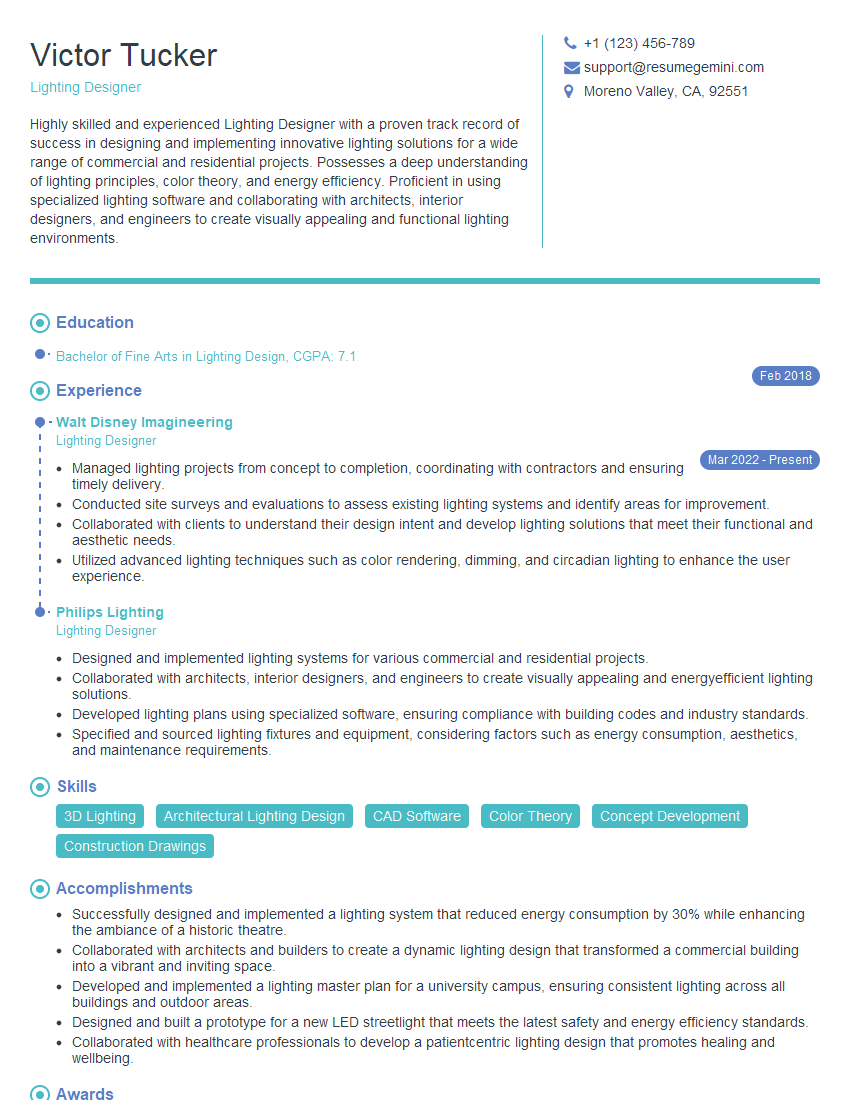
Explore more articles
Users Rating of Our Blogs
Share Your Experience
We value your feedback! Please rate our content and share your thoughts (optional).
What Readers Say About Our Blog
To the interviewgemini.com Webmaster.
Very helpful and content specific questions to help prepare me for my interview!
Thank you
To the interviewgemini.com Webmaster.
This was kind of a unique content I found around the specialized skills. Very helpful questions and good detailed answers.
Very Helpful blog, thank you Interviewgemini team.