The right preparation can turn an interview into an opportunity to showcase your expertise. This guide to Knowledge of Molding Processes interview questions is your ultimate resource, providing key insights and tips to help you ace your responses and stand out as a top candidate.
Questions Asked in Knowledge of Molding Processes Interview
Q 1. Explain the different types of molding processes.
Molding processes encompass various techniques to create parts from raw materials. The choice depends on factors like part complexity, material properties, production volume, and cost. Major categories include:
- Injection Molding: A high-volume process where molten material is injected into a mold cavity under pressure. This is ideal for complex parts with high precision.
- Compression Molding: Material is placed in a heated mold cavity and compressed until it fills the space. This is often used for thermosetting plastics and larger parts.
- Transfer Molding: Similar to compression molding, but the material is preheated and transferred to the mold cavity under pressure, ensuring better consistency.
- Blow Molding: Used primarily for hollow parts like bottles. A heated plastic tube (parison) is inflated inside a mold cavity to form the final shape.
- Rotational Molding: Powdered or liquid plastic is placed in a mold that rotates on multiple axes, distributing the material evenly and then heated to melt and fuse it.
- Thermoforming: A sheet of plastic is heated and then formed into a shape using a mold. This is well-suited for large, shallow parts.
Each process offers unique advantages and limitations. For example, injection molding excels in high-volume, precise parts, while rotational molding is best for large, hollow parts with potentially thicker walls.
Q 2. Describe the injection molding cycle in detail.
The injection molding cycle is a precise sequence of steps:
- Clamping: The mold halves are clamped together tightly to prevent leakage during injection.
- Injection: Molten plastic is injected into the mold cavity under high pressure, filling the space completely.
- Holding/Dwelling: Pressure is maintained for a short period to compensate for shrinkage and ensure complete filling.
- Cooling: The mold and the plastic part are cooled to solidify the material.
- Ejection: Ejector pins within the mold push the finished part out of the cavity.
- Mold Opening: The mold halves separate, allowing for part removal.
The entire cycle is automated and controlled by sophisticated machinery, allowing for consistent part production. Precise control of parameters like injection speed, pressure, and temperature are critical for part quality.
Q 3. What are the common defects found in injection molded parts and their causes?
Several defects can occur in injection molded parts. Here are some common ones and their potential causes:
- Short Shots: Incomplete filling of the mold cavity. Causes: Insufficient injection pressure, low melt temperature, restricted flow, or a clogged nozzle.
- Flash: Excess material that escapes between the mold halves. Causes: Inadequate clamping force, worn mold components, or excessive injection pressure.
- Sink Marks: Depressions on the surface of the part. Causes: Insufficient material, poor cooling, or high part thickness.
- Warping: Distortion of the part after molding. Causes: Uneven cooling, residual stresses, or improper mold design.
- Weld Lines: Visible lines indicating where two flows of molten plastic have merged. Causes: Complex part geometry, inadequate melt flow, or low injection pressure.
Proper process monitoring and mold maintenance are crucial to minimize these defects. Careful selection of molding parameters is equally important.
Q 4. How do you determine the appropriate molding parameters (e.g., temperature, pressure, injection speed)?
Determining optimal molding parameters involves a combination of experience, experimentation, and simulation. Key parameters include:
- Melt Temperature: Too low leads to incomplete flow; too high causes degradation. It’s determined based on the resin’s properties and the part geometry.
- Mold Temperature: Affects the cooling rate and part properties. Lower temperatures provide faster cooling but can increase stresses and warpage.
- Injection Pressure: Sufficient pressure ensures complete filling. Excessive pressure can lead to flash and stress.
- Injection Speed: Controls the fill rate. Too fast can cause excessive shear and stress, while too slow may result in short shots.
- Holding Pressure: Compensates for shrinkage during cooling. Excessive pressure increases stresses.
Process optimization often involves using Design of Experiments (DOE) methodology to systematically vary parameters and observe their impact on part quality. Simulation software can also help predict the flow behavior and potential defects before actual production.
For example, if sink marks are observed, one might increase the melt temperature or injection pressure. Conversely, if flash occurs, clamping force might need to be increased or injection pressure reduced.
Q 5. What are the different types of molding resins and their applications?
A wide variety of molding resins are available, each with unique properties suitable for specific applications:
- Polypropylene (PP): Tough, versatile, and resistant to chemicals; used in containers, automotive parts, and consumer goods.
- Polyethylene (PE): Flexible, durable, and low-cost; used in films, bottles, and packaging.
- Polyvinyl Chloride (PVC): Rigid or flexible, inexpensive, and resistant to weathering; used in pipes, windows, and flooring.
- Acrylonitrile Butadiene Styrene (ABS): Strong, rigid, and impact-resistant; used in automotive parts, electronics housings, and toys.
- Polycarbonate (PC): High impact resistance, transparency, and heat resistance; used in safety glasses, lenses, and automotive parts.
- Nylon (PA): High strength, toughness, and abrasion resistance; used in gears, bearings, and electrical components.
The selection of resin depends on factors such as required strength, stiffness, temperature resistance, chemical resistance, and cost. For example, if high impact resistance is needed, ABS or PC would be suitable; if cost is a major concern, PP or PE might be preferred.
Q 6. Explain the importance of mold design in the molding process.
Mold design is paramount to successful molding. A well-designed mold ensures consistent part quality, high production rates, and efficient manufacturing. Key aspects include:
- Part Geometry: The design must consider flow characteristics, wall thicknesses, draft angles (for easy part removal), and potential stress points.
- Cooling System: Efficient cooling is crucial to avoid warping and ensure consistent cycle times. Internal cooling channels are often incorporated into the mold.
- Ejector System: This ensures reliable part ejection without damage. The placement and design of ejector pins are crucial.
- Gate and Runner System: The gate controls material flow into the cavity, while the runner channels the material from the sprue to the gate. The design must minimize flow restrictions and pressure drops.
- Material Selection: Mold materials must be chosen based on their durability, wear resistance, and compatibility with the molding resin.
Poor mold design can lead to various defects like warping, short shots, and flash, significantly impacting part quality and production efficiency. Advanced CAD software and simulation tools are frequently used to optimize mold design.
Q 7. Describe your experience with mold maintenance and troubleshooting.
My experience with mold maintenance and troubleshooting includes proactive measures like regular inspections, preventative maintenance schedules (e.g., polishing mold surfaces, replacing worn components), and meticulous record-keeping of mold performance data. When issues arise, I utilize a systematic troubleshooting approach:
- Identify the Defect: Thoroughly examine the molded parts to pinpoint the defect (e.g., flash, short shots, sink marks).
- Analyze the Process Parameters: Review the molding parameters (temperature, pressure, speed) to see if any deviations exist.
- Inspect the Mold: Check for wear, damage, or contamination of mold components (e.g., cracks, scratches, build-up of resin).
- Implement Corrective Actions: Based on the analysis, adjust process parameters or repair/replace mold components as needed.
- Document the Findings: Maintain detailed records of the defect, root cause, and corrective actions taken.
For instance, I once resolved repeated instances of flash by carefully inspecting the mold and identifying a slightly warped clamping plate. Replacing the plate resolved the issue immediately. This methodical approach ensures efficient troubleshooting and minimized downtime.
Q 8. How do you ensure the quality of molded parts?
Ensuring the quality of molded parts is a multifaceted process that begins even before the molding machine starts. It involves meticulous planning, rigorous process control, and comprehensive inspection. We need to consider the entire value stream, from raw material selection to the final product.
- Material Selection and Testing: We start by carefully selecting raw materials, ensuring they meet the required specifications. This includes testing for things like melt flow index, moisture content, and additives. Inconsistencies in the raw material can directly impact part quality.
- Mold Design and Manufacturing: A well-designed mold is crucial. This requires expertise in mold flow analysis to predict potential issues like warping, sink marks, or short shots. Precise machining and regular maintenance of the mold are also essential.
- Process Parameter Control: This is where monitoring and controlling the molding process is key. Parameters like injection pressure, melt temperature, mold temperature, and cycle time must be carefully controlled and documented. Variations can lead to defects. Think of it like baking a cake; you need the right ingredients and the perfect temperature.
- In-Process Inspection: Regular checks during the molding process are critical. We visually inspect parts for obvious defects and periodically use dimensional measuring equipment to ensure parts conform to specifications.
- Final Inspection: This usually involves thorough visual and dimensional inspection, sometimes augmented by destructive testing (e.g., tensile strength tests) to verify material properties and part integrity. We often use automated vision systems for high-volume production.
By implementing a robust quality control system with these elements, we can minimize defects, reduce waste, and ensure our molded parts meet the highest quality standards.
Q 9. What are your experiences with statistical process control (SPC) in molding?
Statistical Process Control (SPC) is fundamental to maintaining consistent quality in molding. I’ve extensively used SPC techniques to monitor and control critical process parameters. This involves collecting data on key variables, plotting them on control charts (like X-bar and R charts or individual and moving range charts), and analyzing the data for trends and patterns.
For example, I used SPC to monitor melt temperature during the production of a complex automotive part. By plotting the temperature data over time, we identified a slight upward trend. This subtle variation might have eventually led to warping or other defects. We addressed the issue by adjusting the heating system and promptly brought the process back under control. This prevented thousands of potentially defective parts from being produced.
Another application was in analyzing cycle time variations. By studying control charts, we identified sources of variation and implemented process improvements that reduced cycle time and increased production efficiency. SPC isn’t just about detecting problems; it’s a proactive approach to continuous improvement.
Q 10. Explain the concept of cycle time reduction in molding.
Cycle time reduction in molding involves optimizing the entire molding process to decrease the time it takes to complete one molding cycle. This boosts productivity and reduces manufacturing costs. It’s a crucial aspect of competitiveness in the industry.
- Mold Design Optimization: A well-designed mold with efficient cooling channels and optimized gating systems is essential. Shorter cooling times significantly impact the cycle time.
- Process Parameter Optimization: Fine-tuning parameters like injection speed, pressure, and holding pressure can reduce the overall cycle time without compromising part quality.
- Automation: Automating tasks such as part ejection, material handling, and robotic part placement can drastically reduce cycle time, especially in high-volume production.
- Material Selection: Selecting materials with faster cooling rates can contribute to cycle time reduction.
- Preventive Maintenance: Regular maintenance of the molding machine and mold prevents unexpected downtime, allowing for more consistent cycle times.
For instance, in one project, we reduced cycle time by 15% by optimizing the cooling system in the mold and implementing a more efficient robotic part removal system. This translated to significant cost savings and increased production output.
Q 11. How do you troubleshoot common molding issues, such as short shots, flash, or sink marks?
Troubleshooting molding issues requires a systematic approach. Let’s look at some common problems:
- Short Shots: This is where the molten plastic doesn’t completely fill the mold cavity. Causes include insufficient injection pressure, low melt temperature, restricted flow paths, or leaks in the mold. Troubleshooting involves checking the injection pressure, melt temperature, and mold venting, as well as inspecting the mold for any restrictions or damage.
- Flash: Flash is excess material that squeezes out between the mold halves. It results from excessive clamping force, excessive injection pressure, or poor mold fit. Solutions include adjusting clamping force and injection pressure, inspecting and repairing the mold, and ensuring proper mold alignment.
- Sink Marks: These are indentations on the surface of the part, often caused by insufficient material in thicker sections. They arise from uneven cooling and shrinkage. Addressing this often involves redesigning the part to minimize thick sections, optimizing the cooling system, or adjusting the injection parameters.
My approach is to methodically investigate each potential cause. I begin by visually inspecting the part and the mold, and then systematically check and adjust process parameters. If the problem persists, I may consult mold flow analysis software to identify root causes and guide corrective actions.
Q 12. What are your experiences with different types of molding machines?
My experience encompasses a range of molding machines, from smaller, all-electric machines suitable for precision parts to large hydraulic machines used for high-volume production. I’m familiar with various types, including:
- Hydraulic Injection Molding Machines: These are commonly used for high-tonnage applications and offer versatility but may have higher energy consumption compared to electric machines.
- All-Electric Injection Molding Machines: These machines offer precise control, energy efficiency, and low maintenance costs. They are particularly useful for applications requiring high precision.
- Two-Platoon Injection Molding Machines: These machines enable higher productivity by using two molds, significantly reducing cycle time.
In one project, we transitioned from hydraulic to all-electric machines to improve the precision and consistency of a medical device component. The resulting improvements in part quality and reduced energy costs justified the investment.
Q 13. Describe your experience with mold flow analysis software.
Mold flow analysis (MFA) software is an invaluable tool for predicting potential molding problems and optimizing the molding process *before* production begins. I have extensive experience using several leading MFA packages. The software simulates the flow of molten plastic into the mold cavity, enabling us to visualize factors like fill time, pressure distribution, weld lines, and potential areas for defects like sink marks or warping.
For example, in a recent project involving a complex geometry part, MFA software helped us identify a potential problem with air trapping in a certain area of the mold. By modifying the gate location and runner design based on the simulation results, we avoided the production of defective parts. This significantly reduced material waste and expedited the project timeline.
MFA isn’t a replacement for practical experience, but it is a powerful predictive tool that enhances our understanding of the molding process and allows us to make informed decisions that improve efficiency and quality.
Q 14. How do you manage material inventory in a molding environment?
Material inventory management in a molding environment is crucial for ensuring uninterrupted production and minimizing waste. It’s a delicate balance between having enough material on hand to meet production demands and avoiding excessive inventory storage costs.
- Demand Forecasting: Accurate demand forecasting is essential to predict material needs. This helps avoid material shortages and prevents excess inventory buildup.
- Inventory Tracking: A robust inventory tracking system allows us to monitor material levels, track usage rates, and identify potential shortages in advance.
- Supplier Relationships: Strong relationships with reliable suppliers are vital for ensuring timely material delivery and managing potential supply chain disruptions.
- Storage and Handling: Proper storage conditions are essential to prevent material degradation or contamination. This includes maintaining appropriate temperature and humidity levels and using appropriate handling techniques.
- FIFO (First-In, First-Out): Implementing a FIFO system ensures that older materials are used first, reducing the risk of material degradation and obsolescence.
Implementing a well-defined inventory management system, often leveraging ERP or MRP software, enables us to optimize material flow, reduce waste, and ensure the smooth operation of the molding process.
Q 15. What are your experiences with different types of gating systems?
Gating systems are crucial in injection molding, controlling how molten plastic enters the mold cavity. My experience encompasses a wide range, from simple to complex designs.
- Sprue, Runner, and Gate Systems: These are the most common, with the sprue acting as the main channel, runners distributing the melt, and gates controlling flow into individual cavities. I’ve worked extensively optimizing runner layouts to minimize pressure drops and ensure consistent filling. For example, in a project producing intricate medical components, a balanced runner system was key to achieving uniform wall thickness.
- Hot Runner Systems: These eliminate runners and gates by individually injecting material directly into each cavity. I’ve implemented these in high-volume production runs of small parts, where the significant material savings and reduced cycle times offset the initial higher investment. A specific instance involved manufacturing bottle caps – the hot runner system significantly boosted production efficiency.
- Cold Runner Systems: These require the runners to be cut away from the finished parts post-molding, resulting in material waste. While less efficient, they can be more cost-effective for lower volume productions or complex parts where hot runner systems are difficult to design and maintain. I’ve used these for prototyping and short-run projects.
- Submarine Gating: In this system, the gate is submerged within the part and is usually less noticeable than other gating systems. I found this particularly useful in high-aesthetic applications where gate vestige removal was important.
My experience allows me to select the optimal gating system based on factors such as part geometry, material properties, production volume, and cost considerations.
Career Expert Tips:
- Ace those interviews! Prepare effectively by reviewing the Top 50 Most Common Interview Questions on ResumeGemini.
- Navigate your job search with confidence! Explore a wide range of Career Tips on ResumeGemini. Learn about common challenges and recommendations to overcome them.
- Craft the perfect resume! Master the Art of Resume Writing with ResumeGemini’s guide. Showcase your unique qualifications and achievements effectively.
- Don’t miss out on holiday savings! Build your dream resume with ResumeGemini’s ATS optimized templates.
Q 16. Explain the importance of proper ventilation in a molding facility.
Proper ventilation in a molding facility is paramount for both worker safety and equipment performance. Molding processes often release volatile organic compounds (VOCs), such as styrene, from the plastic materials. These compounds can be harmful if inhaled in high concentrations and can also create a fire hazard.
Adequate ventilation systems must remove these VOCs and ensure fresh air circulation. This typically involves a combination of:
- Local Exhaust Ventilation (LEV): This focuses on capturing emissions at their source, like directly above the injection molding machine.
- General Ventilation: This provides overall air circulation within the facility to dilute any remaining VOCs.
Beyond VOCs, adequate ventilation also helps control temperature and humidity, preventing mold growth and improving worker comfort. In one project, I collaborated with the safety officer to implement a real-time VOC monitoring system alongside the ventilation system, providing immediate alerts and enabling proactive adjustments to maintain safe working conditions. Failing to maintain adequate ventilation can result in serious health issues for workers and potentially damage the equipment, making it a critical factor in facility operation.
Q 17. What are your experiences with automation in the molding process?
Automation has revolutionized the molding process, significantly improving efficiency, consistency, and safety. My experience spans various levels of automation:
- Robotic Integration: I’ve integrated robots for tasks like part removal, material handling, and machine tending. This frees up human operators for higher-level tasks and reduces manual labor, leading to reduced errors and improved output.
- Automated Material Handling: Automated systems for conveying raw materials to the machine and transporting finished parts to storage improve efficiency and reduce the potential for manual handling errors.
- Process Monitoring and Control: Automated systems for monitoring parameters such as temperature, pressure, and injection speed, allow for real-time adjustments and prevent defects. In one case, implementing a closed-loop control system significantly improved the consistency of part dimensions.
- Predictive Maintenance: Using sensors and data analysis to predict equipment failures enables proactive maintenance, minimizing downtime and ensuring continuous production.
The choice of automation level depends on factors like production volume, part complexity, and budget. However, the return on investment in automation is often significant in terms of both cost reduction and improved product quality.
Q 18. How do you ensure the safety of personnel in a molding environment?
Ensuring personnel safety is paramount in a molding environment. This involves a multi-faceted approach:
- Lockout/Tagout Procedures (LOTO): Strict adherence to LOTO procedures before performing any maintenance or repair work on machinery is crucial to prevent accidental start-ups. I’ve implemented and overseen rigorous LOTO training programs to ensure all personnel understand and follow procedures.
- Personal Protective Equipment (PPE): Providing and enforcing the use of appropriate PPE, including safety glasses, hearing protection, and heat-resistant gloves, minimizes the risk of injury. Regular PPE inspections are vital.
- Emergency Shutdown Systems: Ensuring easily accessible and well-maintained emergency stop buttons and other safety systems is essential. I’ve participated in safety audits focusing on emergency procedures and system functionality.
- Machine Guarding: All moving parts of machinery must be properly guarded to prevent accidental contact. Regular inspections of machine guarding are vital.
- Training and Education: Comprehensive training programs covering safety procedures, hazard recognition, and emergency response are critical for all personnel. Ongoing refreshers are important to maintain awareness.
A strong safety culture, fostered through regular safety meetings, incident reporting, and proactive hazard identification, is the foundation for a safe molding environment. In my experience, investing time in training and reinforcing safety protocols pays significant dividends in accident prevention.
Q 19. Explain your experience with root cause analysis in a molding process.
Root cause analysis (RCA) is critical in resolving molding process issues and preventing recurrence. My approach generally follows a structured methodology, such as the 5 Whys, Fishbone diagrams, or Fault Tree Analysis.
For example, encountering consistent sink marks on a particular part, I’d systematically investigate:
- Data Collection: Gather data on the affected parts, including location, size, and frequency of the defects.
- 5 Whys Analysis: Repeatedly ask “Why?” to delve deeper into the root cause: Why are there sink marks? Because of insufficient material flow. Why insufficient flow? Because of a restricted gate. Why restricted gate? Because of a small gate size. Why a small gate size? Because of an outdated mold design.
- Corrective Actions: Based on the identified root cause, implement corrective actions such as modifying the gate size, adjusting injection parameters, or redesigning the mold. In the sink mark scenario, adjusting the gate size and injection pressure resolved the issue.
- Verification: Once the corrective actions are implemented, verify their effectiveness by monitoring production output.
- Documentation: Documenting the entire RCA process, including the root cause, corrective actions, and verification results, allows for continuous improvement and prevents similar issues in the future.
Effective RCA requires a combination of technical expertise, problem-solving skills, and a methodical approach. I’ve found that a collaborative approach, involving engineers, operators, and quality control personnel, leads to more comprehensive and effective solutions.
Q 20. What are your experiences with different types of mold materials?
Mold materials must be chosen carefully to withstand the harsh conditions of the molding process and to meet the specific requirements of the application. My experience includes working with various materials:
- Tool Steel: High-strength tool steels, such as P20, H13, and S7, are commonly used for molds due to their excellent wear resistance, hardenability, and machinability. The choice of steel depends on the production volume and part complexity. For example, P20 is suitable for lower-volume applications, while H13 is used for higher-volume production of more demanding parts.
- Aluminum: Aluminum alloys are often used for prototyping and low-volume production runs due to their lower cost and faster machining times. However, they have lower wear resistance compared to steel.
- BeCu (Beryllium Copper): This material offers excellent electrical conductivity, making it suitable for molds used in electrical component manufacturing.
- Maraging Steel: This is used for high-precision molds that demand exceptional dimensional accuracy and stability.
The selection of the mold material also depends on factors such as the molding temperature, material being molded, and the desired mold life. In practice, careful consideration of these factors, coupled with understanding the strengths and weaknesses of each material, is essential for successful mold design and manufacturing.
Q 21. How do you select the right type of mold for a specific application?
Selecting the right mold for a specific application requires careful consideration of several factors:
- Part Geometry: The complexity of the part, including undercuts, ribs, and draft angles, dictates the mold design and complexity. Simple parts can be molded with simpler, less expensive molds, while complex parts require more intricate designs.
- Material Properties: The properties of the plastic material to be molded, such as melting point, viscosity, and shrinkage, significantly influence the mold design. Materials with high shrinkage require more careful consideration of mold dimensions to minimize warpage.
- Production Volume: The required production volume directly impacts the choice between single-cavity or multi-cavity molds. High-volume production usually justifies the cost of a multi-cavity mold for increased output.
- Budget: Mold costs can vary significantly depending on the material, complexity, and features. Balancing cost with production needs is essential.
- Mold Life: The expected lifespan of the mold is a crucial factor. Materials known for durability, design and proper maintenance affect mold longevity.
In selecting the right mold, I often utilize a decision matrix, weighing the various factors against each other to arrive at the optimal solution. For example, a high-volume production run of a simple part would favor a multi-cavity mold made from a durable tool steel, while prototyping a complex part might necessitate a single-cavity aluminum mold.
Q 22. What are your experiences with different types of runners and sprues?
Runners and sprues are crucial elements in injection molding, responsible for delivering molten plastic from the machine to the mold cavity. My experience encompasses various types, each with its own advantages and disadvantages.
Hot Runner Systems: These systems keep the plastic molten within the runner system, eliminating the need for a sprue and runner that would later need to be removed. This leads to less material waste and faster cycle times. I’ve worked extensively with both valve-gated and hot manifold systems, optimizing gate locations for minimal weld lines and improved part quality. For example, in a project involving complex medical devices, we switched from a cold runner to a valve-gated hot runner system, reducing material waste by 15% and improving cycle time by 10%.
Cold Runner Systems: In these systems, the plastic in the runner solidifies, and this solidified plastic needs to be removed from the finished part. These are simpler and often less expensive upfront, but result in greater material waste. I’ve used different configurations, including single-point and multi-point gates, choosing the optimal design based on part geometry and material properties. A project involving large plastic containers benefitted from a carefully designed cold runner system optimized to minimize stress concentrations during ejection.
Submarine Sprue Bushings: These are used for improved mold strength and easier sprue removal in some mold designs, offering a more streamlined process. I’ve encountered situations where this type of sprue design proved beneficial in reducing mold damage caused by repetitive ejection and insertion.
Selecting the right runner and sprue system is critical for efficiency and part quality. The choice depends on factors like part complexity, production volume, material type, and cost considerations. My expertise allows me to evaluate these factors and make informed decisions for each project.
Q 23. Explain the importance of proper cooling in the molding process.
Proper cooling is paramount in injection molding; it directly impacts the mechanical properties, dimensional accuracy, and cycle time of the molded parts. Inadequate cooling can lead to warping, sink marks, residual stresses, and even part failure.
The cooling process involves controlling the temperature of the mold to rapidly solidify the molten plastic. This is typically achieved through strategically placed cooling channels within the mold. I’ve extensively worked with different cooling channel designs, including spiral, serpentine, and pin-type channels. The optimal design depends on factors such as part geometry, material properties, and desired cycle time.
For instance, in a project involving thin-walled parts, I implemented a specialized cooling channel design that enhanced cooling efficiency, reducing the cycle time by 20% without compromising part quality. Conversely, in projects requiring specific material properties, careful temperature control was crucial to avoid internal stresses or warping. I’ve utilized thermal analysis software to simulate cooling behavior, optimizing the cooling system for optimal part quality and production efficiency.
Monitoring cooling system performance is an ongoing process. Accurate temperature monitoring and control are vital. I’ve successfully implemented real-time monitoring systems to detect anomalies, allowing for proactive adjustments and preventing production issues.
Q 24. How do you ensure the dimensional accuracy of molded parts?
Ensuring dimensional accuracy is crucial for the success of any molding project. It involves a multi-faceted approach encompassing mold design, material selection, and process parameters. In my experience, this is achieved by combining precise mold tooling, strict process control, and ongoing monitoring and adjustments.
Mold Design: Precise CAD modeling and machining ensure that the mold cavity precisely matches the part’s specifications. This includes careful consideration of shrinkage factors for the specific material and process conditions. I’ve used advanced CAD/CAM software to create highly accurate mold designs, minimizing the need for later adjustments.
Material Selection: Selecting the right material is crucial. Different materials have different shrinkage characteristics, requiring adjustments in the mold design. My experience includes working with various plastics and elastomers, understanding their material properties and how they impact shrinkage and dimensional stability.
Process Parameters: Accurate control of parameters like injection pressure, melt temperature, and mold temperature is essential for consistent results. I use statistical process control (SPC) methods to monitor and maintain tight tolerances during production runs. For example, using control charts to monitor part dimensions, helps to identify and resolve issues promptly.
Regular Inspection: Ongoing dimensional checks with precision measuring equipment like CMM (Coordinate Measuring Machine) are essential to ensure that parts stay within specified tolerances.
By meticulously managing these factors, we can consistently produce molded parts that meet the stringent dimensional accuracy required in many industries, including automotive, aerospace and medical device manufacturing.
Q 25. What are your experiences with different types of ejection systems?
Ejection systems are vital for removing molded parts from the mold cavity without damaging them. My experience includes various ejection system types, each selected based on part geometry and material characteristics.
Ejector Pins: The most common type, ejector pins push the part out of the cavity. I’ve used various configurations, including single and multiple pins, to address complex part geometries. Careful pin placement and design is crucial to avoid damage.
Slide Mechanisms: For intricate or undercuts, slide mechanisms are employed to allow parts with complex shapes to be removed. I’ve worked with various slider configurations to efficiently eject parts with side pulls or internal cavities.
Stripper Plates: Used to strip parts from the cores in molds with inserts, these ensure that parts are removed cleanly without damage. Proper design and lubrication are essential to avoid scratching or deformation of the parts.
Air Ejection: In some cases, air ejection provides a gentle, yet effective way to remove parts. I’ve applied pneumatic ejection systems for sensitive or delicate parts requiring minimal force.
Choosing the right ejection system is crucial to prevent part damage and maintain production efficiency. A poorly designed ejection system can result in significant downtime and part defects. I always carefully evaluate the part design and material properties before selecting the most appropriate ejection system.
Q 26. Explain your experience with process optimization in molding.
Process optimization in molding is an ongoing endeavor focused on improving efficiency, reducing costs, and enhancing part quality. My approach is data-driven, relying on a combination of process monitoring, statistical analysis, and design of experiments (DOE).
A typical optimization process starts with a thorough understanding of the current process. This involves collecting data on key process parameters like injection pressure, melt temperature, mold temperature, and cycle time. We then utilize statistical methods, such as control charts, to identify areas for improvement. DOE methodologies allow for a systematic investigation of the influence of different parameters on the output variables (part quality, cycle time, material waste).
For example, in a project involving a specific part exhibiting excessive warpage, I employed a DOE study to systematically examine the effects of injection speed, mold temperature, and holding pressure on part distortion. This led to adjustments in the process parameters, which resulted in a 75% reduction in warpage. Software simulations can assist in this, allowing for the prediction of changes before being implemented on the production floor.
Continuous improvement is key. Regular monitoring, data analysis, and implementation of adjustments are critical for sustained improvement in the molding process. This might include implementing new technologies, improving tooling, or fine-tuning the process parameters.
Q 27. Describe your familiarity with different types of mold bases.
Mold bases are the foundation of an injection mold, providing structural support for the mold components. My experience spans various types, each with its own strengths and limitations.
Standard Mold Bases: These are the most common type and offer a cost-effective solution for simpler molds. I’ve used these extensively in high-volume production runs, opting for robust designs to withstand the rigors of continuous operation.
Modular Mold Bases: These bases consist of standardized components, simplifying assembly and maintenance. The modular approach facilitates faster mold construction and reduces tooling costs. I’ve successfully implemented modular mold bases in projects requiring frequent design changes or short lead times.
Churchill Mold Bases: This type offers a very robust design and are often chosen when high clamping forces are needed, like with large or thick parts. Their inherent strength has proven invaluable when processing highly viscous materials.
Specialty Mold Bases: For specialized applications, such as overmolding or multi-component molding, I’ve worked with customized mold bases designed to meet specific requirements.
The choice of mold base depends on factors like mold size, part complexity, production volume, and budget. Selecting the appropriate base is crucial for the longevity and performance of the mold. A well-chosen mold base minimizes maintenance and ensures consistent part quality. A poorly chosen base can lead to premature mold failure, extensive downtime, and increased costs.
Q 28. What is your experience with implementing and maintaining a preventative maintenance program for molding equipment?
A preventative maintenance (PM) program is essential for ensuring the longevity and reliable performance of molding equipment. I have extensive experience in implementing and maintaining such programs, which focus on proactive measures to prevent equipment failures and reduce downtime.
A comprehensive PM program includes regular inspections, lubrication, cleaning, and replacement of worn parts. This involves establishing a schedule of routine maintenance tasks, assigning responsibilities, and tracking performance. I’ve used computerized maintenance management systems (CMMS) to effectively schedule and track these tasks, improving efficiency and reducing the risk of overlooking crucial steps.
For example, I implemented a PM program that included regular lubrication of the injection unit, timely replacement of wear parts, and regular inspections of the clamping unit. This resulted in a significant reduction in unscheduled downtime and increased the lifespan of the molding equipment. We also established a system for recording and analyzing maintenance data, which allowed us to identify potential problem areas and adjust the PM schedule accordingly. This data-driven approach is crucial for continuous improvement in the maintenance process.
Effective communication and training are essential components of a successful PM program. I’ve established clear procedures and provided comprehensive training to the maintenance team, ensuring that everyone understands their responsibilities and can effectively carry out the maintenance tasks. This collaborative approach is vital to ensure consistent and reliable equipment performance.
Key Topics to Learn for Knowledge of Molding Processes Interview
- Injection Molding: Understand the process, machine components, material selection criteria, and common defects like sink marks, short shots, and warping. Consider practical applications across different industries (automotive, consumer goods, medical).
- Compression Molding: Learn the differences from injection molding, focusing on material properties suitable for this method, cycle times, and typical applications (rubber, thermosets).
- Thermoforming: Explore the various thermoforming techniques (vacuum, pressure, etc.), suitable plastics, and the design considerations for successful thermoforming.
- Mold Design & Engineering: Grasp fundamental mold design principles, including gating systems, cooling channels, and ejection mechanisms. Understand the role of CAD/CAM software in mold design.
- Material Selection: Develop a strong understanding of different polymer types and their properties relevant to molding. Know how to choose the right material based on application requirements.
- Process Optimization & Troubleshooting: Learn techniques for optimizing molding processes to improve efficiency and reduce defects. Be prepared to discuss common problems and their solutions.
- Quality Control & Testing: Familiarize yourself with quality control measures in molding, including dimensional inspection, material testing, and statistical process control (SPC).
- Safety Procedures & Regulations: Demonstrate awareness of safety protocols and industry regulations related to molding processes and machinery.
Next Steps
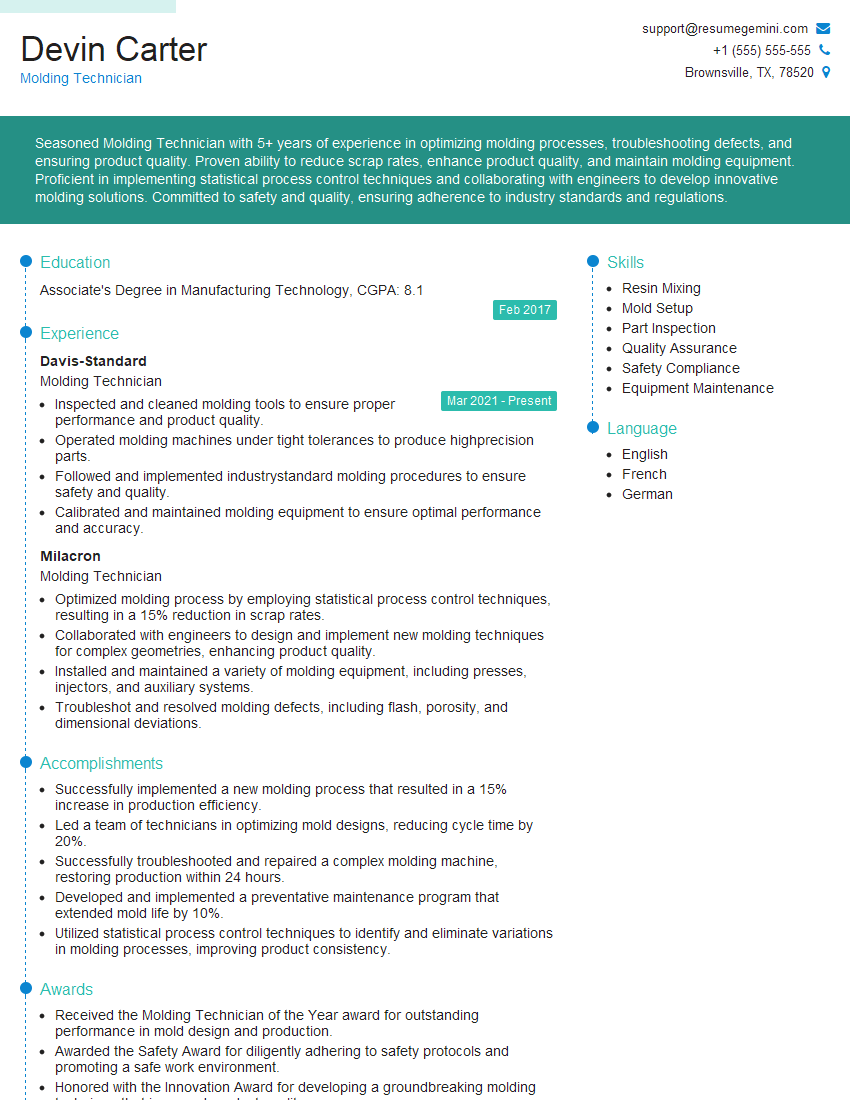
Mastering Knowledge of Molding Processes is crucial for advancing your career in manufacturing and related fields. A strong understanding of these processes opens doors to exciting opportunities and higher earning potential. To significantly boost your job prospects, crafting a compelling and ATS-friendly resume is essential. ResumeGemini is a trusted resource that can help you build a professional resume showcasing your skills and experience effectively. We provide examples of resumes tailored to highlight expertise in Knowledge of Molding Processes to help you get started.
Explore more articles
Users Rating of Our Blogs
Share Your Experience
We value your feedback! Please rate our content and share your thoughts (optional).
What Readers Say About Our Blog
To the interviewgemini.com Webmaster.
Very helpful and content specific questions to help prepare me for my interview!
Thank you
To the interviewgemini.com Webmaster.
This was kind of a unique content I found around the specialized skills. Very helpful questions and good detailed answers.
Very Helpful blog, thank you Interviewgemini team.