The right preparation can turn an interview into an opportunity to showcase your expertise. This guide to Knowledge of seismic codes and standards interview questions is your ultimate resource, providing key insights and tips to help you ace your responses and stand out as a top candidate.
Questions Asked in Knowledge of seismic codes and standards Interview
Q 1. Explain the difference between IBC and ASCE 7 seismic codes.
The International Building Code (IBC) and the ASCE 7 Minimum Design Loads and Associated Criteria for Buildings and Other Structures are both crucial for seismic design, but they have distinct roles. Think of it like this: the IBC is the overarching building code, setting the general requirements and referencing other standards for specific aspects like seismic design. ASCE 7, on the other hand, is the detailed standard that provides the specific procedures and calculations for determining seismic forces on structures. The IBC mandates adherence to ASCE 7 for seismic design, essentially adopting its technical provisions. In simpler terms, the IBC tells you *what* to do (meet seismic requirements), while ASCE 7 tells you *how* to do it (calculate seismic loads and design accordingly).
For example, the IBC might specify that a building in a high seismic zone must meet certain drift limits. ASCE 7 provides the detailed methodology for determining the seismic forces that cause those drifts and how the structure should be designed to resist them. It outlines the procedures for site-specific seismic hazard analysis, which are then used to determine design parameters used in the overall structural design per IBC requirements.
Q 2. Describe your experience with seismic hazard analysis.
My experience in seismic hazard analysis encompasses a wide range of projects, from small residential buildings to large, complex infrastructure projects. I’ve utilized various software packages, including (but not limited to) ETABS, SAP2000, and PERFORM-3D, to conduct probabilistic and deterministic seismic hazard analyses. This includes developing ground motion records for use in time-history analysis, using both geographically-specific and spectral matching approaches. A recent project involved developing site-specific response spectra for a high-rise building in a seismically active region. This involved analyzing geological data, performing ground response analyses, and developing site-specific design spectra in accordance with ASCE 7.
I’ve also been involved in evaluating the seismic performance of existing structures, which often requires investigating historical seismic data and employing advanced nonlinear analysis techniques to assess their vulnerability to future earthquakes. This includes developing fragility curves to assess the probability of damage exceeding specific thresholds. Throughout my career, accuracy and adherence to industry best practices have always been paramount to ensuring the safety and resilience of the structures I’ve worked on.
Q 3. How do you determine the seismic design category of a building?
The seismic design category (SDC) of a building is determined based on its occupancy category, the seismic zone in which it is located, and the soil conditions at the site. It’s a crucial step as the SDC directly influences the level of seismic forces applied in the design. The process generally involves:
- Identifying Occupancy Category: This is defined in ASCE 7 based on the intended use of the building (e.g., residential, educational, healthcare). Different occupancy categories have different importance factors, reflecting the potential consequences of failure.
- Determining Seismic Zone: ASCE 7 maps the United States into various seismic zones based on historical earthquake activity and geological characteristics. The higher the zone number, the higher the seismic hazard.
- Classifying Site Soil Conditions: Soil properties significantly affect ground shaking during an earthquake. ASCE 7 provides a classification system based on shear wave velocity and other soil parameters. Softer soils generally amplify ground motion.
- Consulting ASCE 7 Tables: Using the occupancy category, seismic zone, and site soil classification, appropriate tables within ASCE 7 are consulted to directly determine the SDC. This is a straightforward look-up procedure.
For example, a hospital in a high seismic zone with soft soil conditions will likely have a higher SDC compared to a single-family home in a low seismic zone with stiff soil.
Q 4. What are the different methods for seismic analysis?
Several methods exist for seismic analysis, each with its own level of complexity and accuracy. The choice depends on factors like the building’s size, complexity, and the required level of detail. Common methods include:
- Equivalent Lateral Force Procedure (ELF): This is a simplified method suitable for regular, low-to-mid-rise buildings. It approximates the seismic forces as equivalent lateral forces applied at different levels of the structure. It’s less computationally intensive but less accurate than other methods.
- Modal Response Spectrum Analysis (MRSA): A more sophisticated method that considers the dynamic characteristics of the structure, including its natural frequencies and mode shapes. It accounts for the response across multiple modes of vibration, providing a more accurate estimate of seismic forces than ELF.
- Time History Analysis (THA): The most complex and accurate method. It involves simulating the building’s response to a set of recorded ground motions (earthquake records). This accounts for nonlinear behavior and soil-structure interaction effects. THA is commonly used for critical structures or those with irregular configurations.
- Pushover Analysis: A nonlinear static procedure used to estimate the building’s capacity and assess its potential for collapse. It involves applying increasing lateral loads to a simplified model of the structure until failure is predicted. Used for performance-based design.
The selection of the most appropriate analysis method is crucial for ensuring the safety and performance of the structure under seismic loads and is often dictated by the complexity of the structure and code requirements.
Q 5. Explain the concept of base shear and how it’s calculated.
Base shear is the total horizontal force acting at the base of a structure due to an earthquake. It’s a fundamental parameter in seismic design, representing the overall seismic demand on the building. The calculation of base shear involves several steps:
- Determining the seismic base shear coefficient (V): This coefficient depends on the seismic design category (SDC), the importance factor of the building, the soil conditions, and the building’s fundamental period (T). These parameters are all obtained from ASCE 7.
- Calculating the building’s weight (W): This is the total dead load and specified live load of the structure. It is then adjusted for seismic factors in some cases.
- Applying the formula: The base shear (V) is calculated using the formula V = CsW, where Cs is the seismic response coefficient (obtained from ASCE 7 using parameters above) and W is the total weight of the structure.
This calculated base shear is then distributed along the height of the building using appropriate procedures prescribed in ASCE 7 to determine the lateral forces acting at each floor level. The base shear acts as the ultimate seismic force used in the design of the structural system.
Q 6. What are the key design considerations for seismic detailing of reinforced concrete structures?
Seismic detailing of reinforced concrete structures is critical for ensuring their ability to withstand earthquake forces. Key design considerations include:
- Confinement of Columns: Providing adequate confinement reinforcement (ties) to prevent brittle failure of concrete columns under shear and compression. This is crucial for maintaining column strength and ductility during seismic events.
- Ductile Beam-Column Joints: Designing joints with sufficient flexural and shear capacity to prevent premature failure. This often involves special detailing such as confinement hoops around the column and proper anchorage of the beams.
- Shear Walls: Incorporating shear walls, which are stiff elements designed to resist lateral forces. These are particularly effective in resisting earthquake-induced shear forces.
- Adequate Development Length: Ensuring sufficient embedment length of reinforcing bars to guarantee proper stress transfer between concrete and steel. Insufficient development length can result in bar pullout failure during seismic events.
- Minimum Concrete Cover: Using enough concrete cover around reinforcement to protect it from corrosion and ensure adequate bond.
- Avoiding Brittle Elements: Minimizing the use of elements prone to brittle failure, such as unreinforced masonry.
These detailing requirements are explicitly defined in seismic design codes like ACI 318 and are critical for the life safety and structural integrity of the building in seismic conditions.
Q 7. How do you account for soil-structure interaction in seismic design?
Soil-structure interaction (SSI) refers to the influence of the soil on the dynamic response of a structure during an earthquake. Ignoring SSI can lead to inaccurate estimations of seismic demands and potentially unsafe designs. Accounting for SSI involves:
- Soil Characterization: Thorough investigation of soil properties, including shear wave velocity, damping ratio, and density. This is typically achieved through geotechnical investigations.
- SSI Analysis: Employing specialized software and techniques to model the interaction between the structure and the soil. This may include substructure modeling that represents the soil mass and its interactions with the foundation.
- Modified Response Spectra: Using the results of the SSI analysis to modify the design response spectra, thus obtaining more realistic seismic inputs that incorporate soil effects.
- Foundation Design: Optimizing the foundation design to minimize detrimental SSI effects. This might include using deep foundations or other strategies to improve the structure’s resistance to soil-induced vibrations.
For example, a structure on soft soil will experience amplified ground motion compared to one on stiff soil. Accounting for SSI ensures that the design adequately addresses these amplified effects, preventing potential structural failure.
Q 8. What are the common types of structural failures observed during earthquakes?
Earthquake-induced structural failures are sadly common and vary greatly depending on factors like building type, age, construction methods, and the intensity of the shaking. Some frequently observed failures include:
Foundation failures: These can range from simple cracking to complete collapse, often caused by soil liquefaction or lateral spreading. Imagine a building’s foundation as its feet; if the ground beneath moves unpredictably, the building is at risk of falling.
Column failures: Columns are vertical supports; their failure, often due to buckling or shear, can lead to partial or complete building collapse. Think of columns as the backbone of a structure – if they fail, the whole thing is compromised.
Beam failures: Beams are horizontal supports; their failure, typically through bending or shear, can cause floor or roof collapse. They’re like the building’s arms, supporting the weight above.
Wall failures: Infilling walls, particularly in older buildings, are prone to cracking and collapse due to out-of-plane loading from the earthquake. Think of them as the building’s skin; their failure leaves the structure vulnerable.
Connection failures: The connections between different structural elements are crucial; weak or improperly designed connections can lead to catastrophic failures. These are the joints holding the entire system together – the weakest link will always break first.
Understanding these failure modes is critical in designing and retrofitting structures to withstand seismic activity.
Q 9. Explain your experience with seismic retrofitting projects.
I have extensive experience in seismic retrofitting projects, encompassing a wide range of building types and scales. For instance, I led a project to retrofit a mid-rise office building constructed in the 1970s. This building lacked adequate shear walls and had weak connections between the columns and beams. Our approach involved adding steel bracing to strengthen the existing frame, upgrading the foundation, and installing base isolation systems. We carefully documented each stage, including detailed assessments before and after the retrofitting, and ensured compliance with the latest seismic codes. Another significant project involved the seismic upgrade of a historic brick school building, where we focused on strengthening the masonry walls and improving the connection between them and the roof structure. We used specialized techniques such as the addition of external steel reinforcement and grout injection to preserve the building’s historic integrity while improving its seismic performance. These projects required detailed analysis, careful planning, and coordination with various stakeholders, including engineers, contractors, and building owners. The successful completion of these projects demonstrates my capability to manage complex projects, adhering to strict codes and achieving the desired safety levels.
Q 10. What are some common seismic vulnerabilities in existing buildings?
Many existing buildings exhibit seismic vulnerabilities, often stemming from outdated design practices or inadequate construction. Common vulnerabilities include:
Soft stories: These are floors with significantly less stiffness than adjacent floors, often resulting from open parking garages or commercial spaces on the ground floor. They act like hinges during an earthquake.
Weak foundation: Poorly designed or constructed foundations are prone to failure under seismic loads. This is especially problematic in areas prone to soil liquefaction.
Lack of ductility: Ductility refers to the building’s ability to deform under load without fracturing. Buildings lacking ductility tend to fail brittlely during earthquakes.
Unreinforced masonry (URM): These structures are notoriously vulnerable due to the lack of strong connections between the masonry units. They crumble easily during shaking.
Improper connections: Weak connections between different structural elements can result in collapse during shaking. This is a very common and serious vulnerability.
Identifying and mitigating these vulnerabilities is essential to reduce seismic risk in existing structures.
Q 11. Describe different types of seismic isolation systems.
Seismic isolation systems are designed to decouple the building from the ground motion, reducing the forces transmitted to the structure during an earthquake. Several types exist:
Lead-rubber bearings (LRB): These are the most commonly used type. They consist of alternating layers of lead and rubber, providing both stiffness and damping.
High-damping rubber bearings (HDR): Similar to LRBs but with higher damping properties, reducing the building’s sway during shaking.
Friction pendulum bearings (FPB): These bearings allow for large displacements while providing significant resistance to overturning.
Sliding bearings: These bearings allow the structure to slide horizontally relative to the foundation, accommodating significant ground displacements.
The choice of isolation system depends on various factors, including site conditions, building type, and design requirements. Think of these systems as shock absorbers for buildings, significantly reducing the impact of ground shaking.
Q 12. What is the importance of damping in seismic design?
Damping plays a crucial role in seismic design. It represents the energy dissipation capacity of a structure, reducing the amplitude of vibrations caused by earthquake ground motion. Higher damping leads to smaller structural responses, minimizing damage and improving safety. Damping can be achieved through various means, including:
Material damping: Inherent energy dissipation within the structural materials themselves (e.g., concrete, steel).
Damping devices: Specialized devices, such as viscous dampers or friction dampers, strategically placed within the structure to increase energy dissipation.
Seismic isolation: As mentioned before, isolation systems also contribute significantly to damping.
Imagine a swing; if you add friction to the chain (damping), it will stop more quickly. Similarly, in structures, higher damping ensures quicker decay of vibrations during an earthquake, significantly reducing damage.
Q 13. How do you consider the effect of soil liquefaction in seismic design?
Soil liquefaction is a critical consideration in seismic design. It occurs when saturated loose sandy soils lose their strength and stiffness due to earthquake shaking, behaving like a liquid. This can lead to foundation settlement, lateral spreading, and even complete collapse of structures. To address liquefaction risk, several approaches are used:
Ground improvement techniques: These include techniques like densification (compacting the soil), vibro-compaction, or using ground improvement materials like geotextiles or stone columns to increase soil strength.
Foundation design: Foundations need to be designed to withstand the increased settlement and lateral loads caused by liquefaction. This might involve deep foundations, pile foundations or using floating raft foundations.
Liquefaction analysis: Thorough geotechnical investigations and liquefaction analyses are essential to assess the likelihood and potential severity of liquefaction at the site. This is crucial for designing appropriate mitigation measures.
Ignoring liquefaction risk can have devastating consequences. It’s crucial to incorporate appropriate measures in the design process to ensure the safety and stability of structures in liquefaction-prone areas.
Q 14. Explain your experience with seismic performance evaluation.
Seismic performance evaluation is a crucial part of my work. I have experience using various methods to assess the seismic performance of existing and new structures. This involves employing advanced analytical tools and techniques such as:
Nonlinear static analysis (pushover analysis): This method uses simplified models to estimate the building’s behavior under increasing lateral loads.
Nonlinear dynamic analysis (time history analysis): This method uses more sophisticated models to simulate the building’s response to specific earthquake ground motions.
Capacity spectrum method: This method compares the building’s capacity to resist seismic forces with the expected demand from the earthquake.
These analyses help determine the building’s vulnerability, identify weak points, and guide retrofitting strategies. I also have experience in conducting field inspections to assess damage and develop repair plans. A recent project involved evaluating the seismic performance of a multi-story residential building after a minor earthquake. My analysis revealed weaknesses in the lateral load-resisting system, and I developed a retrofit plan to strengthen the structure and prevent future damage. The successful implementation of this plan highlights my ability to effectively evaluate seismic performance and propose appropriate solutions.
Q 15. Describe the process of developing a seismic design plan for a new building.
Developing a seismic design plan for a new building is a multi-stage process that begins with a thorough site investigation. This involves assessing the geological conditions, identifying potential soil liquefaction risks, and determining the site’s seismic hazard using established hazard maps and ground motion prediction equations. We then determine the building’s occupancy category and importance factor, which dictate the stringency of the seismic design requirements. The structural system selection is crucial; this decision considers factors like the building’s height, shape, and intended use. Common systems include moment-resisting frames, shear walls, braced frames, or a combination thereof. The next phase involves detailed structural analysis, often using advanced software like ETABS or SAP2000. This analysis determines the forces the building will experience during an earthquake and allows us to design structural elements that can withstand these forces. The design must ensure that the building’s performance meets the required ductility and strength levels as defined in relevant codes (e.g., ASCE 7, IBC). Finally, detailed construction drawings and specifications are produced, incorporating all necessary seismic design details, including connection design, detailing of reinforcement, and proper anchorage. Regular reviews and quality control throughout the entire process are essential.
For example, in a recent high-rise project, we employed a hybrid structural system combining moment-resisting frames and shear walls for optimal seismic performance. The analysis indicated that the shear walls primarily resist lateral loads in the lower stories, while the moment frames play a crucial role in the upper floors, where lateral drift needs to be minimized. Regular site visits and inspections ensured that the construction adhered to the design specifications.
Career Expert Tips:
- Ace those interviews! Prepare effectively by reviewing the Top 50 Most Common Interview Questions on ResumeGemini.
- Navigate your job search with confidence! Explore a wide range of Career Tips on ResumeGemini. Learn about common challenges and recommendations to overcome them.
- Craft the perfect resume! Master the Art of Resume Writing with ResumeGemini’s guide. Showcase your unique qualifications and achievements effectively.
- Don’t miss out on holiday savings! Build your dream resume with ResumeGemini’s ATS optimized templates.
Q 16. What are the key considerations for seismic design of bridges?
Seismic design of bridges presents unique challenges due to their extended lengths and complex interactions between different structural components. Key considerations include the selection of appropriate foundation systems that can withstand ground shaking and potential soil liquefaction. The superstructure design, whether it’s a steel, concrete, or composite structure, must accommodate significant seismic forces. Expansion joints must be meticulously designed to allow for movements during earthquakes without compromising the bridge’s structural integrity. A crucial aspect is the design of abutments and piers, which need to resist large lateral forces and overturning moments. Furthermore, the use of seismic isolation bearings or energy dissipation devices can significantly reduce seismic forces transferred to the bridge structure. Regular inspection and maintenance are crucial for ensuring the long-term seismic performance of bridges, as damage can accumulate over time. Consideration should also be given to the potential for induced seismic loads on other infrastructure connected to the bridge. For example, if the bridge is carrying a gas pipeline, that pipeline’s response to seismic loading needs to be investigated. The selection of appropriate materials and detailing is vital, considering their behavior under cyclic loading.
Q 17. What is the role of a structural engineer in post-earthquake investigations?
A structural engineer plays a critical role in post-earthquake investigations. Our primary responsibility is to assess the extent of damage to structures, identifying the causes of failure and evaluating the safety of buildings and other infrastructure. This involves on-site visual inspections, followed by detailed structural assessments that might include non-destructive testing and sampling. We prepare damage reports outlining our findings, including recommendations for repair, strengthening, or demolition. The investigation often includes working with other experts such as geotechnical engineers, seismologists, and material scientists to develop a holistic understanding of the factors contributing to the damage. We use our findings to inform future seismic design practices and codes, improving the resilience of structures to future earthquakes. In one instance, I led a team that investigated the collapse of a reinforced concrete building after a significant earthquake. Our analysis revealed deficiencies in the design and construction of the building’s foundation, contributing to the collapse. This investigation led to recommendations for stricter regulatory oversight and improvements to design practices.
Q 18. Explain your experience with the use of seismic design software.
I have extensive experience using various seismic design software packages, including ETABS, SAP2000, and OpenSees. These tools are indispensable for performing nonlinear static and dynamic analyses to evaluate the seismic performance of structures. My expertise extends to model creation, meshing, material property definition, loading applications, and interpretation of results. I am proficient in using these programs to assess the response of structures to earthquake ground motions, evaluate structural demands against design capacities, and optimize the design for seismic resilience. For example, in a recent project involving a hospital building, I used ETABS to model the complex structural system and assess its performance against multiple earthquake scenarios. The software allowed me to efficiently analyze the effects of different design parameters and optimize the structure’s seismic resistance while ensuring compliance with relevant building codes.
Q 19. What is your experience in using finite element analysis (FEA) for seismic design?
Finite Element Analysis (FEA) is an integral part of my seismic design workflow. I use FEA software to conduct detailed nonlinear analyses of structures under earthquake loading. This allows for a more accurate assessment of the structure’s behavior, capturing complex phenomena such as material nonlinearity, cracking, and yielding. My experience includes modeling various structural elements, such as beams, columns, walls, and foundations, using appropriate constitutive models. I am skilled in using FEA to investigate localized damage, determine the distribution of stresses and deformations, and estimate the structure’s capacity under seismic loads. FEA allows for a refined understanding of structural behavior beyond what simpler methods can achieve. In a past project involving a historic building retrofit, FEA was critical in evaluating the effectiveness of different strengthening techniques. The results from the analysis guided the selection of the most appropriate intervention strategy, balancing cost and performance requirements.
Q 20. How do you ensure compliance with seismic codes throughout the design process?
Ensuring compliance with seismic codes is a continuous process that begins with selecting the appropriate code and understanding its specific provisions. This involves staying updated on code revisions and any relevant interpretations. At each stage of the design process, from conceptual design to detailed drawings, we verify that our design meets all code requirements. This includes checking the adequacy of structural elements, detailing, and connections. Regular peer reviews and internal quality control measures are crucial. I also ensure that all design calculations and analyses are documented thoroughly, providing a clear audit trail for compliance. Throughout the construction phase, we conduct site inspections to verify that construction adheres to the design drawings and specifications. Post-construction, we may also provide inspection services to ensure that the completed structure meets the specified seismic performance levels.
Q 21. How do you interpret and apply seismic design provisions in building codes?
Interpreting and applying seismic design provisions in building codes requires a thorough understanding of the code’s structure, terminology, and the underlying principles. This involves familiarizing oneself with the code’s organization, its various sections addressing different aspects of seismic design, and the different design methodologies offered. The interpretation process necessitates understanding how design forces are determined (e.g., through response spectrum analysis, time history analysis), selecting appropriate design parameters, and applying the relevant factors for strength and ductility. Properly calculating seismic forces, and ensuring that these forces are accurately incorporated into the design, is critical. Moreover, one must understand the code’s requirements regarding detailing, material properties, and construction practices that influence the seismic performance of the structure. For instance, understanding the code’s stipulations on detailing of reinforcement in concrete columns and beams is vital. For any ambiguity, consulting relevant code commentary and other authoritative sources, and seeking guidance from code officials, is essential to a correct and safe design. Regular training and professional development are key to maintaining up-to-date knowledge of seismic codes and their interpretations.
Q 22. Explain your understanding of response spectrum analysis.
Response spectrum analysis is a powerful tool in seismic engineering that simplifies the complex task of evaluating a structure’s response to earthquake ground motion. Instead of directly analyzing the time history of the earthquake, which can be computationally expensive and cumbersome, response spectrum analysis uses a simplified representation of the earthquake’s effect. It provides the maximum response (e.g., displacement, velocity, acceleration) of a single-degree-of-freedom (SDOF) system for various natural periods and damping ratios.
Imagine a child on a swing. The swing’s natural period (the time it takes to complete one oscillation) determines how effectively it’s moved by different pushes. A strong, slow push might be very effective, while a rapid, weak push might be less so. The response spectrum is like a chart that shows how much the swing (our SDOF system) will move based on the frequency (period) of the pushes (ground motion). This allows engineers to determine the maximum demand on the structure without having to simulate the full earthquake’s duration.
In practice, we use software to generate response spectra from recorded earthquake data or synthetic accelerograms. We then use the relevant spectral values (typically spectral acceleration, Sa) corresponding to the structure’s natural frequencies to determine the seismic forces acting upon it. This allows for efficient and reliable design, considering the structure’s dynamic characteristics and the intensity of the anticipated earthquake.
Q 23. What are the differences between static and dynamic analysis methods in seismic design?
Static and dynamic analysis methods represent different approaches to modeling a structure’s behavior under seismic loading. Static analysis simplifies the problem by treating seismic forces as equivalent static forces applied to the structure. This is a relatively simple method, often suitable for regular, low-rise buildings in areas with moderate seismicity. The seismic forces are typically calculated using a simplified approach based on the building’s weight and a seismic zone factor.
Dynamic analysis, in contrast, directly models the structure’s response to the time-varying nature of earthquake ground motion. This is crucial for complex structures or in regions with high seismicity. There are several types of dynamic analysis, including time-history analysis (which directly simulates the structure’s response to the earthquake’s time history) and response spectrum analysis (explained in the previous question). Dynamic analysis provides a more accurate representation of the structure’s behavior but requires significantly more computational effort.
In essence, static analysis is a simplified approximation, while dynamic analysis offers greater accuracy and considers the structure’s inherent dynamic properties, such as its stiffness and mass distribution. The choice between them depends on factors such as building complexity, seismic hazard level, and the required accuracy.
Q 24. Explain your familiarity with different seismic design philosophies (e.g., force-based, displacement-based).
Seismic design philosophies guide the overall approach to ensuring a structure’s safety during earthquakes. Force-based design traditionally focuses on controlling the forces acting on the structure. This involves calculating the seismic forces based on the response spectrum or time history analysis and designing members to resist these forces. This approach is widely used and understood, but it can sometimes lead to overly conservative designs.
Displacement-based design, on the other hand, emphasizes controlling the deformation of the structure during an earthquake. It’s concerned with limiting interstory drifts (the relative displacement between floors) to prevent structural damage and maintain functionality. This approach recognizes that some yielding or inelastic deformation is often unavoidable and attempts to manage this deformation to ensure structural integrity. This methodology can lead to more efficient designs by allowing for controlled inelastic behavior in less critical components.
A hybrid approach, combining aspects of both force-based and displacement-based design, is often employed in practice. This ensures that both force demands and deformation limits are considered for a robust design. The choice between approaches is influenced by the structural system, the desired level of performance, and the availability of specialized software and expertise.
Q 25. Describe your experience with seismic instrumentation and monitoring.
My experience with seismic instrumentation and monitoring includes designing and deploying sensor networks for various projects, from bridges and dams to tall buildings. This involves selecting appropriate sensors (accelerometers, inclinometers, strain gauges, etc.), installing them strategically, data acquisition and processing, and interpreting the data to understand the structure’s response during earthquakes or other dynamic events. For example, I was involved in a project monitoring a newly constructed high-rise building. We installed accelerometers at various levels to record ground motions and structural response during minor seismic events, providing valuable data for validating the design assumptions and model accuracy.
Analyzing the data from these monitoring systems is critical. It allows for a comparison of the observed behavior with the predicted behavior from the design analysis. Discrepancies could indicate areas requiring further investigation or improvements in modeling techniques. This real-world data is invaluable for improving our understanding of seismic response and refining design practices. The data may also provide valuable insights into the long-term behavior of the structure and enable timely detection of potential issues. This data-driven approach is becoming increasingly important in seismic design and assessment.
Q 26. How do you address uncertainties in seismic design?
Uncertainties in seismic design are inherent, stemming from incomplete knowledge about future earthquake ground motions, material properties, and structural behavior. Addressing these uncertainties requires a probabilistic approach. We use probabilistic seismic hazard analysis (PSHA) to estimate the probability of exceedance of various ground motion intensities over a design lifetime. This allows us to choose design ground motions that reflect the desired level of risk. Furthermore, we incorporate factors of safety and use performance-based design methodologies that consider the probability of achieving various performance objectives under different earthquake scenarios.
In addition to PSHA, we incorporate uncertainties in material properties through the use of partial factors or statistical distributions of material parameters. We also consider uncertainties related to modeling errors by applying appropriate model uncertainty factors. These procedures, guided by relevant codes and standards (like ASCE 7 and IBC), help to ensure a reasonable level of safety despite the inherent uncertainties in seismic design.
Ultimately, the goal is not to eliminate uncertainty, which is impossible, but to manage it through thoughtful design decisions, robust analysis methods, and a probabilistic framework that reflects the acceptable level of risk.
Q 27. Explain your experience with seismic microzonation studies.
Seismic microzonation studies involve detailed investigations of local soil conditions and their influence on seismic ground motions. This is crucial because variations in soil properties significantly affect the intensity and characteristics of earthquake shaking at a particular site. My experience includes conducting field investigations (like soil borings and geophysical surveys), analyzing geotechnical data, and using numerical modeling techniques (e.g., finite element analysis) to simulate the propagation of seismic waves through different soil layers.
For instance, I participated in a project where we conducted a microzonation study for a city planning development. We identified areas with potentially amplified seismic response due to soft soils and liquefaction susceptibility. This information helped to guide the development of site-specific design parameters and mitigation strategies, resulting in safer and more resilient infrastructure within the project area. Microzonation plays a critical role in tailoring seismic design requirements to site-specific conditions, leading to improved safety and efficiency.
Q 28. What are your strengths and weaknesses regarding seismic design?
My strengths lie in my deep understanding of seismic codes and standards, my proficiency in advanced analytical techniques (including nonlinear dynamic analysis and response spectrum analysis), and my experience in integrating different aspects of structural and geotechnical engineering within the seismic design process. I’m also adept at communicating complex technical information to both technical and non-technical audiences.
One area I’m actively working to improve is my expertise in the latest advancements in performance-based earthquake engineering. While I understand the core concepts, staying abreast of cutting-edge research and software tools is an ongoing process. I regularly attend conferences and workshops to enhance my knowledge in this area and am continuously seeking opportunities to apply these methods in real-world projects.
Key Topics to Learn for Knowledge of Seismic Codes and Standards Interview
- Fundamental Principles of Seismic Design: Understanding basic concepts like earthquake ground motion, structural response, and force distribution. Consider exploring different types of seismic waves and their impact on structures.
- Code Requirements and Interpretations: Familiarize yourself with the key provisions of relevant seismic codes (e.g., IBC, ASCE 7). Practice interpreting code language and applying it to specific design scenarios. This includes understanding load combinations and the importance of detailing for seismic performance.
- Seismic Analysis Methods: Gain a working knowledge of various analysis techniques, such as static equivalent, response spectrum, and time-history analysis. Understand the strengths and limitations of each method and when they are appropriately applied.
- Structural Systems and Seismic Performance: Study different structural systems (e.g., moment frames, braced frames, shear walls) and their relative seismic performance. Understand the concept of ductility and its role in energy dissipation.
- Design for Specific Building Types: Explore the unique seismic design considerations for different building types (e.g., residential, commercial, industrial). This includes understanding the influence of building height, irregularity, and occupancy on seismic design.
- Practical Application: Review case studies of successful seismic designs and understand how code provisions were implemented. Analyze examples of seismic failures and identify contributing factors.
- Software Proficiency: Demonstrate familiarity with commonly used structural analysis and design software relevant to seismic engineering.
Next Steps
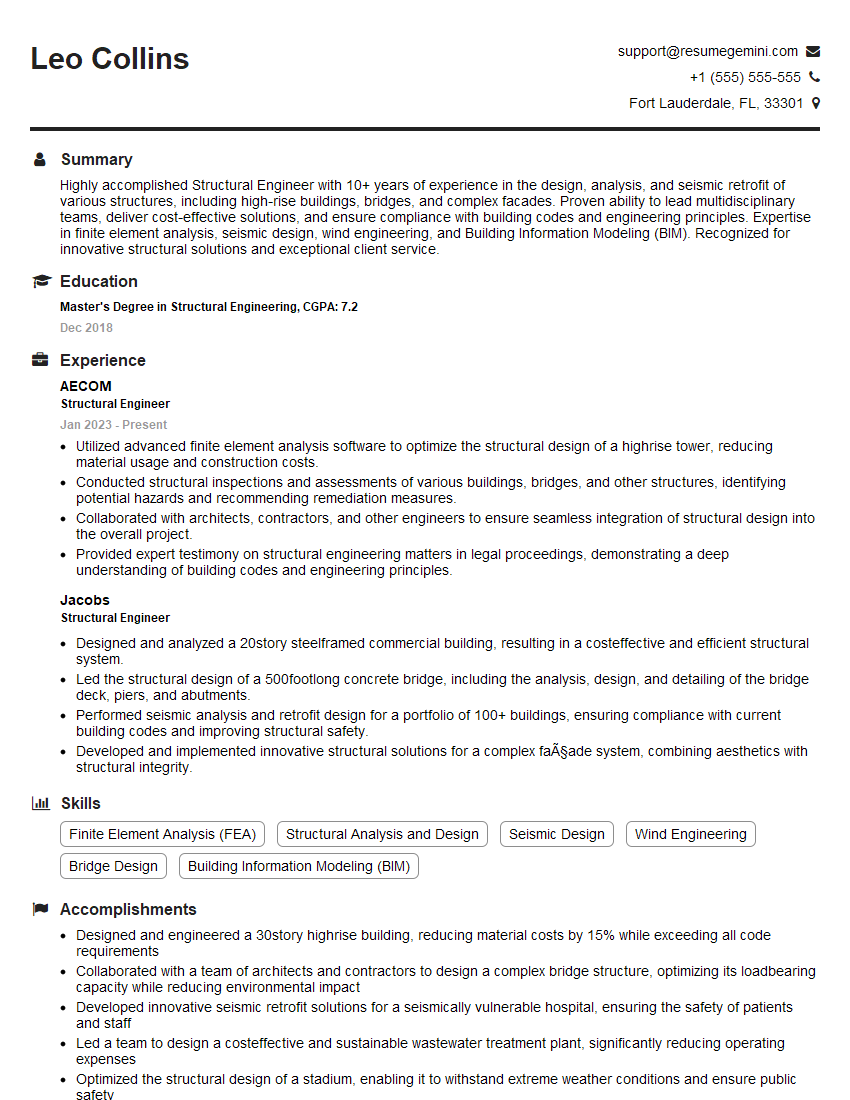
Mastering knowledge of seismic codes and standards is crucial for advancing your career in structural engineering. A strong understanding of these principles demonstrates your commitment to safety and your ability to design resilient structures. To maximize your job prospects, create an ATS-friendly resume that highlights your skills and experience effectively. ResumeGemini is a trusted resource that can help you build a professional and impactful resume. Examples of resumes tailored to showcase expertise in seismic codes and standards are available through ResumeGemini, assisting you in presenting your qualifications compellingly to prospective employers.



Explore more articles
Users Rating of Our Blogs
Share Your Experience
We value your feedback! Please rate our content and share your thoughts (optional).
What Readers Say About Our Blog
To the interviewgemini.com Webmaster.
Very helpful and content specific questions to help prepare me for my interview!
Thank you
To the interviewgemini.com Webmaster.
This was kind of a unique content I found around the specialized skills. Very helpful questions and good detailed answers.
Very Helpful blog, thank you Interviewgemini team.