Interviews are more than just a Q&A session—they’re a chance to prove your worth. This blog dives into essential Land Improvement interview questions and expert tips to help you align your answers with what hiring managers are looking for. Start preparing to shine!
Questions Asked in Land Improvement Interview
Q 1. Explain the process of site grading for optimal drainage.
Site grading for optimal drainage is the process of shaping the land to effectively manage water runoff, preventing erosion and ensuring proper foundation support. It involves a careful analysis of the site’s topography, soil type, and surrounding environment to create a system where water flows away from structures and sensitive areas.
The process typically begins with a thorough site survey to determine existing elevations and drainage patterns. This data informs the creation of a grading plan, which outlines the precise cuts and fills needed to achieve the desired slopes and drainage pathways. Key considerations include:
- Establishing a consistent slope: Generally, a minimum slope of 2% (2 feet of drop per 100 feet of horizontal distance) is recommended to ensure adequate drainage away from buildings and paved areas. Steeper slopes may be necessary in areas with high rainfall.
- Creating swales and ditches: These are shallow, vegetated channels designed to collect and convey surface water to designated drainage outlets. Swales provide a more natural and environmentally friendly approach compared to traditional ditches.
- Utilizing French drains: These are underground drainage systems comprising perforated pipes surrounded by gravel, effective in managing subsurface water flow.
- Incorporating detention or retention basins: These are engineered structures that temporarily store excess runoff, reducing the peak flow rate and minimizing downstream flooding. Detention basins allow water to drain gradually, while retention basins retain water for a longer period, often for water reuse or environmental purposes.
For example, I worked on a residential development where the site had a significant slope. We implemented a system of swales and graded the individual lots to direct runoff away from houses and towards a central detention basin, preventing potential basement flooding and erosion problems.
Q 2. Describe your experience with erosion and sediment control measures.
Erosion and sediment control is paramount in land improvement projects to protect water quality and prevent damage to the surrounding environment. My experience encompasses a wide range of best management practices (BMPs), from simple measures to sophisticated engineered solutions.
I’ve implemented various techniques, including:
- Mulching: Applying a layer of organic material (wood chips, straw) to exposed soil stabilizes it and prevents erosion. I’ve found using a biodegradable polymer mulch particularly effective in areas with high winds or slopes.
- Temporary seeding: Planting fast-growing vegetation helps bind the soil and protect it from erosion during construction. Selection of the seed mix depends on the climate and soil conditions.
- Sediment basins and silt fences: These are used to trap sediment-laden runoff before it reaches water bodies. I’ve designed and oversaw the construction of several sediment basins, ensuring proper sizing and placement for effective performance. Silt fences are cost-effective for smaller areas.
- Erosion control blankets: These are synthetic fabrics that provide immediate protection against erosion, often used on steep slopes or areas prone to heavy rainfall. I’ve particularly found coir (coconut fiber) blankets to be a sustainable and environmentally friendly option.
- Check dams: Small, temporary structures built across drainage channels to reduce the velocity of water flow, minimizing erosion in steep areas. These can be constructed from readily available materials on site, and help avoid large scale soil erosion.
In one project, a hillside development required meticulous erosion control. We employed a combination of erosion control blankets, temporary seeding, and strategically placed check dams to prevent sediment from washing into a nearby creek, ensuring environmental compliance and protecting the water quality.
Q 3. How do you determine the appropriate type of soil for a specific land improvement project?
Selecting the appropriate soil is critical for the success of any land improvement project. The choice depends on the project’s specific needs, such as bearing capacity, drainage characteristics, and intended use. This involves a combination of laboratory testing and field observations.
The process begins with a detailed soil survey, which involves collecting soil samples from different depths and locations across the site. These samples are sent to a geotechnical laboratory for analysis to determine the following:
- Soil type: Classifying the soil according to its texture (sand, silt, clay), structure, and organic matter content.
- Shear strength: Measuring the soil’s ability to resist deformation under stress. This is crucial for foundation design.
- Permeability: Determining the soil’s ability to transmit water, which affects drainage design.
- Compaction characteristics: Assessing the soil’s ability to be compacted to achieve the required density for stability.
Based on these results, we can determine whether the existing soil is suitable for the project or if amendments (such as adding sand to improve drainage or clay to increase strength) are necessary. In some cases, importing suitable soil may be the most cost-effective option. For example, I worked on a project requiring significant fill for a new road, where we had to import well-graded gravel and sand to ensure sufficient bearing capacity and stability.
Q 4. What are the common challenges in land improvement projects, and how do you address them?
Land improvement projects often present numerous challenges, ranging from environmental concerns to logistical hurdles. Some common challenges include:
- Unexpected subsurface conditions: Encountering unforeseen rock formations, unsuitable soil, or buried utilities can significantly impact project costs and schedules. Thorough site investigations, including geotechnical surveys, are essential to mitigate this risk.
- Weather-related delays: Rainfall, extreme temperatures, and snow can disrupt construction activities. Contingency planning, including alternative construction methods and scheduling adjustments, is necessary to manage these delays.
- Permitting and regulatory compliance: Navigating the complex permitting process, often involving multiple agencies, can be time-consuming and challenging. Proactive engagement with regulatory bodies is crucial for timely approvals.
- Cost overruns and schedule delays: Unexpected issues and changes in project scope can lead to cost overruns and schedule delays. Effective project management and change control processes are key to mitigating these risks.
- Environmental concerns: Protecting water quality, minimizing erosion, and avoiding impact to sensitive habitats requires careful planning and implementation of appropriate environmental protection measures. Understanding regulations and engaging with environmental specialists is crucial.
To address these challenges, I employ a proactive approach, emphasizing thorough planning, risk assessment, and open communication with stakeholders. For instance, during a project where we unexpectedly encountered bedrock, I immediately convened a meeting with the geotechnical engineer and contractor to develop a revised plan, minimizing project disruption and cost overruns.
Q 5. Describe your experience with different types of retaining walls.
My experience with retaining walls encompasses a variety of types, each suited to different soil conditions, aesthetic requirements, and project budgets.
- Gravity walls: These are simple, freestanding walls that rely on their own weight for stability. They are suitable for low-height applications and stable soils. I’ve used them successfully in residential landscaping projects.
- Cantilever walls: These walls are anchored into the soil, with the back portion extending into the ground to resist overturning. They are cost-effective for medium-height applications.
- Sheet pile walls: These consist of interlocking steel or vinyl sheets driven into the ground to retain soil. They are suitable for deep excavations and challenging soil conditions. I’ve used them in larger-scale infrastructure projects.
- Gabion walls: These are constructed from wire baskets filled with rocks, providing a visually appealing and environmentally friendly solution. Their permeability makes them suitable for situations where drainage is crucial. This is increasingly being adopted for their aesthetic and sustainable benefits.
- Reinforced concrete walls: These offer high strength and durability and are suitable for high-height retaining walls. They often require specialized engineering design and construction techniques.
The selection of a particular retaining wall type depends on factors such as height, soil conditions, aesthetic requirements, and budget constraints. I always prioritize safety and structural integrity, adhering to relevant design codes and standards.
Q 6. How do you manage the permitting process for a land improvement project?
Managing the permitting process for land improvement projects requires meticulous attention to detail and proactive communication with relevant authorities. The process typically involves:
- Identifying relevant agencies: Determining which local, state, and federal agencies have jurisdiction over the project.
- Preparing and submitting applications: Compiling all necessary documents, including site plans, engineering designs, and environmental impact assessments, ensuring they adhere to all regulatory requirements.
- Attending meetings and responding to requests: Participating in meetings with regulatory agencies to address any concerns and respond to their requests for additional information.
- Obtaining necessary approvals: Following up on applications and ensuring timely receipt of all necessary permits and approvals.
- Maintaining compliance: Adhering to all permit conditions throughout the construction process.
I have extensive experience navigating the permitting process, working with various agencies to secure approvals for complex projects. I find building strong relationships with regulatory personnel is essential for efficient permitting and proactive compliance. In one instance, we engaged with the environmental agency early on to address their concerns, resulting in a smoother and faster permitting process.
Q 7. Explain your experience with AutoCAD or other relevant design software.
I’m proficient in AutoCAD and Civil 3D, leveraging their capabilities for creating detailed site plans, grading designs, and preparing construction drawings. My experience includes using these software packages to:
- Develop site plans: Creating accurate representations of the site’s topography, existing features, and proposed improvements.
- Design grading plans: Modeling the earthwork required to achieve optimal drainage and foundation support, including cut and fill calculations.
- Prepare construction drawings: Producing detailed drawings that communicate design intent to the construction team.
- Conduct earthwork calculations: Accurately estimating the volume of earthwork required for cuts and fills, helping with cost estimation and material procurement.
- Create 3D models: Developing three-dimensional models of the site to visualize the proposed changes and identify potential conflicts.
Beyond AutoCAD and Civil 3D, I’m also familiar with other relevant software such as ArcGIS for geospatial analysis and various project management tools. For example, in a recent project, I utilized Civil 3D’s advanced grading tools to optimize the design of a large-scale residential development, minimizing earthwork costs while ensuring adequate drainage.
Q 8. How do you ensure compliance with environmental regulations during land improvement?
Ensuring environmental compliance in land improvement is paramount. It starts long before the first shovel hits the ground. We begin by conducting thorough environmental site assessments, identifying potential impacts, and adhering to all applicable federal, state, and local regulations. This includes understanding and complying with the Clean Water Act, the Endangered Species Act, and any relevant local ordinances pertaining to wetlands, endangered species, and water quality.
For example, on a recent project near a designated wetland, we implemented stringent erosion and sediment control measures, including silt fences, sediment basins, and vegetated buffer strips to prevent runoff contamination. We also obtained all necessary permits and worked closely with environmental consultants to monitor water quality and ensure compliance throughout the project lifecycle. Regular inspections and detailed reporting are crucial to demonstrate compliance and mitigate potential risks.
- Pre-construction Phase: Environmental impact assessments, permitting, and stakeholder engagement.
- Construction Phase: Implementing erosion and sediment control plans, waste management protocols, and regular monitoring.
- Post-construction Phase: Site restoration, ongoing monitoring, and reporting to regulatory agencies.
Q 9. Describe your experience with utility coordination during site development.
Utility coordination is critical for avoiding costly delays and safety hazards during site development. My experience involves proactive communication and collaboration with utility companies from the initial planning stages. This includes requesting utility locates (e.g., 811 calls) to mark underground utilities before excavation, reviewing plans with utility representatives to identify potential conflicts, and scheduling excavation work around utility lines. I also have experience negotiating easements and working with utility companies to relocate or adjust their infrastructure as needed.
For instance, on a recent large-scale commercial development, we discovered a conflict with an existing gas line. Rather than delaying the project, we worked closely with the gas company to develop a plan for rerouting the line, obtaining the necessary permits, and scheduling the relocation work efficiently to minimize project disruption. Open communication, thorough planning, and flexible problem-solving are key to successful utility coordination.
Q 10. What are your preferred methods for managing construction schedules and budgets?
Effective construction schedule and budget management relies on a combination of planning, technology, and proactive monitoring. I utilize project management software (like Primavera P6 or MS Project) to create detailed schedules, track progress, and identify potential delays. The budget is carefully developed based on detailed cost estimates, factoring in materials, labor, equipment, and contingency costs. Regular progress meetings with the project team are held to review the schedule, address any issues, and make necessary adjustments.
For example, I use earned value management (EVM) to monitor project performance against the planned schedule and budget. This involves tracking the planned value, earned value, and actual cost to identify variances and take corrective actions. We also use critical path analysis to identify the most critical activities in the project and prioritize their completion to ensure on-time delivery.
Q 11. How do you handle unexpected site conditions during construction?
Unexpected site conditions are inevitable in land improvement projects. My approach involves a proactive risk assessment during the planning phase to identify potential issues and develop contingency plans. During construction, we have a system for immediately reporting any unexpected conditions to the project team, including geologists, engineers, and the client. This is followed by a thorough assessment to determine the impact on the project schedule and budget.
For example, if we encounter unexpected bedrock during excavation, we immediately halt work, assess the situation, revise the plans accordingly (e.g., adjust excavation methods or depths), and work with the engineers and client to approve the changes before proceeding. This includes providing updated cost estimates and a revised schedule reflecting the changes. Open communication and a collaborative approach are crucial to successfully navigate these challenges.
Q 12. Describe your experience with different types of pavement construction.
I have extensive experience with various pavement construction methods, including flexible pavements (asphalt) and rigid pavements (concrete). Flexible pavements are commonly used for roads and parking lots due to their flexibility and ease of repair. Rigid pavements, typically concrete, are more durable and suitable for high-traffic areas. My experience encompasses the full construction process, from subgrade preparation and base course construction to paving, compaction, and final surface treatment.
For example, in a recent project involving the construction of a parking lot, we chose asphalt pavement due to its cost-effectiveness and ease of construction. The project involved proper subgrade preparation, placement of a stabilized base, and the application of multiple asphalt layers to ensure appropriate thickness and strength. For a high-traffic industrial road, we opted for a concrete pavement design, ensuring proper joint design and reinforcement to withstand heavy loads.
Q 13. Explain your understanding of stormwater management best practices.
Stormwater management best practices focus on minimizing the impact of development on water quality and quantity. This includes implementing strategies to reduce runoff, treat pollutants, and manage peak flows. Common methods include the use of detention basins, infiltration basins, bioretention areas, and vegetated swales. These measures help to filter pollutants, reduce runoff volume, and recharge groundwater.
For instance, on a recent residential development, we incorporated a series of bioretention areas and vegetated swales to manage stormwater runoff. These areas not only filter pollutants but also provide aesthetic value to the community. We also ensured that all construction activities adhered to erosion and sediment control best practices to minimize runoff pollution. Careful planning, proper design, and regular maintenance are essential for effective stormwater management.
Q 14. How do you ensure the safety of workers on a land improvement project?
Worker safety is my top priority. This begins with thorough job hazard analyses (JHAs) to identify potential hazards associated with each phase of the project. We provide comprehensive safety training to all workers, covering topics such as fall protection, excavation safety, and the use of personal protective equipment (PPE). We also implement rigorous safety protocols on the job site, including daily safety meetings, regular inspections, and enforcement of safety rules. This includes maintaining a clean and organized site, providing adequate lighting and signage, and using appropriate safety equipment.
For instance, on a recent excavation project, we implemented a robust safety plan including trench shoring, regular inspections by a competent person, and providing workers with appropriate PPE like hard hats, safety glasses, and high-visibility vests. Proactive safety measures, coupled with a strong safety culture, are essential for maintaining a safe working environment and preventing accidents.
Q 15. Describe your experience with different types of excavation techniques.
My experience encompasses a wide range of excavation techniques, chosen based on project specifics like soil type, project scale, and environmental concerns. For instance, I’ve extensively used conventional excavation with excavators and backhoes for large-scale projects like road construction and site clearing. This method is effective for moving significant volumes of earth efficiently. For more delicate tasks like utility installations or working in confined spaces, I’ve employed hydraulic excavation, which utilizes specialized equipment for precise digging minimizing damage to underground utilities. In sensitive environmental areas, trenchless excavation methods, like horizontal directional drilling (HDD), are my preferred choice. HDD allows for the installation of pipelines and utilities without extensive surface disruption, minimizing environmental impact. Finally, for smaller, more controlled projects, manual excavation using shovels and hand tools is sometimes necessary, especially in areas where machinery access is limited.
For example, on a recent residential development, we utilized conventional excavation for the initial site clearing and grading. However, when installing utilities near existing structures, we switched to hydraulic excavation to ensure the safety of the buildings and avoid any damage to underground services. On a separate project, involving a pipeline installation crossing a sensitive wetland area, trenchless excavation via HDD proved crucial in minimizing environmental disturbance.
Career Expert Tips:
- Ace those interviews! Prepare effectively by reviewing the Top 50 Most Common Interview Questions on ResumeGemini.
- Navigate your job search with confidence! Explore a wide range of Career Tips on ResumeGemini. Learn about common challenges and recommendations to overcome them.
- Craft the perfect resume! Master the Art of Resume Writing with ResumeGemini’s guide. Showcase your unique qualifications and achievements effectively.
- Don’t miss out on holiday savings! Build your dream resume with ResumeGemini’s ATS optimized templates.
Q 16. What are your methods for quality control and assurance in land improvement?
Quality control and assurance are paramount in land improvement. My methods are multi-faceted, starting with detailed planning and specifications. This includes regular site inspections, adherence to strict safety protocols, and meticulous record-keeping. We employ pre-construction surveys to establish baseline data and identify potential challenges. During construction, we conduct regular quality checks using established benchmarks and tolerances. For example, the compaction of fill material is verified using density tests to ensure stability. We use third-party inspections for major milestones to guarantee independence and objectivity. Post-construction, we conduct final inspections, comparing the completed work to the design specifications and addressing any discrepancies. This process is complemented by detailed documentation, including photographs, test results, and inspection reports, all maintained in a centralized system for easy access and future reference.
For instance, on a recent highway project, regular density tests throughout the fill placement process ensured the compacted soil met our required specifications, preventing potential future settlements. Our meticulous documentation, including daily logs and photographs, enabled a smooth transition between phases and provided an irrefutable record of our quality control measures.
Q 17. How do you coordinate with subcontractors on a land improvement project?
Coordination with subcontractors is critical for project success. I initiate this process with clear and comprehensive contracts that outline the scope of work, payment schedules, and performance expectations for each subcontractor. Regular pre-construction meetings establish communication channels, review project plans, and identify potential conflicts early. During construction, we maintain open communication using daily reports, progress meetings, and collaborative software platforms to track progress and address emerging issues. A centralized schedule helps to synchronize the activities of various subcontractors, minimizing delays and conflicts. Finally, we implement regular safety checks to ensure all subcontractors adhere to our strict safety standards.
For example, on a large-scale commercial development, effective communication through daily progress reports and weekly meetings with subcontractors specializing in utilities, paving, and landscaping ensured that each phase of the project progressed smoothly and according to schedule. This proactive approach to coordination averted any significant delays or cost overruns.
Q 18. Explain your experience with different types of land surveying techniques.
My experience in land surveying includes proficiency in both traditional and modern techniques. Traditional surveying, using total stations and levels, provides accurate data for topographic mapping, boundary determination, and setting out construction lines. This method is particularly useful in challenging terrain or when GPS access is limited. In contrast, GPS surveying offers increased speed and efficiency, particularly for large-scale projects where rapid data acquisition is needed. I’m also familiar with photogrammetry, utilizing drone imagery to generate high-resolution 3D models of the site, which is beneficial for planning, monitoring progress, and detecting potential problems. We also use LiDAR scanning for accurate topographic mapping in complex environments where precision is crucial.
For instance, on a recent project involving a large-scale infrastructure project, we leveraged GPS surveying for rapid data acquisition across the extensive site. This data was then integrated with data obtained using traditional surveying methods in areas where GPS signals were weak or obscured.
Q 19. How do you conduct a site assessment to determine the feasibility of a project?
Conducting a thorough site assessment is crucial before commencing any land improvement project. This involves a multi-stage process. First, we review existing site data, including maps, aerial photos, and previous site reports. This provides a preliminary understanding of the site’s characteristics. Then, a physical site visit is undertaken to assess the terrain, vegetation, and existing structures. We also check for potential constraints, such as utilities, wetlands, or environmentally sensitive areas. Soil testing and other geotechnical investigations determine the soil properties, bearing capacity, and potential subsurface issues. This data informs the feasibility study, which evaluates the project’s viability considering cost, time, environmental regulations, and potential risks. The final stage involves regulatory compliance checks, ensuring that the project adheres to all local, regional, and national regulations.
For example, on a recent project, an initial site assessment revealed the presence of an underground stream, a critical factor that required changes to the original design to minimize environmental impact. This proactive approach prevented costly delays and environmental infractions later in the project.
Q 20. Describe your experience with geotechnical investigations and reports.
Geotechnical investigations are fundamental to sound land improvement practices. I have extensive experience in interpreting and applying geotechnical reports. This involves collaboration with geotechnical engineers to plan and execute investigations using techniques such as soil borings, cone penetration testing (CPT), and laboratory testing. The reports provide invaluable information about soil composition, shear strength, permeability, and groundwater levels. This data is crucial in designing foundations, earthworks, and drainage systems. We use this information to select appropriate construction methods, materials, and to ensure the stability and longevity of the project. Understanding the limitations and potential risks outlined in the reports is vital to the project’s overall success.
For example, a recent geotechnical report revealed an unexpectedly high water table on a project site. This information led us to adjust the foundation design and implement a more robust drainage system, preventing potential structural problems and project delays.
Q 21. How do you handle conflicts or disputes with clients or contractors?
Conflict resolution is a key aspect of project management. My approach prioritizes open communication and proactive problem-solving. I always attempt to address issues promptly and directly, working collaboratively with all parties involved. This often includes mediation, facilitating discussions to find mutually acceptable solutions. If necessary, I utilize formal dispute resolution mechanisms, such as arbitration or litigation, as a last resort. Maintaining detailed records throughout the project is crucial in documenting events and supporting our position in case of a dispute. A strong emphasis on clear contractual agreements helps to minimize misunderstandings and the potential for conflicts from the outset.
For instance, on one occasion a dispute arose regarding the interpretation of a contract clause. By revisiting the original contract documents and involving a neutral mediator, we were able to arrive at a solution that satisfied all parties involved, preventing a costly and time-consuming legal battle.
Q 22. Explain your experience with value engineering in land improvement projects.
Value engineering in land improvement focuses on enhancing project value while reducing costs without sacrificing quality or functionality. It involves a systematic review of project plans, specifications, and designs to identify areas where cost savings can be achieved through alternative materials, methods, or designs.
In my experience, I’ve successfully implemented value engineering on several projects. For instance, on a large-scale residential development, we initially planned to use imported topsoil. Through value engineering, we identified a local source of equally suitable topsoil, resulting in significant savings on transportation and material costs. We also explored alternative drainage solutions, opting for a more cost-effective system that still met the project’s drainage requirements. This involved detailed analysis of soil properties and water flow modeling to ensure the chosen system was both effective and economical.
Another example involved a highway construction project where we explored the use of recycled materials in base layers. This not only reduced costs but also promoted sustainability by diverting waste from landfills. The key to effective value engineering is a collaborative approach, involving engineers, contractors, and stakeholders to identify creative solutions that deliver optimal value.
Q 23. How do you ensure the sustainability of a land improvement project?
Sustainability in land improvement is crucial for long-term environmental and economic viability. It involves minimizing the project’s environmental footprint and ensuring its resilience to future challenges. This involves considering various aspects throughout the project lifecycle.
- Material Selection: Prioritizing locally sourced and recycled materials reduces transportation emissions and landfill waste.
- Water Management: Implementing strategies for rainwater harvesting, efficient irrigation, and minimizing runoff protects water resources and reduces erosion. This often includes designing sustainable drainage systems (SuDS) to manage stormwater onsite.
- Soil Conservation: Protecting existing topsoil and employing erosion control measures during and after construction safeguards soil health and prevents pollution of waterways.
- Energy Efficiency: Incorporating energy-efficient technologies and practices in construction and operation minimizes carbon emissions.
- Biodiversity: Protecting and enhancing biodiversity through habitat restoration and careful landscaping mitigates the negative impacts on local ecosystems.
For example, on a recent park development project, we incorporated permeable paving to reduce stormwater runoff and recharge groundwater. We also used native plant species for landscaping, promoting biodiversity and minimizing the need for irrigation.
Q 24. What are the key factors you consider when selecting construction materials?
Selecting construction materials involves a careful assessment of several key factors:
- Project Requirements: The material’s properties must meet the project’s specific needs in terms of strength, durability, permeability, and aesthetic considerations.
- Cost-Effectiveness: Balancing initial cost with long-term performance and maintenance expenses is crucial. A slightly more expensive material might offer longer lifespan and reduce future costs.
- Availability and Sourcing: Locally sourced materials reduce transportation costs and environmental impact. We also consider the sustainability of supply chains.
- Environmental Impact: Material selection should consider life-cycle assessment, minimizing carbon footprint and resource depletion. Embodied carbon is a key consideration.
- Workability: The material’s ease of handling, placement, and compaction impacts project efficiency and cost.
For example, when choosing aggregates for a road project, we’d consider factors like compressive strength, gradation, and availability of local sources. We would also analyze the environmental impact of different aggregates – including transportation distance and potential for dust pollution during transport and use.
Q 25. Describe your experience with the preparation of construction drawings and specifications.
I have extensive experience in preparing construction drawings and specifications for land improvement projects. This involves using CAD software (such as AutoCAD or Civil 3D) to create detailed plans, sections, and details. Specifications are equally important, outlining the required materials, construction methods, quality control procedures, and tolerances for each aspect of the project.
My process typically involves:
- Gathering Information: Thorough site surveys, geotechnical investigations, and client consultations are essential to understand project needs and constraints.
- Design Development: Creating detailed drawings and specifications that meet all relevant codes and regulations. This often involves collaboration with other engineers and specialists.
- Coordination and Review: Ensuring all drawings and specifications are consistent and coordinated. This involves internal reviews and often external reviews by agencies or other stakeholders.
- Document Control: Maintaining a controlled version of the project drawings and specifications. This can involve using version control software.
Clear and concise documentation is vital for effective construction. Ambiguity can lead to errors, delays, and cost overruns. I strive for clarity and accuracy in all my work, using detailed annotations and schedules to ensure that the construction team has all the information needed to execute the project successfully.
Q 26. How familiar are you with different types of soil compaction techniques?
Soil compaction is a critical aspect of land improvement, aiming to increase soil density and stability. Different techniques are chosen based on soil type, project requirements, and site conditions.
- Static Compaction: This involves using heavy rollers or vibratory plates to compact the soil. It’s suitable for large areas and cohesive soils. Different rollers, such as smooth-wheel rollers, pneumatic-tired rollers, and sheepsfoot rollers, are employed depending on the soil type and required compaction level.
- Dynamic Compaction: This technique uses a heavy weight dropped from a significant height to compact the soil. It’s effective for loose, granular soils and deep compaction needs. This is often used for the preparation of deep foundations.
- Vibratory Compaction: This uses vibratory equipment, such as vibratory rollers or rammers, to compact the soil. It’s efficient for a variety of soil types, particularly granular soils.
- Impact Compaction: This technique employs a heavy weight that is repeatedly dropped onto the soil surface. This is effective for loose sandy or gravelly soils.
The choice of compaction technique is determined by the soil type, the required degree of compaction, the depth of compaction, and the available equipment. Proper compaction is essential for preventing settlement, ensuring stability, and achieving the desired load-bearing capacity. Compaction tests are essential to verify that the specified density has been achieved.
Q 27. How do you manage project risks and mitigate potential problems?
Risk management is integral to successful land improvement projects. My approach involves identifying potential risks, analyzing their likelihood and impact, and developing mitigation strategies.
The process includes:
- Risk Identification: Brainstorming sessions with the project team, reviewing historical data, and utilizing checklists to identify potential risks such as weather delays, material shortages, changes in regulations, or unforeseen site conditions.
- Risk Assessment: Evaluating the likelihood and potential impact of each identified risk, using a qualitative or quantitative method. This often involves using a risk matrix to categorize risks by severity.
- Risk Response Planning: Developing strategies to mitigate, transfer, avoid, or accept each risk. For example, contingency planning for weather delays or using alternative materials to mitigate supply chain risks.
- Risk Monitoring and Control: Regularly monitoring identified risks and implementing the planned mitigation strategies as needed. This involves tracking progress, adjusting plans as necessary, and documenting all changes.
For example, on a project prone to flooding, we implemented a robust drainage system and contingency plans for temporary work stoppages due to heavy rainfall. Effective communication and proactive risk management are crucial for maintaining project schedules and budgets while ensuring safety.
Q 28. Explain your experience with the use of building information modeling (BIM) in land improvement.
Building Information Modeling (BIM) is transforming land improvement. BIM is a digital representation of the physical and functional characteristics of a project. It enhances collaboration, improves design coordination, and facilitates better decision-making.
My experience with BIM in land improvement includes:
- 3D Modeling: Creating 3D models of the site and proposed improvements, which allows for better visualization and coordination of different disciplines.
- Quantity Takeoff: Using BIM software to automatically generate quantities of materials, facilitating accurate cost estimations and procurement planning.
- Clash Detection: Identifying and resolving potential conflicts between different design elements before construction begins, minimizing costly rework during construction.
- 4D Simulation: Creating 4D models (combining 3D models with time scheduling) to simulate the construction process, optimize sequencing, and identify potential delays.
- 5D Cost Modeling: Integrating cost data into BIM models for real-time cost tracking and change management.
For example, using BIM on a large-scale earthworks project allowed us to identify potential conflicts between utility lines and excavation plans early in the design process, avoiding costly excavation delays and potential damage to existing infrastructure. BIM also enabled better coordination with different contractors and subcontractors, improving overall project efficiency.
Key Topics to Learn for Land Improvement Interview
- Site Analysis & Planning: Understanding site characteristics (soil type, drainage, topography), developing grading plans, and complying with environmental regulations.
- Earthwork Calculations & Design: Practical application of cut and fill calculations, volume estimations, and designing effective earthmoving strategies for projects of varying scales.
- Drainage Systems: Designing and implementing effective drainage solutions, including surface and subsurface drainage systems, to prevent erosion and water damage.
- Erosion and Sediment Control: Implementing best management practices (BMPs) to minimize environmental impact during construction and maintain site stability.
- Construction Sequencing & Scheduling: Understanding the logical order of land improvement tasks and creating efficient project schedules.
- Construction Materials & Specifications: Familiarity with various materials used in land improvement (e.g., aggregates, geotextiles) and interpreting construction specifications.
- Cost Estimation & Budgeting: Developing accurate cost estimates for land improvement projects, including labor, materials, and equipment.
- Project Management & Communication: Effectively managing projects, communicating with stakeholders, and solving on-site problems efficiently.
- Health & Safety Regulations: Adhering to relevant health and safety standards and regulations related to land improvement construction.
- Sustainable Land Improvement Practices: Integrating environmentally friendly techniques and materials into project design and implementation.
Next Steps
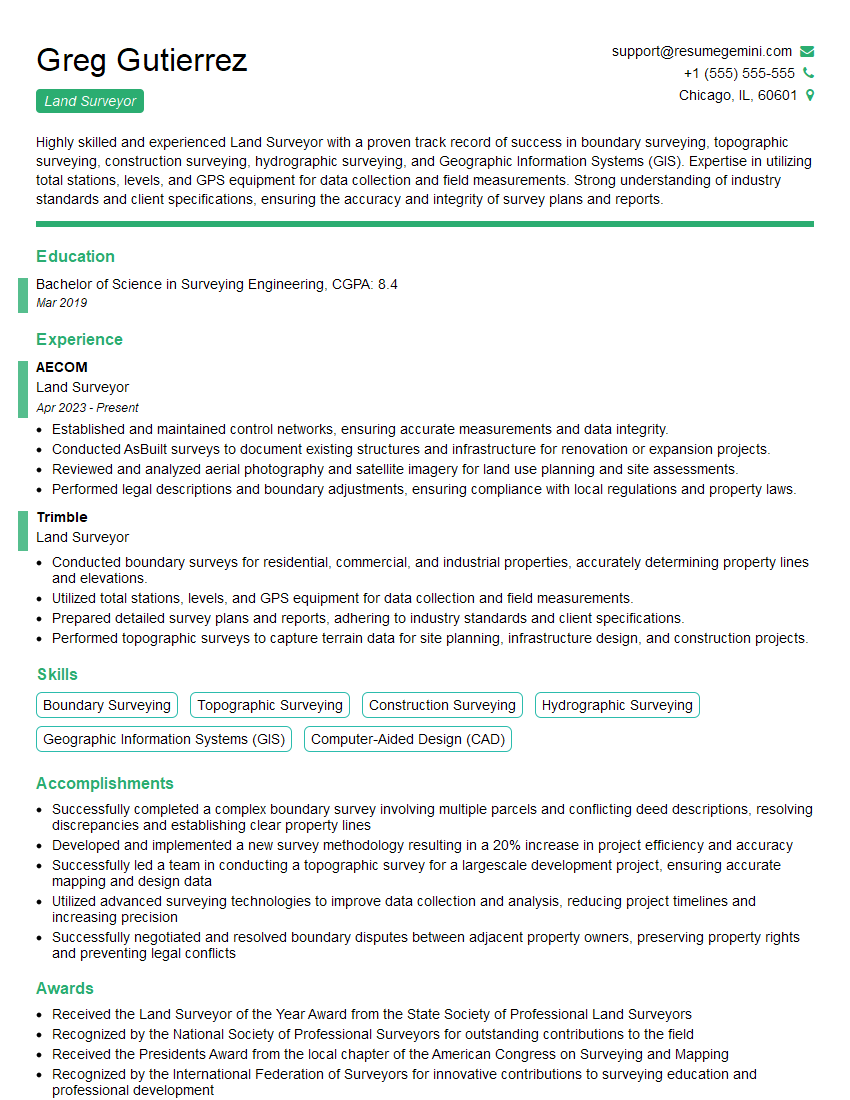
Mastering Land Improvement opens doors to exciting career opportunities with increasing responsibility and earning potential. A strong foundation in these key areas will set you apart. To maximize your job prospects, create an ATS-friendly resume that showcases your skills and experience effectively. ResumeGemini is a trusted resource for building professional resumes that catch the eye of recruiters. We provide examples of resumes tailored to Land Improvement to help you present your qualifications in the best possible light.
Explore more articles
Users Rating of Our Blogs
Share Your Experience
We value your feedback! Please rate our content and share your thoughts (optional).
What Readers Say About Our Blog
To the interviewgemini.com Webmaster.
Very helpful and content specific questions to help prepare me for my interview!
Thank you
To the interviewgemini.com Webmaster.
This was kind of a unique content I found around the specialized skills. Very helpful questions and good detailed answers.
Very Helpful blog, thank you Interviewgemini team.