The right preparation can turn an interview into an opportunity to showcase your expertise. This guide to Laser Spectroscopy interview questions is your ultimate resource, providing key insights and tips to help you ace your responses and stand out as a top candidate.
Questions Asked in Laser Spectroscopy Interview
Q 1. Explain the principle of Laser Induced Breakdown Spectroscopy (LIBS).
Laser-Induced Breakdown Spectroscopy (LIBS) is a powerful analytical technique that uses a high-intensity pulsed laser to ablate a tiny amount of material from a sample. This ablation process creates a plasma – a hot, ionized gas – containing atoms and ions characteristic of the sample’s composition. The plasma then emits light at specific wavelengths, forming an emission spectrum. By analyzing this spectrum, we can identify the elements present in the sample and determine their concentrations. Think of it like creating a miniature ‘star’ from your sample and studying its light to understand its elemental makeup.
The process involves focusing a high-energy laser pulse onto the sample surface. The intense energy causes rapid heating and ionization of the material, forming the plasma. This plasma then cools and emits light, which is collected and analyzed by a spectrometer. The spectrometer separates the light into its constituent wavelengths, revealing the characteristic spectral lines of the elements present. The intensity of these lines is directly related to the concentration of the elements.
LIBS finds applications in various fields including environmental monitoring (analyzing soil or water contaminants), geological exploration (identifying mineral compositions), art conservation (analyzing the composition of pigments), and industrial process control (monitoring alloy composition).
Q 2. Describe different types of lasers used in spectroscopy and their applications.
Many different lasers are used in spectroscopy, each with unique properties suited for specific applications. Here are a few examples:
- Helium-Neon (HeNe) Lasers: These are relatively inexpensive and produce stable, continuous-wave (CW) output at visible wavelengths (e.g., 632.8 nm). They are often used in simple absorption spectroscopy experiments and educational settings.
- Diode Lasers: These are compact, efficient, and tunable lasers, widely used across various spectroscopic techniques. Their small size and low cost make them ideal for portable instruments.
- Nd:YAG Lasers: These are solid-state lasers that emit powerful pulses in the near-infrared (1064 nm). Their high energy makes them suitable for applications like LIBS and Raman spectroscopy.
- Excimer Lasers: These produce ultraviolet (UV) laser light, crucial for applications requiring high-energy photons to excite molecules and study their electronic transitions. They’re often used in photoelectron spectroscopy.
- Ti:Sapphire Lasers: These are broadly tunable lasers, spanning a wide range of wavelengths in the visible and near-infrared regions. Their tunability is valuable for precise spectroscopic measurements.
The choice of laser depends heavily on the specific spectroscopic technique, the sample being analyzed, and the desired spectral information. For instance, UV lasers are often preferred for applications involving electronic transitions, while near-infrared lasers might be better for vibrational spectroscopy.
Q 3. What are the advantages and disadvantages of using lasers in spectroscopy compared to other light sources?
Lasers offer significant advantages over traditional light sources in spectroscopy:
- High Spectral Brightness: Lasers produce highly monochromatic (single-wavelength) and coherent (in-phase) light, leading to improved signal-to-noise ratios and higher sensitivity.
- High Intensity: Lasers can provide extremely high intensities, allowing for the study of weak signals and nonlinear phenomena.
- Spatial Coherence: This allows for highly focused beams, essential for microscopic applications and precise sample manipulation.
- Tunability: Many lasers can be tuned across a wide range of wavelengths, making them versatile tools for probing various energy transitions.
However, lasers also have some drawbacks:
- Cost: Lasers, particularly specialized ones, can be expensive.
- Safety Concerns: High-intensity laser beams pose potential eye and skin hazards, requiring careful safety precautions.
- Potential for Sample Damage: High-intensity lasers can damage or modify the sample being analyzed.
The choice between lasers and other light sources depends on the specific requirements of the experiment. For high-sensitivity measurements or applications requiring specific wavelengths and high intensity, lasers are generally preferred. For simpler experiments or situations where cost or safety is a major concern, other light sources may be more suitable.
Q 4. Explain the concept of Doppler broadening in laser spectroscopy.
Doppler broadening refers to the widening of spectral lines due to the Doppler effect. The Doppler effect is the change in frequency or wavelength of a wave (in this case, light) for an observer moving relative to its source. Imagine the sound of a siren changing pitch as an ambulance passes by – the same principle applies to light emitted by atoms.
In laser spectroscopy, atoms in a gas sample are constantly moving at various speeds due to thermal motion. Atoms moving towards the detector emit light with a slightly higher frequency (blueshift), while atoms moving away emit light with a slightly lower frequency (redshift). This results in a broadening of the spectral line observed, with the extent of broadening directly related to the temperature of the sample. The warmer the sample, the faster the atomic motion and the broader the spectral line.
Understanding Doppler broadening is critical for high-resolution spectroscopy. Techniques like Doppler-free spectroscopy are employed to eliminate this effect and achieve extremely narrow spectral lines, allowing for more precise measurements of atomic properties.
Q 5. How does laser cooling work and how is it applied in spectroscopy?
Laser cooling is a technique that uses lasers to slow down and cool atoms to extremely low temperatures, close to absolute zero. This is achieved by exploiting the Doppler effect. Atoms moving towards the laser beam absorb photons, which carry momentum. This absorption slows down the atoms. After a short time, the atoms re-emit the photons in a random direction, leading to a net reduction in the average atomic velocity.
The process typically involves multiple laser beams aimed at the atoms from different directions. Each beam is tuned slightly below the atomic resonance frequency. Atoms moving towards a specific beam are more likely to absorb photons, slowing them down. This process is repeated until the atoms reach ultra-low temperatures.
Laser cooling finds important applications in spectroscopy because it leads to significantly narrower spectral lines. The reduction in atomic motion minimizes Doppler broadening, allowing for high-resolution studies of atomic energy levels and other properties. This is crucial for building highly precise atomic clocks and other quantum technologies.
Q 6. Describe different laser scanning techniques used in microscopy.
Laser scanning techniques are fundamental to modern laser microscopy, allowing for the acquisition of high-resolution images. Several methods exist, each with its advantages and drawbacks:
- Raster Scanning: The most common method. The laser beam is systematically scanned across the sample in a grid-like pattern (raster). The intensity of the light emitted or reflected from the sample at each point is measured to construct an image. Think of it like reading a page from left to right and top to bottom.
- Point Scanning: The laser is focused to a very small spot and moved across the sample to build the image point by point. This is particularly useful for high-resolution imaging, allowing for the examination of very fine details within the sample.
- Spiral Scanning: The laser beam scans the sample in a spiral pattern, which can be more efficient than raster scanning for large samples.
- Random Access Scanning: The laser is directed to specific points of interest within the sample, allowing for efficient data acquisition in areas of particular interest. This technique is often employed in conjunction with advanced image processing algorithms.
The choice of laser scanning technique depends on factors such as the sample size, desired resolution, and imaging speed. Advanced techniques like confocal microscopy utilize pinholes to further enhance resolution and reduce background noise.
Q 7. What is Raman spectroscopy and how does it differ from other spectroscopic techniques?
Raman spectroscopy is a vibrational spectroscopic technique that utilizes inelastic scattering of light to probe the vibrational modes of molecules. When a molecule interacts with a monochromatic light source (often a laser), most of the scattered light retains the same frequency (Rayleigh scattering). However, a small fraction of the scattered light undergoes a frequency shift, corresponding to the vibrational energy levels of the molecule. This frequency-shifted light is called Raman scattering.
The difference in frequency between the incident and scattered light provides information about the vibrational modes, which are characteristic of the molecular structure and chemical composition. This allows us to identify molecules and study their chemical bonding.
Raman spectroscopy differs from other spectroscopic techniques such as infrared (IR) spectroscopy, which directly probes vibrational transitions by absorption or emission of light. Raman spectroscopy, relying on inelastic scattering, offers complementary information and can access vibrational modes that are either weak or forbidden in IR spectroscopy. It is also less sensitive to water interference which makes it ideal for aqueous solutions.
Raman spectroscopy is widely used in various fields, including material science, chemistry, biology, and environmental science, for identification of compounds, studying molecular structures, and characterizing materials.
Q 8. Explain the concept of hyperfine splitting in atomic spectra.
Hyperfine splitting refers to the slight splitting of spectral lines in atomic spectra caused by the interaction between the electron’s spin and orbital angular momentum with the nuclear spin. Imagine the atom’s nucleus as a tiny spinning magnet; its magnetic field interacts with the magnetic field generated by the orbiting electrons. This interaction introduces small energy differences, causing a single spectral line (expected from considering only electronic energy levels) to split into multiple closely spaced lines.
The magnitude of the splitting depends on the nuclear spin (I), the total electronic angular momentum (J), and the hyperfine coupling constant. For example, the ground state of sodium (23Na) exhibits hyperfine splitting due to the interaction of the single valence electron with the nuclear spin (I=3/2). This results in four closely spaced lines in the spectrum, corresponding to the different possible orientations of the nuclear spin relative to the electronic angular momentum.
Hyperfine splitting is crucial in fields like precision spectroscopy, atomic clocks, and astrophysics. By precisely measuring the splitting, we can determine nuclear properties like the nuclear magnetic moment and quadrupole moment, which provide valuable information about nuclear structure.
Q 9. What is the difference between absorption and emission spectroscopy?
Absorption and emission spectroscopy are complementary techniques that probe atomic and molecular transitions. In absorption spectroscopy, we measure the amount of light absorbed by a sample as a function of wavelength or frequency. Think of it like shining a light through a colored filter – certain colors (wavelengths) are absorbed more strongly than others. The resulting spectrum reveals characteristic absorption peaks corresponding to transitions from the ground state to higher energy levels.
In contrast, emission spectroscopy involves measuring the light emitted by a sample after it has been excited. This could be through heating, electrical discharge, or by shining a laser on it. The emitted light contains information about the energy levels of the excited states and provides a characteristic emission spectrum. Imagine a firework – the different colors are due to the emission of specific wavelengths by excited atoms.
Both techniques are powerful tools, but they offer different perspectives. Absorption spectroscopy is often used to analyze the composition of a sample and measure its concentration, while emission spectroscopy is used to analyze the excited states of atoms and molecules.
Q 10. Describe different types of detectors used in laser spectroscopy and their limitations.
Several detectors are used in laser spectroscopy, each with strengths and limitations. Common types include:
- Photomultiplier Tubes (PMTs): Excellent sensitivity in the UV-Vis range, but can suffer from high dark current (noise) and limited dynamic range.
- Avalanche Photodiodes (APDs): Higher sensitivity than PMTs, particularly in the near-infrared, but have a limited dynamic range and can be prone to afterpulsing (noise).
- Charge-Coupled Devices (CCDs): Provide excellent sensitivity and high dynamic range, particularly for imaging applications, but can be expensive and have slower readout speeds than PMTs or APDs.
- Photodiodes: Simple, robust, and relatively inexpensive detectors, but their sensitivity is generally lower than PMTs or APDs.
- InGaAs Photodiodes: Ideal for the near-infrared (NIR) region, commonly used in various laser spectroscopy setups.
The choice of detector depends on the specific application, wavelength range, required sensitivity, and budget. For example, a PMT might be preferred for highly sensitive single-photon counting experiments, while a CCD might be more suitable for spectral imaging applications.
Q 11. How does cavity ring-down spectroscopy (CRDS) work?
Cavity Ring-Down Spectroscopy (CRDS) is a highly sensitive absorption technique that measures the decay rate of light trapped within a high-finesse optical cavity. Imagine a laser beam bouncing back and forth between two highly reflective mirrors—the ‘cavity’.
When a laser pulse is injected into the cavity, it initially undergoes multiple reflections, causing a buildup of light intensity. However, due to small losses (e.g., absorption by the sample, scattering from imperfections) the light intensity gradually decays exponentially. The decay time (ring-down time) is inversely proportional to the total losses within the cavity. By measuring this decay time, we can determine the absorption coefficient of the sample with high precision.
CRDS is extremely sensitive because the light interacts with the sample for a long time before it exits the cavity, significantly enhancing the detection sensitivity. This makes it ideal for detecting trace gases or weak absorption features.
Q 12. Explain the principles of two-photon absorption spectroscopy.
Two-photon absorption (TPA) spectroscopy involves the simultaneous absorption of two photons by an atom or molecule, promoting it to a higher energy level. This is a non-linear process that only occurs at high laser intensities. The energy of the two absorbed photons must equal the energy difference between the initial and final states. Unlike one-photon absorption, TPA allows us to access excited states that are not directly accessible via single-photon excitation.
Imagine climbing a tall staircase. With one-photon absorption, you take one step at a time. In TPA, you take two smaller steps simultaneously to reach a higher level. This often happens with transitions forbidden by one-photon selection rules, opening up new opportunities for spectroscopic investigations.
TPA spectroscopy is particularly useful for studying excited states with different symmetries and for microscopy applications like two-photon fluorescence microscopy, as the excitation is localized to the focal region of the laser beam, minimizing photodamage to surrounding areas.
Q 13. How would you calibrate a laser spectrometer?
Calibrating a laser spectrometer involves accurately determining the relationship between the measured signal (e.g., voltage from a detector) and the actual wavelength or frequency of the light. This is crucial for obtaining accurate measurements.
A common approach involves using known spectral lines of a calibration source, such as a low-pressure gas discharge lamp (e.g., Neon, Argon). The spectral lines’ precise wavelengths are documented in databases. The spectrometer measures these known wavelengths, and the resulting data is used to create a calibration curve or function which corrects for any deviations in the spectrometer’s response. This function converts raw detector signals into accurate wavelength values.
The calibration process must consider potential sources of error, such as instrument drift over time and temperature variations. Regular recalibration is essential to maintain measurement accuracy, especially for high-precision applications.
Q 14. Describe different methods for noise reduction in laser spectroscopy.
Noise reduction in laser spectroscopy is crucial for enhancing signal-to-noise ratio (SNR) and achieving accurate measurements. Several methods can be employed:
- Lock-in amplification: This technique uses a modulated laser source and a lock-in amplifier to selectively detect the signal at the modulation frequency, greatly reducing the influence of noise sources at other frequencies.
- Averaging multiple scans: Repeated measurements and averaging the results reduce the effect of random noise, improving the SNR. This is particularly effective for shot noise.
- Background subtraction: Measuring a background signal (e.g., without the sample) and subtracting it from the sample signal eliminates noise contributions from the optical setup and detector dark current.
- Cooling of detectors: Lowering the detector temperature minimizes thermal noise, improving sensitivity.
- Proper shielding and grounding: This minimizes interference from external electromagnetic fields.
- Noise filtering techniques: Digital signal processing techniques like moving average filters and Fourier transforms can help remove noise components from the signal.
The choice of noise reduction technique(s) depends on the nature of the noise and the specific experimental setup. Often, a combination of methods is employed to achieve optimal results.
Q 15. What are the applications of laser spectroscopy in environmental monitoring?
Laser spectroscopy offers a powerful suite of techniques for environmental monitoring, leveraging the unique properties of lasers to detect and quantify various pollutants and trace gases with high sensitivity and specificity. Think of it as a highly precise and sensitive ‘molecular fingerprint’ reader for the environment.
Atmospheric Monitoring: Techniques like DIAL (Differential Absorption Lidar) use lasers to measure the concentration of gases like ozone, nitrogen dioxide, and methane in the atmosphere. A laser beam is transmitted, and the backscattered light is analyzed to determine the gas concentration based on its absorption characteristics at specific wavelengths. This is crucial for understanding air quality and climate change.
Water Quality Analysis: Laser-induced fluorescence (LIF) is used to detect pollutants and contaminants in water bodies. Specific wavelengths of laser light excite fluorescent molecules in the water, and the emitted fluorescence is analyzed to identify and quantify the pollutants present. For example, this can be used to detect oil spills or algal blooms.
Soil Analysis: Laser-induced breakdown spectroscopy (LIBS) can analyze the elemental composition of soil samples. A high-intensity laser pulse vaporizes a small amount of soil, and the emitted light is analyzed to determine the presence and concentration of various elements. This is invaluable for assessing soil health and contamination.
Career Expert Tips:
- Ace those interviews! Prepare effectively by reviewing the Top 50 Most Common Interview Questions on ResumeGemini.
- Navigate your job search with confidence! Explore a wide range of Career Tips on ResumeGemini. Learn about common challenges and recommendations to overcome them.
- Craft the perfect resume! Master the Art of Resume Writing with ResumeGemini’s guide. Showcase your unique qualifications and achievements effectively.
- Don’t miss out on holiday savings! Build your dream resume with ResumeGemini’s ATS optimized templates.
Q 16. How is laser spectroscopy used in medical diagnostics?
Laser spectroscopy plays a vital role in medical diagnostics, providing non-invasive and highly sensitive methods for analyzing biological samples and tissues. It’s like having a microscopic, highly specific ‘light-based scalpel’ for diagnosis.
Raman Spectroscopy: This technique uses lasers to analyze the vibrational modes of molecules, providing information about the chemical composition of tissues and cells. It’s used in cancer diagnostics, for example, to distinguish cancerous tissue from healthy tissue based on subtle differences in their molecular vibrations.
Optical Coherence Tomography (OCT): OCT uses low-coherence interferometry with lasers to create high-resolution images of internal tissue structures. Think of it like an ultrasound, but using light instead of sound waves. It’s widely used in ophthalmology for imaging the retina and in cardiology for visualizing blood vessels.
Laser-Induced Fluorescence Spectroscopy (LIF): LIF is used in various applications, including flow cytometry (analyzing cells in a fluid stream) and DNA sequencing. By selectively exciting fluorescently labeled molecules, LIF can provide detailed information about cellular components and genetic material.
Q 17. Explain the concept of Fourier Transform Infrared (FTIR) spectroscopy.
Fourier Transform Infrared (FTIR) spectroscopy is a powerful technique that utilizes the interaction of infrared light with molecules to obtain their vibrational spectra. Instead of scanning through different wavelengths sequentially, FTIR employs interferometry to measure the entire infrared spectrum simultaneously. This significantly increases the speed and sensitivity of the measurements.
Imagine shining a broad spectrum of infrared light on a sample. Different molecules absorb specific frequencies of this light, creating a unique pattern of absorption. The FTIR instrument uses a Michelson interferometer to create an interference pattern, which is then mathematically transformed (using a Fourier transform) into the characteristic absorption spectrum of the sample. This spectrum reveals the ‘fingerprint’ of the molecules present, allowing for their identification and quantification.
Practical Applications: FTIR is widely used in various fields, including materials science (analyzing polymer composition), environmental monitoring (identifying pollutants), and analytical chemistry (qualitative and quantitative analysis of organic and inorganic compounds).
Q 18. What are some common problems encountered during laser alignment and how are they resolved?
Laser alignment is critical for optimal performance in laser spectroscopy experiments. Misalignment can lead to reduced signal strength, increased noise, and inaccurate measurements. It’s like aiming a rifle – a slight misalignment can mean a huge difference in accuracy.
Problem: Beam drift due to temperature fluctuations or vibrations.
Solution: Use thermally stable optical mounts and vibration isolation tables. Active alignment systems can also continuously monitor and correct for beam drift.
Problem: Diffraction and scattering caused by dust or imperfections on optical components.
Solution: Maintain clean optical surfaces using appropriate cleaning procedures and implement optical filters to minimize scattered light.
Problem: Incorrect focusing of the laser beam on the sample.
Solution: Utilize appropriate lenses and ensure accurate positioning of the sample using micrometer stages and imaging systems.
Q 19. How do you analyze spectral data obtained from laser spectroscopy experiments?
Analyzing spectral data from laser spectroscopy experiments involves several steps, ranging from raw data processing to sophisticated statistical analysis. It’s a bit like detective work, piecing together clues from the spectral data to understand the sample’s properties.
Baseline Correction: Removing background noise and artifacts from the raw spectral data.
Peak Identification and Integration: Identifying peaks corresponding to specific molecular transitions and quantifying their intensity.
Spectral Fitting: Fitting theoretical models to the experimental data to extract parameters like concentration or reaction rates.
Data Normalization: Adjusting the data to account for variations in experimental conditions.
Multivariate Analysis: Using statistical techniques like principal component analysis (PCA) or partial least squares (PLS) to analyze complex spectral data sets and identify patterns.
Q 20. Describe different methods for data processing and analysis in laser spectroscopy.
Data processing and analysis in laser spectroscopy employs various methods depending on the specific application and the nature of the data. It’s like having a toolbox with different instruments for different tasks.
Smoothing Techniques: Moving average, Savitzky-Golay filtering to reduce noise in the spectra.
Derivative Spectroscopy: Enhancing spectral features by calculating the first or second derivative of the spectrum.
Deconvolution: Separating overlapping spectral peaks to resolve individual components.
Curve Fitting: Using mathematical functions (e.g., Gaussian, Lorentzian) to model the spectral peaks and extract parameters.
Chemometrics: Advanced statistical methods such as PCA, PLS, and artificial neural networks for complex data analysis.
Q 21. How would you troubleshoot a malfunctioning laser system?
Troubleshooting a malfunctioning laser system requires a systematic approach, starting with the simplest checks and progressing to more complex diagnostics. It’s like diagnosing a car problem – you start with the basics and work your way up.
Check Power Supply and Interlocks: Ensure the laser is properly connected to the power supply and that all safety interlocks are functioning correctly.
Inspect Optical Components: Examine the laser mirrors, lenses, and other optical components for damage, dust, or misalignment.
Verify Cooling System: Check the laser’s cooling system (e.g., water cooling) to ensure it is functioning properly.
Monitor Laser Output: Measure the laser’s output power and beam profile using appropriate instruments. Deviations from expected values can indicate a problem.
Check Control Electronics: Inspect the laser’s control electronics for any signs of malfunction.
Consult Manufacturer’s Documentation: Refer to the laser system’s manual for troubleshooting guidance and diagnostic procedures.
Q 22. Explain the safety precautions required when working with lasers.
Laser safety is paramount. Working with lasers, especially high-powered ones, demands strict adherence to safety protocols. The specific precautions depend on the laser’s power, wavelength, and the type of work being performed. However, some fundamental rules apply universally.
- Eye protection: This is the most critical aspect. Always wear laser safety eyewear specifically designed for the laser’s wavelength and power. Regular glasses or sunglasses are insufficient and can even be dangerous.
- Beam enclosure and alignment: Whenever possible, enclose the laser beam path using appropriate materials to prevent accidental exposure. During alignment, use low power settings and appropriate safety screens. Never look directly into the beam.
- Proper signage: Clearly mark laser areas with warning signs indicating laser type and power, appropriate eye protection, and emergency procedures. This helps to protect both the operator and any bystanders.
- Training: Thorough training on laser safety procedures is mandatory before working with any laser system. This should cover potential hazards, emergency procedures, and safe handling techniques.
- Emergency shut-off: Ensure easy access to emergency shut-off switches for quick power disconnection in case of an accident.
- Skin protection: High-powered lasers can cause skin burns. Appropriate clothing and skin protection should be worn where necessary.
For instance, during my PhD, we were working with a high-power Nd:YAG laser. We always used specialized goggles rated for its 1064nm wavelength and had a fully enclosed beam path. Regular safety checks and training sessions ensured everyone adhered to protocols.
Q 23. What is the difference between spontaneous and stimulated emission?
Spontaneous and stimulated emission are two fundamental processes in laser physics that govern light amplification. Both involve an excited atom releasing a photon, but they differ significantly in their mechanism.
Spontaneous emission is a random process. An excited atom decays to a lower energy level spontaneously, emitting a photon in a random direction and with a random phase. Think of it like a lightbulb; it emits light in all directions without any external stimulus.
Stimulated emission, on the other hand, requires an external stimulus. When a photon with energy matching the energy difference between two atomic levels interacts with an excited atom, it triggers the atom to decay to the lower energy level, emitting a second photon identical to the first in terms of direction, phase, and wavelength. This is the principle behind laser amplification – we ‘stimulate’ the atoms to emit photons in a coherent manner. This process is the heart of how a laser generates a highly directional and monochromatic beam.
Imagine a group of singers. Spontaneous emission is like them all singing their own tune at their own time. Stimulated emission is like a choir – they all sing the same song in unison, creating a powerful, coherent sound.
Q 24. Explain the concept of laser frequency stabilization.
Laser frequency stabilization is crucial for many applications requiring high precision, such as spectroscopy, metrology, and optical communication. It involves techniques to minimize or eliminate fluctuations in the laser’s output frequency. These fluctuations can arise from various sources, including temperature changes, mechanical vibrations, and power supply variations.
Several methods are employed for stabilization. One common approach is to lock the laser frequency to a stable reference, such as a highly stable atomic or molecular transition. This is often achieved using a feedback loop that compares the laser frequency to the reference frequency. If a discrepancy is detected, a correction signal adjusts the laser’s frequency accordingly. Another method involves using a frequency-stabilized cavity, which serves as a frequency reference.
For example, in atomic clocks, lasers are stabilized to extremely narrow atomic transitions, achieving incredible frequency precision. This ensures that the clock maintains an accurate timekeeping.
Techniques like Pound-Drever-Hall locking and polarization spectroscopy are often used for precise frequency stabilization. These methods use sophisticated electronics and optics to achieve sub-kHz stability, which is crucial for applications where precision frequency control is needed.
Q 25. What are the advantages and disadvantages of different types of laser cavities?
Laser cavities, also known as resonators, are essential for generating laser light. They provide feedback to amplify the light generated through stimulated emission. Different cavity designs offer unique advantages and disadvantages.
- Fabry-Pérot cavity: This is the simplest type, consisting of two parallel mirrors. It’s easy to construct but can be sensitive to misalignment and has relatively high losses. It’s widely used due to its simplicity.
- Confocal cavity: Mirrors are placed at the focal points of each other, providing a tightly focused beam within the cavity, resulting in higher gain and mode selectivity but requiring precise alignment.
- Unstable cavity: Mirrors are curved to form a resonator where the beam expands gradually with each pass. This generates a high-power output beam but is less forgiving in terms of alignment.
- Ring cavity: The beam travels in a loop, enabling unidirectional operation and enhancing stability.
The choice of cavity depends on the application’s requirements. For example, a Fabry-Pérot cavity might be suitable for a low-power laser pointer, while an unstable cavity would be chosen for a high-power industrial laser. Confocal cavities are preferred for applications needing good spatial mode quality.
Q 26. Describe your experience with different types of optical components used in laser spectroscopy.
My experience encompasses a wide range of optical components used in laser spectroscopy. These components are crucial for shaping, manipulating, and detecting the laser beam. Some examples include:
- Lenses: Used for focusing and collimating the laser beam, influencing spatial resolution and interaction with the sample.
- Mirrors: Essential for directing and reflecting the beam, often used in creating optical cavities or directing light through optical setups. Different mirror coatings provide specific wavelength reflection and transmission characteristics.
- Diffraction gratings: Used for dispersing light into its spectral components, enabling high-resolution spectroscopy.
- Polarizers: Control the polarization state of the light, important for polarization-based spectroscopic techniques.
- Beam splitters: Divide the laser beam into multiple paths, enabling simultaneous measurements or referencing. They allow us to send a portion of the laser beam to a detector for monitoring the intensity and another to interact with the sample.
- Optical fibers: Used for delivering and guiding light to difficult-to-access areas or for implementing long distance signal transmission.
- Waveplates: Used to change the polarization state of light.
During my postdoctoral work, we extensively used a high-resolution grating spectrometer coupled with a CCD detector to analyze the emitted fluorescence spectrum of a molecular sample. Accurate alignment of the gratings and careful choice of lenses were critical for achieving high signal-to-noise ratios and resolving spectral features.
Q 27. How would you design an experiment to measure the concentration of a specific molecule using laser spectroscopy?
To measure the concentration of a specific molecule using laser spectroscopy, several approaches exist, depending on the molecule’s properties and the available equipment. Let’s outline an experiment using absorption spectroscopy.
- Choose a suitable laser: Select a laser whose wavelength coincides with a strong absorption line of the target molecule. The laser wavelength must match the specific absorption line of the molecule to maximize absorption.
- Sample preparation: Prepare a series of samples with known concentrations of the target molecule. Ideally these are prepared with solutions of known concentration to be analyzed.
- Optical setup: Construct an optical setup with the laser, sample cell, and a detector (like a photodiode). This setup will shine the laser beam through a series of samples with known concentrations. The sample cell is where the interaction occurs. The beam will then be passed to a photodiode that measures the intensity of the light beam after it has interacted with the sample.
- Data acquisition: Measure the transmitted laser intensity through each sample. Note that the amount of light absorbed by the sample will be related to the concentration. A lower transmitted intensity signifies higher concentration.
- Calibration curve: Plot the absorbance (or transmittance) against the known concentration to generate a calibration curve. This involves the use of the Beer-Lambert law. This curve relates the light passed through the sample to the concentration of the analyte.
- Unknown sample measurement: Measure the absorbance (or transmittance) of the unknown sample using the same setup. Use the calibration curve to determine the concentration of the target molecule in the unknown sample.
The Beer-Lambert law, A = εlc, governs the relationship, where A is the absorbance, ε is the molar absorptivity, l is the path length, and c is the concentration. This forms the basis of quantitative absorption spectroscopy.
Q 28. Discuss your experience with data analysis software relevant to Laser Spectroscopy.
My experience with data analysis software relevant to laser spectroscopy includes proficiency in several packages. The choice of software often depends on the specific experiment and the type of data generated.
- Igor Pro: Excellent for handling spectroscopic data, providing powerful tools for peak fitting, baseline correction, and spectral analysis. I’ve used it extensively for analyzing Raman and fluorescence spectroscopy data, performing curve fitting and background subtraction to extract meaningful information.
- MATLAB: A versatile platform for numerical computation and data visualization. I have utilized it to develop custom algorithms for data processing, image analysis, signal processing, and model fitting. This is particularly helpful when the data requires complex mathematical treatment.
- OriginPro: Another popular choice for scientific data analysis, offering features similar to Igor Pro. Its robust graphing capabilities and data manipulation tools make it suitable for various spectroscopic applications.
- Python with SciPy and NumPy: For more customized analysis, Python’s extensive scientific libraries provide excellent flexibility and control. I have used it for tasks ranging from data import and cleaning to advanced statistical analysis and machine learning applications related to spectroscopic data.
In one project involving time-resolved fluorescence spectroscopy, I developed a custom MATLAB script to analyze the decay curves, extracting kinetic parameters such as lifetimes and rate constants. This required knowledge of both the underlying physics and effective data processing techniques.
Key Topics to Learn for Laser Spectroscopy Interview
- Fundamental Principles: Understanding the interaction of light with matter, including absorption, emission, and scattering processes. Reviewing concepts like energy levels, transitions, and selection rules is crucial.
- Laser Sources and Characteristics: Familiarize yourself with different types of lasers (e.g., He-Ne, diode, Ti:sapphire) and their properties (wavelength, linewidth, power, coherence). Be prepared to discuss their suitability for specific spectroscopic techniques.
- Spectroscopic Techniques: Master the theoretical basis and practical applications of various techniques, such as absorption spectroscopy, fluorescence spectroscopy, Raman spectroscopy, and laser-induced breakdown spectroscopy (LIBS). Understand their strengths and limitations.
- Data Analysis and Interpretation: Develop strong skills in analyzing spectroscopic data, including peak identification, fitting, and quantitative analysis. Practice interpreting spectra and extracting meaningful information.
- Instrumentation and Experimental Setup: Understand the components of a laser spectroscopy system, including lasers, detectors, optical components, and signal processing electronics. Be ready to discuss experimental design and troubleshooting.
- Specific Applications: Explore applications of laser spectroscopy in your area of interest (e.g., environmental monitoring, medical diagnostics, materials science). Understanding real-world applications demonstrates practical knowledge and problem-solving skills.
- Advanced Topics (depending on the role): Consider exploring areas like nonlinear spectroscopy, ultrafast spectroscopy, or cavity ring-down spectroscopy, depending on the specific requirements of the position.
Next Steps
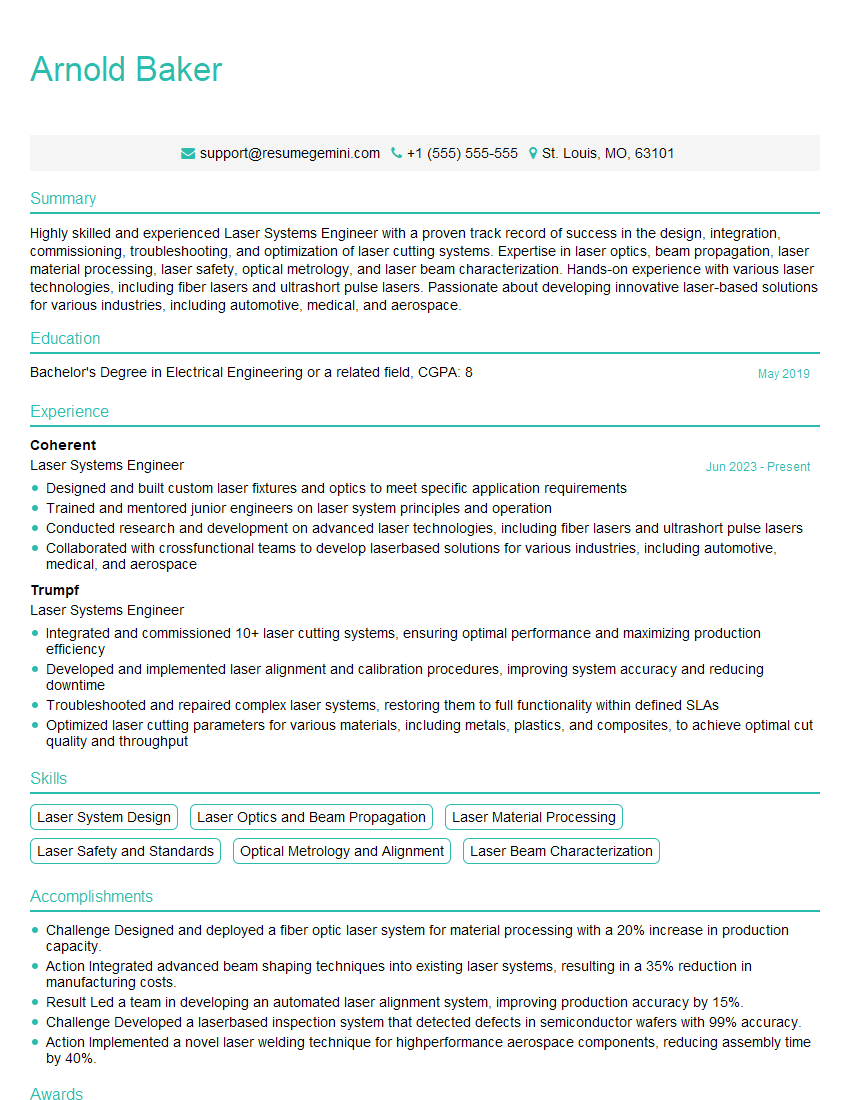
Mastering laser spectroscopy opens doors to exciting career opportunities in research, development, and industrial applications. To maximize your job prospects, it’s crucial to present your skills effectively. Creating an ATS-friendly resume is essential for getting your application noticed by recruiters and hiring managers. ResumeGemini is a trusted resource to help you build a professional and impactful resume that showcases your expertise in laser spectroscopy. Examples of resumes tailored to laser spectroscopy professionals are available to help you create a winning application.
Explore more articles
Users Rating of Our Blogs
Share Your Experience
We value your feedback! Please rate our content and share your thoughts (optional).
What Readers Say About Our Blog
To the interviewgemini.com Webmaster.
Very helpful and content specific questions to help prepare me for my interview!
Thank you
To the interviewgemini.com Webmaster.
This was kind of a unique content I found around the specialized skills. Very helpful questions and good detailed answers.
Very Helpful blog, thank you Interviewgemini team.