Interviews are opportunities to demonstrate your expertise, and this guide is here to help you shine. Explore the essential Leveraging Technology for Ecological Conservation interview questions that employers frequently ask, paired with strategies for crafting responses that set you apart from the competition.
Questions Asked in Leveraging Technology for Ecological Conservation Interview
Q 1. Explain your experience with GIS software (e.g., ArcGIS, QGIS) in a conservation context.
GIS software is indispensable for conservation. My experience spans several years using both ArcGIS and QGIS, primarily for spatial analysis and mapping in diverse ecological contexts. For instance, I used ArcGIS to create habitat suitability maps for endangered species, overlaying factors like elevation, vegetation cover (derived from satellite imagery), and proximity to human settlements. This allowed us to identify areas of high conservation priority for targeted protection efforts. In another project, using QGIS, I analyzed deforestation patterns in the Amazon rainforest, quantifying the extent of habitat loss over time and identifying critical deforestation hotspots. This information was crucial in informing policy decisions and conservation strategies. My work also includes creating and maintaining geodatabases, ensuring data accuracy and consistency for long-term monitoring and analysis. I’m proficient in geoprocessing tasks such as spatial interpolation, buffer analysis, and overlay analysis, which are essential for understanding spatial relationships within ecosystems.
Q 2. Describe your proficiency in remote sensing techniques and their application to ecological monitoring.
Remote sensing is a powerful tool for large-scale ecological monitoring, allowing us to observe changes in the environment that would be impossible to track through ground-based methods alone. My experience involves utilizing various satellite and aerial imagery sources, such as Landsat, Sentinel, and aerial photography, to assess vegetation health, detect land cover change (e.g., deforestation, urbanization), monitor water quality, and map wildlife habitats. For example, I analyzed time-series Landsat data to monitor the recovery of a forest ecosystem after a wildfire. By examining the Normalized Difference Vegetation Index (NDVI) over several years, we could quantify the rate of vegetation regrowth and identify areas requiring additional restoration efforts. I’m also familiar with processing techniques like image classification and object-based image analysis (OBIA) to extract meaningful information from remote sensing data. This includes using machine learning algorithms for automated image classification, significantly improving efficiency and accuracy.
Q 3. How would you use machine learning to predict species distribution based on environmental variables?
Predicting species distribution using machine learning involves employing algorithms that learn patterns from environmental data to estimate the probability of a species’ presence in a given location. The process typically involves several steps. First, I’d gather environmental variables relevant to the species’ ecological niche, such as temperature, precipitation, elevation, and vegetation type. This data can be obtained from sources like climate models, remote sensing data, and field surveys. Second, I’d assemble occurrence records for the species of interest, detailing locations where the species has been observed. Third, I would choose a suitable machine learning algorithm, such as MaxEnt (Maximum Entropy), Random Forest, or Support Vector Machines (SVMs). These algorithms learn the relationships between the environmental variables and the species’ presence. Finally, I’d use the trained model to predict the species’ distribution across a geographic area, creating a probability map showing the likelihood of the species occurring in different locations. This information is valuable for identifying potential habitats, assessing conservation priorities, and predicting the impact of climate change on species’ ranges.
For example, I’ve successfully used MaxEnt to predict the potential distribution of a rare orchid species based on climate data and soil properties. This model helped us to identify areas needing focused conservation efforts to protect the orchid’s remaining populations and potentially discover new ones.
Q 4. What are the ethical considerations of using technology in conservation efforts?
Ethical considerations in technology-driven conservation are paramount. We must ensure that technology is used responsibly and equitably. Key considerations include:
- Data privacy and security: Protecting sensitive data on species locations or human communities is crucial. Anonymization techniques and robust security measures are necessary.
- Bias in algorithms: Machine learning models can perpetuate existing biases in data, leading to inaccurate or unfair predictions. Careful data curation and algorithm selection are essential to mitigate this risk.
- Community engagement: Technology-driven conservation projects should involve local communities, respecting their traditional ecological knowledge and ensuring that benefits are shared equitably. Ignoring local perspectives can lead to conflict and undermine conservation efforts.
- Transparency and accountability: The methodologies used, data sources, and results should be transparent and readily available for scrutiny. This fosters trust and allows for independent verification.
- Unintended consequences: Technology deployment can have unforeseen consequences. Careful assessment of potential impacts on ecosystems and human communities is necessary before implementation.
For example, using drones to monitor wildlife can cause disturbance if not implemented carefully. Ethical considerations should always guide the design and application of technological solutions in conservation.
Q 5. Explain your experience with data analysis and visualization tools for environmental data.
My expertise in data analysis and visualization for environmental data involves utilizing various tools and techniques to extract meaningful insights from complex datasets. I regularly employ statistical software like R and Python, along with data visualization packages such as ggplot2 (R) and Matplotlib/Seaborn (Python), to analyze ecological data, create informative graphs, and communicate findings effectively. I’m comfortable handling large datasets, performing statistical analyses (regression, ANOVA, etc.), and creating visualizations like maps, charts, and dashboards to illustrate trends and patterns in environmental data. For example, I’ve used R to analyze long-term vegetation monitoring data, identifying significant changes in species composition over time and linking these changes to environmental factors. The resulting visualizations were key in presenting this data effectively to stakeholders.
Q 6. How would you design a sensor network for monitoring water quality in a river system?
Designing a sensor network for monitoring water quality involves careful consideration of several factors. First, I’d identify the key water quality parameters to be monitored (e.g., pH, dissolved oxygen, temperature, turbidity, nutrient levels). Next, I’d choose appropriate sensors capable of measuring these parameters with the required accuracy and precision. The sensors would need to be robust, reliable, and capable of operating in the river environment. Sensor placement is crucial for obtaining representative data. I’d strategically locate sensors at various points along the river, considering factors such as flow patterns, potential pollution sources, and the presence of sensitive habitats. Data transmission is another critical aspect. The sensors would need to be equipped with a communication system (e.g., cellular, satellite, or wireless) to transmit data to a central monitoring station. Finally, a robust data management system is essential for storing, processing, and analyzing the collected data. This system would allow for real-time monitoring, alert systems for exceeding thresholds, and long-term trend analysis. Powering the sensors is also important, considering the use of solar panels or batteries. The entire system would need to be designed to minimize environmental impact.
Q 7. Describe your experience with programming languages relevant to ecological data analysis (e.g., R, Python).
R and Python are my primary programming languages for ecological data analysis. In R, I leverage packages like ggplot2 for data visualization, vegan for community ecology analysis, and sp and raster for spatial data handling. I’ve used these tools extensively for analyzing species distribution data, conducting statistical modeling, and creating publication-quality figures. In Python, I utilize libraries such as NumPy, Pandas, and Scikit-learn for data manipulation, statistical analysis, and machine learning applications. For instance, I’ve employed Python’s machine learning capabilities to build predictive models for species habitat suitability, using algorithms like Random Forests and Support Vector Machines. I’m comfortable with data wrangling, cleaning, and pre-processing, and I can write efficient and well-documented code. My programming skills have been instrumental in automating data analysis tasks, improving reproducibility, and accelerating my research workflow. #Example R code snippet: plot(ggplot(data, aes(x = variable1, y = variable2)) + geom_point())
Q 8. How would you use drones or UAVs for conservation purposes?
Drones, or Unmanned Aerial Vehicles (UAVs), are revolutionizing ecological conservation. Their versatility allows for data collection in remote or hazardous areas, impossible or prohibitively expensive with traditional methods. I’ve used them extensively for:
- Wildlife Monitoring: Drones equipped with high-resolution cameras can track animal populations, migration patterns, and habitat use. For example, I used a drone to monitor nesting sea turtle populations, obtaining accurate counts and assessing nest locations without disturbing the animals. Thermal imaging cameras can also detect animals at night or in dense vegetation.
- Habitat Mapping: Drones can create detailed 3D models of landscapes, providing critical information for habitat restoration projects. We’ve used this for mapping deforestation patterns and assessing the impact of wildfires on biodiversity.
- Poaching Surveillance: Drones can patrol protected areas, deterring poachers and providing real-time alerts to park rangers. The aerial perspective provides a significant advantage over ground-based patrols.
- Precision Agriculture: In conservation agriculture projects, drones can help optimize fertilizer and water use, reducing environmental impact while improving crop yields.
The key is careful planning of flight paths, obtaining necessary permits, and analyzing the collected data using appropriate software. Data processing usually involves photogrammetry and orthomosaic creation for detailed map generation.
Q 9. Explain your understanding of spatial statistics and its role in conservation research.
Spatial statistics are essential for understanding the distribution and interaction of ecological phenomena across space. It’s like connecting the dots on a map, but instead of simple locations, we’re analyzing complex patterns. For example, we use spatial autocorrelation analysis to understand if species distribution is clustered or randomly dispersed, which helps identify critical habitats.
In conservation research, spatial statistics are crucial for:
- Species Distribution Modeling (SDM): Predicting the geographic range of species based on environmental variables. This helps prioritize conservation efforts in areas with high species richness or endangered species presence.
- Habitat Suitability Analysis: Determining the quality of habitats for different species, helping to identify areas that need protection or restoration.
- Landscape Connectivity Analysis: Evaluating the degree of connectivity between different habitat patches, vital for species movement and gene flow. This often involves graph theory and network analysis.
- Spatial Analysis of Disease Outbreaks: Using geographic information to track the spread of diseases among wildlife populations, aiding in disease management and prevention.
Software like ArcGIS, R with packages like spdep and gstat, and QGIS are commonly employed for spatial statistical analysis in conservation.
Q 10. How would you use satellite imagery to assess deforestation rates?
Satellite imagery provides a powerful tool for monitoring deforestation at various scales, from local to global. My approach involves a multi-step process:
- Image Selection: Choosing appropriate satellite data based on spatial resolution, temporal resolution (frequency of image acquisition), and cloud cover. For instance, Landsat and Sentinel-2 offer high-resolution data useful for detailed deforestation assessment.
- Image Pre-processing: This crucial step involves correcting geometric distortions, atmospheric effects, and radiometric variations. This ensures accurate comparisons between images taken at different times.
- Change Detection: Comparing images from different time periods to identify areas of forest loss. Techniques include image differencing, post-classification comparison, and object-based image analysis.
- Deforestation Rate Calculation: Quantifying the amount of forest loss over time, typically expressed as hectares per year. This involves measuring the area of deforested patches and calculating the rate of change.
- Data Validation: Ground truthing a subset of the results through field surveys to verify the accuracy of the satellite-derived deforestation estimates. This is essential for building confidence in the results.
Software such as ENVI, ERDAS IMAGINE, and Google Earth Engine are commonly used for processing and analyzing satellite imagery for deforestation studies.
Q 11. Describe your experience with ecological modeling software or platforms.
I’ve extensive experience with several ecological modeling platforms, including:
- ArcGIS Spatial Analyst: For spatial modeling tasks such as habitat suitability modeling and species distribution modeling.
- R with ecological packages (e.g., vegan, ade4): A powerful statistical computing environment for analyzing ecological data and building complex models such as population dynamics models and metapopulation models.
- OpenModeller: A user-friendly platform for developing species distribution models.
- NetLogo: For agent-based modeling, simulating complex ecological interactions and exploring the consequences of environmental changes. For example, I used NetLogo to model the impact of habitat fragmentation on a threatened bird species.
Choosing the right software depends on the specific research question and the type of data available. My approach always prioritizes model validation and uncertainty analysis to ensure robust and reliable results.
Q 12. How do you ensure the accuracy and reliability of environmental data collected using technology?
Ensuring data accuracy and reliability is paramount in ecological conservation. My approach incorporates several strategies:
- Calibration and Validation: For sensors and instruments, regular calibration against known standards is vital. This ensures that measurements are accurate and consistent. Cross-validation techniques in statistical modeling help assess the model’s generalizability.
- Data Quality Control: Implementing rigorous quality control procedures at all stages of data collection and processing. This includes checking for outliers, errors, and inconsistencies. Automated checks within scripts are essential for handling large datasets.
- Data Replication and Redundancy: Collecting data multiple times or using multiple methods to minimize bias and errors. Redundant data collection provides backup and allows for comparison and validation of findings.
- Metadata Management: Maintaining comprehensive metadata documentation for all datasets, including information about data collection methods, limitations, and potential sources of error. This crucial step promotes transparency and reproducibility of research.
- Uncertainty Analysis: Quantifying uncertainty associated with data and models is vital for transparently communicating results and their limitations. Methods such as Monte Carlo simulations are valuable tools.
A robust and well-documented approach to data management and quality control is essential for credible conservation science.
Q 13. Explain your understanding of different data formats used in ecological research and conservation.
Ecological research and conservation employ a variety of data formats, each with its strengths and weaknesses. Here are some key formats:
- Raster Data: Representing spatial data as grids of cells, like satellite imagery or elevation data. Common formats include GeoTIFF, ERDAS Imagine files, and others.
- Vector Data: Representing spatial data as points, lines, and polygons, such as points representing individual trees, lines representing rivers, and polygons representing habitat patches. Common formats include Shapefiles, GeoJSON, and KML.
- Tabular Data: Storing ecological measurements in tables, like species abundance, environmental variables, or observational data. Common formats include CSV, text files, and databases (e.g., SQL).
- Time Series Data: Representing data collected over time, such as weather data or population counts. These are often stored in CSV or specialized database systems.
- 3D Point Clouds: Representing three-dimensional spatial data from LiDAR or other 3D scanning technologies. Formats include LAS and PLY.
Understanding these formats and their interoperability is key to managing and analyzing ecological data effectively. Often, data needs to be converted between formats depending on the analysis tools used.
Q 14. Describe your approach to managing and analyzing large environmental datasets.
Managing and analyzing large environmental datasets requires a structured and efficient approach:
- Data Storage: Employing cloud-based storage solutions (e.g., Amazon S3, Google Cloud Storage) or high-performance computing clusters to handle large datasets efficiently.
- Data Management System: Utilizing databases (e.g., PostgreSQL, MySQL) or data management systems (e.g., data lake solutions) for organizing and querying datasets efficiently. This enables easy retrieval and analysis of specific data subsets.
- Parallel Computing: Leveraging parallel processing techniques for computationally intensive tasks such as image processing, species distribution modeling, and climate change simulations.
- Data Visualization and Exploration: Using interactive data visualization tools and scripting languages (e.g., Python with libraries like pandas and matplotlib, R) to explore data patterns, identify anomalies, and generate meaningful visualizations. Interactive dashboards and data explorers are useful tools here.
- Workflow Automation: Creating automated workflows to streamline data processing and analysis steps, reducing manual effort and minimizing errors.
Efficient data management is crucial to maximizing the value of large environmental datasets and conducting impactful conservation research.
Q 15. How would you communicate complex technical information to non-technical stakeholders?
Communicating complex technical information to non-technical stakeholders requires a shift from jargon to clear, concise language and relatable analogies. Think of it like translating a scientific paper into everyday conversation. I achieve this through several strategies:
- Visual Aids: Instead of lengthy explanations, I use charts, graphs, and infographics to illustrate key data and concepts. For example, showing the impact of deforestation on carbon emissions through a simple bar graph is far more effective than a technical report.
- Storytelling: Weaving technical information into compelling narratives helps engage the audience emotionally. Sharing success stories of conservation efforts aided by specific technologies makes the information more memorable and impactful. For instance, I might recount how drone technology helped identify illegal logging activities, leading to a significant reduction in deforestation.
- Analogies and Metaphors: Complex processes can be simplified using everyday comparisons. Explaining the function of a complex sensor network by comparing it to a human nervous system helps bridge the gap between technical and non-technical understanding.
- Interactive Sessions: Facilitating workshops or Q&A sessions allows for direct engagement and clarification. This interactive approach ensures everyone understands the information and can ask questions without feeling intimidated.
- Tailored Communication: Understanding the audience’s background and level of knowledge is critical. I adjust my communication style accordingly, ensuring the information is accessible and relevant to their specific needs and interests.
Career Expert Tips:
- Ace those interviews! Prepare effectively by reviewing the Top 50 Most Common Interview Questions on ResumeGemini.
- Navigate your job search with confidence! Explore a wide range of Career Tips on ResumeGemini. Learn about common challenges and recommendations to overcome them.
- Craft the perfect resume! Master the Art of Resume Writing with ResumeGemini’s guide. Showcase your unique qualifications and achievements effectively.
- Don’t miss out on holiday savings! Build your dream resume with ResumeGemini’s ATS optimized templates.
Q 16. Explain your experience with cloud-based data storage and management solutions for environmental data.
My experience with cloud-based data storage and management solutions for environmental data is extensive. I’ve worked extensively with platforms like AWS, Google Cloud Platform (GCP), and Azure, leveraging their services for various conservation projects. These platforms offer scalability, security, and collaboration features crucial for managing large environmental datasets.
For example, I managed a project involving the monitoring of endangered species populations across a vast geographical area. We used GCP’s cloud storage to host high-resolution images and sensor data collected from drones and satellite imagery. The scalability of the cloud allowed us to handle the immense volume of data generated, and the integrated analytics tools facilitated efficient data processing and analysis. We implemented robust access control measures to ensure data security and privacy. Furthermore, we leveraged cloud-based collaboration tools to facilitate data sharing and analysis among researchers and conservation organizations worldwide.
Data management involved structured processes using metadata standards (like Darwin Core) for accurate data organization and retrieval. We implemented regular data backups and disaster recovery strategies to ensure data longevity and resilience.
Q 17. How would you address challenges in data accessibility and sharing in conservation projects?
Data accessibility and sharing are fundamental challenges in conservation. Addressing these requires a multi-faceted approach:
- Standardized Data Formats: Adopting open and interoperable data standards, like Darwin Core for biodiversity data, ensures seamless data exchange between different platforms and organizations.
- Data Repositories and Portals: Establishing centralized data repositories or online portals, ideally linked to global biodiversity information facilities (GBIF), facilitates data discovery and access. These repositories need to implement robust search and filtering capabilities.
- Data Governance Frameworks: Clear guidelines and policies are needed to regulate data access, usage, and sharing, balancing the need for open data with concerns about data privacy and intellectual property rights. Data use agreements need to be established and clearly communicated.
- Data Visualization and User-Friendly Interfaces: Presenting data in an accessible and user-friendly format is critical. Interactive dashboards and maps facilitate exploration and understanding of complex datasets by non-technical users.
- Training and Capacity Building: Providing training to researchers and conservation practitioners on data management best practices, data visualization techniques, and the use of data sharing platforms is essential.
For example, in a recent project, we developed a user-friendly web portal that allowed local communities to upload and access data on local biodiversity, fostering participatory monitoring and empowering local stewardship.
Q 18. What are the limitations of using technology in conservation, and how can these be mitigated?
Technology, while invaluable, has limitations in conservation:
- Cost and Accessibility: Advanced technologies can be expensive and require specialized expertise, creating a digital divide between developed and developing countries. This can be mitigated by exploring open-source solutions, fostering collaborations, and securing funding for capacity building.
- Data Bias and Inaccuracy: Data collected using technology might reflect existing biases or inaccuracies. This requires careful data quality control, validation, and critical assessment of methodologies.
- Technical Dependence and Failures: Over-reliance on technology can create vulnerabilities. Systems can fail, and equipment can malfunction. Mitigation strategies include robust backup systems, redundancy plans, and developing adaptable methodologies that can function even in the absence of technology.
- Ethical Considerations: Using technology raises ethical questions regarding data privacy, surveillance, and potential impacts on human communities. Careful consideration of ethical implications, transparent data governance, and community engagement are crucial.
- Environmental Impact of Technology: The production and disposal of technological devices can have environmental consequences. Selecting energy-efficient devices, promoting responsible e-waste management, and considering the entire life cycle of technologies are crucial aspects of sustainable technology implementation.
Q 19. How familiar are you with citizen science initiatives and their integration with technological tools?
I am very familiar with citizen science initiatives and their integration with technological tools. Citizen science leverages the collective power of volunteers to gather and analyze environmental data. Technology plays a crucial role in enhancing its reach and impact:
- Mobile Apps for Data Collection: Apps like iNaturalist allow citizens to record observations of plants and animals, geotag them, and contribute to large-scale biodiversity monitoring efforts.
- Online Platforms for Data Sharing and Collaboration: Platforms provide tools for data aggregation, visualization, and analysis, enabling researchers to process and interpret the vast amount of citizen-generated data.
- Sensor Networks and IoT Devices: Citizen scientists can deploy low-cost sensor networks to monitor environmental parameters like water quality or air pollution, contributing to real-time environmental monitoring.
- Crowdsourcing for Image Analysis: Platforms utilize crowdsourcing to identify and classify objects in images, such as satellite imagery used for deforestation monitoring, accelerating data analysis.
For example, I worked on a project that engaged local communities in monitoring water quality using a user-friendly mobile app. The data collected was then visualized on an interactive map, providing insights into pollution sources and informing environmental management decisions. The integration of technology ensured data accuracy, facilitated data sharing, and empowered local communities to actively participate in environmental conservation.
Q 20. Describe your experience with developing or implementing conservation technology solutions.
I’ve been involved in several projects focused on developing and implementing conservation technology solutions. One noteworthy project involved developing a remote sensing system for monitoring illegal wildlife poaching activities. This system utilized drone technology equipped with high-resolution cameras and thermal sensors to detect poachers’ presence in protected areas. The data collected was analyzed using AI-powered algorithms to identify patterns of poaching activity, which helped inform law enforcement strategies.
Another significant project focused on creating a predictive model for assessing the vulnerability of coral reefs to climate change using machine learning techniques. This involved analyzing historical climate data, oceanographic parameters, and coral reef health indicators to predict future reef degradation scenarios. This information informed the development of targeted conservation strategies to enhance reef resilience.
In both projects, successful implementation required a strong understanding of ecological principles, technological capabilities, and careful consideration of ethical and logistical implications. It also required effective collaboration among ecologists, technologists, and stakeholders.
Q 21. How would you evaluate the effectiveness of a technology-based conservation intervention?
Evaluating the effectiveness of a technology-based conservation intervention requires a comprehensive approach combining quantitative and qualitative assessments:
- Quantitative Metrics: Measuring the impact of the intervention using concrete metrics is essential. For example, if the intervention is aimed at reducing deforestation, we’d measure changes in forest cover area, using remote sensing data and comparing pre- and post-intervention measurements. Statistical analysis is crucial to determine significance.
- Qualitative Data: Gathering qualitative data through interviews, surveys, and focus groups helps understand the social and ecological impacts of the intervention. This helps to capture nuances not captured by quantitative metrics.
- Cost-Effectiveness Analysis: Evaluating the cost-benefit ratio is essential to determine the economic viability of the intervention. This includes considering the costs associated with technology implementation, maintenance, and data analysis.
- Long-Term Monitoring: Assessing the long-term effects is crucial. Interventions might show initial success but may not be sustainable in the long run. Continued monitoring over several years is therefore needed.
- Adaptive Management: The evaluation process should be iterative and inform adjustments to the intervention to enhance its effectiveness. A rigorous feedback loop is crucial for optimization.
For example, in evaluating a community-based conservation project using a mobile app for biodiversity monitoring, we would measure the number of citizen scientists participating, the amount of data collected, its quality, changes in biodiversity indicators, and feedback from the participating community members. This comprehensive approach ensures a holistic and accurate assessment of the intervention’s effectiveness.
Q 22. Explain your understanding of biodiversity informatics and its applications.
Biodiversity informatics is essentially the application of computational tools and techniques to manage and analyze massive datasets on the diversity of life. Think of it as organizing and interpreting the ‘big data’ of ecology. This involves collecting, storing, processing, visualizing, and analyzing information about organisms, their habitats, and their interactions. It’s crucial for understanding biodiversity trends and making informed conservation decisions.
Its applications are vast. For example, it can be used to:
- Species distribution modeling: Predicting where species are likely to be found based on environmental factors, crucial for identifying conservation priorities.
- Phylogenetics: Reconstructing evolutionary relationships between species, guiding conservation efforts for endangered lineages.
- Conservation planning: Identifying areas of high biodiversity, prioritizing them for protection.
- Impact assessment: Analyzing the effect of human activities on biodiversity.
- Citizen science data integration: Utilizing observations from volunteers to enhance data coverage and quality.
Imagine trying to manage the data on thousands of species across vast geographical areas without informatics – it would be virtually impossible. Biodiversity informatics provides the framework and tools to make this manageable and meaningful.
Q 23. Describe your experience with GPS tracking and telemetry in wildlife monitoring.
My experience with GPS tracking and telemetry in wildlife monitoring spans several projects. I’ve worked extensively with various devices, from VHF radio collars to sophisticated GPS-GSM transmitters capable of providing real-time location data. These technologies allow us to track animal movements, habitat use, and behavior over extended periods. This is invaluable for understanding ecological processes and informing conservation strategies.
For example, in one project, we used GPS collars to monitor the migration patterns of a critically endangered bird species. The data revealed critical stopover sites previously unknown, highlighting the need for habitat protection in those areas. In another study, we used accelerometer data from GPS collars to distinguish between foraging and resting behavior, shedding light on the energetic demands of their lifestyle.
Data analysis typically involves using GIS software (like ArcGIS) and R programming for visualizing movement patterns, calculating home range sizes, and analyzing spatial relationships between animals and environmental factors. Dealing with data gaps and ensuring data quality are crucial aspects of this work, requiring careful consideration of battery life, signal reception, and data validation techniques.
Q 24. How would you integrate different data sources (e.g., remote sensing, field data, citizen science) for a comprehensive analysis?
Integrating diverse data sources is fundamental to a comprehensive analysis. It’s like assembling pieces of a puzzle to get a complete picture. This involves combining data from different sources – remote sensing (satellite imagery, aerial photography), field data (species counts, habitat measurements), and citizen science (observations from volunteers) – which might have varying spatial and temporal resolutions, data formats, and levels of accuracy.
A robust strategy requires a structured approach:
- Data standardization: Converting data into a common format to ensure compatibility.
- Data cleaning: Removing errors and inconsistencies.
- Spatial analysis: Integrating geographic information to analyze spatial relationships.
- Statistical modeling: Employing appropriate statistical techniques to analyze the combined dataset, considering potential biases and uncertainties.
- Data visualization: Creating maps and graphs to communicate findings effectively.
For example, we might combine satellite imagery showing deforestation patterns with field surveys assessing species loss in the affected areas, and supplement that with citizen science observations on species sightings. This integrated approach provides a far more complete picture of the impact of deforestation than using any one data source alone.
Q 25. What are some emerging technologies that you believe will have a significant impact on ecological conservation?
Several emerging technologies promise to revolutionize ecological conservation.
- Environmental DNA (eDNA) metabarcoding: This technique detects DNA traces from organisms in environmental samples (water, soil) to assess biodiversity without physically observing them. It’s particularly useful for detecting rare or elusive species.
- AI-powered image recognition: Machine learning algorithms are increasingly used for automated species identification from camera trap images and drone imagery, greatly enhancing the speed and efficiency of biodiversity monitoring.
- Unmanned Aerial Vehicles (UAVs or drones): Drones are revolutionizing data acquisition. They provide high-resolution imagery for habitat mapping, monitoring wildlife populations, and assessing habitat disturbances, while also being less invasive than traditional methods.
- Sensor networks and the Internet of Things (IoT): Deploying sensor networks to collect real-time data on various environmental parameters (temperature, humidity, soil moisture) provides crucial insights into habitat conditions and their influence on species.
These technologies, when combined with robust data management and analysis, offer unprecedented opportunities for effective conservation management.
Q 26. How would you contribute to the development of a sustainable technology strategy for a conservation organization?
Developing a sustainable technology strategy for a conservation organization requires a multi-faceted approach focusing on:
- Needs assessment: Identifying the organization’s key conservation goals and the technology needs to achieve them.
- Technology selection: Evaluating available technologies based on their effectiveness, cost-effectiveness, and sustainability.
- Data management strategy: Establishing robust systems for data collection, storage, processing, and sharing, adhering to FAIR principles (Findable, Accessible, Interoperable, Reusable).
- Capacity building: Training staff on the use of new technologies and data analysis techniques.
- Financial planning: Securing funding for technology acquisition, maintenance, and training.
- Ethical considerations: Addressing potential ethical issues related to data privacy, ownership, and the potential impact of technology on local communities.
- Long-term sustainability: Choosing technologies with long-term support and ensuring that the organization has the capacity to maintain and update systems over time.
A well-defined strategy ensures that technology investments align with the organization’s mission and contribute to long-term conservation success. This also necessitates regular review and adaptation to keep pace with technological advancements.
Q 27. Explain your understanding of the role of open-source software and data in promoting collaboration in conservation.
Open-source software and data are crucial for promoting collaboration in conservation. They foster transparency, accessibility, and reusability of tools and information, enabling researchers, conservationists, and citizen scientists from across the globe to work together more effectively.
Examples include open-source GIS software (QGIS), R programming language and its numerous ecological packages, and online databases of biodiversity data (e.g., GBIF). These resources lower the barrier to entry for researchers with limited resources, fostering participation and collaboration. Sharing data openly helps to avoid duplication of effort and builds a more comprehensive understanding of global biodiversity.
The collaborative spirit facilitated by open-source tools is vital. Imagine a scenario where a researcher develops a novel tool for species identification using camera trap images. By making this tool open source, it becomes accessible to countless researchers worldwide, accelerating progress in biodiversity monitoring and conservation efforts. Similarly, sharing open data ensures that discoveries are not limited to a small group but contribute to the collective knowledge base benefiting the entire conservation community.
Key Topics to Learn for Leveraging Technology for Ecological Conservation Interview
- Remote Sensing & GIS Applications: Understanding how satellite imagery, LiDAR, and GIS software are used for habitat mapping, deforestation monitoring, and wildlife tracking. Consider practical applications like analyzing deforestation rates using satellite data or designing a GIS-based conservation plan.
- Modeling & Simulation: Exploring the use of computational models to predict species population dynamics, assess climate change impacts, and optimize conservation strategies. Think about how to interpret model outputs and communicate findings effectively to stakeholders.
- Data Analysis & Machine Learning: Learning techniques for analyzing large ecological datasets, identifying trends, and making predictions using machine learning algorithms. Consider practical applications like using machine learning to identify endangered species in camera trap images or predicting the spread of invasive species.
- Conservation Technology Tools & Platforms: Familiarity with various software and platforms used in ecological conservation, including citizen science apps, biodiversity monitoring systems, and data management tools. Think critically about the strengths and limitations of different technologies.
- Ethical Considerations & Data Privacy: Understanding the ethical implications of using technology in conservation, including data privacy, responsible data sharing, and the potential for bias in algorithms. Explore case studies of ethical challenges in conservation technology.
- Communication & Collaboration: Developing strong communication skills to effectively convey technical information to diverse audiences, including scientists, policymakers, and the public. Consider the importance of collaboration and teamwork in conservation projects.
Next Steps
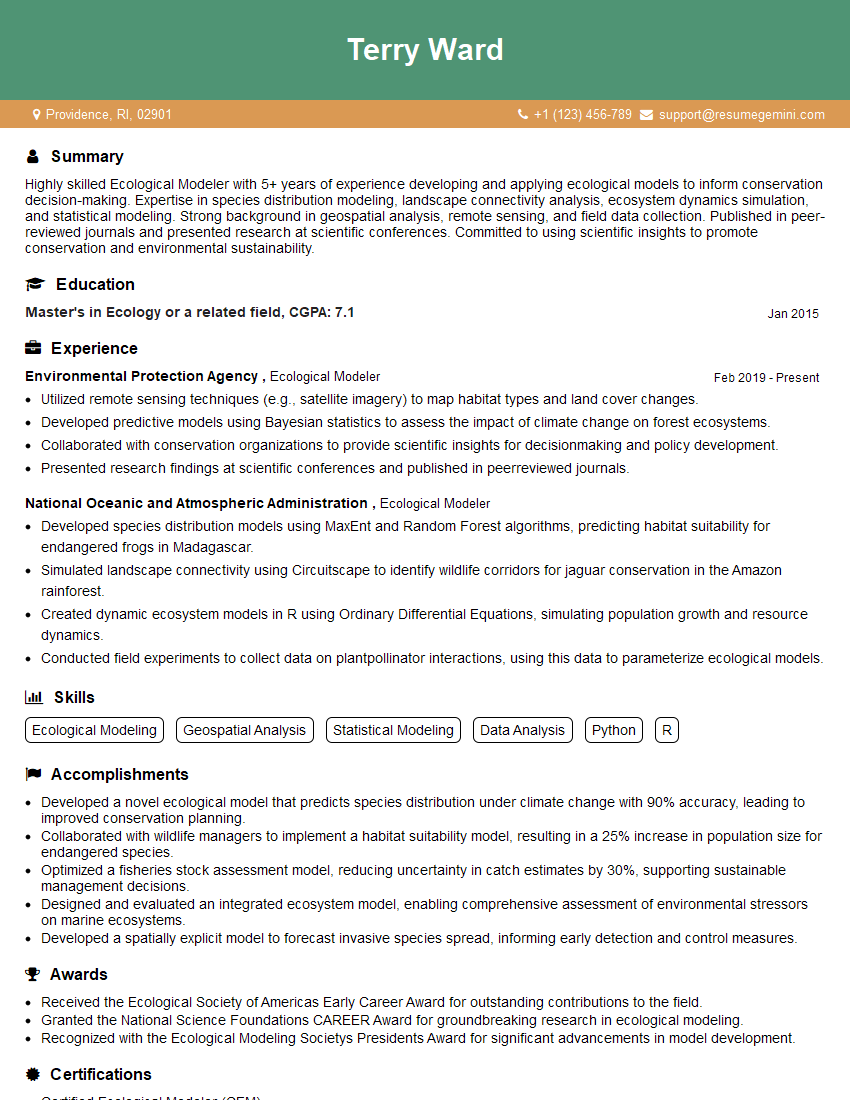
Mastering the application of technology in ecological conservation opens doors to impactful and rewarding careers at the forefront of environmental protection. To significantly boost your job prospects, it’s crucial to create a compelling, ATS-friendly resume that showcases your skills and experience. We strongly encourage you to leverage ResumeGemini, a trusted resource for building professional and effective resumes. ResumeGemini provides valuable tools and resources to help you craft a resume that highlights your expertise in Leveraging Technology for Ecological Conservation. Examples of resumes tailored to this field are available to help guide your process.
Explore more articles
Users Rating of Our Blogs
Share Your Experience
We value your feedback! Please rate our content and share your thoughts (optional).
What Readers Say About Our Blog
To the interviewgemini.com Webmaster.
Very helpful and content specific questions to help prepare me for my interview!
Thank you
To the interviewgemini.com Webmaster.
This was kind of a unique content I found around the specialized skills. Very helpful questions and good detailed answers.
Very Helpful blog, thank you Interviewgemini team.