Feeling uncertain about what to expect in your upcoming interview? We’ve got you covered! This blog highlights the most important Lift Planning and Coordination interview questions and provides actionable advice to help you stand out as the ideal candidate. Let’s pave the way for your success.
Questions Asked in Lift Planning and Coordination Interview
Q 1. Describe your experience with different types of lifting equipment.
My experience encompasses a wide range of lifting equipment, from basic chain hoists and lever blocks to complex crane systems, including overhead cranes, mobile cranes (both crawler and wheeled), and specialized lifting devices like vacuum lifters and air hoists. I’m familiar with their operational principles, limitations, and safety protocols. For instance, I’ve extensively used overhead cranes in industrial settings for lifting heavy machinery, while mobile cranes were essential in construction projects for placing prefabricated components. Understanding the specific capabilities and limitations of each type is crucial for safe and efficient lift planning.
- Chain Hoists: Simple, reliable for lighter loads, requiring manual operation.
- Overhead Cranes: High capacity, efficient for repetitive lifts in controlled environments.
- Mobile Cranes: Versatile, used for lifting and placing loads in various locations.
- Vacuum Lifters: Ideal for delicate or sensitive materials, requiring specialized surface preparation.
Q 2. Explain your understanding of load capacity calculations.
Load capacity calculations are fundamental to safe lifting operations. They involve determining the weight of the load, considering any additional factors that might increase stress on the lifting equipment, and ensuring the chosen equipment has sufficient capacity with a significant safety margin. This includes accounting for the weight of slings, rigging hardware, and any potential dynamic loads during the lift. The formula is deceptively simple – Load Capacity >= (Weight of Load + Weight of Rigging + Dynamic Load) x Safety Factor. However, accurately determining each component, especially the dynamic load (considering acceleration, swing, and other factors), is where expertise comes in. For example, if we’re lifting a 10-ton transformer, we need to consider not just the transformer’s weight but also the weight of the spreader beam, shackles, and slings, and add a safety factor (typically 1.5-2 depending on the risk assessment) to account for unexpected forces.
Q 3. How do you assess risk in lift planning?
Risk assessment in lift planning is a systematic process to identify potential hazards and mitigate them. It involves a thorough examination of the entire lifting operation, considering factors like the environment (weather conditions, ground stability), equipment condition (inspections, maintenance records), personnel competency (training, experience), and the load characteristics (weight, dimensions, center of gravity). A common method is using a risk matrix, where hazards are ranked based on likelihood and severity, leading to prioritization of control measures. This might involve selecting appropriate lifting equipment, implementing traffic control measures, using fall protection, and providing adequate training and supervision. For example, in a confined space lift, the risk of collision is high and requires detailed planning and spotters. A thorough risk assessment minimizes the chances of accidents and ensures a smooth, safe operation.
Q 4. What are the critical steps in developing a lift plan?
Developing a lift plan requires a structured approach. The critical steps include:
- Pre-Lift Planning: This includes defining the scope of work, identifying the load characteristics, and selecting suitable lifting equipment. This is where risk assessment plays a crucial role.
- Equipment Selection and Inspection: Choosing the right equipment based on load capacity, reach, and other specifications, followed by thorough inspections to ensure it’s in good working order.
- Rigging Plan Development: Designing the rigging arrangement (slings, shackles, hooks, etc.), including calculations to ensure stability and safe load distribution.
- Personnel Assignment and Training: Identifying responsible personnel and ensuring they have adequate training and experience.
- Lift Procedure Development: Creating a step-by-step procedure, outlining the sequence of events, communication protocols, and emergency procedures.
- Supervision and Execution: Overseeing the lift, ensuring adherence to the plan, and addressing any unforeseen issues.
- Post-Lift Review: Reviewing the entire operation to identify areas for improvement and to document lessons learned.
Q 5. How do you ensure compliance with safety regulations during lifting operations?
Compliance with safety regulations is paramount. This involves adherence to local, national, and international standards (e.g., OSHA, ANSI, ISO). It starts with ensuring that all personnel involved possess the necessary certifications and training, that equipment undergoes regular inspections and maintenance, and that lift plans are developed and approved by competent personnel. Thorough documentation of all aspects of the lift, including risk assessments, equipment inspections, lift procedures, and any deviations or incidents, is essential for demonstrating compliance. Furthermore, strict adherence to safe operating procedures and the use of appropriate Personal Protective Equipment (PPE) are critical. Regular audits and internal reviews help to ensure continuous improvement in safety practices.
Q 6. Explain your experience with creating lift schedules and coordinating activities.
Creating lift schedules involves careful coordination of resources, including personnel, equipment, and other activities on the site. This often requires detailed scheduling software or spreadsheets, factoring in available equipment, crew availability, and potential conflicts with other ongoing operations. It’s crucial to build buffer time into the schedule to account for unforeseen delays. In coordinating activities, effective communication is key, employing regular briefings and on-site communication systems to ensure everyone is aware of the plan and any adjustments. For example, in a large construction project, coordinating the lifts of multiple structural components requires close collaboration with other trades, ensuring that the lift areas are clear, and appropriate safety zones are established. This ensures a smooth, efficient, and safe flow of operations.
Q 7. Describe a challenging lift plan you’ve developed and how you overcame obstacles.
One challenging lift involved installing a large, heavy transformer into a power substation with extremely limited access and overhead obstructions. The transformer’s weight, combined with the restricted space, posed significant risks. We overcame this by first using detailed 3D modeling to simulate the lift, confirming the feasibility and identifying potential points of failure. This allowed us to design a specialized rigging arrangement using a combination of cranes and a mobile gantry system to navigate the obstructions. We also implemented a comprehensive traffic management plan and established detailed communication protocols to ensure safety and prevent collisions. Careful execution of the plan, along with constant monitoring, resulted in a successful installation without incidents. The project highlighted the value of thorough pre-planning, simulation, and detailed risk mitigation strategies in tackling complex lift scenarios.
Q 8. What software or tools do you use for lift planning?
Lift planning software is crucial for efficient and safe operations. I’ve extensively used programs like CADMATIC, which allows for detailed 3D modeling of the lift, including the crane, load, and surrounding environment. This helps visualize potential obstructions and optimize rigging configurations. Other tools I utilize include specialized lift planning software like Rigging Calculator and LiftPlan, which perform complex calculations concerning center of gravity, load stability, and critical lift parameters. These applications significantly reduce the risk of errors compared to manual calculations. Furthermore, I leverage project management software like Microsoft Project or Primavera P6 to integrate lift plans into the overall construction schedule, ensuring seamless coordination with other trades.
For simpler lifts, I sometimes utilize spreadsheet software like Excel for basic calculations, but this is only appropriate for straightforward scenarios. The choice of software always depends on the complexity and scale of the lifting operation.
Q 9. How do you communicate lift plans to the construction team?
Clear and concise communication is paramount. I use a multi-pronged approach:
- Detailed Lift Plans: I provide comprehensive, easy-to-understand lift plans with clear diagrams, calculations, and sequence of operations. These plans are often presented in both digital and physical formats.
- Pre-Lift Meetings: Mandatory pre-lift meetings are conducted with the entire lift team, including crane operators, riggers, spotters, and other relevant personnel. These meetings review the plan step-by-step, addressing potential concerns and clarifying any ambiguities.
- Visual Aids: Utilizing photographs, videos, and even 3D models where applicable enhances comprehension and allows everyone to fully grasp the plan’s details.
- Checklists: Pre-lift and post-lift checklists are employed to ensure each stage is completed accurately and safely.
- Real-time Communication: During the lift itself, I use two-way radios for immediate communication and to address any unforeseen issues promptly.
Open communication ensures everyone is on the same page and actively contributes to a safe and successful lift.
Q 10. Explain your understanding of different rigging techniques.
Rigging techniques are diverse and chosen based on factors like load characteristics, environmental conditions, and available equipment. My expertise encompasses a range of methods:
- Vertical Lifting: Using slings (chain, wire rope, or synthetic) attached directly to the load, hoisted vertically. This is the most common method for straightforward lifts.
- Directional Lifting: Employing specialized rigging hardware like spreader beams or shackles to distribute the load evenly and control its orientation during the lift. This is essential for large, unwieldy objects.
- Derrick Systems: Utilizing derricks, often in confined spaces where crane access is limited. This requires precise planning and coordination.
- Specialized Lifting Devices: Depending on the load, vacuum lifters, magnet lifters, or other specialized equipment might be necessary. For instance, glass panels might require suction cups for safe handling.
- Crane-assisted Lifting: Utilizing cranes in combination with other rigging techniques.
Selecting the right technique is crucial for safety and efficiency. A poorly chosen rigging setup can lead to accidents or damage to the load.
Q 11. How do you handle unexpected issues during a lift operation?
Unexpected issues are inherent in construction. My approach focuses on preparedness and decisive action:
- Risk Assessment and Contingency Planning: I proactively identify potential problems during the planning phase, developing contingency plans to mitigate their impact. For instance, if weather is a concern, alternative lift schedules or protective measures are implemented.
- Communication: Immediately communicate the issue to the entire lift team, clearly outlining the problem and potential solutions.
- Problem-Solving: Collaboratively brainstorm solutions with the team. This might involve adjusting the rigging, using alternative equipment, or temporarily halting the lift to rectify the situation.
- Documentation: Meticulously document the issue, the steps taken to resolve it, and any lessons learned for future operations.
- Safety First: If a situation poses an unacceptable safety risk, the lift is immediately halted until the issue is resolved. Safety always trumps schedule.
A recent example involved a sudden gust of wind. We immediately halted the lift, secured the load, and waited for calmer conditions before resuming. Clear communication prevented panic and ensured a safe resolution.
Q 12. What are your strategies for ensuring timely completion of lifting tasks?
Timely completion requires meticulous planning and efficient execution:
- Detailed Scheduling: Integrating the lift plan into the overall project schedule, considering dependencies on other trades and resources.
- Resource Allocation: Ensuring that the necessary equipment, personnel, and materials are available at the right time.
- Clear Communication: Avoiding delays through prompt and clear communication with all stakeholders.
- Risk Management: Proactive identification and mitigation of potential delays, for example, through buffer times in the schedule.
- Continuous Monitoring: Tracking progress against the schedule and making necessary adjustments to maintain the timeline.
One key strategy is to identify potential bottlenecks upfront. For example, if a specific crane is required and its availability is uncertain, contingency plans—such as using a different crane or adjusting the schedule—must be developed early on.
Q 13. Describe your experience with load monitoring and control systems.
I have extensive experience with load monitoring and control systems, both simple and complex. Simple systems might involve load cells to measure the weight and tension on slings. More advanced systems incorporate sensors, data loggers, and software to monitor multiple parameters in real-time, such as load weight, hook height, swing angle, and wind speed. This data provides crucial information for safe and controlled lifts, particularly for very heavy or complex loads. I’m proficient in using systems that provide visual and audible alerts if any parameters exceed pre-set limits. For extremely critical lifts, these systems might interface with the crane’s control system, allowing for automatic load limiting and prevention of potentially hazardous situations.
For instance, on a recent project involving the installation of a large transformer, a load monitoring system alerted us to a slight imbalance in the load distribution. We were able to adjust the rigging before the imbalance became problematic. This early warning prevented a potential accident and ensured the safe installation of the transformer.
Q 14. How do you ensure the safety of personnel during lifting operations?
Safety is my utmost priority. My approach involves several layers of protection:
- Risk Assessments: Conducting thorough risk assessments before every lift, identifying potential hazards and implementing control measures to minimize risks.
- Safe Work Procedures: Establishing and enforcing clear, detailed safe work procedures for all personnel involved, including pre-lift inspections, emergency procedures, and communication protocols.
- Personal Protective Equipment (PPE): Ensuring that all personnel wear appropriate PPE, including hard hats, safety glasses, high-visibility clothing, and safety harnesses.
- Exclusion Zones: Establishing and maintaining exclusion zones around the lift area to prevent unauthorized personnel from entering the hazardous area.
- Competent Personnel: Ensuring that only trained and competent personnel operate the lifting equipment and perform the rigging tasks.
- Regular Inspections: Regularly inspecting lifting equipment to ensure it’s in good working condition.
- Emergency Response Plan: Having a well-defined emergency response plan in place to address any unexpected incidents.
Safety isn’t just a checklist; it’s a mindset that permeates every aspect of my work.
Q 15. What are the key considerations for planning lifts in confined spaces?
Planning lifts in confined spaces presents unique challenges demanding meticulous attention to detail and safety. The key considerations revolve around accessibility, maneuverability, stability, and risk mitigation.
- Accessibility: Determining whether the load can even fit through the space, considering clearances, doorways, and potential obstructions. For example, a large piece of equipment might require dismantling before it can be moved into a confined space like a stairwell.
- Maneuverability: Planning the precise path the load will take, ensuring sufficient clearance at all points. This includes accounting for the swing radius of the crane or lifting device, and any potential interference with pipes, cables, or other structural elements.
- Stability: Ensuring a stable base for the lifting equipment and the load itself. In confined spaces, this often means employing specialized lifting techniques or using smaller, more maneuverable equipment. We might use a smaller mobile crane instead of a tower crane, or even employ manual lifting methods with multiple workers.
- Risk Mitigation: Identifying and mitigating all potential hazards, including falls, collisions, crushing, and electrocution. This often necessitates additional safety precautions such as more personnel, additional safety inspections, and more stringent rigging procedures. Detailed risk assessments and method statements are crucial.
Career Expert Tips:
- Ace those interviews! Prepare effectively by reviewing the Top 50 Most Common Interview Questions on ResumeGemini.
- Navigate your job search with confidence! Explore a wide range of Career Tips on ResumeGemini. Learn about common challenges and recommendations to overcome them.
- Craft the perfect resume! Master the Art of Resume Writing with ResumeGemini’s guide. Showcase your unique qualifications and achievements effectively.
- Don’t miss out on holiday savings! Build your dream resume with ResumeGemini’s ATS optimized templates.
Q 16. How do you manage changes to the lift plan during the project?
Managing changes to the lift plan requires a robust and flexible system. It’s not just about making the change; it’s about ensuring that the change is communicated effectively and that the updated plan remains safe and feasible.
- Formal Change Request Process: All changes should be documented formally through a change request process. This usually involves a written request specifying the proposed change, the rationale behind it, and a safety assessment of the implications.
- Impact Assessment: Thoroughly analyze the impact of the change on other aspects of the project. For example, a change in the lift sequence might impact other trades or cause delays.
- Updated Documentation: All relevant documentation, including drawings, method statements, and risk assessments, must be updated to reflect the change.
- Communication: The change must be clearly communicated to all relevant parties involved in the lift, including the crane operator, riggers, spotters, and project management team. This could involve toolbox talks or updated work permits.
For instance, if a structural element is discovered to be weaker than originally anticipated, the lift plan might need to be adjusted to reduce the load or change the lifting technique. This necessitates a formal change request, a reassessment of the risks, and updated plans and method statements to ensure safety.
Q 17. Explain your experience with pre-lift inspections.
Pre-lift inspections are crucial for ensuring a safe and efficient lift. My experience encompasses a detailed checklist approach, verifying equipment, personnel, and environmental conditions.
- Equipment Inspection: This includes inspecting the crane, rigging equipment (slings, shackles, hooks), and any other lifting devices for defects, damage, or wear and tear. Verification of certifications and proper maintenance records is essential.
- Environmental Inspection: This involves assessing the area around the lift for potential hazards, such as obstructions, overhead power lines, unstable ground, and weather conditions (wind speed is especially crucial).
- Personnel Check: Ensuring that all personnel involved in the lift are properly trained, qualified, and have the necessary permits and certifications. This also includes confirming they understand their roles and responsibilities in the lift plan.
- Load Verification: Verifying the weight and dimensions of the load, ensuring it is compatible with the lifting equipment and the planned lift method.
In one project, a pre-lift inspection revealed a damaged sling that was not immediately apparent. Replacing the sling prevented a potential accident and ensured the lift was executed safely. These inspections are not just a tick-box exercise; they are a crucial safety safeguard.
Q 18. How do you integrate lift planning with overall project scheduling?
Integrating lift planning into the overall project schedule is paramount for efficient project execution. It involves identifying critical lift activities, defining dependencies, and allocating sufficient resources and time.
- Critical Path Analysis: Identifying lifts that are critical to the project schedule. Delays in these lifts can significantly impact the overall project timeline. Software tools like Primavera P6 are valuable for this.
- Dependency Identification: Determining the relationships between different lift activities and other project tasks. For example, a structural steel erection might depend on the prior lift of the steel beams.
- Resource Allocation: Allocating the necessary resources for each lift activity, such as cranes, riggers, and other personnel. Overlapping lift activities are usually avoided to save time and cost.
- Contingency Planning: Building in buffer time to account for potential delays or unforeseen circumstances. This helps to minimize the impact of disruptions.
In practice, this could involve creating a Gantt chart that visually represents the project schedule, clearly showing the timing and duration of lift activities. This provides a clear overview and helps to avoid scheduling conflicts.
Q 19. What is your understanding of the legal requirements for lifting operations?
Legal requirements for lifting operations vary by jurisdiction but generally emphasize safety and compliance. Key aspects include adherence to relevant regulations, certifications, and training standards.
- Regulations: Compliance with local and national regulations regarding lifting operations, including those related to safe working loads, crane inspections, and operator certification.
- Certifications: Ensuring that all lifting equipment and personnel are properly certified and meet the required standards. This often includes equipment testing certificates and operator licenses.
- Risk Assessments: Conducting thorough risk assessments before every lift and implementing appropriate control measures to mitigate identified hazards. These should be documented and reviewed regularly.
- Accident Reporting: Establishing procedures for reporting and investigating accidents or near misses.
Ignoring legal requirements can lead to severe consequences, including fines, legal action, and reputational damage. It is crucial to prioritize legal compliance to maintain a safe working environment.
Q 20. How do you manage potential conflicts between different lift activities?
Managing conflicts between different lift activities requires careful coordination and planning. The goal is to sequence lifts to minimize interference and ensure a safe working environment.
- Scheduling Coordination: Careful coordination of the project schedule to avoid overlapping lift activities that might require the same resources (e.g., cranes) or occupy the same space.
- Clear Communication: Maintaining open communication between different lift teams and project stakeholders to ensure everyone is aware of planned activities and potential conflicts.
- Alternative Lift Strategies: Developing alternative lift strategies for situations where conflicts are unavoidable. This might involve using different lifting equipment or adjusting the lift sequence.
- Resource Management: Efficient resource allocation to ensure that sufficient cranes and other lifting equipment are available without creating scheduling conflicts.
For example, if two lifts require the same crane at the same time, we might adjust the schedule, use a different crane, or utilize a temporary solution like a smaller lifting device.
Q 21. Explain your experience with developing emergency response plans for lifting operations.
Developing effective emergency response plans for lifting operations is crucial for mitigating the risk of accidents. These plans should be tailored to the specific circumstances of each lift.
- Hazard Identification: Identify potential hazards specific to the lift operation, including equipment failure, load instability, and environmental factors.
- Emergency Procedures: Develop clear and concise emergency procedures that detail the actions to be taken in the event of various incidents (e.g., crane malfunction, load drop, personnel injury).
- Communication Protocols: Establish clear communication protocols to facilitate rapid response and coordination among personnel during an emergency. This often includes designated communication channels and emergency contacts.
- Emergency Equipment: Ensure that appropriate emergency equipment is readily available and easily accessible, such as first-aid kits, fire extinguishers, and emergency shut-off switches.
- Training and Drills: Conduct regular training and drills to familiarize personnel with emergency procedures and ensure their effectiveness. Practical drills are essential to develop a coordinated team response.
A well-defined emergency response plan, practiced regularly, is the best way to minimize the consequences of unforeseen events during lifting operations.
Q 22. How do you select appropriate lifting equipment for specific tasks?
Selecting the right lifting equipment is crucial for safety and efficiency. It’s not a one-size-fits-all process; it requires careful consideration of several factors. Think of it like choosing the right tool for a job – you wouldn’t use a screwdriver to hammer a nail!
- Weight and dimensions of the load: This is the most fundamental aspect. The equipment’s rated capacity must exceed the weight of the load, considering any potential increases due to rigging and attachments. For example, a 10-ton crane is needed for a 9-ton load, not a 9-ton crane.
- Height and reach requirements: The equipment must be able to reach the load’s location and have sufficient vertical clearance. This involves assessing the boom length and the presence of any obstructions.
- Working environment: Consider factors like ground conditions (stable or uneven), weather conditions (wind speed, rain), and the presence of overhead obstructions or confined spaces. A rough terrain crane might be necessary for an uneven site, while a smaller, more maneuverable crane may be better suited for confined areas.
- Type of load: Is the load bulky, fragile, or hazardous? Different rigging techniques and equipment (e.g., vacuum lifters, specialized slings) may be required. Fragile items may need a gentler approach than a steel beam.
- Accessibility and maneuverability: Ensure the chosen equipment can easily reach the lifting point and maneuver around obstacles without compromising safety. A telescopic crane might be chosen over a lattice boom crane for tight spaces.
For example, during a recent project involving lifting large transformers, we carefully evaluated the weight, dimensions, fragility of the load, and the confined space of the substation before opting for a specialized crawler crane with advanced rigging and positioning systems.
Q 23. Describe your experience with documenting lift plans and procedures.
Comprehensive documentation is paramount in lift planning. It acts as a blueprint for the entire operation, ensuring everyone is on the same page and reduces the risk of errors. My documentation typically includes:
- Lift plan: This detailed document outlines the lifting procedure, equipment specifications, personnel roles, safety precautions, and emergency procedures. I use diagrams and drawings to clearly visualize the lift setup.
- Risk assessment: Identifying potential hazards, analyzing their severity, and implementing control measures is vital. This forms the basis of a safe operation.
- Method statements: These describe the step-by-step process, including rigging procedures, load securing, and crane operation instructions.
- Inspection reports: Regular equipment inspections are vital. I document the pre-lift and post-lift inspections, ensuring all equipment is in optimal condition.
- Post-lift report: This summarizes the completed lift, noting any deviations from the plan, lessons learned, and recommendations for future improvements.
I’ve always used a combination of digital and physical documentation. Software like specialized lift planning programs helps create detailed plans and calculations, while hard copies are essential on-site for easy reference, even in situations with limited or no network connectivity.
Q 24. How do you train personnel on safe lifting practices?
Training is not just about providing information; it’s about fostering a safety-conscious culture. My training program for personnel involves a multi-faceted approach:
- Classroom instruction: Theoretical aspects are covered, including safe lifting techniques, recognizing hazards, understanding load charts, and emergency procedures.
- Hands-on training: Practical demonstrations and supervised exercises are essential. This helps build confidence and competence in using equipment and following procedures.
- On-site mentoring: Experienced professionals guide trainees during actual lifts, providing real-time feedback and correction.
- Regular refresher courses: Safety regulations and best practices evolve. Refresher courses keep personnel up-to-date and reinforce safe working habits.
- Use of simulations and virtual reality: These tools can provide a risk-free environment for trainees to practice complex lifting scenarios and develop decision-making skills under pressure.
For example, when training riggers on using specific types of slings, we use practical demonstrations, showing them how to correctly inspect, attach and secure the load. We also simulate different scenarios where they have to identify and solve potential problems.
Q 25. What are your strategies for minimizing downtime during lifting operations?
Minimizing downtime requires proactive planning and efficient execution. My strategies include:
- Thorough pre-lift planning: Careful planning reduces the likelihood of unexpected delays or problems. This includes detailed site surveys, equipment selection, and coordination of resources.
- Efficient rigging procedures: Well-trained riggers and streamlined rigging processes minimize setup and dismantling time.
- Preventive maintenance: Regular equipment maintenance prevents breakdowns and delays. A well-maintained crane is less likely to suffer a sudden malfunction.
- Effective communication: Clear communication among the team prevents misunderstandings and delays. Using a communication protocol ensures everyone is informed.
- Contingency planning: Having backup plans in place for unforeseen circumstances (e.g., equipment failure, weather delays) helps mitigate potential downtime.
For instance, on a recent construction project, we meticulously scheduled crane movements and material delivery to avoid congestion and ensure smooth workflow. This reduced delays and saved considerable time and money.
Q 26. How do you ensure the accuracy of lift calculations?
Accuracy in lift calculations is critical for safety. I use a multi-layered approach:
- Accurate load weight determination: Using calibrated scales and considering additional weights from rigging equipment is essential.
- Using appropriate software and formulas: Specialized lift planning software helps calculate center of gravity, stresses on the crane, and other critical parameters. I always double-check manual calculations.
- Factor of safety: Applying an appropriate safety factor ensures the crane operates well within its capabilities, accounting for unforeseen circumstances.
- Regularly calibrating equipment: Ensuring the accuracy of load cells and other measuring devices is critical.
- Peer review: Having another experienced professional review the calculations provides an additional layer of assurance.
An example would be that we would never rely solely on a manufacturer’s rated capacity; we would always conduct our own independent load calculations based on the actual conditions on-site, accounting for the wind speed, the geometry of the lift and any other factors that might affect the lift’s stability.
Q 27. How do you use technology to improve efficiency in lift planning?
Technology significantly improves lift planning efficiency. I leverage several tools:
- Lift planning software: Software allows for precise calculations, 3D modeling of the lift, and the creation of detailed plans.
- Crane control systems: Modern cranes often have advanced control systems that provide real-time data, aiding in precise positioning and load handling.
- Digital documentation and collaboration tools: Cloud-based platforms facilitate collaboration, allowing team members to access and update plans in real-time.
- Simulation and modeling: Simulating lifts helps identify potential problems before they occur on-site.
- Mobile devices and data collection tools: Mobile devices can collect data on-site, minimizing the need for manual data entry.
For example, using 3D modeling software, we can virtually simulate the lifting of heavy components in a congested workspace, identifying potential obstructions and optimizing the crane movements before the actual lift commences. This greatly reduces on-site delays and improves safety.
Q 28. Describe your experience with different types of cranes and their applications.
Experience with various cranes is essential for effective lift planning. I’m familiar with several types:
- Tower cranes: Primarily used in construction for lifting heavy materials to great heights. They have a fixed location and limited mobility.
- Mobile cranes (rough-terrain, all-terrain, crawler): These cranes offer greater mobility than tower cranes and are suitable for various terrains. Rough-terrain cranes are designed for uneven surfaces, while crawler cranes offer superior stability for heavy lifting.
- Overhead cranes: These are used in factories and workshops for lifting materials within a defined area.
- Floating cranes: Used in port operations and other marine applications for lifting heavy items onto ships or from water.
- Gantry cranes: Used for heavier loads in factory or port settings, running on rails, offering large lifting capacity.
The selection depends on the specific project requirements. For instance, a high-rise construction project would utilize tower cranes, while the transportation of heavy equipment would likely involve a mobile crane or a gantry crane. Each crane type has its strengths and weaknesses, and understanding these is vital for efficient and safe lifting operations.
Key Topics to Learn for Lift Planning and Coordination Interview
- Lift Selection and Capacity Analysis: Understanding different lift types (passenger, freight, construction), weight limitations, and safe working loads. Practical application: Calculating the required lift capacity for a specific project and justifying your choice.
- Risk Assessment and Mitigation: Identifying potential hazards associated with lift operations (e.g., falls, collisions, overloading) and implementing preventive measures. Practical application: Developing a detailed risk assessment plan for a complex lift operation.
- Planning and Scheduling: Creating detailed lift plans including timelines, resource allocation, and sequencing of operations. Practical application: Optimizing lift schedules to minimize downtime and maximize efficiency.
- Communication and Coordination: Effective communication with all stakeholders (e.g., engineers, operators, site personnel) to ensure safe and efficient lift operations. Practical application: Demonstrating clear and concise communication strategies for managing lift operations in a complex environment.
- Legal Compliance and Regulations: Understanding and adhering to all relevant safety regulations and standards for lift operations. Practical application: Ensuring compliance with local and national regulations throughout the lift planning process.
- Emergency Procedures and Contingency Planning: Developing comprehensive emergency procedures and contingency plans to handle unexpected situations. Practical application: Creating a detailed emergency response plan for a critical lift operation.
- Technology and Software Applications: Familiarity with lift planning software and relevant technologies for optimizing lift operations. Practical application: Demonstrating proficiency in using software to model and analyze lift operations.
Next Steps
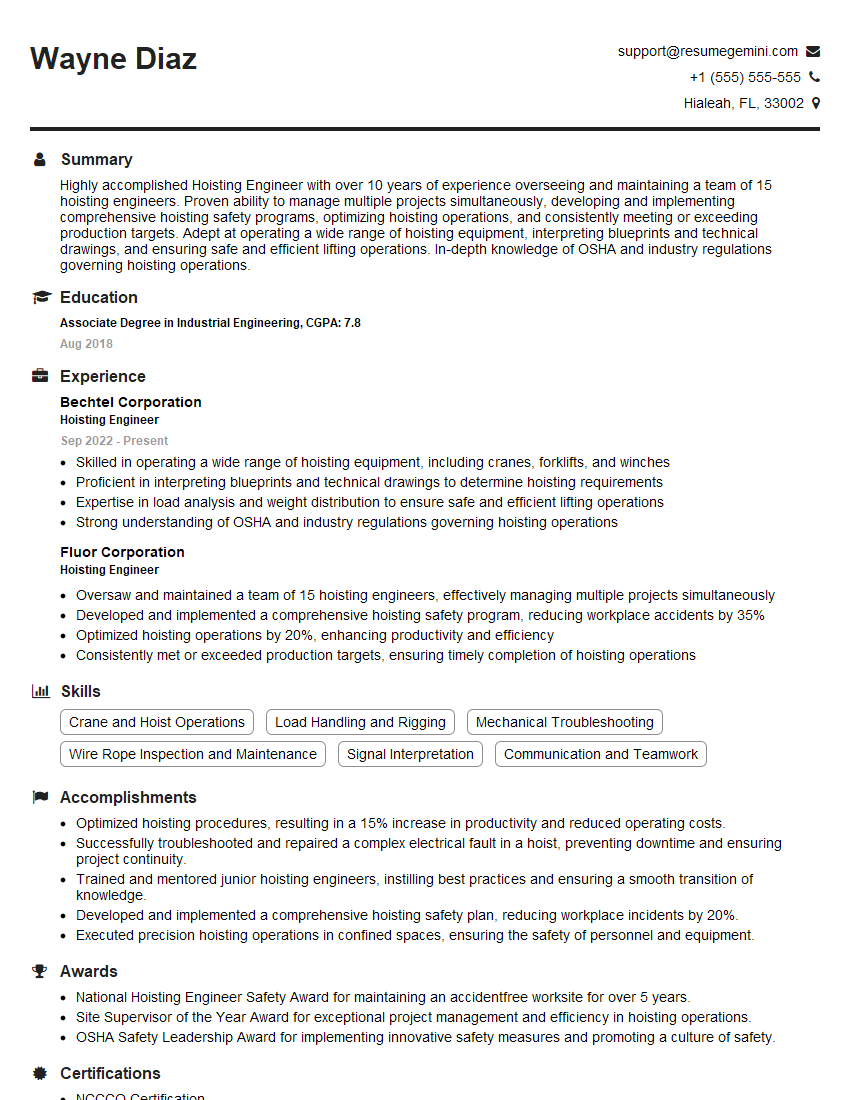
Mastering Lift Planning and Coordination opens doors to exciting career opportunities in construction, manufacturing, and logistics, offering rewarding challenges and excellent growth potential. To significantly boost your job prospects, create an ATS-friendly resume that highlights your skills and experience effectively. ResumeGemini is a trusted resource that can help you build a professional and impactful resume tailored to your specific career goals. Examples of resumes tailored to Lift Planning and Coordination are available to guide you through the process.
Explore more articles
Users Rating of Our Blogs
Share Your Experience
We value your feedback! Please rate our content and share your thoughts (optional).
What Readers Say About Our Blog
To the interviewgemini.com Webmaster.
Very helpful and content specific questions to help prepare me for my interview!
Thank you
To the interviewgemini.com Webmaster.
This was kind of a unique content I found around the specialized skills. Very helpful questions and good detailed answers.
Very Helpful blog, thank you Interviewgemini team.