Cracking a skill-specific interview, like one for Low vision support groups, requires understanding the nuances of the role. In this blog, we present the questions you’re most likely to encounter, along with insights into how to answer them effectively. Let’s ensure you’re ready to make a strong impression.
Questions Asked in Low vision support groups Interview
Q 1. Describe your experience facilitating low vision support groups.
Facilitating low vision support groups involves creating a safe and supportive environment where individuals can share their experiences, learn coping strategies, and connect with others facing similar challenges. My approach is built on principles of empathy, active listening, and evidence-based practices. I structure meetings around specific themes, such as adapting to vision loss, utilizing assistive technology, navigating social situations, and maintaining independence. For instance, one particularly successful session focused on using smartphones with accessibility features. We explored voice commands, screen readers, and magnification apps, followed by a hands-on practice period. The feedback was overwhelmingly positive; members felt empowered and more confident in managing their devices. Beyond structured activities, I encourage peer support and knowledge sharing among group members. This fosters a sense of community and helps individuals realize they aren’t alone in their journey.
Q 2. What assistive technologies are you familiar with and how would you train clients to use them?
I’m proficient with a wide range of assistive technologies, including screen readers (like JAWS and NVDA), screen magnifiers (ZoomText and MAGic), electronic magnifiers (CCTV), and optical aids such as large-print books and magnifiers. Training clients involves a personalized approach, starting with an assessment of their individual needs and preferences. For example, a client primarily using a computer would benefit from in-depth screen reader training, focusing on keyboard shortcuts, navigation techniques, and document management. For someone who needs to read printed materials, we’d focus on the use of CCTV or handheld magnifiers, tailored to their specific visual limitations. The training process is iterative, with practical exercises and ongoing support to ensure they confidently integrate these technologies into their daily routines. We often start with simple tasks and gradually increase the complexity, providing ample opportunities for practice and questions.
Q 3. Explain different types of low vision and their impact on daily living.
Low vision encompasses a wide spectrum of visual impairments, ranging from mild to severe. Common types include:
- Age-related macular degeneration (AMD): Affects the central vision, making it difficult to see fine details, read, and recognize faces. Daily life impacts include difficulty reading, driving, and recognizing objects at a distance.
- Glaucoma: Damages peripheral vision, resulting in tunnel vision. This impacts mobility, awareness of surroundings, and the ability to navigate safely.
- Diabetic retinopathy: Causes blurred vision, floaters, and dark spots. This can affect reading, driving, and overall visual acuity.
- Cataracts: Clouding of the eye’s lens, leading to blurry or hazy vision. Daily impacts include difficulty seeing in low light, glare sensitivity, and reduced visual acuity.
The impact on daily living varies greatly depending on the type and severity of vision loss. It can affect activities such as reading, writing, cooking, driving, socializing, and overall independence. It’s crucial to understand these diverse impacts to provide tailored support.
Q 4. How do you adapt your communication style to clients with varying levels of visual impairment?
Adapting my communication style is paramount to effective support. I avoid jargon and use clear, concise language. For clients with profound vision loss, I provide detailed verbal descriptions, ensuring they understand the context. I also use tactile aids where appropriate, such as large-print materials or raised-line drawings. For those with mild to moderate vision loss, I may simply use visual aids with large fonts and high contrast. Non-verbal communication is also crucial; I maintain good eye contact, speak clearly and slowly, and ensure my body language is approachable. Open and honest communication, actively seeking their feedback on my communication approach, ensures that the client feels comfortable and understood.
Q 5. How would you address a client experiencing emotional distress related to their vision loss?
Addressing emotional distress is a crucial aspect of low vision support. I approach this with empathy and validation, creating a safe space for clients to express their feelings. Active listening is essential, allowing them to fully share their concerns without interruption. I avoid minimizing their feelings or offering unsolicited advice. Instead, I focus on understanding their perspective and helping them identify their coping mechanisms and emotional support networks. Depending on the severity, I might suggest connecting them with mental health professionals specializing in vision loss. Sometimes, simply having someone to listen and validate their experiences provides immense relief. Collaborative goal-setting, focusing on building resilience and coping skills, is an integral part of addressing emotional distress.
Q 6. Describe your experience in assessing a client’s needs for low vision aids.
Assessing a client’s needs begins with a thorough understanding of their visual function, lifestyle, and personal goals. This involves reviewing their medical history, conducting visual acuity tests, and observing their performance in everyday tasks like reading, writing, and object recognition. I then discuss their daily activities to pinpoint specific challenges and preferences. For instance, a client may struggle with reading menus at restaurants, so we might explore large-print menus or assistive technology for smartphone use. This collaborative approach ensures that any recommended low vision aids align with the client’s needs and preferences. I also consider factors like affordability, comfort, and ease of use when recommending assistive devices.
Q 7. What are some common challenges faced by individuals with low vision?
Individuals with low vision face numerous challenges, including:
- Difficulty with daily tasks: Reading, writing, cooking, driving, and managing personal care can become significantly more difficult.
- Social isolation: Vision loss can limit social participation and lead to feelings of loneliness and isolation.
- Reduced independence: Reliance on others for assistance can impact self-esteem and autonomy.
- Financial strain: The cost of assistive devices and adaptive equipment can be substantial.
- Emotional distress: Grief, anxiety, and depression are common emotional responses to vision loss.
- Accessibility barriers: Navigating environments that are not designed for low vision can pose significant challenges.
Understanding these challenges helps to tailor interventions and support services to effectively address their needs and improve their quality of life. Addressing these needs requires a holistic approach, integrating medical care, assistive technology, social support, and emotional counseling.
Q 8. How would you teach a client to use a magnifier effectively?
Teaching effective magnifier use involves a multi-step process focusing on proper technique and personalized adjustments. It’s not just about handing someone a magnifier; it’s about empowering them to use it comfortably and efficiently.
Assessment: I begin by understanding the client’s specific visual needs and limitations. This includes assessing their remaining vision, the type of tasks they need to perform (reading, writing, close-up work), and their physical dexterity.
Magnifier Selection: Choosing the right magnifier is crucial. This depends on the client’s visual acuity and the size of the material they need to magnify. Options range from handheld magnifiers with different magnifications to stand magnifiers offering hands-free viewing.
Technique Instruction: I demonstrate proper technique, emphasizing the importance of good lighting, appropriate distance between the magnifier and the material, and comfortable posture. I also teach them how to adjust the distance and angle for optimal viewing. For example, with handheld magnifiers, I’ll show them how to move the magnifier slowly, rather than moving the material.
Practice and Refinement: Practice is key. I’ll guide them through various tasks using the magnifier, providing feedback and making adjustments as needed. This might involve reading different sizes of print, writing, or working with small objects. We’ll focus on building confidence and speed.
Adaptive Strategies: We’ll explore strategies for adapting to limitations. This could involve changing the background color of the material being read (a dark background with light text can enhance contrast), using different fonts, or utilizing assistive software.
For example, a client struggling with newspaper reading might benefit from a large-print version, coupled with a high-powered illuminated magnifier. With practice, they’ll develop a comfortable and efficient reading method.
Q 9. Describe your experience working with families of individuals with low vision.
Working with families of individuals with low vision requires a holistic approach that addresses the emotional, practical, and social impact of vision loss. My experience includes providing education and support to family members on understanding the condition, adapting the home environment, and accessing available resources.
I’ve found that family involvement is critical for successful rehabilitation. Families often need support in learning how to adapt to the changes in their loved one’s abilities, and I provide guidance on techniques for communication, managing daily tasks, and advocating for their needs.
One example is working with a family where the mother was losing her vision. We not only focused on teaching her adaptive techniques for reading and daily tasks but also helped the family learn strategies for maintaining open communication, adapting household chores, and fostering emotional support. Open communication between family members and our shared commitment to their independence was vital. Support groups and family counseling sessions were also integral to their adjustment.
Q 10. How do you stay current with advancements in low vision technology and rehabilitation techniques?
Staying current in the rapidly evolving field of low vision technology and rehabilitation requires a proactive approach. I actively participate in professional development opportunities, including conferences, workshops, and online courses offered by organizations such as the American Academy of Optometry and the Association for Education and Rehabilitation of the Blind and Visually Impaired (AER).
I also subscribe to relevant journals and online publications that publish the latest research on low vision technology and rehabilitation techniques. I regularly review new product information from assistive technology vendors. Networking with other professionals in the field through professional organizations and online forums allows me to exchange information and learn about new advancements. Keeping a finger on the pulse of new research, technology, and rehabilitation strategies ensures that I provide the best and most up-to-date care for my clients.
Q 11. How would you handle a conflict between two members of a support group?
Conflict resolution in a support group requires a neutral and facilitative approach. My first step is to create a safe and respectful environment where members feel comfortable expressing their concerns. I would then actively listen to each member, ensuring they feel heard and understood.
I’d guide the conversation toward finding common ground and solutions that are acceptable to all parties involved. This might involve helping the members reframe their perspectives, identifying the root cause of the conflict, and exploring mutually agreeable compromises. If the conflict is serious or cannot be resolved within the group setting, I may recommend individual or group counseling or mediation.
The key is to remain impartial, focus on the issue at hand, and uphold the group’s rules and values of respect and inclusivity. Maintaining confidentiality and promoting a sense of community are critical for the group’s overall success.
Q 12. What is your approach to building rapport and trust with clients?
Building rapport and trust with clients is fundamental to effective low vision rehabilitation. It’s a process built on empathy, active listening, and respect. I begin by creating a comfortable and welcoming environment, demonstrating genuine interest in their experiences and concerns.
I actively listen to their stories and validate their feelings. I use open-ended questions to encourage them to share their thoughts and concerns. I explain the rehabilitation process clearly and collaboratively, empowering them to participate actively in setting goals and developing strategies. I am transparent about my expertise and limitations, maintaining honesty and integrity. By consistently demonstrating respect, empathy, and a genuine commitment to their well-being, I foster a strong foundation of trust and partnership.
Q 13. Describe a time you had to adapt your approach to meet the specific needs of a client.
One client, a highly accomplished artist, experienced significant challenges adapting to vision loss. Initially, our focus was on traditional low vision aids like magnifiers and large-print materials. However, this approach proved insufficient because it hindered her artistic expression. She felt frustrated and isolated.
I realized I needed to adapt my approach. We explored assistive technology tailored to her artistic pursuits, such as screen magnifiers with color contrast adjustment for digital art and specialized easels with adaptive lighting. We also explored alternative art forms that could accommodate her vision loss. By collaborating closely and adapting my strategies, she not only regained some independence but also rediscovered her passion for art in a new and creative way. This experience highlighted the importance of individualised plans and flexibility in low vision rehabilitation.
Q 14. How would you ensure the confidentiality of client information?
Maintaining client confidentiality is paramount. I adhere to strict ethical guidelines and legal regulations regarding the privacy of client information. This includes using secure electronic storage, limiting access to client records to authorized personnel only, and obtaining informed consent before sharing any information.
I also follow HIPAA (Health Insurance Portability and Accountability Act) guidelines, ensuring compliance with all relevant regulations. In group settings, I clearly articulate the importance of confidentiality at the outset, reminding members that discussions remain within the group. I never share information about clients with others outside the professional context without their explicit consent, unless legally obligated to do so.
Q 15. What resources would you recommend to a client seeking information about low vision support services?
Finding the right low vision support services can feel overwhelming, but there are several excellent resources available. I would recommend starting with a referral from an ophthalmologist or optometrist. They often have strong working relationships with local services and can guide the client to the most appropriate options. Beyond that, I suggest exploring state and national organizations for the visually impaired. These organizations often maintain databases of local support groups, rehabilitation centers, and assistive technology providers. Many offer online resources such as directories and informational brochures.
For instance, the client could search online for “low vision services [their state/city]” to find local resources. They could also look into national organizations like the American Foundation for the Blind (AFB) or the National Federation of the Blind (NFB). These organizations offer a wealth of information about low vision, including support groups, educational materials, and advocacy initiatives.
- Local Hospitals and Clinics: Many offer low vision clinics or connect clients with specialists.
- State Agencies for the Blind: Provide a range of services, including orientation and mobility training, assistive technology evaluations, and rehabilitation.
- National Organizations: Offer online resources, support networks, and advocacy.
Finally, I would encourage clients to tap into online support communities. These can provide peer-to-peer support and valuable insights into living with low vision.
Career Expert Tips:
- Ace those interviews! Prepare effectively by reviewing the Top 50 Most Common Interview Questions on ResumeGemini.
- Navigate your job search with confidence! Explore a wide range of Career Tips on ResumeGemini. Learn about common challenges and recommendations to overcome them.
- Craft the perfect resume! Master the Art of Resume Writing with ResumeGemini’s guide. Showcase your unique qualifications and achievements effectively.
- Don’t miss out on holiday savings! Build your dream resume with ResumeGemini’s ATS optimized templates.
Q 16. How would you design a session for a low vision support group focusing on a specific topic (e.g., adaptive cooking)?
Designing a support group session on adaptive cooking requires a thoughtful approach that considers both the practical and the emotional aspects of the experience. The session needs to be interactive and hands-on, acknowledging the varying levels of vision impairment among participants. I’d begin with an icebreaker to encourage a sense of community and sharing. This could be something as simple as asking participants to share their favorite dish or a cooking memory.
The core of the session would involve demonstrating adaptive cooking techniques. I would use large print recipes, tactile measuring cups, clearly labeled containers, and brightly colored food. For example, we might prepare a simple one-pot meal that requires minimal chopping and involves easily distinguishable ingredients. Participants would be actively involved, working in pairs or small groups under supervision to ensure safety and support. We might use contrasting colors on cutting boards to increase visibility of food items.
Throughout the session, I would emphasize the importance of safety, highlighting strategies for preventing accidents in the kitchen, such as using oven mitts, keeping knives sharp and using the proper knife skills, and being aware of hot surfaces. I’d also incorporate strategies for adapting standard recipes to be easier to manage with low vision. For example, we might discuss using larger fonts on recipes or creating audio recipes.
The session would conclude with a taste test and a discussion of the experience, providing a platform for participants to share tips, challenges, and success stories. The goal is not just to teach new techniques but to build confidence and a sense of community. Following the session, I would provide participants with a handout summarizing the discussed techniques and resources for further learning. This could include links to online resources or information about assistive technology for cooking.
Q 17. Explain the importance of collaborating with other healthcare professionals in low vision care.
Collaboration with other healthcare professionals is crucial for comprehensive low vision care. It’s a team approach. A successful outcome depends on the coordinated expertise of several professionals, resulting in a holistic and effective plan. Consider it a symphony where each instrument contributes to a cohesive masterpiece.
For instance, an ophthalmologist diagnoses and manages the underlying eye condition, while an optometrist provides low vision rehabilitation services, prescribes and fits low vision devices, and suggests strategies for enhancing vision. An occupational therapist might assess the client’s functional abilities and recommend adaptive equipment for daily living tasks. A rehabilitation counselor assists with social services and vocational training. A social worker can provide emotional and social support while a mobility specialist teaches orientation and mobility skills.
Effective communication and coordination among these professionals are essential. Regular team meetings and shared progress reports ensure the client receives a comprehensive and coordinated approach to their care. This integrated approach ensures that all aspects of the client’s needs are met, maximizing their independence and quality of life.
Q 18. Describe your experience with different types of magnification devices.
My experience encompasses a wide range of magnification devices, each with its own strengths and limitations. I’ve worked with simple magnifiers, handheld and stand magnifiers, electronic magnifiers (closed-circuit television or CCTV), video magnifiers, and optical devices like telescopes and microscopes. I’ve also had experience with specialized reading systems such as screen readers.
Handheld magnifiers are portable and useful for quick tasks, but their magnification power is limited. CCTV systems offer higher magnification, adjustable contrast, and the ability to display text on a larger screen, but are less portable. Video magnifiers provide portability along with the magnified image features. Each device has its own strengths and limitations depending on the client’s individual needs and preferences. For example, a client who primarily needs magnification for reading might benefit from a CCTV, while a client who needs magnification for short periods or for tasks outside the home might benefit from a handheld magnifier. Choosing the right device requires a thorough assessment of the client’s needs and visual abilities.
Furthermore, I’ve seen how the technological advances in these devices have made a significant difference in the lives of individuals with low vision. The availability of portable, high-powered electronic magnifiers with features such as text-to-speech capabilities has vastly expanded the options for managing everyday tasks.
Q 19. How would you assess a client’s reading skills and suggest appropriate reading aids?
Assessing a client’s reading skills involves a multifaceted approach going beyond simply asking about their ability to read. It requires evaluating various aspects, such as visual acuity, contrast sensitivity, reading speed, and preferred reading strategies. I would begin by administering standardized low vision tests that measure their visual acuity and contrast sensitivity. I would also assess their reading speed and accuracy using passages of varying font sizes and styles. This helps determine the level of magnification and other assistive devices needed.
Observing their reading techniques is key. Do they use any compensatory strategies? Do they have any preferences or difficulties with specific font styles or sizes? In addition to formal testing, I’d engage in a conversation with the client about their reading habits, challenges, and goals. This provides valuable insights into their functional vision and identifies specific needs and preferences. I would also note any signs of fatigue, which could signify a need for increased magnification or different reading techniques.
Based on the assessment, I might suggest various reading aids, such as large-print books, audiobooks, screen readers (for electronic devices), e-readers with adjustable font sizes, magnifiers, or CCTV systems. The choice depends on their visual capabilities, reading habits, and lifestyle needs. For instance, a client with limited visual acuity and poor contrast sensitivity might benefit more from an electronic magnifier than from large-print books. Trial and error with different devices is sometimes necessary to find the most effective approach. Ongoing support and adjustments are essential to ensure that the chosen aids continue to meet the client’s changing needs.
Q 20. How do you measure the effectiveness of low vision interventions?
Measuring the effectiveness of low vision interventions requires a comprehensive approach combining quantitative and qualitative data. We can’t just rely on the client saying a device is ‘better.’ We need measurable, objective data. It’s not enough to just ask, ‘Are you seeing better?’
Quantitative measures might include pre- and post-intervention assessments of visual acuity, contrast sensitivity, reading speed, and the time taken to complete daily living tasks. For example, we might measure how long it takes a client to read a passage of text before and after being fitted with a new pair of glasses or a magnifier. We could also assess their performance on functional vision tasks such as reading medication labels or identifying food items in the supermarket.
Qualitative measures incorporate the client’s subjective experience and feedback. We’d use questionnaires and interviews to gauge their satisfaction with the intervention, their perceived improvement in vision, and their ability to perform daily tasks. Client feedback on ease of use, comfort, and impact on their overall quality of life provides invaluable insights. Qualitative data adds depth to the understanding of the impact of the intervention.
By combining quantitative and qualitative data, we gain a complete picture of the intervention’s effectiveness. This approach helps us fine-tune interventions and ensure they are truly meeting the client’s needs and improving their quality of life.
Q 21. How would you teach a client effective strategies for orientation and mobility?
Teaching orientation and mobility (O&M) skills involves a gradual and individualized approach. The goal is to empower clients to navigate their environment safely and independently, building their confidence and reducing their reliance on others. It’s more than just walking; it’s about spatial awareness and safety.
I begin by assessing the client’s current mobility skills, their remaining vision, and their cognitive abilities. This assessment helps tailor the training to their specific needs. The training itself typically starts in a controlled environment, such as a quiet indoor space, progressing to more complex outdoor settings as the client’s skills develop.
We’ll teach techniques such as using a cane (long cane techniques are particularly important), environmental cues (like sounds and textures), and spatial awareness exercises. For example, I might teach them how to use their cane to scan their environment for obstacles, how to identify landmarks, and how to navigate intersections safely. We’d work on route planning and practicing different routes regularly. We’d discuss strategies to manage challenging situations such as crowded streets or unfamiliar environments.
Throughout the process, safety is paramount. I would emphasize the importance of risk assessment and decision-making. Regular practice and feedback are crucial, allowing the client to develop confidence and refine their skills. The ultimate goal is to equip clients with the skills and strategies to navigate their environment safely and confidently, enhancing their independence and participation in daily activities.
Q 22. What are some strategies for teaching computer access skills to individuals with low vision?
Teaching computer access skills to individuals with low vision requires a tailored approach, considering the specific visual impairments and individual needs. We start by assessing their current abilities and preferences, understanding their level of computer literacy, and identifying their visual challenges – such as macular degeneration, glaucoma, or retinitis pigmentosa, each impacting visual function differently.
Strategies include:
- Magnification software: Programs like ZoomText or MAGic enlarge the screen content, making it easier to read. We teach clients how to adjust magnification levels, customize fonts, and navigate the interface effectively. For example, we might show them how to use keyboard shortcuts to zoom in and out quickly.
- Screen readers: JAWS and NVDA are powerful tools that read on-screen text aloud. Training focuses on understanding how to navigate using the keyboard, interpret audio cues, and configure the reader’s settings to suit their individual needs. We work through practical scenarios, like checking emails or browsing the web, building their confidence.
- High contrast settings: Adjusting screen color and brightness can significantly improve readability. We guide clients in finding optimal settings for their specific condition. For example, a client with light sensitivity might benefit from a dark background with light text.
- Alternative input devices: Larger keyboards, trackballs, and touch screens might be more accessible than standard mice and keyboards. We explore these options and adapt the training based on what feels most comfortable and efficient.
- Adaptive techniques: We teach techniques like using keyboard shortcuts, organizing files logically, and employing assistive features built into operating systems like Windows or MacOS, thereby enhancing their efficiency and independence.
Throughout the training, we emphasize a gradual and patient approach, celebrating small successes and adapting our methods as needed. Regular follow-up sessions ensure continued support and address any challenges that may arise.
Q 23. How would you explain the concept of visual field loss to a client and their family?
Explaining visual field loss requires clear, empathetic communication. We use analogies to help clients and their families understand the concept. For instance, we might explain it like this:
“Imagine looking through a tunnel or a keyhole. That’s what visual field loss can feel like. You can only see a portion of what’s in front of you, while the rest is obscured. The size and location of the ‘tunnel’ or ‘keyhole’ varies depending on the type and severity of the condition.”
We then tailor our explanation to the specific type of visual field loss, such as hemianopia (loss of half the visual field) or quadrantanopia (loss of a quarter of the visual field). Visual aids, such as diagrams, are extremely helpful in clarifying the affected areas. It’s crucial to address their concerns, answer their questions patiently, and provide them with resources for further learning and support. We emphasize that visual field loss doesn’t necessarily mean complete blindness, and that with appropriate strategies and adaptations, they can still maintain a high level of independence and quality of life.
Q 24. What are some strategies for promoting independence in clients with low vision?
Promoting independence in clients with low vision involves a multi-faceted approach. It’s about empowering them to manage their daily lives as effectively and autonomously as possible.
- Adaptive strategies: We teach them to use assistive technology effectively, organize their homes for better accessibility (e.g., labeling items clearly, using contrasting colors), and develop compensatory strategies for tasks like cooking, reading, and dressing.
- Orientation and mobility training: This is particularly crucial for individuals with significant visual impairment. We can refer them to qualified specialists who can teach safe and efficient techniques for navigating various environments, including the use of canes or other mobility aids.
- Skill-building workshops: Participation in workshops focusing on specific skills like cooking, money management, or using public transportation provides valuable hands-on experience and fosters confidence.
- Environmental modifications: Suggesting changes in the home environment like improved lighting, removing tripping hazards, and organizing clutter can significantly improve safety and independence.
- Emotional support: We recognize that adjusting to vision loss can be emotionally challenging. We provide emotional support, connect clients with support groups, and help them cope with any feelings of grief, frustration, or isolation.
The key is to collaborate with clients, empowering them to identify their goals and develop strategies to achieve those goals. This collaborative and person-centered approach ensures that we’re addressing their individual needs and preferences, fostering a sense of ownership and control over their lives.
Q 25. Describe your understanding of the legal and ethical considerations in working with individuals with low vision.
Legal and ethical considerations are paramount in working with individuals with low vision. Confidentiality is crucial – all client information must be kept strictly private and protected under relevant data protection laws (e.g., HIPAA in the US). Informed consent is essential before initiating any intervention or sharing information with other professionals.
We must adhere to professional codes of conduct, ensuring our actions are competent, ethical, and non-judgmental. This involves ongoing professional development to maintain our expertise and stay updated on best practices. We need to respect client autonomy, empowering them to make informed decisions about their care and treatment.
Furthermore, we must be aware of any potential biases or stereotypes surrounding disability and ensure that our interactions are respectful, inclusive, and non-discriminatory. If a situation arises where a conflict of interest might occur, we have a responsibility to disclose this and take appropriate action to protect the client’s best interests. We are responsible for accurately representing our qualifications and expertise and for only undertaking tasks within our professional competence.
Q 26. How would you manage a situation where a client is resistant to using assistive technology?
Resistance to assistive technology is common and often stems from factors like fear of the unknown, feeling overwhelmed, or concerns about competence. We address this situation by:
- Active listening and empathy: We begin by actively listening to their concerns and validating their feelings. It’s about understanding their perspective and reasons for resistance.
- Gradual introduction and personalized training: We don’t overwhelm them. We start with one or two simple tools, providing personalized training that matches their learning style and pace. We focus on the benefits directly relevant to their needs.
- Hands-on experience and demonstration: Direct experience is invaluable. We demonstrate the assistive technology in practical scenarios related to their daily routines.
- Addressing concerns and providing reassurance: We address specific concerns and provide reassurance and support. We highlight the positive aspects and the improvements they will experience in their daily lives.
- Trial periods and adjustments: We offer trial periods to let clients experience the technology without any pressure. We are flexible and willing to adjust our approach based on their feedback and progress.
Sometimes, it’s not about convincing the client immediately but about building trust and gradually demonstrating the value of the technology. Our persistence and patience, while respecting the client’s decision, are crucial.
Q 27. How do you prioritize client needs when faced with limited resources?
Prioritizing client needs with limited resources requires careful assessment and strategic decision-making. We start by evaluating each client’s needs using a standardized assessment tool, classifying them based on urgency and impact on daily living. This could involve rating each need based on severity and impact on quality of life.
We prioritize clients with the most significant needs, focusing on interventions that offer the greatest potential impact on their independence and quality of life. We might involve collaborative decision-making with the client and their family to identify the most impactful interventions given resource constraints. This might involve exploring options for cost-effective solutions, seeking community resources or support, or making difficult choices about resource allocation based on a needs-based framework.
Transparency and clear communication with clients about resource limitations and how priorities are determined are essential. Regular review of resource allocation is crucial, allowing us to adapt strategies as circumstances change.
Q 28. What are your professional development goals related to low vision support?
My professional development goals center around enhancing my skills and knowledge in low vision support. This involves:
- Staying current with advancements in assistive technology: The field of assistive technology is constantly evolving, so staying up-to-date is crucial. I aim to attend relevant conferences, workshops, and training sessions to learn about new technologies and best practices.
- Expanding my expertise in specific areas: I plan to deepen my knowledge in areas like orientation and mobility training, low vision rehabilitation, and the psychological aspects of vision loss.
- Developing advanced skills in client assessment and intervention: I want to hone my skills in conducting comprehensive needs assessments and developing tailored intervention plans.
- Strengthening collaborative relationships with other professionals: Effective low vision support requires a team approach. I aim to strengthen my relationships with ophthalmologists, occupational therapists, and other relevant professionals to better serve my clients.
- Exploring research opportunities: I would like to contribute to the field by engaging in research activities related to improving the lives of individuals with low vision.
Ultimately, my goal is to provide the most effective and compassionate support possible, continually improving my practice to enhance the independence and well-being of my clients.
Key Topics to Learn for Low Vision Support Groups Interview
- Understanding Low Vision: Develop a comprehensive understanding of the various types of low vision, their impact on daily life, and the diverse needs of individuals experiencing vision loss.
- Adaptive Techniques and Assistive Technology: Familiarize yourself with a range of adaptive techniques and assistive technologies used to enhance independence and participation in daily activities. Be prepared to discuss practical applications and troubleshooting common challenges.
- Communication and Support Strategies: Learn effective communication strategies for interacting with individuals with low vision, including empathetic listening and providing appropriate support and guidance.
- Group Facilitation and Leadership: Explore the skills and techniques involved in leading and facilitating support groups, including conflict resolution, fostering a supportive environment, and managing group dynamics.
- Resources and Referral Networks: Understand the landscape of available resources and referral networks for individuals with low vision, and be prepared to discuss how to connect clients with appropriate services.
- Legal and Ethical Considerations: Become familiar with relevant legal and ethical considerations pertaining to confidentiality, privacy, and professional boundaries within the context of support groups.
- Program Planning and Evaluation: Understand the principles of program planning and evaluation, including identifying needs, developing goals and objectives, implementing programs, and measuring outcomes.
- Advocacy and Empowerment: Explore strategies for advocating for the rights and needs of individuals with low vision and empowering them to achieve their goals.
Next Steps
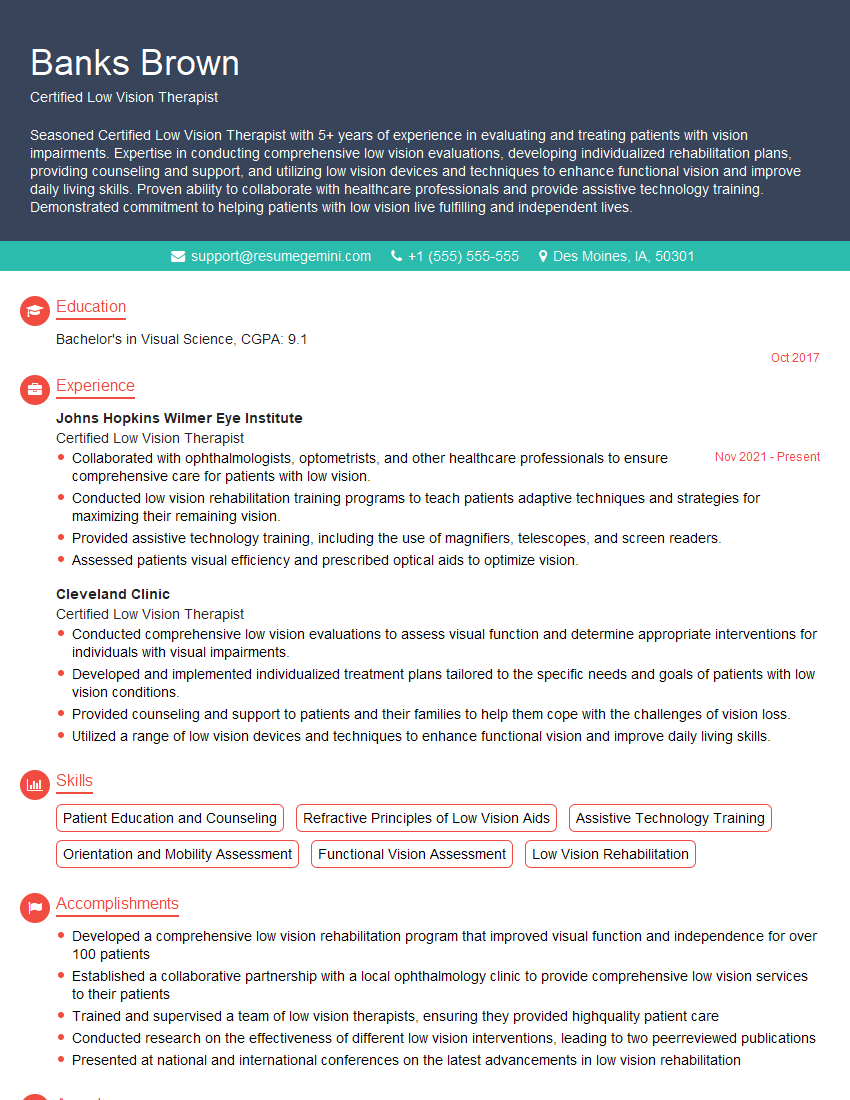
Mastering the complexities of low vision support groups significantly enhances your career prospects within the field of vision rehabilitation and social work. A strong understanding of these key areas demonstrates your commitment to providing exceptional support and care. To increase your chances of landing your dream role, creating an ATS-friendly resume is crucial. ResumeGemini is a trusted resource to help you build a professional and effective resume that highlights your skills and experience. Examples of resumes tailored to low vision support group positions are available to guide you through this process. Invest time in crafting a compelling resume – it’s your first impression!
Explore more articles
Users Rating of Our Blogs
Share Your Experience
We value your feedback! Please rate our content and share your thoughts (optional).
What Readers Say About Our Blog
To the interviewgemini.com Webmaster.
Very helpful and content specific questions to help prepare me for my interview!
Thank you
To the interviewgemini.com Webmaster.
This was kind of a unique content I found around the specialized skills. Very helpful questions and good detailed answers.
Very Helpful blog, thank you Interviewgemini team.