The thought of an interview can be nerve-wracking, but the right preparation can make all the difference. Explore this comprehensive guide to Machine Learning and Statistical Modeling interview questions and gain the confidence you need to showcase your abilities and secure the role.
Questions Asked in Machine Learning and Statistical Modeling Interview
Q 1. Explain the difference between supervised and unsupervised learning.
Supervised and unsupervised learning are two fundamental approaches in machine learning that differ primarily in how they use data to train models. Think of it like this: supervised learning is like having a teacher who provides labeled examples, while unsupervised learning is like exploring a dataset without a teacher, trying to discover patterns on your own.
Supervised Learning: In supervised learning, the algorithm is trained on a dataset where each data point is labeled with the correct output (target variable). The algorithm learns to map inputs to outputs based on these labeled examples. Examples include image classification (labeling images as cats or dogs), spam detection (classifying emails as spam or not spam), and predicting house prices based on features like size and location. The goal is to build a model that can accurately predict the output for new, unseen data.
Unsupervised Learning: Unsupervised learning, on the other hand, deals with unlabeled data. The algorithm’s task is to identify patterns, structures, or relationships within the data without any prior knowledge of the correct outputs. Common unsupervised learning techniques include clustering (grouping similar data points together), dimensionality reduction (reducing the number of variables while preserving important information), and anomaly detection (identifying unusual data points).
In short: Supervised learning uses labeled data to predict outcomes; unsupervised learning uses unlabeled data to discover patterns.
Q 2. Describe different types of bias in machine learning models.
Bias in machine learning refers to systematic errors in a model that are caused by flaws in the data, the algorithm, or the model’s design. These biases can lead to unfair or inaccurate predictions, particularly for certain subgroups within the data. There are several types:
- Sampling Bias: This occurs when the training data doesn’t accurately represent the real-world population. For example, if you’re training a model to predict customer behavior but your data only includes customers from a specific demographic, the model may perform poorly on other demographics.
- Measurement Bias: This arises from errors in how the data is collected or measured. Imagine a survey with leading questions that encourage specific responses; the resulting data would be biased.
- Algorithm Bias: This is inherent in the algorithm itself. Certain algorithms may be more prone to specific biases based on their design and assumptions.
- Confirmation Bias (in model selection): This can happen when researchers choose a model based on its ability to confirm their existing hypotheses, rather than its overall accuracy and generalizability.
- Label Bias: This happens when the labels themselves are biased. For example, if historical data reflects existing societal biases, a model trained on this data will likely perpetuate those biases.
Addressing bias requires careful data collection, preprocessing, and model selection, often involving techniques like data augmentation to balance datasets and fairness-aware algorithms.
Q 3. Explain the bias-variance tradeoff.
The bias-variance tradeoff is a fundamental concept in machine learning that describes the relationship between a model’s ability to fit the training data (bias) and its ability to generalize to new, unseen data (variance). It’s a delicate balancing act.
Bias: High bias means the model is too simple and makes strong assumptions about the data. It underfits the training data, resulting in poor performance on both training and testing data. Think of it like trying to fit a straight line to a curvy dataset – you’ll miss a lot of the nuances.
Variance: High variance means the model is too complex and overfits the training data. It learns the training data too well, including the noise, and performs poorly on unseen data. This is like trying to fit a highly complex curve to a relatively simple dataset – you’ll perfectly match the training data but fail miserably on new data because you’ve captured the noise.
The Tradeoff: The goal is to find a sweet spot where the model is complex enough to capture the underlying patterns in the data but not so complex that it overfits. Reducing bias often increases variance, and vice versa. Techniques like regularization help manage this tradeoff.
Q 4. What is regularization and why is it important?
Regularization is a technique used to prevent overfitting in machine learning models. Overfitting occurs when a model learns the training data too well, including the noise, and performs poorly on new, unseen data. Regularization adds a penalty to the model’s complexity, discouraging it from fitting the training data too closely.
Importance: Regularization is crucial for building robust and generalizable models that perform well on unseen data. Without regularization, complex models can achieve perfect accuracy on the training data but fail miserably when presented with new data because they’ve essentially memorized the training set instead of learning the underlying patterns.
Think of it like this: if a student memorizes the answers to a test instead of learning the concepts, they’ll do well on that specific test but will likely struggle on a similar but different test. Regularization encourages the student to learn the underlying concepts, resulting in better performance on various tests.
Q 5. Explain different regularization techniques (L1, L2).
L1 and L2 regularization are two common techniques that add a penalty term to the loss function of a machine learning model. This penalty term discourages the model from having large weights, thus preventing overfitting.
L1 Regularization (LASSO): Adds a penalty term proportional to the absolute value of the model’s weights. This penalty encourages sparsity, meaning that many weights become exactly zero. This is useful for feature selection, as it effectively removes less important features from the model. The penalty term is added to the loss function like this: Loss = Original Loss + λ * Σ|wi|, where λ is the regularization strength (hyperparameter) and wi are the model weights.
L2 Regularization (Ridge): Adds a penalty term proportional to the square of the model’s weights. This penalty shrinks the weights towards zero but doesn’t force them to be exactly zero. It’s less prone to feature selection than L1 but is generally more stable. The penalty term is added like this: Loss = Original Loss + λ * Σwi2
The choice between L1 and L2 often depends on the specific problem and dataset. L1 is preferred when feature selection is important, while L2 is often preferred for its stability.
Q 6. How do you handle imbalanced datasets?
Imbalanced datasets, where one class significantly outnumbers others, are a common challenge in machine learning. This can lead to models that perform poorly on the minority class, even if they have high overall accuracy. Several techniques can be used to address this:
- Resampling: This involves modifying the dataset to balance the class distribution. Oversampling duplicates instances of the minority class, while undersampling removes instances of the majority class. Techniques like SMOTE (Synthetic Minority Over-sampling Technique) create synthetic minority class samples.
- Cost-Sensitive Learning: This involves assigning different misclassification costs to different classes. For example, misclassifying a minority class instance might be given a higher cost than misclassifying a majority class instance. This encourages the model to pay more attention to the minority class.
- Ensemble Methods: Techniques like bagging and boosting can be adapted to handle imbalanced data. Boosting algorithms, in particular, often perform well on imbalanced datasets.
- Anomaly Detection Techniques: If the minority class represents anomalies, one-class classification techniques might be suitable.
The best approach often depends on the specific dataset and problem. Experimentation with different techniques is often necessary to find the most effective solution.
Q 7. What are some common evaluation metrics for classification and regression problems?
The choice of evaluation metric depends heavily on the specific problem and the relative importance of different types of errors. Here are some common metrics:
Classification:
- Accuracy: The percentage of correctly classified instances. Simple but can be misleading with imbalanced datasets.
- Precision: The proportion of correctly predicted positive instances out of all instances predicted as positive. Focuses on minimizing false positives.
- Recall (Sensitivity): The proportion of correctly predicted positive instances out of all actual positive instances. Focuses on minimizing false negatives.
- F1-Score: The harmonic mean of precision and recall, providing a balance between the two.
- AUC-ROC (Area Under the Receiver Operating Characteristic Curve): Measures the model’s ability to distinguish between classes across different thresholds. Useful when dealing with imbalanced datasets.
Regression:
- Mean Squared Error (MSE): The average squared difference between predicted and actual values. Sensitive to outliers.
- Root Mean Squared Error (RMSE): The square root of MSE. Easier to interpret than MSE because it’s in the same units as the target variable.
- Mean Absolute Error (MAE): The average absolute difference between predicted and actual values. Less sensitive to outliers than MSE.
- R-squared (R2): Represents the proportion of variance in the target variable explained by the model. Ranges from 0 to 1, with higher values indicating better fit.
It’s often beneficial to use a combination of metrics to get a comprehensive understanding of a model’s performance.
Q 8. Explain the concept of cross-validation.
Cross-validation is a crucial technique in machine learning used to evaluate the performance of a model and prevent overfitting. Imagine you’re baking a cake; you wouldn’t just taste one tiny slice to determine if it’s good. You’d sample several pieces from different parts of the cake to get a representative taste. Cross-validation does the same for models. It works by splitting your data into multiple subsets (folds). The model is trained on some folds and tested on the remaining fold. This process is repeated multiple times, with different folds used for testing each time. The average performance across all folds gives a more robust estimate of the model’s generalization ability.
k-fold cross-validation is a common approach where the data is divided into k equal-sized folds. For example, with 5-fold cross-validation (k=5), the model is trained 5 times, each time using 4 folds for training and 1 fold for testing. The results are then averaged. Leave-one-out cross-validation (LOOCV) is an extreme case where k equals the number of data points; each data point is used as a test set once. While LOOCV provides a very low bias estimate, it’s computationally expensive for large datasets.
Example: Suppose you have a dataset of 100 images for classifying cats and dogs. Using 10-fold cross-validation, you’d split the data into 10 sets of 10 images each. The model would be trained on 9 sets (90 images) and tested on the remaining set (10 images) ten times. The average accuracy across these 10 tests would be a more reliable measure of the model’s performance than a single train-test split.
Q 9. What are some common techniques for feature selection?
Feature selection is the process of identifying and selecting the most relevant features (variables) in your dataset for building a predictive model. Think of it as choosing the right ingredients for your recipe; using only the essential ones leads to a better outcome. Irrelevant or redundant features can increase model complexity, lead to overfitting, and reduce predictive accuracy.
- Filter methods: These methods rank features based on statistical measures without considering the model. Examples include correlation analysis (measuring linear relationships between features and the target variable), chi-squared test (for categorical features), and information gain (measuring the reduction in uncertainty).
- Wrapper methods: These methods evaluate feature subsets by training a model on each subset and selecting the subset that yields the best performance. Recursive feature elimination (RFE) is a common example, where features are iteratively removed until a desired number of features is reached.
- Embedded methods: These methods perform feature selection as part of the model training process. Regularization techniques like LASSO (L1 regularization) and Ridge (L2 regularization) shrink the coefficients of less important features towards zero, effectively performing feature selection. Decision trees and random forests also inherently perform feature selection through their splitting criteria.
Example: In predicting house prices, you might initially have features like ‘square footage’, ‘number of bedrooms’, ‘location’, ‘year built’, and ‘color of paint’. Feature selection techniques can identify that ‘square footage’, ‘number of bedrooms’, and ‘location’ are the most impactful features, while ‘color of paint’ might be less relevant.
Q 10. Explain different types of dimensionality reduction techniques (PCA, t-SNE).
Dimensionality reduction aims to reduce the number of variables in a dataset while preserving important information. This is akin to summarizing a lengthy novel into a concise plot summary – you lose some details but retain the essential storyline.
Principal Component Analysis (PCA): PCA is a linear transformation that projects data onto a lower-dimensional space spanned by principal components. These components are orthogonal (uncorrelated) and capture the maximum variance in the data. PCA is useful for noise reduction and visualization. It’s best for linearly separable data.
t-distributed Stochastic Neighbor Embedding (t-SNE): t-SNE is a non-linear dimensionality reduction technique that aims to preserve local neighborhood relationships in the high-dimensional space in the low-dimensional space. Unlike PCA, t-SNE focuses on preserving the distances between data points, making it suitable for visualizing clusters and non-linear relationships. However, t-SNE can be computationally expensive and the visualization can be sensitive to parameter settings.
Example: Imagine you have gene expression data with thousands of genes. PCA can reduce the dimensionality to a few principal components that capture most of the variance, simplifying analysis and visualization. t-SNE could be used to visualize the clusters of different cell types based on their gene expression profiles, revealing potentially hidden relationships.
Q 11. What is the difference between a parametric and non-parametric model?
The key difference between parametric and non-parametric models lies in their assumptions about the data’s underlying distribution.
Parametric models: These models assume a specific functional form for the relationship between the variables. They assume the data follows a known probability distribution (e.g., normal distribution) with a fixed number of parameters. The model’s parameters are estimated from the data. Examples include linear regression, logistic regression, and Gaussian Naive Bayes. They are generally computationally efficient but can be inaccurate if the assumed distribution is incorrect.
Non-parametric models: These models make no assumptions about the underlying data distribution. They estimate the relationship between variables directly from the data without assuming a specific functional form. They are more flexible and can capture complex relationships but are often more computationally expensive. Examples include k-nearest neighbors (k-NN), decision trees, and support vector machines (SVMs).
Example: Predicting house prices using linear regression (parametric) assumes a linear relationship between features (size, location, etc.) and price. A decision tree (non-parametric) would not make this assumption and could potentially capture more complex non-linear relationships.
Q 12. Explain different types of probability distributions.
Probability distributions describe the likelihood of different outcomes in a random process. Several types exist, each suited for different kinds of data and modeling tasks.
- Normal (Gaussian) Distribution: A bell-shaped curve, characterized by its mean (average) and standard deviation (spread). It’s widely used because of the Central Limit Theorem, which states that the average of many independent random variables tends towards a normal distribution.
- Binomial Distribution: Describes the probability of getting a certain number of successes in a fixed number of independent Bernoulli trials (e.g., coin flips). It’s characterized by the number of trials (n) and the probability of success in a single trial (p).
- Poisson Distribution: Models the probability of a given number of events occurring in a fixed interval of time or space when events occur with a known average rate and independently of the time since the last event. Think of the number of cars passing a certain point on a highway in an hour.
- Exponential Distribution: Models the time until an event occurs in a Poisson process. It’s often used to model the lifespan of equipment or the time between customer arrivals.
- Uniform Distribution: Every outcome in a given range has an equal probability. Imagine rolling a fair six-sided die; each number has a probability of 1/6.
Example: The height of adult women might be modeled using a normal distribution. The number of heads in 10 coin flips would follow a binomial distribution. The number of customers arriving at a store per hour could be modeled using a Poisson distribution.
Q 13. What is maximum likelihood estimation (MLE)?
Maximum Likelihood Estimation (MLE) is a method for estimating the parameters of a statistical model given some observed data. Imagine you have a coin and you want to estimate the probability of getting heads. You flip the coin many times and observe the number of heads. MLE finds the parameter values (in this case, the probability of heads) that make the observed data most likely.
Formally, MLE finds the parameters (θ) that maximize the likelihood function L(θ|x), which represents the probability of observing the data (x) given the parameters (θ). The likelihood function is often the product of the probabilities of each individual data point, assuming independence. Maximizing the likelihood function is equivalent to maximizing the log-likelihood function (log L(θ|x)), which is often easier to work with mathematically.
Example: Suppose you flip a coin 10 times and observe 7 heads. The likelihood function would give the probability of observing 7 heads in 10 flips for different values of the probability of heads (θ). The MLE estimate for θ would be 0.7 (7/10), as this value maximizes the likelihood function.
Q 14. Explain the concept of Bayesian inference.
Bayesian inference is a statistical method that updates our beliefs about a parameter (or hypothesis) based on observed data. It contrasts with frequentist methods (like MLE) which treat parameters as fixed but unknown quantities. In Bayesian inference, parameters are treated as random variables with probability distributions.
We start with a prior distribution, representing our initial beliefs about the parameter before seeing any data. Then, we use Bayes’ theorem to update our beliefs based on the observed data. This updated belief is called the posterior distribution.
Bayes’ Theorem: P(θ|x) = [P(x|θ) * P(θ)] / P(x)
where:
- P(θ|x) is the posterior distribution (our updated belief about θ given the data x).
- P(x|θ) is the likelihood function (probability of observing the data given θ).
- P(θ) is the prior distribution (our initial belief about θ).
- P(x) is the marginal likelihood (evidence), which acts as a normalizing constant.
Example: Suppose you’re testing a new drug. Your prior belief might be that the drug has a 50% chance of being effective (prior distribution). After a clinical trial, you observe that 70% of patients improved. Using Bayesian inference, you’d update your belief, resulting in a posterior distribution that places higher probability on the drug being effective.
Q 15. What is a Markov Chain Monte Carlo (MCMC) method?
Markov Chain Monte Carlo (MCMC) methods are a class of algorithms for sampling from a probability distribution. Imagine you have a complex, high-dimensional probability distribution that’s difficult to sample directly. MCMC methods cleverly build a Markov chain – a sequence of random variables where the next state depends only on the current state – whose stationary distribution is the target distribution we want to sample from. By simulating this chain for a long enough time, we obtain samples that approximate the target distribution.
One popular MCMC algorithm is the Metropolis-Hastings algorithm. It works by proposing a new sample from a proposal distribution, and then accepting or rejecting this proposal based on a probability that depends on the ratio of the target distribution’s probability densities at the proposed and current states. This ensures that the algorithm gradually explores the target distribution, even in regions with low probability.
For instance, imagine you’re trying to estimate the parameters of a Bayesian model. The posterior distribution, representing our belief about the parameters after observing the data, can be incredibly complex. MCMC methods allow us to generate samples from this posterior, which we can then use to estimate the parameters’ mean, variance, and credible intervals.
Career Expert Tips:
- Ace those interviews! Prepare effectively by reviewing the Top 50 Most Common Interview Questions on ResumeGemini.
- Navigate your job search with confidence! Explore a wide range of Career Tips on ResumeGemini. Learn about common challenges and recommendations to overcome them.
- Craft the perfect resume! Master the Art of Resume Writing with ResumeGemini’s guide. Showcase your unique qualifications and achievements effectively.
- Don’t miss out on holiday savings! Build your dream resume with ResumeGemini’s ATS optimized templates.
Q 16. Explain different types of time series models (ARIMA, etc.).
Time series models are used to analyze data points collected over time, exploiting the temporal dependence between observations. Different models capture this dependence in various ways.
- ARIMA (Autoregressive Integrated Moving Average): This is a widely used family of models that combines three components: Autoregressive (AR), Integrated (I), and Moving Average (MA).
- AR (Autoregressive): Models the current value as a linear combination of past values. Think of predicting tomorrow’s temperature based on temperatures from the previous few days.
- I (Integrated): This component accounts for non-stationarity in the time series. Non-stationary time series show trends or seasonality – their statistical properties change over time. Differencing (subtracting consecutive values) is often used to make a time series stationary.
- MA (Moving Average): Models the current value as a linear combination of past forecast errors. This accounts for ‘shocks’ or unpredictable variations in the data.
An ARIMA(p,d,q) model has p autoregressive terms, d differencing steps, and q moving average terms. The order (p,d,q) must be determined based on the data’s characteristics. For example, an ARIMA(1,1,0) would model the first difference of the time series using one autoregressive term.
Other time series models include:
- SARIMA (Seasonal ARIMA): Extends ARIMA to handle seasonality.
- Exponential Smoothing: Assigns exponentially decreasing weights to older observations.
- ARCH/GARCH (Autoregressive Conditional Heteroskedasticity): Models the volatility (variance) of the time series, useful for financial time series.
Q 17. Describe your experience with deep learning frameworks (TensorFlow, PyTorch).
I have extensive experience with both TensorFlow and PyTorch, two leading deep learning frameworks. My experience spans various tasks, including building and training complex neural networks for image classification, natural language processing, and time series forecasting.
TensorFlow, with its strong emphasis on production deployment, has been my go-to for projects requiring scalability and integration with other systems. I’ve leveraged TensorFlow Extended (TFX) for building robust ML pipelines, from data ingestion to model deployment. I’m familiar with TensorFlow’s various APIs, including Keras, which simplifies the development process significantly.
PyTorch, on the other hand, excels in its dynamic computation graph, making it more intuitive for research and experimentation. Its Pythonic nature and strong community support make it easier to debug and prototype new models. I’ve used PyTorch extensively for research projects involving custom neural network architectures and exploring novel approaches to training.
I’m proficient in utilizing both frameworks’ features for tasks such as model optimization, visualization, and monitoring during training.
Q 18. Explain the concept of backpropagation.
Backpropagation is the core algorithm used to train artificial neural networks. Imagine the network as a complex function that maps inputs to outputs. The goal of training is to adjust the network’s internal parameters (weights and biases) to minimize the difference between its predictions and the actual target values.
Backpropagation accomplishes this through a process of calculating gradients – the rate of change of the network’s error with respect to each weight and bias. It does this using the chain rule of calculus, propagating the error signal backward from the output layer to the input layer. Each layer’s gradient is calculated based on the gradients of the subsequent layers.
Once the gradients are computed, the weights and biases are updated using an optimization algorithm such as gradient descent. This process is iterated repeatedly until the network’s error reaches a satisfactory level.
Think of it like this: you’re trying to navigate a mountain to find the lowest point. The gradient tells you the direction of steepest descent at any given location. Backpropagation helps you find this gradient, allowing you to take steps downhill until you reach the lowest point – the minimum error.
Q 19. How do you handle missing data?
Handling missing data is crucial for building reliable machine learning models. The best approach depends on several factors: the amount of missing data, the pattern of missingness, and the nature of the variables involved.
Here are some common strategies:
- Deletion: Simple but can lead to significant information loss, especially with a large proportion of missing data. Listwise deletion removes entire rows with missing values; pairwise deletion uses available data for each analysis.
- Imputation: Replacing missing values with estimated values. Common methods include:
- Mean/Median/Mode imputation: Replacing missing values with the mean, median, or mode of the observed values. Simple but can distort the distribution.
- K-Nearest Neighbors (KNN) imputation: Replacing missing values based on the values of similar data points.
- Multiple Imputation: Creating multiple plausible imputed datasets and combining the results. This is a more sophisticated approach that accounts for uncertainty in the imputed values.
- Model-based imputation: Using a predictive model (like regression) to predict missing values based on other variables.
Before choosing a method, it’s important to analyze the missing data mechanism (MCAR, MAR, MNAR) to avoid bias. If the missingness is related to the values themselves (MNAR), more advanced techniques might be necessary.
Q 20. What are some common challenges in building machine learning models?
Building successful machine learning models comes with its share of challenges:
- Data Quality: Noisy, incomplete, inconsistent, or biased data can severely impact model performance. Data cleaning and preprocessing are often the most time-consuming aspects.
- Overfitting and Underfitting: Overfitting occurs when a model learns the training data too well and performs poorly on unseen data. Underfitting happens when a model is too simple to capture the underlying patterns in the data. Regularization techniques, cross-validation, and careful model selection help mitigate these issues.
- Feature Engineering: Choosing the right features and transforming them appropriately is critical for model performance. It often requires domain expertise and creative problem-solving.
- Model Selection: Choosing the right algorithm for the problem at hand requires understanding different model strengths and weaknesses.
- Interpretability: Understanding why a model makes a particular prediction is important, especially in high-stakes applications. Some models (like deep learning models) are notoriously ‘black boxes’.
- Computational Resources: Training complex models, especially deep learning models, can require significant computational power and time.
- Evaluation Metrics: Selecting the right metrics to assess model performance is crucial and depends on the specific problem and business objectives.
Q 21. Explain your experience with different types of model deployment.
My experience with model deployment spans various approaches, from simple scripts to sophisticated cloud-based solutions:
- Local Deployment: Deploying models as standalone applications or scripts on local machines. This is suitable for small-scale projects or situations where data privacy is paramount.
- Cloud Deployment: Deploying models on cloud platforms like AWS, Azure, or Google Cloud. This allows for scalability and easy access to computing resources. I’ve used services like AWS SageMaker and Google Cloud AI Platform for deploying and managing models at scale.
- Serverless Deployment: Leveraging serverless functions (like AWS Lambda or Google Cloud Functions) for efficient model serving. This approach is cost-effective for low-traffic applications.
- Mobile and Edge Deployment: Deploying models on mobile devices or edge devices using frameworks like TensorFlow Lite or PyTorch Mobile. This allows for real-time inference in resource-constrained environments.
- API Deployment: Creating REST APIs using frameworks like Flask or FastAPI to expose model predictions to other applications. This enables seamless integration with existing systems.
In each case, I prioritize robust monitoring and logging to track model performance and ensure timely detection of issues. I also consider factors like security, scalability, maintainability, and cost-effectiveness when choosing a deployment strategy.
Q 22. How do you ensure the reproducibility of your experiments?
Reproducibility is paramount in machine learning. It ensures that your results are reliable and can be independently verified. Think of it like a scientific experiment – if someone else can’t repeat your steps and get the same outcome, your findings are questionable. I achieve reproducibility through a multi-pronged approach:
- Version Control (Git): I meticulously track all code changes using Git, making it easy to revert to previous versions and understand the evolution of the project. This includes not only the model training scripts but also data preprocessing steps and configuration files.
- Environment Management (Conda or Docker): I use tools like Conda or Docker to create reproducible environments. This ensures that everyone working on the project, or anyone trying to replicate it, has the exact same dependencies and software versions. This eliminates discrepancies arising from different library versions.
- Documented Data Preprocessing: I thoroughly document all data cleaning, transformation, and feature engineering steps. This involves detailed descriptions, including the libraries and parameters used. This is critical, as small variations in data handling can significantly impact results.
- Seed Setting: For stochastic algorithms (like those involving random number generation), I always set random seeds. This guarantees that the random number generation is consistent across runs, leading to comparable results.
random.seed(42)is a common example in Python. - Detailed Logging: Comprehensive logging of all experiments is vital. This includes hyperparameters, metrics, training time, and any other relevant information. This allows for easy comparison and analysis of different experiments.
By combining these techniques, I build a robust and auditable workflow, minimizing the risk of irreproducible results and fostering collaboration.
Q 23. Explain your approach to model selection.
Model selection is a crucial step, akin to choosing the right tool for a job. A poor choice can lead to inaccurate predictions or inefficient performance. My approach involves a structured process:
- Define Evaluation Metrics: The first step is to clearly define the evaluation metrics relevant to the problem. For example, accuracy, precision, recall, F1-score, AUC, or RMSE, depending on whether it’s a classification or regression problem.
- Baseline Model: I start with a simple baseline model (e.g., a logistic regression for classification or a linear regression for regression). This provides a benchmark to compare against more complex models.
- Cross-Validation: I use k-fold cross-validation to rigorously assess model performance and avoid overfitting. This technique splits the data into k subsets, training the model on k-1 subsets and evaluating it on the remaining subset. The process is repeated k times, and the average performance is used as the estimate.
- Hyperparameter Tuning: For each model considered, I systematically tune hyperparameters using techniques like grid search or random search. This ensures that the model is performing at its best. Tools like Optuna or Hyperopt can automate this process.
- Model Comparison: Finally, I compare the performance of different models based on the pre-defined evaluation metrics, considering factors such as model complexity, interpretability, and training time. I often visualize the results to easily compare the performance.
This structured approach ensures that the selected model is not only accurate but also efficient and appropriate for the specific context.
Q 24. How do you monitor and maintain your deployed models?
Maintaining deployed models is as crucial as building them. It’s like regularly servicing a car – neglect leads to breakdowns. My approach involves:
- Monitoring Performance: I continuously monitor model performance using metrics relevant to the business problem. This might involve tracking accuracy, latency, or error rates. I set up alerts to notify me of any significant deviations from expected performance.
- Data Drift Detection: I actively monitor for data drift, which occurs when the characteristics of the input data change over time. This can render the model inaccurate. Techniques like concept drift detection algorithms are used to identify this issue.
- Retraining Strategy: Based on monitoring and data drift detection, I establish a retraining schedule. This might involve retraining the model regularly (e.g., daily or weekly) with new data, or triggering retraining when performance drops below a certain threshold.
- Versioning and Rollback: I always maintain version control of the deployed models, enabling easy rollback to previous versions if needed. This minimizes the risk of deploying a faulty model and causing disruptions.
- A/B Testing: Before fully deploying a new model or a significant update, I conduct A/B testing to compare its performance against the existing model in a real-world setting. This provides a final check before complete deployment.
This comprehensive approach to model maintenance ensures its ongoing accuracy and reliability, safeguarding the business value it provides.
Q 25. How do you explain complex machine learning models to non-technical stakeholders?
Explaining complex models to non-technical stakeholders requires clear communication and avoiding technical jargon. I often use analogies and visualizations to make the concepts relatable. For example:
- Analogies: I might compare a machine learning model to a recipe. The inputs are ingredients, the model is the cooking process, and the output is the final dish. This helps them understand the input-process-output relationship.
- Visualizations: I use charts and graphs to illustrate model performance, key features, and predictions. A simple bar chart showing the accuracy of different models is more effective than lengthy technical explanations.
- Focus on Business Impact: I emphasize the business value of the model, focusing on how it improves decision-making, increases efficiency, or reduces costs. This connects the technical aspects to tangible business outcomes.
- Storytelling: I weave a narrative around the model, explaining the problem it solves, the data used, and the resulting insights. A compelling story is far more memorable than a list of technical specifications.
- Interactive Demonstrations: Where possible, I use interactive demonstrations or simulations to show how the model works in action. This makes the explanation more engaging and easier to understand.
By focusing on clear communication and relatable examples, I ensure that even non-technical stakeholders can grasp the essence of the model and its implications.
Q 26. Describe a challenging machine learning project you worked on and how you overcame the obstacles.
One challenging project involved building a fraud detection system for a large financial institution. The challenge was twofold: imbalanced data (far more legitimate transactions than fraudulent ones) and the constantly evolving nature of fraud tactics.
To address the imbalanced data, I employed several techniques. First, I used oversampling of the minority class (fraudulent transactions) and undersampling of the majority class to create a more balanced training set. I also experimented with cost-sensitive learning, assigning higher penalties to misclassifying fraudulent transactions. These methods helped improve the model’s ability to detect the rare positive cases.
For the evolving nature of fraud, I implemented an online learning approach. This involved continuously retraining the model with new data as it became available, allowing it to adapt to emerging patterns. I also incorporated anomaly detection techniques to identify unusual transactions that might not fit known patterns of fraud. This adaptive approach proved crucial in maintaining the model’s effectiveness over time. Regular monitoring and A/B testing were also critical to assessing the impact of the model updates.
The project successfully reduced false positives while maintaining high detection rates, resulting in significant cost savings for the institution. This experience highlighted the importance of adapting techniques to specific data challenges and continually monitoring model performance in dynamic environments.
Q 27. What are your preferred programming languages and tools for statistical modeling?
My preferred programming languages for statistical modeling are Python and R. Python offers a broad range of powerful libraries such as scikit-learn, pandas, NumPy, and TensorFlow/PyTorch for various aspects of machine learning, data manipulation, and deep learning. Its versatility and large community support make it ideal for a wide range of tasks.
R, on the other hand, excels in statistical graphics and data visualization. Packages like ggplot2 and dplyr provide robust tools for exploring and presenting data effectively. R is particularly strong in statistical modeling and analysis, offering many specialized packages for specific statistical techniques.
In addition to these languages, I utilize various tools including Jupyter notebooks for interactive coding and documentation, Git for version control, and cloud computing platforms like AWS or Google Cloud for scalable model training and deployment. The choice of tools often depends on the specific project requirements and scale.
Q 28. Explain your understanding of A/B testing
A/B testing, also known as split testing, is a controlled experiment used to compare two versions of something – typically a website, app, or marketing campaign – to see which performs better. It’s a crucial tool for making data-driven decisions.
Imagine you’re a website designer and you want to test two different layouts for your homepage. In A/B testing, you would randomly split your website traffic into two groups: Group A sees the original design (Control), and Group B sees the new design (Treatment). By tracking key metrics (e.g., conversion rates, click-through rates), you can statistically determine whether one design performs significantly better than the other.
Key aspects of a good A/B test include:
- Randomization: Ensuring participants are randomly assigned to groups to avoid bias.
- Sufficient Sample Size: Having enough participants in each group to achieve statistically significant results. This is determined using power analysis.
- Well-Defined Metrics: Clearly defining the metrics you’ll use to compare the two versions.
- Statistical Significance: Using statistical tests (e.g., t-tests, chi-squared tests) to determine if the observed differences are statistically significant, not just due to random chance.
A/B testing is essential for iterative improvement. It allows for data-driven decisions, reducing reliance on intuition and maximizing the effectiveness of your efforts.
Key Topics to Learn for Machine Learning and Statistical Modeling Interviews
- Supervised Learning: Understand the core concepts of regression (linear, logistic, polynomial) and classification (SVM, decision trees, naive Bayes). Explore practical applications like fraud detection and customer churn prediction.
- Unsupervised Learning: Grasp clustering techniques (k-means, hierarchical clustering) and dimensionality reduction (PCA, t-SNE). Consider applications in customer segmentation and anomaly detection.
- Model Evaluation & Selection: Master metrics like accuracy, precision, recall, F1-score, AUC-ROC. Understand bias-variance tradeoff, cross-validation, and hyperparameter tuning.
- Bayesian Statistics: Familiarize yourself with Bayesian inference, prior and posterior distributions, and their applications in model building and uncertainty quantification.
- Statistical Hypothesis Testing: Understand t-tests, chi-squared tests, ANOVA, and their applications in drawing conclusions from data.
- Time Series Analysis: Learn about ARIMA models, forecasting techniques, and their application in predicting trends and patterns in data over time.
- Data Preprocessing & Feature Engineering: Master techniques for handling missing data, outliers, and feature scaling. Understand feature selection and creation for improved model performance.
- Deep Learning Fundamentals (Optional but advantageous): Basic understanding of neural networks, backpropagation, and common architectures (CNNs, RNNs).
- Communication & Problem Solving: Practice articulating your technical understanding clearly and concisely. Develop your ability to approach problems systematically and explain your reasoning.
Next Steps
Mastering Machine Learning and Statistical Modeling significantly enhances your career prospects, opening doors to exciting roles with high earning potential and intellectual stimulation. A strong resume is crucial for showcasing your skills to potential employers. To maximize your chances, focus on creating an ATS-friendly resume that highlights your accomplishments and technical expertise. ResumeGemini is a trusted resource to help you build a professional and impactful resume. We provide examples of resumes tailored to Machine Learning and Statistical Modeling to guide you in this process.

Risk Manager Resume Sample

Data Analyst Resume Sample

Quantitative Analyst Resume Sample

Data Scientist Resume Sample

Research Scientist Resume Sample

Business Intelligence Analyst Resume Sample

Actuary Resume Sample

Biostatistician Resume Sample

Robotics Engineer Resume Sample

Machine Learning Engineer Resume Sample

Big Data Engineer Resume Sample
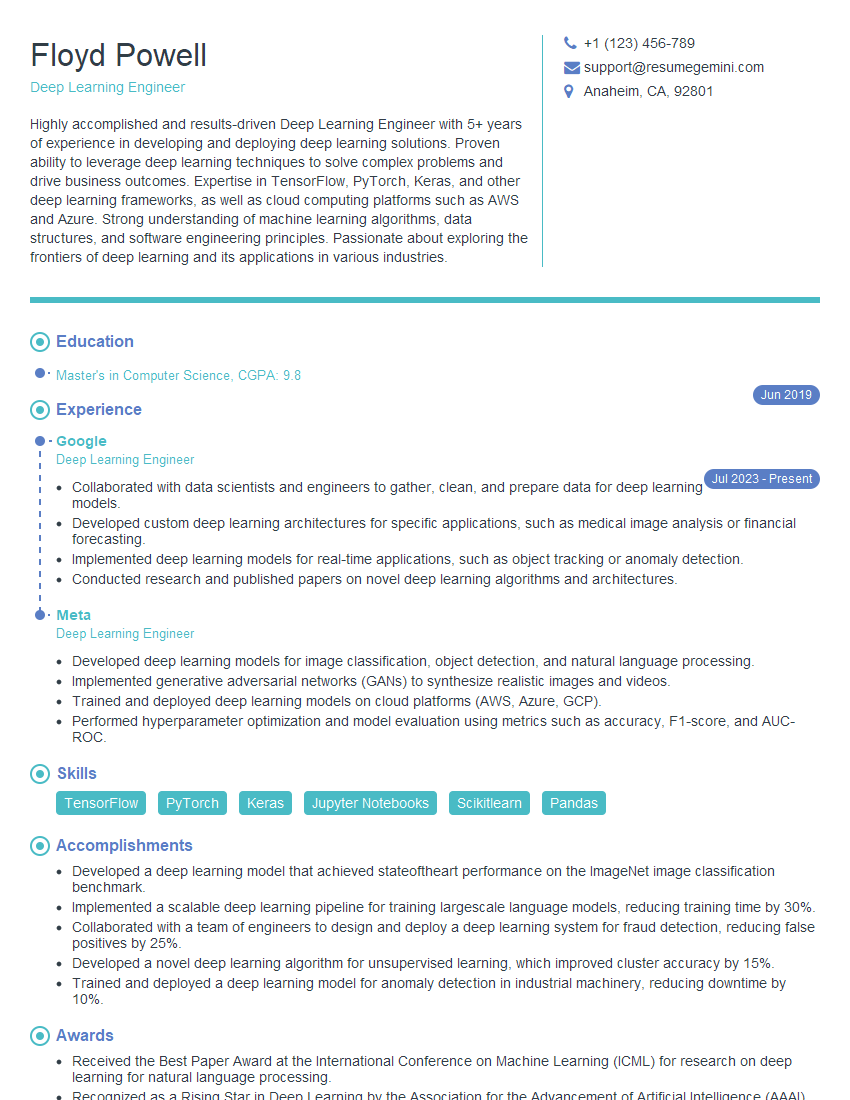
Deep Learning Engineer Resume Sample

Natural Language Processing Engineer Resume Sample

Computer Vision Engineer Resume Sample
Explore more articles
Users Rating of Our Blogs
Share Your Experience
We value your feedback! Please rate our content and share your thoughts (optional).
What Readers Say About Our Blog
To the interviewgemini.com Webmaster.
Very helpful and content specific questions to help prepare me for my interview!
Thank you
To the interviewgemini.com Webmaster.
This was kind of a unique content I found around the specialized skills. Very helpful questions and good detailed answers.
Very Helpful blog, thank you Interviewgemini team.