Interviews are opportunities to demonstrate your expertise, and this guide is here to help you shine. Explore the essential Masonry Installations interview questions that employers frequently ask, paired with strategies for crafting responses that set you apart from the competition.
Questions Asked in Masonry Installations Interview
Q 1. What types of mortar are commonly used in masonry construction, and what are their applications?
Mortar is the binding agent in masonry, crucial for the structural integrity of the wall. Different types cater to specific needs and applications. Common types include:
- Type N Mortar: A general-purpose mortar suitable for most masonry applications, offering a good balance of strength and workability. Think of it as the ‘all-rounder’ for average-strength walls and moderate exposure to the elements.
- Type S Mortar: Higher strength mortar, ideal for applications requiring increased compressive strength, like load-bearing walls or structures in high-wind areas. It’s your go-to for projects needing that extra robust hold.
- Type M Mortar: The strongest type, used in high-stress situations such as foundation walls or areas prone to significant seismic activity. This is the heavy-duty choice for demanding projects.
- Type O Mortar: A low-strength mortar best suited for interior non-load-bearing walls where high strength isn’t critical. It’s more workable than stronger types, making it easier to use in intricate designs.
Choosing the right mortar is paramount. Using Type N for a foundation wall would be a mistake, as it wouldn’t provide the necessary strength. Similarly, using Type M for a simple interior partition would be overkill and potentially more expensive than necessary.
Q 2. Explain the process of laying brick in a running bond pattern.
The running bond is a classic and simple bricklaying pattern. It’s characterized by a continuous horizontal alignment of bricks, with each brick overlapping the one below by half its length. Imagine building a wall like a gently sloped staircase.
The process involves:
- Laying the First Course: Establish a perfectly level and straight foundation. This is the most important step! Lay the first row of bricks, ensuring proper spacing and alignment using a line and level.
- Laying Subsequent Courses: Each subsequent row is laid with a half-brick offset from the row below. This creates the characteristic staggered pattern. A mason’s line is essential to maintain a consistent vertical alignment.
- Mortar Application: Apply mortar to the bed (bottom) and sides of each brick, ensuring full coverage. Don’t skimp on the mortar, but avoid excessive amounts which can lead to unsightly bulges.
- Joint Tooling: After the mortar has partially set, use a joint tool to create a neat and consistent finish. This not only improves the aesthetics but also helps protect the mortar from the elements.
Consistency is key in a running bond. Inaccurate placement can compromise the structural integrity and visual appeal of the wall. A skilled mason maintains perfect alignment throughout the entire process.
Q 3. Describe different types of masonry units (bricks, blocks, stones).
Masonry units vary widely in size, shape, material, and strength. Common types include:
- Bricks: Made from clay or shale, fired at high temperatures. They’re available in various sizes, colors, and textures, offering versatility in design. They are strong, durable, and offer excellent weather resistance.
- Concrete Blocks (CMUs): Manufactured from concrete, these hollow blocks are larger than bricks, leading to faster construction. They are very strong and are often used for load-bearing walls. Their hollow cores can also improve insulation.
- Stone: Natural stone units such as granite, limestone, or sandstone offer a unique aesthetic appeal. They are incredibly durable and weather-resistant but can be more expensive and challenging to work with than bricks or blocks. Each stone is unique in size and shape, often requiring greater skill and attention to detail during installation.
The choice of masonry unit depends on factors like the project’s budget, aesthetic requirements, structural needs, and the availability of materials in the region.
Q 4. How do you ensure proper leveling and alignment during masonry construction?
Leveling and alignment are crucial for a structurally sound and aesthetically pleasing masonry structure. Achieving this requires precision and the use of specific tools:
- Line Level: A long, taut line set at the desired height guides the mason, ensuring each course remains perfectly horizontal.
- Plumb Bob: Used to check vertical alignment, this ensures walls are perfectly perpendicular.
- Spirit Level: A small, hand-held level verifies the horizontal level of individual bricks and blocks.
- Mason’s Square: Checks right angles, crucial for corners and openings.
Regular checks throughout the construction process, rather than just at the beginning, are essential. Slight deviations can accumulate, leading to significant problems later on. It’s better to correct small errors immediately than to deal with large discrepancies at the end. For example, a small misalignment at the base of a wall might lead to a noticeable lean several courses higher.
Q 5. What safety precautions are essential when working at heights during masonry installations?
Working at heights in masonry presents significant safety risks. Essential precautions include:
- Scaffolding: Using properly erected and inspected scaffolding is mandatory for any work above ground level. The scaffolding must be strong enough to support the weight of the masons, materials, and tools.
- Fall Protection: Harness systems and guardrails are essential. Workers must always be connected to a lifeline if working at a height where a fall could cause injury or death.
- Proper Training: All workers must be properly trained on safe work practices at heights, including the use of safety equipment.
- Regular Inspections: Scaffolding and safety equipment should be inspected regularly to ensure everything is in good working order.
- Appropriate Footwear: Workers should wear sturdy, non-slip boots to prevent falls.
Neglecting safety precautions at heights can lead to serious injury or fatality. It’s never worth cutting corners on safety.
Q 6. Explain the importance of proper curing of mortar.
Proper curing of mortar is essential for its long-term strength and durability. Curing is the process by which the mortar gains strength through hydration – a chemical reaction between the cement and water. Insufficient curing leads to weakened mortar, increasing the risk of cracking and structural failure.
Methods for proper curing include:
- Water Curing: Keeping the mortar continuously moist for a specified period (usually several days) is the most common method. This can involve spraying the wall with water or covering it with damp burlap.
- Membrane Curing: Applying a curing membrane helps retain moisture within the mortar.
The curing period depends on the type of mortar, temperature, and humidity. Following manufacturer’s recommendations is crucial. An improperly cured wall might look fine initially, but over time, the weaker mortar will be more susceptible to damage from weather and stress.
Q 7. How do you handle different weather conditions during masonry work?
Weather significantly impacts masonry work. Extreme temperatures and precipitation can affect both the mortar and the masonry units themselves:
- Extreme Heat: High temperatures can cause rapid drying of the mortar, reducing its strength. It may be necessary to adjust the water content of the mix or to cure the masonry more frequently in hot conditions.
- Freezing Temperatures: Mortar should not be laid when freezing temperatures are expected, as the water in the mortar can freeze and cause cracking and damage. Work should halt until temperatures are above freezing for a significant period.
- Rain: Rain can wash away mortar before it sets, compromising the bond between units. Protective measures, such as tarpaulins, may be needed to protect the work.
- Wind: Strong winds can make it difficult to maintain accurate placement of bricks or blocks and may even blow away loose mortar.
Careful planning and adaptation are necessary. For example, working during cooler parts of the day in hot weather, delaying work during rain or freezing conditions, and using windbreaks are common strategies used to mitigate weather related challenges.
Q 8. What are the common causes of cracks in masonry walls, and how are they repaired?
Cracks in masonry walls are unfortunately common, and their causes are multifaceted. They can range from minor settlement issues to more serious structural problems. Common culprits include:
- Foundation settlement: Uneven settling of the foundation puts stress on the walls, leading to cracks. Imagine a building settling unevenly – one side sinking more than the other; this uneven pressure will manifest as cracks.
- Soil expansion and contraction: Clay soils, especially, expand when wet and contract when dry. This movement can exert pressure on the foundation and walls, causing cracking. This is a classic example of why proper soil testing is crucial before any masonry work begins.
- Thermal expansion and contraction: Different materials expand and contract at different rates in response to temperature changes. This differential movement can create stress that leads to cracking, particularly noticeable in areas with significant temperature fluctuations.
- Moisture damage: Water penetration can weaken the mortar and bricks, leading to cracks. This is especially problematic in freeze-thaw cycles where water expands as it freezes, putting additional stress on already weakened materials.
- Poor workmanship: Insufficient mortar, inadequate compaction, or improper curing can all weaken the structure and contribute to cracking. A skilled mason understands the importance of attention to detail to minimize these issues.
Repairing cracks depends on their severity and cause. Minor cracks may only require filling with appropriate mortar. Larger, more structural cracks require more extensive repairs, possibly involving underpinning the foundation or replacing damaged sections of the wall. A thorough inspection by a qualified mason is always necessary to determine the best course of action.
Q 9. Describe the process of installing a chimney.
Chimney installation is a complex process requiring expertise and adherence to building codes. It typically involves these steps:
- Foundation: A solid foundation is paramount. This often involves a reinforced concrete footing designed to withstand the weight of the chimney.
- Chimney base: A sturdy base, often made of concrete blocks, is built on the foundation to support the chimney structure.
- Brickwork: The chimney itself is constructed using bricks and mortar, laid in a specific bond pattern (e.g., running bond) to ensure stability. A skilled mason ensures proper alignment and levelling at each stage.
- Flue liner: A clay tile or metal flue liner is installed inside the chimney to ensure efficient venting of combustion gases and prevent fires. This is a crucial safety aspect.
- Mortar joints: The mortar joints must be properly filled and tooled to prevent water penetration and maintain structural integrity. A well-tooled joint is both aesthetically pleasing and functionally important.
- Cap: A chimney cap is essential to protect the chimney from the elements and prevent water damage. It’s typically made of concrete or metal.
- Inspection: Throughout the process, regular inspections are essential to ensure compliance with building codes and the quality of the workmanship.
The specifics of chimney construction vary based on factors like chimney height, local building codes, and the type of fireplace or appliance it serves. A professional mason’s knowledge and experience are critical for a safe and effective chimney installation.
Q 10. How do you calculate the number of bricks needed for a given project?
Calculating the number of bricks needed involves several factors: the wall’s dimensions (length, height, and thickness), the size of the bricks, and the type of bond used. Here’s a simplified approach:
- Calculate the wall area: Multiply the length and height of the wall.
- Determine the brick coverage: This depends on the brick size and the mortar joint thickness. A standard brick covers approximately 7.625 sq inches (face of brick), but you’ll need to adjust for the mortar joints.
- Account for waste: Always add a percentage for breakage and waste (typically 5-10%).
- Calculate the number of bricks: Divide the total wall area by the effective brick coverage area and then multiply by the waste factor.
Example: A wall is 10ft long and 8ft high, using standard bricks with a 3/8” mortar joint. The effective brick coverage is approximately 7.625 sq inches, and we’ll add 10% for waste. First, convert feet to inches: 10ft x 12 inches/ft = 120 inches and 8ft x 12 inches/ft = 96 inches. The area is 120 inches x 96 inches = 11520 square inches. Divide by the effective brick coverage: 11520 sq inches / 7.625 sq inches/brick ≈ 1510 bricks. Adding 10% for waste: 1510 bricks * 1.1 = 1661 bricks. You’d need approximately 1661 bricks.
Note: This is a simplified calculation. Factors such as openings (doors, windows) and complex designs need to be considered for accurate estimations. Consulting a professional for larger projects is always recommended.
Q 11. What are the different types of brick bonds?
Brick bonds refer to the patterns in which bricks are laid to create a wall. Different bonds offer varying levels of strength, aesthetics, and weather resistance. Here are some common types:
- Running Bond: The simplest bond, with bricks laid in a continuous horizontal course. It’s visually straightforward but less strong than other options.
- Common Bond (Stretcher Bond): Uses headers (bricks laid with their short ends visible) at regular intervals to break up the continuous horizontal lines of the running bond, improving both strength and aesthetics.
- English Bond: Alternates courses of headers and stretchers. It provides excellent strength and is a classic choice for its visual appeal.
- Flemish Bond: Alternates headers and stretchers in each course, creating a visually intricate and strong bond.
- Stack Bond: Bricks are stacked vertically, offering a modern minimalist aesthetic but is less strong and not suitable for load-bearing walls.
The choice of bond depends on the project requirements, architectural style, and structural considerations. More complex bonds require skilled craftsmanship to ensure proper alignment and stability.
Q 12. How do you ensure proper waterproofing in masonry structures?
Waterproofing masonry structures is crucial to prevent damage from moisture, which can lead to cracking, efflorescence (salt deposits), and structural weakness. Effective waterproofing strategies involve a multi-pronged approach:
- Proper flashing: Flashing, which is a waterproof material, is installed at critical areas like window and door openings, chimney intersections, and roof lines to divert water away from the wall. This prevents water from getting behind the masonry.
- Effective drainage: Proper grading around the building ensures that water flows away from the foundation, minimizing moisture build-up against the walls. This is fundamental to good masonry practice.
- Waterproof membranes: Applying a waterproof membrane to the exterior of the wall can provide an additional layer of protection. This could involve applying a liquid membrane or installing a sheet membrane.
- Water-repellent sealers: These sealers penetrate the brick and mortar, reducing water absorption without blocking vapor transmission. This allows moisture from within the wall to escape while reducing external water penetration.
- Cavity wall construction: For external walls, using a cavity wall construction with an air gap between two leaves of brickwork allows for better ventilation and reduces moisture build-up.
The best waterproofing approach depends on the specific structure, climate, and the level of protection required. A qualified mason or waterproofing specialist can assess the situation and recommend the most appropriate solution.
Q 13. What tools and equipment are essential for masonry work?
Masonry work requires a range of tools and equipment, varying in complexity depending on the project. Essential tools include:
- Brick trowel: Used for applying and shaping mortar.
- Mortar board: A flat surface for mixing and holding mortar.
- Mason’s level: Ensures accurate alignment and leveling of bricks and courses.
- Plumb bob: Used to check vertical alignment.
- Line level: Helps establish and maintain consistent horizontal lines.
- Brick hammer: Used to break or chip bricks as needed.
- Chisel and mallet: Used for cutting and shaping bricks or mortar.
- Measuring tape and square: For accurate measurements and layout.
- Wheelbarrow: For transporting materials.
- Scaffolding or ladders: For working at heights.
- Safety equipment: Safety glasses, gloves, and dust masks are essential for protecting the worker.
For larger projects or specialized work, more advanced equipment such as power mixers, brick saws, and specialized lifting equipment might be necessary. Always prioritize safety and use appropriate Personal Protective Equipment (PPE).
Q 14. Describe your experience with different types of stone masonry.
My experience encompasses various types of stone masonry, each presenting unique challenges and rewards. I’ve worked with:
- Limestone: A relatively soft and easily worked stone, ideal for intricate detailing but requiring careful handling to avoid damage. I recall a project where we used locally sourced limestone to restore a historical building; the intricate carvings demanded precision and patience.
- Granite: A very hard and durable stone, requiring specialized tools and techniques for cutting and shaping. Its strength makes it perfect for load-bearing applications, though the added challenge lies in its hardness and resistance to shaping.
- Sandstone: A sedimentary stone with varying degrees of hardness and texture. Its porosity requires consideration during waterproofing. I’ve worked on projects incorporating sandstone that required specific sealant treatments to protect from moisture damage.
- Marble: A metamorphic stone known for its beauty and elegance. Its susceptibility to etching necessitates careful cleaning and maintenance. One project involved a marble fireplace; the elegance of the material required attention to even the smallest detail.
Each stone type presents its own set of properties; understanding these properties – its strength, workability, porosity, and aesthetic qualities – is critical for successful stone masonry. This requires not just skill in the craft, but also a deep understanding of materials science. This knowledge allows me to select appropriate tools, techniques, and treatments for each project, ensuring both longevity and beauty.
Q 15. Explain the importance of proper scaffolding and safety harnesses.
Proper scaffolding and safety harnesses are paramount in masonry installation, not merely for compliance but for the safety of the workers and the integrity of the project. Think of scaffolding as the foundation of your work at height – it provides a stable, secure platform. Without it, you’re significantly increasing the risk of falls, which can lead to serious injury or death. Safety harnesses act as a crucial backup, catching you should a fall occur. They are an essential element of a comprehensive fall protection system.
For instance, on a recent project building a three-story brick wall, we used a robust system of scaffolding that was carefully engineered to support the weight of both the materials and the workers. Every scaffold section was properly braced and inspected daily. Each mason wore a full-body harness attached to a lifeline secured to the scaffold. This prevented any potential accidents despite working at considerable heights. This diligent approach is not just about rules; it’s about ensuring that everyone goes home safe at the end of the day.
- Scaffolding: Must be correctly erected, inspected regularly, and have appropriate load-bearing capacity.
- Safety Harnesses: Should be properly fitted, regularly checked for wear and tear, and used in conjunction with anchor points.
- Fall Protection Plan: A comprehensive plan addressing all potential fall hazards should be in place before commencing work at heights.
Career Expert Tips:
- Ace those interviews! Prepare effectively by reviewing the Top 50 Most Common Interview Questions on ResumeGemini.
- Navigate your job search with confidence! Explore a wide range of Career Tips on ResumeGemini. Learn about common challenges and recommendations to overcome them.
- Craft the perfect resume! Master the Art of Resume Writing with ResumeGemini’s guide. Showcase your unique qualifications and achievements effectively.
- Don’t miss out on holiday savings! Build your dream resume with ResumeGemini’s ATS optimized templates.
Q 16. How do you read and interpret masonry blueprints?
Reading masonry blueprints requires a keen eye for detail and a solid understanding of construction drawings. It’s not just about understanding the dimensions; it’s about interpreting the symbols, notations, and specifications to build the structure accurately. Think of the blueprint as a recipe for the wall, outlining the ingredients (materials) and the steps (construction sequence).
I start by reviewing the title block to understand the project scope and scale. Then I carefully examine the plans, focusing on: wall elevations showing brick type, pattern, and dimensions; sections showing the wall’s thickness and composition (including insulation and cavity details); and details providing close-up views of crucial elements, like flashing or lintel arrangements. I meticulously check for notations specifying mortar type, brick bond patterns, and any special construction techniques. I cross-reference these details to ensure consistency throughout the drawings. For example, a blueprint might specify a running bond pattern with a specific type of brick and mortar mix—I need to ensure that those details are followed correctly to achieve the specified aesthetic and structural integrity.
Q 17. Describe your experience with different types of mortar mixes.
My experience encompasses a wide range of mortar mixes, each with its own properties and applications. Choosing the right mix is crucial because it directly impacts the strength, durability, and aesthetics of the finished masonry. It’s like choosing the right glue – you wouldn’t use superglue for wallpaper!
- Type N Mortar: A general-purpose mix, suitable for most masonry applications. It’s a good balance of strength and workability.
- Type S Mortar: Higher strength than Type N, commonly used where greater structural integrity is needed, such as in load-bearing walls or areas exposed to harsh weather conditions.
- Type M Mortar: The strongest type, ideal for high-stress applications like retaining walls or structures under significant load.
- Lime Mortar: A traditional mix offering excellent workability and vapor permeability, often preferred for historic preservation or projects emphasizing breathability of the wall.
I’ve used these different mixes on various projects, from simple residential repairs to complex commercial constructions. The selection depends on factors such as the type of brick, the structural requirements, and the local climate. In high-humidity areas, for instance, I might opt for a mix with better water-repellent properties.
Q 18. How do you address issues with uneven surfaces during masonry installation?
Uneven surfaces are a common challenge in masonry, but they can be addressed with careful planning and execution. Ignoring them can lead to cracks, instability, and an unsightly finish. Think of it like building a tower of blocks – if the base isn’t level, the whole structure is at risk.
My approach begins with a thorough assessment of the surface irregularities. For minor imperfections, I might use a leveling course of mortar, carefully adjusting the thickness to compensate for the unevenness. For larger discrepancies, I’ll employ techniques like using shims (thin wedges) or creating a leveling bed of concrete to achieve a stable foundation. In instances with severe irregularities, I’ll consult the project’s engineer or architect to determine the appropriate remedial measures. This could involve adding a reinforced concrete base or using specialized anchoring techniques. Maintaining consistent thickness and proper bonding between courses are crucial to preventing long-term problems.
Q 19. What are the different types of pointing techniques?
Pointing refers to the process of filling the mortar joints between masonry units. It not only enhances the aesthetics but also provides crucial protection against water ingress. Different pointing techniques provide varied looks and levels of protection. Think of pointing as the finishing touch, similar to grout in tiling.
- Concave Pointing: Creates a recessed joint, offering better protection against water penetration.
- Convex Pointing: Produces a slightly raised joint, giving a more traditional look.
- V-Joint Pointing: Forms a V-shaped joint, often used for decorative purposes.
- Weather Pointing: A technique that focuses on creating a water-resistant seal in the joints, critical in exposed areas.
The selection of pointing technique depends on factors like the aesthetic requirements of the project and the level of weather protection needed. For example, a historic building restoration might call for a specific pointing style to maintain its original character.
Q 20. What are the common problems encountered during masonry installation?
Masonry installation, while seemingly straightforward, presents several challenges. These challenges, if not addressed properly, can compromise the structure’s integrity and appearance.
- Efflorescence: Salt deposits appearing on the surface, caused by moisture migration and soluble salts in the masonry. This can be addressed by cleaning the affected area and improving drainage.
- Cracking: Can result from various factors, including foundation settlement, poor mortar mix, or improper construction techniques. Repair methods range from simple patching to more extensive structural interventions.
- Water Penetration: Leads to damage and deterioration of the masonry. This can be mitigated through proper waterproofing techniques, such as using dampproofing membranes or effective pointing.
- Uneven Mortar Joints: Affects aesthetics and can lead to structural weakness. Carefully controlling the amount of mortar and using appropriate tooling techniques are key to achieving consistent joints.
Careful planning, quality materials, and skilled workmanship are essential to minimizing these issues. Regular inspection during construction is crucial for early detection and timely remediation.
Q 21. Explain your experience with tuckpointing.
Tuckpointing is a specialized pointing technique used to restore and repair historic masonry structures. It involves removing deteriorated mortar and replacing it with new mortar that precisely matches the original in color and texture. It’s a meticulous process demanding a high level of skill and attention to detail. Think of it as cosmetic surgery for brickwork.
My experience includes numerous tuckpointing projects on heritage buildings. The process involves carefully raking out the old mortar, cleaning the joints, and then applying new mortar with precision tooling to replicate the original joint profile. This requires a good understanding of historical mortar compositions and techniques. The color matching is especially crucial to maintaining the aesthetic integrity of the building, sometimes requiring custom mortar mixes to achieve the perfect shade. A recent project involved restoring a Victorian-era townhouse; the meticulous tuckpointing not only improved its appearance but also protected it from further deterioration.
Q 22. How do you ensure the structural integrity of a masonry wall?
Ensuring the structural integrity of a masonry wall is paramount. It involves a multi-faceted approach starting from the design phase and extending throughout the construction process. Think of it like building a strong, stable castle – each brick needs to be placed correctly and supported effectively.
- Proper Foundation: A solid, level foundation is crucial. Any settlement or unevenness will create stress points and compromise the wall’s stability. We carefully check soil conditions and use appropriate foundation techniques, like reinforced footings, depending on the project’s requirements.
- Quality Materials: Using high-quality bricks, blocks, and mortar is non-negotiable. Defective units weaken the structure, leading to cracks and instability. We always meticulously inspect deliveries and reject any substandard materials.
- Accurate Laying Patterns: Correct bonding patterns (like running bond, English bond, or Flemish bond) distribute weight evenly and provide strength. We strictly follow specified patterns and ensure proper head-joint and bed-joint thickness for optimal strength.
- Reinforcement: Depending on the height and loading conditions, reinforcement like steel bars or mesh can be integrated into the masonry. This significantly improves the wall’s resistance to lateral forces and seismic activity. We always consult structural engineers’ specifications for reinforcement details.
- Proper Curing: Allowing sufficient time for the mortar to cure is crucial. This prevents premature shrinkage and cracking. We use appropriate curing methods, including water curing or using curing compounds, based on weather conditions and mortar type.
- Regular Inspections: We conduct regular inspections throughout the construction process to identify and address any potential problems early on. This proactive approach prevents small issues from escalating into major structural problems.
Q 23. Describe your experience with different types of masonry tools.
My experience with masonry tools is extensive, encompassing both traditional and modern equipment. I’m proficient in using a wide range of tools, each suited for specific tasks.
- Traditional Tools: I’m comfortable using brick hammers, trowels (various sizes), plumb bobs, levels, lines, and jointing tools. My skill in using these tools ensures precision and efficiency in bricklaying. For example, I can quickly and accurately check the plumbness of a wall using a plumb bob and ensure level courses with a level.
- Modern Tools: I’ve also worked with power tools, such as electric saws for cutting bricks or blocks, and mixers for preparing mortar. The use of these tools enhances efficiency and accuracy, particularly on large projects.
- Specialized Tools: Depending on the project, I might also use specialized equipment like brick clamps, scaffolding, and lifting equipment to handle materials and ensure worker safety.
My expertise allows me to choose the right tool for each job, maximizing efficiency and producing high-quality results. I’m always keen to learn about and utilize new tools and technologies in the industry to improve my performance.
Q 24. What is your experience with restoration work on historic masonry structures?
I have significant experience in the restoration of historic masonry structures. This work requires a delicate balance of preserving historical integrity while ensuring structural soundness. It’s like restoring an ancient artifact – you must be careful, precise, and knowledgeable.
- Material Matching: Finding and using matching or compatible materials is crucial for maintaining historical aesthetics. For instance, I’ve worked on projects where we sourced bricks from salvage yards to match the existing ones, ensuring minimal visual impact.
- Traditional Techniques: We often employ traditional masonry techniques and methods used during the original construction of the structure. This ensures a consistent look and feel and preserves the building’s character.
- Structural Assessments: Careful structural assessments are paramount before starting any restoration work. This helps us understand the extent of damage, identify weak points, and determine the best approach for repair.
- Sustainable Repair Methods: Modern restoration work often involves the use of environmentally friendly and sustainable materials and techniques. For example, using lime-based mortars to repair older buildings is a common practice as it is often better suited to the original mortar type.
I’ve worked on projects ranging from repairing minor cracks to complete reconstruction of failing walls in historic buildings. Each project presented unique challenges, which I overcame through careful planning, precise execution, and a thorough understanding of historic masonry techniques.
Q 25. How do you handle damaged or defective masonry units?
Handling damaged or defective masonry units requires careful assessment and appropriate action. A small crack isn’t always a deal-breaker, but serious damage necessitates replacement or repair. Think of it like a chain – one weak link can compromise the entire structure.
- Assessment: We carefully inspect each unit for cracks, chips, or other imperfections. The severity of the damage determines the course of action.
- Minor Damage: Small cracks or chips can sometimes be repaired using appropriate mortar and careful patching techniques. We use compatible materials and ensure a smooth, seamless repair.
- Major Damage: Severely damaged or defective units must be removed and replaced. We ensure that the replacement unit matches the surrounding ones in size, color, and texture, maintaining the overall appearance of the wall.
- Waste Management: Proper disposal of damaged or defective units is crucial for environmental responsibility. We always follow local regulations for waste disposal.
Throughout the process, I prioritize safety and ensure that the structural integrity of the wall isn’t compromised during the removal, repair, or replacement of damaged units.
Q 26. How do you prepare a surface for masonry installation?
Proper surface preparation is fundamental to a successful masonry installation. A poorly prepared surface can lead to adhesion problems, compromising the wall’s stability and appearance. It’s like painting a wall – if the surface isn’t clean and smooth, the paint won’t adhere properly.
- Cleaning: The surface must be thoroughly cleaned of any loose material, debris, dirt, or dust. This ensures proper adhesion of the mortar.
- Leveling: Uneven surfaces need to be leveled using appropriate methods such as pouring a concrete base or using leveling compounds. This guarantees a straight and stable wall.
- Moisture Control: Excessive moisture can weaken the bond between the masonry units and the foundation. We use moisture barriers or allow sufficient drying time before installation.
- Priming: In some cases, applying a primer or bonding agent can improve the adhesion of the mortar to the surface, especially on porous materials.
The specific preparation method depends on the type of surface and the project requirements. We always follow best practices to ensure a strong, long-lasting bond between the masonry units and the foundation.
Q 27. What are your methods for ensuring the quality of your work?
Ensuring the quality of my work involves meticulous attention to detail at every stage of the project. I use a combination of preventative measures and quality control checks to deliver exceptional results.
- Careful Planning: Thorough planning, including detailed drawings and specifications, guides the entire process and prevents errors. We carefully review all plans and specifications before starting any work.
- Regular Inspections: Regular inspections throughout the project allow us to identify and correct any minor issues before they become major problems.
- Use of Appropriate Tools and Techniques: Using the correct tools and techniques ensures accuracy and efficiency, leading to a high-quality finished product. This includes using levels, plumb bobs, and proper bonding techniques.
- Quality Materials: Using high-quality materials is essential for a durable and aesthetically pleasing structure. We carefully inspect all materials before they are used in the project.
- Adherence to Building Codes and Regulations: We strictly comply with all relevant building codes and regulations, ensuring the safety and structural integrity of the project.
My commitment to quality isn’t just about meeting specifications; it’s about exceeding expectations. I take pride in my work and strive for perfection in every project.
Q 28. Describe your experience with working within a team on masonry projects.
Teamwork is essential in masonry projects. A successful project depends on effective communication, collaboration, and mutual respect within the team. It’s like a well-oiled machine – each part needs to work in harmony to achieve the desired outcome.
- Communication: Open and clear communication among team members is crucial for coordination and problem-solving. I always ensure that everyone understands their role and responsibilities.
- Collaboration: We work collaboratively to solve problems and ensure that the project is completed on time and within budget. This includes sharing expertise and assisting fellow team members.
- Respect: Mutual respect and appreciation among team members are essential for a positive and productive work environment. I create a supportive and inclusive atmosphere where everyone feels valued and respected.
- Delegation of Tasks: I am comfortable delegating tasks based on individual skills and experience, ensuring that everyone has the opportunity to contribute to the project’s success.
My experience working in teams on numerous projects has strengthened my collaboration skills. I understand the importance of clear communication, mutual support, and respectful interaction in achieving collective goals. I am a strong team player, and I thrive in collaborative environments.
Key Topics to Learn for Masonry Installations Interview
- Materials and Their Properties: Understanding different types of bricks, stones, mortars, and their strengths, weaknesses, and appropriate applications. This includes knowledge of material sourcing and sustainability considerations.
- Construction Techniques: Mastering various laying patterns (running bond, common bond, etc.), techniques for achieving level and plumb walls, and methods for constructing arches, piers, and columns. Practical experience with different tools and equipment is crucial.
- Blueprint Reading and Design Interpretation: Accurately interpreting architectural drawings, understanding specifications for materials and construction methods, and identifying potential challenges or inconsistencies in the plans.
- Safety Regulations and Best Practices: Demonstrating a thorough understanding of OSHA regulations and safety procedures relevant to masonry work, including fall protection, proper handling of materials, and use of personal protective equipment (PPE).
- Quality Control and Troubleshooting: Explaining methods for ensuring the quality of workmanship, identifying and rectifying common masonry problems (e.g., cracks, efflorescence), and performing necessary repairs and maintenance.
- Estimating and Costing: Understanding how to estimate material quantities, labor costs, and overall project budgets. This includes familiarity with different bidding processes and contract negotiation.
- Advanced Techniques (Optional): Depending on the seniority of the role, you might be asked about specialized techniques like restoration work, historical preservation methods, or the use of specialized masonry tools and equipment.
Next Steps
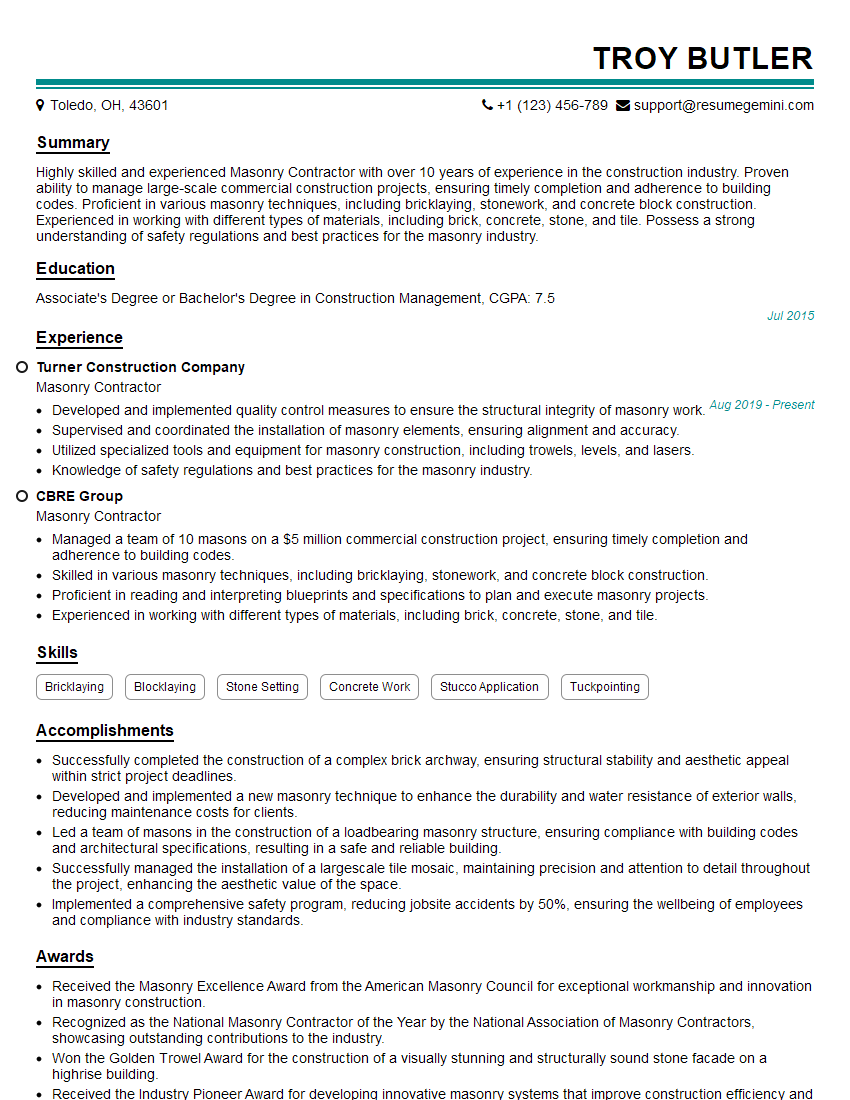
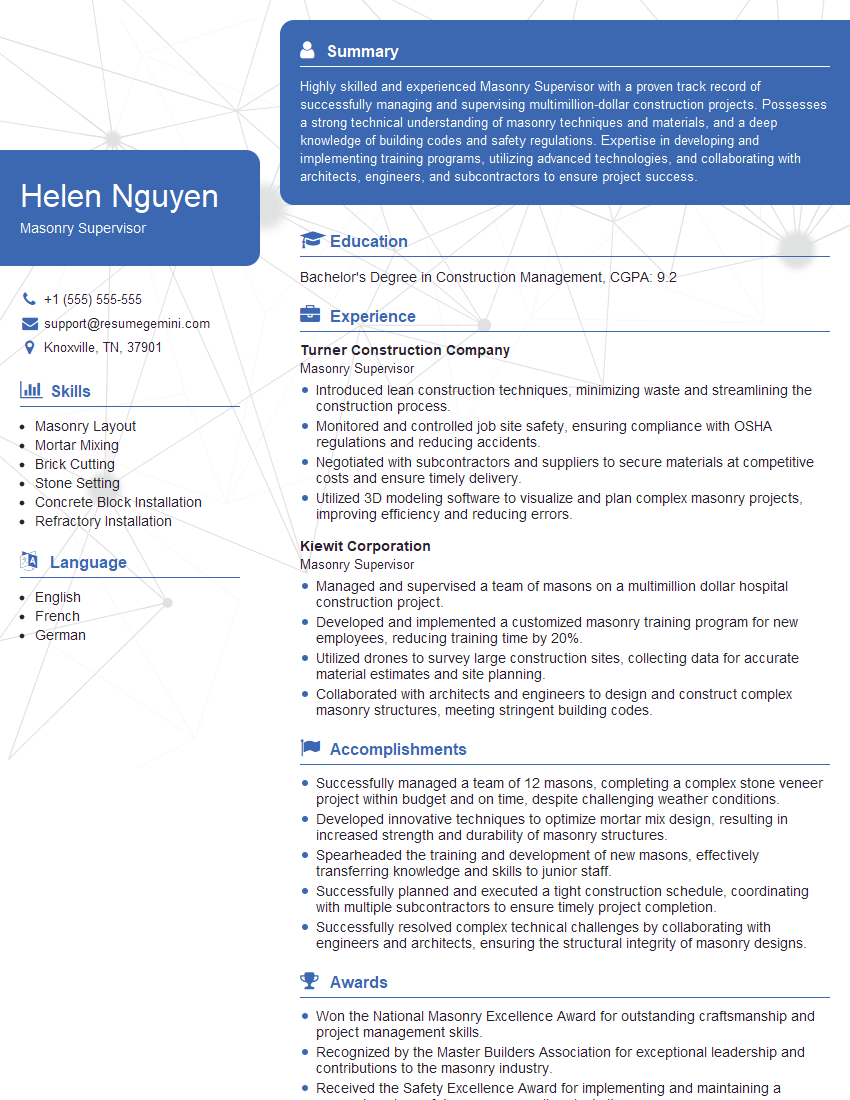
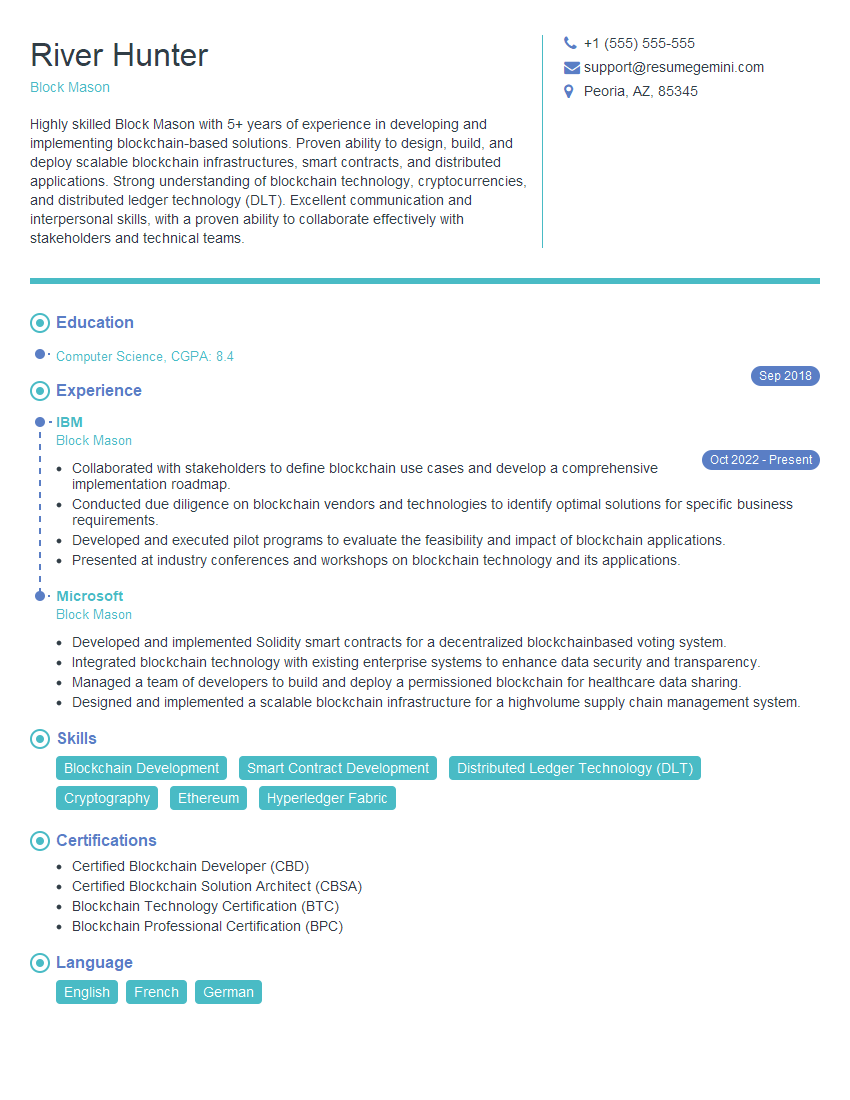
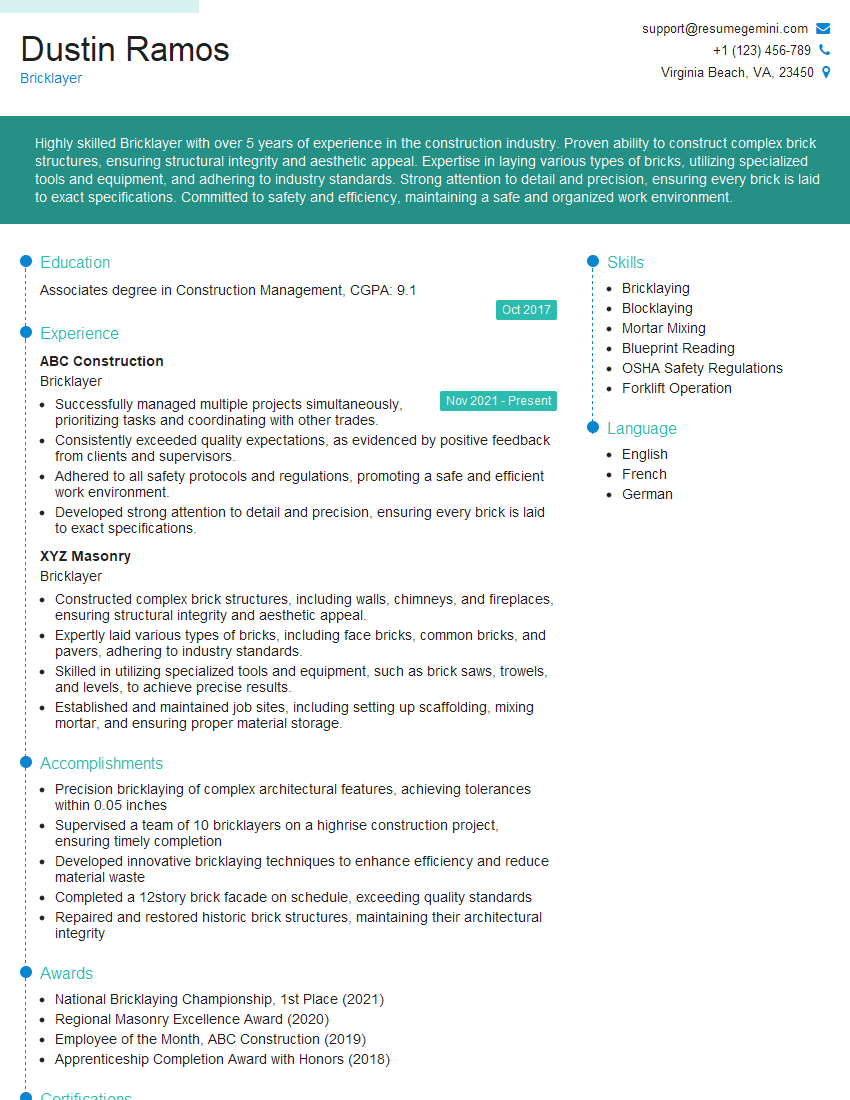
Mastering Masonry Installations opens doors to a rewarding career with excellent growth potential. Demand for skilled masons remains consistently high, offering opportunities for advancement and specialization. To maximize your job prospects, create a compelling and ATS-friendly resume that highlights your skills and experience effectively. ResumeGemini is a trusted resource that can help you build a professional resume that stands out. They offer examples of resumes tailored specifically to Masonry Installations to guide you through the process.
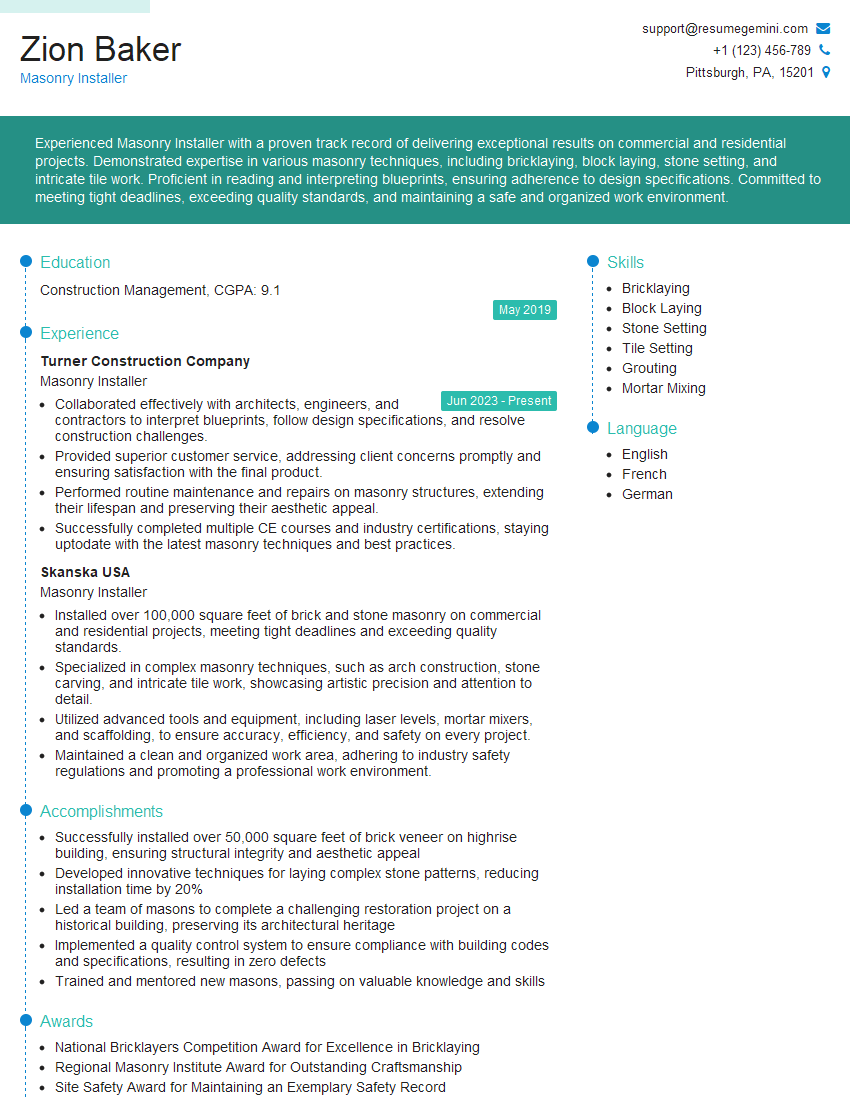
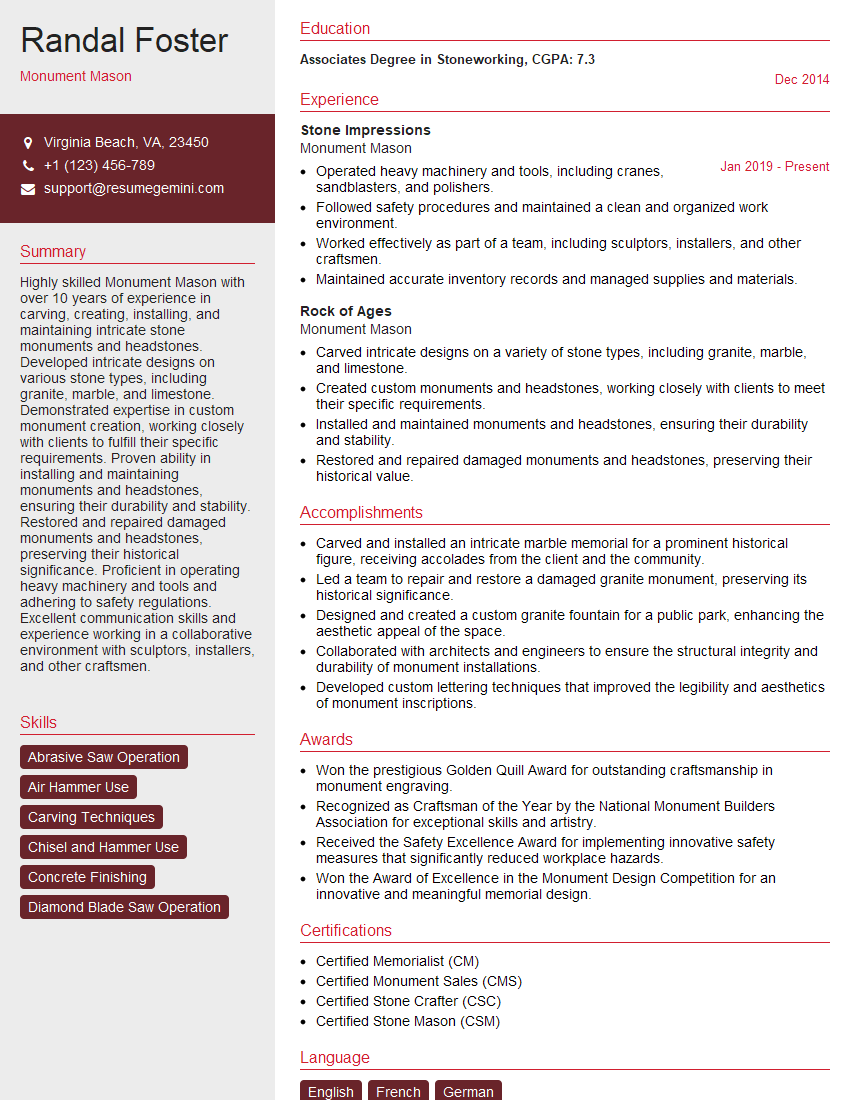
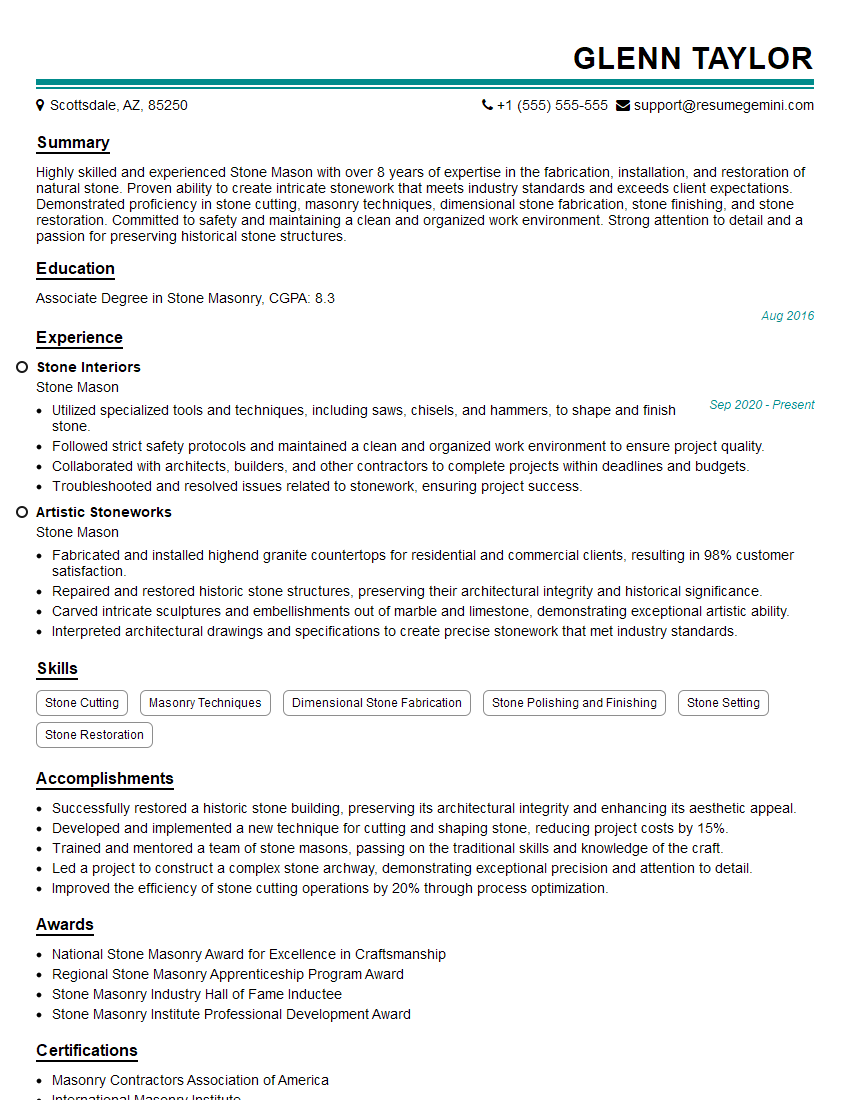
Explore more articles
Users Rating of Our Blogs
Share Your Experience
We value your feedback! Please rate our content and share your thoughts (optional).
What Readers Say About Our Blog
To the interviewgemini.com Webmaster.
Very helpful and content specific questions to help prepare me for my interview!
Thank you
To the interviewgemini.com Webmaster.
This was kind of a unique content I found around the specialized skills. Very helpful questions and good detailed answers.
Very Helpful blog, thank you Interviewgemini team.